Regenerative Cooling Nozzle
Team 11
Tom Ransegnola
Geoff McMahon
Alex Freedman
Chris Tjia
Georgios Skoufalos
Boston University
Mechanical Engineering Senior Design
Capstone Experience
2014 – 2015
5/1/2015 ENG ME 461 A5
Presentation Summary
1. Motivation / Design Statement
2. Relevant Physics
3. Design Decisions and Results
4. Evaluations
5. Moving Forward
5/1/2014 ENG ME 461 A5
Design Statement
Conduct research and design a
regenerative cooling nozzle for BURPG’s
MK IIB rocket, while also creating a user
friendly model for further research by
BURPG
ENG ME 461 A55/1/2015
Regenerative Cooling Nozzle
5/1/2014 ENG ME 461 A5
Requirements
• Nozzle Hot Wall
• Temperature along Hot Wall
• Heat Transfer Coefficients
• Designing for a student group
– Limitations in cost and manufacturing
– $2000
• Try to use N2O as coolant
ENG ME 461 A55/1/2015
Success Points
1. User-friendly nozzle model
2. Decide on coolant. Is N2O viable?
3. CAD model
4. Functioning prototype
ENG ME 461 A55/1/2015
Background and Benchmarking
• Motivation : High thermal loads
• Current state of the art
– Circular Tubes
– Square Tubes
– Spiraling Tubes
– Corrugated Pathways
• Coolants
– Oxidizer / Fuel
ENG ME 461 A55/1/2015
Engineering Specifications
• Nozzle Specifications
– Geometry, area ratio, flame temperature
• Tank Conditions
– Temperature, pressure
• Combustion Chamber Properties
– Pressure
• N2O / Coolant Conditions
– Density, temperature, pressure, specific heat etc.
• Other
– Burn time
ENG ME 461 A55/1/2015
Relevant Basic Physics
• Conduction
• Forced and Free Convection
• Thermal Stresses
• Thermal Circuits
ENG ME 461 A55/1/2015
Relevant Basic Physics
ENG ME 461 A55/1/2015
Relevant Basic Physics
ENG ME 461 A55/1/2015
Relevant Basic Physics
ENG ME 461 A55/1/2015
Relevant Basic Physics
ENG ME 461 A55/1/2015
Relevant Basic Physics
ENG ME 461 A55/1/2015
MATLAB Model
ENG ME 461 A55/1/2015
MATLAB Model
ENG ME 461 A55/1/2015
MATLAB Model
ENG ME 461 A55/1/2015
Coolant
Channel Geometry
Nozzle Body
Number of Tubes
MATLAB Model
ENG ME 461 A55/1/2015
MATLAB Model
ENG ME 461 A55/1/2015
MATLAB Model
ENG ME 461 A55/1/2015
MATLAB Model
ENG ME 461 A55/1/2015
Results: FEA/CFD
CFD Flow Simulation Thermal Simulation
ENG ME 461 A55/1/2015
Max
Temperature
Results: FEA/CFD
Thermal Simulation Structural Simulation
5/1/2014 ENG ME 461 A5
Maximum
Equivalent Stress
Comparison with Test Case
5/1/2014 ENG ME 461 A5
Maximum Wall
Temperature (k)
Model Data 852.2
Test Data 872.5
Percent Error 2.33
Comparison with Test Case
5/1/2014 ENG ME 461 A5
Maximum Coolant
Temperature (k)
Model Data 652.9
Test Data 724.0
Percent Error 9.82
Results
Functional Decomposition
ENG ME 461 A55/1/2015
Regenerative Cooling
Nozzle
Accelerate propellant from
combustion chamber to
supersonic
Cool hot wall
Connect to rocket
components
Converging Diverging
hot wall geometry NPT
Port Ammonia
as a
coolant
Circular
channels
Aluminum
body
Design Process
• Selection Criteria
– Cost and Manufacturability
– Material and Fluid Properties
ENG ME 461 A5
Regenerative Cooling Nozzle
Cooling
Channels
Circular
Tube
Square Tube Spiraling
Tube
Corrugated
Jacket
Nozzle
Material
6061
Aluminum
110 Copper 360 Brass
Coolant N2O Ammonia CO2
5/1/2015
Design Decisions (Channel Profile)
ENG ME 461 A5
Criteria Weight
Circular
Tubes
Square
Tubes
Spiraling
Tubes
Corrugated
Jacket
Efficiency in Heat
Transfer
1 0 1 0 1
Stays Below
Super Critical
Temperature
2 0 0 -1 0
Cost 1 0 -1 -1 -1
Manufacturability 1 0 -1 -1 -1
Total 0 -1 -4 -1
5/1/2015
Design Decisions (Nozzle Material)
ENG ME 461 A5
Criteria Weight
6061
Aluminum
110 Copper 360 Brass
Cost 1 0 -1 -1
Manufacturability 1 0 0 0
Does Not Deform
Under
Temperatures of
Rocket
1 0 0 0
Weight 1 0 -1 -1
Availability 1 0 -1 0
Can Withstand
Thermal Stresses
1 0 0 0
Total 0 -3 -25/1/2015
Design Decisions (Coolant)
ENG ME 461 A5
Criteria Weight N2O Ammonia CO2
Remains Below
Super Critical
Temperature
2 0 1 1
Used by BURPG 1 0 0 -1
Oxidizer / Fuel 1 0 0 0
Total 0 2 1
5/1/2015
Final Design
ENG ME 461 A55/1/2015
Final Design
ENG ME 461 A55/1/2015
Coolant Travel Path
ENG ME 461 A55/1/2015
FEA Joint Stress
5/1/2014 ENG ME 461 A5
Process Flow Chart
ENG ME 461 A55/1/2015
00:15:00
Machining the Channels
ENG ME 461 A55/1/2015
Physical Prototype
ENG ME 461 A55/1/2015
Budget Analysis
ENG ME 461 A5
Part Cost
Total Cost
$346
Clear Acrylic Rod $125
6061 Aluminum
Rod
$105
Misc $116
5/1/2015
Production Cost Estimate
Process
Body Manifold
Turn Drill Mill Turn
Fixturing 4.00 0.00
Setup 1.00 2.00 0.25 0.25
Run Time 1.00 1.00 0.50 0.75
GibbsCAM/Solidworks
Edits
0.50 2.00
TOTAL TIME 9.5 3.75
ENG ME 461 A5
Processing Times for First Nozzle (hours)
5/1/2015
Production Cost Estimate
Nozzle # Processing
Materials
Total
Aluminum O-Rings
1 $1,275 $30.00 $2.00 $1,307
2 $675 $30.00 $2.00 $707
3 $534 $30.00 $2.00 $565
4 $459 $30.00 $2.00 $491
ENG ME 461 A5
Cost Estimates for Four Nozzles
5/1/2015
Moving Forward
• Testing
• Design Iteration
– Gasket
– Manifold
– Optimal diameter / aerodynamics
– Rocket interface
ENG ME 461 A55/1/2015
Success Points
1. User-friendly nozzle model
2. Decide on coolant. Is N2O viable?
3. CAD model
4. Functioning prototype
ENG ME 461 A55/1/2015
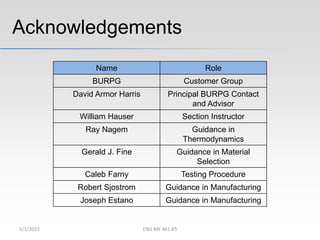
Acknowledgements
ENG ME 461 A5
Name Role
BURPG Customer Group
David Armor Harris Principal BURPG Contact
and Advisor
William Hauser Section Instructor
Ray Nagem Guidance in
Thermodynamics
Gerald J. Fine Guidance in Material
Selection
Caleb Farny Testing Procedure
Robert Sjostrom Guidance in Manufacturing
Joseph Estano Guidance in Manufacturing
5/1/2015
Thank you for your time
Questions, comments or concerns
ENG ME 461 A55/1/2015
Relevant Basic Physics
ENG ME 461 A55/1/2015
Relevant Basic Physics
ENG ME 461 A55/1/2015
Relevant Basic Physics
ENG ME 461 A55/1/2015
Relevant Basic Physics
ENG ME 461 A55/1/2015
Relevant Basic Physics
ENG ME 461 A55/1/2015
MATLAB Model
ENG ME 461 A55/1/2015
MATLAB Model
ENG ME 461 A55/1/2015
Coolant
Channel Geometry
Nozzle Body
Number of Tubes
Results: FEA/CFD
CFD Flow Simulation Thermal Simulation
ENG ME 461 A55/1/2015
Max
Temperature
Results: FEA/CFD
Thermal Simulation Structural Simulation
5/1/2014 ENG ME 461 A5
Maximum
Equivalent Stress
Coolant Travel Path
ENG ME 461 A55/1/2015
FEA Joint Stress
5/1/2014 ENG ME 461 A5
Process Flow Chart
ENG ME 461 A55/1/2015
00:15:00
Machining the Channels
ENG ME 461 A55/1/2015
Production Cost Estimate
Process
Body Manifold
Turn Drill Mill Turn
Fixturing 4.00 0.00
Setup 1.00 2.00 0.25 0.25
Run Time 1.00 1.00 0.50 0.75
GibbsCAM/Solidworks
Edits
0.50 2.00
TOTAL TIME 9.5 3.75
ENG ME 461 A5
Processing Times for First Nozzle (hours)
5/1/2015
Production Cost Estimate
Nozzle # Processing
Materials
Total
Aluminum O-Rings
1 $1,275 $30.00 $2.00 $1,307
2 $675 $30.00 $2.00 $707
3 $534 $30.00 $2.00 $565
4 $459 $30.00 $2.00 $491
ENG ME 461 A5
Cost Estimates for Four Nozzles
5/1/2015

Senior Project Presentation

Editor's Notes

  • #2 George Introduce project, team, BURPG, Hauser
  • #3 George Presentation contents
  • #4 George Discuss BURPG and Armor Say Design Statement Talk about open ended nature of presentation but that we have tangible success points Explain what it means to regenerative cool a nozzle
  • #6 Alex Discuss what BURPG gave us to start with (first 3 pts) We are designing for a student group and not an institution like NASA which limits us in cost and manufacturing capabilities. If BURPG were to use our methods they should only have to spend $2000 or less BURPG also asked that we try to use N2O as a coolant because it is the propellant and will add no extra weight to the rocket
  • #7 Alex These are our success points. They were made so we use our time productively.
  • #8 Alex Our motivation for this project is that high heat causes damage to the nozzle interior and forces BURPG to use new nozzles every time Discuss material damage We did a lot of research on current art and the way people use this technology differently. We found four dominant designs for passing the fluid over the nozzle We want to use oxidizer or fuel as coolant
  • #9 Alex Discuss eng specs we find to be relevant to our project. Make this brief. No need to go into everything specifically. Stick to nozzle specs, tank conditions, combustion prop, N20/coolant conditions and burn time
  • #10 Alex Talk about how all these physics relate to our project
  • #11 George Explain the model Discuss previous idea (lumped)
  • #12 George
  • #13 George
  • #14 Tom. This is the circuit you saw previously but organized
  • #15 Tom. Take your time and make it clear. Explain what they are seeing and why its important. Orient the listener
  • #16 Tom. Make sure to just focus on user input and model output, but not so much on every box bc that’s hard to follow for the listener
  • #17 Tom, briefly introduce. Highlight that left side is plots and right side is user input
  • #18 Tom discuss what the user can vary in this model using this input module
  • #19 tom
  • #20 Tom
  • #21 tom
  • #22 tom
  • #23 alex
  • #24 alex
  • #25 Chris In addition to using ANSYS simulations, to corroborate the Matlab model, we also did a comparison to a test case on a larger scale. The rocket nozzle was approximately 1m in length and used kerosene as the coolant. The channel geometry was a rectangle that was 4mm in height and 3mm in width. Shown here in the graph on the left is the temperature of the wall along the normalized position of the nozzle, the line we are interested in is the on that spikes as the nozzle converges shown in blue, this corresponds to the temperature of the hot wall. The maximum temperature reached was 852 kelvin, about 20 kelvin off from the test data. Which corresponds to an error of 2%. This is highly promising because it shows that the model is accurate, even on different scales.
  • #26 Chris Shown here is the temperature of the coolant along the normalized position of the nozzle. The maximum temperature reached was 653 kelvin, about 70 kelvin off from the test data. Which corresponds to about a 10% error. This is still a small margin, and the error may be due to not having as high a resolution while inputting the test data to the model, this results in the interpolated data being less accurate.
  • #27 George
  • #28 George Discuss our selection criteria. Remind people we are working for a student group We have BURPG limitations (cost and manuf.) We also have physical limitations
  • #29 George Discuss practicality too. Square is hard. Spiral doesn’t work. Corrugated is hard.
  • #30 george
  • #31 george
  • #32 Geoff Explain the pictures
  • #33 Geoff Explain the pictures
  • #34 Geoff. Make sure to mention that there are 12 channels around the hotwall
  • #35 geoff
  • #36 Geoff. Discuss drilling in next slide as a transition. Listener has something more tangible to look at
  • #37 geoff
  • #38 geoff
  • #39 Chris. This table shows the total cost of materials for the two prototypes. It comes out to $346, which is within the Senior design budget, as well as the additional budget available to the BURPG. The bulk of the cost comes from the stock material, and the miscellaneous items include the sealants, screws, and different sized o-rings
  • #40 geoff
  • #41 geoff
  • #42 george
  • #43 george These are our success points which will be further discussed later Briefly, we have to create user friendly model, decide on whether N2O is viable, create a CAD model of the nozzle and prototype it for testing
  • #44 george
  • #45 george
  • #46 This slide is here in case questions arise
  • #47 This slide is here in case questions arise
  • #48 This slide is here in case questions arise
  • #49 This slide is here in case questions arise
  • #50 This slide is here in case questions arise
  • #51 This slide is here in case questions arise
  • #52 This slide is here in case questions arise
  • #53 This slide is here in case questions arise
  • #54 This slide is here in case questions arise
  • #55 This slide is here in case questions arise
  • #56 geoff
  • #57 Geoff. Discuss drilling in next slide as a transition. Listener has something more tangible to look at
  • #58 geoff
  • #59 This slide is here in case questions arise
  • #60 This slide is here in case questions arise