codename:  imaGInation KIeve
FYP Presentation – the Finale! 24.04.08 Project Team : Syed Waqas A Burney, 2004185, FCSE  (Team Lead) Mutahira Ikram Khan, 2004136, FCSE Project Advisor : Mr. Badre Munir, FCSE
Agenda : Core Progeny Project Objective Project Modularization The System Overview Architecture Module 1 – Motion Detection & Human Activity Monitoring Module 2 – The Decision Making Software Engine Module 3 – Appliance Control Mechanism & Prototype Modeling Project Status Envisioning Ahead v Smart Demo
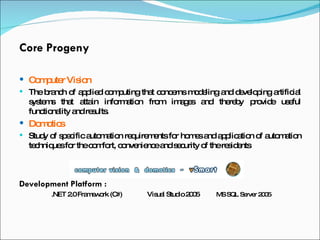
Core Progeny Computer Vision The branch of applied computing that concerns modeling and developing artificial systems that attain information from images and thereby provide useful functionality and results. Domotics Study of specific automation requirements for homes and application of automation techniques for the comfort, convenience and security of the residents Development Platform : .NET 2.0 Framework   (C#) Visual Studio 2005   MS SQL Server 2005
Objective Prototyping an integrated system for the smart control of domestic electronic appliances in local environments, based on monitored user presence and activity ; thereby achieving multidimensional user-convenience and using modern technology to endow a sustainable environment in our everyday lives.  Applications : User Convenience and Energy Saving Offices (lunch hours, after-office timings, etc) Houses (the ‘Digital Home’ concept)
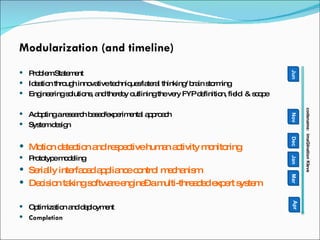
Modularization (and timeline) Problem Statement Ideation through innovative techniques/lateral thinking/ brain storming Engineering solutions, and thereby outlining the very FYP definition, field  & scope Adopting a research based/experimental approach System design Motion detection and respective human activity monitoring Prototype modeling Serially interfaced appliance control mechanism Decision taking software engine– a multi-threaded expert system  Optimization and deployment Completion Nov Jun Dec Jan Mar Apr codename:  imaGInation KIeve
System Overview Module 1  Human  Activity Monitoring ( Input ) Module 2  The Software Engine  ( Processing ) Module 3 Appliance Control ( Output ) CMOS Webcams Local Environment
System Architecture
System Architecture MODULE 1 MODULE 1
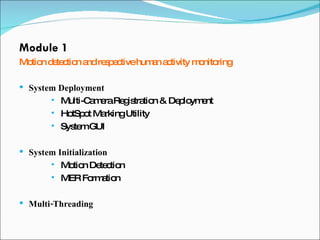
Module 1 Motion detection and respective human activity monitoring System Deployment Multi-Camera Registration & Deployment HotSpot Marking Utility System GUI System Initialization Motion Detection MER Formation Multi-Threading
Module 1 (cntd..) Motion detection and respective human activity monitoring  Critical Difficulties Encountered– Camera Zoom [View Angle , Shadows] Camera Mounted in Room Camera Mounted in  the Model
Module 1 (cntd..) Motion detection and respective human activity monitoring Prototype Environments :  Room (Hostel);  Model House Image Capture Devices : CMOS Webcam; 640 x 480 pixels; Frame Rate: 30 fps; View Angle: 54 degrees Platform : .NET 2.0 based  Aforge C# Framework  (open source) Using the AForge.Imaging & AForge.Vision  libraries [ http://code.google.com/p/aforge/ ]
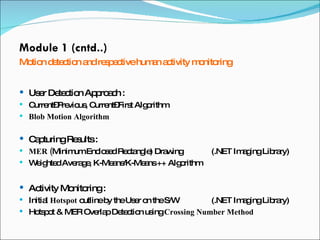
Module 1 (cntd..) Motion detection and respective human activity monitoring User Detection Approach :  Current–Previous, Current–First Algorithm Blob Motion Algorithm Capturing Results : MER ( Minimum Enclosed Rectangle) Drawing (.NET Imaging Library) Weighted Average, K-Means/K-Means ++ Algorithm Activity Monitoring :  Initial  Hotspot  outline by the User on the S/W  (.NET Imaging Library) Hotspot & MER Overlap Detection using  Crossing Number Method
Module 1 (cntd..) Motion detection and respective human activity monitoring MER formation for Motion Detection Hotspot marking by user
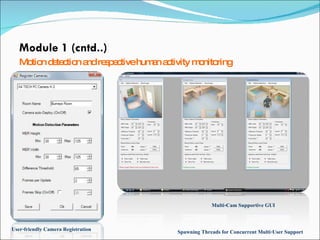
Module 1 (cntd..) Motion detection and respective human activity monitoring  Multi-Cam Supportive GUI  User-friendly Camera Registration Spawning Threads for Concurrent Multi-User Support
System Architecture MODULE 2 MODULE 2
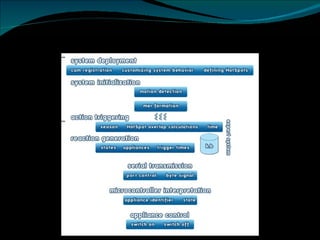
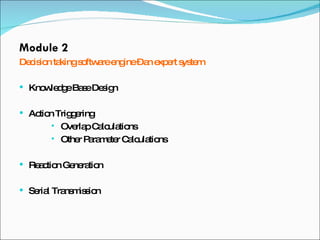
Module 2 Decision taking software engine – an expert system Knowledge Base Design Action Triggering Overlap Calculations Other Parameter Calculations Reaction Generation Serial Transmission
Module 2 Decision taking software engine – an expert system The brain of the system– responsible for the actual “monitoring”  Decides  when  to turn off  what Expert System : Defining classes for rules Having defined facts in a relational database Using inference techniques to judge which rules, based on user  activity, stand, and hence which devices are to be respectively switched off Rules and Facts subject to changes and modifications based on user behavior Overview : Small scale expert system with a dynamically adjusting knowledge base
System Architecture MODULE 3 MODULE 3
Module 3 Serially interfaced appliance control mechanism Connection to Devices :  Serial port communication via RS232  Microcontroller Interface circuitry Device Model House. Microcontroller Interface Electronic Devices Computer RS232
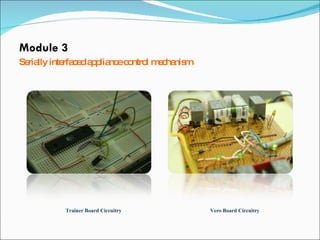
Module 3 Serially interfaced appliance control mechanism Trainer Board Circuitry Vero Board Circuitry
Module 3 Serially interfaced appliance control mechanism
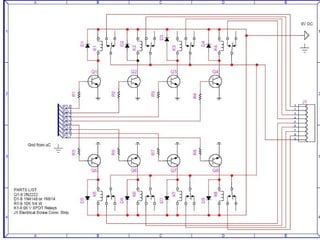
Module 3 Serially interfaced appliance control mechanism Serial Communication  Data is transmitted to the microcontroller  via RS-232 standard DB- 9 connector is used to connect to the microcontroller Hardware circuitry ATMEL 89C51 MAX 233 2n222 Transistors Diodes 6 volt relays Capacitors Resistors
Module 3 Serially interfaced appliance control mechanism Circuit : Part I
 
Module 3 Serially interfaced appliance control mechanism Circuit : Part II (implemented on Veroboard)
 
Module 3 (cntd..) Serially interfaced appliance control mechanism Microcontroller ( ATMEL 89C51):  Receives data serially from computer port Processes the data Sends data to its port to which devices are connected Turning relays on and off MAX 233 RS-232 not compatible with today’s microcontrollers Line driver to convert RS-232 signal to TTL logic levels  Interface Circuit : BJT based Relay-Driver (2n222) :  It provides sufficient current to drive the relay Diode  :  When the relay is switched off, magnetic field generated inside produces a high voltage, which can damage circuit Diode prevents short circuiting when the relay is switched off
Module 3 (cntd..) Serially interfaced appliance control mechanism Interface Circuit (cntd..) :  Resistor  :  It prevents flow of high current from the transistor to the ground on the application of  VCC Relay  :  Mechanical relay is used to switch device off
Modeling the Prototype The Model House ( realistic cut-scale ) Model Specifications: 3.5‘ x 3.5‘ x (equivalent height) Two bedroom house (1.5‘ x 1.5') Double-walled structure with the outer walls removable The  house is raised 1 feet in height, by supports, for  magnet movements Test Men with magnets are used to depict movements in the household Outer Slide-Up-and-Removable Walls Normal Walls Wiring concealed in between by the removable Outer Wall ROOM
Modeling the Prototype (cntd..) The Model House House Dimensions:  3.5’ x 3.5’ x 2’   Room Dimensions:  1.5’ x 1.5’ x 8”
Modeling the Prototype (cntd..) The Model House with Domestic Appliances Installed Installed Appliances:  Room Lights, Room Fan, Bed-side Lamp & Study-table Lamp
(Work-based) Modular Completion Status Module 1  :  Motion detection and respective human activity monitoring System Deployment Multi-Camera Registration & Deployment HotSpot Marking Utility System GUI  System Initialization Motion Detection MER Formation Multi-Threading ( debugging issues! ) Module 2  :  Decision taking software engine – an expert system Action Triggering Overlap Calculations Other Parameter Calculations Knowledge Base Design Reaction Generation Serial Transmission Module 3  :  Serially interfaced appliance control mechanism Trainer/Vero-board Circuit Designing Microcontroller Interpretation Electrical Interfacing of Appliance System Optimization
Envisioning Ahead Microsoft Imagine Cup 2008 GIKI Participation @ Different Technology Competitions ~ Softec ’08 Submissions on Various Research-based Platforms for Domotics Video Documentation
 

Senior Design Project, GIKI

  • 1.
  • 2.
    FYP Presentation –the Finale! 24.04.08 Project Team : Syed Waqas A Burney, 2004185, FCSE (Team Lead) Mutahira Ikram Khan, 2004136, FCSE Project Advisor : Mr. Badre Munir, FCSE
  • 3.
    Agenda : CoreProgeny Project Objective Project Modularization The System Overview Architecture Module 1 – Motion Detection & Human Activity Monitoring Module 2 – The Decision Making Software Engine Module 3 – Appliance Control Mechanism & Prototype Modeling Project Status Envisioning Ahead v Smart Demo
  • 4.
    Core Progeny ComputerVision The branch of applied computing that concerns modeling and developing artificial systems that attain information from images and thereby provide useful functionality and results. Domotics Study of specific automation requirements for homes and application of automation techniques for the comfort, convenience and security of the residents Development Platform : .NET 2.0 Framework (C#) Visual Studio 2005 MS SQL Server 2005
  • 5.
    Objective Prototyping anintegrated system for the smart control of domestic electronic appliances in local environments, based on monitored user presence and activity ; thereby achieving multidimensional user-convenience and using modern technology to endow a sustainable environment in our everyday lives. Applications : User Convenience and Energy Saving Offices (lunch hours, after-office timings, etc) Houses (the ‘Digital Home’ concept)
  • 6.
    Modularization (and timeline)Problem Statement Ideation through innovative techniques/lateral thinking/ brain storming Engineering solutions, and thereby outlining the very FYP definition, field & scope Adopting a research based/experimental approach System design Motion detection and respective human activity monitoring Prototype modeling Serially interfaced appliance control mechanism Decision taking software engine– a multi-threaded expert system Optimization and deployment Completion Nov Jun Dec Jan Mar Apr codename: imaGInation KIeve
  • 7.
    System Overview Module1 Human Activity Monitoring ( Input ) Module 2 The Software Engine ( Processing ) Module 3 Appliance Control ( Output ) CMOS Webcams Local Environment
  • 8.
  • 9.
  • 10.
    Module 1 Motiondetection and respective human activity monitoring System Deployment Multi-Camera Registration & Deployment HotSpot Marking Utility System GUI System Initialization Motion Detection MER Formation Multi-Threading
  • 11.
    Module 1 (cntd..)Motion detection and respective human activity monitoring Critical Difficulties Encountered– Camera Zoom [View Angle , Shadows] Camera Mounted in Room Camera Mounted in the Model
  • 12.
    Module 1 (cntd..)Motion detection and respective human activity monitoring Prototype Environments : Room (Hostel); Model House Image Capture Devices : CMOS Webcam; 640 x 480 pixels; Frame Rate: 30 fps; View Angle: 54 degrees Platform : .NET 2.0 based Aforge C# Framework (open source) Using the AForge.Imaging & AForge.Vision libraries [ http://code.google.com/p/aforge/ ]
  • 13.
    Module 1 (cntd..)Motion detection and respective human activity monitoring User Detection Approach : Current–Previous, Current–First Algorithm Blob Motion Algorithm Capturing Results : MER ( Minimum Enclosed Rectangle) Drawing (.NET Imaging Library) Weighted Average, K-Means/K-Means ++ Algorithm Activity Monitoring : Initial Hotspot outline by the User on the S/W (.NET Imaging Library) Hotspot & MER Overlap Detection using Crossing Number Method
  • 14.
    Module 1 (cntd..)Motion detection and respective human activity monitoring MER formation for Motion Detection Hotspot marking by user
  • 15.
    Module 1 (cntd..)Motion detection and respective human activity monitoring Multi-Cam Supportive GUI User-friendly Camera Registration Spawning Threads for Concurrent Multi-User Support
  • 16.
  • 17.
    Module 2 Decisiontaking software engine – an expert system Knowledge Base Design Action Triggering Overlap Calculations Other Parameter Calculations Reaction Generation Serial Transmission
  • 18.
    Module 2 Decisiontaking software engine – an expert system The brain of the system– responsible for the actual “monitoring” Decides when to turn off what Expert System : Defining classes for rules Having defined facts in a relational database Using inference techniques to judge which rules, based on user activity, stand, and hence which devices are to be respectively switched off Rules and Facts subject to changes and modifications based on user behavior Overview : Small scale expert system with a dynamically adjusting knowledge base
  • 19.
  • 20.
    Module 3 Seriallyinterfaced appliance control mechanism Connection to Devices : Serial port communication via RS232 Microcontroller Interface circuitry Device Model House. Microcontroller Interface Electronic Devices Computer RS232
  • 21.
    Module 3 Seriallyinterfaced appliance control mechanism Trainer Board Circuitry Vero Board Circuitry
  • 22.
    Module 3 Seriallyinterfaced appliance control mechanism
  • 23.
    Module 3 Seriallyinterfaced appliance control mechanism Serial Communication Data is transmitted to the microcontroller via RS-232 standard DB- 9 connector is used to connect to the microcontroller Hardware circuitry ATMEL 89C51 MAX 233 2n222 Transistors Diodes 6 volt relays Capacitors Resistors
  • 24.
    Module 3 Seriallyinterfaced appliance control mechanism Circuit : Part I
  • 25.
  • 26.
    Module 3 Seriallyinterfaced appliance control mechanism Circuit : Part II (implemented on Veroboard)
  • 27.
  • 28.
    Module 3 (cntd..)Serially interfaced appliance control mechanism Microcontroller ( ATMEL 89C51): Receives data serially from computer port Processes the data Sends data to its port to which devices are connected Turning relays on and off MAX 233 RS-232 not compatible with today’s microcontrollers Line driver to convert RS-232 signal to TTL logic levels Interface Circuit : BJT based Relay-Driver (2n222) : It provides sufficient current to drive the relay Diode : When the relay is switched off, magnetic field generated inside produces a high voltage, which can damage circuit Diode prevents short circuiting when the relay is switched off
  • 29.
    Module 3 (cntd..)Serially interfaced appliance control mechanism Interface Circuit (cntd..) : Resistor : It prevents flow of high current from the transistor to the ground on the application of VCC Relay : Mechanical relay is used to switch device off
  • 30.
    Modeling the PrototypeThe Model House ( realistic cut-scale ) Model Specifications: 3.5‘ x 3.5‘ x (equivalent height) Two bedroom house (1.5‘ x 1.5') Double-walled structure with the outer walls removable The house is raised 1 feet in height, by supports, for magnet movements Test Men with magnets are used to depict movements in the household Outer Slide-Up-and-Removable Walls Normal Walls Wiring concealed in between by the removable Outer Wall ROOM
  • 31.
    Modeling the Prototype(cntd..) The Model House House Dimensions: 3.5’ x 3.5’ x 2’ Room Dimensions: 1.5’ x 1.5’ x 8”
  • 32.
    Modeling the Prototype(cntd..) The Model House with Domestic Appliances Installed Installed Appliances: Room Lights, Room Fan, Bed-side Lamp & Study-table Lamp
  • 33.
    (Work-based) Modular CompletionStatus Module 1 : Motion detection and respective human activity monitoring System Deployment Multi-Camera Registration & Deployment HotSpot Marking Utility System GUI System Initialization Motion Detection MER Formation Multi-Threading ( debugging issues! ) Module 2 : Decision taking software engine – an expert system Action Triggering Overlap Calculations Other Parameter Calculations Knowledge Base Design Reaction Generation Serial Transmission Module 3 : Serially interfaced appliance control mechanism Trainer/Vero-board Circuit Designing Microcontroller Interpretation Electrical Interfacing of Appliance System Optimization
  • 34.
    Envisioning Ahead MicrosoftImagine Cup 2008 GIKI Participation @ Different Technology Competitions ~ Softec ’08 Submissions on Various Research-based Platforms for Domotics Video Documentation
  • 35.