©Ian Sommerville 2004 Software Engineering, 7th edition. Chapter 22 Slide 1
Verification and Validation
Dr.Jonathan
Senior Lecturer
University of Lay Adventist Of Kigali
©Ian Sommerville 2004 Software Engineering, 7th edition. Chapter 22 Slide 2
 Verification and validation planning
 Software inspections
 Automated static analysis
Topics covered
©Ian Sommerville 2004 Software Engineering, 7th edition. Chapter 22 Slide 3
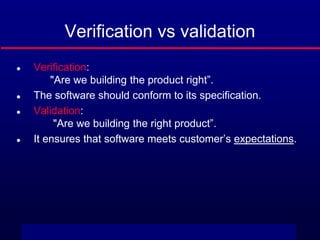
 Verification:
"Are we building the product right”.
 The software should conform to its specification.
 Validation:
"Are we building the right product”.
 It ensures that software meets customer’s expectations.
Verification vs validation
©Ian Sommerville 2004 Software Engineering, 7th edition. Chapter 22 Slide 4
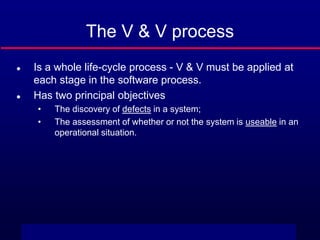
 Is a whole life-cycle process - V & V must be applied at
each stage in the software process.
 Has two principal objectives
• The discovery of defects in a system;
• The assessment of whether or not the system is useable in an
operational situation.
The V & V process
©Ian Sommerville 2004 Software Engineering, 7th edition. Chapter 22 Slide 5
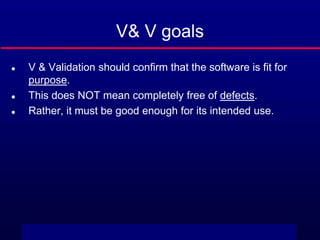
V& V goals
 V & Validation should confirm that the software is fit for
purpose.
 This does NOT mean completely free of defects.
 Rather, it must be good enough for its intended use.
©Ian Sommerville 2004 Software Engineering, 7th edition. Chapter 22 Slide 6
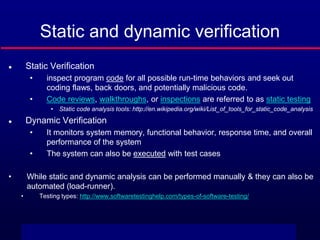
 Static Verification
• inspect program code for all possible run-time behaviors and seek out
coding flaws, back doors, and potentially malicious code.
• Code reviews, walkthroughs, or inspections are referred to as static testing
• Static code analysis tools: http://en.wikipedia.org/wiki/List_of_tools_for_static_code_analysis
 Dynamic Verification
• It monitors system memory, functional behavior, response time, and overall
performance of the system
• The system can also be executed with test cases
• While static and dynamic analysis can be performed manually & they can also be
automated (load-runner).
• Testing types: http://www.softwaretestinghelp.com/types-of-software-testing/
Static and dynamic verification
©Ian Sommerville 2004 Software Engineering, 7th edition. Chapter 22 Slide 7
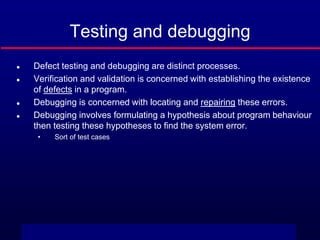
 Defect testing and debugging are distinct processes.
 Verification and validation is concerned with establishing the existence
of defects in a program.
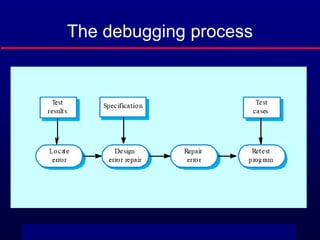
 Debugging is concerned with locating and repairing these errors.
 Debugging involves formulating a hypothesis about program behaviour
then testing these hypotheses to find the system error.
• Sort of test cases
Testing and debugging
©Ian Sommerville 2004 Software Engineering, 7th edition. Chapter 22 Slide 8
The debugging process
©Ian Sommerville 2004 Software Engineering, 7th edition. Chapter 22 Slide 9
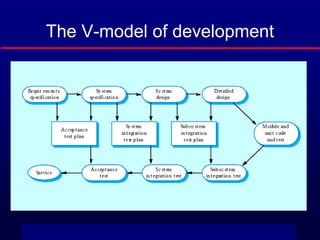
The V-model of development
©Ian Sommerville 2004 Software Engineering, 7th edition. Chapter 22 Slide 10
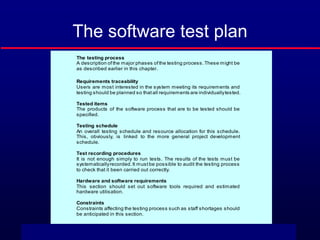
The structure of a software test plan
 The testing process.
 Requirements traceability.
 Tested items.
 Testing schedule.
 Test recording procedures.[Jing, bugzilla etc]
 Hardware and software requirements.
 Constraints.
 We will do usability and functionality testing and make test cases
• learning assignment (non-graded)
• My test cases: http://jmp.sh/J0KW3Vz
©Ian Sommerville 2004 Software Engineering, 7th edition. Chapter 22 Slide 11
The software test plan
The testing process
A description ofthe major phases ofthe testing process.These might be
as described earlier in this chapter.
Requirements traceability
Users are most interested in the system meeting its requirements and
testing should be planned so thatall requirements are individuallytested.
Tested items
The products of the software process that are to be tested should be
specified.
Testing schedule
An overall testing schedule and resource allocation for this schedule.
This, obviously, is linked to the more general project development
schedule.
Test recording procedures
It is not enough simply to run tests. The results of the tests must be
systematicallyrecorded.It mustbe possible to audit the testing process
to check that it been carried out correctly.
Hardware and software requirements
This section should set out software tools required and estimated
hardware utilisation.
Constraints
Constraints affecting the testing process such as staff shortages should
be anticipated in this section.
©Ian Sommerville 2004 Software Engineering, 7th edition. Chapter 22 Slide 12
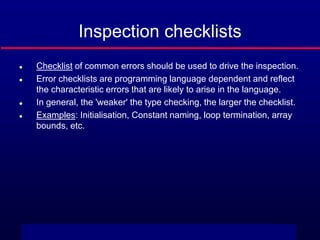
Inspection checklists
 Checklist of common errors should be used to drive the inspection.
 Error checklists are programming language dependent and reflect
the characteristic errors that are likely to arise in the language.
 In general, the 'weaker' the type checking, the larger the checklist.
 Examples: Initialisation, Constant naming, loop termination, array
bounds, etc.
©Ian Sommerville 2004 Software Engineering, 7th edition. Chapter 22 Slide 13
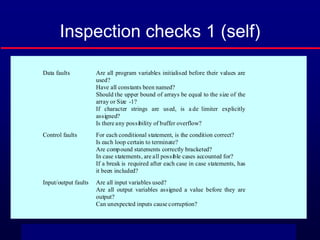
Inspection checks 1 (self)
Data faults Are all program variables initialised before their values are
used?
Have all constants been named?
Should the upper bound of arrays be equal to the size of the
array or Size -1?
If character strings are used, is a de limiter explicitly
assigned?
Is there any possibility of buffer overflow?
Control faults For each conditional statement, is the condition correct?
Is each loop certain to terminate?
Are compound statements correctly bracketed?
In case statements, are all possible cases accounted for?
If a break is required after each case in case statements, has
it been included?
Input/output faults Are all input variables used?
Are all output variables assigned a value before they are
output?
Can unexpected inputs cause corruption?
©Ian Sommerville 2004 Software Engineering, 7th edition. Chapter 22 Slide 14
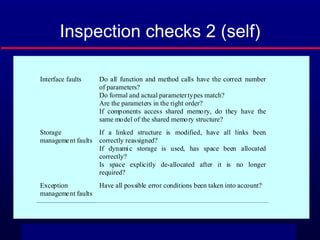
Inspection checks 2 (self)
Interface faults Do all function and method calls have the correct number
of parameters?
Do formal and actual parametertypes match?
Are the parameters in the right order?
If components access shared memory, do they have the
same model of the shared memory structure?
Storage
management faults
If a linked structure is modified, have all links been
correctly reassigned?
If dynamic storage is used, has space been allocated
correctly?
Is space explicitly de-allocated after it is no longer
required?
Exception
management faults
Have all possible error conditions been taken into account?
©Ian Sommerville 2004 Software Engineering, 7th edition. Chapter 22 Slide 15
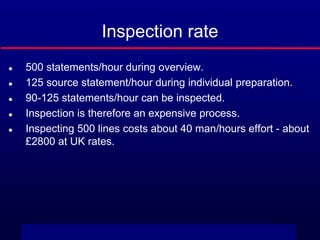
Inspection rate
 500 statements/hour during overview.
 125 source statement/hour during individual preparation.
 90-125 statements/hour can be inspected.
 Inspection is therefore an expensive process.
 Inspecting 500 lines costs about 40 man/hours effort - about
£2800 at UK rates.

Dr.Jonathan Software verification validation.ppt

  • 1.
    ©Ian Sommerville 2004Software Engineering, 7th edition. Chapter 22 Slide 1 Verification and Validation Dr.Jonathan Senior Lecturer University of Lay Adventist Of Kigali
  • 2.
    ©Ian Sommerville 2004Software Engineering, 7th edition. Chapter 22 Slide 2  Verification and validation planning  Software inspections  Automated static analysis Topics covered
  • 3.
    ©Ian Sommerville 2004Software Engineering, 7th edition. Chapter 22 Slide 3  Verification: "Are we building the product right”.  The software should conform to its specification.  Validation: "Are we building the right product”.  It ensures that software meets customer’s expectations. Verification vs validation
  • 4.
    ©Ian Sommerville 2004Software Engineering, 7th edition. Chapter 22 Slide 4  Is a whole life-cycle process - V & V must be applied at each stage in the software process.  Has two principal objectives • The discovery of defects in a system; • The assessment of whether or not the system is useable in an operational situation. The V & V process
  • 5.
    ©Ian Sommerville 2004Software Engineering, 7th edition. Chapter 22 Slide 5 V& V goals  V & Validation should confirm that the software is fit for purpose.  This does NOT mean completely free of defects.  Rather, it must be good enough for its intended use.
  • 6.
    ©Ian Sommerville 2004Software Engineering, 7th edition. Chapter 22 Slide 6  Static Verification • inspect program code for all possible run-time behaviors and seek out coding flaws, back doors, and potentially malicious code. • Code reviews, walkthroughs, or inspections are referred to as static testing • Static code analysis tools: http://en.wikipedia.org/wiki/List_of_tools_for_static_code_analysis  Dynamic Verification • It monitors system memory, functional behavior, response time, and overall performance of the system • The system can also be executed with test cases • While static and dynamic analysis can be performed manually & they can also be automated (load-runner). • Testing types: http://www.softwaretestinghelp.com/types-of-software-testing/ Static and dynamic verification
  • 7.
    ©Ian Sommerville 2004Software Engineering, 7th edition. Chapter 22 Slide 7  Defect testing and debugging are distinct processes.  Verification and validation is concerned with establishing the existence of defects in a program.  Debugging is concerned with locating and repairing these errors.  Debugging involves formulating a hypothesis about program behaviour then testing these hypotheses to find the system error. • Sort of test cases Testing and debugging
  • 8.
    ©Ian Sommerville 2004Software Engineering, 7th edition. Chapter 22 Slide 8 The debugging process
  • 9.
    ©Ian Sommerville 2004Software Engineering, 7th edition. Chapter 22 Slide 9 The V-model of development
  • 10.
    ©Ian Sommerville 2004Software Engineering, 7th edition. Chapter 22 Slide 10 The structure of a software test plan  The testing process.  Requirements traceability.  Tested items.  Testing schedule.  Test recording procedures.[Jing, bugzilla etc]  Hardware and software requirements.  Constraints.  We will do usability and functionality testing and make test cases • learning assignment (non-graded) • My test cases: http://jmp.sh/J0KW3Vz
  • 11.
    ©Ian Sommerville 2004Software Engineering, 7th edition. Chapter 22 Slide 11 The software test plan The testing process A description ofthe major phases ofthe testing process.These might be as described earlier in this chapter. Requirements traceability Users are most interested in the system meeting its requirements and testing should be planned so thatall requirements are individuallytested. Tested items The products of the software process that are to be tested should be specified. Testing schedule An overall testing schedule and resource allocation for this schedule. This, obviously, is linked to the more general project development schedule. Test recording procedures It is not enough simply to run tests. The results of the tests must be systematicallyrecorded.It mustbe possible to audit the testing process to check that it been carried out correctly. Hardware and software requirements This section should set out software tools required and estimated hardware utilisation. Constraints Constraints affecting the testing process such as staff shortages should be anticipated in this section.
  • 12.
    ©Ian Sommerville 2004Software Engineering, 7th edition. Chapter 22 Slide 12 Inspection checklists  Checklist of common errors should be used to drive the inspection.  Error checklists are programming language dependent and reflect the characteristic errors that are likely to arise in the language.  In general, the 'weaker' the type checking, the larger the checklist.  Examples: Initialisation, Constant naming, loop termination, array bounds, etc.
  • 13.
    ©Ian Sommerville 2004Software Engineering, 7th edition. Chapter 22 Slide 13 Inspection checks 1 (self) Data faults Are all program variables initialised before their values are used? Have all constants been named? Should the upper bound of arrays be equal to the size of the array or Size -1? If character strings are used, is a de limiter explicitly assigned? Is there any possibility of buffer overflow? Control faults For each conditional statement, is the condition correct? Is each loop certain to terminate? Are compound statements correctly bracketed? In case statements, are all possible cases accounted for? If a break is required after each case in case statements, has it been included? Input/output faults Are all input variables used? Are all output variables assigned a value before they are output? Can unexpected inputs cause corruption?
  • 14.
    ©Ian Sommerville 2004Software Engineering, 7th edition. Chapter 22 Slide 14 Inspection checks 2 (self) Interface faults Do all function and method calls have the correct number of parameters? Do formal and actual parametertypes match? Are the parameters in the right order? If components access shared memory, do they have the same model of the shared memory structure? Storage management faults If a linked structure is modified, have all links been correctly reassigned? If dynamic storage is used, has space been allocated correctly? Is space explicitly de-allocated after it is no longer required? Exception management faults Have all possible error conditions been taken into account?
  • 15.
    ©Ian Sommerville 2004Software Engineering, 7th edition. Chapter 22 Slide 15 Inspection rate  500 statements/hour during overview.  125 source statement/hour during individual preparation.  90-125 statements/hour can be inspected.  Inspection is therefore an expensive process.  Inspecting 500 lines costs about 40 man/hours effort - about £2800 at UK rates.