
Tobias Uhlig, Solutions Engineer, Sencha
Rich Waters, Chief Software Architect, Extnd LLC
@tobiasuhlig
@rwaters
tobiu@sencha.com
senchacon@rich-waters.com
Pushing the
Boundaries of Sencha
and HTML5’s
WebRTC
Agenda
• Google+
• Facebook
• S-Circles
• WebRTC
Google+
Google+ Sign-In
<!-- Place this asynchronous JavaScript just before your </body>
tag -->
<script type="text/javascript">
(function() {
var po = document.createElement('script');
po.type = 'text/javascript'; po.async = true;
po.src = 'https://apis.google.com/js/client:plusone.js';
var s = document.getElementsByTagName('script')[0];
s.parentNode.insertBefore(po, s);
})();
</script>
<span id="signinButton">...</span>
Web 2.0 Google+ Sign-In
loadGooglePlusApi : function() {
window.onSignInCallback = function(authResult) {
SCircles.app.fireEvent('googlePlusSignInCallback', authResult);
};
var api = document.createElement('script');
Ext.apply(api, {
async : true,
type : 'text/javascript',
src : 'https://plus.google.com/js/client:plusone.js'
});
var s = document.getElementsByTagName('script')[0];
s.parentNode.insertBefore(api, s);
}
Facebook
Facebook Query Language
• SQL-Style
• Provides for some advanced features not available in the
Graph API
• Supports subqueries
• Does not support (left) joining tables
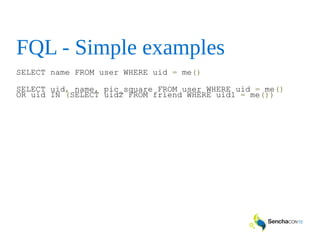
FQL - Simple examples
SELECT name FROM user WHERE uid = me()
SELECT uid, name, pic_square FROM user WHERE uid = me()
OR uid IN (SELECT uid2 FROM friend WHERE uid1 = me())
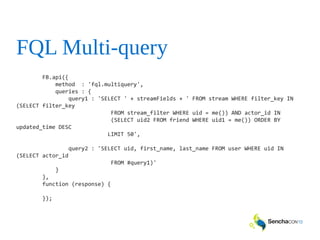
FQL Multi-query
FB.api({
method : 'fql.multiquery',
queries : {
query1 : 'SELECT ' + streamFields + ' FROM stream WHERE filter_key IN
(SELECT filter_key
FROM stream_filter WHERE uid = me()) AND actor_id IN
(SELECT uid2 FROM friend WHERE uid1 = me()) ORDER BY
updated_time DESC
LIMIT 50',
query2 : 'SELECT uid, first_name, last_name FROM user WHERE uid IN
(SELECT actor_id
FROM #query1)'
}
},
function (response) {
});
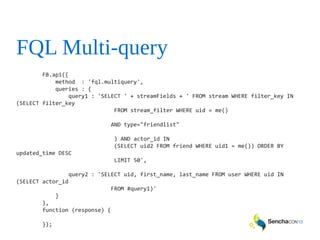
FQL Multi-query
FB.api({
method : 'fql.multiquery',
queries : {
query1 : 'SELECT ' + streamFields + ' FROM stream WHERE filter_key IN
(SELECT filter_key
FROM stream_filter WHERE uid = me()
AND type="friendlist"
) AND actor_id IN
(SELECT uid2 FROM friend WHERE uid1 = me()) ORDER BY
updated_time DESC
LIMIT 50',
query2 : 'SELECT uid, first_name, last_name FROM user WHERE uid IN
(SELECT actor_id
FROM #query1)'
}
},
function (response) {
});
Graph API Explorer
• Live Demo
• http://developers.facebook.com/tools/explorer
Open Graph - Simple examples
• 2 main starting points:
- me
- me/home
• http://developers.facebook.com/docs/reference/api/field_expa
Open Graph VS FQL
• Different Focus:
- Open Graph easier to use
- FQL more powerful
• Be careful:
- different table structures
- different field names and types (even for “same” fields)
- different output JSON
WebRTC
Web RTC
• <video>
• MediaStream
• WebSockets (Signaling)
• PeerConnection
MediaStream - getUserMedia
video = document.createElement(‘video’);
...
n.getMedia = n.webkitGetUserMedia || n.mozGetUserMedia;
n.getMedia({
audio: true,
video: {
mandatory: {},
optional: []
}
}, function() {
video[moz ? 'mozSrcObject' : 'src'] = moz ? stream :
window.webkitURL.createObjectURL(stream);
video.play();
}, function (e) {
console.error(e);
});
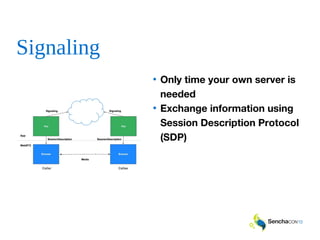
Signaling
• Only time your own server is
needed
• Exchange information using
Session Description Protocol
(SDP)
Signaling
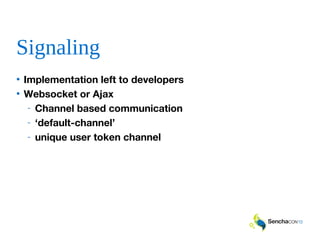
• Implementation left to developers
• Websocket or Ajax
- Channel based communication
- ‘default-channel’
- unique user token channel
RTCPeerConnection
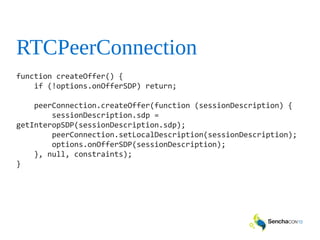
function createOffer() {
if (!options.onOfferSDP) return;
peerConnection.createOffer(function (sessionDescription) {
sessionDescription.sdp =
getInteropSDP(sessionDescription.sdp);
peerConnection.setLocalDescription(sessionDescription);
options.onOfferSDP(sessionDescription);
}, null, constraints);
}
RTCPeerConnection
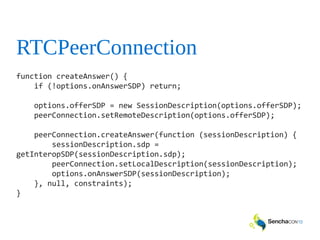
function createAnswer() {
if (!options.onAnswerSDP) return;
options.offerSDP = new SessionDescription(options.offerSDP);
peerConnection.setRemoteDescription(options.offerSDP);
peerConnection.createAnswer(function (sessionDescription) {
sessionDescription.sdp =
getInteropSDP(sessionDescription.sdp);
peerConnection.setLocalDescription(sessionDescription);
options.onAnswerSDP(sessionDescription);
}, null, constraints);
}
ICE & STUN & TURN
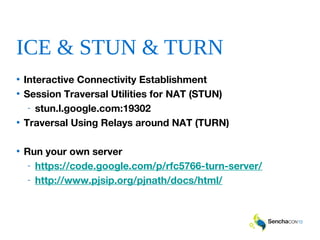
• Interactive Connectivity Establishment
• Session Traversal Utilities for NAT (STUN)
- stun.l.google.com:19302
• Traversal Using Relays around NAT (TURN)
• Run your own server
- https://code.google.com/p/rfc5766-turn-server/
- http://www.pjsip.org/pjnath/docs/html/
ICE Candidates
• Get automatically generated once SDP exchange
complete
• a=candidate:747209234 1 udp 1845501695 66.90.30.120
61920 typ srflx raddr 172.19.8.196 rport 61920 generation 0
• ICE Candidates must be sent through signaling server as
connection is not yet established until all candidates
received
PeerConnection.onaddstream
PeerConnection.onaddstream = function(event) {
var video = document.createElement(‘video’);
video[moz ? 'mozSrcObject' : 'src'] = moz ? stream :
webkitURL.createObjectURL(stream);
video.play();
...
};
Ensure video is flowing:
(video.readyState <= HTMLMediaElement.HAVE_CURRENT_DATA
|| video.paused
|| video.currentTime <= 0)
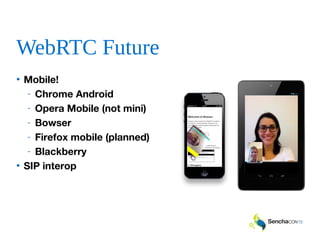
WebRTC Future
• Mobile!
- Chrome Android
- Opera Mobile (not mini)
- Bowser
- Firefox mobile (planned)
- Blackberry
• SIP interop
WebRTC Resources
• PeerJS - http://peerjs.com/
- simplified communication & provided signaling server
- only supports DataChannel (no streaming)
• WebRTC Experiments & Demos -
https://www.webrtc-experiment.com/
- much lower level
- examples of video chat, screen sharing & DataChannels
• Adapter.js -
https://code.google.com/p/webrtc/source/browse/trunk/samp
- Chrome/Firefox polyfill
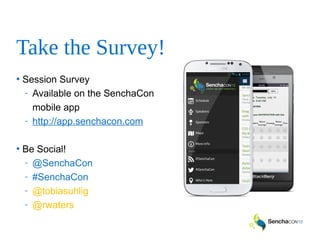
Take the Survey!
• Session Survey
- Available on the SenchaCon
mobile app
- http://app.senchacon.com
• Be Social!
- @SenchaCon
- #SenchaCon
- @tobiasuhlig
- @rwaters

Pushing the Boundaries of Sencha and HTML5′s WebRTC

  • 1.
    Tobias Uhlig, SolutionsEngineer, Sencha Rich Waters, Chief Software Architect, Extnd LLC @tobiasuhlig @rwaters tobiu@sencha.com senchacon@rich-waters.com Pushing the Boundaries of Sencha and HTML5’s WebRTC
  • 2.
  • 3.
  • 4.
    Google+ Sign-In <!-- Placethis asynchronous JavaScript just before your </body> tag --> <script type="text/javascript"> (function() { var po = document.createElement('script'); po.type = 'text/javascript'; po.async = true; po.src = 'https://apis.google.com/js/client:plusone.js'; var s = document.getElementsByTagName('script')[0]; s.parentNode.insertBefore(po, s); })(); </script> <span id="signinButton">...</span>
  • 5.
    Web 2.0 Google+Sign-In loadGooglePlusApi : function() { window.onSignInCallback = function(authResult) { SCircles.app.fireEvent('googlePlusSignInCallback', authResult); }; var api = document.createElement('script'); Ext.apply(api, { async : true, type : 'text/javascript', src : 'https://plus.google.com/js/client:plusone.js' }); var s = document.getElementsByTagName('script')[0]; s.parentNode.insertBefore(api, s); }
  • 6.
  • 7.
    Facebook Query Language •SQL-Style • Provides for some advanced features not available in the Graph API • Supports subqueries • Does not support (left) joining tables
  • 8.
    FQL - Simpleexamples SELECT name FROM user WHERE uid = me() SELECT uid, name, pic_square FROM user WHERE uid = me() OR uid IN (SELECT uid2 FROM friend WHERE uid1 = me())
  • 9.
    FQL Multi-query FB.api({ method :'fql.multiquery', queries : { query1 : 'SELECT ' + streamFields + ' FROM stream WHERE filter_key IN (SELECT filter_key FROM stream_filter WHERE uid = me()) AND actor_id IN (SELECT uid2 FROM friend WHERE uid1 = me()) ORDER BY updated_time DESC LIMIT 50', query2 : 'SELECT uid, first_name, last_name FROM user WHERE uid IN (SELECT actor_id FROM #query1)' } }, function (response) { });
  • 10.
    FQL Multi-query FB.api({ method :'fql.multiquery', queries : { query1 : 'SELECT ' + streamFields + ' FROM stream WHERE filter_key IN (SELECT filter_key FROM stream_filter WHERE uid = me() AND type="friendlist" ) AND actor_id IN (SELECT uid2 FROM friend WHERE uid1 = me()) ORDER BY updated_time DESC LIMIT 50', query2 : 'SELECT uid, first_name, last_name FROM user WHERE uid IN (SELECT actor_id FROM #query1)' } }, function (response) { });
  • 11.
    Graph API Explorer •Live Demo • http://developers.facebook.com/tools/explorer
  • 12.
    Open Graph -Simple examples • 2 main starting points: - me - me/home • http://developers.facebook.com/docs/reference/api/field_expa
  • 13.
    Open Graph VSFQL • Different Focus: - Open Graph easier to use - FQL more powerful • Be careful: - different table structures - different field names and types (even for “same” fields) - different output JSON
  • 15.
  • 17.
    Web RTC • <video> •MediaStream • WebSockets (Signaling) • PeerConnection
  • 18.
    MediaStream - getUserMedia video= document.createElement(‘video’); ... n.getMedia = n.webkitGetUserMedia || n.mozGetUserMedia; n.getMedia({ audio: true, video: { mandatory: {}, optional: [] } }, function() { video[moz ? 'mozSrcObject' : 'src'] = moz ? stream : window.webkitURL.createObjectURL(stream); video.play(); }, function (e) { console.error(e); });
  • 19.
    Signaling • Only timeyour own server is needed • Exchange information using Session Description Protocol (SDP)
  • 20.
    Signaling • Implementation leftto developers • Websocket or Ajax - Channel based communication - ‘default-channel’ - unique user token channel
  • 21.
    RTCPeerConnection function createOffer() { if(!options.onOfferSDP) return; peerConnection.createOffer(function (sessionDescription) { sessionDescription.sdp = getInteropSDP(sessionDescription.sdp); peerConnection.setLocalDescription(sessionDescription); options.onOfferSDP(sessionDescription); }, null, constraints); }
  • 22.
    RTCPeerConnection function createAnswer() { if(!options.onAnswerSDP) return; options.offerSDP = new SessionDescription(options.offerSDP); peerConnection.setRemoteDescription(options.offerSDP); peerConnection.createAnswer(function (sessionDescription) { sessionDescription.sdp = getInteropSDP(sessionDescription.sdp); peerConnection.setLocalDescription(sessionDescription); options.onAnswerSDP(sessionDescription); }, null, constraints); }
  • 23.
    ICE & STUN& TURN • Interactive Connectivity Establishment • Session Traversal Utilities for NAT (STUN) - stun.l.google.com:19302 • Traversal Using Relays around NAT (TURN) • Run your own server - https://code.google.com/p/rfc5766-turn-server/ - http://www.pjsip.org/pjnath/docs/html/
  • 24.
    ICE Candidates • Getautomatically generated once SDP exchange complete • a=candidate:747209234 1 udp 1845501695 66.90.30.120 61920 typ srflx raddr 172.19.8.196 rport 61920 generation 0 • ICE Candidates must be sent through signaling server as connection is not yet established until all candidates received
  • 25.
    PeerConnection.onaddstream PeerConnection.onaddstream = function(event){ var video = document.createElement(‘video’); video[moz ? 'mozSrcObject' : 'src'] = moz ? stream : webkitURL.createObjectURL(stream); video.play(); ... }; Ensure video is flowing: (video.readyState <= HTMLMediaElement.HAVE_CURRENT_DATA || video.paused || video.currentTime <= 0)
  • 26.
    WebRTC Future • Mobile! -Chrome Android - Opera Mobile (not mini) - Bowser - Firefox mobile (planned) - Blackberry • SIP interop
  • 27.
    WebRTC Resources • PeerJS- http://peerjs.com/ - simplified communication & provided signaling server - only supports DataChannel (no streaming) • WebRTC Experiments & Demos - https://www.webrtc-experiment.com/ - much lower level - examples of video chat, screen sharing & DataChannels • Adapter.js - https://code.google.com/p/webrtc/source/browse/trunk/samp - Chrome/Firefox polyfill
  • 28.
    Take the Survey! •Session Survey - Available on the SenchaCon mobile app - http://app.senchacon.com • Be Social! - @SenchaCon - #SenchaCon - @tobiasuhlig - @rwaters

Editor's Notes

  • #26 fires as soon as we have a clue about a remote stream, but data will not be immediately flowing