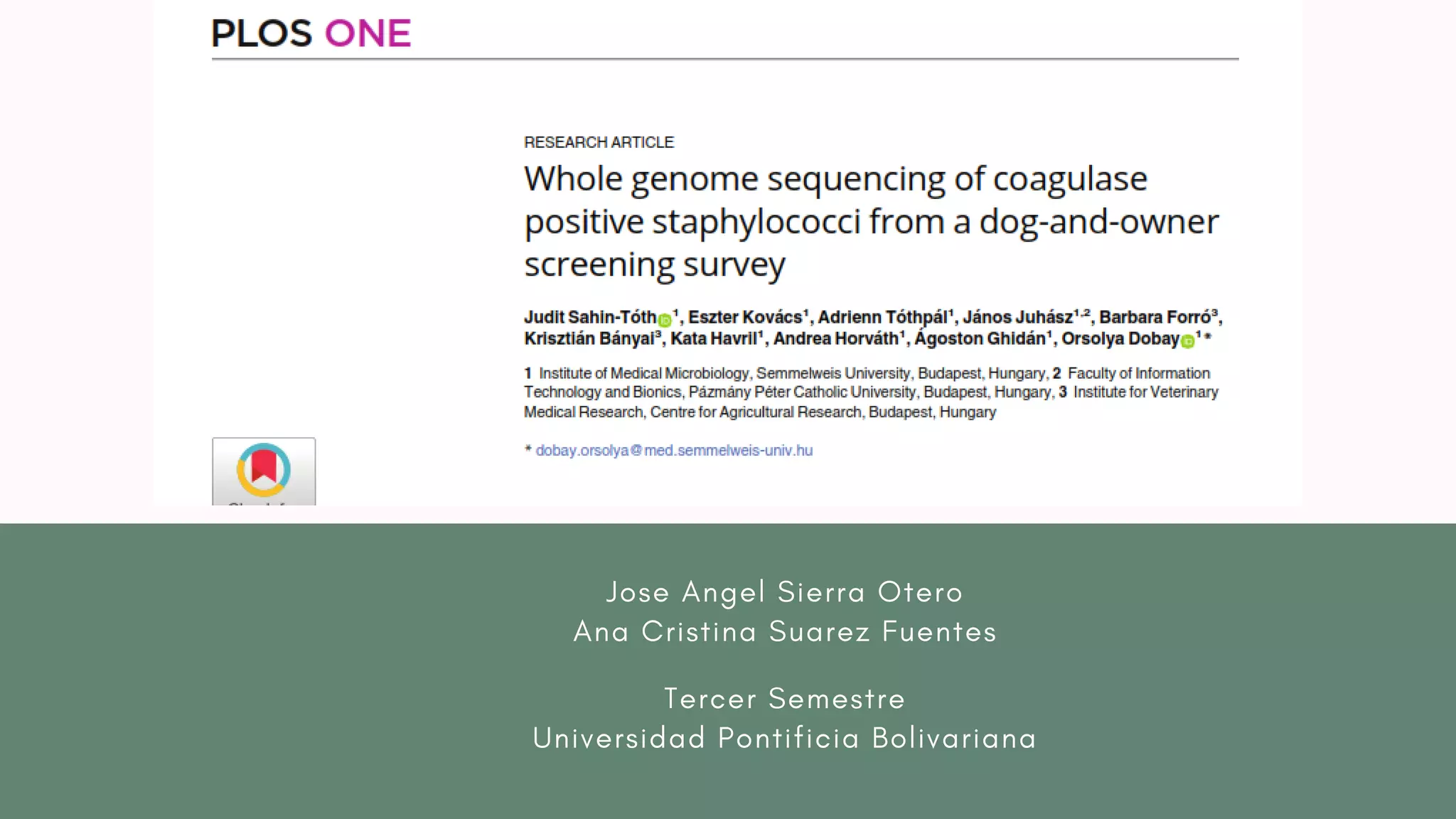
Jose Angel Sierra Otero
Ana Cristina Suarez Fuentes
Tercer Semestre
Universidad Pontificia Bolivariana
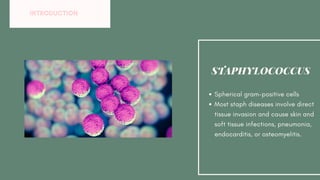
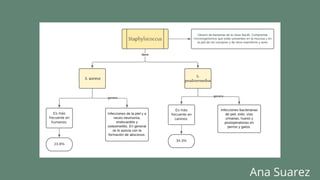
Spherical gram-positive cells
Most staph diseases involve direct
tissue invasion and cause skin and
soft tissue infections, pneumonia,
endocarditis, or osteomyelitis.
STAPHYLOCOCCUS
INTRODUCTION
A laboratory method used to
determine the complete genetic
makeup of a specific organism or
cell type.
Genome
Sequencing
INTRODUCTION
OBJECTIVE
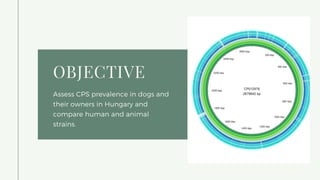
Assess CPS prevalence in dogs and
their owners in Hungary and
compare human and animal
strains.
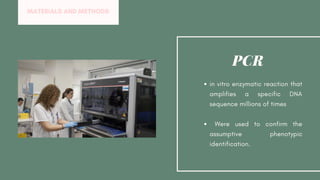
in vitro enzymatic reaction that
amplifies a specific DNA
sequence millions of times
Were used to confirm the
assumptive phenotypic
identification.
PCR
MATERIALS AND METHODS
Technique based on the enzymatic
amplification of a specific DNA
sequence.
PCR RFLP
MATERIALS AND METHODS
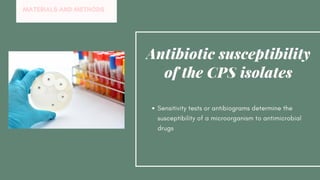
Sensitivity tests or antibiograms determine the
susceptibility of a microorganism to antimicrobial
drugs
Antibiotic susceptibility
of the CPS isolates
MATERIALS AND METHODS
The sequencing of the complete genome
allows to identify the differences between
isolated microorganisms and to know the
functional and genetic information.
Genome
Sequencing
MATERIALS AND METHODS
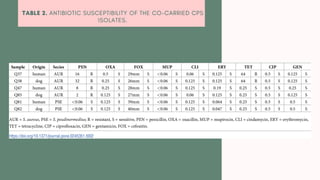
TABLE 2. ANTIBIOTIC SUSCEPTIBILITY OF THE CO-CARRIED CPS
ISOLATES.
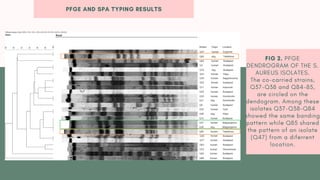
PFGE AND SPA TYPING RESULTS
FIG 2. PFGE
DENDROGRAM OF THE S.
AUREUS ISOLATES.
The co-carried strains,
Q37-Q38 and Q84-85,
are circled on the
dendogram. Among these
isolates Q37-Q38-Q84
showed the same banding
pattern while Q85 shared
the pattern of an isolate
(Q47) from a diferrent
location.
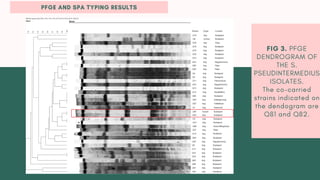
FIG 3. PFGE
DENDROGRAM OF
THE S.
PSEUDINTERMEDIUS
ISOLATES.
The co-carried
strains indicated on
the dendogram are
Q81 and Q82.
PFGE AND SPA TYPING RESULTS
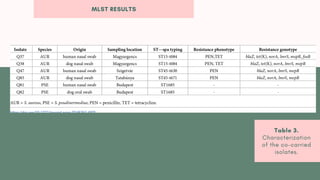
MLST RESULTS
Table 3.
Characterization
of the co-carried
isolates.
DISCUSSION
AUTOR ARGUMENT AGREE/DISAGREE
Laub K, et al
In our previous human carriage
studies, the nasal colonisation
rates were found to be 29.3%
among university students.
A four week course of
doxycycline therapy is part of
the management of this
disease in dogs.
In the Q47-85 pair the WGS
showed amino acid
replacements in GrlA which
could manifest in
fluoroquinolone resistance
Nelson CT, et al
Zankari E, et al
Molecular biology help us understand the biological mechanism
involved in the regulation of gene expression, acumulating
information on the structure and function of genes and has
provided the oppotunity to investigate the role in changes in the
cell and in the organism.
CONCLUSION
Molecular biology has provided us with various tools such as RFLP,
PCR, among others, which have been based on the principles of
DNA and which help us to predict physical, pathological and similar
aspects of a person or a group of people.
The tools of molecular biology have been extensively studied and
have shown great potential for the manipulation of many species,
having as the main goal the investigation of genes that specify traits
and characteristics of the species and help us understand them.
Jose Sierra
Ana Suarez

Seminario

  • 1.
    Jose Angel SierraOtero Ana Cristina Suarez Fuentes Tercer Semestre Universidad Pontificia Bolivariana
  • 2.
    Spherical gram-positive cells Moststaph diseases involve direct tissue invasion and cause skin and soft tissue infections, pneumonia, endocarditis, or osteomyelitis. STAPHYLOCOCCUS INTRODUCTION
  • 3.
    A laboratory methodused to determine the complete genetic makeup of a specific organism or cell type. Genome Sequencing INTRODUCTION
  • 4.
    OBJECTIVE Assess CPS prevalencein dogs and their owners in Hungary and compare human and animal strains.
  • 5.
    in vitro enzymaticreaction that amplifies a specific DNA sequence millions of times Were used to confirm the assumptive phenotypic identification. PCR MATERIALS AND METHODS
  • 6.
    Technique based onthe enzymatic amplification of a specific DNA sequence. PCR RFLP MATERIALS AND METHODS
  • 7.
    Sensitivity tests orantibiograms determine the susceptibility of a microorganism to antimicrobial drugs Antibiotic susceptibility of the CPS isolates MATERIALS AND METHODS
  • 8.
    The sequencing ofthe complete genome allows to identify the differences between isolated microorganisms and to know the functional and genetic information. Genome Sequencing MATERIALS AND METHODS
  • 9.
    TABLE 2. ANTIBIOTICSUSCEPTIBILITY OF THE CO-CARRIED CPS ISOLATES.
  • 10.
    PFGE AND SPATYPING RESULTS FIG 2. PFGE DENDROGRAM OF THE S. AUREUS ISOLATES. The co-carried strains, Q37-Q38 and Q84-85, are circled on the dendogram. Among these isolates Q37-Q38-Q84 showed the same banding pattern while Q85 shared the pattern of an isolate (Q47) from a diferrent location.
  • 11.
    FIG 3. PFGE DENDROGRAMOF THE S. PSEUDINTERMEDIUS ISOLATES. The co-carried strains indicated on the dendogram are Q81 and Q82. PFGE AND SPA TYPING RESULTS
  • 12.
  • 13.
    DISCUSSION AUTOR ARGUMENT AGREE/DISAGREE LaubK, et al In our previous human carriage studies, the nasal colonisation rates were found to be 29.3% among university students. A four week course of doxycycline therapy is part of the management of this disease in dogs. In the Q47-85 pair the WGS showed amino acid replacements in GrlA which could manifest in fluoroquinolone resistance Nelson CT, et al Zankari E, et al
  • 14.
    Molecular biology helpus understand the biological mechanism involved in the regulation of gene expression, acumulating information on the structure and function of genes and has provided the oppotunity to investigate the role in changes in the cell and in the organism. CONCLUSION Molecular biology has provided us with various tools such as RFLP, PCR, among others, which have been based on the principles of DNA and which help us to predict physical, pathological and similar aspects of a person or a group of people. The tools of molecular biology have been extensively studied and have shown great potential for the manipulation of many species, having as the main goal the investigation of genes that specify traits and characteristics of the species and help us understand them.
  • 15.
  • 16.