MYOFUNCTIONAL
APPLIANCES
INTRODUCTION
• Functional appliance is a device that changes the
posture of the mandible, holding it open or open and
forward to alter the growth of the mandible by
transmitting muscle forces to the teeth and
dentoalveolar structures in the predetermined
direction.
Cartilage
• It’s a type of connective tissue found on the
ends of bones, which protects and cushions
them, and absorbs the forces transmitted
throughout the body; a living tissue without a
direct blood supply.
Facts about cartilage
• Mesenchymal in origin
• Consists of cartilage cells called chondrocytes and a
ground substance
• Rigid and firm, but not hard
• Matrix is noncalcified and avascular
• Can grow both interstitially and appositionally
• Is covered by perichondrium but can exist without
one.
• Uniquely Pressure tolerant.
Types of Cartilage and their
Distribution
• Hyaline cartilage - 1. Costochondral Junctions
2. Articular surfaces of most
joints
3. Some laryngeal cartilages
4. Walls of Trachea and large
bronchi
5. Epiphyseal plate of long bones
• Fibrocartilage – 1. Secondary cartilaginous joints or symphysis
2. Articular discs of Synovial joints
3. Shoulder and hip joints
Elastic cartilage – 1. Auricle
2. Medial part of auditory tube
3. Epiglottis
Methods of Ossification
• Endochondral Ossification
• Intramembranous Ossification
Primary Vs Secondary Cartilage
• According to Stutzmann (1976)
• Primary Cartilage – exists in the axial skeleton, skull
base and limbs; the dividing cells , the differentiated
chondroblasts are surrounded by a cartilaginous
matrix that isolates them from local factors able to
restrain or stimulate cartilaginous growth
Secondary Cartilages – exist in the condylar and
coronoid processes and sometimes in sutures;the
dividing cells ,prechondroblasts, are not surrounded by a
cartilaginous matrix and thus are not isolated from local
growth modifications
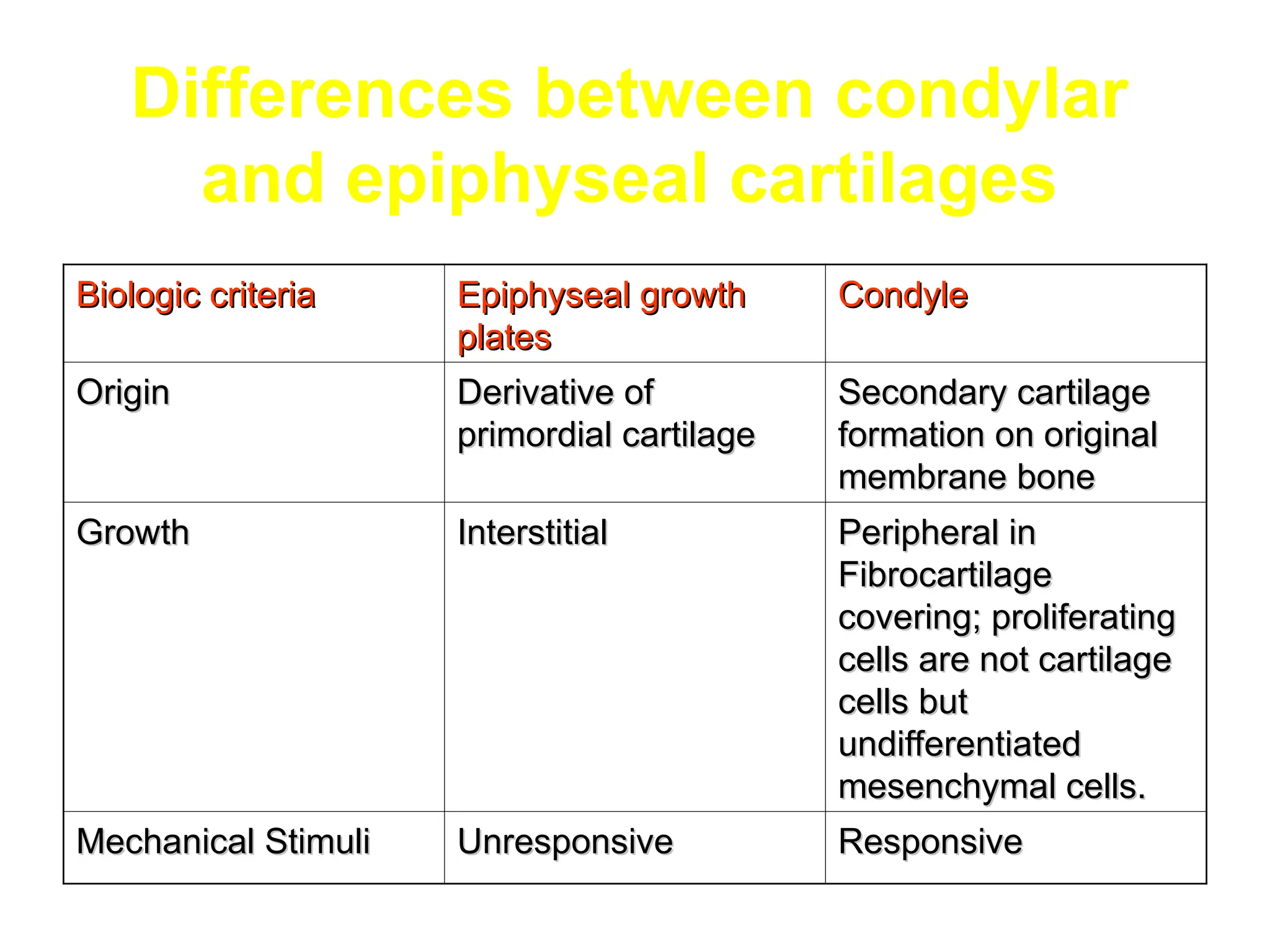
Differences between condylar
and epiphyseal cartilages
Biologic criteria
Biologic criteria Epiphyseal growth
Epiphyseal growth
plates
plates
Condyle
Condyle
Origin
Origin Derivative of
Derivative of
primordial cartilage
Secondary cartilage
Secondary cartilage
formation on original
membrane bone
membrane bone
Growth
Growth Interstitial
Interstitial Peripheral in
Peripheral in
Fibrocartilage
Fibrocartilage
covering; proliferating
cells are not cartilage
cells but
cells but
undifferentiated
undifferentiated
mesenchymal cells.
mesenchymal cells.
Mechanical Stimuli
Mechanical Stimuli Unresponsive
Unresponsive Responsive
Responsive
Biologic Criteria
Biologic Criteria Epiphyseal
Epiphyseal
Growth Plates
Growth Plates
Condyles
Condyles
Maturation
Maturation Secondary ossification
Secondary ossification
centers,final fusion and
disappearance of all
cartilage
cartilage
Conversion from
Conversion from
hypertrophic to non
hypertrophic to non
hypertrophic state but
not complete conversion
to bone
to bone
Histology
Histology Only the degenrative
Only the degenrative
zone is mineralizing
Whole hypertrophic area
is in state of
is in state of
mineralization, structural
organization is lacking
Hormonal control
Hormonal control After final fusion no
After final fusion no
further response to
further response to
growth hormone
growth hormone
Mature condyle can be
reawakened by growth
hormone
hormone
Effects of Orthodontic forces on the Mandible
• It is fair to say that controlling excessive mandibular
growth is an important unsolved problem in orthodontics.
• If growth stimulation is defined as producing a larger
mandible at the end of total growth period than would
have existed without treatment; it is much harder to
demonstrate a positive effect.
• The ultimate size of mandible in treated and untreated
patients is remarkably similar.
• When the mandible is protruded or restrained, changes
occur on the temporal as well as the mandibular side of
the TMJ.
• The Herbst appliance is potentially the most effective of
functional appliances in altering jaw growth probably
because of its full time action, but is also rather
unpredictable in terms of the amount of skeletal versus
dental changes likely to be produced.
• Acceleration of mandibular
growth often occurs but a long
term increase in size is difficult to
demonstrate and,if it exists at all,
is so small to be clinically
significant.
• Functional appliances that are
aimed at stimulating mandibular
growth produce a highly variable
response,but the growth
acceleration that sometimes
occurs can be useful
Tentative interpretation of the method of
operation of functional appliances
Functional Appliance
Increased contractile activity of the LPM
Intensification of repetitive activity of the
retrodiscal pad
Increase in growth
stimulating factors
Increase in growth stimulating factors
.Change in condylar trabecular orientation
.Additional Growth of condylar cartilage
.Additional subperiosteal ossification of the posterior border of
The mandible
Supplementary lengthening of
the mandible
Demise of the Lateral Pterygoid
Hypothesis
• Anatomic research has not
found significant
attachments of the LPM to
the condylar head.
• Hyperactivity of the LPM
during mandibular
advancement thereapy is
doubtful as the muscle
actually shortens during this
procedure.
• New bone formation at the
condyle was associated with
decreased postural EMG
activity in the LPM,
masseter and digastric
muscles
• This has led to the evolution
of NON MUSCULAR
HYPOTHESIS.
What exactly affects the growth of the
condylar head?
• Genetic theory - suggests that condylar growth is
strongly under the influence of genes.
• Functional Matrix Theory – though attractive could
not satisfactorily explain how condylar growth would be
stimulated by the growth of the soft tissues.
• Endow and Hans – mandibular growth is a composite of
regional forces and functional agents of growth control that
interact in response to specific extracoronal activating signals.
Growth Relativity Hypothesis – John
Voudouris
• Based on three main
foundations –
• Glenoid fossa promotes
condylar growth with
the use of mandibular
advancement thereapy.
Growth Relativity Hypothesis
• Viscoelastic tissues
anchored between glenoid
fossa and the condyle insert
directly into condylar
fibrocartilage and affect its
growth.
• Transduction of forces over
the fibrocartilaginous cap of
condylar head occurs as the
viscoelastic tissues are
stretched during
mandibular advancement
Light Bulb Analogy of Condylar
growth and Retention
• The condyle lights up
like a LIGHT BULB on a
dimmer switch when it
is continuously
advanced.
• The reactivated muscle
activity dims the light
bulb and returns it to
normal growth activity
at the end of treatment.
Conclusions of John Voudouris
• Propulsive mandibular appliances such as herbst and twinblock cause growth
modification of the condyle fossa region that involves–
• Displacement of mandible
• Viscoelastic tissue extension forces to the condyle
• Transduction of forces radiating beneath the fibrocartilage of the condyle and
glenoid fossa.
• Condylar growth modifications occur relative to the glenoid fossa and not
necessarily as an independent and isolated phenomenon.
• New bone formation at the condyle and glenoid fossa is associated with decreased
postural EMG activity in the LPM, masseter and anterior digastric muscles.
• Fixed functional appliances (Herbst) produce consistent and reproducible condyle
fossa changes compared with inconsistent results reported for removable
functional appliances.
• Bone formation in the glenoid fossa and condyle was statistically significant
compared to controls.
• Condylar response appears to be age determined.
Unique features of the mandibular
condyle
• A major site of growth having considerable clinical
significance.
• Not a pacesetting “master center” with all other regional
growth fields subordinate to and dependant on it .
• The condylar cartilage has a secondary type of cartilage which
developed because of changed functional and developmental
conditions imposed on this part of the mandible.
• The condylar cartilage is not the pacemaker for the growth of
the mandible. It functions to provide regional adaptive
growth.
• The condyle performs a dual role –
• Provides pressure tolerant articular contact.
• Makes possible a multidimensional growth capacity
in response to ever changing developmental
conditions and variations.
• The condylar cartilage does have some measure of
intrinsic genetic programming. The cartilage cells are
coded to divide and divide but extracondylar
features are needed to sustain this activity.
• Condylar prechondroblasts are randomly arranged
providing an opportunity for selected
multidirectional growth potential in contrast to long
bones.
Skeletal Maturity Indicators
CVMI
MP 3
Hand Wrist radiograph
Construction Bite
General Rules for the construction
bite
• If the forward posturing of the mandible is 7 –
8 mm ; the vertical opening must be slight to
moderate ( 2 mm – 4 mm)
• If the forward posturing is no more than 3 mm
to 5 mm, the vertical opening should be 4 mm
– 6 mm.
Types of construction bite
• Low construction bite with marked forward
posturing of the mandible
• High construction bite with slight anterior
mandibular positioning
• Construction bite without forward posturing
of the mandible
• Construction bite with opening and posterior
positioning of the mandible for Class III
malocclusions.
Functional Appliances
INTRODUCTION
• Originated and developed in Europe
• Controversy
features
• Harness forces of muscles
• Construction bite
• Only work in growing children
• Can’t correct the teeth irregularity
Correction of Class malocclusion
Ⅱ
Categories of functional appliances
• Passive tooth-borne appliances: no active
components
• Active tooth-borne appliances:including
expansive screw or springs to move teeth
• Tissue-borne appliances: Functional
Regulator-FR
Effects of functional appliances
Dento-alveolar changes
• Antero-posterior: Anterior movement of
lower teeth, posterior movement of upper
teeth.
• Vertical: lower posterior teeth erupt.
Modification of Maxillary growth
• Restrain the forward growth of maxilla
• Catch up growth occurs after treatment
Cephlomatric superimposition
Changes in mandibular growth
• Stimulate mandible growth
• Improve the growth direction of mandible
Cephlogram superimposition
Changes in glenoid fossae
• Remolding of the glenoid fossa more
anteriorly
Indications for functional appliances
• The patient must still be growing,preferably
approaching a phase of rapid growth.
• The pattern and direction of facial growth should be
favorable.
• The profile improved immediately as the patient
move mandible forward – positive VTO
• The patient must be well motivated.
• Dentition are well aligned
The timing of treatment
Late stage of mixed dentition,1-2 years before
the pubertal growth occur
Female: 9~10 year old
Male: 11~12 year old
Management of functional
appliances
Diagnosis
• Skeletal or non-skeletal(dental)
• Mandibular retrusion or maxillary protrusion
• Degree of severity
Appliance Design
• No ideal appliance can be used in all situations
• Exactly what is desired in the treatment
• consideration of cost, complexity,
acceptability
• Vertical control
• Mobile or exfoliating primary teeth
impression
• Differ with the diagnostic records
• Areas where appliance components will
contact soft tissues must be clearly delineated
• The impression must not stretch soft tissues in
areas of contact with the appliance.
Bite registration
1.Anteroposterior dimension: for most
patients: 4~6mm (edge to edge if not
uncomfortable)
2.Vertical opening: 3~4mm in incisor
region
Bite registration
--methods
• A horseshoe-shaped wax bite rim is prepared
• Guiding the mandible into planned position
• Forming the wax bite
• Check and hardened
fabrication
Fit the appliance
• Instruction
• Check the surface for roughness, adjust
clasps .
• How to insert and remove the appliances
• Initially few hours, gradually increase the
wearing time. At least 14 hours each day over
2 weeks
First review appointment
2 weeks later
Check and trim the appliance
Review appointment
• 1.Every 6~8 weeks
• 2.Check the appliance
• 3.Assess progress(improvement or no/slow
improvement)
4.Adjustment
• Trimming of interocclusal elements to allow
teeth erupt where desired
• Adjustment of the labial bow: reduce its
contact with the anterior teeth
• Outward bending of buccal shields and lip
pads,facilitate arch expansion
Retention
• Gradually reduce the amount of wearing time
till sleeping hours only
• Period: the pubertal growth is over
Popular types of
appliances
Activator
Tu
construction
• Base plate
• Labial bow: transmit
forces to upper incisors
• Lower incisors
capping: minimize
⑴
the tendency of lower
incisors procline
reducing overbite
⑵
principles
Muscles stretched-producing forces-retracting mandible-transmitted
to maxilla through labial bow-restraining the maxillary growth
Rules for construction bite
• In a forward positioning of the mandible of 7-
8mm,the vertical opening must be slightly to
moderate(2-4mm)
• If the forward positioning is no more than 3-
5mm,the vertical opening should be 4-6mm
Management
Checkup appointments should be scheduled every 6 weeks:
1.Observe the hygiene levels maintained by the patient
2.The labial bows must be checked
3.In expansion treatment the jackscrew are normally activated by
the patients at 1-week interval. Check the screw
Trimming
1.vertical control
• For dolichofacial patients:intrude molars,
extrude incisors
• For brachyfacial patients: intrude incisors,
extrude molars
Acrylic contact Intrusion of
the molars
Acrylic contour for
extrusion of the molars
Intrusion of the incisors
2.sagittal control
Retrusion of the incisors
bionator
principles
• Less bulky
• Modulates muscular activity
Types of Bionator
• Standard Bionator
• Horseshoe-shaped
acrylic lingual plate
• Palatal bar
• Labial bow extend
buccally
• No incisors capping
Class Bionator
Ⅲ
Indications
• The dental arches are well aligned originally
• The mandible is in a posterior position
• The skeletal problem is not too severe
Clinical management
• The time interval between office visit is 3-5
weeks
• Adjust labial bow to touch the teeth lightly
• Trimming the interocclusal block to guide
premolar into full occlusion
Frankel appliance(Functional
Regulator-FR)
• The large part of Frankel appliance is
confined to the oral vestibule
• The buccal shields and lip pads hold the
buccal and labial soft tissue away from the
teeth,eliminating restrictive influence
• The manner in which the anteroposterior
correction is different
tu
variation
• FR1:correction of class division 1
Ⅱ
• FR2:correction of class division 1 and 2
Ⅱ
• FR3:correction of class Ⅲ
• FR4:correction of openbite
• Among them, the FR2 and FR3 are often used
FR3
• Acrylic parts:
• Lip pads:eliminate
restriction,stimulation
of bone growth;
transmitting forces to
mandible
• Buccal shields:
maxillary expansion
Steel wire
• Lower labial bow:restrain
mandible
• Protrusion bow:stimulate
forward movement of
maxillary incisors
• Palatal bar: stabling
component
• Occlusal rests:prevent
lower molar eruption,
Construction bite
• Protruding mandible as much as possible,
generally edge to edge
• Vertical dimension: opened only enough to
correct crossbite, allow wires to pass through,
about 2mm in posterior region
Fabrication
Working model trimming
wax relief
wire forming
fabrication of acrylic portion.
Clinical management
• All margins are checked for smoothness
• Fitting the appliance 1-2 weeks
• First visit: extending wearing time to 4-6 hours
• Second visit:exercises may be prescribed
including speech and lip-seal
• Upper molars rest will be cut
Twin block appliance
tu
introduction
• Two piece appliance
• Giving greater freedom of movement in
anterior and lateral excursion
• The appliance can be worn full day
• Harness all oral functional forces especially
the forces of mastication
• Correct the malocclusion rapidly
Construction bite
• Overjet≤10mm,bite may be activated edge to edge
on incisors if the patient can posture forward
comfortable
• Vertical dimension: 2mm interincisal clearance
Design and construction
Midline screw to expand the upper arch
Design and construction
retainer
Design and construction
Bite blocks
Design and construction
Inclined plane
Design and construction
Base plane
Design and construction
Labial bow
Stage of treatment
Stage 1: active phase:twin block
Stage 2: support phase-anterior plane
Dolichofacial patients:non-trimming, prevent second
molars extrusion
Branchfacial patients:trimming
Timing:1-2 months after the appliance was inserted
Method:trimming the upper block to leave 1mm
clearance between bite and lower molar
Vertical control
trimming
Herbst
Conclusions
• Condylar cartilage because of its unique structure ; is a regional
adaptive center ; the growth of which can be influenced by
external influences
•Growth modification is a relative phenomenon wherein both the
glenoid fossa and the head of the condyle undergo remodelling in
response to functional mandibular advancement.
•Timing of the functional appliance is very critical if one has to
achieve skeletal effects. Giving a functional appliance after the
peak of pubertal growth spurt has more dental effects rather than
skeletal.
Conclusions
• Amongst most of the removable functional appliances; the
twin block is the most successfully accepted by the patient.
The ability of the patient to speak and chew with it together
with the dramatic change in the facial appearance are all
factors which enhance compliance.
• Not every case can by put on PAE appliance; functional
appliances do have an important role in correction of
skeletal discrepancies as well as correction of abnormal
neuromuscular pattern.

Myofunctional Appliances for orthodontics.ppt

  • 1.
  • 2.
    INTRODUCTION • Functional applianceis a device that changes the posture of the mandible, holding it open or open and forward to alter the growth of the mandible by transmitting muscle forces to the teeth and dentoalveolar structures in the predetermined direction.
  • 3.
    Cartilage • It’s atype of connective tissue found on the ends of bones, which protects and cushions them, and absorbs the forces transmitted throughout the body; a living tissue without a direct blood supply.
  • 4.
    Facts about cartilage •Mesenchymal in origin • Consists of cartilage cells called chondrocytes and a ground substance • Rigid and firm, but not hard • Matrix is noncalcified and avascular • Can grow both interstitially and appositionally • Is covered by perichondrium but can exist without one. • Uniquely Pressure tolerant.
  • 5.
    Types of Cartilageand their Distribution • Hyaline cartilage - 1. Costochondral Junctions 2. Articular surfaces of most joints 3. Some laryngeal cartilages 4. Walls of Trachea and large bronchi 5. Epiphyseal plate of long bones
  • 6.
    • Fibrocartilage –1. Secondary cartilaginous joints or symphysis 2. Articular discs of Synovial joints 3. Shoulder and hip joints Elastic cartilage – 1. Auricle 2. Medial part of auditory tube 3. Epiglottis
  • 7.
    Methods of Ossification •Endochondral Ossification • Intramembranous Ossification
  • 8.
    Primary Vs SecondaryCartilage • According to Stutzmann (1976) • Primary Cartilage – exists in the axial skeleton, skull base and limbs; the dividing cells , the differentiated chondroblasts are surrounded by a cartilaginous matrix that isolates them from local factors able to restrain or stimulate cartilaginous growth
  • 9.
    Secondary Cartilages –exist in the condylar and coronoid processes and sometimes in sutures;the dividing cells ,prechondroblasts, are not surrounded by a cartilaginous matrix and thus are not isolated from local growth modifications
  • 11.
    Differences between condylar andepiphyseal cartilages Biologic criteria Biologic criteria Epiphyseal growth Epiphyseal growth plates plates Condyle Condyle Origin Origin Derivative of Derivative of primordial cartilage primordial cartilage Secondary cartilage Secondary cartilage formation on original formation on original membrane bone membrane bone Growth Growth Interstitial Interstitial Peripheral in Peripheral in Fibrocartilage Fibrocartilage covering; proliferating covering; proliferating cells are not cartilage cells are not cartilage cells but cells but undifferentiated undifferentiated mesenchymal cells. mesenchymal cells. Mechanical Stimuli Mechanical Stimuli Unresponsive Unresponsive Responsive Responsive
  • 12.
    Biologic Criteria Biologic CriteriaEpiphyseal Epiphyseal Growth Plates Growth Plates Condyles Condyles Maturation Maturation Secondary ossification Secondary ossification centers,final fusion and centers,final fusion and disappearance of all disappearance of all cartilage cartilage Conversion from Conversion from hypertrophic to non hypertrophic to non hypertrophic state but hypertrophic state but not complete conversion not complete conversion to bone to bone Histology Histology Only the degenrative Only the degenrative zone is mineralizing zone is mineralizing Whole hypertrophic area Whole hypertrophic area is in state of is in state of mineralization, structural mineralization, structural organization is lacking organization is lacking Hormonal control Hormonal control After final fusion no After final fusion no further response to further response to growth hormone growth hormone Mature condyle can be Mature condyle can be reawakened by growth reawakened by growth hormone hormone
  • 13.
    Effects of Orthodonticforces on the Mandible • It is fair to say that controlling excessive mandibular growth is an important unsolved problem in orthodontics. • If growth stimulation is defined as producing a larger mandible at the end of total growth period than would have existed without treatment; it is much harder to demonstrate a positive effect. • The ultimate size of mandible in treated and untreated patients is remarkably similar. • When the mandible is protruded or restrained, changes occur on the temporal as well as the mandibular side of the TMJ. • The Herbst appliance is potentially the most effective of functional appliances in altering jaw growth probably because of its full time action, but is also rather unpredictable in terms of the amount of skeletal versus dental changes likely to be produced.
  • 14.
    • Acceleration ofmandibular growth often occurs but a long term increase in size is difficult to demonstrate and,if it exists at all, is so small to be clinically significant. • Functional appliances that are aimed at stimulating mandibular growth produce a highly variable response,but the growth acceleration that sometimes occurs can be useful
  • 16.
    Tentative interpretation ofthe method of operation of functional appliances Functional Appliance Increased contractile activity of the LPM Intensification of repetitive activity of the retrodiscal pad Increase in growth stimulating factors
  • 17.
    Increase in growthstimulating factors .Change in condylar trabecular orientation .Additional Growth of condylar cartilage .Additional subperiosteal ossification of the posterior border of The mandible Supplementary lengthening of the mandible
  • 18.
    Demise of theLateral Pterygoid Hypothesis • Anatomic research has not found significant attachments of the LPM to the condylar head. • Hyperactivity of the LPM during mandibular advancement thereapy is doubtful as the muscle actually shortens during this procedure.
  • 19.
    • New boneformation at the condyle was associated with decreased postural EMG activity in the LPM, masseter and digastric muscles • This has led to the evolution of NON MUSCULAR HYPOTHESIS.
  • 20.
    What exactly affectsthe growth of the condylar head? • Genetic theory - suggests that condylar growth is strongly under the influence of genes. • Functional Matrix Theory – though attractive could not satisfactorily explain how condylar growth would be stimulated by the growth of the soft tissues. • Endow and Hans – mandibular growth is a composite of regional forces and functional agents of growth control that interact in response to specific extracoronal activating signals.
  • 21.
    Growth Relativity Hypothesis– John Voudouris • Based on three main foundations – • Glenoid fossa promotes condylar growth with the use of mandibular advancement thereapy.
  • 22.
    Growth Relativity Hypothesis •Viscoelastic tissues anchored between glenoid fossa and the condyle insert directly into condylar fibrocartilage and affect its growth. • Transduction of forces over the fibrocartilaginous cap of condylar head occurs as the viscoelastic tissues are stretched during mandibular advancement
  • 23.
    Light Bulb Analogyof Condylar growth and Retention • The condyle lights up like a LIGHT BULB on a dimmer switch when it is continuously advanced. • The reactivated muscle activity dims the light bulb and returns it to normal growth activity at the end of treatment.
  • 24.
    Conclusions of JohnVoudouris • Propulsive mandibular appliances such as herbst and twinblock cause growth modification of the condyle fossa region that involves– • Displacement of mandible • Viscoelastic tissue extension forces to the condyle • Transduction of forces radiating beneath the fibrocartilage of the condyle and glenoid fossa. • Condylar growth modifications occur relative to the glenoid fossa and not necessarily as an independent and isolated phenomenon. • New bone formation at the condyle and glenoid fossa is associated with decreased postural EMG activity in the LPM, masseter and anterior digastric muscles. • Fixed functional appliances (Herbst) produce consistent and reproducible condyle fossa changes compared with inconsistent results reported for removable functional appliances. • Bone formation in the glenoid fossa and condyle was statistically significant compared to controls. • Condylar response appears to be age determined.
  • 25.
    Unique features ofthe mandibular condyle • A major site of growth having considerable clinical significance. • Not a pacesetting “master center” with all other regional growth fields subordinate to and dependant on it . • The condylar cartilage has a secondary type of cartilage which developed because of changed functional and developmental conditions imposed on this part of the mandible. • The condylar cartilage is not the pacemaker for the growth of the mandible. It functions to provide regional adaptive growth. • The condyle performs a dual role – • Provides pressure tolerant articular contact.
  • 26.
    • Makes possiblea multidimensional growth capacity in response to ever changing developmental conditions and variations. • The condylar cartilage does have some measure of intrinsic genetic programming. The cartilage cells are coded to divide and divide but extracondylar features are needed to sustain this activity. • Condylar prechondroblasts are randomly arranged providing an opportunity for selected multidirectional growth potential in contrast to long bones.
  • 27.
    Skeletal Maturity Indicators CVMI MP3 Hand Wrist radiograph
  • 28.
  • 29.
    General Rules forthe construction bite • If the forward posturing of the mandible is 7 – 8 mm ; the vertical opening must be slight to moderate ( 2 mm – 4 mm) • If the forward posturing is no more than 3 mm to 5 mm, the vertical opening should be 4 mm – 6 mm.
  • 30.
    Types of constructionbite • Low construction bite with marked forward posturing of the mandible • High construction bite with slight anterior mandibular positioning • Construction bite without forward posturing of the mandible • Construction bite with opening and posterior positioning of the mandible for Class III malocclusions.
  • 31.
  • 32.
    INTRODUCTION • Originated anddeveloped in Europe • Controversy
  • 33.
    features • Harness forcesof muscles • Construction bite • Only work in growing children • Can’t correct the teeth irregularity
  • 34.
    Correction of Classmalocclusion Ⅱ
  • 35.
    Categories of functionalappliances • Passive tooth-borne appliances: no active components • Active tooth-borne appliances:including expansive screw or springs to move teeth • Tissue-borne appliances: Functional Regulator-FR
  • 36.
  • 37.
    Dento-alveolar changes • Antero-posterior:Anterior movement of lower teeth, posterior movement of upper teeth. • Vertical: lower posterior teeth erupt.
  • 38.
    Modification of Maxillarygrowth • Restrain the forward growth of maxilla • Catch up growth occurs after treatment
  • 39.
  • 40.
    Changes in mandibulargrowth • Stimulate mandible growth • Improve the growth direction of mandible
  • 41.
  • 42.
    Changes in glenoidfossae • Remolding of the glenoid fossa more anteriorly
  • 43.
    Indications for functionalappliances • The patient must still be growing,preferably approaching a phase of rapid growth. • The pattern and direction of facial growth should be favorable. • The profile improved immediately as the patient move mandible forward – positive VTO • The patient must be well motivated. • Dentition are well aligned
  • 44.
    The timing oftreatment Late stage of mixed dentition,1-2 years before the pubertal growth occur Female: 9~10 year old Male: 11~12 year old
  • 45.
  • 46.
    Diagnosis • Skeletal ornon-skeletal(dental) • Mandibular retrusion or maxillary protrusion • Degree of severity
  • 47.
    Appliance Design • Noideal appliance can be used in all situations • Exactly what is desired in the treatment • consideration of cost, complexity, acceptability • Vertical control • Mobile or exfoliating primary teeth
  • 48.
    impression • Differ withthe diagnostic records • Areas where appliance components will contact soft tissues must be clearly delineated • The impression must not stretch soft tissues in areas of contact with the appliance.
  • 49.
    Bite registration 1.Anteroposterior dimension:for most patients: 4~6mm (edge to edge if not uncomfortable) 2.Vertical opening: 3~4mm in incisor region
  • 50.
    Bite registration --methods • Ahorseshoe-shaped wax bite rim is prepared • Guiding the mandible into planned position • Forming the wax bite • Check and hardened
  • 53.
  • 54.
    Fit the appliance •Instruction • Check the surface for roughness, adjust clasps . • How to insert and remove the appliances • Initially few hours, gradually increase the wearing time. At least 14 hours each day over 2 weeks
  • 55.
    First review appointment 2weeks later Check and trim the appliance
  • 56.
    Review appointment • 1.Every6~8 weeks • 2.Check the appliance • 3.Assess progress(improvement or no/slow improvement)
  • 57.
    4.Adjustment • Trimming ofinterocclusal elements to allow teeth erupt where desired • Adjustment of the labial bow: reduce its contact with the anterior teeth • Outward bending of buccal shields and lip pads,facilitate arch expansion
  • 58.
    Retention • Gradually reducethe amount of wearing time till sleeping hours only • Period: the pubertal growth is over
  • 59.
  • 60.
  • 61.
    construction • Base plate •Labial bow: transmit forces to upper incisors • Lower incisors capping: minimize ⑴ the tendency of lower incisors procline reducing overbite ⑵
  • 63.
    principles Muscles stretched-producing forces-retractingmandible-transmitted to maxilla through labial bow-restraining the maxillary growth
  • 64.
    Rules for constructionbite • In a forward positioning of the mandible of 7- 8mm,the vertical opening must be slightly to moderate(2-4mm) • If the forward positioning is no more than 3- 5mm,the vertical opening should be 4-6mm
  • 65.
    Management Checkup appointments shouldbe scheduled every 6 weeks: 1.Observe the hygiene levels maintained by the patient 2.The labial bows must be checked 3.In expansion treatment the jackscrew are normally activated by the patients at 1-week interval. Check the screw
  • 66.
    Trimming 1.vertical control • Fordolichofacial patients:intrude molars, extrude incisors • For brachyfacial patients: intrude incisors, extrude molars
  • 67.
    Acrylic contact Intrusionof the molars Acrylic contour for extrusion of the molars
  • 68.
  • 69.
  • 70.
  • 71.
    principles • Less bulky •Modulates muscular activity
  • 72.
    Types of Bionator •Standard Bionator • Horseshoe-shaped acrylic lingual plate • Palatal bar • Labial bow extend buccally • No incisors capping
  • 73.
  • 74.
    Indications • The dentalarches are well aligned originally • The mandible is in a posterior position • The skeletal problem is not too severe
  • 75.
    Clinical management • Thetime interval between office visit is 3-5 weeks • Adjust labial bow to touch the teeth lightly • Trimming the interocclusal block to guide premolar into full occlusion
  • 76.
  • 77.
    • The largepart of Frankel appliance is confined to the oral vestibule • The buccal shields and lip pads hold the buccal and labial soft tissue away from the teeth,eliminating restrictive influence • The manner in which the anteroposterior correction is different
  • 78.
  • 79.
    variation • FR1:correction ofclass division 1 Ⅱ • FR2:correction of class division 1 and 2 Ⅱ • FR3:correction of class Ⅲ • FR4:correction of openbite • Among them, the FR2 and FR3 are often used
  • 80.
    FR3 • Acrylic parts: •Lip pads:eliminate restriction,stimulation of bone growth; transmitting forces to mandible • Buccal shields: maxillary expansion
  • 81.
    Steel wire • Lowerlabial bow:restrain mandible • Protrusion bow:stimulate forward movement of maxillary incisors • Palatal bar: stabling component • Occlusal rests:prevent lower molar eruption,
  • 82.
    Construction bite • Protrudingmandible as much as possible, generally edge to edge • Vertical dimension: opened only enough to correct crossbite, allow wires to pass through, about 2mm in posterior region
  • 83.
    Fabrication Working model trimming waxrelief wire forming fabrication of acrylic portion.
  • 84.
    Clinical management • Allmargins are checked for smoothness • Fitting the appliance 1-2 weeks • First visit: extending wearing time to 4-6 hours • Second visit:exercises may be prescribed including speech and lip-seal • Upper molars rest will be cut
  • 88.
  • 89.
    introduction • Two pieceappliance • Giving greater freedom of movement in anterior and lateral excursion • The appliance can be worn full day • Harness all oral functional forces especially the forces of mastication • Correct the malocclusion rapidly
  • 90.
    Construction bite • Overjet≤10mm,bitemay be activated edge to edge on incisors if the patient can posture forward comfortable • Vertical dimension: 2mm interincisal clearance
  • 91.
    Design and construction Midlinescrew to expand the upper arch
  • 92.
  • 93.
  • 94.
  • 95.
  • 96.
  • 97.
    Stage of treatment Stage1: active phase:twin block
  • 98.
    Stage 2: supportphase-anterior plane
  • 99.
    Dolichofacial patients:non-trimming, preventsecond molars extrusion Branchfacial patients:trimming Timing:1-2 months after the appliance was inserted Method:trimming the upper block to leave 1mm clearance between bite and lower molar Vertical control
  • 100.
  • 102.
  • 106.
    Conclusions • Condylar cartilagebecause of its unique structure ; is a regional adaptive center ; the growth of which can be influenced by external influences •Growth modification is a relative phenomenon wherein both the glenoid fossa and the head of the condyle undergo remodelling in response to functional mandibular advancement. •Timing of the functional appliance is very critical if one has to achieve skeletal effects. Giving a functional appliance after the peak of pubertal growth spurt has more dental effects rather than skeletal.
  • 107.
    Conclusions • Amongst mostof the removable functional appliances; the twin block is the most successfully accepted by the patient. The ability of the patient to speak and chew with it together with the dramatic change in the facial appearance are all factors which enhance compliance. • Not every case can by put on PAE appliance; functional appliances do have an important role in correction of skeletal discrepancies as well as correction of abnormal neuromuscular pattern.

Editor's Notes

  • #9 -Secondary cartilage does not develop by the differentiation of the established primary cartilages of the skull ( that is the cartilages of the pharyngeal arches) Phylogenetically the original cartilage and bone that provided for mandibular articulation become converted to an ear ossicle (malleus) .thus a secondary cartilage developed on the dentary bone to provide for articulation of lower jaw with the cranium. An adventitious type of cartilage forms rather than bone because of functional and developmental conditions imposed on this part of the mandible. Secondary cartilageof the mandible extends from the mandibular head down and forwards in the the ramus contributing to its growth in height ;though it is largely replaced by bone in mid fetal life;it’s proximal end persists as proliferating cartilage under articular fibrocartilage until the third decade.
  • #13  - Herbst appliance has been shown to be the most effective in the management of class 2 malocclusions. Occlusal changes seen during treatment are mainly a result of increased mandibular growth and maxillary and mandibular tooth movements. Mandibular condyle position seems to be unaffected by Herbst thereapy. The telescope mechanism of the Herbst appliance produces a posterior –upward directed force on the maxillary jaw base and an anterior –downward directed force on the mandibular jaw base and dentition. This was not a consistent pattern. The amount and direction of maxillary rotation varied considerably amongst patients. The herbst has been likened to a high pull headgear.
  • #20 It is now generally agreed that the secondary cartilage of the condyle is not the pacemaker for the growth of the mandible. It’s contribution is to provide regional adaptive growth. It maintains the condylar region in proper anatomic relation with the temporal bone as the whole mandible is brought downward and forward.
  • #22 . The glenoid fossa has been reported to relocate anteroinferiorly to meet active condylar modification and to restore normal function during orthopedic treatment. . Modification of the GF can be clinically significant whenever two strucutres – the condyle and fossa are seperated.