1.
1.
2.
3.
Semester IV Exam Notes
Theory OR
What is transportation problem?
The transportation problem is a special type of linear programming problem where the objective
consists in minimizing transportation cost of a given commodity from a number of sources or
origins (e.g. factory, manufacturing facility) to a number of destinations (e.g. warehouse,
store). Each source has a limited supply (i.e. maximum number of products that can be sent
from it) while each destination has a demand to be satisfied (i.e. minimum number of products
that need to be shipped to it). The cost of shipping from a source to a destination is directly
proportional to the number of units shipped.
B. Types of Transportation Problems
There are two different types of transportation problems based on the initial given information:
Balanced Transportation Problems: cases where the total supply is equal to the total demand.
Unbalanced Transportation Problems: cases where the total supply is not equal to the total
demand. When the supply is higher than the demand, a dummy destination is introduced in the
equation to make it equal to the supply (with shipping costs of $0); the excess supply is
assumed to go to inventory. On the other hand, when the demand is higher than the supply, a
dummy source is introduced in the equation to make it equal to the demand (in these cases
there is usually a penalty cost associated for not fulfilling the demand).
In order to proceed with the solution of any given transportation problem, the first step consists
in verifying if it is balanced. If it is not, it must be balanced accordingly.
what is feasible solution and non degenerate solution in transportation problem?
Feasible Solution: A feasible solution to a transportation problem is a set of non-negative values
x, (i = 1, 2,
... m, j= 1,2, ... n) that satisfies the constraints.
Non-degenerate basic feasible solution: If a basic feasible solution to a transportation problem
contains
exactly m + n - 1 allocations in independent positions, it is called a Non-degenerate basic
feasible solution.
Here m is the number of rows and n is the number of columns in a transportation problem.
A. What do you mean by balanced transportation problem
3.
4.
5.
Ans - balanced transportation problem is a transportation problem where the total availability at
the origins is equal to the total requirements at the destinations.
B. Methods of solving Transportation method
There are three ways for determining the initial basic feasible solution. They are
1. NorthWest Corner Cell Method.
2. Vogel’s Approximation Method (VAM).
3. Least Call Cell Method.
What is the Assignment problem?
The assignment problem is a special case of linear programming problem; it is one of the
fundamental combinational optimization problems in the branch of optimization or operations
research in mathematics. Its goal consists in assigning m resources (usually workers) to n tasks
(usually jobs) one a one to one basis while minimizing assignment costs. As a general rule, all
jobs must be performed by exactly one worker and every worker must be assigned exclusively
to one job. Any worker can be assigned to perform any job, incurring in some cost that may vary
depending on the work-job assignment.
Give mathematical form of assignment problem.
Mathematical Formulation:
Any basic feasible solution of an Assignment problem consists (2n – 1) variables of which the (n
– 1) variables are zero, n is number of jobs or number of facilities. Due to this high degeneracy,
if we solve the problem by usual transportation method, it will be a complex and time consuming
work. Thus a separate technique is derived for it. Before going to the absolute method it is very
important to formulate the problem.
Suppose xjj is a variable which is defined as
1 if the ith job is assigned to jth machine or facility
.
.
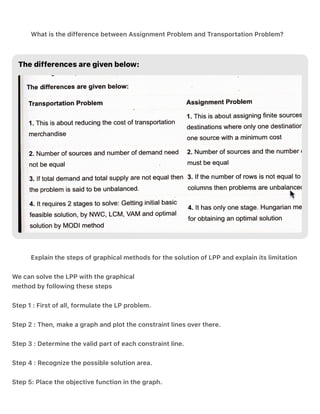
What is the difference between Assignment Problem and Transportation Problem?
Explain the steps of graphical methods for the solution of LPP and explain its limitation
We can solve the LPP with the graphical
method by following these steps
Step 1 : First of all, formulate the LP problem.
Step 2 : Then, make a graph and plot the constraint lines over there.
Step 3 : Determine the valid part of each constraint line.
Step 4 : Recognize the possible solution area.
Step 5: Place the objective function in the graph.
Step 6 : Finally, find out the optimum point.
Limitations are
The graphical method is one of the easiest way to solve a small LP problem. However this is
useful only when the decision variables are not
more than two.
It is not possible to plot the solution on a two-dimensional graph when there are more than two
variables and we must turn to more complex methods.
Another limitation of graphical method is that, an incorrect or inconsistent graph will produce
inaccurate answers, so one need to be very careful while drawing and plotting the graph.
Theory Research Methodology
M1 Nature and scope of RM
Q 1 - What are the types of research?
•Quantitative research
Quantitative refers to the number where the data is collected based on numbers (numeric form)
Example - car manufacturers can compare no of sales of red sedans to white.
•Qualitative research
Qualitative refers to the non numerical form of data in research. It helps to form a better
summary in terms of theories in data.
Example -
•Fundamental research
It is a research which is generally conducted to develop new theorie. It is also known as basic
research. It mainly focuses on generalization and formulation of theory
Example- Research studies that are concerned with human behavior, its conducted by devoting
in generating knowledge in a particular area of interest.
•Applied research
Its a research which is usually conducted to solve the problem of the organization. It is also
called action research. It is deductive in nature whcih means it keeps same theories as its base
while conducting research so as to generate solution.
Example - it can be used to find out conclusion/ solution to business problem.
•Descriptive research
It is a type of research which describes a population, situation or phenomenon that is being
studied. It focuses on answering the how what when and where questions in a research problem
than just why. It is important to have a paper understanding of what a research problem is
about, before investigating why it exists at the first place.
Example-
•Analytic research
It is a type of research where the researcher uses facts or information that is already available
and analyze them ti make a critical evaluation of the material.
•Exploratory research
It is defined as a research used to investigate a problem which is not clearly defined. It is
conducted to have better understanding at the existing problem but usually doesn’t lead to a
conclusive result.
Example- a study into the implications of covid-19 pandemic into the global economy.
•Conclusive research
It is used to obtain information that can be used to reach conclusions to make decisions. The
data collected in this research is generally quantitative in nature and therefore it takes
numerical values. The information needed must be clearly defined.
•Casual research
It is a type of conclusive research which attempts to establish a cause and effect relationship
between two or more variables.
•Conceptual research
It is a type of research which is related to same abstract idea or theory. It is generally used by
philosophers and thinkers to develop new concepts kr to reinspect existing ones.
•Empirical research
It is a type of study where the conclusion of the study is strictly drawn from observation or
experiments.
Q 2 - What is research design and its types
It is a structural framework of various research methods as well as techniques that are chosen
by a researcher. It refers to a he overall strategy utilized to carry out research that defines a suc
and logical plan to tackle established research questions through collection, interpretation
analysis and discussion of data.
Types
•Explanatory
•Descriptive
•Experimental - Experimental research is a scientific method of conducting research using two
variables: independent and dependent
Q 3 - Name the steps in research process
•Selection of research problem
•Reviewing literature
•Making hypothesis
•Preparing for research design
•Deciding on the sample design
•Data collection
•Processing and analyzing data
•Preparing of the report
Q 4 - What are the types of approaches in research
•Deductive
This approach tests the validity of assumptions ie theories of hypothesis. If there is no theory
one cant conduct deductive research.
•Inductive
It contributes yo the emergence of new theory and generalization. Data collection is used to
explore a phenomenon, identify themes and patterns and create a conceptual framework.
•Quantitative
It emphasizes the objective measures and the statistical mathematical or numeric analysis of
data. It focuses on gathering numerical data in order to explain a particular phenomenon.
–
–
–
–
•Qualitative
It emphasizes on the subjective assessments of attitudes opinions and behavior. Such an
approach in research is generates results in non quantitative form. Focus groups, questions,
interviews etc are the technique used.
M2 Research methods and data collection techniques
Q 1 - What is data collection methods? And its types
•Data collection method
The task of data collection begins after the research problem has been defined and the
research design plan has been called out.
The researcher has to keep in mind about the two types of data ie primary and secondary.
Primary data is a type of data that is collected by researching directly from main sources
through interviews, surveys, etc and it happens to be original in character.
Few methods of collecting primary data are
observation methods
Interviews
Questionnaire
Survey
The secondary data is a data that has been already collected through primary sources and
made readily available for researches to use for their research. Its basically the data has been
collected in the past.
•Observation method
•Questionnaire method
•Surveys
•Publications
Q 2 - Explain the six steps to good questionnaire design
•Identity your research aim and the goal of your questionnaire
•Define target respondents
•Develop questions
•Choose your question type
•Design question sequence and overall layout
•Piloting the questionnaire
Q 3 - Explain the types of questions
•Close ended questions
•Open ended questions
•Multiple choice question
•Rating survey questions
•Likest scale questions
•Drop down questions
Q 4 - What is attitude measurement survey?
An attitude measurement survey is a study, on a properly drawn sample, of a specified
population to find out what people in that population feel about a specified issue.
explanatory context. Attitude surveys usually use carefully constructed, standardised
questionnaires.
Q 5 - What is scaling techniques and what are its types
Definition: Scaling technique is a method of placing respondents in continuation of
gradual change in the pre-assigned values, symbols or numbers based on the
features of a particular object as per the defined rules.
Types of scale
Qualitative research mostly uses descriptive statements to seek answers to the
research questions, whereas in quantitative research these answers are usually sough
on one of the measurement scales (nominal, ordinal, interval or ratio).
> Those scales which have a unit of measurement (interval and ratio) are considered to be more
refined, objective and accurate. On the other hand, nominal and ordinal scale (used for rankings
etc) are considered subjective and hence not as accurate as they do not have a unit of
measurement per se.
> The greater the refinement in the unit of measurement of a variable, the better.
> Steve classified the different types of scale into four categories
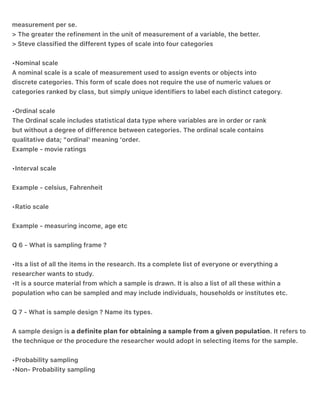
•Nominal scale
A nominal scale is a scale of measurement used to assign events or objects into
discrete categories. This form of scale does not require the use of numeric values or
categories ranked by class, but simply unique identifiers to label each distinct category.
•Ordinal scale
The Ordinal scale includes statistical data type where variables are in order or rank
but without a degree of difference between categories. The ordinal scale contains
qualitative data; "ordinal' meaning 'order.
Example - movie ratings
•Interval scale
Example - celsius, Fahrenheit
•Ratio scale
Example - measuring income, age etc
Q 6 - What is sampling frame ?
•Its a list of all the items in the research. Its a complete list of everyone or everything a
researcher wants to study.
•It is a source material from which a sample is drawn. It is also a list of all these within a
population who can be sampled and may include individuals, households or institutes etc.
Q 7 - What is sample design ? Name its types.
A sample design is a definite plan for obtaining a sample from a given population. It refers to
the technique or the procedure the researcher would adopt in selecting items for the sample.
•Probability sampling
•Non- Probability sampling
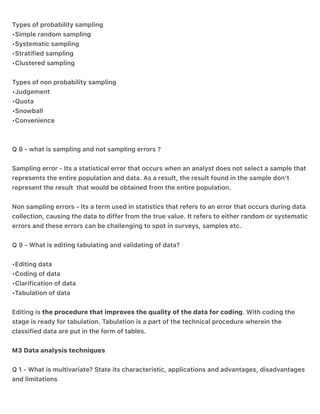
Types of probability sampling
•Simple random sampling
•Systematic sampling
•Stratified sampling
•Clustered sampling
Types of non probability sampling
•Judgement
•Quota
•Snowball
•Convenience
Q 8 - what is sampling and not sampling errors ?
Sampling error - Its a statistical error that occurs when an analyst does not select a sample that
represents the entire population and data. As a result, the result found in the sample don’t
represent the result that would be obtained from the entire population.
Non sampling errors - Its a term used in statistics that refers to an error that occurs during data
collection, causing the data to differ from the true value. It refers to either random or systematic
errors and these errors can be challenging to spot in surveys, samples etc.
Q 9 - What is editing tabulating and validating of data?
•Editing data
•Coding of data
•Clarification of data
•Tabulation of data
Editing is the procedure that improves the quality of the data for coding. With coding the
stage is ready for tabulation. Tabulation is a part of the technical procedure wherein the
classified data are put in the form of tables.
M3 Data analysis techniques
Q 1 - What is multivariate? State its characteristic, applications and advantages, disadvantages
and limitations
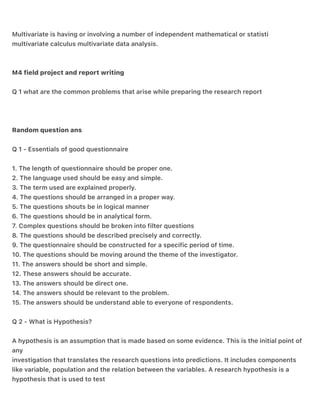
Multivariate is having or involving a number of independent mathematical or statisti
multivariate calculus multivariate data analysis.
M4 field project and report writing
Q 1 what are the common problems that arise while preparing the research report
Random question ans
Q 1 - Essentials of good questionnaire
1. The length of questionnaire should be proper one.
2. The language used should be easy and simple.
3. The term used are explained properly.
4. The questions should be arranged in a proper way.
5. The questions shouts be in logical manner
6. The questions should be in analytical form.
7. Complex questions should be broken into filter questions
8. The questions should be described precisely and correctly.
9. The questionnaire should be constructed for a specific period of time.
10. The questions should be moving around the theme of the investigator.
11. The answers should be short and simple.
12. These answers should be accurate.
13. The answers should be direct one.
14. The answers should be relevant to the problem.
15. The answers should be understand able to everyone of respondents.
Q 2 - What is Hypothesis?
A hypothesis is an assumption that is made based on some evidence. This is the initial point of
any
investigation that translates the research questions into predictions. It includes components
like variable, population and the relation between the variables. A research hypothesis is a
hypothesis that is used to test
the relationship between two or more variables.
Characteristics of Hypothesis
Following are the characteristics of hypothesis:
The hypothesis should be clear and precise to consider it to be reliable.
• If the hypothesis is a relational hypothesis, then it should be stating the relationship between
varia
• The hypothesis must be specific and should have scope for conducting more tests.
• The way of explanation of the hypothesis must be very simple and it should also be
understood tha
simplicity of the hypothesis is not related to its significance.
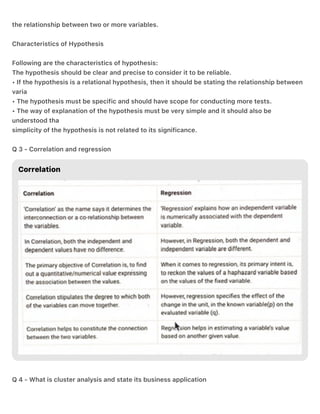
Q 3 - Correlation and regression
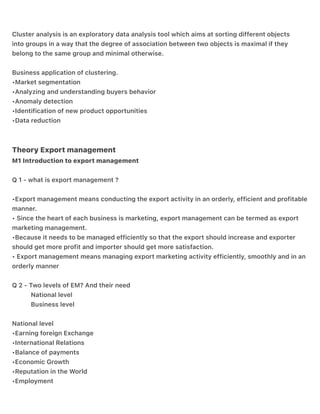
Q 4 - What is cluster analysis and state its business application
.
.
Cluster analysis is an exploratory data analysis tool which aims at sorting different objects
into groups in a way that the degree of association between two objects is maximal if they
belong to the same group and minimal otherwise.
Business application of clustering.
•Market segmentation
•Analyzing and understanding buyers behavior
•Anomaly detection
•Identification of new product opportunities
•Data reduction
Theory Export management
M1 Introduction to export management
Q 1 - what is export management ?
•Export management means conducting the export activity in an orderly, efficient and profitable
manner.
• Since the heart of each business is marketing, export management can be termed as export
marketing management.
•Because it needs to be managed efficiently so that the export should increase and exporter
should get more profit and importer should get more satisfaction.
• Export management means managing export marketing activity efficiently, smoothly and in an
orderly manner
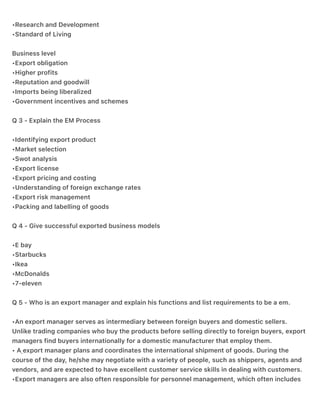
Q 2 - Two levels of EM? And their need
National level
Business level
National level
•Earning foreign Exchange
•International Relations
•Balance of payments
•Economic Growth
•Reputation in the World
•Employment
•Research and Development
•Standard of Living
Business level
•Export obligation
•Higher profits
•Reputation and goodwill
•Imports being liberalized
•Government incentives and schemes
Q 3 - Explain the EM Process
•Identifying export product
•Market selection
•Swot analysis
•Export license
•Export pricing and costing
•Understanding of foreign exchange rates
•Export risk management
•Packing and labelling of goods
Q 4 - Give successful exported business models
•E bay
•Starbucks
•Ikea
•McDonalds
•7-eleven
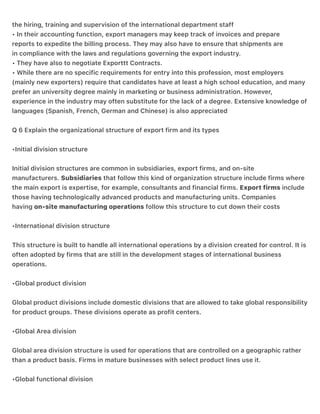
Q 5 - Who is an export manager and explain his functions and list requirements to be a em.
•An export manager serves as intermediary between foreign buyers and domestic sellers.
Unlike trading companies who buy the products before selling directly to foreign buyers, export
managers find buyers internationally for a domestic manufacturer that employ them.
• A export manager plans and coordinates the international shipment of goods. During the
course of the day, he/she may negotiate with a variety of people, such as shippers, agents and
vendors, and are expected to have excellent customer service skills in dealing with customers. 
•Export managers are also often responsible for personnel management, which often includes
the hiring, training and supervision of the international department staff
• In their accounting function, export managers may keep track of invoices and prepare
reports to expedite the billing process. They may also have to ensure that shipments are
in compliance with the laws and regulations governing the export industry.
• They have also to negotiate Exporttt Contracts.
• While there are no specific requirements for entry into this profession, most employers
(mainly new exporters) require that candidates have at least a high school education, and many
prefer an university degree mainly in marketing or business administration. However,
experience in the industry may often substitute for the lack of a degree. Extensive knowledge of
languages (Spanish, French, German and Chinese) is also appreciated
Q 6 Explain the organizational structure of export firm and its types
•Initial division structure
Initial division structures are common in subsidiaries, export firms, and on-site
manufacturers. Subsidiaries that follow this kind of organization structure include firms where
the main export is expertise, for example, consultants and financial firms. Export firms include
those having technologically advanced products and manufacturing units. Companies
having on-site manufacturing operations follow this structure to cut down their costs
•International division structure
This structure is built to handle all international operations by a division created for control. It is
often adopted by firms that are still in the development stages of international business
operations.
•Global product division
Global product divisions include domestic divisions that are allowed to take global responsibility
for product groups. These divisions operate as profit centers.
•Global Area division
Global area division structure is used for operations that are controlled on a geographic rather
than a product basis. Firms in mature businesses with select product lines use it.
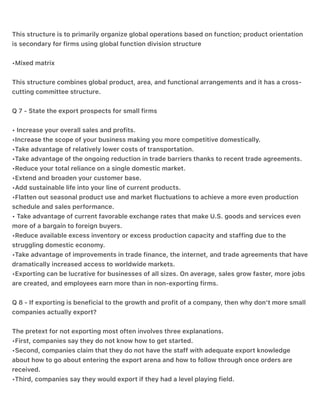
•Global functional division
This structure is to primarily organize global operations based on function; product orientation
is secondary for firms using global function division structure
•Mixed matrix
This structure combines global product, area, and functional arrangements and it has a cross-
cutting committee structure.
Q 7 - State the export prospects for small firms
• Increase your overall sales and profits.
•Increase the scope of your business making you more competitive domestically.
•Take advantage of relatively lower costs of transportation.
•Take advantage of the ongoing reduction in trade barriers thanks to recent trade agreements.
•Reduce your total reliance on a single domestic market.
•Extend and broaden your customer base.
•Add sustainable life into your line of current products.
•Flatten out seasonal product use and market fluctuations to achieve a more even production
schedule and sales performance.
• Take advantage of current favorable exchange rates that make U.S. goods and services even
more of a bargain to foreign buyers.
•Reduce available excess inventory or excess production capacity and staffing due to the
struggling domestic economy.
•Take advantage of improvements in trade finance, the internet, and trade agreements that have
dramatically increased access to worldwide markets.
•Exporting can be lucrative for businesses of all sizes. On average, sales grow faster, more jobs
are created, and employees earn more than in non-exporting firms.
Q 8 - If exporting is beneficial to the growth and profit of a company, then why don't more small
companies actually export?
The pretext for not exporting most often involves three explanations.
•First, companies say they do not know how to get started.    
•Second, companies claim that they do not have the staff with adequate export knowledge
about how to go about entering the export arena and how to follow through once orders are
received.
•Third, companies say they would export if they had a level playing field.
M2 Setting up Export Firm and Product Planning
Q 1 - Explain the nature of export firm
•Their products and/or services are successful domestically
•They have a solid domestic business plan with proven effectiveness
•They have specific advantages over the competition
•Their products and/or services are unique in one or more ways
•Their products and/or services are competitively priced
•They are willing to invest resources of time, people and capital without return for a period of
time.
•Entry into new markets may require two or three years of effort before showing a profit
•They are sensitive to and aware of the cultural differences of doing business in other countries
Q 2 - What are the registration formalities for setting up an export firm ?
• Selection of name of the firm
•Approval to name of the firm
•Registration of organization
•Opening of bank account
•Obtaining permanent account number (PAN)
•Registration with sales tax authorities
•Importer-Exporter Code number (IEC number)
•Registration cum membership certificate
•Registration with Export credit guarantee corporation (ECGC)
•Registration under central excise law
•Registration with with other authorities
•Registration for Business Identification number (BIN)
•Export licensing

Semester IV Exam Notes.pdf

  • 1.
    1. 1. 2. 3. Semester IV ExamNotes Theory OR What is transportation problem? The transportation problem is a special type of linear programming problem where the objective consists in minimizing transportation cost of a given commodity from a number of sources or origins (e.g. factory, manufacturing facility) to a number of destinations (e.g. warehouse, store). Each source has a limited supply (i.e. maximum number of products that can be sent from it) while each destination has a demand to be satisfied (i.e. minimum number of products that need to be shipped to it). The cost of shipping from a source to a destination is directly proportional to the number of units shipped. B. Types of Transportation Problems There are two different types of transportation problems based on the initial given information: Balanced Transportation Problems: cases where the total supply is equal to the total demand. Unbalanced Transportation Problems: cases where the total supply is not equal to the total demand. When the supply is higher than the demand, a dummy destination is introduced in the equation to make it equal to the supply (with shipping costs of $0); the excess supply is assumed to go to inventory. On the other hand, when the demand is higher than the supply, a dummy source is introduced in the equation to make it equal to the demand (in these cases there is usually a penalty cost associated for not fulfilling the demand). In order to proceed with the solution of any given transportation problem, the first step consists in verifying if it is balanced. If it is not, it must be balanced accordingly. what is feasible solution and non degenerate solution in transportation problem? Feasible Solution: A feasible solution to a transportation problem is a set of non-negative values x, (i = 1, 2, ... m, j= 1,2, ... n) that satisfies the constraints. Non-degenerate basic feasible solution: If a basic feasible solution to a transportation problem contains exactly m + n - 1 allocations in independent positions, it is called a Non-degenerate basic feasible solution. Here m is the number of rows and n is the number of columns in a transportation problem. A. What do you mean by balanced transportation problem
  • 2.
    3. 4. 5. Ans - balancedtransportation problem is a transportation problem where the total availability at the origins is equal to the total requirements at the destinations. B. Methods of solving Transportation method There are three ways for determining the initial basic feasible solution. They are 1. NorthWest Corner Cell Method. 2. Vogel’s Approximation Method (VAM). 3. Least Call Cell Method. What is the Assignment problem? The assignment problem is a special case of linear programming problem; it is one of the fundamental combinational optimization problems in the branch of optimization or operations research in mathematics. Its goal consists in assigning m resources (usually workers) to n tasks (usually jobs) one a one to one basis while minimizing assignment costs. As a general rule, all jobs must be performed by exactly one worker and every worker must be assigned exclusively to one job. Any worker can be assigned to perform any job, incurring in some cost that may vary depending on the work-job assignment. Give mathematical form of assignment problem. Mathematical Formulation: Any basic feasible solution of an Assignment problem consists (2n – 1) variables of which the (n – 1) variables are zero, n is number of jobs or number of facilities. Due to this high degeneracy, if we solve the problem by usual transportation method, it will be a complex and time consuming work. Thus a separate technique is derived for it. Before going to the absolute method it is very important to formulate the problem. Suppose xjj is a variable which is defined as 1 if the ith job is assigned to jth machine or facility
  • 3.
    . . What is thedifference between Assignment Problem and Transportation Problem? Explain the steps of graphical methods for the solution of LPP and explain its limitation We can solve the LPP with the graphical method by following these steps Step 1 : First of all, formulate the LP problem. Step 2 : Then, make a graph and plot the constraint lines over there. Step 3 : Determine the valid part of each constraint line. Step 4 : Recognize the possible solution area. Step 5: Place the objective function in the graph.
  • 4.
    Step 5: Placethe objective function in the graph. Step 6 : Finally, find out the optimum point. Limitations are The graphical method is one of the easiest way to solve a small LP problem. However this is useful only when the decision variables are not more than two. It is not possible to plot the solution on a two-dimensional graph when there are more than two variables and we must turn to more complex methods. Another limitation of graphical method is that, an incorrect or inconsistent graph will produce inaccurate answers, so one need to be very careful while drawing and plotting the graph. Theory Research Methodology M1 Nature and scope of RM Q 1 - What are the types of research? •Quantitative research Quantitative refers to the number where the data is collected based on numbers (numeric form) Example - car manufacturers can compare no of sales of red sedans to white. •Qualitative research Qualitative refers to the non numerical form of data in research. It helps to form a better summary in terms of theories in data. Example - •Fundamental research It is a research which is generally conducted to develop new theorie. It is also known as basic research. It mainly focuses on generalization and formulation of theory Example- Research studies that are concerned with human behavior, its conducted by devoting in generating knowledge in a particular area of interest. •Applied research Its a research which is usually conducted to solve the problem of the organization. It is also
  • 5.
    Its a researchwhich is usually conducted to solve the problem of the organization. It is also called action research. It is deductive in nature whcih means it keeps same theories as its base while conducting research so as to generate solution. Example - it can be used to find out conclusion/ solution to business problem. •Descriptive research It is a type of research which describes a population, situation or phenomenon that is being studied. It focuses on answering the how what when and where questions in a research problem than just why. It is important to have a paper understanding of what a research problem is about, before investigating why it exists at the first place. Example- •Analytic research It is a type of research where the researcher uses facts or information that is already available and analyze them ti make a critical evaluation of the material. •Exploratory research It is defined as a research used to investigate a problem which is not clearly defined. It is conducted to have better understanding at the existing problem but usually doesn’t lead to a conclusive result. Example- a study into the implications of covid-19 pandemic into the global economy. •Conclusive research It is used to obtain information that can be used to reach conclusions to make decisions. The data collected in this research is generally quantitative in nature and therefore it takes numerical values. The information needed must be clearly defined. •Casual research It is a type of conclusive research which attempts to establish a cause and effect relationship between two or more variables. •Conceptual research It is a type of research which is related to same abstract idea or theory. It is generally used by philosophers and thinkers to develop new concepts kr to reinspect existing ones. •Empirical research It is a type of study where the conclusion of the study is strictly drawn from observation or experiments.
  • 6.
    Q 2 -What is research design and its types It is a structural framework of various research methods as well as techniques that are chosen by a researcher. It refers to a he overall strategy utilized to carry out research that defines a suc and logical plan to tackle established research questions through collection, interpretation analysis and discussion of data. Types •Explanatory •Descriptive •Experimental - Experimental research is a scientific method of conducting research using two variables: independent and dependent Q 3 - Name the steps in research process •Selection of research problem •Reviewing literature •Making hypothesis •Preparing for research design •Deciding on the sample design •Data collection •Processing and analyzing data •Preparing of the report Q 4 - What are the types of approaches in research •Deductive This approach tests the validity of assumptions ie theories of hypothesis. If there is no theory one cant conduct deductive research. •Inductive It contributes yo the emergence of new theory and generalization. Data collection is used to explore a phenomenon, identify themes and patterns and create a conceptual framework. •Quantitative It emphasizes the objective measures and the statistical mathematical or numeric analysis of data. It focuses on gathering numerical data in order to explain a particular phenomenon.
  • 7.
    – – – – •Qualitative It emphasizes onthe subjective assessments of attitudes opinions and behavior. Such an approach in research is generates results in non quantitative form. Focus groups, questions, interviews etc are the technique used. M2 Research methods and data collection techniques Q 1 - What is data collection methods? And its types •Data collection method The task of data collection begins after the research problem has been defined and the research design plan has been called out. The researcher has to keep in mind about the two types of data ie primary and secondary. Primary data is a type of data that is collected by researching directly from main sources through interviews, surveys, etc and it happens to be original in character. Few methods of collecting primary data are observation methods Interviews Questionnaire Survey The secondary data is a data that has been already collected through primary sources and made readily available for researches to use for their research. Its basically the data has been collected in the past. •Observation method •Questionnaire method •Surveys •Publications Q 2 - Explain the six steps to good questionnaire design
  • 8.
    •Identity your researchaim and the goal of your questionnaire •Define target respondents •Develop questions •Choose your question type •Design question sequence and overall layout •Piloting the questionnaire Q 3 - Explain the types of questions •Close ended questions •Open ended questions •Multiple choice question •Rating survey questions •Likest scale questions •Drop down questions Q 4 - What is attitude measurement survey? An attitude measurement survey is a study, on a properly drawn sample, of a specified population to find out what people in that population feel about a specified issue. explanatory context. Attitude surveys usually use carefully constructed, standardised questionnaires. Q 5 - What is scaling techniques and what are its types Definition: Scaling technique is a method of placing respondents in continuation of gradual change in the pre-assigned values, symbols or numbers based on the features of a particular object as per the defined rules. Types of scale Qualitative research mostly uses descriptive statements to seek answers to the research questions, whereas in quantitative research these answers are usually sough on one of the measurement scales (nominal, ordinal, interval or ratio). > Those scales which have a unit of measurement (interval and ratio) are considered to be more refined, objective and accurate. On the other hand, nominal and ordinal scale (used for rankings etc) are considered subjective and hence not as accurate as they do not have a unit of
  • 9.
    measurement per se. >The greater the refinement in the unit of measurement of a variable, the better. > Steve classified the different types of scale into four categories •Nominal scale A nominal scale is a scale of measurement used to assign events or objects into discrete categories. This form of scale does not require the use of numeric values or categories ranked by class, but simply unique identifiers to label each distinct category. •Ordinal scale The Ordinal scale includes statistical data type where variables are in order or rank but without a degree of difference between categories. The ordinal scale contains qualitative data; "ordinal' meaning 'order. Example - movie ratings •Interval scale Example - celsius, Fahrenheit •Ratio scale Example - measuring income, age etc Q 6 - What is sampling frame ? •Its a list of all the items in the research. Its a complete list of everyone or everything a researcher wants to study. •It is a source material from which a sample is drawn. It is also a list of all these within a population who can be sampled and may include individuals, households or institutes etc. Q 7 - What is sample design ? Name its types. A sample design is a definite plan for obtaining a sample from a given population. It refers to the technique or the procedure the researcher would adopt in selecting items for the sample. •Probability sampling •Non- Probability sampling
  • 10.
    Types of probabilitysampling •Simple random sampling •Systematic sampling •Stratified sampling •Clustered sampling Types of non probability sampling •Judgement •Quota •Snowball •Convenience Q 8 - what is sampling and not sampling errors ? Sampling error - Its a statistical error that occurs when an analyst does not select a sample that represents the entire population and data. As a result, the result found in the sample don’t represent the result that would be obtained from the entire population. Non sampling errors - Its a term used in statistics that refers to an error that occurs during data collection, causing the data to differ from the true value. It refers to either random or systematic errors and these errors can be challenging to spot in surveys, samples etc. Q 9 - What is editing tabulating and validating of data? •Editing data •Coding of data •Clarification of data •Tabulation of data Editing is the procedure that improves the quality of the data for coding. With coding the stage is ready for tabulation. Tabulation is a part of the technical procedure wherein the classified data are put in the form of tables. M3 Data analysis techniques Q 1 - What is multivariate? State its characteristic, applications and advantages, disadvantages and limitations
  • 11.
    Multivariate is havingor involving a number of independent mathematical or statisti multivariate calculus multivariate data analysis. M4 field project and report writing Q 1 what are the common problems that arise while preparing the research report Random question ans Q 1 - Essentials of good questionnaire 1. The length of questionnaire should be proper one. 2. The language used should be easy and simple. 3. The term used are explained properly. 4. The questions should be arranged in a proper way. 5. The questions shouts be in logical manner 6. The questions should be in analytical form. 7. Complex questions should be broken into filter questions 8. The questions should be described precisely and correctly. 9. The questionnaire should be constructed for a specific period of time. 10. The questions should be moving around the theme of the investigator. 11. The answers should be short and simple. 12. These answers should be accurate. 13. The answers should be direct one. 14. The answers should be relevant to the problem. 15. The answers should be understand able to everyone of respondents. Q 2 - What is Hypothesis? A hypothesis is an assumption that is made based on some evidence. This is the initial point of any investigation that translates the research questions into predictions. It includes components like variable, population and the relation between the variables. A research hypothesis is a hypothesis that is used to test
  • 12.
    the relationship betweentwo or more variables. Characteristics of Hypothesis Following are the characteristics of hypothesis: The hypothesis should be clear and precise to consider it to be reliable. • If the hypothesis is a relational hypothesis, then it should be stating the relationship between varia • The hypothesis must be specific and should have scope for conducting more tests. • The way of explanation of the hypothesis must be very simple and it should also be understood tha simplicity of the hypothesis is not related to its significance. Q 3 - Correlation and regression Q 4 - What is cluster analysis and state its business application
  • 13.
    . . Cluster analysis isan exploratory data analysis tool which aims at sorting different objects into groups in a way that the degree of association between two objects is maximal if they belong to the same group and minimal otherwise. Business application of clustering. •Market segmentation •Analyzing and understanding buyers behavior •Anomaly detection •Identification of new product opportunities •Data reduction Theory Export management M1 Introduction to export management Q 1 - what is export management ? •Export management means conducting the export activity in an orderly, efficient and profitable manner. • Since the heart of each business is marketing, export management can be termed as export marketing management. •Because it needs to be managed efficiently so that the export should increase and exporter should get more profit and importer should get more satisfaction. • Export management means managing export marketing activity efficiently, smoothly and in an orderly manner Q 2 - Two levels of EM? And their need National level Business level National level •Earning foreign Exchange •International Relations •Balance of payments •Economic Growth •Reputation in the World •Employment
  • 14.
    •Research and Development •Standardof Living Business level •Export obligation •Higher profits •Reputation and goodwill •Imports being liberalized •Government incentives and schemes Q 3 - Explain the EM Process •Identifying export product •Market selection •Swot analysis •Export license •Export pricing and costing •Understanding of foreign exchange rates •Export risk management •Packing and labelling of goods Q 4 - Give successful exported business models •E bay •Starbucks •Ikea •McDonalds •7-eleven Q 5 - Who is an export manager and explain his functions and list requirements to be a em. •An export manager serves as intermediary between foreign buyers and domestic sellers. Unlike trading companies who buy the products before selling directly to foreign buyers, export managers find buyers internationally for a domestic manufacturer that employ them. • A export manager plans and coordinates the international shipment of goods. During the course of the day, he/she may negotiate with a variety of people, such as shippers, agents and vendors, and are expected to have excellent customer service skills in dealing with customers.  •Export managers are also often responsible for personnel management, which often includes
  • 15.
    the hiring, trainingand supervision of the international department staff • In their accounting function, export managers may keep track of invoices and prepare reports to expedite the billing process. They may also have to ensure that shipments are in compliance with the laws and regulations governing the export industry. • They have also to negotiate Exporttt Contracts. • While there are no specific requirements for entry into this profession, most employers (mainly new exporters) require that candidates have at least a high school education, and many prefer an university degree mainly in marketing or business administration. However, experience in the industry may often substitute for the lack of a degree. Extensive knowledge of languages (Spanish, French, German and Chinese) is also appreciated Q 6 Explain the organizational structure of export firm and its types •Initial division structure Initial division structures are common in subsidiaries, export firms, and on-site manufacturers. Subsidiaries that follow this kind of organization structure include firms where the main export is expertise, for example, consultants and financial firms. Export firms include those having technologically advanced products and manufacturing units. Companies having on-site manufacturing operations follow this structure to cut down their costs •International division structure This structure is built to handle all international operations by a division created for control. It is often adopted by firms that are still in the development stages of international business operations. •Global product division Global product divisions include domestic divisions that are allowed to take global responsibility for product groups. These divisions operate as profit centers. •Global Area division Global area division structure is used for operations that are controlled on a geographic rather than a product basis. Firms in mature businesses with select product lines use it. •Global functional division
  • 16.
    This structure isto primarily organize global operations based on function; product orientation is secondary for firms using global function division structure •Mixed matrix This structure combines global product, area, and functional arrangements and it has a cross- cutting committee structure. Q 7 - State the export prospects for small firms • Increase your overall sales and profits. •Increase the scope of your business making you more competitive domestically. •Take advantage of relatively lower costs of transportation. •Take advantage of the ongoing reduction in trade barriers thanks to recent trade agreements. •Reduce your total reliance on a single domestic market. •Extend and broaden your customer base. •Add sustainable life into your line of current products. •Flatten out seasonal product use and market fluctuations to achieve a more even production schedule and sales performance. • Take advantage of current favorable exchange rates that make U.S. goods and services even more of a bargain to foreign buyers. •Reduce available excess inventory or excess production capacity and staffing due to the struggling domestic economy. •Take advantage of improvements in trade finance, the internet, and trade agreements that have dramatically increased access to worldwide markets. •Exporting can be lucrative for businesses of all sizes. On average, sales grow faster, more jobs are created, and employees earn more than in non-exporting firms. Q 8 - If exporting is beneficial to the growth and profit of a company, then why don't more small companies actually export? The pretext for not exporting most often involves three explanations. •First, companies say they do not know how to get started.     •Second, companies claim that they do not have the staff with adequate export knowledge about how to go about entering the export arena and how to follow through once orders are received. •Third, companies say they would export if they had a level playing field.
  • 17.
    M2 Setting upExport Firm and Product Planning Q 1 - Explain the nature of export firm •Their products and/or services are successful domestically •They have a solid domestic business plan with proven effectiveness •They have specific advantages over the competition •Their products and/or services are unique in one or more ways •Their products and/or services are competitively priced •They are willing to invest resources of time, people and capital without return for a period of time. •Entry into new markets may require two or three years of effort before showing a profit •They are sensitive to and aware of the cultural differences of doing business in other countries Q 2 - What are the registration formalities for setting up an export firm ? • Selection of name of the firm •Approval to name of the firm •Registration of organization •Opening of bank account •Obtaining permanent account number (PAN) •Registration with sales tax authorities •Importer-Exporter Code number (IEC number) •Registration cum membership certificate •Registration with Export credit guarantee corporation (ECGC) •Registration under central excise law •Registration with with other authorities •Registration for Business Identification number (BIN) •Export licensing