SEMENALYSIS
Prof. Shiela May Molina RMT, MSMT
UERM
7:00am-9:00am
Page 01
Page 02
4 FRACTIONS
• The ejaculate can be divided into four
fractions:
1) PRE - EJACULATORY FRACTION : It is
clear secretion of COWPER'S or LITTER'S
GLANDS & contains proteins with
moderately viscous consistency, which may
possibly serve to neutralize residues of
urine
2) PRELIMINARY FRACTION : This originates
from the prostrate gland. It gives SEMEN
it's characteristic ODOR. It contain
enzymes which liquefies the spermatozoa
coagulum.
12:01 PM
Page 02
4 FRACTIONS
3) MAIN FRACTION : It originates
from the seminal vessicles, tested
epididymis and partially from
prostate gland.
4)TERMINAL FRACTION : Is formed by
secretions of seminal vesicles & is
entirely gelatinous in consistency,
with large no. of immotile
spermatozoa.
12:01 PM
Page 02
WHAT IS
SEMEN?
Semen is a greyish white bodily
fluid that is secreted by the
gonads of male animals. It
carries sperm or the spermatozoa
and fructose and other enzymes
that help the sperm survive to
facilitate successful
fertilization.​
12:01 PM
Page 03
SEMEN
COMPOSITION
12:01 PM
Page 04 12:01 PM
Page 05 12:01 PM
PRACTICAL CONSIDERATIONS
Page 06
SPECIMEN
COLLECTION
period of sexual abstinence
of at least 2 days to not
more than 7 days
two or three samples be
collected not less than 7
days or more than 3 weeks
apart, with two abnormal
samples considered
significant
specimen should be placed
in a warm sterile glass or
plastic containers
specimen should be kept at
room temperature and
delivered to the
laboratory within 1 hour
of collection
12:01 PM
proper collection of a
complete specimen – most
important pre-analytical
factor
PRACTICAL CONSIDERATIONS
Page 07
SPECIMEN
COLLECTION
specimens awaiting analysis
should be kept at 37°C
record the patient’s name and
birth date, the period of
sexual abstinence, the
completeness of the sample,
difficulties with collection,
and the times of specimen
collection and specimen
receipt
If this is not possible,
only nonlubricant-
containing rubber or
polyurethane condoms should
be used.
specimens should be collected
by masturbation​


12:01 PM
proper collection of a
complete specimen – most
important pre-analytical
factor
Page 08
TECHNICAL
TIP
Coitus interruptus is not a
reliable means of semen collection
because the first portion of the
ejaculate, which contains the
highest number of spermatozoa, may
be lost and the low pH of the
vaginal fluid may affect sperm
motility
12:01 PM
Page 09
Parameters reported include
appearance, volume, viscosity, pH,
sperm concentration and count,
motility, and morphology
SEMEN ANALYSIS
12:01 PM
A fresh semen specimen is clotted
and should liquefy within 30 to
60 minutes after collection ​
Analysis of the specimen cannot
begin until liquefaction has
occurred.
Normal​
Clear​
White turbid​
Red coloration​
Yellow coloration
2 PARAMETERS
1
12:01 PM
Page 10
APPEARANCE
LIQUEFACTION
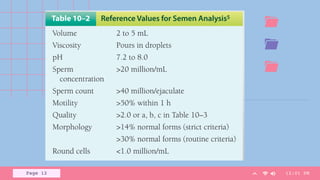
The pH of semen indicates the
balance between the pH values
from the acidic prostatic
secretion and the alkaline
seminal vesicles secretion
PARAMETERS
3
12:01 PM
Page 11
pH
Page 12 12:01 PM
Page 13
SPERM CONCENTRATION
AND SPERM COUNT
12:01 PM
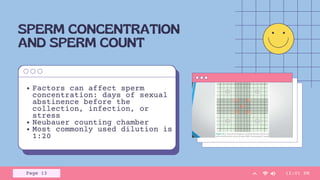
Factors can affect sperm
concentration: days of sexual
abstinence before the
collection, infection, or
stress ​
Neubauer counting chamber ​
Most commonly used dilution is
1:20
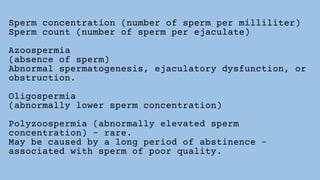
Sperm concentration (number of sperm per milliliter)
Sperm count (number of sperm per ejaculate)
Azoospermia
(absence of sperm)
Abnormal spermatogenesis, ejaculatory dysfunction, or
obstruction.
Oligospermia
(abnormally lower sperm concentration)
Polyzoospermia (abnormally elevated sperm
concentration) - rare.
May be caused by a long period of abstinence -
associated with sperm of poor quality.
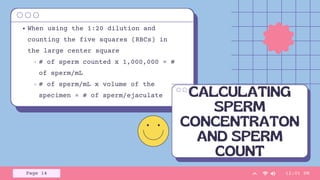
When using the 1:20 dilution and
counting the five squares (RBCs) in
the large center square ​
# of sperm counted x 1,000,000 = #
of sperm/mL​
# of sperm/mL x volume of the
specimen = # of sperm/ejaculate​ CALCULATING
SPERM
CONCENTRATON
AND SPERM
COUNT
12:01 PM
Page 14
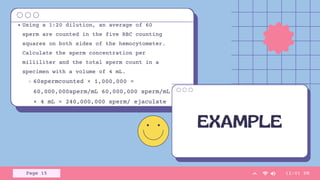
Using a 1:20 dilution, an average of 60
sperm are counted in the five RBC counting
squares on both sides of the hemocytometer.
Calculate the sperm concentration per
milliliter and the total sperm count in a
specimen with a volume of 4 mL. ​
60spermcounted × 1,000,000 =
60,000,000sperm/mL 60,000,000 sperm/mL
× 4 mL = 240,000,000 sperm/ ejaculate ​
EXAMPLE
12:01 PM
Page 15
When using the 1:20 dilution and counting
2 WBC counting squares​
# sperm counted × dilution = # of sperm/
μL (volume counted) ​
squares counted × depth​
# of sperm/μL × 1000 = # of sperm/mL ​
# of sperm/mL × volume of specimen= # of
sperm/ejaculate ​
CALCULATION
12:01 PM
Page 16
In a 1:20 dilution, 600 sperm are counted in two WBC
counting squares. Calculate the sperm concentration
per milliliter and the total sperm count in a
specimen with a volume of 2 mL. ​
600 sperm counted × 20 (dilution) = 60,000 sperm/μL
(volume counted) ​
2 sq mm (squares counted) × 0.1 mm (depth)​
60,000 sperm/μL × 1000 = 60,000,000 sperm/mL ​
60,000,000/mL × 2 mL = 120,000,000 sperm/ejaculate
EXAMPLE
12:01 PM
Page 17
Page 18 12:01 PM
Page 19 12:01 PM
Page 20
SPERM
MORPHOLOGY
Sperm morphology is evaluated with
respect to the structure of the head,
neckpiece, midpiece, and tail.
Abnormalities in head morphology are
associated with poor ovum penetration,
whereas neckpiece, midpiece, and tail
abnormalities affect motility. ​
The normal sperm has an oval-shaped
head approximately 5 μm long and 3 μm
wide and a long, flagellar tail
approximately 45 μm long
12:01 PM
Page 21 12:01 PM
Page 22
SPERM
MORPHOLOGY
Sperm morphology is evaluated
from a thinly smeared, stained
slide under oil immersion ​
Staining can be performed using
Wright’s, Giemsa, H & E stain,
Shorr, or Papanicolaou stain.
12:01 PM
Page 23 12:01 PM
Page 24 12:01 PM
Page 25 12:01 PM
Page 26 12:01 PM
Page 27 12:01 PM
Page 28 12:01 PM
Page 29
By counting the number of spermatids or
leukocytes seen in conjunction with 100
mature sperm, the amount per milliliter can
be calculated using the following formula,
where N is the number of spermatids or
neutrophils counted per 100 mature sperm,
and S is the sperm concentration in millions
per milliliter:
CALCULATING ROUND
CELLS
12:01 PM
Page 30 12:01 PM
Page 31 12:01 PM
Page 32 12:01 PM
Page 33
ANTISPERM ANTIBODIES
12:01 PM
The presence of antibodies in a male
subject can be suspected when clumps
of sperm are observed during a
routine semen analysis. ​
Sperm-agglutinating antibodies cause
sperm to stick to each other in a
head-to-head, head-to-tail, or tail-
to-tail pattern.1​
The agglutination is graded as “few,”
“moderate,” or “many” on microscopic
examination. ​
Page 34
ANTISPERM ANTIBODIES
12:01 PM
The presence of antisperm antibodies in a female
subject results in a normal semen analysis
accompanied by continued infertility. ​
The presence of antisperm antibodies in women may be
demonstrated by mixing the semen with the female
cervical mucosa or serum and observing for
agglutination. ​
Two frequently used tests to detect the presence of
anti- body-coated sperm are the mixed agglutination
reaction (MAR) test and the immunobead test. ​
Head-directed antibodies can interfere with
penetration into the cervical mucosa or ovum,
whereas tail-directed antibodies affect movement
through the cervical mucosa.
Page 35
MICROBIAL AND
CHEMICAL TESTING
12:01 PM
Routine aerobic and anaerobic
cultures and tests for Chlamydia
trachomatis, Mycoplasma hominis, and
Ureaplasma urealyticum are most
frequently performed. ​
neutral α-glucosidase,
glycerophospho- choline, and L-
carnitine ​
zinc, citric acid, glutamyl
transpeptidase, and acid phosphatase ​
Page 36 12:01 PM
THANK YOU!
Prof. Shiela May P. Molina RMT, MSMT
UERM
12:01 PM
Page 37

SEMENALYSIS-3.pdf

  • 1.
    SEMENALYSIS Prof. Shiela MayMolina RMT, MSMT UERM 7:00am-9:00am Page 01
  • 2.
    Page 02 4 FRACTIONS •The ejaculate can be divided into four fractions: 1) PRE - EJACULATORY FRACTION : It is clear secretion of COWPER'S or LITTER'S GLANDS & contains proteins with moderately viscous consistency, which may possibly serve to neutralize residues of urine 2) PRELIMINARY FRACTION : This originates from the prostrate gland. It gives SEMEN it's characteristic ODOR. It contain enzymes which liquefies the spermatozoa coagulum. 12:01 PM
  • 3.
    Page 02 4 FRACTIONS 3)MAIN FRACTION : It originates from the seminal vessicles, tested epididymis and partially from prostate gland. 4)TERMINAL FRACTION : Is formed by secretions of seminal vesicles & is entirely gelatinous in consistency, with large no. of immotile spermatozoa. 12:01 PM
  • 4.
    Page 02 WHAT IS SEMEN? Semenis a greyish white bodily fluid that is secreted by the gonads of male animals. It carries sperm or the spermatozoa and fructose and other enzymes that help the sperm survive to facilitate successful fertilization.​ 12:01 PM
  • 5.
  • 6.
  • 7.
  • 8.
    PRACTICAL CONSIDERATIONS Page 06 SPECIMEN COLLECTION periodof sexual abstinence of at least 2 days to not more than 7 days two or three samples be collected not less than 7 days or more than 3 weeks apart, with two abnormal samples considered significant specimen should be placed in a warm sterile glass or plastic containers specimen should be kept at room temperature and delivered to the laboratory within 1 hour of collection 12:01 PM proper collection of a complete specimen – most important pre-analytical factor
  • 9.
    PRACTICAL CONSIDERATIONS Page 07 SPECIMEN COLLECTION specimensawaiting analysis should be kept at 37°C record the patient’s name and birth date, the period of sexual abstinence, the completeness of the sample, difficulties with collection, and the times of specimen collection and specimen receipt If this is not possible, only nonlubricant- containing rubber or polyurethane condoms should be used. specimens should be collected by masturbation​ 12:01 PM proper collection of a complete specimen – most important pre-analytical factor
  • 10.
    Page 08 TECHNICAL TIP Coitus interruptusis not a reliable means of semen collection because the first portion of the ejaculate, which contains the highest number of spermatozoa, may be lost and the low pH of the vaginal fluid may affect sperm motility 12:01 PM
  • 11.
    Page 09 Parameters reportedinclude appearance, volume, viscosity, pH, sperm concentration and count, motility, and morphology SEMEN ANALYSIS 12:01 PM
  • 12.
    A fresh semenspecimen is clotted and should liquefy within 30 to 60 minutes after collection ​ Analysis of the specimen cannot begin until liquefaction has occurred. Normal​ Clear​ White turbid​ Red coloration​ Yellow coloration 2 PARAMETERS 1 12:01 PM Page 10 APPEARANCE LIQUEFACTION
  • 13.
    The pH ofsemen indicates the balance between the pH values from the acidic prostatic secretion and the alkaline seminal vesicles secretion PARAMETERS 3 12:01 PM Page 11 pH
  • 14.
  • 15.
    Page 13 SPERM CONCENTRATION ANDSPERM COUNT 12:01 PM Factors can affect sperm concentration: days of sexual abstinence before the collection, infection, or stress ​ Neubauer counting chamber ​ Most commonly used dilution is 1:20
  • 16.
    Sperm concentration (numberof sperm per milliliter) Sperm count (number of sperm per ejaculate) Azoospermia (absence of sperm) Abnormal spermatogenesis, ejaculatory dysfunction, or obstruction. Oligospermia (abnormally lower sperm concentration) Polyzoospermia (abnormally elevated sperm concentration) - rare. May be caused by a long period of abstinence - associated with sperm of poor quality.
  • 17.
    When using the1:20 dilution and counting the five squares (RBCs) in the large center square ​ # of sperm counted x 1,000,000 = # of sperm/mL​ # of sperm/mL x volume of the specimen = # of sperm/ejaculate​ CALCULATING SPERM CONCENTRATON AND SPERM COUNT 12:01 PM Page 14
  • 18.
    Using a 1:20dilution, an average of 60 sperm are counted in the five RBC counting squares on both sides of the hemocytometer. Calculate the sperm concentration per milliliter and the total sperm count in a specimen with a volume of 4 mL. ​ 60spermcounted × 1,000,000 = 60,000,000sperm/mL 60,000,000 sperm/mL × 4 mL = 240,000,000 sperm/ ejaculate ​ EXAMPLE 12:01 PM Page 15
  • 19.
    When using the1:20 dilution and counting 2 WBC counting squares​ # sperm counted × dilution = # of sperm/ μL (volume counted) ​ squares counted × depth​ # of sperm/μL × 1000 = # of sperm/mL ​ # of sperm/mL × volume of specimen= # of sperm/ejaculate ​ CALCULATION 12:01 PM Page 16
  • 20.
    In a 1:20dilution, 600 sperm are counted in two WBC counting squares. Calculate the sperm concentration per milliliter and the total sperm count in a specimen with a volume of 2 mL. ​ 600 sperm counted × 20 (dilution) = 60,000 sperm/μL (volume counted) ​ 2 sq mm (squares counted) × 0.1 mm (depth)​ 60,000 sperm/μL × 1000 = 60,000,000 sperm/mL ​ 60,000,000/mL × 2 mL = 120,000,000 sperm/ejaculate EXAMPLE 12:01 PM Page 17
  • 21.
  • 22.
  • 23.
    Page 20 SPERM MORPHOLOGY Sperm morphologyis evaluated with respect to the structure of the head, neckpiece, midpiece, and tail. Abnormalities in head morphology are associated with poor ovum penetration, whereas neckpiece, midpiece, and tail abnormalities affect motility. ​ The normal sperm has an oval-shaped head approximately 5 μm long and 3 μm wide and a long, flagellar tail approximately 45 μm long 12:01 PM
  • 24.
  • 25.
    Page 22 SPERM MORPHOLOGY Sperm morphologyis evaluated from a thinly smeared, stained slide under oil immersion ​ Staining can be performed using Wright’s, Giemsa, H & E stain, Shorr, or Papanicolaou stain. 12:01 PM
  • 26.
  • 27.
  • 28.
  • 29.
  • 30.
  • 31.
  • 32.
    Page 29 By countingthe number of spermatids or leukocytes seen in conjunction with 100 mature sperm, the amount per milliliter can be calculated using the following formula, where N is the number of spermatids or neutrophils counted per 100 mature sperm, and S is the sperm concentration in millions per milliliter: CALCULATING ROUND CELLS 12:01 PM
  • 33.
  • 34.
  • 35.
  • 36.
    Page 33 ANTISPERM ANTIBODIES 12:01PM The presence of antibodies in a male subject can be suspected when clumps of sperm are observed during a routine semen analysis. ​ Sperm-agglutinating antibodies cause sperm to stick to each other in a head-to-head, head-to-tail, or tail- to-tail pattern.1​ The agglutination is graded as “few,” “moderate,” or “many” on microscopic examination. ​
  • 37.
    Page 34 ANTISPERM ANTIBODIES 12:01PM The presence of antisperm antibodies in a female subject results in a normal semen analysis accompanied by continued infertility. ​ The presence of antisperm antibodies in women may be demonstrated by mixing the semen with the female cervical mucosa or serum and observing for agglutination. ​ Two frequently used tests to detect the presence of anti- body-coated sperm are the mixed agglutination reaction (MAR) test and the immunobead test. ​ Head-directed antibodies can interfere with penetration into the cervical mucosa or ovum, whereas tail-directed antibodies affect movement through the cervical mucosa.
  • 38.
    Page 35 MICROBIAL AND CHEMICALTESTING 12:01 PM Routine aerobic and anaerobic cultures and tests for Chlamydia trachomatis, Mycoplasma hominis, and Ureaplasma urealyticum are most frequently performed. ​ neutral α-glucosidase, glycerophospho- choline, and L- carnitine ​ zinc, citric acid, glutamyl transpeptidase, and acid phosphatase ​
  • 39.
  • 40.
    THANK YOU! Prof. ShielaMay P. Molina RMT, MSMT UERM 12:01 PM Page 37