
Semantic Rule-checking for Regulation
Compliance Checking: An Overview of
Strategies and Approaches
Pieter Pauwels, Ghent University
pipauwel.pauwels@ugent.be
Sijie Zhang, Chevron
sijie.zhang@chevron.com
CIB W078 conference
28 October 2015
INTRODUCTION
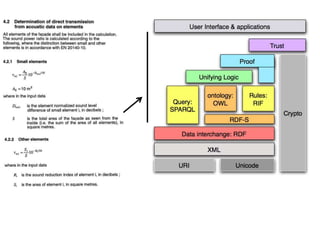
[1] European Committee for Standardization (CEN), European Standard EN 12354-3, Building Acoustics — Estimation of
Acoustic Performance of Buildings from the Performance of Elements — Part 3: Airborne Sound Insulation Against Outdoor
Sound, 2000.
[2] P. Pauwels, D. Van Deursen, R. Verstraeten, J. De Roo, R. De Meyer, R. Van de Walle, J. Van Campenhout. A semantic rule
checking environment for building performance checking. Automation in Construction 20 (2011) 506–518.
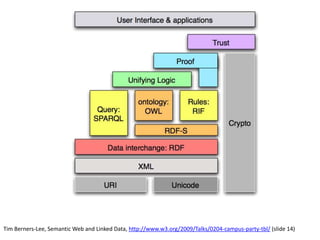
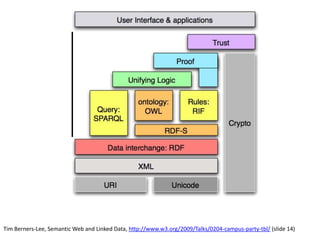
Tim Berners-Lee, Semantic Web and Linked Data, http://www.w3.org/2009/Talks/0204-campus-party-tbl/ (slide 14)
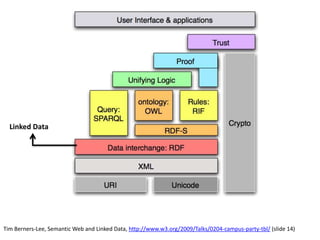
Linked Data
Tim Berners-Lee, Semantic Web and Linked Data, http://www.w3.org/2009/Talks/0204-campus-party-tbl/ (slide 14)
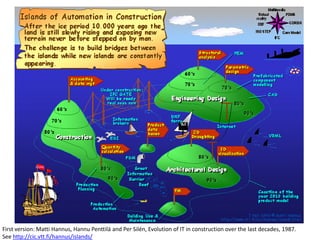
First version: Matti Hannus, Hannu Penttilä and Per Silén, Evolution of IT in construction over the last decades, 1987.
See http://cic.vtt.fi/hannus/islands/
Tim Berners-Lee, Semantic Web and Linked Data, http://www.w3.org/2009/Talks/0204-campus-party-tbl/ (slide 14)
EXISTING APPROACHES
THE BASICS OF RULE CHECKING
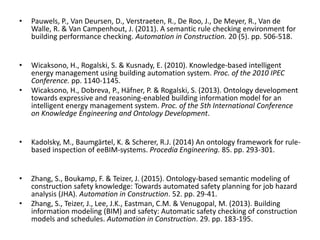
• Pauwels, P., Van Deursen, D., Verstraeten, R., De Roo, J., De Meyer, R., Van de
Walle, R. & Van Campenhout, J. (2011). A semantic rule checking environment for
building performance checking. Automation in Construction. 20 (5). pp. 506-518.
• Wicaksono, H., Rogalski, S. & Kusnady, E. (2010). Knowledge-based intelligent
energy management using building automation system. Proc. of the 2010 IPEC
Conference. pp. 1140-1145.
• Wicaksono, H., Dobreva, P., Häfner, P. & Rogalski, S. (2013). Ontology development
towards expressive and reasoning-enabled building information model for an
intelligent energy management system. Proc. of the 5th International Conference
on Knowledge Engineering and Ontology Development.
• Kadolsky, M., Baumgärtel, K. & Scherer, R.J. (2014) An ontology framework for rule-
based inspection of eeBIM-systems. Procedia Engineering. 85. pp. 293-301.
• Zhang, S., Boukamp, F. & Teizer, J. (2015). Ontology-based semantic modeling of
construction safety knowledge: Towards automated safety planning for job hazard
analysis (JHA). Automation in Construction. 52. pp. 29-41.
• Zhang, S., Teizer, J., Lee, J.K., Eastman, C.M. & Venugopal, M. (2013). Building
information modeling (BIM) and safety: Automatic safety checking of construction
models and schedules. Automation in Construction. 29. pp. 183-195.
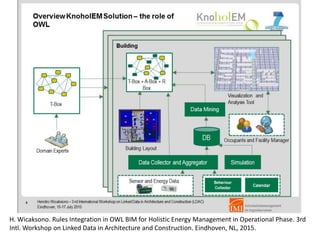
H. Wicaksono. Rules Integration in OWL BIM for Holistic Energy Management in Operational Phase. 3rd
Intl. Workshop on Linked Data in Architecture and Construction. Eindhoven, NL, 2015.
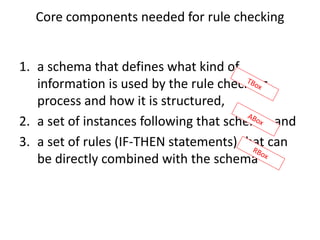
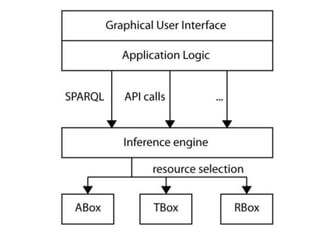
Core components needed for rule checking
1. a schema that defines what kind of
information is used by the rule checking
process and how it is structured,
2. a set of instances following that schema, and
3. a set of rules (IF-THEN statements) that can
be directly combined with the schema
ADVANTAGES
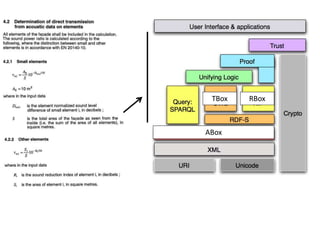
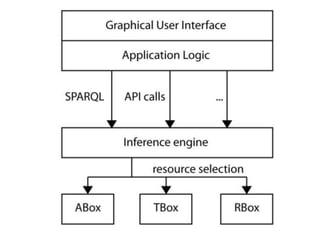
ABox
TBox RBox
Schema, instances and rules are all described in one and the
same language
advantages for a language-driven approach apply, as given
by Eastman et al (2009)
1. the possibility to easily retarget an implementation to
different source formats (e.g. an alternative ontology: a
Revit ontology instead of an IFC ontology);
2. portability across contexts, applications and devices, and
3. the availability of an unlimited representation wealth,
including ‘nested conditions’ and ‘branching of alternative
contexts’.
Semantic rule checking as a language-driven approach for
regulation compliance checking
C.M. Eastman, J. Lee, Y. Jeong, J. Lee, Automatic rule-based checking of building designs, Automation in
Construction 18 (2009) 1011–1033.
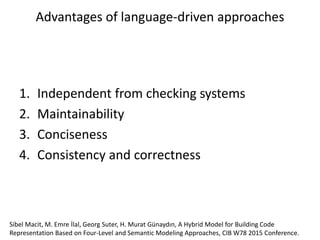
1. Independent from checking systems
2. Maintainability
3. Conciseness
4. Consistency and correctness
Advantages of language-driven approaches
Sibel Macit, M. Emre İlal, Georg Suter, H. Murat Günaydın, A Hybrid Model for Building Code
Representation Based on Four-Level and Semantic Modeling Approaches, CIB W78 2015 Conference.
CHALLENGES
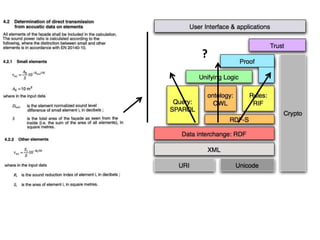
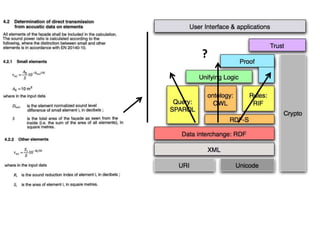
?
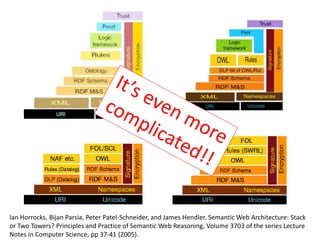
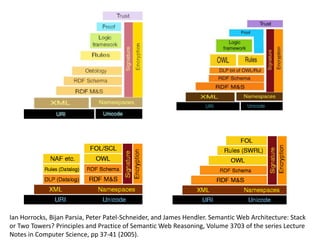
Ian Horrocks, Bijan Parsia, Peter Patel-Schneider, and James Hendler. Semantic Web Architecture: Stack
or Two Towers? Principles and Practice of Semantic Web Reasoning, Volume 3703 of the series Lecture
Notes in Computer Science, pp 37-41 (2005).
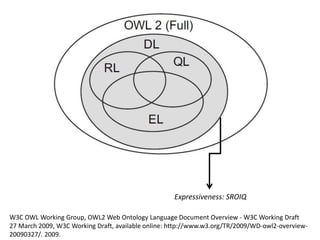
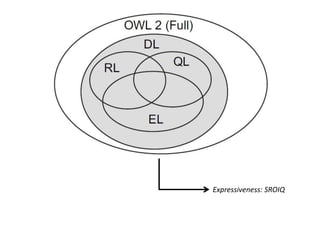
Expressiveness: SROIQ
W3C OWL Working Group, OWL2 Web Ontology Language Document Overview - W3C Working Draft
27 March 2009, W3C Working Draft, available online: http://www.w3.org/TR/2009/WD-owl2-overview-
20090327/. 2009.
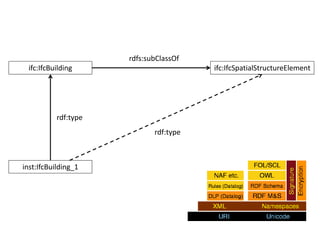
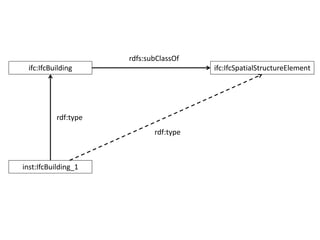
ifc:IfcBuilding ifc:IfcSpatialStructureElement
inst:IfcBuilding_1
rdfs:subClassOf
rdf:type
rdf:type
RULE CHECKING STRATEGIES
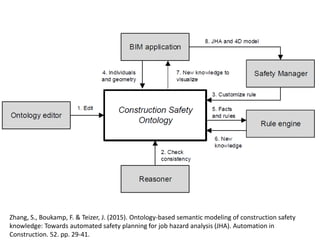
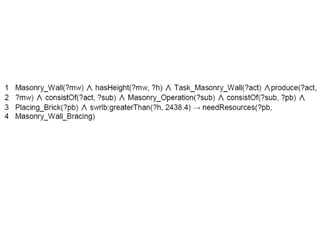
Zhang, S., Boukamp, F. & Teizer, J. (2015). Ontology-based semantic modeling of construction safety
knowledge: Towards automated safety planning for job hazard analysis (JHA). Automation in
Construction. 52. pp. 29-41.
STRATEGY 1: HARD-CODED RULE
CHECKING AFTER QUERYING FOR
INFORMATION
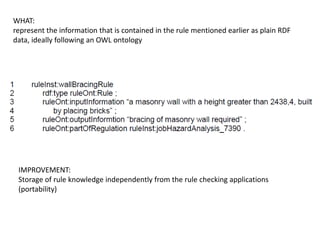
WHAT:
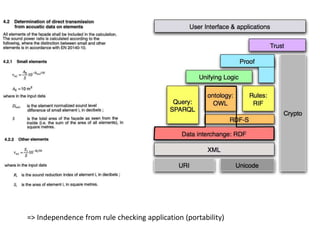
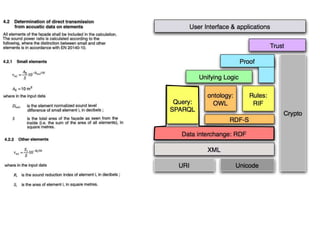
represent the information that is contained in the rule mentioned earlier as plain RDF
data, ideally following an OWL ontology
IMPROVEMENT:
Storage of rule knowledge independently from the rule checking applications
(portability)
=> Independence from rule checking application (portability)
STRATEGY 2: RULE-CHECKING BY
QUERYING
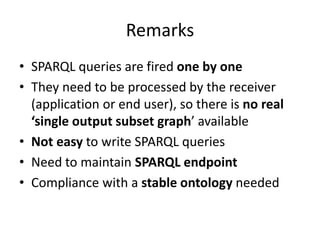
Remarks
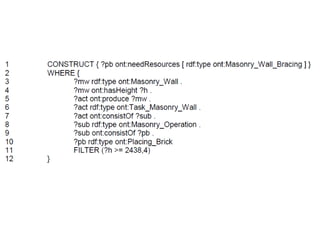
• SPARQL queries are fired one by one
• They need to be processed by the receiver
(application or end user), so there is no real
‘single output subset graph’ available
• Not easy to write SPARQL queries
• Need to maintain SPARQL endpoint
• Compliance with a stable ontology needed
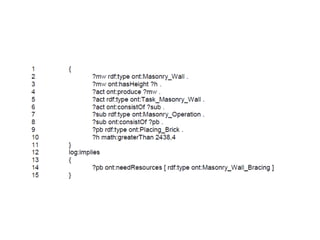
STRATEGY 3: SEMANTIC RULE
CHECKING WITH DEDICATED RULE
LANGUAGES
Remarks
• One can combine as many rules as one wishes in one
‘inference run’
• The receiver (application or end user) receives the result as
a ‘single output subset graph’
• The individuals are still in the original namespace (so they
have the same URIs / are identical). The relations, class
attributions and potential additional statements can be
placed in a separate namespace. But the link to the original
is always maintained through the URIs of the individuals.
• Performance can change a lot, depending on the amount
of resources and rules that is loaded by the reasoning
engine.
• Not easy to write rules
• Compliance with a stable ontology needed
DISCUSSING AND CONCLUDING
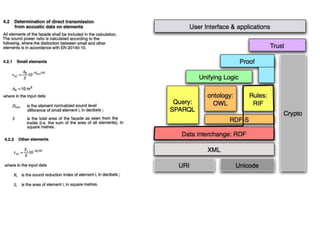
Best performance?
?
Ian Horrocks, Bijan Parsia, Peter Patel-Schneider, and James Hendler. Semantic Web Architecture: Stack
or Two Towers? Principles and Practice of Semantic Web Reasoning, Volume 3703 of the series Lecture
Notes in Computer Science, pp 37-41 (2005).
Expressiveness: SROIQ
ifc:IfcBuilding ifc:IfcSpatialStructureElement
inst:IfcBuilding_1
rdfs:subClassOf
rdf:type
rdf:type
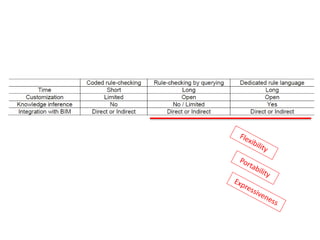
Flexibility and expressiveness?
[1] Pauwels, P., Van Deursen, D., Verstraeten, R., De Roo, J., De Meyer, R., Van de Walle, R. & Van Campenhout, J. (2011). A
semantic rule checking environment for building performance checking. Automation in Construction. 20 (5). pp. 506-518.
[2] Sibel Macit, M. Emre İlal, Georg Suter, H. Murat Günaydın, A Hybrid Model for Building Code Representation Based on
Four-Level and Semantic Modeling Approaches, CIB W78 2015 Conference.  RASE
Thank you
Pieter Pauwels, Ghent University
http://users.ugent.be/~pipauwel/
pipauwel.pauwels@ugent.be
Sijie Zhang, Chevron
sijie.zhang@chevron.com

CIB W78 2015 - Semantic Rule-checking for Regulation Compliance Checking

  • 1.
    Semantic Rule-checking forRegulation Compliance Checking: An Overview of Strategies and Approaches Pieter Pauwels, Ghent University pipauwel.pauwels@ugent.be Sijie Zhang, Chevron sijie.zhang@chevron.com CIB W078 conference 28 October 2015
  • 2.
  • 3.
    [1] European Committeefor Standardization (CEN), European Standard EN 12354-3, Building Acoustics — Estimation of Acoustic Performance of Buildings from the Performance of Elements — Part 3: Airborne Sound Insulation Against Outdoor Sound, 2000. [2] P. Pauwels, D. Van Deursen, R. Verstraeten, J. De Roo, R. De Meyer, R. Van de Walle, J. Van Campenhout. A semantic rule checking environment for building performance checking. Automation in Construction 20 (2011) 506–518.
  • 4.
    Tim Berners-Lee, SemanticWeb and Linked Data, http://www.w3.org/2009/Talks/0204-campus-party-tbl/ (slide 14)
  • 5.
    Linked Data Tim Berners-Lee,Semantic Web and Linked Data, http://www.w3.org/2009/Talks/0204-campus-party-tbl/ (slide 14)
  • 7.
    First version: MattiHannus, Hannu Penttilä and Per Silén, Evolution of IT in construction over the last decades, 1987. See http://cic.vtt.fi/hannus/islands/
  • 8.
    Tim Berners-Lee, SemanticWeb and Linked Data, http://www.w3.org/2009/Talks/0204-campus-party-tbl/ (slide 14)
  • 10.
  • 11.
    • Pauwels, P.,Van Deursen, D., Verstraeten, R., De Roo, J., De Meyer, R., Van de Walle, R. & Van Campenhout, J. (2011). A semantic rule checking environment for building performance checking. Automation in Construction. 20 (5). pp. 506-518. • Wicaksono, H., Rogalski, S. & Kusnady, E. (2010). Knowledge-based intelligent energy management using building automation system. Proc. of the 2010 IPEC Conference. pp. 1140-1145. • Wicaksono, H., Dobreva, P., Häfner, P. & Rogalski, S. (2013). Ontology development towards expressive and reasoning-enabled building information model for an intelligent energy management system. Proc. of the 5th International Conference on Knowledge Engineering and Ontology Development. • Kadolsky, M., Baumgärtel, K. & Scherer, R.J. (2014) An ontology framework for rule- based inspection of eeBIM-systems. Procedia Engineering. 85. pp. 293-301. • Zhang, S., Boukamp, F. & Teizer, J. (2015). Ontology-based semantic modeling of construction safety knowledge: Towards automated safety planning for job hazard analysis (JHA). Automation in Construction. 52. pp. 29-41. • Zhang, S., Teizer, J., Lee, J.K., Eastman, C.M. & Venugopal, M. (2013). Building information modeling (BIM) and safety: Automatic safety checking of construction models and schedules. Automation in Construction. 29. pp. 183-195.
  • 12.
    H. Wicaksono. RulesIntegration in OWL BIM for Holistic Energy Management in Operational Phase. 3rd Intl. Workshop on Linked Data in Architecture and Construction. Eindhoven, NL, 2015.
  • 13.
    Core components neededfor rule checking 1. a schema that defines what kind of information is used by the rule checking process and how it is structured, 2. a set of instances following that schema, and 3. a set of rules (IF-THEN statements) that can be directly combined with the schema
  • 14.
  • 15.
  • 16.
    Schema, instances andrules are all described in one and the same language advantages for a language-driven approach apply, as given by Eastman et al (2009) 1. the possibility to easily retarget an implementation to different source formats (e.g. an alternative ontology: a Revit ontology instead of an IFC ontology); 2. portability across contexts, applications and devices, and 3. the availability of an unlimited representation wealth, including ‘nested conditions’ and ‘branching of alternative contexts’. Semantic rule checking as a language-driven approach for regulation compliance checking C.M. Eastman, J. Lee, Y. Jeong, J. Lee, Automatic rule-based checking of building designs, Automation in Construction 18 (2009) 1011–1033.
  • 17.
    1. Independent fromchecking systems 2. Maintainability 3. Conciseness 4. Consistency and correctness Advantages of language-driven approaches Sibel Macit, M. Emre İlal, Georg Suter, H. Murat Günaydın, A Hybrid Model for Building Code Representation Based on Four-Level and Semantic Modeling Approaches, CIB W78 2015 Conference.
  • 18.
  • 19.
  • 20.
    Ian Horrocks, BijanParsia, Peter Patel-Schneider, and James Hendler. Semantic Web Architecture: Stack or Two Towers? Principles and Practice of Semantic Web Reasoning, Volume 3703 of the series Lecture Notes in Computer Science, pp 37-41 (2005).
  • 21.
    Expressiveness: SROIQ W3C OWLWorking Group, OWL2 Web Ontology Language Document Overview - W3C Working Draft 27 March 2009, W3C Working Draft, available online: http://www.w3.org/TR/2009/WD-owl2-overview- 20090327/. 2009.
  • 22.
  • 23.
  • 24.
    Zhang, S., Boukamp,F. & Teizer, J. (2015). Ontology-based semantic modeling of construction safety knowledge: Towards automated safety planning for job hazard analysis (JHA). Automation in Construction. 52. pp. 29-41.
  • 26.
    STRATEGY 1: HARD-CODEDRULE CHECKING AFTER QUERYING FOR INFORMATION
  • 27.
    WHAT: represent the informationthat is contained in the rule mentioned earlier as plain RDF data, ideally following an OWL ontology IMPROVEMENT: Storage of rule knowledge independently from the rule checking applications (portability)
  • 28.
    => Independence fromrule checking application (portability)
  • 29.
  • 32.
    Remarks • SPARQL queriesare fired one by one • They need to be processed by the receiver (application or end user), so there is no real ‘single output subset graph’ available • Not easy to write SPARQL queries • Need to maintain SPARQL endpoint • Compliance with a stable ontology needed
  • 33.
    STRATEGY 3: SEMANTICRULE CHECKING WITH DEDICATED RULE LANGUAGES
  • 37.
    Remarks • One cancombine as many rules as one wishes in one ‘inference run’ • The receiver (application or end user) receives the result as a ‘single output subset graph’ • The individuals are still in the original namespace (so they have the same URIs / are identical). The relations, class attributions and potential additional statements can be placed in a separate namespace. But the link to the original is always maintained through the URIs of the individuals. • Performance can change a lot, depending on the amount of resources and rules that is loaded by the reasoning engine. • Not easy to write rules • Compliance with a stable ontology needed
  • 38.
  • 39.
  • 40.
  • 43.
    Ian Horrocks, BijanParsia, Peter Patel-Schneider, and James Hendler. Semantic Web Architecture: Stack or Two Towers? Principles and Practice of Semantic Web Reasoning, Volume 3703 of the series Lecture Notes in Computer Science, pp 37-41 (2005).
  • 44.
  • 45.
  • 46.
  • 47.
    [1] Pauwels, P.,Van Deursen, D., Verstraeten, R., De Roo, J., De Meyer, R., Van de Walle, R. & Van Campenhout, J. (2011). A semantic rule checking environment for building performance checking. Automation in Construction. 20 (5). pp. 506-518. [2] Sibel Macit, M. Emre İlal, Georg Suter, H. Murat Günaydın, A Hybrid Model for Building Code Representation Based on Four-Level and Semantic Modeling Approaches, CIB W78 2015 Conference.  RASE
  • 48.
    Thank you Pieter Pauwels,Ghent University http://users.ugent.be/~pipauwel/ pipauwel.pauwels@ugent.be Sijie Zhang, Chevron sijie.zhang@chevron.com