Slide 110/02/2012Slide 1
Metering Operations
During and after
AMI Deployment
Prepared by Tom Lawton,TESCO
The Eastern Specialty Company
For NYSEG & RG&E Annual State Meter Tech Meeting
Slide 2
Abstract
• As many utilities have elected to deploy advanced metering systems
and millions of new solid-state, microprocessor based end-points
with communications under glass, a dramatic shift has begun
regarding where metering resources are being deployed and what
they are doing.
• This presentation will highlight the new value proposition for
metering personnel at their respective utility companies in this AMI
dominated World.
• Examples of issues which have arisen or been identified over the
course of various deployments and in the immediate aftermath of an
AMI deployment.
Slide 3
Pre-AMI Meter Operations
• Fewer meter techs in the field and in the shop than
there were 25 years ago
• Fewer Field checks and site verifications due to lack of
personnel, lack of experience and lack of expertise
• More features under glass in the meters even before
AMI deployed
• Significantly more features under glass in every AMR
and AMI system being considered or being deployed
• Metering losses starting to be identified “by accident” as
opposed to being “by design”.
Common Features and Common Sources of Concern
Slide 4
The Pendulum Starts to Move
• Meter Operations. Prior to deployment many larger utilities take an attitude
of “this is only metering – how hard can that be?”. Over the course of
deployment Meter Operations gains a stature and a respect from the rest of
the organization that was not previously accorded them – even if this is only
begrudging respect.
• New tests for AMI meters (e.g. communication,
disconnect) are identified
• The complexity and issues around high revenue
metering are at least acknowledged by the rest of
the organization
• Tests which have not been performed in years are
suddenly back in vogue
Slide 5
The New Realities
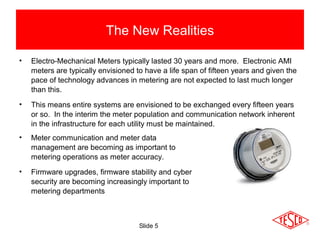
• Electro-Mechanical Meters typically lasted 30 years and more. Electronic AMI
meters are typically envisioned to have a life span of fifteen years and given the
pace of technology advances in metering are not expected to last much longer
than this.
• This means entire systems are envisioned to be exchanged every fifteen years
or so. In the interim the meter population and communication network inherent
in the infrastructure for each utility must be maintained.
• Meter communication and meter data
management are becoming as important to
metering operations as meter accuracy.
• Firmware upgrades, firmware stability and cyber
security are becoming increasingly important to
metering departments
Slide 6
Expected & Unexpected Trends at the
End of Deployment
Expected:
• The AMI deployment team will declare victory at some point and move on.
Clean-up will be left for the meter service department
• Change Management continues to be a tremendous challenge for every vendor
through every deployment
• Meter Acceptance testing including far more than accuracy testing for every
deployment
• Firmware upgrades must be checked and tested before mass deployment
Unexpected:
• Not all forms are available by the end
of deployment and must be installed
as part of normal operations by the
meter service department
• Meter Certification Testing never
slowed down over the course of any of
the deployments
Slide 7
Why do AMI meters fail?
Looking back at various deployments – what are the chief
causes to reject meter shipments?
Meter functional test failures including but not limited to;
• Incorrect firmware
• Bad settings
• Alarms and errors that do not clear
• Communication test failures
• Bad tables
• Failed disconnect switches
Slide 8
Lessons for the Future?
• Are these infant mortality issues or are these issues to be concerned about
going forward?
• What was NEVER the reason for rejecting a shipment – meter accuracy.
• Which are the most difficult meters for every deployment – the transformer
rated meters. Often these forms are not available until very late in the
deployment and sometimes not until the deployment has officially ended.
Slide 9
• Most AMI deployments utilize third party contractors to handle the
residential and some self contained non-2S services. The balance are
typically handled by the meter service department of the utility.
• No AMI deployment has used the AMI communication network to handle the
communication with the largest customer meters. The risk from even a
short term interruption of communication or loss of data far outweighs to
benefit of meters which are already being communicated with daily or even
several times a day.
• As these services are evaluated for new metering technology issues are
being found at some accounts. These issues represent sometimes
significant revenue losses (or overcharges) due to inappropriate metering
schemes or partially failed metering components (e.g. transformers,
electronic components).
Commercial and Industrial Metering Challenges
Slide 10
• Metering is becoming more about IT. Some metering departments have
been reorganized after AMI as part of the IT department.
• Metering emphasis will shift strongly toward C&I customers and further and
further away from residential meters
• Metering resources are being refocused on C&I accounts.
• There are fewer levels of meter tech. Every meter tech needs to be at the
higher level as there is not enough lower level work to warrant full time
employees
• Utility commissions are being less forgiving of allowing rate relief for project
over runs and metering inaccuracies
How are these new realities starting to affect
metering operations?
Slide 11
• Responsible for either reviewing ANSI Tests or even performing some of
these ANSI Tests
• Perform Meter Functionality testing on new and returned AMI meters
• Register and communication module energy measurement comparison
• Disconnect/Reconnect Functionality
• Outage Performance
• Meter Communications Performance
• Consumer safety and combating real and perceived issues
• Near continuous research into the “next” technology and the next
deployment
New or expanded roles for metering
departments of all sizes
Slide 12
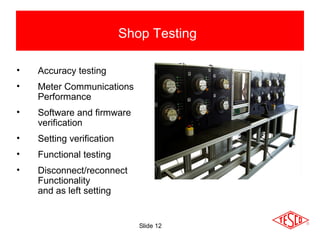
• Accuracy testing
• Meter Communications
Performance
• Software and firmware
verification
• Setting verification
• Functional testing
• Disconnect/reconnect
Functionality
and as left setting
Shop Testing
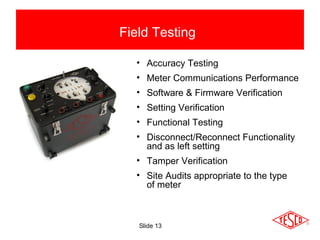
Slide 13
Field Testing
• Accuracy Testing
• Meter Communications Performance
• Software & Firmware Verification
• Setting Verification
• Functional Testing
• Disconnect/Reconnect Functionality
and as left setting
• Tamper Verification
• Site Audits appropriate to the type
of meter
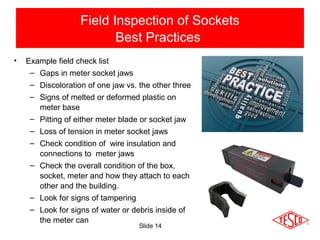
Slide 14
Field Inspection of Sockets
Best Practices
• Example field check list
– Gaps in meter socket jaws
– Discoloration of one jaw vs. the other three
– Signs of melted or deformed plastic on
meter base
– Pitting of either meter blade or socket jaw
– Loss of tension in meter socket jaws
– Check condition of wire insulation and
connections to meter jaws
– Check the overall condition of the box,
socket, meter and how they attach to each
other and the building.
– Look for signs of tampering
– Look for signs of water or debris inside of
the meter can
Slide 15
• Most AMI deployments utilize third party contractors to handle residential and
some self contained non-2S services.
• After to or prior to AMI deployments, Utility personnel typically see these
sockets
• Transformer rated meters typically handled by the meter service department
of the utility.
• Hot socket concerns with lever by-pass sockets used on 3-phase meters are
extremely rare.
Who Sees Hot Sockets?
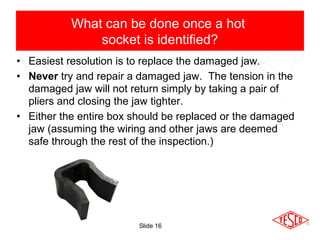
Slide 16
• Easiest resolution is to replace the damaged jaw.
• Never try and repair a damaged jaw. The tension in the
damaged jaw will not return simply by taking a pair of
pliers and closing the jaw tighter.
• Either the entire box should be replaced or the damaged
jaw (assuming the wiring and other jaws are deemed
safe through the rest of the inspection.)
What can be done once a hot
socket is identified?
Slide 17
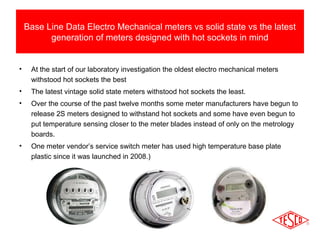
Base Line Data Electro Mechanical meters vs solid state vs the latest
generation of meters designed with hot sockets in mind
• At the start of our laboratory investigation the oldest electro mechanical meters
withstood hot sockets the best
• The latest vintage solid state meters withstood hot sockets the least.
• Over the course of the past twelve months some meter manufacturers have begun to
release 2S meters designed to withstand hot sockets and some have even begun to
put temperature sensing closer to the meter blades instead of only on the metrology
boards.
• One meter vendor’s service switch meter has used high temperature base plate
plastic since it was launched in 2008.)
Slide 18
Hot Socket Summary
• Hot sockets start with a loss of tension in at least one of the meter socket jaws. This
loss of tension can be from a variety of sources that start as early as improper
installation or even “tight sockets”.
• Loss of tension is necessary to create the initial micro-arcing conditions.
• Sockets with repeated meter exchanges observed to have higher incidence of hot
socket issues and “booting” a meter may spring jaws even more.
• Vibration appears to be the most common catalyst to the micro-arcing that creates the
initial heat in a “hot socket”.
• The meter must have some power, but current is not a significant factor in how quickly
or dramatically a hot socket occurs
• The effects of vibration and weakened jaw are cumulative
• Meter Manufacturers have all been working on the design of their meters to better
withstand a hot socket. These new meters have better baseline performance than
even the older electro mechanical meters, but a hot socket will eventually burn up
even the most robust meter.
Slide 19
RMA’s, Root Cause Analysis and
In Service Testing
Opportunities to Learn:
• Meters returned from the field as bad or flagged on incoming inspection. These
RMA’s need to be tracked not only for warranty purposes but more importantly to
understand the root cause of the issues.
• In Service Test programs need to be utilized to understand
the overall performance of AMI meters and as failures are
identified these meters need to be dissected and the
failure mode understood. If necessary, once the failure
mode is understood the meter population may need to also
be dissected to identify sub-groups of meter that may be
similarly affected. This could be a group of meters…
• from the same shipment.
• that were deployed in the same geographic area.
• that saw the same type of usage or environment.
No one knows the actual life of their AMI meter. To do this we must learn as
much as we can from the failures and the performance of the meters we have
deployed.
Slide 20
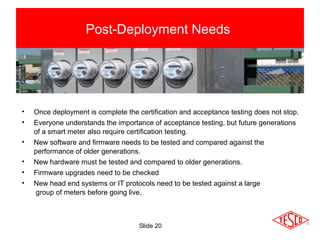
Post-Deployment Needs
• Once deployment is complete the certification and acceptance testing does not stop.
• Everyone understands the importance of acceptance testing, but future generations
of a smart meter also require certification testing.
• New software and firmware needs to be tested and compared against the
performance of older generations.
• New hardware must be tested and compared to older generations.
• Firmware upgrades need to be checked
• New head end systems or IT protocols need to be tested against a large
group of meters before going live.
Slide 21
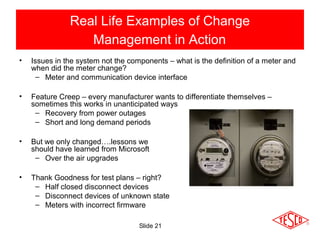
Real Life Examples of Change
Management in Action
• Issues in the system not the components – what is the definition of a meter and
when did the meter change?
– Meter and communication device interface
• Feature Creep – every manufacturer wants to differentiate themselves –
sometimes this works in unanticipated ways
– Recovery from power outages
– Short and long demand periods
• But we only changed….lessons we
should have learned from Microsoft
– Over the air upgrades
• Thank Goodness for test plans – right?
– Half closed disconnect devices
– Disconnect devices of unknown state
– Meters with incorrect firmware
Slide 22
Summary
• The focus is on far more than accuracy
• The meter man of the future knows not only metering but they are communication
experts and are involved with handling, reporting and analyzing far more customer
and system data
• There are fewer “routine jobs” in the field and many of the standard tasks are no
longer required. This will lead to fewer classifications of meter techs going forward
and the need for a more highly trained tech.
• Each Utility must take a far more active role as part of checking, certifying, and
rechecking the functionality of their meters.
• Metering will be in a near constant cycle of looking for
the next technology, evaluating those technologies,
planning for deploying these technologies, and
cleaning up the aftermath of the deployment of
these technologies.
Slide 23
Questions and Discussion
Tom Lawton
TESCO – The Eastern Specialty Company
Bristol, PA
1-800-762-8211
www.tesco-advent.com

Meter Operations During and After AMI Deployment

  • 1.
    Slide 110/02/2012Slide 1 MeteringOperations During and after AMI Deployment Prepared by Tom Lawton,TESCO The Eastern Specialty Company For NYSEG & RG&E Annual State Meter Tech Meeting
  • 2.
    Slide 2 Abstract • Asmany utilities have elected to deploy advanced metering systems and millions of new solid-state, microprocessor based end-points with communications under glass, a dramatic shift has begun regarding where metering resources are being deployed and what they are doing. • This presentation will highlight the new value proposition for metering personnel at their respective utility companies in this AMI dominated World. • Examples of issues which have arisen or been identified over the course of various deployments and in the immediate aftermath of an AMI deployment.
  • 3.
    Slide 3 Pre-AMI MeterOperations • Fewer meter techs in the field and in the shop than there were 25 years ago • Fewer Field checks and site verifications due to lack of personnel, lack of experience and lack of expertise • More features under glass in the meters even before AMI deployed • Significantly more features under glass in every AMR and AMI system being considered or being deployed • Metering losses starting to be identified “by accident” as opposed to being “by design”. Common Features and Common Sources of Concern
  • 4.
    Slide 4 The PendulumStarts to Move • Meter Operations. Prior to deployment many larger utilities take an attitude of “this is only metering – how hard can that be?”. Over the course of deployment Meter Operations gains a stature and a respect from the rest of the organization that was not previously accorded them – even if this is only begrudging respect. • New tests for AMI meters (e.g. communication, disconnect) are identified • The complexity and issues around high revenue metering are at least acknowledged by the rest of the organization • Tests which have not been performed in years are suddenly back in vogue
  • 5.
    Slide 5 The NewRealities • Electro-Mechanical Meters typically lasted 30 years and more. Electronic AMI meters are typically envisioned to have a life span of fifteen years and given the pace of technology advances in metering are not expected to last much longer than this. • This means entire systems are envisioned to be exchanged every fifteen years or so. In the interim the meter population and communication network inherent in the infrastructure for each utility must be maintained. • Meter communication and meter data management are becoming as important to metering operations as meter accuracy. • Firmware upgrades, firmware stability and cyber security are becoming increasingly important to metering departments
  • 6.
    Slide 6 Expected &Unexpected Trends at the End of Deployment Expected: • The AMI deployment team will declare victory at some point and move on. Clean-up will be left for the meter service department • Change Management continues to be a tremendous challenge for every vendor through every deployment • Meter Acceptance testing including far more than accuracy testing for every deployment • Firmware upgrades must be checked and tested before mass deployment Unexpected: • Not all forms are available by the end of deployment and must be installed as part of normal operations by the meter service department • Meter Certification Testing never slowed down over the course of any of the deployments
  • 7.
    Slide 7 Why doAMI meters fail? Looking back at various deployments – what are the chief causes to reject meter shipments? Meter functional test failures including but not limited to; • Incorrect firmware • Bad settings • Alarms and errors that do not clear • Communication test failures • Bad tables • Failed disconnect switches
  • 8.
    Slide 8 Lessons forthe Future? • Are these infant mortality issues or are these issues to be concerned about going forward? • What was NEVER the reason for rejecting a shipment – meter accuracy. • Which are the most difficult meters for every deployment – the transformer rated meters. Often these forms are not available until very late in the deployment and sometimes not until the deployment has officially ended.
  • 9.
    Slide 9 • MostAMI deployments utilize third party contractors to handle the residential and some self contained non-2S services. The balance are typically handled by the meter service department of the utility. • No AMI deployment has used the AMI communication network to handle the communication with the largest customer meters. The risk from even a short term interruption of communication or loss of data far outweighs to benefit of meters which are already being communicated with daily or even several times a day. • As these services are evaluated for new metering technology issues are being found at some accounts. These issues represent sometimes significant revenue losses (or overcharges) due to inappropriate metering schemes or partially failed metering components (e.g. transformers, electronic components). Commercial and Industrial Metering Challenges
  • 10.
    Slide 10 • Meteringis becoming more about IT. Some metering departments have been reorganized after AMI as part of the IT department. • Metering emphasis will shift strongly toward C&I customers and further and further away from residential meters • Metering resources are being refocused on C&I accounts. • There are fewer levels of meter tech. Every meter tech needs to be at the higher level as there is not enough lower level work to warrant full time employees • Utility commissions are being less forgiving of allowing rate relief for project over runs and metering inaccuracies How are these new realities starting to affect metering operations?
  • 11.
    Slide 11 • Responsiblefor either reviewing ANSI Tests or even performing some of these ANSI Tests • Perform Meter Functionality testing on new and returned AMI meters • Register and communication module energy measurement comparison • Disconnect/Reconnect Functionality • Outage Performance • Meter Communications Performance • Consumer safety and combating real and perceived issues • Near continuous research into the “next” technology and the next deployment New or expanded roles for metering departments of all sizes
  • 12.
    Slide 12 • Accuracytesting • Meter Communications Performance • Software and firmware verification • Setting verification • Functional testing • Disconnect/reconnect Functionality and as left setting Shop Testing
  • 13.
    Slide 13 Field Testing •Accuracy Testing • Meter Communications Performance • Software & Firmware Verification • Setting Verification • Functional Testing • Disconnect/Reconnect Functionality and as left setting • Tamper Verification • Site Audits appropriate to the type of meter
  • 14.
    Slide 14 Field Inspectionof Sockets Best Practices • Example field check list – Gaps in meter socket jaws – Discoloration of one jaw vs. the other three – Signs of melted or deformed plastic on meter base – Pitting of either meter blade or socket jaw – Loss of tension in meter socket jaws – Check condition of wire insulation and connections to meter jaws – Check the overall condition of the box, socket, meter and how they attach to each other and the building. – Look for signs of tampering – Look for signs of water or debris inside of the meter can
  • 15.
    Slide 15 • MostAMI deployments utilize third party contractors to handle residential and some self contained non-2S services. • After to or prior to AMI deployments, Utility personnel typically see these sockets • Transformer rated meters typically handled by the meter service department of the utility. • Hot socket concerns with lever by-pass sockets used on 3-phase meters are extremely rare. Who Sees Hot Sockets?
  • 16.
    Slide 16 • Easiestresolution is to replace the damaged jaw. • Never try and repair a damaged jaw. The tension in the damaged jaw will not return simply by taking a pair of pliers and closing the jaw tighter. • Either the entire box should be replaced or the damaged jaw (assuming the wiring and other jaws are deemed safe through the rest of the inspection.) What can be done once a hot socket is identified?
  • 17.
    Slide 17 Base LineData Electro Mechanical meters vs solid state vs the latest generation of meters designed with hot sockets in mind • At the start of our laboratory investigation the oldest electro mechanical meters withstood hot sockets the best • The latest vintage solid state meters withstood hot sockets the least. • Over the course of the past twelve months some meter manufacturers have begun to release 2S meters designed to withstand hot sockets and some have even begun to put temperature sensing closer to the meter blades instead of only on the metrology boards. • One meter vendor’s service switch meter has used high temperature base plate plastic since it was launched in 2008.)
  • 18.
    Slide 18 Hot SocketSummary • Hot sockets start with a loss of tension in at least one of the meter socket jaws. This loss of tension can be from a variety of sources that start as early as improper installation or even “tight sockets”. • Loss of tension is necessary to create the initial micro-arcing conditions. • Sockets with repeated meter exchanges observed to have higher incidence of hot socket issues and “booting” a meter may spring jaws even more. • Vibration appears to be the most common catalyst to the micro-arcing that creates the initial heat in a “hot socket”. • The meter must have some power, but current is not a significant factor in how quickly or dramatically a hot socket occurs • The effects of vibration and weakened jaw are cumulative • Meter Manufacturers have all been working on the design of their meters to better withstand a hot socket. These new meters have better baseline performance than even the older electro mechanical meters, but a hot socket will eventually burn up even the most robust meter.
  • 19.
    Slide 19 RMA’s, RootCause Analysis and In Service Testing Opportunities to Learn: • Meters returned from the field as bad or flagged on incoming inspection. These RMA’s need to be tracked not only for warranty purposes but more importantly to understand the root cause of the issues. • In Service Test programs need to be utilized to understand the overall performance of AMI meters and as failures are identified these meters need to be dissected and the failure mode understood. If necessary, once the failure mode is understood the meter population may need to also be dissected to identify sub-groups of meter that may be similarly affected. This could be a group of meters… • from the same shipment. • that were deployed in the same geographic area. • that saw the same type of usage or environment. No one knows the actual life of their AMI meter. To do this we must learn as much as we can from the failures and the performance of the meters we have deployed.
  • 20.
    Slide 20 Post-Deployment Needs •Once deployment is complete the certification and acceptance testing does not stop. • Everyone understands the importance of acceptance testing, but future generations of a smart meter also require certification testing. • New software and firmware needs to be tested and compared against the performance of older generations. • New hardware must be tested and compared to older generations. • Firmware upgrades need to be checked • New head end systems or IT protocols need to be tested against a large group of meters before going live.
  • 21.
    Slide 21 Real LifeExamples of Change Management in Action • Issues in the system not the components – what is the definition of a meter and when did the meter change? – Meter and communication device interface • Feature Creep – every manufacturer wants to differentiate themselves – sometimes this works in unanticipated ways – Recovery from power outages – Short and long demand periods • But we only changed….lessons we should have learned from Microsoft – Over the air upgrades • Thank Goodness for test plans – right? – Half closed disconnect devices – Disconnect devices of unknown state – Meters with incorrect firmware
  • 22.
    Slide 22 Summary • Thefocus is on far more than accuracy • The meter man of the future knows not only metering but they are communication experts and are involved with handling, reporting and analyzing far more customer and system data • There are fewer “routine jobs” in the field and many of the standard tasks are no longer required. This will lead to fewer classifications of meter techs going forward and the need for a more highly trained tech. • Each Utility must take a far more active role as part of checking, certifying, and rechecking the functionality of their meters. • Metering will be in a near constant cycle of looking for the next technology, evaluating those technologies, planning for deploying these technologies, and cleaning up the aftermath of the deployment of these technologies.
  • 23.
    Slide 23 Questions andDiscussion Tom Lawton TESCO – The Eastern Specialty Company Bristol, PA 1-800-762-8211 www.tesco-advent.com