Self-Organization in Agile & Digital
Transformation
15th March, 2017
About us
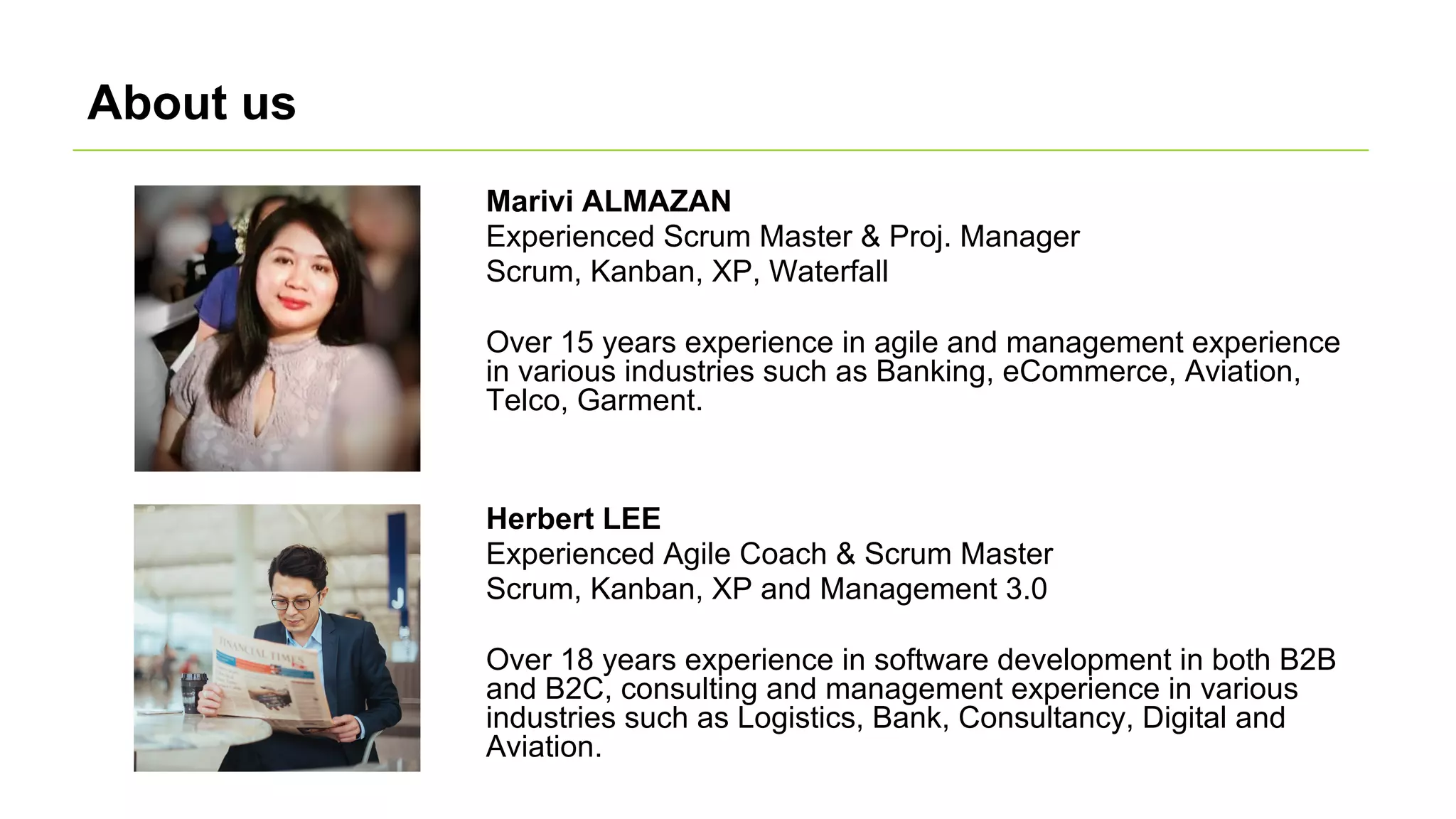
Herbert LEE
Experienced Agile Coach & Scrum Master
Scrum, Kanban, XP and Management 3.0
Over 18 years experience in software development in both B2B
and B2C, consulting and management experience in various
industries such as Logistics, Bank, Consultancy, Digital and
Aviation.
Marivi ALMAZAN
Experienced Scrum Master & Proj. Manager
Scrum, Kanban, XP, Waterfall
Over 15 years experience in agile and management experience
in various industries such as Banking, eCommerce, Aviation,
Telco, Garment.
Warm up
Self-Organization
Self organizing team
A Self-organizing teams empowered to make their own
decisions with their ability to achieve the goal within
boundaries.
“The best architectures, requirements, and designs
emerge from self-organizing teams”, an agile principle.
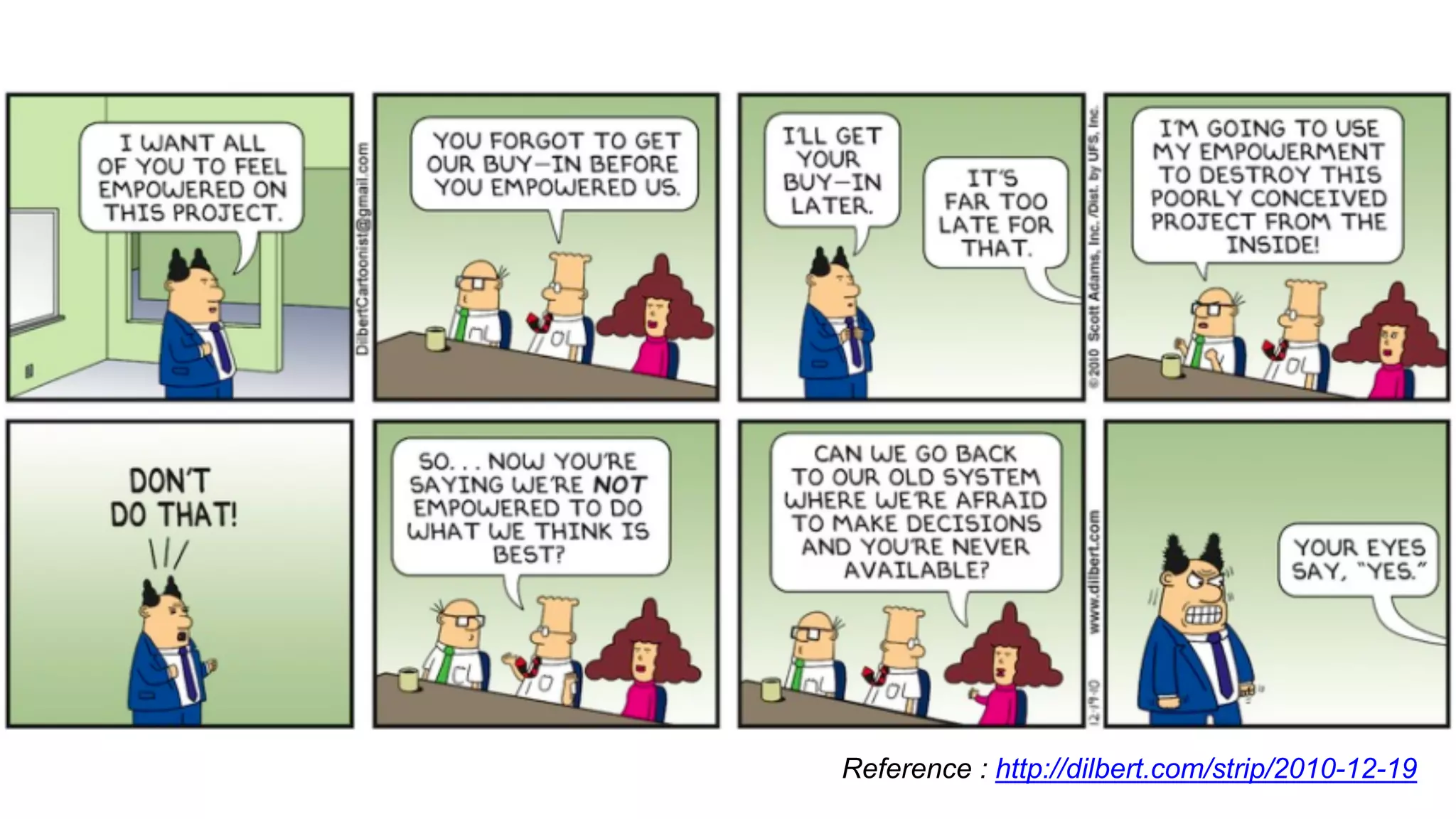
Reference : http://dilbert.com/strip/2010-12-19
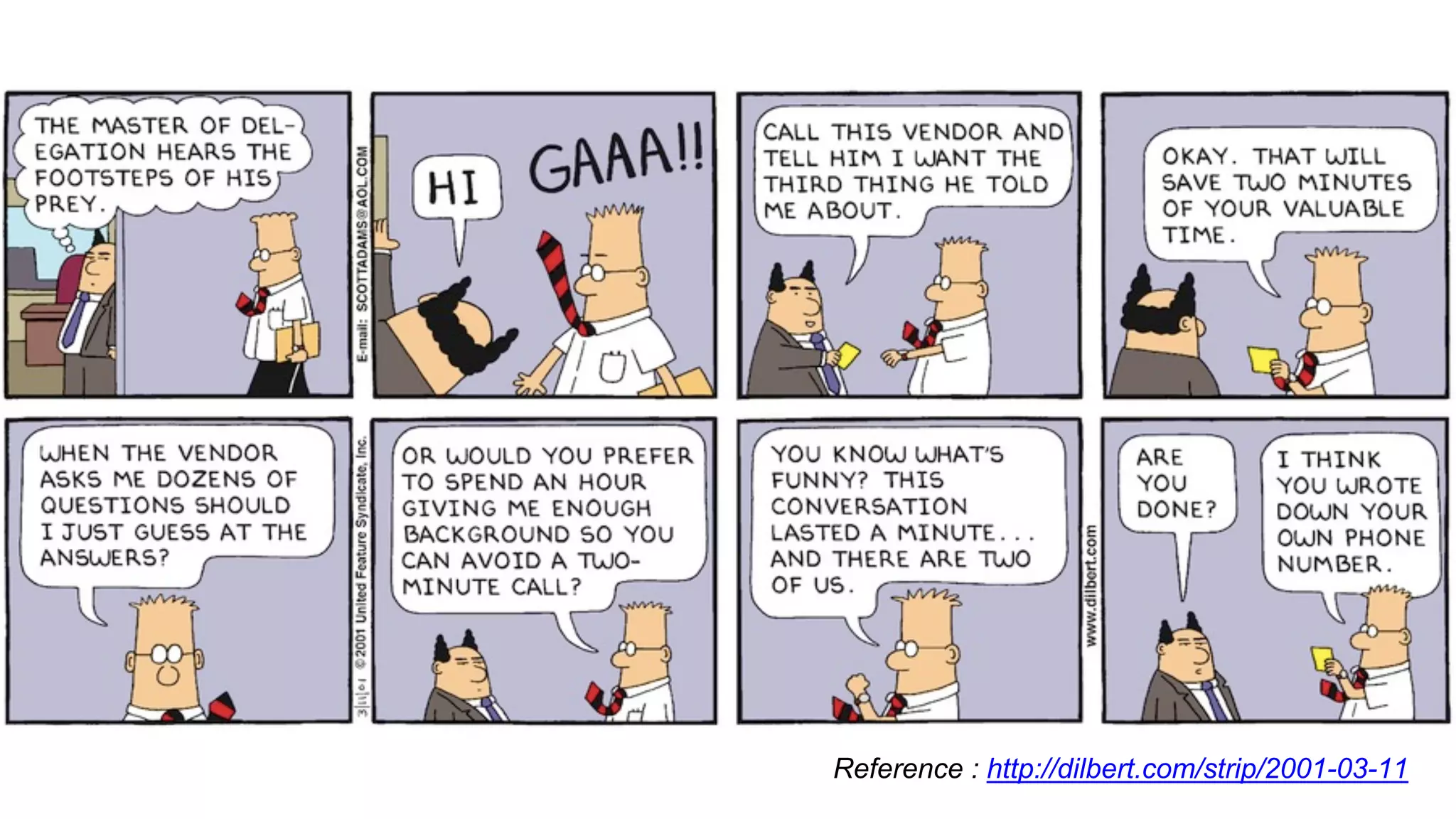
Reference : http://dilbert.com/strip/2001-03-11
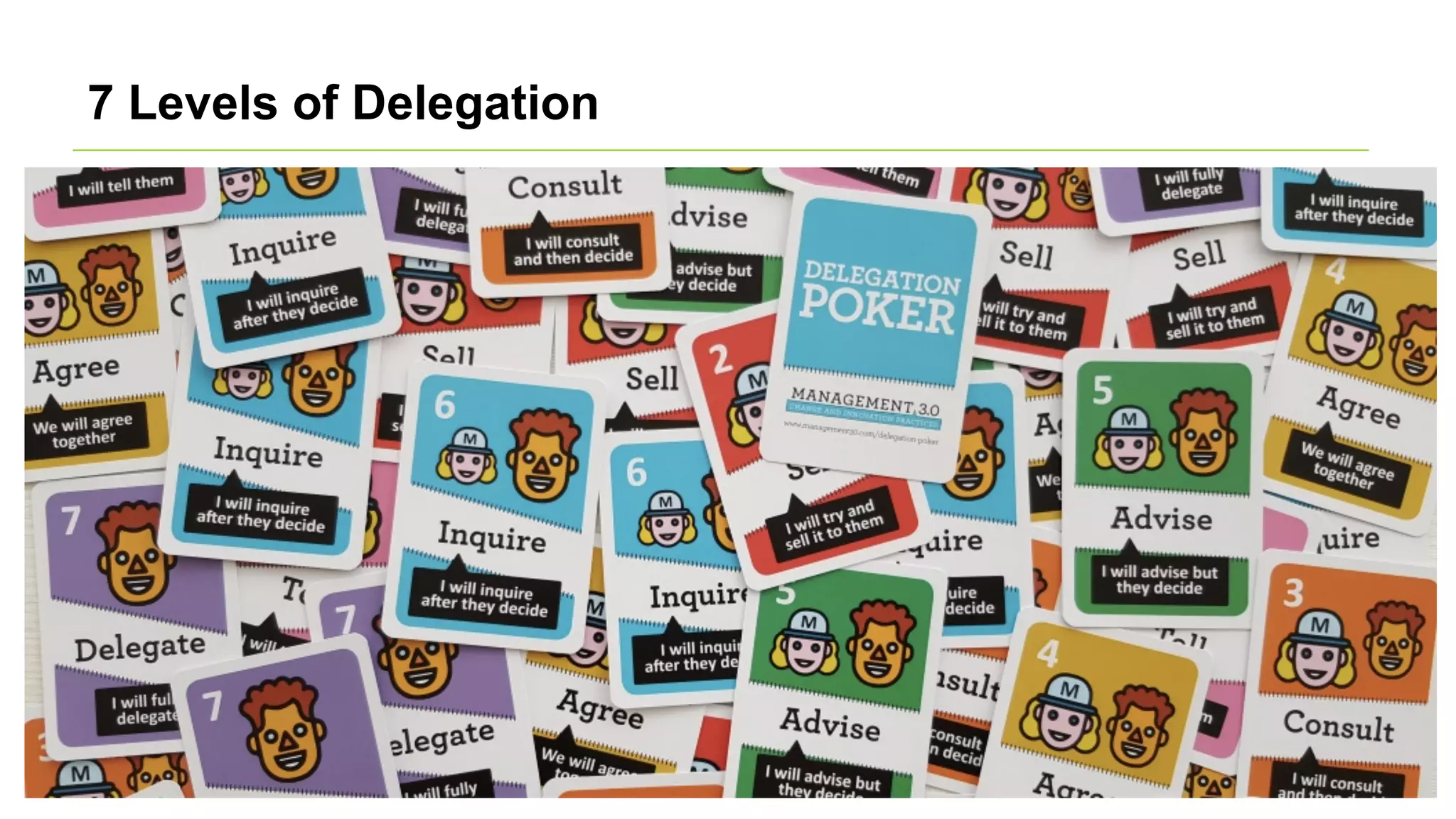
7 Levels of Delegation
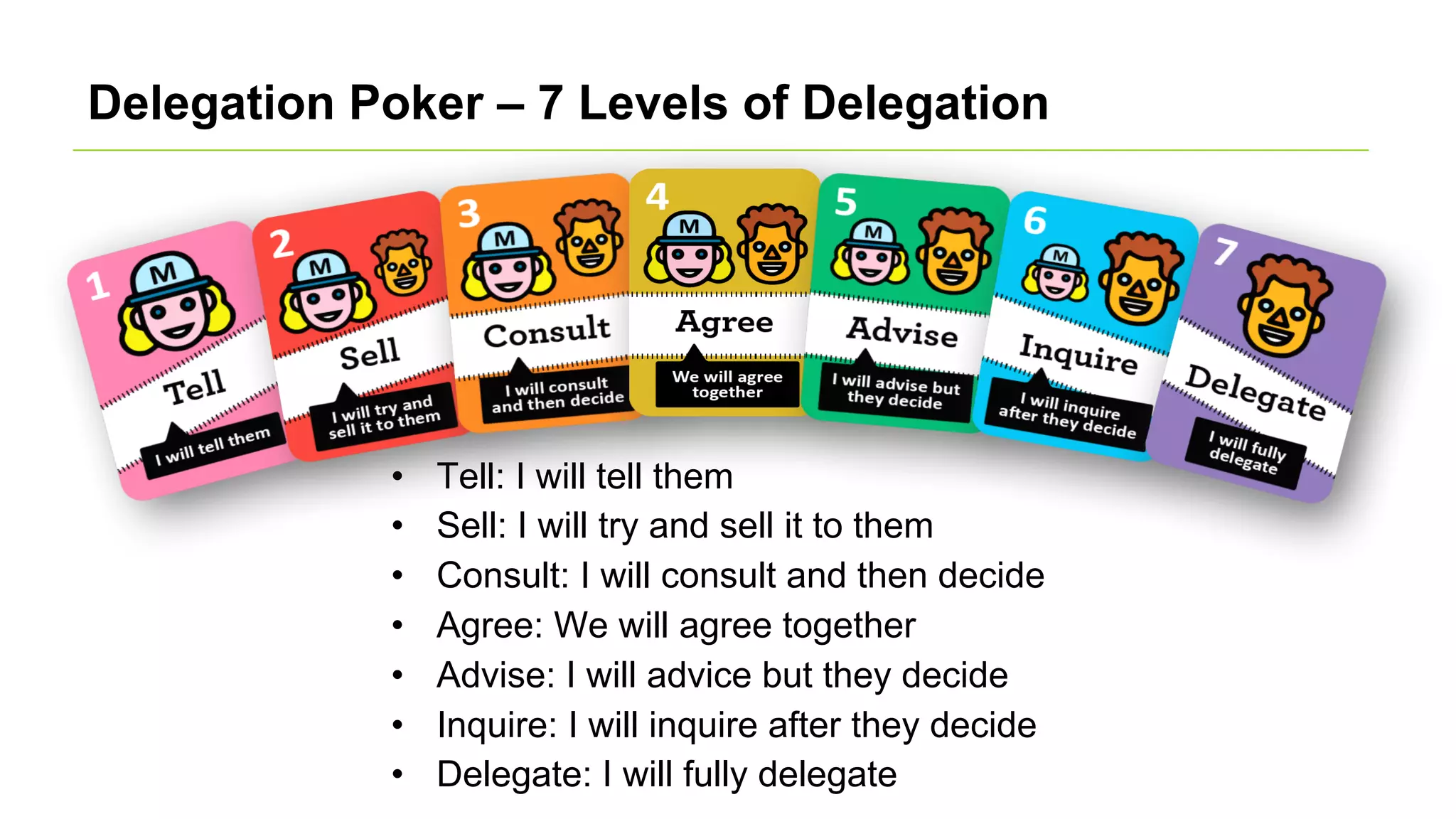
Delegation Poker – 7 Levels of Delegation
• Tell: I will tell them
• Sell: I will try and sell it to them
• Consult: I will consult and then decide
• Agree: We will agree together
• Advise: I will advice but they decide
• Inquire: I will inquire after they decide
• Delegate: I will fully delegate
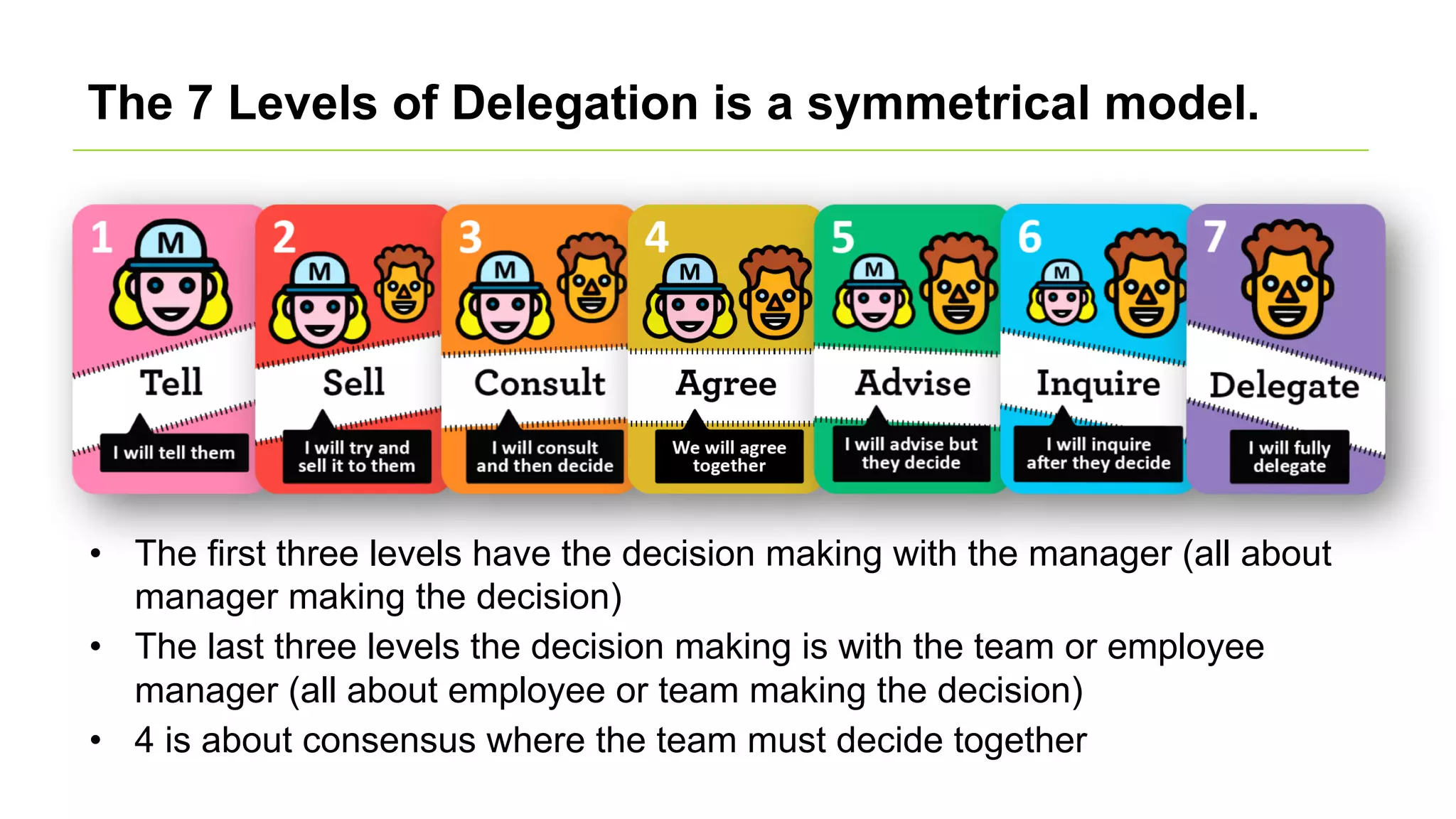
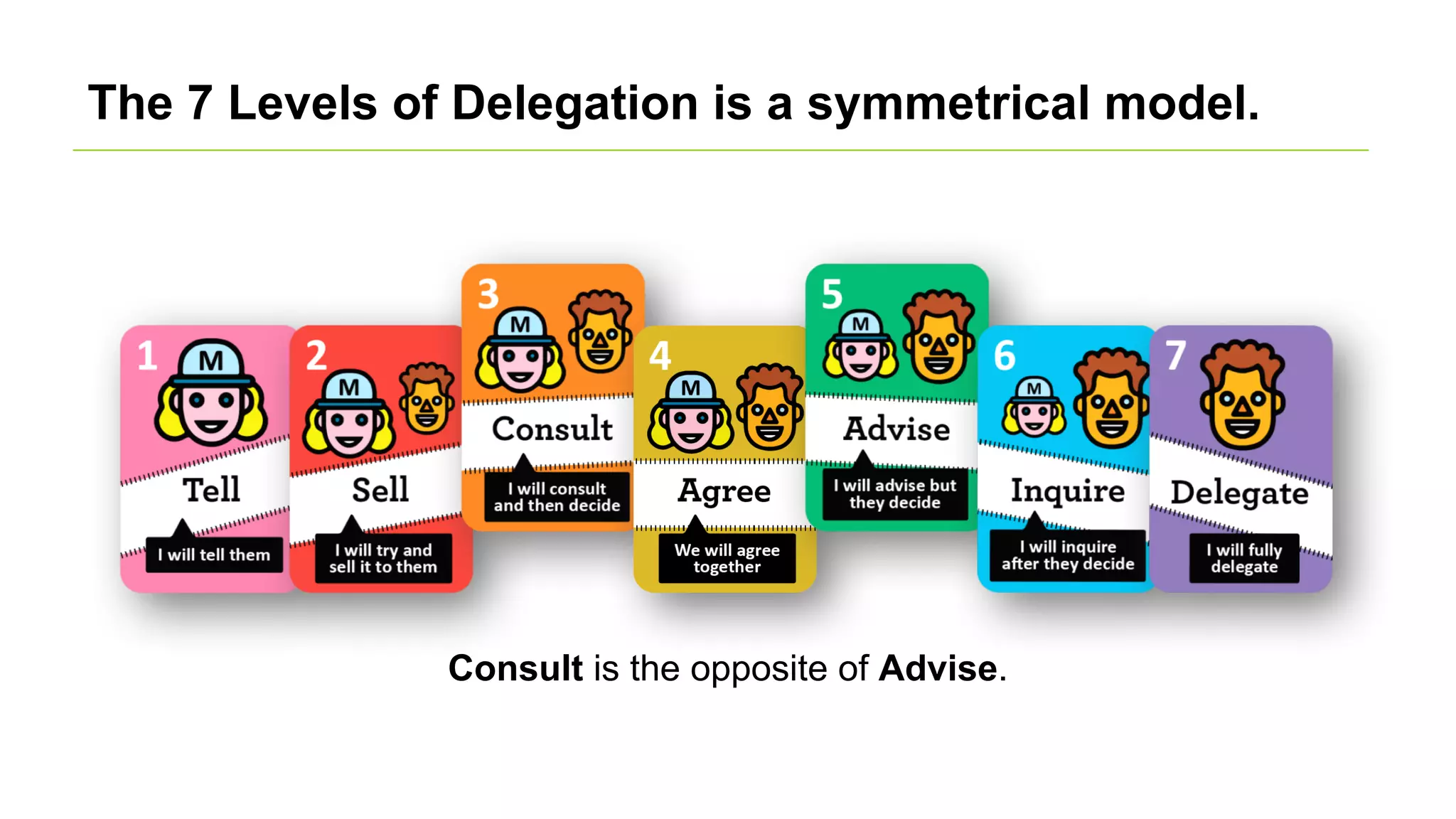
The 7 Levels of Delegation is a symmetrical model.
• The first three levels have the decision making with the manager (all about
manager making the decision)
• The last three levels the decision making is with the team or employee
manager (all about employee or team making the decision)
• 4 is about consensus where the team must decide together
The 7 Levels of Delegation is a symmetrical model.
Consult is the opposite of Advise.
The 7 Levels of Delegation is a symmetrical model.
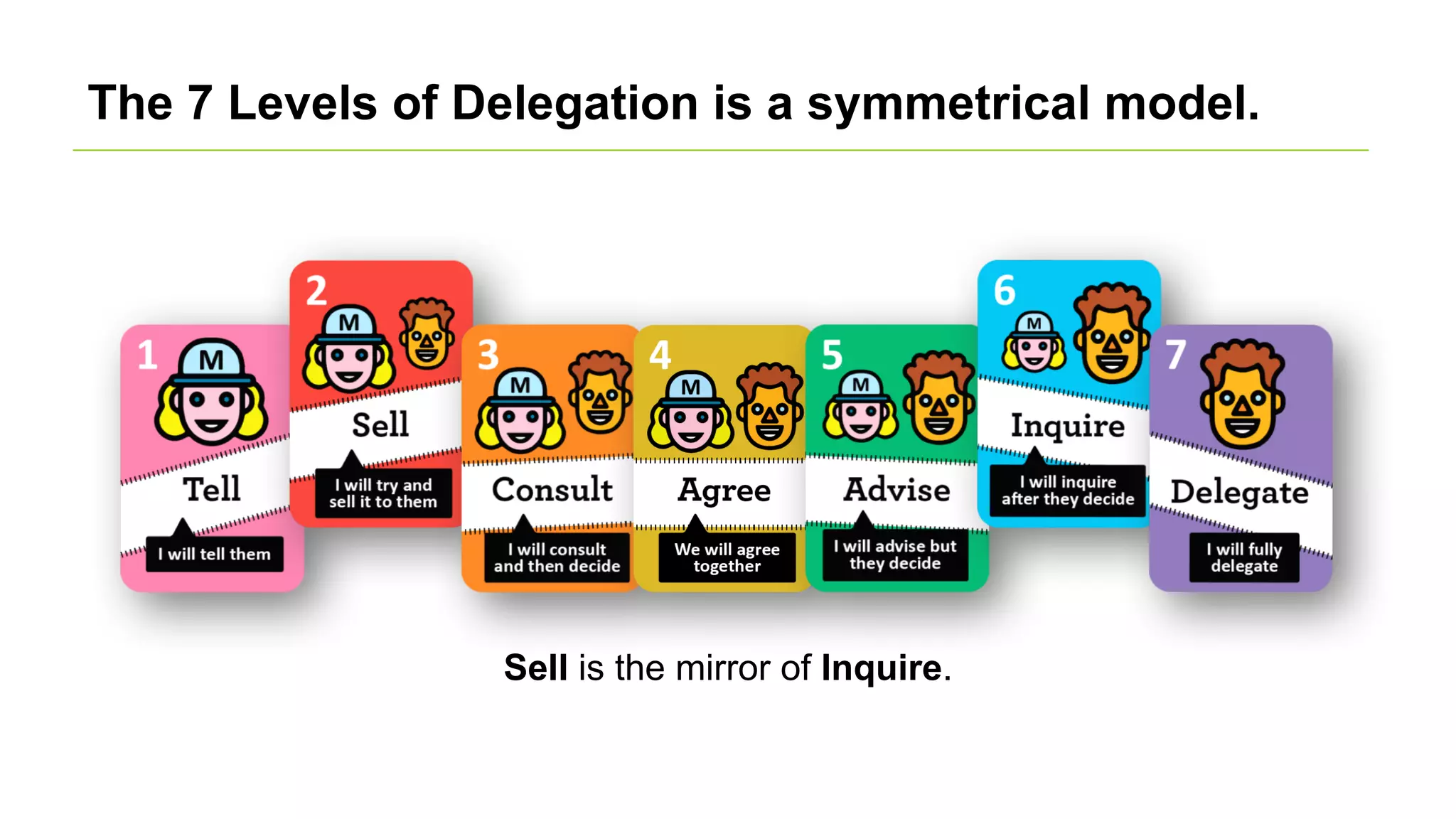
Sell is the mirror of Inquire.
Let’s take a break – 10 mins
Preparation
How do we start
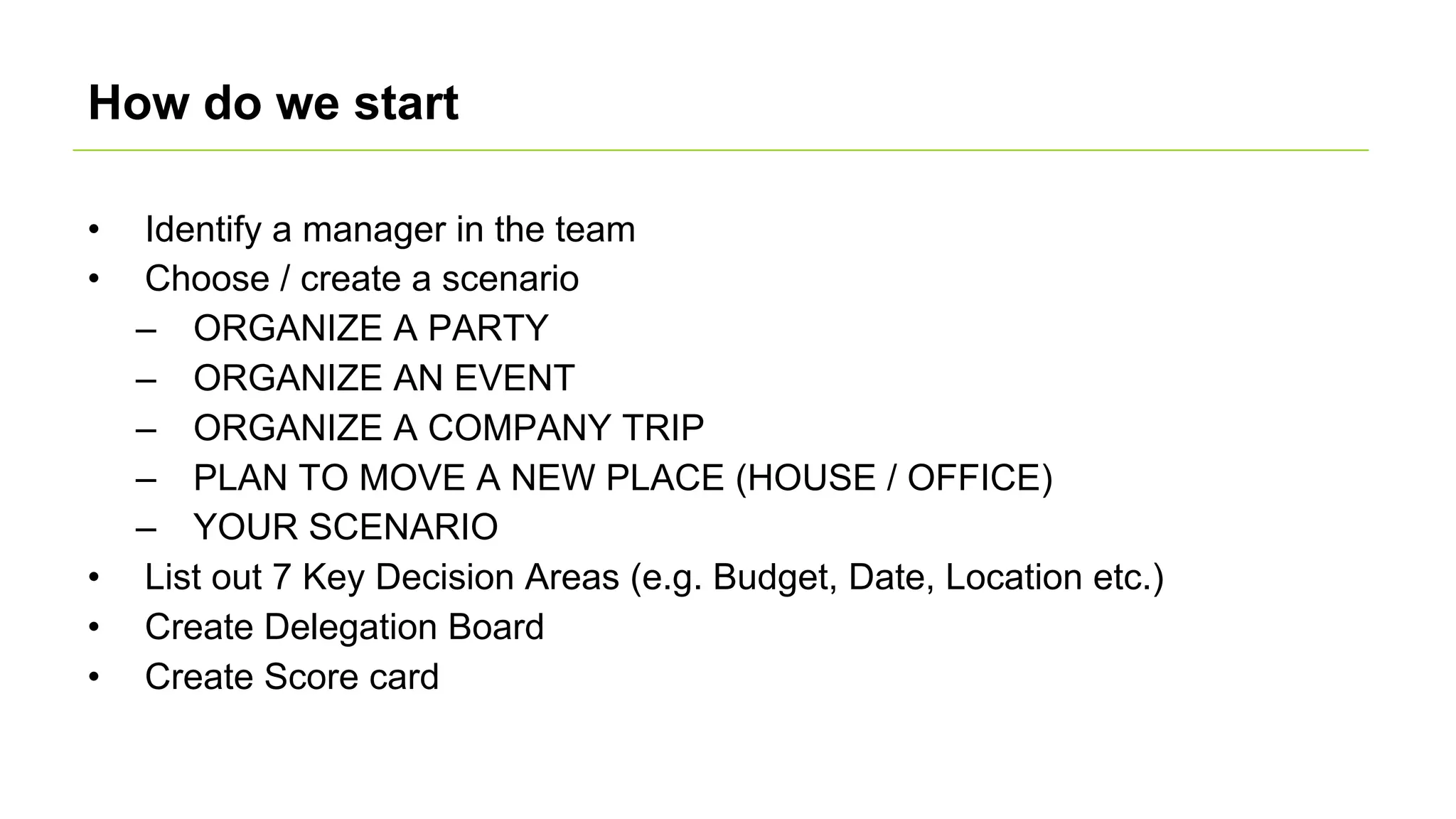
• Identify a manager in the team
• Choose / create a scenario
– ORGANIZE A PARTY
– ORGANIZE AN EVENT
– ORGANIZE A COMPANY TRIP
– PLAN TO MOVE A NEW PLACE (HOUSE / OFFICE)
– YOUR SCENARIO
• List out 7 Key Decision Areas (e.g. Budget, Date, Location etc.)
• Create Delegation Board
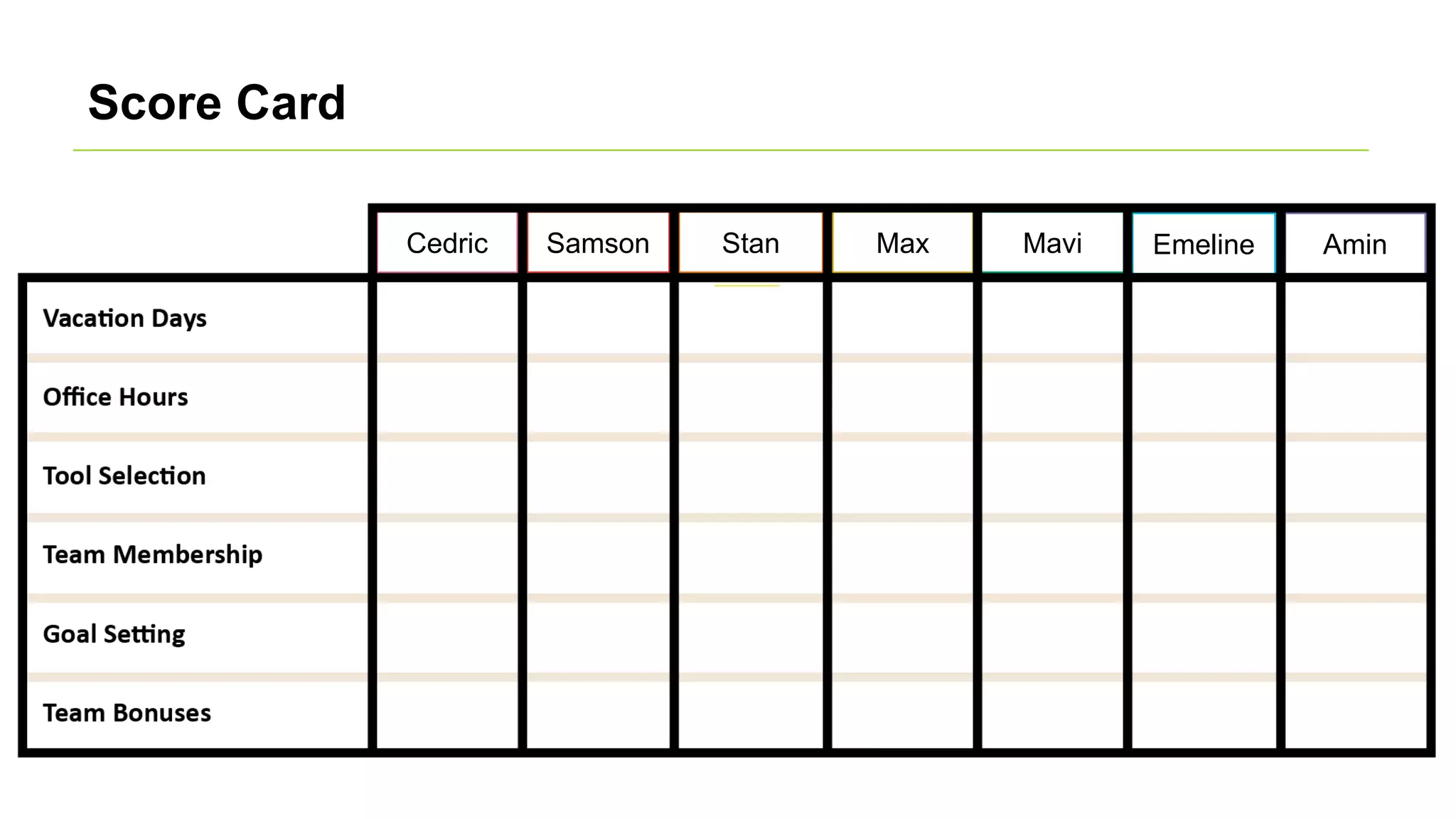
• Create Score card
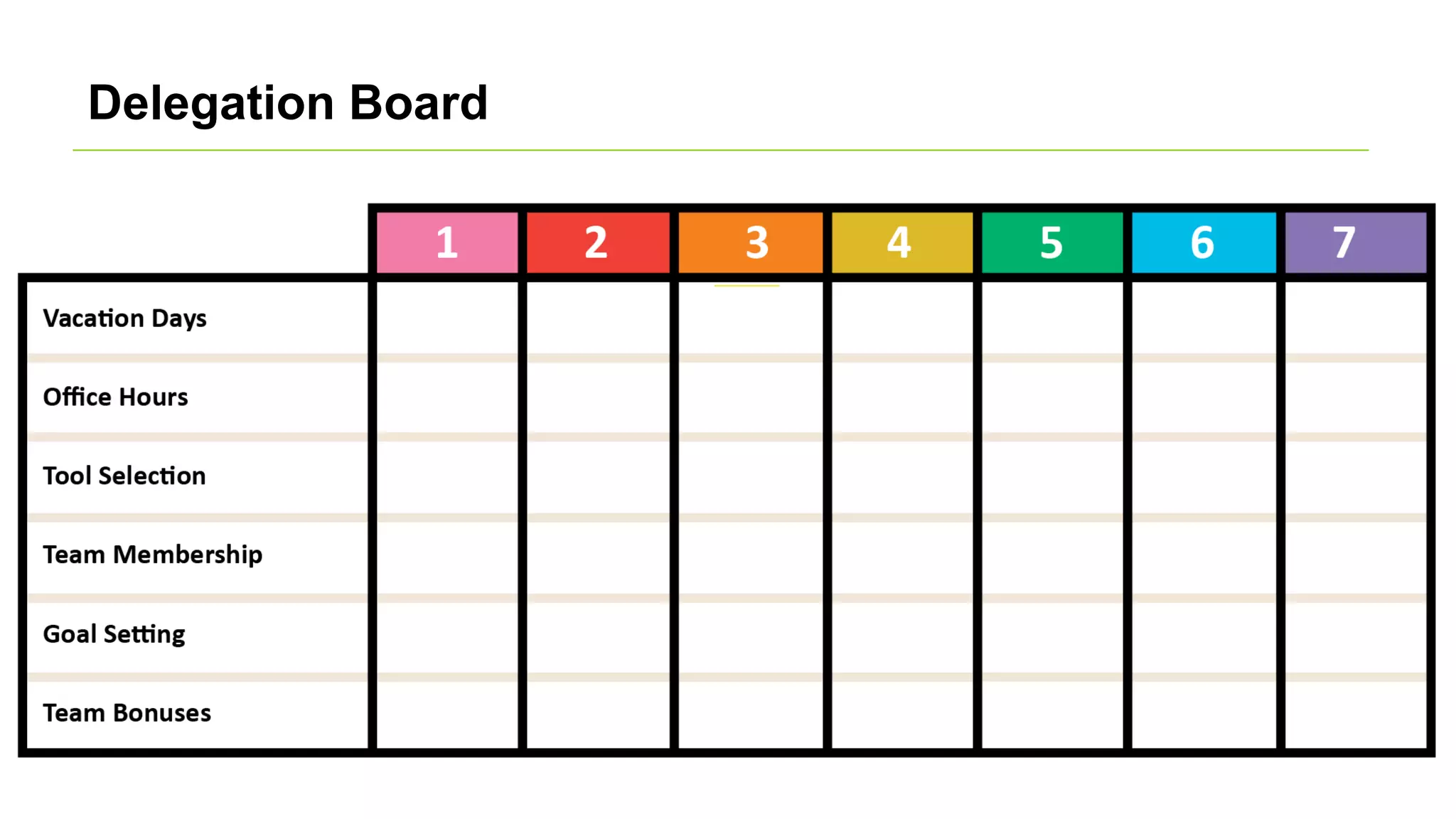
Delegation Board
Score Card
Cedric Samson Stan Max Mavi Emeline Amin
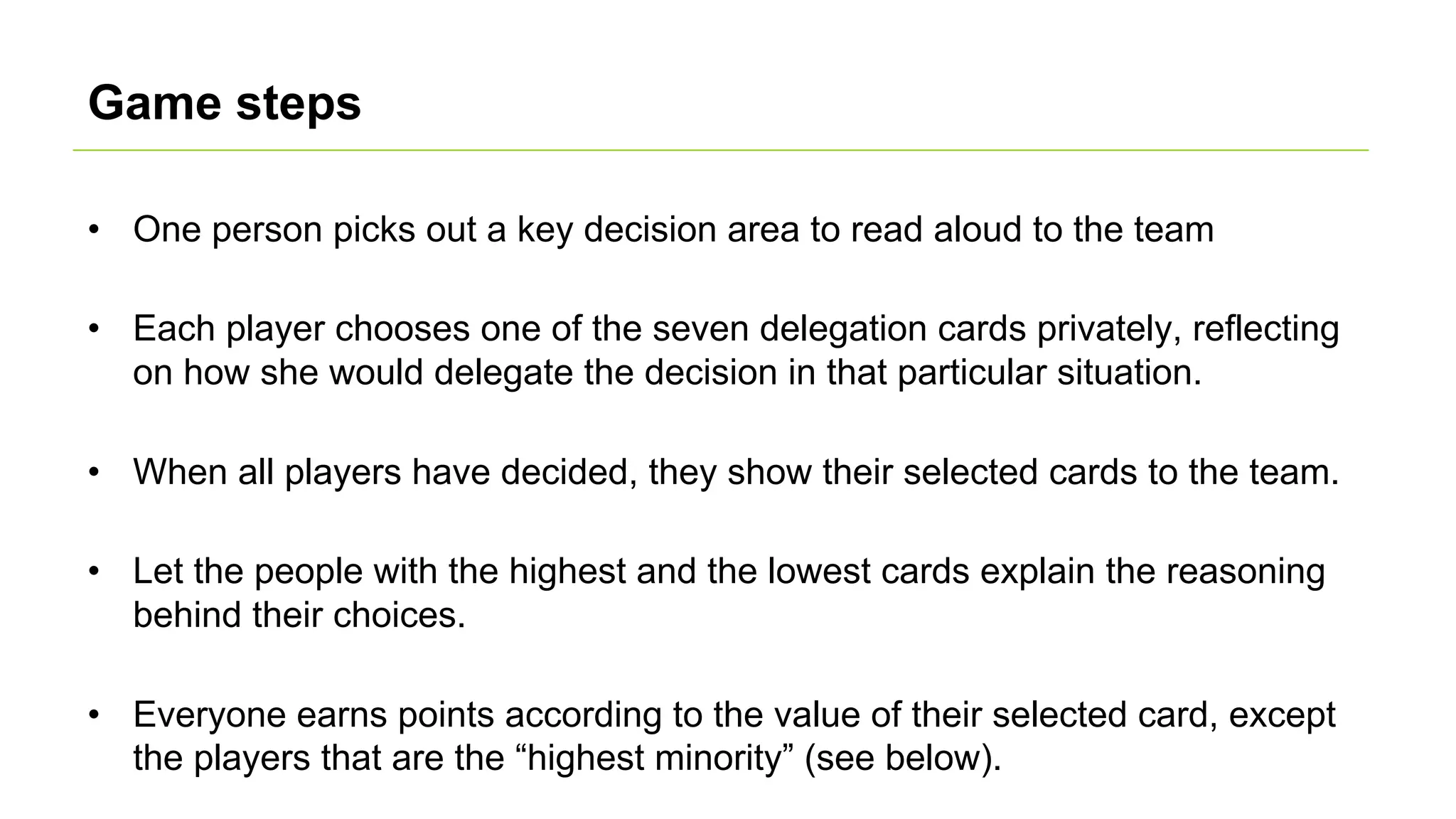
Game steps
• One person picks out a key decision area to read aloud to the team
• Each player chooses one of the seven delegation cards privately, reflecting
on how she would delegate the decision in that particular situation.
• When all players have decided, they show their selected cards to the team.
• Let the people with the highest and the lowest cards explain the reasoning
behind their choices.
• Everyone earns points according to the value of their selected card, except
the players that are the “highest minority” (see below).
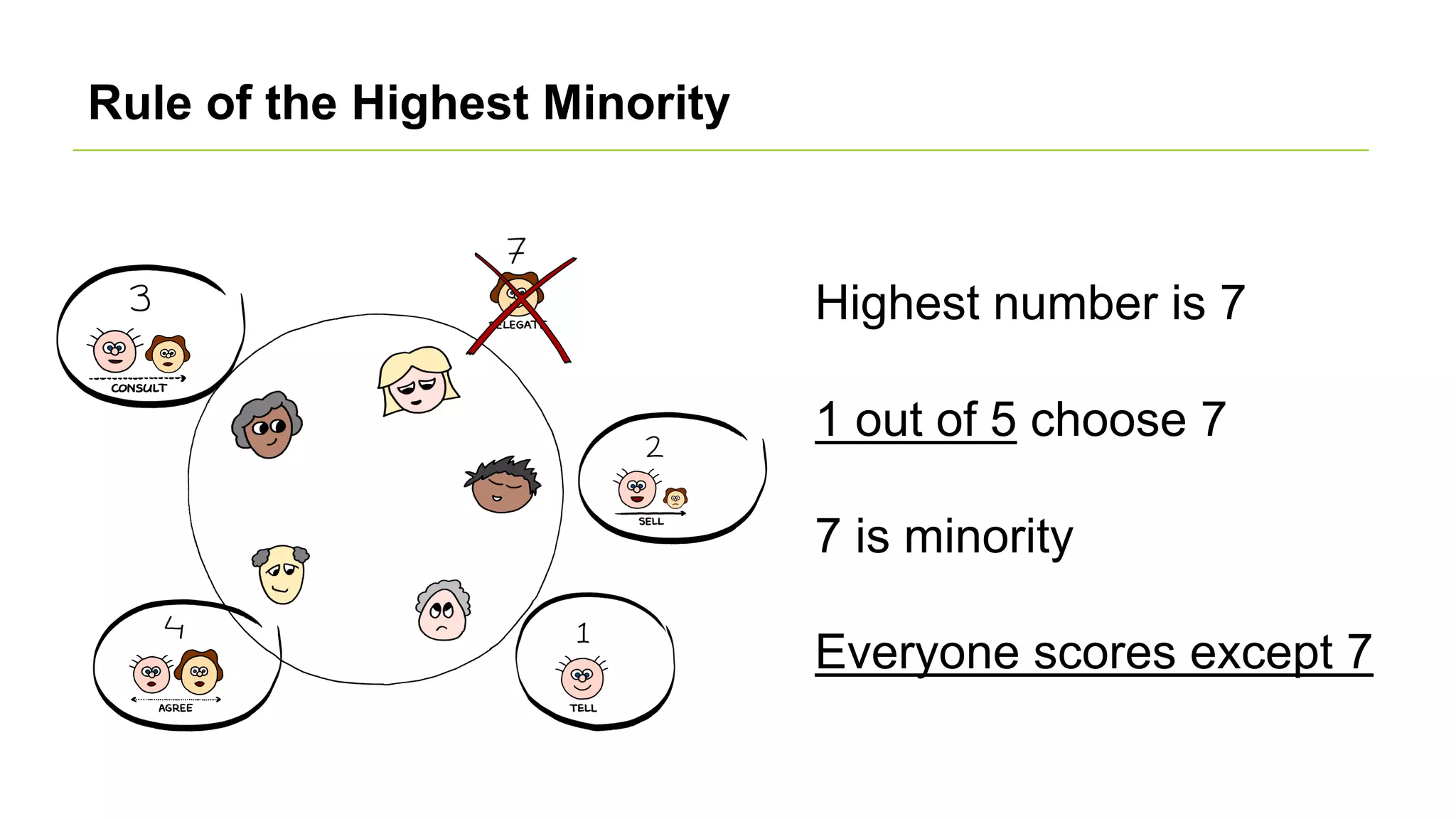
Rule of the Highest Minority
Highest number is 7
1 out of 5 choose 7
7 is minority
Everyone scores except 7
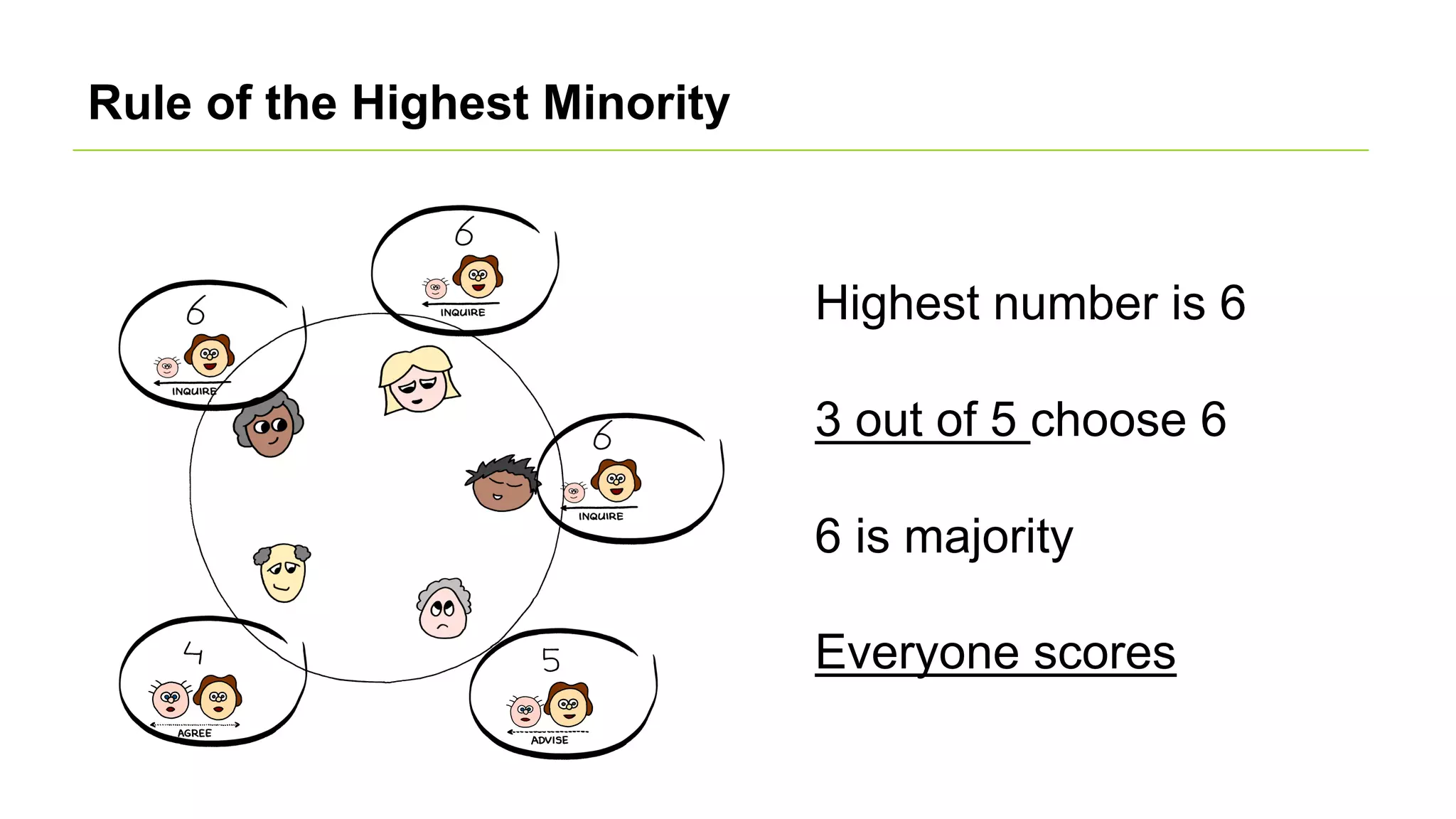
Rule of the Highest Minority
Highest number is 6
3 out of 5 choose 6
6 is majority
Everyone scores
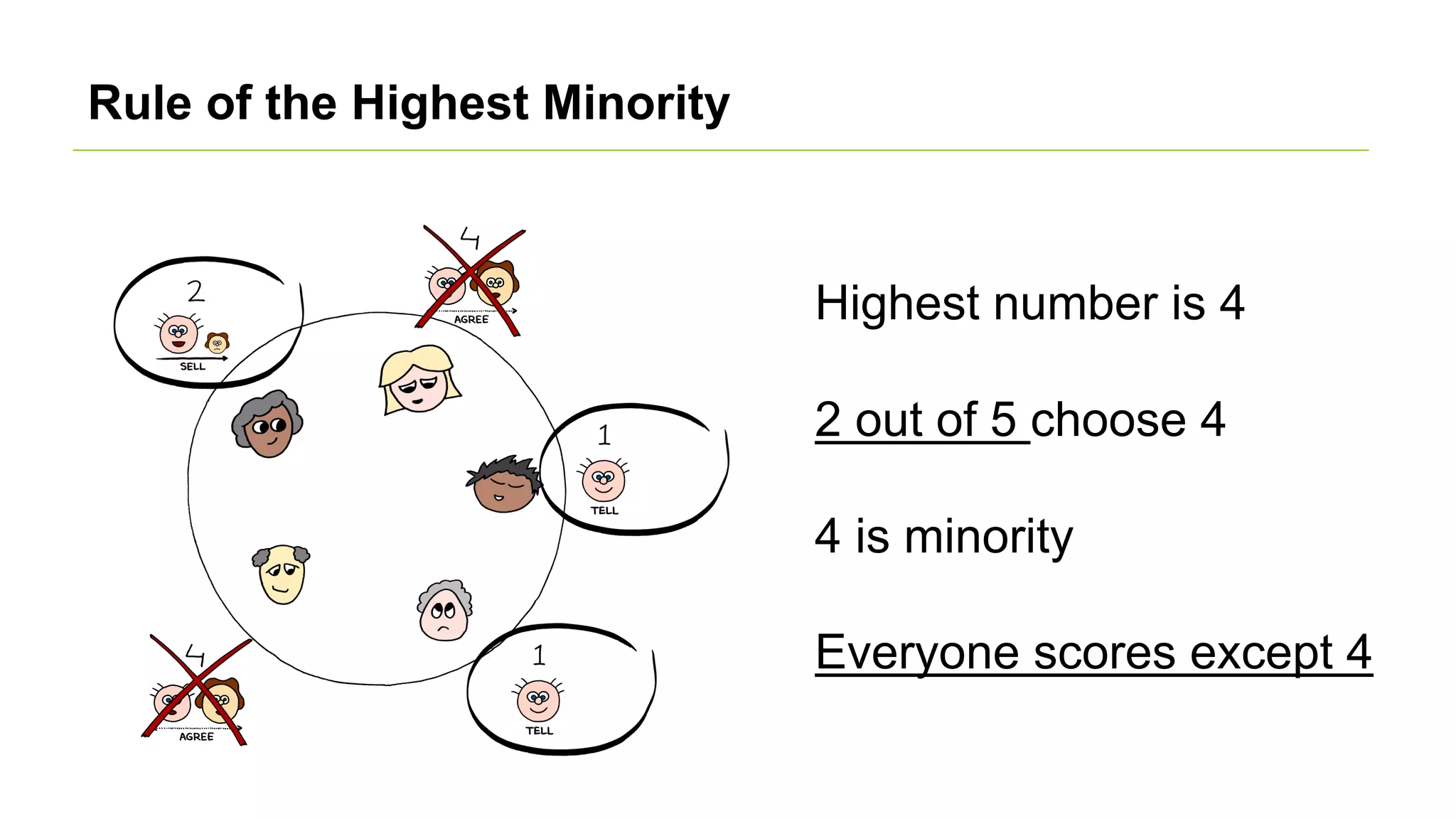
Rule of the Highest Minority
Highest number is 4
2 out of 5 choose 4
4 is minority
Everyone scores except 4
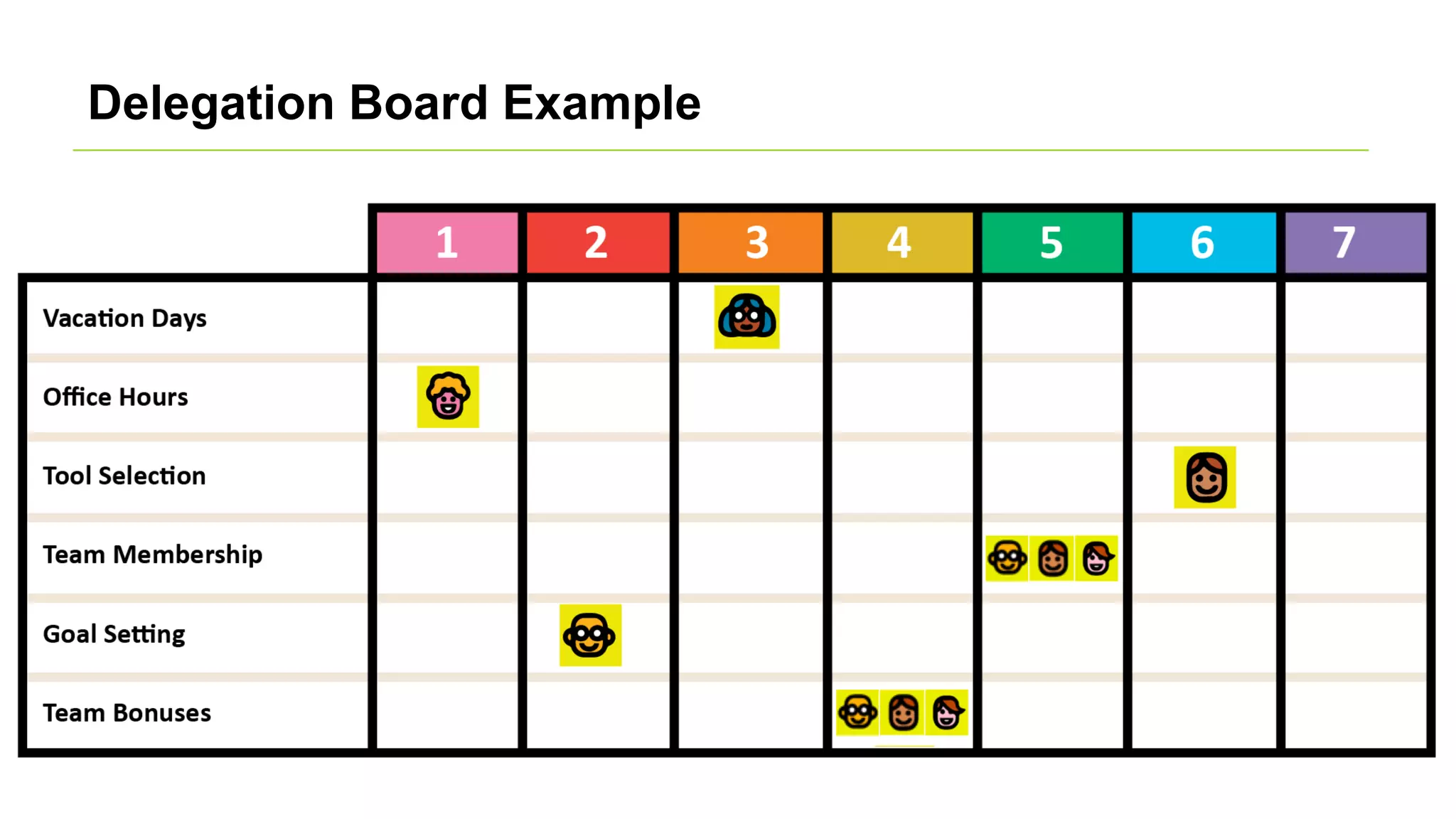
Delegation Board Example
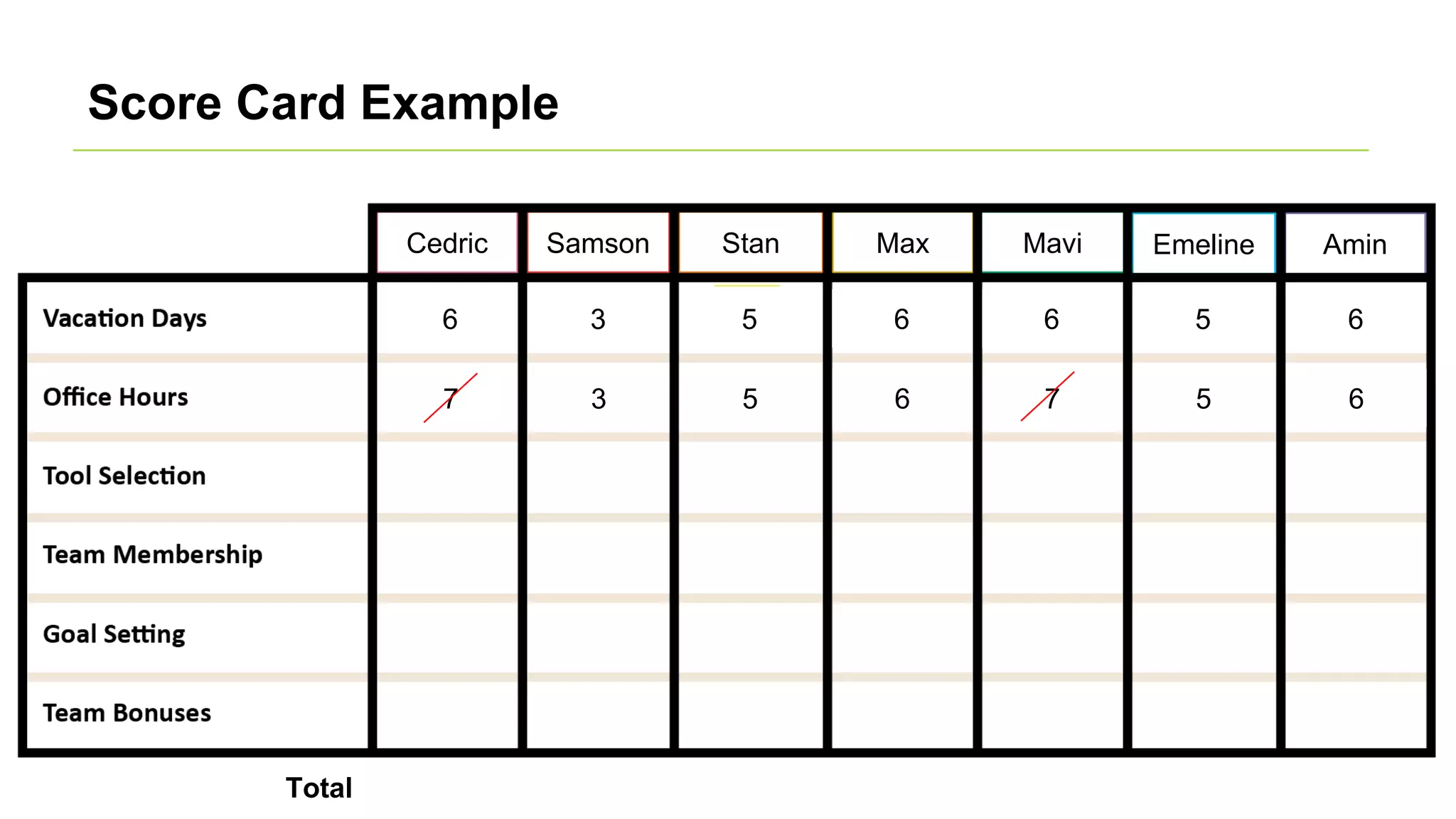
Score Card Example
Cedric Samson Stan Max Mavi Emeline Amin
36 5 6 6 5 6
37 5 6 7 5 6
Total
Game Start
Debrief (3 minutes)
What we experienced?
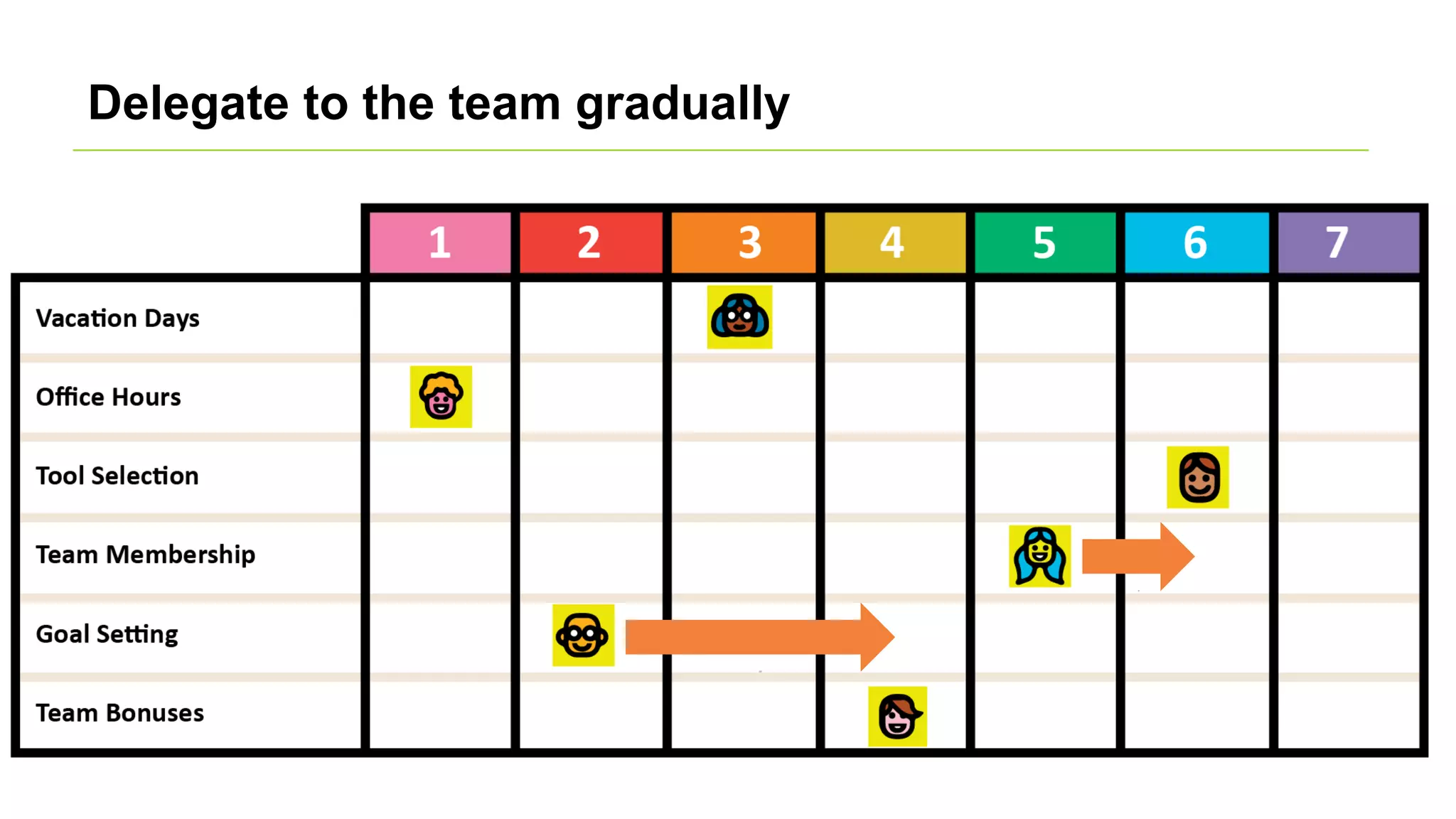
Delegate to the team gradually
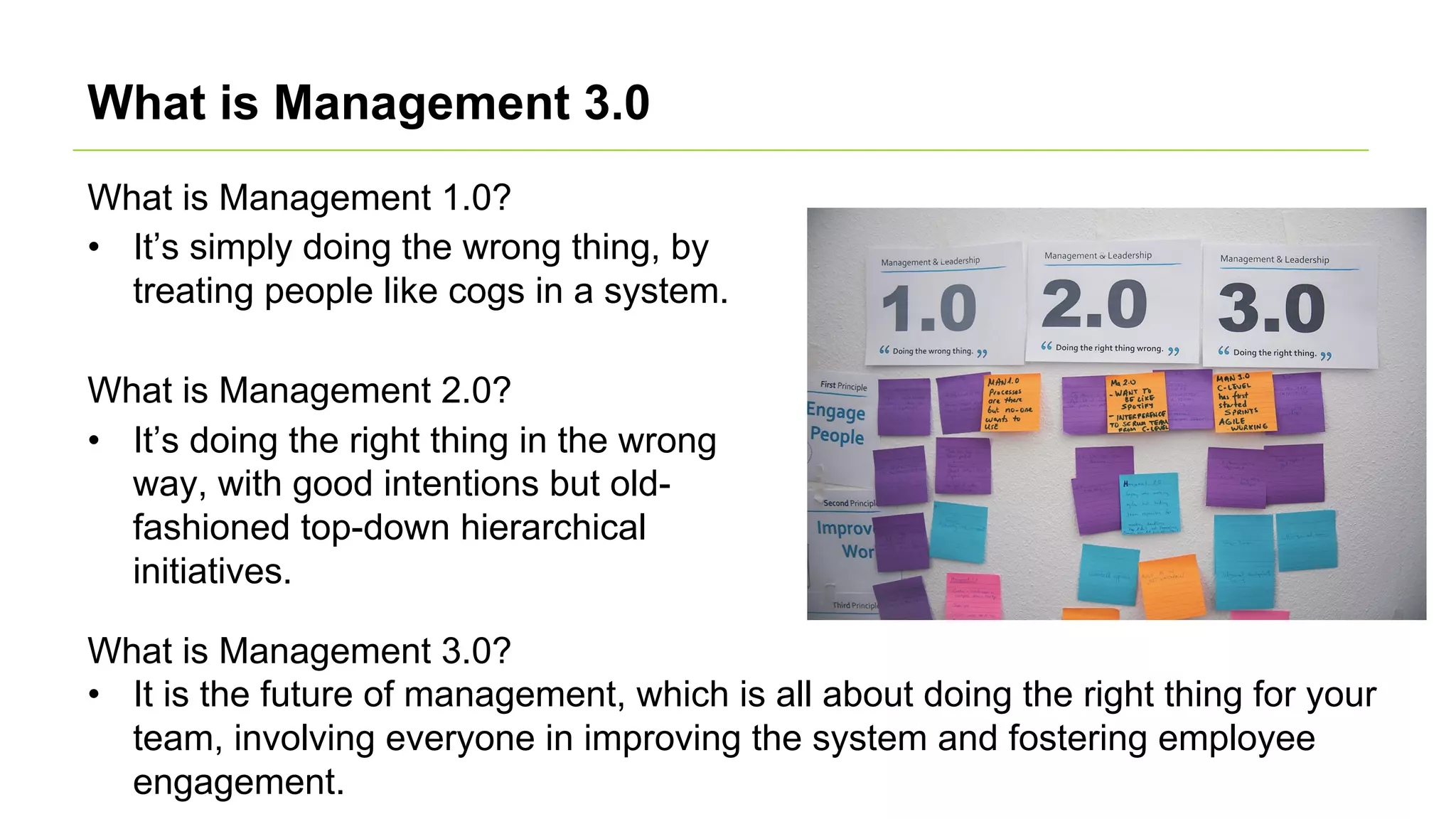
What is Management 3.0
What is Management 1.0?
• It’s simply doing the wrong thing, by
treating people like cogs in a system.
What is Management 2.0?
• It’s doing the right thing in the wrong
way, with good intentions but old-
fashioned top-down hierarchical
initiatives.
What is Management 3.0?
• It is the future of management, which is all about doing the right thing for your
team, involving everyone in improving the system and fostering employee
engagement.
Reference
Closing
Thank You
SINGAPORE
26A Circular Road
Singapore 049382
+65 6220 9908
singapore@palo-it.com
HONG KONG
WeWork Tower 535
20/F, 535 Jaffe Road
Causeway Bay, Hong Kong
+852 5987 2954
hongkong@palo-it.com
FRANCE
21 rue de Cléry, Schoolab,
75002 Paris
+33(0)1 76 54 38 16
france@palo-it.com
MEXICO
Calle Moliere 50,
11560, Mexico CDMX
+52(1) 55 4000 1282
mexico@palo-it.com
Contact Us
Contact Person:
Name
Title
+852 9999 9999
xxxxxx@palo-it.com
Thank You

Self-Organization in Agile & Digital Transformation

  • 1.
    Self-Organization in Agile& Digital Transformation 15th March, 2017
  • 2.
    About us Herbert LEE ExperiencedAgile Coach & Scrum Master Scrum, Kanban, XP and Management 3.0 Over 18 years experience in software development in both B2B and B2C, consulting and management experience in various industries such as Logistics, Bank, Consultancy, Digital and Aviation. Marivi ALMAZAN Experienced Scrum Master & Proj. Manager Scrum, Kanban, XP, Waterfall Over 15 years experience in agile and management experience in various industries such as Banking, eCommerce, Aviation, Telco, Garment.
  • 3.
  • 4.
  • 5.
    Self organizing team ASelf-organizing teams empowered to make their own decisions with their ability to achieve the goal within boundaries. “The best architectures, requirements, and designs emerge from self-organizing teams”, an agile principle.
  • 6.
  • 7.
  • 12.
    7 Levels ofDelegation
  • 13.
    Delegation Poker –7 Levels of Delegation • Tell: I will tell them • Sell: I will try and sell it to them • Consult: I will consult and then decide • Agree: We will agree together • Advise: I will advice but they decide • Inquire: I will inquire after they decide • Delegate: I will fully delegate
  • 14.
    The 7 Levelsof Delegation is a symmetrical model. • The first three levels have the decision making with the manager (all about manager making the decision) • The last three levels the decision making is with the team or employee manager (all about employee or team making the decision) • 4 is about consensus where the team must decide together
  • 15.
    The 7 Levelsof Delegation is a symmetrical model. Consult is the opposite of Advise.
  • 16.
    The 7 Levelsof Delegation is a symmetrical model. Sell is the mirror of Inquire.
  • 17.
    Let’s take abreak – 10 mins
  • 18.
  • 19.
    How do westart • Identify a manager in the team • Choose / create a scenario – ORGANIZE A PARTY – ORGANIZE AN EVENT – ORGANIZE A COMPANY TRIP – PLAN TO MOVE A NEW PLACE (HOUSE / OFFICE) – YOUR SCENARIO • List out 7 Key Decision Areas (e.g. Budget, Date, Location etc.) • Create Delegation Board • Create Score card
  • 20.
  • 21.
    Score Card Cedric SamsonStan Max Mavi Emeline Amin
  • 22.
    Game steps • Oneperson picks out a key decision area to read aloud to the team • Each player chooses one of the seven delegation cards privately, reflecting on how she would delegate the decision in that particular situation. • When all players have decided, they show their selected cards to the team. • Let the people with the highest and the lowest cards explain the reasoning behind their choices. • Everyone earns points according to the value of their selected card, except the players that are the “highest minority” (see below).
  • 23.
    Rule of theHighest Minority Highest number is 7 1 out of 5 choose 7 7 is minority Everyone scores except 7
  • 24.
    Rule of theHighest Minority Highest number is 6 3 out of 5 choose 6 6 is majority Everyone scores
  • 25.
    Rule of theHighest Minority Highest number is 4 2 out of 5 choose 4 4 is minority Everyone scores except 4
  • 26.
  • 27.
    Score Card Example CedricSamson Stan Max Mavi Emeline Amin 36 5 6 6 5 6 37 5 6 7 5 6 Total
  • 28.
  • 29.
    Debrief (3 minutes) Whatwe experienced?
  • 30.
    Delegate to theteam gradually
  • 31.
    What is Management3.0 What is Management 1.0? • It’s simply doing the wrong thing, by treating people like cogs in a system. What is Management 2.0? • It’s doing the right thing in the wrong way, with good intentions but old- fashioned top-down hierarchical initiatives. What is Management 3.0? • It is the future of management, which is all about doing the right thing for your team, involving everyone in improving the system and fostering employee engagement.
  • 32.
  • 33.
  • 34.
  • 35.
    SINGAPORE 26A Circular Road Singapore049382 +65 6220 9908 singapore@palo-it.com HONG KONG WeWork Tower 535 20/F, 535 Jaffe Road Causeway Bay, Hong Kong +852 5987 2954 hongkong@palo-it.com FRANCE 21 rue de Cléry, Schoolab, 75002 Paris +33(0)1 76 54 38 16 france@palo-it.com MEXICO Calle Moliere 50, 11560, Mexico CDMX +52(1) 55 4000 1282 mexico@palo-it.com Contact Us Contact Person: Name Title +852 9999 9999 xxxxxx@palo-it.com
  • 36.