MINI PROJECT SEMINER ON
SELF COMPACTING CONCRETE
UNDER THE GUIDANCE OF BY
Asst. Prof SHRIDEVI CHIKKUR AVINASH H 1VJ14CV401
NECHI TANA 1VJ14CV405
VIKASH KUMAR 1VJ14CV408
WRISHOV NANDAN 1VJ14CV409
INTRODUCTION
• Self compacting concrete is highly engineered concrete with much higher
fluidity without segregation and is capable of filling every corner of
formwork under its self weight .
• In 1983, the problem of the durability of the concrete structures was a
major topic of interest in Japan.
• The necessity of this type of concrete was proposed by Okamura in 1986
• By the early 1990's, Japan has developed and used Self compacting
concrete
• Thus self compacting concrete eliminates the vibration for the compaction
of concrete without affecting its engineering properties.
• As of the year 2000, self compacting concrete used for prefabricated
products (precast members) and ready mixed concrete (cast-in-situ) in
JAPAN, USA and later on INDIA etc.
• Studies to develop self compacting concrete have been carried out by
Ozawa and Melawi at the university of Tokyo.
• Present-day self compacting concrete can be treated as an advanced
construction material.
LITERATURE REVIEW
• Payal Painuly (2016) [1] Making concrete structure without compaction
has been done in the past. Like placement of concrete underwater by the
use of termie without compaction. Inaccessible areas were concreted using
such techniques. The production of such mixes often used expensive
admixtures and very large quantity of cement. But such concrete was
generally of lower strength and difficult to obtain. This lead to the
development of Self Compacting Concrete (SCC) The workability
properties of SCC such as filling ability, passing ability and segregation
resistance are evaluated using workability tests such as slump flow, V-
funnel and L-Box tests.
• J M Khatib (2008) [2] The influence of including fly ash (FA) on the
properties of self-compacting concrete (SCC) is investigated. Portland
cement (PC) was partially replaced with 0–80% FA. The water to binder
ratio was maintained at 0.36 for all mixes. Properties included workability,
compressive strength, ultrasonic pulse velocity (V), absorption and
shrinkage. The results indicate that high volume FA can be used in SCC to
produce high strength and low shrinkage. Replacing 40% of PC with FA
resulted in a strength of more than 65 N/mm2 at 56 days. High absorption
values are obtained with increasing amount of FA, however, all FA concrete
exhibits absorption of less than 2%. There is a systematic reduction in
shrinkage as the FA content increases and at 80% FA content, the shrinkage
at 56 days reduced by two third compared with the control. A linear
relationship exists between the 56 day shrinkage and FA content. Increasing
the admixture content beyond a certain level leads to a reduction in strength
and increase in absorption. The correlation between strength and absorption
indicates that there is sharp decrease in strength as absorption increases
from 1 to 2%. After 2% absorption, the strength reduces at a much slower
rate.
• Miao (2010) [3] conducted a research on developing a SCC with cement
replacement with metakaoline up to 80% in all the mixes and examining its
fresh properties. Result show that the metakaolin acts as a lubricant
material; it does not react with superplasticizer and produce a repulsive
force and the superplasticizer may only act on the cement. As a result, the
larger the amount of metakaolin contained, lesser the superplasticizer
needed.
OBJECTIVES
PROBLEM CONTEXT
Due to an over-whelming demand from the construction industry, the
housing industry for the need of sustainable building materials, industrial
by-products are being used in various proportions with the cement binder ,
to increase the workability and strength.
For the present investigation, high strength concrete is being produced by
partial replacement of cement with fly-ash and metakaolin.
The use of traditional binding materials incurs huge cost, for which the
introduction of various by products with cement not only gives excellent
workability and strength but also makes the project economical as the cost
is reduced by decreasing the amount of cement, and increasing the
percentage of by-products.
OBJECTIVES
1. To find out the Filling ability during the Fresh State
2. To find out the Passing ability during the Fresh State
3. To know the Segregation resistance
4. To know the Viscosity
5. To know the Flowing ability
6. To find out the Blocking effects
7. To find out the Compressive strength and Split Tensile Strength
during Hardened state
8. To determine whether the properties obtained are structurally
sufficent compared to the conventional way of compaction.
MATERIALS
With regard to its composition, SCC consists of the same
components as conventionally vibrated concrete, which are :
1. CEMENT: Portland Cement
2. M-SAND : Fines less than 0.125mm - powder,which
is very important for SCC
3. COARSE AGGREGATE :
Normal maximum size is generally 16 –
20mm.
APPLICATION
• The application of this kind of concrete has been used in bridges and even
on pre-cast sections.
One of the most remarkable projects built using self-compacting concrete is
the Akashi-Kaikyo Suspension Bridge, Japan.
In this project the SCC was mixed on-site and pumped through a piping
system to the specified point, located 200 meters away. On this particular
project the construction time was reduced from 2.5 years to 2 years
ADVANTAGES
• The advantages which this concrete gives are
• i) Faster and more efficient placement of fresh concrete is achieved.
• ii) Total concreting time is reduced.
• iii) High quality of placed concrete is achieved, regardless the skill of the
workers.
• iv) No vibration of fresh concrete is necessary during placement into
forms.
• v) Good bond between concrete and reinforcement is obtained, even in
congested reinforcement.
• vi) High quality of concrete surface finish is obtained with no need for
subsequent repair.
• vii) Improved durability of structures is achieved and maintenance costs
are reduced
CHEMICAL ADMIXTURE :
Superplasticizers and VMA or Viscous Modifying Agents.
MINERAL ADMIXTURE :
Fly-ash and Metakaolin
Typical Mix ProportionValues
Constituent Typical range by volume(liter/m3)
Powder 160-240
Water 150-210
Coarse aggregate 270-360
Water to Powder Ratio 0.80-1.10
Fine aggregate 48-55% of total
aggregate weight
METHODOLOGY
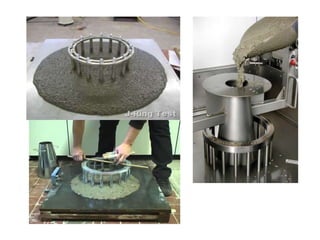
J-ring
i) A modified slump cone is positioned either inverted or upright in the
middle of the J-Ring and filled with concrete in a single lift.
ii) The cone is then lifted straight up and the diameter of the resulting
circular flow of concrete is measured.
iii) Additional measurements or visual classifications may also be
determined at the conclusion of the test
V- funnel
1. The described V-funnel test is used to determine the filling ability
(flow ability) of the concrete with a maximum aggregate size of
20mm.
2. The funnel is filled with about 12 litre of concrete and the time taken
for it to flow through the apparatus measured.
3. After this the funnel can be refilled concrete and left for 5 minutes to
settle. If the concrete shows segregation then the flow time will
increases significantly.
L box
i) The apparatus consist of rectangular section box in the shape of an ‘L’,
with a vertical and horizontal section, separated by a movable gate, in front
of which vertical length of reinforcement bar are fitted.
ii) The vertical section is filled with concrete, and then the gate lifted to let
the concrete flow into the horizontal section.
iii) When the flow has stopped, the height of the concrete at the end of the
horizontal section is expressed as a proportion of that remaining in the
vertical section.
iv) It indicates the slope of the concrete when at rest.
v) This is an indication passing ability, or the degree to which the passage
of concrete through the bars is restricted.
U box
i) The test is used to measure the filing ability of self
compacting concrete.
ii) The apparatus consists of a vessel that is divided by a
middle wall into two compartments; an opening with a sliding
gate is fitted between the two sections
iii) Reinforcing bar with nominal diameter of 134 mm are
installed at the gate with centre to centre spacing of 50 mm.
iv) This create a clear spacing of 35 mm between bars. The
left hand section is filled with about 20 liter of concrete then
the gate is lifted and the concrete flows upwards into the other
section. The height of the concrete in both sections is
measured.
REFERENCES
1. Payal Uniyal (2016) International Journal of Technical Research and
Applications e-ISSN: 2320-8163, www.ijtra.com Volume 4, Issue 2
(March-April, 2016), PP. 178-180
2.Miao, Liu (2010).Self- compacting concrete with different levels of
pulverized fuel ash.Construction and Building Materials. 24: 1245-1252.
3. Khatib, J.M. (2008). Performance of self- compacting concrete
containing fly ash.Construction and Building Materials. 22: 1963-1971

Self_compacting_concrete_with_metakaolin[1].pptx

  • 1.
    MINI PROJECT SEMINERON SELF COMPACTING CONCRETE UNDER THE GUIDANCE OF BY Asst. Prof SHRIDEVI CHIKKUR AVINASH H 1VJ14CV401 NECHI TANA 1VJ14CV405 VIKASH KUMAR 1VJ14CV408 WRISHOV NANDAN 1VJ14CV409
  • 2.
    INTRODUCTION • Self compactingconcrete is highly engineered concrete with much higher fluidity without segregation and is capable of filling every corner of formwork under its self weight . • In 1983, the problem of the durability of the concrete structures was a major topic of interest in Japan. • The necessity of this type of concrete was proposed by Okamura in 1986 • By the early 1990's, Japan has developed and used Self compacting concrete • Thus self compacting concrete eliminates the vibration for the compaction of concrete without affecting its engineering properties. • As of the year 2000, self compacting concrete used for prefabricated products (precast members) and ready mixed concrete (cast-in-situ) in JAPAN, USA and later on INDIA etc. • Studies to develop self compacting concrete have been carried out by Ozawa and Melawi at the university of Tokyo. • Present-day self compacting concrete can be treated as an advanced construction material.
  • 3.
    LITERATURE REVIEW • PayalPainuly (2016) [1] Making concrete structure without compaction has been done in the past. Like placement of concrete underwater by the use of termie without compaction. Inaccessible areas were concreted using such techniques. The production of such mixes often used expensive admixtures and very large quantity of cement. But such concrete was generally of lower strength and difficult to obtain. This lead to the development of Self Compacting Concrete (SCC) The workability properties of SCC such as filling ability, passing ability and segregation resistance are evaluated using workability tests such as slump flow, V- funnel and L-Box tests.
  • 4.
    • J MKhatib (2008) [2] The influence of including fly ash (FA) on the properties of self-compacting concrete (SCC) is investigated. Portland cement (PC) was partially replaced with 0–80% FA. The water to binder ratio was maintained at 0.36 for all mixes. Properties included workability, compressive strength, ultrasonic pulse velocity (V), absorption and shrinkage. The results indicate that high volume FA can be used in SCC to produce high strength and low shrinkage. Replacing 40% of PC with FA resulted in a strength of more than 65 N/mm2 at 56 days. High absorption values are obtained with increasing amount of FA, however, all FA concrete exhibits absorption of less than 2%. There is a systematic reduction in shrinkage as the FA content increases and at 80% FA content, the shrinkage at 56 days reduced by two third compared with the control. A linear relationship exists between the 56 day shrinkage and FA content. Increasing the admixture content beyond a certain level leads to a reduction in strength and increase in absorption. The correlation between strength and absorption indicates that there is sharp decrease in strength as absorption increases from 1 to 2%. After 2% absorption, the strength reduces at a much slower rate.
  • 5.
    • Miao (2010)[3] conducted a research on developing a SCC with cement replacement with metakaoline up to 80% in all the mixes and examining its fresh properties. Result show that the metakaolin acts as a lubricant material; it does not react with superplasticizer and produce a repulsive force and the superplasticizer may only act on the cement. As a result, the larger the amount of metakaolin contained, lesser the superplasticizer needed.
  • 6.
    OBJECTIVES PROBLEM CONTEXT Due toan over-whelming demand from the construction industry, the housing industry for the need of sustainable building materials, industrial by-products are being used in various proportions with the cement binder , to increase the workability and strength. For the present investigation, high strength concrete is being produced by partial replacement of cement with fly-ash and metakaolin. The use of traditional binding materials incurs huge cost, for which the introduction of various by products with cement not only gives excellent workability and strength but also makes the project economical as the cost is reduced by decreasing the amount of cement, and increasing the percentage of by-products.
  • 7.
    OBJECTIVES 1. To findout the Filling ability during the Fresh State 2. To find out the Passing ability during the Fresh State 3. To know the Segregation resistance 4. To know the Viscosity 5. To know the Flowing ability 6. To find out the Blocking effects 7. To find out the Compressive strength and Split Tensile Strength during Hardened state 8. To determine whether the properties obtained are structurally sufficent compared to the conventional way of compaction.
  • 8.
    MATERIALS With regard toits composition, SCC consists of the same components as conventionally vibrated concrete, which are : 1. CEMENT: Portland Cement 2. M-SAND : Fines less than 0.125mm - powder,which is very important for SCC 3. COARSE AGGREGATE : Normal maximum size is generally 16 – 20mm.
  • 9.
    APPLICATION • The applicationof this kind of concrete has been used in bridges and even on pre-cast sections. One of the most remarkable projects built using self-compacting concrete is the Akashi-Kaikyo Suspension Bridge, Japan. In this project the SCC was mixed on-site and pumped through a piping system to the specified point, located 200 meters away. On this particular project the construction time was reduced from 2.5 years to 2 years
  • 10.
    ADVANTAGES • The advantageswhich this concrete gives are • i) Faster and more efficient placement of fresh concrete is achieved. • ii) Total concreting time is reduced. • iii) High quality of placed concrete is achieved, regardless the skill of the workers. • iv) No vibration of fresh concrete is necessary during placement into forms. • v) Good bond between concrete and reinforcement is obtained, even in congested reinforcement. • vi) High quality of concrete surface finish is obtained with no need for subsequent repair. • vii) Improved durability of structures is achieved and maintenance costs are reduced
  • 11.
    CHEMICAL ADMIXTURE : Superplasticizersand VMA or Viscous Modifying Agents. MINERAL ADMIXTURE : Fly-ash and Metakaolin
  • 12.
    Typical Mix ProportionValues ConstituentTypical range by volume(liter/m3) Powder 160-240 Water 150-210 Coarse aggregate 270-360 Water to Powder Ratio 0.80-1.10 Fine aggregate 48-55% of total aggregate weight
  • 13.
    METHODOLOGY J-ring i) A modifiedslump cone is positioned either inverted or upright in the middle of the J-Ring and filled with concrete in a single lift. ii) The cone is then lifted straight up and the diameter of the resulting circular flow of concrete is measured. iii) Additional measurements or visual classifications may also be determined at the conclusion of the test
  • 15.
    V- funnel 1. Thedescribed V-funnel test is used to determine the filling ability (flow ability) of the concrete with a maximum aggregate size of 20mm. 2. The funnel is filled with about 12 litre of concrete and the time taken for it to flow through the apparatus measured. 3. After this the funnel can be refilled concrete and left for 5 minutes to settle. If the concrete shows segregation then the flow time will increases significantly.
  • 17.
    L box i) Theapparatus consist of rectangular section box in the shape of an ‘L’, with a vertical and horizontal section, separated by a movable gate, in front of which vertical length of reinforcement bar are fitted. ii) The vertical section is filled with concrete, and then the gate lifted to let the concrete flow into the horizontal section. iii) When the flow has stopped, the height of the concrete at the end of the horizontal section is expressed as a proportion of that remaining in the vertical section. iv) It indicates the slope of the concrete when at rest. v) This is an indication passing ability, or the degree to which the passage of concrete through the bars is restricted.
  • 19.
    U box i) Thetest is used to measure the filing ability of self compacting concrete. ii) The apparatus consists of a vessel that is divided by a middle wall into two compartments; an opening with a sliding gate is fitted between the two sections iii) Reinforcing bar with nominal diameter of 134 mm are installed at the gate with centre to centre spacing of 50 mm. iv) This create a clear spacing of 35 mm between bars. The left hand section is filled with about 20 liter of concrete then the gate is lifted and the concrete flows upwards into the other section. The height of the concrete in both sections is measured.
  • 21.
    REFERENCES 1. Payal Uniyal(2016) International Journal of Technical Research and Applications e-ISSN: 2320-8163, www.ijtra.com Volume 4, Issue 2 (March-April, 2016), PP. 178-180 2.Miao, Liu (2010).Self- compacting concrete with different levels of pulverized fuel ash.Construction and Building Materials. 24: 1245-1252. 3. Khatib, J.M. (2008). Performance of self- compacting concrete containing fly ash.Construction and Building Materials. 22: 1963-1971