SELF-COMPACTING CONCRETE USING
RECYCLED COARSE AGGREGATE
PRESENTED
BY
SWAPNA RANI PRADHAN, PRIYANSHU SINHA,
SUDIPTA HUI, GAURAV UDGATA.
CONTENTS
• Introduction
• Literature Review
• Methodology
• Advantages & Limitations
• Applications
• Conclusion
• References
INTRODUCTION
• The use of recycled concrete aggregates from demolition waste and
rubble in combination with cementitious additions in concrete has
various advantages. Self Compacting Concrete(SCC) with recycled
aggregate meet EFNARC guidelines for fresh properties of concrete and
with increase in content of recycled aggregate hardened properties like
compressive strength, tensile strength and flexural strength decreases.
SELF-COMPACTING CONCRETE
Self-consolidating concrete is a highly flowable
type of concrete that spreads into the form
without the need for mechanical vibration. Self-
compacting concrete is a non-segregating
concrete that is placed by means of its own
weight. The importance of self-compacting
concrete is that maintains all concrete’s
durability and characteristics, meeting expected
performance requirements.
COMPARISON
SELF-COMPACTING CONCRETE
• Gives good aesthetic finish.
• High workability.
• Water Content is Low.
• Low Viscosity due to high fines content.
• Good choice for thick reinforcement
works.
• Addition of superplasticizer increase the
bond between aggregate and cement
matrix.
NORMAL CONCRETE
• Aesthetic finish is not satisfactory.
• Less workable mix.
• High Water Content.
• High Viscosity.
• Limited in thick reinforcement
areas due to external compaction
difficulties.
• The aggregate-cement matrix is
weak.
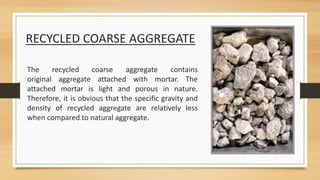
RECYCLED COARSE AGGREGATE
The recycled coarse aggregate contains
original aggregate attached with mortar. The
attached mortar is light and porous in nature.
Therefore, it is obvious that the specific gravity and
density of recycled aggregate are relatively less
when compared to natural aggregate.
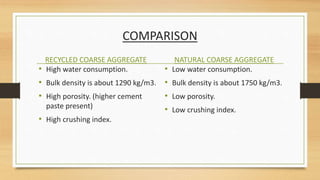
COMPARISON
RECYCLED COARSE AGGREGATE
• High water consumption.
• Bulk density is about 1290 kg/m3.
• High porosity. (higher cement
paste present)
• High crushing index.
NATURAL COARSE AGGREGATE
• Low water consumption.
• Bulk density is about 1750 kg/m3.
• Low porosity.
• Low crushing index.
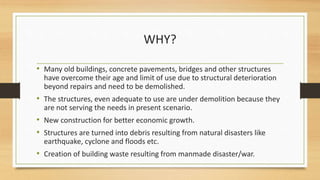
WHY?
• Many old buildings, concrete pavements, bridges and other structures
have overcome their age and limit of use due to structural deterioration
beyond repairs and need to be demolished.
• The structures, even adequate to use are under demolition because they
are not serving the needs in present scenario.
• New construction for better economic growth.
• Structures are turned into debris resulting from natural disasters like
earthquake, cyclone and floods etc.
• Creation of building waste resulting from manmade disaster/war.
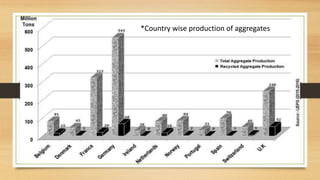
*Country wise production of aggregates
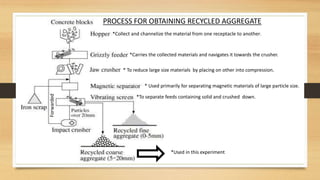
PROCESS FOR OBTAINING RECYCLED AGGREGATE
*Used in this experiment
*Collect and channelize the material from one receptacle to another.
*Carries the collected materials and navigates it towards the crusher.
* To reduce large size materials by placing on other into compression.
* Used primarily for separating magnetic materials of large particle size.
*To separate feeds containing solid and crushed down.
Forwarded
AUTHOR JOURNAL MATERIALS USED REMARKS
M.
Omrane
Z. Pan et
al
S.I.
Mohamm
ed and
K.B.
Najim
Construction and
Building
Materials 247
(2020)
Construction and
Building
Materials 200
(2019) 570–577
Structures 23
(2020) 34–43
Cement type CEM II/A
42.5, Natural pozzolan,
Natural coarse aggregates
Recycled coarse
aggregates,
Super plasticizer
(MEDAFLOW 30).
Ordinary Portland
Cement, Fly ash,
Steel slag powder,
Self compacting concrete
with Recycled aggregates
natural coarse aggregates.
Recycled Concrete
Aggregates ,
self-compacting concrete
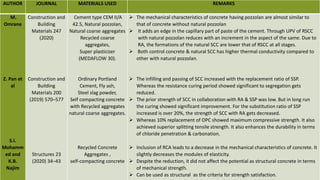
 The mechanical characteristics of concrete having pozzolan are almost similar to
that of concrete without natural pozzolan
 It adds an edge in the capillary part of paste of the cement. Through UPV of RSCC
with natural pozzolan reduces with an increment in the aspect of the same. Due to
RA, the formations of the natural SCC are lower that of RSCC at all stages.
 Both control concrete & natural SCC has higher thermal conductivity compared to
other with natural pozzolan.
 The infilling and passing of SCC increased with the replacement ratio of SSP.
Whereas the resistance curing period showed significant to segregation gets
reduced.
 The prior strength of SCC in collaboration with RA & SSP was low. But in long run
the curing showed significant improvement. For the substitution ratio of SSP
increased is over 20%, the strength of SCC with RA gets decreased.
 Whereas 10% replacement of OPC showed maximum compressive strength. It also
achieved superior splitting tensile strength. It also enhances the durability in terms
of chloride penetration & carbonation.
 Inclusion of RCA leads to a decrease in the mechanical characteristics of concrete. It
slightly decreases the modules of elasticity.
 Despite the reduction, it did not affect the potential as structural concrete in terms
of mechanical strength.
 Can be used as structural as the criteria for strength satisfaction.
AUTHOR JOURNAL MATERIALS REMARKS
L.A.
Pereira-de-
Oliveira et
al
Á. Salesa
et al
Z.J. Grdic
et al.
Construction
and Building
Materials 51
(2014) 113–120
Construction
and Building
Materials 153
(2017) 364–373
Construction
and Building
Materials 24
(2010) 1129–
1133
Recycled coarse
aggregate,
Natural coarse
aggregates.
Precast concrete
Recycled coarse
aggregate,
Multi recycled
coarse aggregate.
Coarse aggregate
Recycled coarse
aggregates.
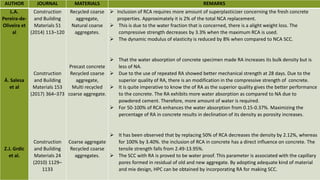
 Inclusion of RCA requires more amount of superplasticizer concerning the fresh concrete
properties. Approximately it is 2% of the total NCA replacement.
 This is due to the water fraction that is concerned, there is a alight weight loss. The
compressive strength decreases by 3.3% when the maximum RCA is used.
 The dynamic modulus of elasticity is reduced by 8% when compared to NCA SCC.
 That the water absorption of concrete specimen made RA increases its bulk density but is
less of NA.
 Due to the use of repeated RA showed better mechanical strength at 28 days. Due to the
superior quality of RA, there is an modification in the compressive strength of concrete.
 It is quite imperative to know the of RA as the superior quality gives the better performance
to the concrete. The RA exhibits more water absorption as compared to NA due to
powdered cement. Therefore, more amount of water is required.
 For 50-100% of RCA enhances the water absorption from 0.15-0.37%. Maximizing the
percentage of RA in concrete results in declination of its density as porosity increases.
 It has been observed that by replacing 50% of RCA decreases the density by 2.12%, whereas
for 100% by 3.40%. the inclusion of RCA in concrete has a direct influence on concrete. The
tensile strength falls from 2.49-13.95%.
 The SCC with RA is proved to be water proof. This parameter is associated with the capillary
pores formed in residual of old and new aggregate. By adopting adequate kind of material
and mix design, HPC can be obtained by incorporating RA for making SCC.
AUTHOR JOURNAL MATERIALS REMARKS
S.C. Kou,
C.S. Poon
K C Panda
and P K Bal
M. Abed et
al.
Cement &
Concrète
Composites
31 (2009)
622–627
Procedia
Engineering
51 ( 2013 )
159 – 164
Journal of
King Saud
University –
Engineering
Sciences
Coarse aggregates,
Recycled coarse
aggregates,
Fine aggregates,
Recycled fine
aggregates,
River sand.
Natural Coarse
Aggregate, normal
vibrated concrete
recycled aggregate,
recycled coarse
aggregate,
self compacting
concrete.
reused recycled
concrete aggregates,
recycled aggregate
concrete.
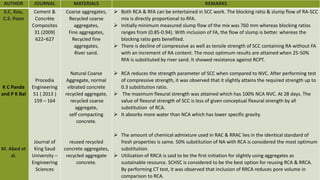
 Both RCA & RFA can be entertained in SCC work. The blocking ratio & slump flow of RA-SCC
mix is directly proportional to RFA.
 Initially minimum measured slump flow of the mix was 760 mm whereas blocking ratios
ranges from (0.85-0.94). With inclusion of FA, the flow of slump is better. whereas the
blocking ratio gets benefited.
 There is decline of compressive as well as tensile strength of SCC containing RA without FA
with an increment of RA content. The most optimum results are attained when 25-50%
RFA is substituted by river sand. It showed resistance against RCPT.
 RCA reduces the strength parameter of SCC when compared to NVC. After performing test
of compressive strength, it was observed that it slightly attains the required strength up to
0.3 substitution ratio.
 The maximum flexural strength was attained which has 100% NCA NVC. At 28 days. The
value of flexural strength of SCC is less of given conceptual flexural strength by all
substitution of RCA.
 It absorbs more water than NCA which has lower specific gravity.
 The amount of chemical admixture used in RAC & RRAC lies in the identical standard of
fresh properties is same. 50% substitution of NA with RCA is considered the most optimum
substitution.
 Utilization of RRCA is said to be the first initiation for slightly using aggregates as
sustainable resource. SCHSC is considered to be the best option for reusing RCA & RRCA.
By performing CT test, it was observed that inclusion of RRCA reduces pore volume in
comparison to RCA.
AUTHOR JOURNAL MATERIALS REMARKS
González-
Taboada, B.
González-
Fonteboa, F.
Martínez-Abella,
and SF.
Fiol et al. Seara-
Paz
E. Güneyisi et al
ACI Materials
Journal/January
2020
Construction and
Building Materials
182 (2018) 309–
323
Construction and
Building Materials
113 (2016) 622–
630
Cement Filler,
Natural sand,
Natural coarse aggregate,
Recycled coarse
aggregate.
Natural aggregate,
Recycled aggregate.
Recycled concrete
aggregate, Fly ash
Coarse recycled concrete
aggregates.
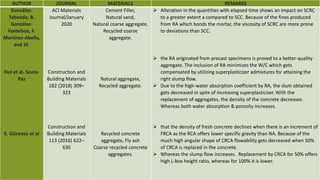
 Alteration in the quantities with elapsed time shows an impact on SCRC
to a greater extent a compared to SCC. Because of the fines produced
from RA which bonds the mortar, the viscosity of SCRC are more prone
to deviations than SCC.
 the RA originated from precast specimens is proved to a better-quality
aggregate. The inclusion of RA minimizes the W/C which gets
compensated by utilizing superplasticizer admixtures for attaining the
right slump flow.
 Due to the high-water absorption coefficient by RA, the slum obtained
gets decreased in spite of increasing superplasticizer. With the
replacement of aggregates, the density of the concrete decreases.
Whereas both water absorption & porosity increases.
 that the density of fresh concrete declines when there is an increment of
FRCA as the RCA offers lower specific gravity than NA. Because of the
much high angular shape of CRCA flowability gets decreased when 50%
of CRCA is replaced in the concrete.
 Whereas the slump flow increases. Replacement by CRCA for 50% offers
high L-box height ratio, whereas for 100% it is lower.
AUTHOR JOURNAL MATERIALS REMARKS
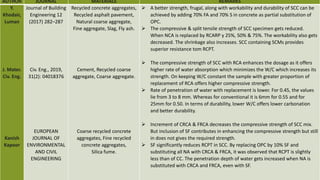
Y.
Khodair,
Luman
J. Mater.
Civ. Eng.
Kanish
Kapoor
Journal of Building
Engineering 12
(2017) 282–287
Civ. Eng., 2019,
31(2): 04018376
EUROPEAN
JOURNAL OF
ENVIRONMENTAL
AND CIVIL
ENGINEERING
Recycled concrete aggregates,
Recycled asphalt pavement,
Natural coarse aggregate,
Fine aggregate, Slag, Fly ash.
Cement, Recycled coarse
aggregate, Coarse aggregate.
Coarse recycled concrete
aggregates, Fine recycled
concrete aggregates,
Silica fume.
 A better strength, frugal, along with workability and durability of SCC can be
achieved by adding 70% FA and 70% S in concrete as partial substitution of
OPC.
 The compressive & split tensile strength of SCC specimen gets reduced.
When NCA is replaced by RCARP y 25%, 50% & 75%. The workability also gets
decreased. The shrinkage also increases. SCC containing SCMs provides
superior resistance tom RCPT.
 The compressive strength of SCC with RCA enhances the dosage as it offers
higher rate of water absorption which minimizes the W/C which increases its
strength. On keeping W/C constant the sample with greater proportion of
replacement of RCA offers higher compressive strength.
 Rate of penetration of water with replacement is lower. For 0.45, the values
lie from 3 to 8 mm. Whereas for conventional it is 6mm for 0.55 and for
25mm for 0.50. In terms of durability, lower W/C offers lower carbonation
and better durability.
 Increment of CRCA & FRCA decreases the compressive strength of SCC mix.
But inclusion of SF contributes in enhancing the compressive strength but still
in does not gives the required strength.
 SF significantly reduces RCPT in SCC. By replacing OPC by 10% SF and
substituting all NA with CRCA & FRCA, it was observed that RCPT is slightly
less than of CC. The penetration depth of water gets increased when NA is
substituted with CRCA and FRCA, even with SF.
AUTHOR JOURNAL MATERIALS REMARKS
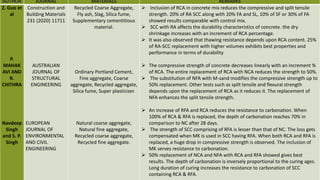
Z. Guo et
al
P.
MAHAK
AVI AND
R.
CHITHRA
Navdeep
Singh
and S. P.
Singh
Construction and
Building Materials
231 (2020) 11711
AUSTRALIAN
JOURNAL OF
STRUCTURAL
ENGINEERING
EUROPEAN
JOURNAL OF
ENVIRONMENTAL
AND CIVIL
ENGINEERING
Recycled Coarse Aggregate,
Fly ash, Slag, Silica fume,
Supplementary cementitious
material.
Ordinary Portland Cement,
Fine aggregate, Coarse
aggregate, Recycled aggregate,
Silica fume, Super plasticizer.
Natural coarse aggregate,
Natural fine aggregate,
Recycled coarse aggregate,
Recycled fine aggregate.
 Inclusion of RCA in concrete mix reduces the compressive and split tensile
strength. 20% of RA SCC along with 20% FA and SL, 10% of SF or 30% of FA
showed results comparable with control mix.
 SCC with RA affects the durability characteristics of concrete. the dry
shrinkage increases with an increment of RCA percentage.
 It was also observed that thawing resistance depends upon RCA content. 25%
of RA-SCC replacement with higher volumes exhibits best properties and
performance in terms of durability
 The compressive strength of concrete decreases linearly with an increment %
of RCA. The entire replacement of RCA with NCA reduces the strength to 50%.
 The substitution of NFA with M-sand modifies the compressive strength up to
50% replacement. Other tests such as spilt tensile and flexural strength
depends upon the replacement of RCA as it reduces it. The replacement of
NFA enhances the split tensile strength.
 An increase of RFA and RCA reduces the resistance to carbonation. When
100% of RCA & RFA is replaced, the depth of carbonation reaches 70% in
comparison to NC after 28 days.
 The strength of SCC comprising of RFA is lesser than that of NC. The loss gets
compensated when MK is used in SCC having RFA. When both RCA and RFA is
replaced, a huge drop in compressive strength is observed. The inclusion of
MK serves resistance to carbonation.
 50% replacement of NCA and NFA with RCA and RFA showed gives best
results. The depth of carbonation is inversely proportional to the curing ages.
Long duration of curing increases the resistance to carbonation of SCC
containing RCA & RFA.
AUTHOR JOURNAL MATERIALS REMARKS
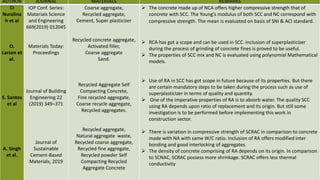
D
Nuralina
h et al
O.
Larsen et
al.
S. Santos
et al
A. Singh
et al.
IOP Conf. Series:
Materials Science
and Engineering
669(2019) 012045
Materials Today:
Proceedings
Journal of Building
Engineering 22
(2019) 349–371
Journal of
Sustainable
Cement-Based
Materials, 2019
Coarse aggregate,
Recycled aggregate,
Cement, Super plasticizer
Recycled concrete aggregate,
Activated filler,
Coarse aggregate
Sand.
Recycled Aggregate Self
Compacting Concrete,
Fine recycled aggregate,
Coarse recycle aggregate,
Recycled aggregates.
Recycled aggregate,
Natural aggregate waste,
Recycled coarse aggregate,
Recycled fine aggregate,
Recycled powder Self
Compacting Recycled
Aggregate Concrete
 The concrete made up of NCA offers higher compressive strength that of
concrete with SCC. The Young’s modulus of both SCC and NC correspond with
compressive strength. The mean is evaluated on basis of SNI & ACI standard.
 RCA has got a scope and can be used in SCC. Inclusion of superplasticizer
during the process of grinding of concrete fines is proved to be useful.
 The properties of SCC mix and NC is evaluated using polynomial Mathematical
models.
 Use of RA in SCC has got scope in future because of its properties. But there
are certain mandatory steps to be taken during the process such as use of
superplasticizer in terms of quality and quantity.
 One of the imperative properties of RA is to absorb water. The quality SCC
using RA depends upon ratio of replacement and its origin. But still some
investigation is to be performed before implementing this work in
construction sector.
 There is variation in compressive strength of SCRAC in comparison to concrete
made with NA with same W/C ratio. Inclusion of RA offers modified inter
bonding and good interlocking of aggregates.
 The density of concrete comprising of RA depends on its origin. In comparison
to SCNAC, SCRAC possess more shrinkage. SCRAC offers less thermal
conductivity
AUTHOR JOURNAL MATERIALS REMARKS
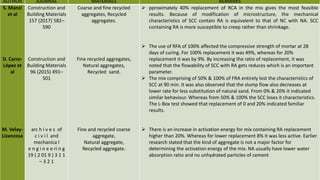
S. Manzi
et al
D. Carro-
López et
al
M. Velay-
Lizancosa
Construction and
Building Materials
157 (2017) 582–
590
Construction and
Building Materials
96 (2015) 491–
501
arc h i v e s of
c i v i l and
mechanica l
e n g i n e e ri n g
19 ( 2 01 9 ) 3 1 1
– 3 2 1
Coarse and fine recycled
aggregates, Recycled
aggregates.
Fine recycled aggregates,
Natural aggregates,
Recycled sand.
Fine and recycled coarse
aggregate,
Natural aggregate,
Recycled aggregate.
 pproximately 40% replacement of RCA in the mix gives the most feasible
results. Because of modification of microstructure, the mechanical
characteristics of SCC contain RA is equivalent to that of NC with NA. SCC
containing RA is more susceptible to creep rather than shrinkage.
 The use of RFA of 100% affected the compressive strength of mortar at 28
days of curing. For 100% replacement it was 49%, whereas for 20%
replacement it was by 9%. By increasing the ratio of replacement, it was
noted that the flowability of SCC with RA gets reduces which is an important
parameter.
 The mix comprising of 50% & 100% of FRA entirely lost the characteristics of
SCC at 90 min. It was also observed that the slump flow also decreases at
lower rate for less substitution of natural sand. From 0% & 20% it indicated
similar behaviour. Whereas from 50% & 100% the SCC loses it characteristics.
The L-Box test showed that replacement of 0 and 20% indicated familiar
results.
 There is an increase in activation energy for mix containing RA replacement
higher than 20%. Whereas for lower replacement 8% it was less active. Earlier
research stated that the kind of aggregate is not a major factor for
determining the activation energy of the mix. NA usually have lower water
absorption ratio and no unhydrated particles of cement
AUTHOR JOURNAL MATERIALS REMARKS
P. Rajhans et
al
R. B. Ardalan
et al.
Construction and
Building
Materials 218
(2019) 568–581
Journal of
Sustainable
Cement-Based
Materials, 2019
sustainable self compacting
heat cured recycled
aggregate
Concrete, Recycled coarse
aggregates.
Type II Portland cement
Poly carboxylic-ether type
super plasticizer
Coarse aggregate
Fine aggregate
RCA
Crushing waste concrete
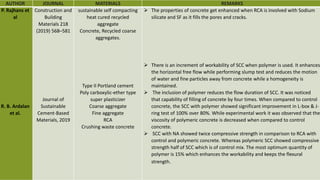
 The properties of concrete get enhanced when RCA is involved with Sodium
silicate and SF as it fills the pores and cracks.
 There is an increment of workability of SCC when polymer is used. It enhances
the horizontal free flow while performing slump test and reduces the motion
of water and fine particles away from concrete while a homogeneity is
maintained.
 The inclusion of polymer reduces the flow duration of SCC. It was noticed
that capability of filling of concrete by four times. When compared to control
concrete, the SCC with polymer showed significant improvement in L-box & J-
ring test of 100% over 80%. While experimental work it was observed that the
viscosity of polymeric concrete is decreased when compared to control
concrete.
 SCC with NA showed twice compressive strength in comparison to RCA with
control and polymeric concrete. Whereas polymeric SCC showed compressive
strength half of SCC which is of control mix. The most optimum quantity of
polymer is 15% which enhances the workability and keeps the flexural
strength.
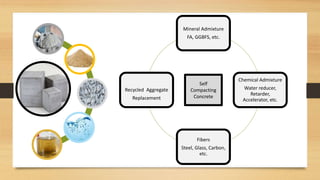
Mineral Admixture
FA, GGBFS, etc.
Chemical Admixture
Water reducer,
Retarder,
Accelerator, etc.
Fibers
Steel, Glass, Carbon,
etc.
Recycled Aggregate
Replacement
Self
Compacting
Concrete
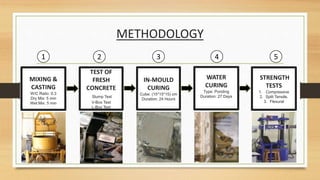
METHODOLOGY
MIXING &
CASTING
W/C Ratio: 0.3
Dry Mix: 5 min
Wet Mix: 5 min
IN-MOULD
CURING
Cube: (15*15*15) cm
Duration: 24 Hours
TEST OF
FRESH
CONCRETE
Slump Test
V-Box Test
L-Box Test
WATER
CURING
Type: Ponding
Duration: 27 Days
STRENGTH
TESTS
1. Compressive
2. Split Tensile.
3. Flexural
1 2 3 4 5
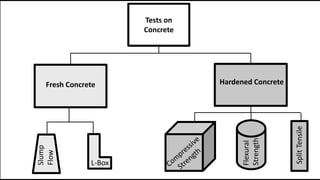
Tests on
Concrete
Hardened ConcreteFresh Concrete
L-Box
Flexural
Strength
SplitTensile
Slump
Flow
ADVANTAGES DRAWBACKS
• Downgrades the quality of concrete.
• Workability of concrete reduces.
• Specifications and guidelines aren’t
available
• Compressive strength of reduces (10-
30%).
• Increases water absorption capacity.
• Serves low-cost alternate solution
to crushing natural raw materials.
• Makes projects sustainable.
• Crushed concrete aggregate
involves has smaller carbon
footprint.
• Reduces the of natural aggregate
depletion.
• Takes less energy than mining
new.
APPLICATIONS
• Can be used for constructing gutters, pavements etc.
• Large pieces of crushed aggregate can be used for building revetments
which in turn is very useful in controlling soil erosion.
• Recycled concrete rubbles can be used as coarse aggregate in concrete.
• Generation of many by-products having many uses such as a ground
improvement material, a concrete addition, an asphalt filler etc.
CONCLUSION
• The use of recycled aggregate has been found to be better than that of
virgin aggregates for certain applications.
• Recycled concrete aggregate is proved to be a valuable, buildings
materials in technical, environmental & economical respects.
• Recycle & reuse is an appropriate solution to problems of dumping
hundred of thousands of tons of demolition wastes.
• However, more research and initiation of pilot project for application of
recycled coarse aggregate is started for modifying our design codes,
specifications & procedure for use of the same.
• Mohammed Omrane, Mohamed Rabehi, “Effect of natural pozzolan and recycled concrete aggregates on thermal and physio-
mechanical characteristics of self-compacting concrete,” Construction and Building Materials, Vol 247, pp. 118-576, (2020).
• Zhihong Pan, Juanlan Zhou, Xin Jiang, Yidong Xu, Ruoyu Jin, Jian Ma, Yuan Zhuang, Zikun Diao, Shengju Zhang, Qi Si, Wei Chen,
“Investigating the effects of steel slag powder on the properties of self-compacting concrete with recycled aggregates,”
Construction and Building Materials, Vol 200, pp 570-577, (2019).
• Saif I. Mohammed, Khalid B. Najim, “Mechanical strength, flexural behaviour and fracture energy of Recycled Concrete
Aggregate self-compacting concrete,” Structures, Vol 23, pp 34-43, (2020).
• L.A. Pereira-de-Oliveira, M.C.S. Nepomuceno, J.P. Castro-Comes, M.F.C. Vila, “Permeability properties of self-compacting
concrete with coarse recycled aggregates,” Construction and Building Materials, Vol 51, pp 113-120, (2014).
• Angel Salesa, Jose Angel Perez-Benedicto, Luis Mariano Esteban, Rosa Vicente-Vas, Martin Orna-Carmona, “Physio-mechanical
properties of multi-recycled self-compacting concrete prepared with precast concrete rejects,” Construction and Building
Materials, Vol. 153, pp 364-373, (2017).
• Zoran Jure Grdic, Gordana A. Toplicic-Curcui, Iva M. Despotovic, Nenad S. Ristic, “Properties of self-compacting concrete
prepared with coarse recycled concrete aggregate,” Construction and Building Materials, Vol. 24, pp 1129-1133, (2010).
• S.C. Kou, C.S. Poon, “Properties of self-compacting concrete prepared with coarse and fine recycled concrete aggregates,”
Cement & Concrete Composites, Vol. 31, pp 622-627, (2009).
• K.C. Panda, P.K. Bal, “Properties of self-compacting concrete using recycled coarse aggregate,” Procedia Engineering, Vol. 51, pp
159-164, (2013).
• Mohammed Abed, Rita Nemes, Bassam A. Tayeh, “Properties of self-compacting high-strength concrete containing multiple use
of recycled aggregate,” Journal of King Saud University – Engineering Sciences, (2018).
REFERENCES
• Puja Rajhans, Gaurav Chand, Nishikant Kisku, Sarat Kumar Panda, Sanket Nayak, “Proposed mix design for producing
sustainable self-compacting heat cured recycled aggregate concrete and its microstructural investigation,” Construction and
Building Materials, Vol 218, pp. 568-581. (2019).
• Reza Bani Ardalan, Zahra Nouri Emamzadeh, Haleh Rasekh, Alireza Joshaghani & Bijan Samali, “Physical and mechanical
properties of polymer modified self-compacting concrete (SCC) using natural and recycled aggregates,” Journal of sustainable
Cement-Based Materials, (2019).
• I. Gonzalez-Taboada, B. Gonzalez-Fonteboa, F. Martinez-Abella, and S.Seara-Paz, “Self-Consolidating Recycled Concrete:
Rheological Behaviour Over Time,” ACI MATERIALS JOURNAL, (2020).
• F. Fiol, C. Thomas, C. Munoz, V. Ortega-Lopez, J.M. Manso, “The influence of recycled aggregates from precast element on the
mechanical properties of structural self-compacting concrete,” Construction and Building Materials, Vol. 182, pp. 309-323,
(2018).
• Erhan Guneyisi, Mehmet Gesoglu, Zeynep Algun, Halit Yazici, “Rheological and fresh properties of self-compacting concretes
containing coarse and fine recycled concrete aggregates”, Construction and Building Materials, Vol. 113, pp 622-630, (2016).
• Yasser Khodair, Luqman, “Self-compacting concrete using recycled asphalt pavement and recycled concrete aggregate,” Journal
of Building Engineering, Vol. 12, pp. 282-287, (2017).
• D. Nieto, E. Dapena, P. Alaejos, J. Dimedo and D. Perez, “Properties of Self-Compacting Concrete Prepared with Coarse
Recycled Concrete Aggregates and Different Water:Ceement Ratios,” American Society of Civil Engineers, Vol. 31(2), (2019).
• Kanish Kapoor, Surinder Pal Singh & Bhupinder Singh, “Evaluating the durability properties of self-compacting concrete made
with coarse and fine recycled concrete aggregates,” European Journal of Environmental and Civil Engineering, (2018).
• Zhanggen Guo, Tao Jiang, Jing Zhang, Xiangkum Kong, Chen Chen, Dawn E. Lehman, “Mechanical and durability properties of
sustainable self-compacting concrete with recycled concrete aggregate and fly ash, slag and silica fume,” Construction and
Building Materials, Vol. 231, pp. 117115, (2020).
• P. Mahakavi & R Chithra, “Effect of recycled coarse aggregate and manufactured sand in self-compacting concrete,” Australian
Journal of structural Engineering, (2019).
• Navdeep Singh & S.P. Singh, “Validation of carbonation behaviour of self-compacting concrete made with recycled aggregates
using microstructural and crystallization investigations,” European Journal of Environmental and Civil Engineering, (2018).
• Amardeep Singh, Zhenhua Duan, Jianzhuang Xiao & Qiong Liu, “Incorporating recycled aggregates in self-compacting concrete:
a review,” Journal of Sustainable Cement-Based Materials, (2019).
• D Nuralinah, E. Arifi and D Setyowulan, “The experimental compressive strength of normal and self-compacting concrete with
recycled coarse aggregate,” Materials Science and Engineering, Vol 669, pp. 012045, (2019).
• O. Larsen, V. Naruts, O. Aleksandrova, “Self-compacting concrete with recycled aggregates,” Materials Today: Proceedings,
(2019).
• S. Santos, P.R. da Silva, J. de Brito, “Self-compacting concrete with recycled aggregates- A literature review,” Journal of Building
Engineering, Vol. 22, pp, 349-371, (2019).
• Stefania Manzi, Claudio Mazzotti, Maria Chaira Bignozzi, “Self-compacting concrete with recycled concrete aggregate: Study of
the long-term properties,” Construction and Building Materials, Vol. 157, pp. 582-590, (2017).
• Diego Carro-Lopez, Belen Gonzalez-Fonteboa, Jorge de Brito, Fernando Martinez-Abella, Iris Gonzalez-Taboada, Pedro Silva,
“Study of the rheology of self-compacting concrete with fine recycled concrete aggregates,” Construction and Building
Materials, Vol. 96, pp. 491-501, (2015).
• M. Velay-Lizancos, J. Martinez-Lage, P. Vazquez-Burgo, “The effect of recycled aggregates on the accuracy of the maturity method
on vibrated and self-compacting concretes,” ARCHIVES OF CIVIL AND MECHANICAL ENGINEERING, Vol. 19, pp. 311-312,
(2019).
THANK YOU

SELF-COMPACTING CONCRETE USING RECYCLED COARSE AGGREGATE

  • 1.
    SELF-COMPACTING CONCRETE USING RECYCLEDCOARSE AGGREGATE PRESENTED BY SWAPNA RANI PRADHAN, PRIYANSHU SINHA, SUDIPTA HUI, GAURAV UDGATA.
  • 2.
    CONTENTS • Introduction • LiteratureReview • Methodology • Advantages & Limitations • Applications • Conclusion • References
  • 3.
    INTRODUCTION • The useof recycled concrete aggregates from demolition waste and rubble in combination with cementitious additions in concrete has various advantages. Self Compacting Concrete(SCC) with recycled aggregate meet EFNARC guidelines for fresh properties of concrete and with increase in content of recycled aggregate hardened properties like compressive strength, tensile strength and flexural strength decreases.
  • 4.
    SELF-COMPACTING CONCRETE Self-consolidating concreteis a highly flowable type of concrete that spreads into the form without the need for mechanical vibration. Self- compacting concrete is a non-segregating concrete that is placed by means of its own weight. The importance of self-compacting concrete is that maintains all concrete’s durability and characteristics, meeting expected performance requirements.
  • 5.
    COMPARISON SELF-COMPACTING CONCRETE • Givesgood aesthetic finish. • High workability. • Water Content is Low. • Low Viscosity due to high fines content. • Good choice for thick reinforcement works. • Addition of superplasticizer increase the bond between aggregate and cement matrix. NORMAL CONCRETE • Aesthetic finish is not satisfactory. • Less workable mix. • High Water Content. • High Viscosity. • Limited in thick reinforcement areas due to external compaction difficulties. • The aggregate-cement matrix is weak.
  • 6.
    RECYCLED COARSE AGGREGATE Therecycled coarse aggregate contains original aggregate attached with mortar. The attached mortar is light and porous in nature. Therefore, it is obvious that the specific gravity and density of recycled aggregate are relatively less when compared to natural aggregate.
  • 7.
    COMPARISON RECYCLED COARSE AGGREGATE •High water consumption. • Bulk density is about 1290 kg/m3. • High porosity. (higher cement paste present) • High crushing index. NATURAL COARSE AGGREGATE • Low water consumption. • Bulk density is about 1750 kg/m3. • Low porosity. • Low crushing index.
  • 8.
    WHY? • Many oldbuildings, concrete pavements, bridges and other structures have overcome their age and limit of use due to structural deterioration beyond repairs and need to be demolished. • The structures, even adequate to use are under demolition because they are not serving the needs in present scenario. • New construction for better economic growth. • Structures are turned into debris resulting from natural disasters like earthquake, cyclone and floods etc. • Creation of building waste resulting from manmade disaster/war.
  • 9.
  • 10.
    PROCESS FOR OBTAININGRECYCLED AGGREGATE *Used in this experiment *Collect and channelize the material from one receptacle to another. *Carries the collected materials and navigates it towards the crusher. * To reduce large size materials by placing on other into compression. * Used primarily for separating magnetic materials of large particle size. *To separate feeds containing solid and crushed down. Forwarded
  • 11.
    AUTHOR JOURNAL MATERIALSUSED REMARKS M. Omrane Z. Pan et al S.I. Mohamm ed and K.B. Najim Construction and Building Materials 247 (2020) Construction and Building Materials 200 (2019) 570–577 Structures 23 (2020) 34–43 Cement type CEM II/A 42.5, Natural pozzolan, Natural coarse aggregates Recycled coarse aggregates, Super plasticizer (MEDAFLOW 30). Ordinary Portland Cement, Fly ash, Steel slag powder, Self compacting concrete with Recycled aggregates natural coarse aggregates. Recycled Concrete Aggregates , self-compacting concrete  The mechanical characteristics of concrete having pozzolan are almost similar to that of concrete without natural pozzolan  It adds an edge in the capillary part of paste of the cement. Through UPV of RSCC with natural pozzolan reduces with an increment in the aspect of the same. Due to RA, the formations of the natural SCC are lower that of RSCC at all stages.  Both control concrete & natural SCC has higher thermal conductivity compared to other with natural pozzolan.  The infilling and passing of SCC increased with the replacement ratio of SSP. Whereas the resistance curing period showed significant to segregation gets reduced.  The prior strength of SCC in collaboration with RA & SSP was low. But in long run the curing showed significant improvement. For the substitution ratio of SSP increased is over 20%, the strength of SCC with RA gets decreased.  Whereas 10% replacement of OPC showed maximum compressive strength. It also achieved superior splitting tensile strength. It also enhances the durability in terms of chloride penetration & carbonation.  Inclusion of RCA leads to a decrease in the mechanical characteristics of concrete. It slightly decreases the modules of elasticity.  Despite the reduction, it did not affect the potential as structural concrete in terms of mechanical strength.  Can be used as structural as the criteria for strength satisfaction.
  • 12.
    AUTHOR JOURNAL MATERIALSREMARKS L.A. Pereira-de- Oliveira et al Á. Salesa et al Z.J. Grdic et al. Construction and Building Materials 51 (2014) 113–120 Construction and Building Materials 153 (2017) 364–373 Construction and Building Materials 24 (2010) 1129– 1133 Recycled coarse aggregate, Natural coarse aggregates. Precast concrete Recycled coarse aggregate, Multi recycled coarse aggregate. Coarse aggregate Recycled coarse aggregates.  Inclusion of RCA requires more amount of superplasticizer concerning the fresh concrete properties. Approximately it is 2% of the total NCA replacement.  This is due to the water fraction that is concerned, there is a alight weight loss. The compressive strength decreases by 3.3% when the maximum RCA is used.  The dynamic modulus of elasticity is reduced by 8% when compared to NCA SCC.  That the water absorption of concrete specimen made RA increases its bulk density but is less of NA.  Due to the use of repeated RA showed better mechanical strength at 28 days. Due to the superior quality of RA, there is an modification in the compressive strength of concrete.  It is quite imperative to know the of RA as the superior quality gives the better performance to the concrete. The RA exhibits more water absorption as compared to NA due to powdered cement. Therefore, more amount of water is required.  For 50-100% of RCA enhances the water absorption from 0.15-0.37%. Maximizing the percentage of RA in concrete results in declination of its density as porosity increases.  It has been observed that by replacing 50% of RCA decreases the density by 2.12%, whereas for 100% by 3.40%. the inclusion of RCA in concrete has a direct influence on concrete. The tensile strength falls from 2.49-13.95%.  The SCC with RA is proved to be water proof. This parameter is associated with the capillary pores formed in residual of old and new aggregate. By adopting adequate kind of material and mix design, HPC can be obtained by incorporating RA for making SCC.
  • 13.
    AUTHOR JOURNAL MATERIALSREMARKS S.C. Kou, C.S. Poon K C Panda and P K Bal M. Abed et al. Cement & Concrète Composites 31 (2009) 622–627 Procedia Engineering 51 ( 2013 ) 159 – 164 Journal of King Saud University – Engineering Sciences Coarse aggregates, Recycled coarse aggregates, Fine aggregates, Recycled fine aggregates, River sand. Natural Coarse Aggregate, normal vibrated concrete recycled aggregate, recycled coarse aggregate, self compacting concrete. reused recycled concrete aggregates, recycled aggregate concrete.  Both RCA & RFA can be entertained in SCC work. The blocking ratio & slump flow of RA-SCC mix is directly proportional to RFA.  Initially minimum measured slump flow of the mix was 760 mm whereas blocking ratios ranges from (0.85-0.94). With inclusion of FA, the flow of slump is better. whereas the blocking ratio gets benefited.  There is decline of compressive as well as tensile strength of SCC containing RA without FA with an increment of RA content. The most optimum results are attained when 25-50% RFA is substituted by river sand. It showed resistance against RCPT.  RCA reduces the strength parameter of SCC when compared to NVC. After performing test of compressive strength, it was observed that it slightly attains the required strength up to 0.3 substitution ratio.  The maximum flexural strength was attained which has 100% NCA NVC. At 28 days. The value of flexural strength of SCC is less of given conceptual flexural strength by all substitution of RCA.  It absorbs more water than NCA which has lower specific gravity.  The amount of chemical admixture used in RAC & RRAC lies in the identical standard of fresh properties is same. 50% substitution of NA with RCA is considered the most optimum substitution.  Utilization of RRCA is said to be the first initiation for slightly using aggregates as sustainable resource. SCHSC is considered to be the best option for reusing RCA & RRCA. By performing CT test, it was observed that inclusion of RRCA reduces pore volume in comparison to RCA.
  • 14.
    AUTHOR JOURNAL MATERIALSREMARKS González- Taboada, B. González- Fonteboa, F. Martínez-Abella, and SF. Fiol et al. Seara- Paz E. Güneyisi et al ACI Materials Journal/January 2020 Construction and Building Materials 182 (2018) 309– 323 Construction and Building Materials 113 (2016) 622– 630 Cement Filler, Natural sand, Natural coarse aggregate, Recycled coarse aggregate. Natural aggregate, Recycled aggregate. Recycled concrete aggregate, Fly ash Coarse recycled concrete aggregates.  Alteration in the quantities with elapsed time shows an impact on SCRC to a greater extent a compared to SCC. Because of the fines produced from RA which bonds the mortar, the viscosity of SCRC are more prone to deviations than SCC.  the RA originated from precast specimens is proved to a better-quality aggregate. The inclusion of RA minimizes the W/C which gets compensated by utilizing superplasticizer admixtures for attaining the right slump flow.  Due to the high-water absorption coefficient by RA, the slum obtained gets decreased in spite of increasing superplasticizer. With the replacement of aggregates, the density of the concrete decreases. Whereas both water absorption & porosity increases.  that the density of fresh concrete declines when there is an increment of FRCA as the RCA offers lower specific gravity than NA. Because of the much high angular shape of CRCA flowability gets decreased when 50% of CRCA is replaced in the concrete.  Whereas the slump flow increases. Replacement by CRCA for 50% offers high L-box height ratio, whereas for 100% it is lower.
  • 15.
    AUTHOR JOURNAL MATERIALSREMARKS Y. Khodair, Luman J. Mater. Civ. Eng. Kanish Kapoor Journal of Building Engineering 12 (2017) 282–287 Civ. Eng., 2019, 31(2): 04018376 EUROPEAN JOURNAL OF ENVIRONMENTAL AND CIVIL ENGINEERING Recycled concrete aggregates, Recycled asphalt pavement, Natural coarse aggregate, Fine aggregate, Slag, Fly ash. Cement, Recycled coarse aggregate, Coarse aggregate. Coarse recycled concrete aggregates, Fine recycled concrete aggregates, Silica fume.  A better strength, frugal, along with workability and durability of SCC can be achieved by adding 70% FA and 70% S in concrete as partial substitution of OPC.  The compressive & split tensile strength of SCC specimen gets reduced. When NCA is replaced by RCARP y 25%, 50% & 75%. The workability also gets decreased. The shrinkage also increases. SCC containing SCMs provides superior resistance tom RCPT.  The compressive strength of SCC with RCA enhances the dosage as it offers higher rate of water absorption which minimizes the W/C which increases its strength. On keeping W/C constant the sample with greater proportion of replacement of RCA offers higher compressive strength.  Rate of penetration of water with replacement is lower. For 0.45, the values lie from 3 to 8 mm. Whereas for conventional it is 6mm for 0.55 and for 25mm for 0.50. In terms of durability, lower W/C offers lower carbonation and better durability.  Increment of CRCA & FRCA decreases the compressive strength of SCC mix. But inclusion of SF contributes in enhancing the compressive strength but still in does not gives the required strength.  SF significantly reduces RCPT in SCC. By replacing OPC by 10% SF and substituting all NA with CRCA & FRCA, it was observed that RCPT is slightly less than of CC. The penetration depth of water gets increased when NA is substituted with CRCA and FRCA, even with SF.
  • 16.
    AUTHOR JOURNAL MATERIALSREMARKS Z. Guo et al P. MAHAK AVI AND R. CHITHRA Navdeep Singh and S. P. Singh Construction and Building Materials 231 (2020) 11711 AUSTRALIAN JOURNAL OF STRUCTURAL ENGINEERING EUROPEAN JOURNAL OF ENVIRONMENTAL AND CIVIL ENGINEERING Recycled Coarse Aggregate, Fly ash, Slag, Silica fume, Supplementary cementitious material. Ordinary Portland Cement, Fine aggregate, Coarse aggregate, Recycled aggregate, Silica fume, Super plasticizer. Natural coarse aggregate, Natural fine aggregate, Recycled coarse aggregate, Recycled fine aggregate.  Inclusion of RCA in concrete mix reduces the compressive and split tensile strength. 20% of RA SCC along with 20% FA and SL, 10% of SF or 30% of FA showed results comparable with control mix.  SCC with RA affects the durability characteristics of concrete. the dry shrinkage increases with an increment of RCA percentage.  It was also observed that thawing resistance depends upon RCA content. 25% of RA-SCC replacement with higher volumes exhibits best properties and performance in terms of durability  The compressive strength of concrete decreases linearly with an increment % of RCA. The entire replacement of RCA with NCA reduces the strength to 50%.  The substitution of NFA with M-sand modifies the compressive strength up to 50% replacement. Other tests such as spilt tensile and flexural strength depends upon the replacement of RCA as it reduces it. The replacement of NFA enhances the split tensile strength.  An increase of RFA and RCA reduces the resistance to carbonation. When 100% of RCA & RFA is replaced, the depth of carbonation reaches 70% in comparison to NC after 28 days.  The strength of SCC comprising of RFA is lesser than that of NC. The loss gets compensated when MK is used in SCC having RFA. When both RCA and RFA is replaced, a huge drop in compressive strength is observed. The inclusion of MK serves resistance to carbonation.  50% replacement of NCA and NFA with RCA and RFA showed gives best results. The depth of carbonation is inversely proportional to the curing ages. Long duration of curing increases the resistance to carbonation of SCC containing RCA & RFA.
  • 17.
    AUTHOR JOURNAL MATERIALSREMARKS D Nuralina h et al O. Larsen et al. S. Santos et al A. Singh et al. IOP Conf. Series: Materials Science and Engineering 669(2019) 012045 Materials Today: Proceedings Journal of Building Engineering 22 (2019) 349–371 Journal of Sustainable Cement-Based Materials, 2019 Coarse aggregate, Recycled aggregate, Cement, Super plasticizer Recycled concrete aggregate, Activated filler, Coarse aggregate Sand. Recycled Aggregate Self Compacting Concrete, Fine recycled aggregate, Coarse recycle aggregate, Recycled aggregates. Recycled aggregate, Natural aggregate waste, Recycled coarse aggregate, Recycled fine aggregate, Recycled powder Self Compacting Recycled Aggregate Concrete  The concrete made up of NCA offers higher compressive strength that of concrete with SCC. The Young’s modulus of both SCC and NC correspond with compressive strength. The mean is evaluated on basis of SNI & ACI standard.  RCA has got a scope and can be used in SCC. Inclusion of superplasticizer during the process of grinding of concrete fines is proved to be useful.  The properties of SCC mix and NC is evaluated using polynomial Mathematical models.  Use of RA in SCC has got scope in future because of its properties. But there are certain mandatory steps to be taken during the process such as use of superplasticizer in terms of quality and quantity.  One of the imperative properties of RA is to absorb water. The quality SCC using RA depends upon ratio of replacement and its origin. But still some investigation is to be performed before implementing this work in construction sector.  There is variation in compressive strength of SCRAC in comparison to concrete made with NA with same W/C ratio. Inclusion of RA offers modified inter bonding and good interlocking of aggregates.  The density of concrete comprising of RA depends on its origin. In comparison to SCNAC, SCRAC possess more shrinkage. SCRAC offers less thermal conductivity
  • 18.
    AUTHOR JOURNAL MATERIALSREMARKS S. Manzi et al D. Carro- López et al M. Velay- Lizancosa Construction and Building Materials 157 (2017) 582– 590 Construction and Building Materials 96 (2015) 491– 501 arc h i v e s of c i v i l and mechanica l e n g i n e e ri n g 19 ( 2 01 9 ) 3 1 1 – 3 2 1 Coarse and fine recycled aggregates, Recycled aggregates. Fine recycled aggregates, Natural aggregates, Recycled sand. Fine and recycled coarse aggregate, Natural aggregate, Recycled aggregate.  pproximately 40% replacement of RCA in the mix gives the most feasible results. Because of modification of microstructure, the mechanical characteristics of SCC contain RA is equivalent to that of NC with NA. SCC containing RA is more susceptible to creep rather than shrinkage.  The use of RFA of 100% affected the compressive strength of mortar at 28 days of curing. For 100% replacement it was 49%, whereas for 20% replacement it was by 9%. By increasing the ratio of replacement, it was noted that the flowability of SCC with RA gets reduces which is an important parameter.  The mix comprising of 50% & 100% of FRA entirely lost the characteristics of SCC at 90 min. It was also observed that the slump flow also decreases at lower rate for less substitution of natural sand. From 0% & 20% it indicated similar behaviour. Whereas from 50% & 100% the SCC loses it characteristics. The L-Box test showed that replacement of 0 and 20% indicated familiar results.  There is an increase in activation energy for mix containing RA replacement higher than 20%. Whereas for lower replacement 8% it was less active. Earlier research stated that the kind of aggregate is not a major factor for determining the activation energy of the mix. NA usually have lower water absorption ratio and no unhydrated particles of cement
  • 19.
    AUTHOR JOURNAL MATERIALSREMARKS P. Rajhans et al R. B. Ardalan et al. Construction and Building Materials 218 (2019) 568–581 Journal of Sustainable Cement-Based Materials, 2019 sustainable self compacting heat cured recycled aggregate Concrete, Recycled coarse aggregates. Type II Portland cement Poly carboxylic-ether type super plasticizer Coarse aggregate Fine aggregate RCA Crushing waste concrete  The properties of concrete get enhanced when RCA is involved with Sodium silicate and SF as it fills the pores and cracks.  There is an increment of workability of SCC when polymer is used. It enhances the horizontal free flow while performing slump test and reduces the motion of water and fine particles away from concrete while a homogeneity is maintained.  The inclusion of polymer reduces the flow duration of SCC. It was noticed that capability of filling of concrete by four times. When compared to control concrete, the SCC with polymer showed significant improvement in L-box & J- ring test of 100% over 80%. While experimental work it was observed that the viscosity of polymeric concrete is decreased when compared to control concrete.  SCC with NA showed twice compressive strength in comparison to RCA with control and polymeric concrete. Whereas polymeric SCC showed compressive strength half of SCC which is of control mix. The most optimum quantity of polymer is 15% which enhances the workability and keeps the flexural strength.
  • 20.
    Mineral Admixture FA, GGBFS,etc. Chemical Admixture Water reducer, Retarder, Accelerator, etc. Fibers Steel, Glass, Carbon, etc. Recycled Aggregate Replacement Self Compacting Concrete
  • 21.
    METHODOLOGY MIXING & CASTING W/C Ratio:0.3 Dry Mix: 5 min Wet Mix: 5 min IN-MOULD CURING Cube: (15*15*15) cm Duration: 24 Hours TEST OF FRESH CONCRETE Slump Test V-Box Test L-Box Test WATER CURING Type: Ponding Duration: 27 Days STRENGTH TESTS 1. Compressive 2. Split Tensile. 3. Flexural 1 2 3 4 5
  • 22.
    Tests on Concrete Hardened ConcreteFreshConcrete L-Box Flexural Strength SplitTensile Slump Flow
  • 23.
    ADVANTAGES DRAWBACKS • Downgradesthe quality of concrete. • Workability of concrete reduces. • Specifications and guidelines aren’t available • Compressive strength of reduces (10- 30%). • Increases water absorption capacity. • Serves low-cost alternate solution to crushing natural raw materials. • Makes projects sustainable. • Crushed concrete aggregate involves has smaller carbon footprint. • Reduces the of natural aggregate depletion. • Takes less energy than mining new.
  • 24.
    APPLICATIONS • Can beused for constructing gutters, pavements etc. • Large pieces of crushed aggregate can be used for building revetments which in turn is very useful in controlling soil erosion. • Recycled concrete rubbles can be used as coarse aggregate in concrete. • Generation of many by-products having many uses such as a ground improvement material, a concrete addition, an asphalt filler etc.
  • 25.
    CONCLUSION • The useof recycled aggregate has been found to be better than that of virgin aggregates for certain applications. • Recycled concrete aggregate is proved to be a valuable, buildings materials in technical, environmental & economical respects. • Recycle & reuse is an appropriate solution to problems of dumping hundred of thousands of tons of demolition wastes. • However, more research and initiation of pilot project for application of recycled coarse aggregate is started for modifying our design codes, specifications & procedure for use of the same.
  • 26.
    • Mohammed Omrane,Mohamed Rabehi, “Effect of natural pozzolan and recycled concrete aggregates on thermal and physio- mechanical characteristics of self-compacting concrete,” Construction and Building Materials, Vol 247, pp. 118-576, (2020). • Zhihong Pan, Juanlan Zhou, Xin Jiang, Yidong Xu, Ruoyu Jin, Jian Ma, Yuan Zhuang, Zikun Diao, Shengju Zhang, Qi Si, Wei Chen, “Investigating the effects of steel slag powder on the properties of self-compacting concrete with recycled aggregates,” Construction and Building Materials, Vol 200, pp 570-577, (2019). • Saif I. Mohammed, Khalid B. Najim, “Mechanical strength, flexural behaviour and fracture energy of Recycled Concrete Aggregate self-compacting concrete,” Structures, Vol 23, pp 34-43, (2020). • L.A. Pereira-de-Oliveira, M.C.S. Nepomuceno, J.P. Castro-Comes, M.F.C. Vila, “Permeability properties of self-compacting concrete with coarse recycled aggregates,” Construction and Building Materials, Vol 51, pp 113-120, (2014). • Angel Salesa, Jose Angel Perez-Benedicto, Luis Mariano Esteban, Rosa Vicente-Vas, Martin Orna-Carmona, “Physio-mechanical properties of multi-recycled self-compacting concrete prepared with precast concrete rejects,” Construction and Building Materials, Vol. 153, pp 364-373, (2017). • Zoran Jure Grdic, Gordana A. Toplicic-Curcui, Iva M. Despotovic, Nenad S. Ristic, “Properties of self-compacting concrete prepared with coarse recycled concrete aggregate,” Construction and Building Materials, Vol. 24, pp 1129-1133, (2010). • S.C. Kou, C.S. Poon, “Properties of self-compacting concrete prepared with coarse and fine recycled concrete aggregates,” Cement & Concrete Composites, Vol. 31, pp 622-627, (2009). • K.C. Panda, P.K. Bal, “Properties of self-compacting concrete using recycled coarse aggregate,” Procedia Engineering, Vol. 51, pp 159-164, (2013). • Mohammed Abed, Rita Nemes, Bassam A. Tayeh, “Properties of self-compacting high-strength concrete containing multiple use of recycled aggregate,” Journal of King Saud University – Engineering Sciences, (2018). REFERENCES
  • 27.
    • Puja Rajhans,Gaurav Chand, Nishikant Kisku, Sarat Kumar Panda, Sanket Nayak, “Proposed mix design for producing sustainable self-compacting heat cured recycled aggregate concrete and its microstructural investigation,” Construction and Building Materials, Vol 218, pp. 568-581. (2019). • Reza Bani Ardalan, Zahra Nouri Emamzadeh, Haleh Rasekh, Alireza Joshaghani & Bijan Samali, “Physical and mechanical properties of polymer modified self-compacting concrete (SCC) using natural and recycled aggregates,” Journal of sustainable Cement-Based Materials, (2019). • I. Gonzalez-Taboada, B. Gonzalez-Fonteboa, F. Martinez-Abella, and S.Seara-Paz, “Self-Consolidating Recycled Concrete: Rheological Behaviour Over Time,” ACI MATERIALS JOURNAL, (2020). • F. Fiol, C. Thomas, C. Munoz, V. Ortega-Lopez, J.M. Manso, “The influence of recycled aggregates from precast element on the mechanical properties of structural self-compacting concrete,” Construction and Building Materials, Vol. 182, pp. 309-323, (2018). • Erhan Guneyisi, Mehmet Gesoglu, Zeynep Algun, Halit Yazici, “Rheological and fresh properties of self-compacting concretes containing coarse and fine recycled concrete aggregates”, Construction and Building Materials, Vol. 113, pp 622-630, (2016). • Yasser Khodair, Luqman, “Self-compacting concrete using recycled asphalt pavement and recycled concrete aggregate,” Journal of Building Engineering, Vol. 12, pp. 282-287, (2017). • D. Nieto, E. Dapena, P. Alaejos, J. Dimedo and D. Perez, “Properties of Self-Compacting Concrete Prepared with Coarse Recycled Concrete Aggregates and Different Water:Ceement Ratios,” American Society of Civil Engineers, Vol. 31(2), (2019). • Kanish Kapoor, Surinder Pal Singh & Bhupinder Singh, “Evaluating the durability properties of self-compacting concrete made with coarse and fine recycled concrete aggregates,” European Journal of Environmental and Civil Engineering, (2018). • Zhanggen Guo, Tao Jiang, Jing Zhang, Xiangkum Kong, Chen Chen, Dawn E. Lehman, “Mechanical and durability properties of sustainable self-compacting concrete with recycled concrete aggregate and fly ash, slag and silica fume,” Construction and Building Materials, Vol. 231, pp. 117115, (2020).
  • 28.
    • P. Mahakavi& R Chithra, “Effect of recycled coarse aggregate and manufactured sand in self-compacting concrete,” Australian Journal of structural Engineering, (2019). • Navdeep Singh & S.P. Singh, “Validation of carbonation behaviour of self-compacting concrete made with recycled aggregates using microstructural and crystallization investigations,” European Journal of Environmental and Civil Engineering, (2018). • Amardeep Singh, Zhenhua Duan, Jianzhuang Xiao & Qiong Liu, “Incorporating recycled aggregates in self-compacting concrete: a review,” Journal of Sustainable Cement-Based Materials, (2019). • D Nuralinah, E. Arifi and D Setyowulan, “The experimental compressive strength of normal and self-compacting concrete with recycled coarse aggregate,” Materials Science and Engineering, Vol 669, pp. 012045, (2019). • O. Larsen, V. Naruts, O. Aleksandrova, “Self-compacting concrete with recycled aggregates,” Materials Today: Proceedings, (2019). • S. Santos, P.R. da Silva, J. de Brito, “Self-compacting concrete with recycled aggregates- A literature review,” Journal of Building Engineering, Vol. 22, pp, 349-371, (2019). • Stefania Manzi, Claudio Mazzotti, Maria Chaira Bignozzi, “Self-compacting concrete with recycled concrete aggregate: Study of the long-term properties,” Construction and Building Materials, Vol. 157, pp. 582-590, (2017). • Diego Carro-Lopez, Belen Gonzalez-Fonteboa, Jorge de Brito, Fernando Martinez-Abella, Iris Gonzalez-Taboada, Pedro Silva, “Study of the rheology of self-compacting concrete with fine recycled concrete aggregates,” Construction and Building Materials, Vol. 96, pp. 491-501, (2015). • M. Velay-Lizancos, J. Martinez-Lage, P. Vazquez-Burgo, “The effect of recycled aggregates on the accuracy of the maturity method on vibrated and self-compacting concretes,” ARCHIVES OF CIVIL AND MECHANICAL ENGINEERING, Vol. 19, pp. 311-312, (2019).
  • 29.