www.wjps.ir /Vol.3/No.2/July 2014
Epidemiology and Outcome of Self-Inflicted Burns at
Pakistan Institute of Medical Sciences, Islamabad
Muhammad Saaiq1
, Bushra Ashraf2
ABSTRACT
BACKGROUND
Self-inflicted burn injuries carry considerable mortality and
morbidity among otherwise fit young individuals. This study
assessed the epidemiologic pattern and outcome of these injuries
in a burn care facility in Pakistan.
METHODS
The study was carried out at Pakistan Institute of Medical
Sciences (PIMS) Burn Care Centre in Islamabad over a period of
2 years. It included all adult patients of either gender, aged over
14 years who presented as cases of burn suicides and attempted
burn suicides during the study period. Convenience sampling
technique was employed. The sociodemographic profile of the
patients, motives underlying the act of self-immolation, any
underlying psychiatric illness, alcohol abuse, total body surface
area (TBSA) burnt, depth of burn injury, associated inhalation
injury, duration of hospital stay, and mortality were all recorded.
RESULTS
Seventyfivepatients(80.64%)werefemalewhile18patients(19.35%)
were male. The overall mean age was 26.89±6.1 years (range=15-52
years). The affected TBSA ranged from 15%-100% with an overall
mean of 69.30±25.42%. The hospital stay ranged from 1-37 days
with a mean of 7.16±6.60 days. Marital conflicts constituted the
most frequent motive underlying the suicidal attempts (n=57;
61.29%) followed by failed love affairs (n=9; 9.67%). There was
an overall mortality of 84.95%. The most common sufferers of self
inflicted burn injuries were young, married, illiterate housewives
who were resident of rural area. Getting marriage was the most
common triggering cause for such injuries.
CONCLUSION
There is need to institute appropriate preventive measures to
address the issue in a national perspective.
KEYWORDS
Burn; Suicide; Burn; Injury; Pakistan
Please cite this paper as:
Saaiq M, Ashraf B. Epidemiology and Outcome of Self-Inflicted Burns
at Pakistan Institute of Medical Sciences, Islamabad. World J Plast Surg
2014;3(2):107-114.
INTRODUCTION
Burn injury as a major cause of death and disability has a high
Original Article
1.	 Department of Plastic Surgery and Burn
Care Centre, Pakistan Institute of Medical
Sciences (PIMS), Islamabad, Pakistan;
2.	 MCH Centre, Pakistan Institute of Medical
Sciences (PIMS), Islamabad, Pakistan
*Correspondence Author:
Muhammad Saaiq,
Department of Plastic Surgery and
Burn Care Centre, PIMS, Islamabad,
Pakistan.
Tel: +92-341-5105173
E-mail: muhammadsaaiq5@gmail.com
Received: April 18, 2014
Accepted: June 4, 2014
107 
108  Self-inflicted burn outcome
www.wjps.ir /Vol.3/No.2/July 2014
cost in health care with an increasing trend in
mortality and morbidity in patients.1,2
Healing
in burn wounds is still a challenge even some
medications were introduced in the literature.
So every effort is done to provide a shorter in-
patient care for burn patients.3
Pseudomonas
aeruginosa as an important cause of nosocomial
infection may result into septicemia and death
in burn patients denoting to its public health
importance.4
So it seems that there is a need for
burn dressings and more effective therapeutic
medications for burn patients. Several products
were shown to have therapeutic efficacy and
to be with less toxicity when compared with
synthetic drugs.5-8
Burn suicide (self-immolation or self-
inflicted burns) constitutes one of the most
bizarre suicidal approaches that continue to
plague humanity even today. Self-immolation
represents one extreme of the burn injury
spectrum while the other extreme is constituted
by assault burn injuries.9-12
Globally, the reported rates of burn suicides
vary considerably from country to country and
centre to centre. These account for less than 1%
of all suicides in high-income countries (such
as the United States), however these figures
are alarmingly higher in many low and middle
income countries like Iran, India, Sri Lanka,
Iraq and Afghanistan. Burn suicide accounts for
up to 40% of all suicidal deaths in some parts of
the developing world and as high as 71% of the
suicides in their specific locales.10-20
Generally, the burden of burn injuries is
disproportionately shared across the globe with
over 95% of burn deaths occurring among the
developing nations.21
This imbalance is further
compounded by the menace of burn suicide
which predominantly affects the developing
nations. Overall, burn suicides account
for 2-36.6% of all burn injury admissions
worldwide.21-24
The present study was carried
out to document the prevalent sociodemographic
pattern and outcome of self-inflicted burns in
our centre at Islamabad, and hence generate
evidence base to better address this menace in a
national perspective.
MATERIALS AND METHODS
This observational study of self-inflicted burns
spanned over a period of two years from June
2010 to May 2012. It was carried out at Burn
Care Centre of Pakistan Institute of Medical
Sciences (PIMS) in Islamabad, Pakistan and
included all adult patients of either gender, aged
over 14 years who presented as cases of burn
suicides and attempted burn suicides during the
study period.
Convenience sampling technique was
employed. Those cases were excluded from the
studywhereeitherthepatientortheaccompanying
attendants refused to be consent for inclusion
in the study. Self-inflicted burn was defined as
the purposeful act of self burning with suicidal
intention. As the study was an observational one
and did not involve any new intervention, it was
conducted in accordance with the Declaration
of Helsinki of 1975, as revised in 2008 and
anonymity of the participants was guaranteed.
Informed consent was taken from all the patients
or their attendants for inclusion in the study.
Initial assessment and diagnosis of burn
injury was made by a thorough history, physical
examination and ancillary investigations. The
total body surface area (TBSA) of burn was
calculated by employing ‘rule of nines’. All the
patients were admitted for indoor management.
Data collection was performed with the help
of a comprehensively designed proforma
that encompassed all relevant epidemiologic
and clinical variables of interest. The
sociodemographic profile of the patients (i.e.
age, gender, marital status, educational status,
employment status, rural versus urban origin),
motives underlying the act of self-burning, any
underlying psychiatric illness, alcohol abuse,
TBSA burnt, depth of burn injury, associated
inhalation injury, duration of hospital stay, and
mortality etc. were all recorded on the proforma.
Serial personal interviews with the patient
and the accompanying attendants (i.e. spouse,
parents, in-laws, siblings, family members and
other accompanying supporting neighbors) in
separate sessions (through the entire course of
management) were carried out to ascertain the
circumstances and dynamics surrounding the
act of self-burning. The main outcome measures
were mortality and length of hospital stay.
As per protocol of our centre, all these patients
weremanagedaccordingtostandardmanagement
protocols of burn injury. Additionally, the
medico-legal issues surrounding the act of burn
suicide and attempted burn suicide were dealt
with by the medico legal officer of the hospital.
The data were subjected to statistical analysis
109 Saaiq et al.
www.wjps.ir /Vol.3/No.2/July 2014
using statistical package for social sciences
(SPSS) (Version 17, Chicago, IL, USA) and
various descriptive statistics were employed to
calculate frequencies, percentages, means and
standard deviation. The numerical data such as
age, TBSA burnt and duration of hospitalization
were expressed as mean ± standard deviation
while the categorical data such as the motives
for suicides and various associated risk factors
were expressed as frequency and percentages.
The percentages were compared by employing
Chi-Square test and a P value of less than 0.05
was regarded statistically significant.
RESULTS
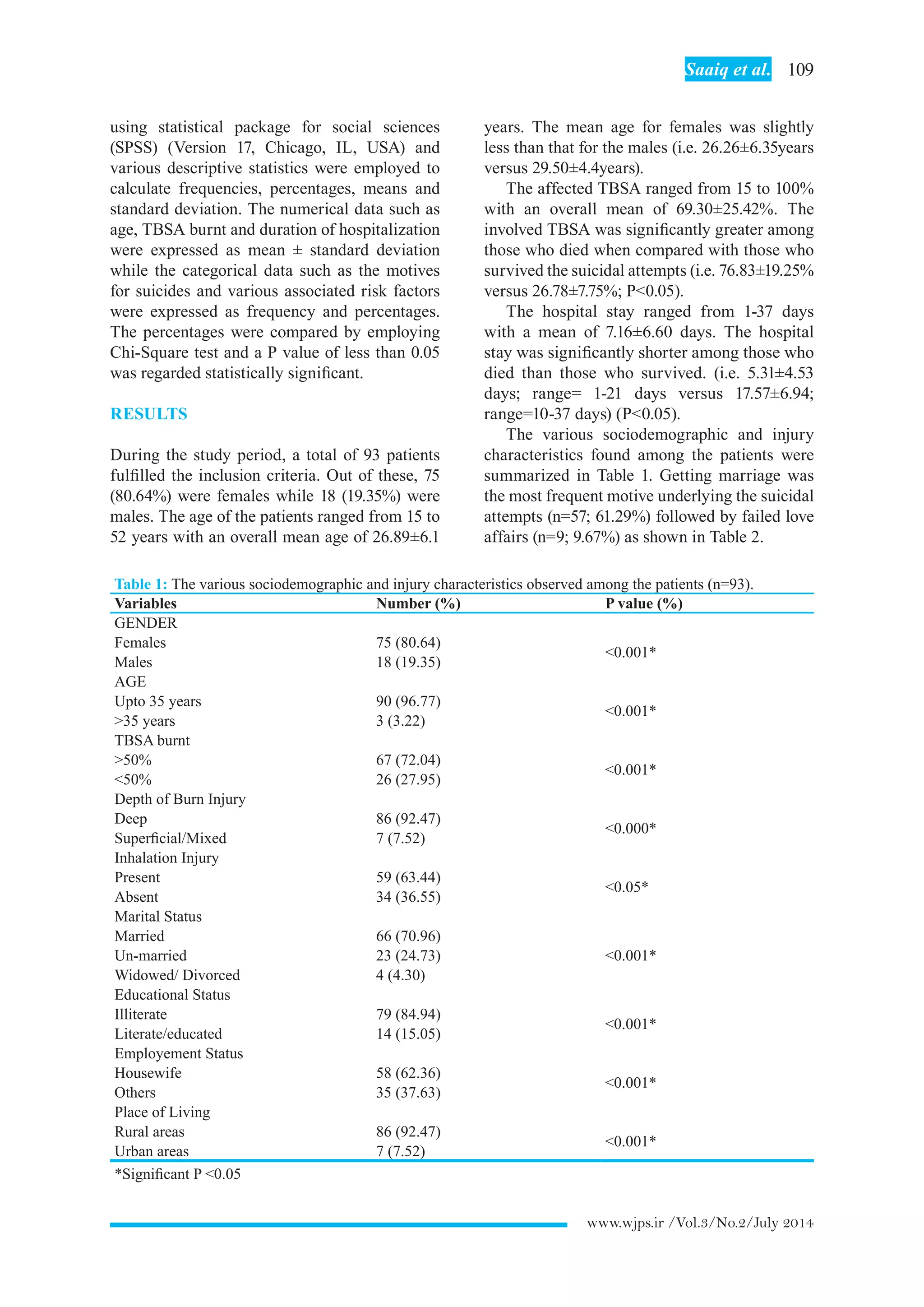
During the study period, a total of 93 patients
fulfilled the inclusion criteria. Out of these, 75
(80.64%) were females while 18 (19.35%) were
males. The age of the patients ranged from 15 to
52 years with an overall mean age of 26.89±6.1
years. The mean age for females was slightly
less than that for the males (i.e. 26.26±6.35years
versus 29.50±4.4years).
The affected TBSA ranged from 15 to 100%
with an overall mean of 69.30±25.42%. The
involved TBSA was significantly greater among
those who died when compared with those who
survived the suicidal attempts (i.e. 76.83±19.25%
versus 26.78±7.75%; P<0.05).
The hospital stay ranged from 1-37 days
with a mean of 7.16±6.60 days. The hospital
stay was significantly shorter among those who
died than those who survived. (i.e. 5.31±4.53
days; range= 1-21 days versus 17.57±6.94;
range=10-37 days) (P<0.05).
The various sociodemographic and injury
characteristics found among the patients were
summarized in Table 1. Getting marriage was
the most frequent motive underlying the suicidal
attempts (n=57; 61.29%) followed by failed love
affairs (n=9; 9.67%) as shown in Table 2.
Table 1: The various sociodemographic and injury characteristics observed among the patients (n=93).
Variables Number (%) P value (%)
GENDER
Females 75 (80.64)
<0.001*
Males 18 (19.35)
AGE
Upto 35 years 90 (96.77)
<0.001*
>35 years 3 (3.22)
TBSA burnt
>50% 67 (72.04)
<0.001*
<50% 26 (27.95)
Depth of Burn Injury
Deep 86 (92.47)
<0.000*
Superficial/Mixed 7 (7.52)
Inhalation Injury
Present 59 (63.44)
<0.05*
Absent 34 (36.55)
Marital Status
Married 66 (70.96)
<0.001*Un-married 23 (24.73)
Widowed/ Divorced 4 (4.30)
Educational Status
Illiterate 79 (84.94)
<0.001*
Literate/educated 14 (15.05)
Employement Status
Housewife 58 (62.36)
<0.001*
Others 35 (37.63)
Place of Living
Rural areas 86 (92.47)
<0.001*
Urban areas 7 (7.52)
*Significant P <0.05
110  Self-inflicted burn outcome
www.wjps.ir /Vol.3/No.2/July 2014
Table 2: Motives triggering burn suicides among
the patients (n=93).
Motives Number of patients (%)
Marital conflicts 57 (61.29)
Failed love affairs 9 (9.67)
Political protests 2 (2.15)
Known depression 1 (1.07)
Alcohol use 1 (1.07)
Unknown/
Undisclosed reasons
23 (24.73)
There were 79 deaths accounting for an
overall mortality rate of 84.95%. First peak
of high number of deaths (n=28; 35.44%) was
observed during the first 24 hours, followed by
the second high peak in number during 5-7 days
after sustaining burn injury (n=30; 37.97%). The
time intervals between sustaining burn injury
and deaths are shown in Figure 1.
DISCUSSION
Self-inflicted burns are prevalent in Pakistan,
however there is scarcity of published literature
on the issue. Most of the recently published local
studies are either focused on the epidemiology
of burns in general or pertain to some particular
aspect of burn injury management.24-28
Hence our study serves to represent the
sociodemographic pattern and outcome of self-
inflicted burn injuries in our country. Owing
to lack of burn suicides registry in our country,
the exact incidence of such injuries is difficult
to estimate, however our study with 93 cases
over two years period signifies the fact that it
is one of our prevalent but neglected medical
issues. In our series, the female patients were in
overwhelming majority.
Predominant involvement of females in burn
suicides is also reported by most of the published
studies from developing countries including
Iran, India, Sri Lanka, Iraq, Uzbekistan, and
Afghanistan.13,16-20,29-35
In sharp contrast to the
female predominance in burn suicides in the
developing world, studies from the European
countries, Australia and North America have
reported more frequent involvement of males
than females.36,37
In our series, adult females in their second
and third decades of life constituted bulk of the
patients. This conforms to most of the published
studies from countries like Iran, India, and
Iraq,11-18,38-40
however Chan et al.41
from Hong
Kong, Seoighe et al.42
from Ireland and several
other studies from the West and Australia have
reported more frequent involvement of higher
age groups.43-46
In our series, the bulk of patients
was constituted by married women. This
observation is in conformity to what is reported
by most of the published studies from other
developing countries.11-19,23,29-33,47-53
Marital conflict and failure in love affairs
were the most frequently admitted underlying
motives for self inflicted burns in our patients.
This observation conforms to many reported
studies from Iran, India, Afghanistan and Iraq.
28
6
30
13
2
0 5 10 15 20 25 30
Number of deaths
Day 01
Day 2-4
Day 5-7
Day 8-14
Day 15-21
Numberofdays
sinceburninjury
Fig. 1: Number of deaths in relation to the number of days following burn injury (n=79).
111 Saaiq et al.
www.wjps.ir /Vol.3/No.2/July 2014
There exists a considerable body of published
literature on self-inflicted burns from Iran
wherein marital and interpersonal conflicts, and
various forms of oppression and violence against
women have been recognized as the triggering
factors. Such domestic and spousal disharmony
is further compounded by low family income,
unemployment of the spouses, and low levels of
literacy among women.11-13,16,29-31,40,47,53-55
As the victims are physically, emotionally, or
mentally tortured by their husband, husband’s
family, or even their own family members,
the young women’ act has been referred to
as a ‘‘cry for help’’ with the victims finding
this self-humiliating act as a means of both
escaping from intolerable conditions as well as
speaking out against their abuse.11,16,29
Groohi
et al.30
identified quarrel with a family member/
relative and marital conflicts as the major factors
precipitating suicidal burns.
Maghsoudi et al.39
reported domestic violence
against women as one of the precipitating factors
for suicidal burns. In contrast to the societal
picture in Pakistan and Iran, the social dynamics
in India are yet different and young wives
commit burn suicides in response to the pressure
of dowry disputes. Additionally, the young bride
is typically living in a joint family where she is
expected to perform majority of the household
chores. She is not given say over choice of
husbands. Historically in the past, the Indian
widow women were forced to set themselves
ablaze at the funeral of their husbands in the
name of “sati”.17,56
In Afghanistan, the situation is even more
sinister with majority of burn suicides occurring
among women as a reaction to their gross social
deprivation. For instance, women are strictly
under the authority of the father or husband and
cannot have the opportunity to assert economic
and social independence. They are also faced
with inhuman acts of Badal, wherein women are
exchanged for material goods and money.20,57,58
Al-Zacko et al. in Iraq have related the burn
suicides among women to the major changes
happening at their age; the transition from youth
to adulthood and adolescent marriages, with
all the responsibilities coming particularly on
young girls who are quite often ill-prepared to
play the role of housewives.19
Contrary to all the aforementioned
observations in studies from the developing
economies, the situation in the developed and
Western nations is different and burn suicides
have been reported to be more common among
men, slightly of higher age group, and among
individuals with co-morbid substance abuse, and
psychiatric and adjustment disorders.37,41,46,59-63
In our series, majority of the patients were
illiterate. This observation conforms to the
published literature from developing countries
like Iran and India.11-17,29-32,39,46,53-58
One possible
explanation for this is that education greatly
improves the personality of the individual
and enhances her understanding of daily life
situations and family dynamics. Also education
empowers women who can better voice their
concerns about any injustices and get their
rights more efficiently. This helps to avert
the possibility of self-defeating behavior and
indulgence in suicidal activities.46,53-58
In our series, majority of the patients were
from rural areas. The published literature has
also reported a higher rate of suicidal burns
among the rural population than the urban
population.11-16
In our series, the bulk of patients
was constituted by those with over 50% TBSA
burnt. Our observation conforms to most studies
on self-immolation which have reported a
greater total body surface area affected, with
higher incidence of smoke inhalation injury, and
with more difficult course of illness.17-19,64,65
The mortality rate in our series was 84.95%.
Other published studies have also reported
high mortality rates, ranging from 25 to 90%.17-
19,64,65
In developing countries, the course and
outcome is reported to be generally more severe
with most women not reaching the hospital and
most dying within the first 24 h.17,66
Two of our
patients presented with self inflicted burns in the
court premises as a symbolic measure of protest.
Political protest is a relatively rare motivation for
self-immolation. Published literature has similar
examples of political protesting with self-
immolation.34
Such protests often receive vast
coverage by the mass media and trigger political
and civil unrests.
Not surprising we faced great difficulty in
extracting true story of the events underlying
burn suicides among our patients. At the very
outset, the patients as well as the attending
family members denied the case as one of self-
inflicted burns and insisted on its being an
accidental event. They often narrated different
false stories, which an experienced burn care
provider would prudently tamper with clinical
112  Self-inflicted burn outcome
www.wjps.ir /Vol.3/No.2/July 2014
judgments of the circumstantial evidences
surrounding the suicidal event plus the typical
stereotyped distribution of the burn injuries.
Several published studies have expressed
similar observations of their patients’ behavior
and related them to social and religious factors
and the tendency to hide the precipitating social
stressors.9,67
Our study has some strength as well as
presentssomelimitations.Itisthefirstlocalstudy
which has tried to identify factors associated
with self inflicted burn injuries among adults in
Pakistan and hence established evidence base
regarding this important health issue. As it was
a hospital based study, we could not measure the
exact incidence of burn suicides and attempted
burn suicides at our typical population level.
Although all the surviving individuals were
routinely referred to psychiatrist, our study did
not include their long term follow up to document
the residual post-burn physical and psychiatric
morbidity amongst them. We recommend the
conduct of further local studies to improve upon
these limitations.
The most common sufferers of self inflicted
burn injuries were young, married, illiterate,
housewives belonging to a rural background.
Marital conflicts constituted the most common
triggering cause for such injuries. These injuries
carry considerable mortality and morbidity of
prolonged hospitalization among otherwise fit
young individuals. Our study highlights the
gravity of this major but neglected catastrophe
in our resource constrained economy. There is
dire need to institute appropriate measures to
address the issue in a national perspective.
CONFLICT OF INTEREST
The authors declare no conflict of interest.
REFERENCES
1	 Mohammadi AA, Amini M, Mehrabani D,
Kiani Z, Seddigh A. A survey on 30 months
electrical burns in Shiraz University of
Medical Sciences Burn Hospital. Burns
2008;34:111-3.
2	 Pasalar M, Mohammadi AA, Rajaeefard
AR, Neghab M, Tolidie HR, Mehrabani D.
Epidemiology of burns during pregnancy in
southern Iran: Effect on maternal and fetal
outcomes. World Appl Sci J 2013;28:153-8.
3	 Gore MA,Akolekar D. Evaluation of banana
leaf dressing for partial thickness burn
wounds. Burns 2003;29:487-92.
4	 Manafi A, Kohanteb J, Mehrabani D, Japoni
A,Amini M, Naghmachi M, ZaghiA, Khalili
N. Active immunization using exotoxin A
confers protection against Pseudomonas
aeruginosa infection in a mouse burn model.
BMC J Microbiol 2009;9:19-23.
5	 Hosseini SV, Tanideh N, Kohanteb J,
Ghodrati Z, Mehrabani D, Yarmohammadi
H. Comparison between Alpha and silver
sulfadiazine ointments in treatment of
Pseudomonas infections in 3rd degree burns.
Int J Surg 2007;5:23-6.
6	 Hosseini SV, Niknahad H, Fakhar N,
Rezaianzadeh A, Mehrabani D. The healing
effect of honey, putty, vitriol and olive oil
in Psudomonas areoginosa infected burns in
experimental rat model. Asian J Anim Vet Adv
2011;6:572-9.
7	 Hazrati M, Mehrabani D, JaponiA, Montasery
H,Azarpira N, Hamidian-shiraziAR, Tanideh
N. Effect of honey on healing of Pseudomonas
aeruginosa infected burn wounds in rat. J Appl
Anim Res 2010;37:161-5.
8	 Amini M, Kherad M, Mehrabani D,Azarpira
N, Panjehshahin Mr, Tanideh N. Effect of
Plantago major on burn wound healing in
rat. J Appl Anim Res 2010;37:53-6.
9	 Mabrouk AR, Mahmod Omar AN, Massoud
K, Sherif MM, El Sayed N. Suicide by burns:
a tragic end. Burns 1999;25:337-9.
10	 American Burn Association. National burn
repository (R): report of data from 1999–
2008; version 5. 0 [Internet]. Chicago,
IL: American Burn Association; 2009
Available from:http://www.ameriburn.org/
2009NBRAnnualReport.pdf .
11	 Ahmadi A. Suicide by self-immolation:
comprehensive overview, experiences and
suggestions. J Burn Care Res 2007;28:30–41.
12	 Ramim T, Mobayen M, Shoar N, Naderan
M, Shoar S. Burnt wives in Tehran: a warm
tragedy of self-injury. Int J Burn Trauma
2013;3:66-71.
13	 MohammadiAA, Danesh N, Sabet B, Jalaeian
H, Mohammadi MK. Self-burning: a common
and tragic way of suicide in Fars province,
Iran. Iran J Med Sci 2008;33:110-3.
14	 Suhrabi Z, Delpisheh A, Taghinejad H.
Tragedy of women’s self-immolation in Iran
and developing communities: a review. Int J
113 Saaiq et al.
www.wjps.ir /Vol.3/No.2/July 2014
Burn Trauma 2012;2:93-104.
15	 Rezaeian M. Epidemiology of self-
immolation. Burns 2013;39:184–6.
16	 Lari AR, Joghataei MT, Adli YR, Zadeh YA,
Alaghehbandan R. Epidemiology of suicide
by burns in the province of Isfahan, Iran. J
Burn Care Res 2007;28:307–11.
17	 Kumar V. Burnt wives -- a study of suicides.
Burns 2003;29:31-5.
18	 Laloe V, Ganesan M. Self-immolation a
common suicidal behavior in eastern Sri
Lanka. Burns 2002;28:475-80.
19	 Al-Zacko SM. Self-inflicted burns in Mosul: a
cross-sectional study. Ann Burns Fire Disaster
2012;25:121-5.
20	 Astill J. Desperate Afghan women seek
escape in self-immolation: distributing rise
in suicide despite the fall of the misogynist
taliban: UK, 2004.avialble at: http://www.
rense.com.general52/ self.htm.
21	 World Health Organization Health Statistics
and Health Information Systems. Cause-
specific mortality: World Bank income
groups estimates for 2008. Geneva [CH]:
World Health Organization; 2008,Available
from: http://www.who.int/healthinfo/
global_burden_disease/estimates_regional/
en/index.html
22	 Saadat M. Epidemiology and mortality of
hospitalized burn patients in Kohkiluye va
Boyerahmad province (Iran):2002-2004.
Burns 2005;31:306-9.
23	 Tsati E, Iconomou T, Tzivaridou D, Keramidas
E, Papadopoulos S, Tsoutsos D. Self inflicted
burns inAthens: a six year retrospective study.
J Burn Care Rehabil 2005;26:75-8.
24	 Iqbal T, Saaiq M. Epidemiology and outcome
of burns: Early experience at the country’s first
national burns center. Burns 2013;39:358-62.
25	 Ahmed I, Farooq U, Afzal W, Salman M.
Medicolegal aspect of burn victims: A ten
years study. Pak J Med Sci 2009;25:797-800.
26	 Saaiq M, Zaib S, Ahmad Sh. Early excision
and grafting versus delayed excision and
grafting of deep thermal burns up to 40% total
body surface area:Acomparison of outcome.
Ann Burns Fire Disasters 2012;25:143-7.
27	 Tahir SM, MemonAR, Kumar M,Ali SA. Self
inflicted burn; a high tide. J Pak Med Assoc
2010;60:338-41.
28	 Saaiq M, Zaib S, Ahmad Sh. The menace of
postburn contractures:Adeveloping country’s
perspective. Ann Burns Fire Disasters
2012;25:152-8.
29	 Alaghehbandan R, Lari AR, Joghataei
MT, Islami A Motavalian A. A prospective
population-based study of suicidal behavior
by burns in the province of Ilam, Iran. Burns
2011;37:164-9.
30	 Groohi B, Rossignol AM, Barrero SP,
Alaghehbandan R. Suicidal behavior by burns
among adolescents in Kurdistan, Iran: a social
tragedy. Crisis 2006;27:16–21.
31	 Ahmadi A, Mohammadi R, Stavrinos D,
Almasi A, Schwebel DC. Self-immolation
in Iran. J Burn Care Res 2008;29:451–60.
32	 Zarghami M and Khalilian A. Deliberate
self-burning in Mazandaran, Iran. Burns
2002;28:115-119.
33	 Campbell E. Perspectives on self-immolation
experiences among Uzbek women. 2005.
34	 Peck MD. Epidemiology of burns throughout
the World. Part II: intentional burns in adults.
Burns 2012;38:630-7.
35	 Raj A, Gomez C, Silverman JG. Driven to a
firy death- the tragedy of self-immolation in
Afghanistan. N Engl J Med 2008;358:2201-3.
36	 Ben Meir P, Sagi A, Ben Yakar Y, Rosenberg
L. Suicide attempts by self-immolation—our
experience. Burns 1990;16:257-8.
37	 Cameron DR, Pegg SP, Muller M. Self-
inflicted burns. Burns 1997;23:519-21.
38	 Laloe V. Patterns of deliberate self-burning in
various parts of the world. A review. Burns
2004;30:207-15.
39	 Maghsoudi H, Garadagi A, Jafary GA,
Azarmir G, Aali N, Karimian B, Tabrizi M.
Women victims of self-inflicted burns in
Tabriz, Iran. Burns 2004;30:217-20.
40	 Forjuoh SN. Burns in low- and middle-
income countries: A review of available
literature on descriptive epidemiology, risk
factors, treatment, and prevention. Burns
2006;32:529- 37.
41	 Chan RC, Burd A. Suicidal burn in Hong
Kong. Burns 2012;38:937-41.
42	 Seoighe DM, Conroy F, Hennessy G, Meagher
P, Eadie P. Self-inflicted burns in the Irish
national burns unit. Burns 2011;37:1229-32.
43	 O’Donoghue J, Panchal J, O’Sullivan S,
O’Shaughnessy M, O’Connor TP, Keeley
H, Kelleher MJ. A study of suicide and
attempted suicide by self-immolation in an
Irish psychiatric population: an increasing
problem. Burns 1998;24:144-6.
44	 Henderson A, Wijewardena A, Streimer J,
114  Self-inflicted burn outcome
www.wjps.ir /Vol.3/No.2/July 2014
Vandervord J. Self-inflicted burns: A case
series. Burns 2013;39:335-40.
45	 Poeschla B, Combs H, Livingstone S,
Romma S, Klein MB. Self-immolation:
Socioeconomic, cultural and psychiatric
patterns. Burns 2011;37:1049-57.
46	 Malic CC, Karoo ROS, Austin O, Phipps A.
Burns inflicted by self or by others—An 11
year snapshot. Burns 2007;33:9 2-7.
47	 Rezaie L, Khazaie H, SoleimaniA, Schwebel
DC. Is self-immolation a distinct method for
suicide? A comparison of Iranian patients
attempting suicide by self-immolation and
by poisoning. Burns 2011;37:159-63.
48	 Mohammadi AA, Danesh N, Sabet B, Amini
M, Jalaeian H. Self inflicted burn injuries in
southwest Iran. Burn Care Res 2008;29:778–83.
49	 Ansari-Lari M,Askarian M. Epidemiology of
burns presenting to an emergency department
in Shiraz, south Iran. Burns 2003;29:579–81.
50	 Hosseini RS, Askarian M, Assadian O.
Epidemiology of hospitalized female burns
patients in a burn center in Shiraz. East
Mediterr Health 2007;13:113–8.
51	 Ytterstad B, Ahmadi A. Prevention of self-
immolation by community-based intervention.
Burns 2007;33:1032–40.
52	 Ahmadi A, Mohammadi M, Schwebel DC,
Hassanzadeh M, Yari M. Classic philosophy
lessons and prevented self-inflicted burns: a
call for action. Burns 2009;35:154–5.
53	 Ahmadi A, Mohammadi R, Schwebel DC,
Yeganeh N, Soroush A, Bazargan-Hejazi S.
Familial risk factors for self-immolation:
a case–control study. J Womens Health
(Larchmt) 2009;18:1025–31.
54	 Rastegar Lari A, Alaghehbandan R,
Panjeshahin MR, Joghataei MT. Suicidal
behavior by burns in the province of Fars,
Iran: a socio-epidemiologic approach. Crisis
2009;30:98–101.
55	 Razaeian M. Suicide among young Middle
Eastern Muslim females. Crisis 2010;31:36-42.
56	 Bhugra D. Sati: a type of nonpsychiatric
suicide. Crisis 2005;26:73–7.
57	 Gall C. For moreAfghan women, immolation
is escape. The New York Times.
58	 Padovese V, De Martino R, Eshan MA,
Racalbuto V, Oryakhail MA. Epidemiology
and outcome of burns in Esteqlal Hospital of
Kabul, Afghanistan. Burns 2010;36:1101–6.
59	 Thombs BD, Bresnick MG, Magyar-Russell
G. Who attempts suicide by burning? An
analysis of age patterns of mortality by self-
inflicted burning in the United States. Gen
Hosp Psychiatry 2007;29:224–50.
60	 Rashid A, Gowar JP. A review of trends of
self-inflicted burns. Burns 2004;30:573–6.
61	 Friedman T, Shalom A, Westreich M. Self-
inflicted burns. Ann Plast Surg 2007;58:622-4.
62	 Palmu R, Isometsä E, Suominen K, Vuola
J, Leppävuori A, Lönnqvist J. Self-inflicted
burns: an eight year retrospective study in
Finland. Burns 2004;30:443-7.
63	 Modjarrad K, McGwin Jr G, Cross JM, Rue
3rd LW. The descriptive epidemiology of
intentional burns in the United States: an
analysis of the National Burn Repository.
Burns 2007;3:828–32.
64	 Horner BM, Ahmadi H, Mulholland R,
Myers SR, Catalan J. Case-controlled study
of patients with self-inflicted burns. Burns
2005;31:471–5.
65	 Hadjiiski O, Todorov P. Suicide by self-
inflicted burns. Burns 1996;22:381–3.
66	 Campbell EA, Guiao IZ. Muslim culture and
female selfimmolation: implications for global
women’s health research and practice. Health
Care Women Int 2004;25:782–93.
67	 Wallace KL, Pegg SP. Self-inflicted burn
injuries: an 11-year retrospective study. J
Burn Care Rehabil 1999;20:191-4.

Self immulation

  • 1.
    www.wjps.ir /Vol.3/No.2/July 2014 Epidemiologyand Outcome of Self-Inflicted Burns at Pakistan Institute of Medical Sciences, Islamabad Muhammad Saaiq1 , Bushra Ashraf2 ABSTRACT BACKGROUND Self-inflicted burn injuries carry considerable mortality and morbidity among otherwise fit young individuals. This study assessed the epidemiologic pattern and outcome of these injuries in a burn care facility in Pakistan. METHODS The study was carried out at Pakistan Institute of Medical Sciences (PIMS) Burn Care Centre in Islamabad over a period of 2 years. It included all adult patients of either gender, aged over 14 years who presented as cases of burn suicides and attempted burn suicides during the study period. Convenience sampling technique was employed. The sociodemographic profile of the patients, motives underlying the act of self-immolation, any underlying psychiatric illness, alcohol abuse, total body surface area (TBSA) burnt, depth of burn injury, associated inhalation injury, duration of hospital stay, and mortality were all recorded. RESULTS Seventyfivepatients(80.64%)werefemalewhile18patients(19.35%) were male. The overall mean age was 26.89±6.1 years (range=15-52 years). The affected TBSA ranged from 15%-100% with an overall mean of 69.30±25.42%. The hospital stay ranged from 1-37 days with a mean of 7.16±6.60 days. Marital conflicts constituted the most frequent motive underlying the suicidal attempts (n=57; 61.29%) followed by failed love affairs (n=9; 9.67%). There was an overall mortality of 84.95%. The most common sufferers of self inflicted burn injuries were young, married, illiterate housewives who were resident of rural area. Getting marriage was the most common triggering cause for such injuries. CONCLUSION There is need to institute appropriate preventive measures to address the issue in a national perspective. KEYWORDS Burn; Suicide; Burn; Injury; Pakistan Please cite this paper as: Saaiq M, Ashraf B. Epidemiology and Outcome of Self-Inflicted Burns at Pakistan Institute of Medical Sciences, Islamabad. World J Plast Surg 2014;3(2):107-114. INTRODUCTION Burn injury as a major cause of death and disability has a high Original Article 1. Department of Plastic Surgery and Burn Care Centre, Pakistan Institute of Medical Sciences (PIMS), Islamabad, Pakistan; 2. MCH Centre, Pakistan Institute of Medical Sciences (PIMS), Islamabad, Pakistan *Correspondence Author: Muhammad Saaiq, Department of Plastic Surgery and Burn Care Centre, PIMS, Islamabad, Pakistan. Tel: +92-341-5105173 E-mail: muhammadsaaiq5@gmail.com Received: April 18, 2014 Accepted: June 4, 2014 107 
  • 2.
    108  Self-inflicted burnoutcome www.wjps.ir /Vol.3/No.2/July 2014 cost in health care with an increasing trend in mortality and morbidity in patients.1,2 Healing in burn wounds is still a challenge even some medications were introduced in the literature. So every effort is done to provide a shorter in- patient care for burn patients.3 Pseudomonas aeruginosa as an important cause of nosocomial infection may result into septicemia and death in burn patients denoting to its public health importance.4 So it seems that there is a need for burn dressings and more effective therapeutic medications for burn patients. Several products were shown to have therapeutic efficacy and to be with less toxicity when compared with synthetic drugs.5-8 Burn suicide (self-immolation or self- inflicted burns) constitutes one of the most bizarre suicidal approaches that continue to plague humanity even today. Self-immolation represents one extreme of the burn injury spectrum while the other extreme is constituted by assault burn injuries.9-12 Globally, the reported rates of burn suicides vary considerably from country to country and centre to centre. These account for less than 1% of all suicides in high-income countries (such as the United States), however these figures are alarmingly higher in many low and middle income countries like Iran, India, Sri Lanka, Iraq and Afghanistan. Burn suicide accounts for up to 40% of all suicidal deaths in some parts of the developing world and as high as 71% of the suicides in their specific locales.10-20 Generally, the burden of burn injuries is disproportionately shared across the globe with over 95% of burn deaths occurring among the developing nations.21 This imbalance is further compounded by the menace of burn suicide which predominantly affects the developing nations. Overall, burn suicides account for 2-36.6% of all burn injury admissions worldwide.21-24 The present study was carried out to document the prevalent sociodemographic pattern and outcome of self-inflicted burns in our centre at Islamabad, and hence generate evidence base to better address this menace in a national perspective. MATERIALS AND METHODS This observational study of self-inflicted burns spanned over a period of two years from June 2010 to May 2012. It was carried out at Burn Care Centre of Pakistan Institute of Medical Sciences (PIMS) in Islamabad, Pakistan and included all adult patients of either gender, aged over 14 years who presented as cases of burn suicides and attempted burn suicides during the study period. Convenience sampling technique was employed. Those cases were excluded from the studywhereeitherthepatientortheaccompanying attendants refused to be consent for inclusion in the study. Self-inflicted burn was defined as the purposeful act of self burning with suicidal intention. As the study was an observational one and did not involve any new intervention, it was conducted in accordance with the Declaration of Helsinki of 1975, as revised in 2008 and anonymity of the participants was guaranteed. Informed consent was taken from all the patients or their attendants for inclusion in the study. Initial assessment and diagnosis of burn injury was made by a thorough history, physical examination and ancillary investigations. The total body surface area (TBSA) of burn was calculated by employing ‘rule of nines’. All the patients were admitted for indoor management. Data collection was performed with the help of a comprehensively designed proforma that encompassed all relevant epidemiologic and clinical variables of interest. The sociodemographic profile of the patients (i.e. age, gender, marital status, educational status, employment status, rural versus urban origin), motives underlying the act of self-burning, any underlying psychiatric illness, alcohol abuse, TBSA burnt, depth of burn injury, associated inhalation injury, duration of hospital stay, and mortality etc. were all recorded on the proforma. Serial personal interviews with the patient and the accompanying attendants (i.e. spouse, parents, in-laws, siblings, family members and other accompanying supporting neighbors) in separate sessions (through the entire course of management) were carried out to ascertain the circumstances and dynamics surrounding the act of self-burning. The main outcome measures were mortality and length of hospital stay. As per protocol of our centre, all these patients weremanagedaccordingtostandardmanagement protocols of burn injury. Additionally, the medico-legal issues surrounding the act of burn suicide and attempted burn suicide were dealt with by the medico legal officer of the hospital. The data were subjected to statistical analysis
  • 3.
    109 Saaiq et al. www.wjps.ir/Vol.3/No.2/July 2014 using statistical package for social sciences (SPSS) (Version 17, Chicago, IL, USA) and various descriptive statistics were employed to calculate frequencies, percentages, means and standard deviation. The numerical data such as age, TBSA burnt and duration of hospitalization were expressed as mean ± standard deviation while the categorical data such as the motives for suicides and various associated risk factors were expressed as frequency and percentages. The percentages were compared by employing Chi-Square test and a P value of less than 0.05 was regarded statistically significant. RESULTS During the study period, a total of 93 patients fulfilled the inclusion criteria. Out of these, 75 (80.64%) were females while 18 (19.35%) were males. The age of the patients ranged from 15 to 52 years with an overall mean age of 26.89±6.1 years. The mean age for females was slightly less than that for the males (i.e. 26.26±6.35years versus 29.50±4.4years). The affected TBSA ranged from 15 to 100% with an overall mean of 69.30±25.42%. The involved TBSA was significantly greater among those who died when compared with those who survived the suicidal attempts (i.e. 76.83±19.25% versus 26.78±7.75%; P<0.05). The hospital stay ranged from 1-37 days with a mean of 7.16±6.60 days. The hospital stay was significantly shorter among those who died than those who survived. (i.e. 5.31±4.53 days; range= 1-21 days versus 17.57±6.94; range=10-37 days) (P<0.05). The various sociodemographic and injury characteristics found among the patients were summarized in Table 1. Getting marriage was the most frequent motive underlying the suicidal attempts (n=57; 61.29%) followed by failed love affairs (n=9; 9.67%) as shown in Table 2. Table 1: The various sociodemographic and injury characteristics observed among the patients (n=93). Variables Number (%) P value (%) GENDER Females 75 (80.64) <0.001* Males 18 (19.35) AGE Upto 35 years 90 (96.77) <0.001* >35 years 3 (3.22) TBSA burnt >50% 67 (72.04) <0.001* <50% 26 (27.95) Depth of Burn Injury Deep 86 (92.47) <0.000* Superficial/Mixed 7 (7.52) Inhalation Injury Present 59 (63.44) <0.05* Absent 34 (36.55) Marital Status Married 66 (70.96) <0.001*Un-married 23 (24.73) Widowed/ Divorced 4 (4.30) Educational Status Illiterate 79 (84.94) <0.001* Literate/educated 14 (15.05) Employement Status Housewife 58 (62.36) <0.001* Others 35 (37.63) Place of Living Rural areas 86 (92.47) <0.001* Urban areas 7 (7.52) *Significant P <0.05
  • 4.
    110  Self-inflicted burnoutcome www.wjps.ir /Vol.3/No.2/July 2014 Table 2: Motives triggering burn suicides among the patients (n=93). Motives Number of patients (%) Marital conflicts 57 (61.29) Failed love affairs 9 (9.67) Political protests 2 (2.15) Known depression 1 (1.07) Alcohol use 1 (1.07) Unknown/ Undisclosed reasons 23 (24.73) There were 79 deaths accounting for an overall mortality rate of 84.95%. First peak of high number of deaths (n=28; 35.44%) was observed during the first 24 hours, followed by the second high peak in number during 5-7 days after sustaining burn injury (n=30; 37.97%). The time intervals between sustaining burn injury and deaths are shown in Figure 1. DISCUSSION Self-inflicted burns are prevalent in Pakistan, however there is scarcity of published literature on the issue. Most of the recently published local studies are either focused on the epidemiology of burns in general or pertain to some particular aspect of burn injury management.24-28 Hence our study serves to represent the sociodemographic pattern and outcome of self- inflicted burn injuries in our country. Owing to lack of burn suicides registry in our country, the exact incidence of such injuries is difficult to estimate, however our study with 93 cases over two years period signifies the fact that it is one of our prevalent but neglected medical issues. In our series, the female patients were in overwhelming majority. Predominant involvement of females in burn suicides is also reported by most of the published studies from developing countries including Iran, India, Sri Lanka, Iraq, Uzbekistan, and Afghanistan.13,16-20,29-35 In sharp contrast to the female predominance in burn suicides in the developing world, studies from the European countries, Australia and North America have reported more frequent involvement of males than females.36,37 In our series, adult females in their second and third decades of life constituted bulk of the patients. This conforms to most of the published studies from countries like Iran, India, and Iraq,11-18,38-40 however Chan et al.41 from Hong Kong, Seoighe et al.42 from Ireland and several other studies from the West and Australia have reported more frequent involvement of higher age groups.43-46 In our series, the bulk of patients was constituted by married women. This observation is in conformity to what is reported by most of the published studies from other developing countries.11-19,23,29-33,47-53 Marital conflict and failure in love affairs were the most frequently admitted underlying motives for self inflicted burns in our patients. This observation conforms to many reported studies from Iran, India, Afghanistan and Iraq. 28 6 30 13 2 0 5 10 15 20 25 30 Number of deaths Day 01 Day 2-4 Day 5-7 Day 8-14 Day 15-21 Numberofdays sinceburninjury Fig. 1: Number of deaths in relation to the number of days following burn injury (n=79).
  • 5.
    111 Saaiq et al. www.wjps.ir/Vol.3/No.2/July 2014 There exists a considerable body of published literature on self-inflicted burns from Iran wherein marital and interpersonal conflicts, and various forms of oppression and violence against women have been recognized as the triggering factors. Such domestic and spousal disharmony is further compounded by low family income, unemployment of the spouses, and low levels of literacy among women.11-13,16,29-31,40,47,53-55 As the victims are physically, emotionally, or mentally tortured by their husband, husband’s family, or even their own family members, the young women’ act has been referred to as a ‘‘cry for help’’ with the victims finding this self-humiliating act as a means of both escaping from intolerable conditions as well as speaking out against their abuse.11,16,29 Groohi et al.30 identified quarrel with a family member/ relative and marital conflicts as the major factors precipitating suicidal burns. Maghsoudi et al.39 reported domestic violence against women as one of the precipitating factors for suicidal burns. In contrast to the societal picture in Pakistan and Iran, the social dynamics in India are yet different and young wives commit burn suicides in response to the pressure of dowry disputes. Additionally, the young bride is typically living in a joint family where she is expected to perform majority of the household chores. She is not given say over choice of husbands. Historically in the past, the Indian widow women were forced to set themselves ablaze at the funeral of their husbands in the name of “sati”.17,56 In Afghanistan, the situation is even more sinister with majority of burn suicides occurring among women as a reaction to their gross social deprivation. For instance, women are strictly under the authority of the father or husband and cannot have the opportunity to assert economic and social independence. They are also faced with inhuman acts of Badal, wherein women are exchanged for material goods and money.20,57,58 Al-Zacko et al. in Iraq have related the burn suicides among women to the major changes happening at their age; the transition from youth to adulthood and adolescent marriages, with all the responsibilities coming particularly on young girls who are quite often ill-prepared to play the role of housewives.19 Contrary to all the aforementioned observations in studies from the developing economies, the situation in the developed and Western nations is different and burn suicides have been reported to be more common among men, slightly of higher age group, and among individuals with co-morbid substance abuse, and psychiatric and adjustment disorders.37,41,46,59-63 In our series, majority of the patients were illiterate. This observation conforms to the published literature from developing countries like Iran and India.11-17,29-32,39,46,53-58 One possible explanation for this is that education greatly improves the personality of the individual and enhances her understanding of daily life situations and family dynamics. Also education empowers women who can better voice their concerns about any injustices and get their rights more efficiently. This helps to avert the possibility of self-defeating behavior and indulgence in suicidal activities.46,53-58 In our series, majority of the patients were from rural areas. The published literature has also reported a higher rate of suicidal burns among the rural population than the urban population.11-16 In our series, the bulk of patients was constituted by those with over 50% TBSA burnt. Our observation conforms to most studies on self-immolation which have reported a greater total body surface area affected, with higher incidence of smoke inhalation injury, and with more difficult course of illness.17-19,64,65 The mortality rate in our series was 84.95%. Other published studies have also reported high mortality rates, ranging from 25 to 90%.17- 19,64,65 In developing countries, the course and outcome is reported to be generally more severe with most women not reaching the hospital and most dying within the first 24 h.17,66 Two of our patients presented with self inflicted burns in the court premises as a symbolic measure of protest. Political protest is a relatively rare motivation for self-immolation. Published literature has similar examples of political protesting with self- immolation.34 Such protests often receive vast coverage by the mass media and trigger political and civil unrests. Not surprising we faced great difficulty in extracting true story of the events underlying burn suicides among our patients. At the very outset, the patients as well as the attending family members denied the case as one of self- inflicted burns and insisted on its being an accidental event. They often narrated different false stories, which an experienced burn care provider would prudently tamper with clinical
  • 6.
    112  Self-inflicted burnoutcome www.wjps.ir /Vol.3/No.2/July 2014 judgments of the circumstantial evidences surrounding the suicidal event plus the typical stereotyped distribution of the burn injuries. Several published studies have expressed similar observations of their patients’ behavior and related them to social and religious factors and the tendency to hide the precipitating social stressors.9,67 Our study has some strength as well as presentssomelimitations.Itisthefirstlocalstudy which has tried to identify factors associated with self inflicted burn injuries among adults in Pakistan and hence established evidence base regarding this important health issue. As it was a hospital based study, we could not measure the exact incidence of burn suicides and attempted burn suicides at our typical population level. Although all the surviving individuals were routinely referred to psychiatrist, our study did not include their long term follow up to document the residual post-burn physical and psychiatric morbidity amongst them. We recommend the conduct of further local studies to improve upon these limitations. The most common sufferers of self inflicted burn injuries were young, married, illiterate, housewives belonging to a rural background. Marital conflicts constituted the most common triggering cause for such injuries. These injuries carry considerable mortality and morbidity of prolonged hospitalization among otherwise fit young individuals. Our study highlights the gravity of this major but neglected catastrophe in our resource constrained economy. There is dire need to institute appropriate measures to address the issue in a national perspective. CONFLICT OF INTEREST The authors declare no conflict of interest. REFERENCES 1 Mohammadi AA, Amini M, Mehrabani D, Kiani Z, Seddigh A. A survey on 30 months electrical burns in Shiraz University of Medical Sciences Burn Hospital. Burns 2008;34:111-3. 2 Pasalar M, Mohammadi AA, Rajaeefard AR, Neghab M, Tolidie HR, Mehrabani D. Epidemiology of burns during pregnancy in southern Iran: Effect on maternal and fetal outcomes. World Appl Sci J 2013;28:153-8. 3 Gore MA,Akolekar D. Evaluation of banana leaf dressing for partial thickness burn wounds. Burns 2003;29:487-92. 4 Manafi A, Kohanteb J, Mehrabani D, Japoni A,Amini M, Naghmachi M, ZaghiA, Khalili N. Active immunization using exotoxin A confers protection against Pseudomonas aeruginosa infection in a mouse burn model. BMC J Microbiol 2009;9:19-23. 5 Hosseini SV, Tanideh N, Kohanteb J, Ghodrati Z, Mehrabani D, Yarmohammadi H. Comparison between Alpha and silver sulfadiazine ointments in treatment of Pseudomonas infections in 3rd degree burns. Int J Surg 2007;5:23-6. 6 Hosseini SV, Niknahad H, Fakhar N, Rezaianzadeh A, Mehrabani D. The healing effect of honey, putty, vitriol and olive oil in Psudomonas areoginosa infected burns in experimental rat model. Asian J Anim Vet Adv 2011;6:572-9. 7 Hazrati M, Mehrabani D, JaponiA, Montasery H,Azarpira N, Hamidian-shiraziAR, Tanideh N. Effect of honey on healing of Pseudomonas aeruginosa infected burn wounds in rat. J Appl Anim Res 2010;37:161-5. 8 Amini M, Kherad M, Mehrabani D,Azarpira N, Panjehshahin Mr, Tanideh N. Effect of Plantago major on burn wound healing in rat. J Appl Anim Res 2010;37:53-6. 9 Mabrouk AR, Mahmod Omar AN, Massoud K, Sherif MM, El Sayed N. Suicide by burns: a tragic end. Burns 1999;25:337-9. 10 American Burn Association. National burn repository (R): report of data from 1999– 2008; version 5. 0 [Internet]. Chicago, IL: American Burn Association; 2009 Available from:http://www.ameriburn.org/ 2009NBRAnnualReport.pdf . 11 Ahmadi A. Suicide by self-immolation: comprehensive overview, experiences and suggestions. J Burn Care Res 2007;28:30–41. 12 Ramim T, Mobayen M, Shoar N, Naderan M, Shoar S. Burnt wives in Tehran: a warm tragedy of self-injury. Int J Burn Trauma 2013;3:66-71. 13 MohammadiAA, Danesh N, Sabet B, Jalaeian H, Mohammadi MK. Self-burning: a common and tragic way of suicide in Fars province, Iran. Iran J Med Sci 2008;33:110-3. 14 Suhrabi Z, Delpisheh A, Taghinejad H. Tragedy of women’s self-immolation in Iran and developing communities: a review. Int J
  • 7.
    113 Saaiq et al. www.wjps.ir/Vol.3/No.2/July 2014 Burn Trauma 2012;2:93-104. 15 Rezaeian M. Epidemiology of self- immolation. Burns 2013;39:184–6. 16 Lari AR, Joghataei MT, Adli YR, Zadeh YA, Alaghehbandan R. Epidemiology of suicide by burns in the province of Isfahan, Iran. J Burn Care Res 2007;28:307–11. 17 Kumar V. Burnt wives -- a study of suicides. Burns 2003;29:31-5. 18 Laloe V, Ganesan M. Self-immolation a common suicidal behavior in eastern Sri Lanka. Burns 2002;28:475-80. 19 Al-Zacko SM. Self-inflicted burns in Mosul: a cross-sectional study. Ann Burns Fire Disaster 2012;25:121-5. 20 Astill J. Desperate Afghan women seek escape in self-immolation: distributing rise in suicide despite the fall of the misogynist taliban: UK, 2004.avialble at: http://www. rense.com.general52/ self.htm. 21 World Health Organization Health Statistics and Health Information Systems. Cause- specific mortality: World Bank income groups estimates for 2008. Geneva [CH]: World Health Organization; 2008,Available from: http://www.who.int/healthinfo/ global_burden_disease/estimates_regional/ en/index.html 22 Saadat M. Epidemiology and mortality of hospitalized burn patients in Kohkiluye va Boyerahmad province (Iran):2002-2004. Burns 2005;31:306-9. 23 Tsati E, Iconomou T, Tzivaridou D, Keramidas E, Papadopoulos S, Tsoutsos D. Self inflicted burns inAthens: a six year retrospective study. J Burn Care Rehabil 2005;26:75-8. 24 Iqbal T, Saaiq M. Epidemiology and outcome of burns: Early experience at the country’s first national burns center. Burns 2013;39:358-62. 25 Ahmed I, Farooq U, Afzal W, Salman M. Medicolegal aspect of burn victims: A ten years study. Pak J Med Sci 2009;25:797-800. 26 Saaiq M, Zaib S, Ahmad Sh. Early excision and grafting versus delayed excision and grafting of deep thermal burns up to 40% total body surface area:Acomparison of outcome. Ann Burns Fire Disasters 2012;25:143-7. 27 Tahir SM, MemonAR, Kumar M,Ali SA. Self inflicted burn; a high tide. J Pak Med Assoc 2010;60:338-41. 28 Saaiq M, Zaib S, Ahmad Sh. The menace of postburn contractures:Adeveloping country’s perspective. Ann Burns Fire Disasters 2012;25:152-8. 29 Alaghehbandan R, Lari AR, Joghataei MT, Islami A Motavalian A. A prospective population-based study of suicidal behavior by burns in the province of Ilam, Iran. Burns 2011;37:164-9. 30 Groohi B, Rossignol AM, Barrero SP, Alaghehbandan R. Suicidal behavior by burns among adolescents in Kurdistan, Iran: a social tragedy. Crisis 2006;27:16–21. 31 Ahmadi A, Mohammadi R, Stavrinos D, Almasi A, Schwebel DC. Self-immolation in Iran. J Burn Care Res 2008;29:451–60. 32 Zarghami M and Khalilian A. Deliberate self-burning in Mazandaran, Iran. Burns 2002;28:115-119. 33 Campbell E. Perspectives on self-immolation experiences among Uzbek women. 2005. 34 Peck MD. Epidemiology of burns throughout the World. Part II: intentional burns in adults. Burns 2012;38:630-7. 35 Raj A, Gomez C, Silverman JG. Driven to a firy death- the tragedy of self-immolation in Afghanistan. N Engl J Med 2008;358:2201-3. 36 Ben Meir P, Sagi A, Ben Yakar Y, Rosenberg L. Suicide attempts by self-immolation—our experience. Burns 1990;16:257-8. 37 Cameron DR, Pegg SP, Muller M. Self- inflicted burns. Burns 1997;23:519-21. 38 Laloe V. Patterns of deliberate self-burning in various parts of the world. A review. Burns 2004;30:207-15. 39 Maghsoudi H, Garadagi A, Jafary GA, Azarmir G, Aali N, Karimian B, Tabrizi M. Women victims of self-inflicted burns in Tabriz, Iran. Burns 2004;30:217-20. 40 Forjuoh SN. Burns in low- and middle- income countries: A review of available literature on descriptive epidemiology, risk factors, treatment, and prevention. Burns 2006;32:529- 37. 41 Chan RC, Burd A. Suicidal burn in Hong Kong. Burns 2012;38:937-41. 42 Seoighe DM, Conroy F, Hennessy G, Meagher P, Eadie P. Self-inflicted burns in the Irish national burns unit. Burns 2011;37:1229-32. 43 O’Donoghue J, Panchal J, O’Sullivan S, O’Shaughnessy M, O’Connor TP, Keeley H, Kelleher MJ. A study of suicide and attempted suicide by self-immolation in an Irish psychiatric population: an increasing problem. Burns 1998;24:144-6. 44 Henderson A, Wijewardena A, Streimer J,
  • 8.
    114  Self-inflicted burnoutcome www.wjps.ir /Vol.3/No.2/July 2014 Vandervord J. Self-inflicted burns: A case series. Burns 2013;39:335-40. 45 Poeschla B, Combs H, Livingstone S, Romma S, Klein MB. Self-immolation: Socioeconomic, cultural and psychiatric patterns. Burns 2011;37:1049-57. 46 Malic CC, Karoo ROS, Austin O, Phipps A. Burns inflicted by self or by others—An 11 year snapshot. Burns 2007;33:9 2-7. 47 Rezaie L, Khazaie H, SoleimaniA, Schwebel DC. Is self-immolation a distinct method for suicide? A comparison of Iranian patients attempting suicide by self-immolation and by poisoning. Burns 2011;37:159-63. 48 Mohammadi AA, Danesh N, Sabet B, Amini M, Jalaeian H. Self inflicted burn injuries in southwest Iran. Burn Care Res 2008;29:778–83. 49 Ansari-Lari M,Askarian M. Epidemiology of burns presenting to an emergency department in Shiraz, south Iran. Burns 2003;29:579–81. 50 Hosseini RS, Askarian M, Assadian O. Epidemiology of hospitalized female burns patients in a burn center in Shiraz. East Mediterr Health 2007;13:113–8. 51 Ytterstad B, Ahmadi A. Prevention of self- immolation by community-based intervention. Burns 2007;33:1032–40. 52 Ahmadi A, Mohammadi M, Schwebel DC, Hassanzadeh M, Yari M. Classic philosophy lessons and prevented self-inflicted burns: a call for action. Burns 2009;35:154–5. 53 Ahmadi A, Mohammadi R, Schwebel DC, Yeganeh N, Soroush A, Bazargan-Hejazi S. Familial risk factors for self-immolation: a case–control study. J Womens Health (Larchmt) 2009;18:1025–31. 54 Rastegar Lari A, Alaghehbandan R, Panjeshahin MR, Joghataei MT. Suicidal behavior by burns in the province of Fars, Iran: a socio-epidemiologic approach. Crisis 2009;30:98–101. 55 Razaeian M. Suicide among young Middle Eastern Muslim females. Crisis 2010;31:36-42. 56 Bhugra D. Sati: a type of nonpsychiatric suicide. Crisis 2005;26:73–7. 57 Gall C. For moreAfghan women, immolation is escape. The New York Times. 58 Padovese V, De Martino R, Eshan MA, Racalbuto V, Oryakhail MA. Epidemiology and outcome of burns in Esteqlal Hospital of Kabul, Afghanistan. Burns 2010;36:1101–6. 59 Thombs BD, Bresnick MG, Magyar-Russell G. Who attempts suicide by burning? An analysis of age patterns of mortality by self- inflicted burning in the United States. Gen Hosp Psychiatry 2007;29:224–50. 60 Rashid A, Gowar JP. A review of trends of self-inflicted burns. Burns 2004;30:573–6. 61 Friedman T, Shalom A, Westreich M. Self- inflicted burns. Ann Plast Surg 2007;58:622-4. 62 Palmu R, Isometsä E, Suominen K, Vuola J, Leppävuori A, Lönnqvist J. Self-inflicted burns: an eight year retrospective study in Finland. Burns 2004;30:443-7. 63 Modjarrad K, McGwin Jr G, Cross JM, Rue 3rd LW. The descriptive epidemiology of intentional burns in the United States: an analysis of the National Burn Repository. Burns 2007;3:828–32. 64 Horner BM, Ahmadi H, Mulholland R, Myers SR, Catalan J. Case-controlled study of patients with self-inflicted burns. Burns 2005;31:471–5. 65 Hadjiiski O, Todorov P. Suicide by self- inflicted burns. Burns 1996;22:381–3. 66 Campbell EA, Guiao IZ. Muslim culture and female selfimmolation: implications for global women’s health research and practice. Health Care Women Int 2004;25:782–93. 67 Wallace KL, Pegg SP. Self-inflicted burn injuries: an 11-year retrospective study. J Burn Care Rehabil 1999;20:191-4.