Selenium
• Essential element
• Chemistry :
– Non-metal
– Biologically active compounds contain Secys.
• Se is substituted for S in Cys
• UGA – co-translational insertion
– SeMet. – only in plants
• Identical to Met
Selenium
• Powerful antioxidant, works closely with
Vitamin E to protect body from
oxidation.
• Total body content of selenium is about
4 to 10mg.
• Highest concentration – liver, kidney &
finger nails.
• Non-specifically incorporated into protein
pool
• Is present in major proteins – albumin &
Hb
• Selenium in SeMet constitutes ½ the total
dietary intake
• Contributes to Secys. synthesis
Sources
Dairy products, vegetables, fruits,
Cereals (good sources)
Daily Requirement:
Adults: 50 - 100µg/day
Children: 20 - 120µg/day
Infants get their selenium through breast milk.
Se intake depends on the nature of the soil in which
food crops are grown.
Se is a well-known growth stimulant in agriculture.
Absorption, Metabolism & Excretion
• Se is absorbed from the duodenum & transported
bound to β-lipoproteins in the form of seleno
methionine.
• Body Se – 15 mg
Normal serum level is 50 - 100µg/dl.
• 50% -60% of plasma selenium is present as
selenoprotein P
--Transport protein for se
– Basic protein--Multiple His residues
– 10atoms Se/molecule
• 30% is present in GSH Px
• Remainder in albumin as SeMet
Absorption, Metabolism & Excretion(contd)
• Powerful antioxidant, works closely with Vitamin E to
protect body from oxidation.
• Highest concentration – liver, kidney & finger nails.
• Excretion :
– Urinary output
– Depends on intake
Absorption, Metabolism & Excretion(contd)
Selenophosphate synthetase:
– Required for intracellular synthesis of
selenoproteins
Functions
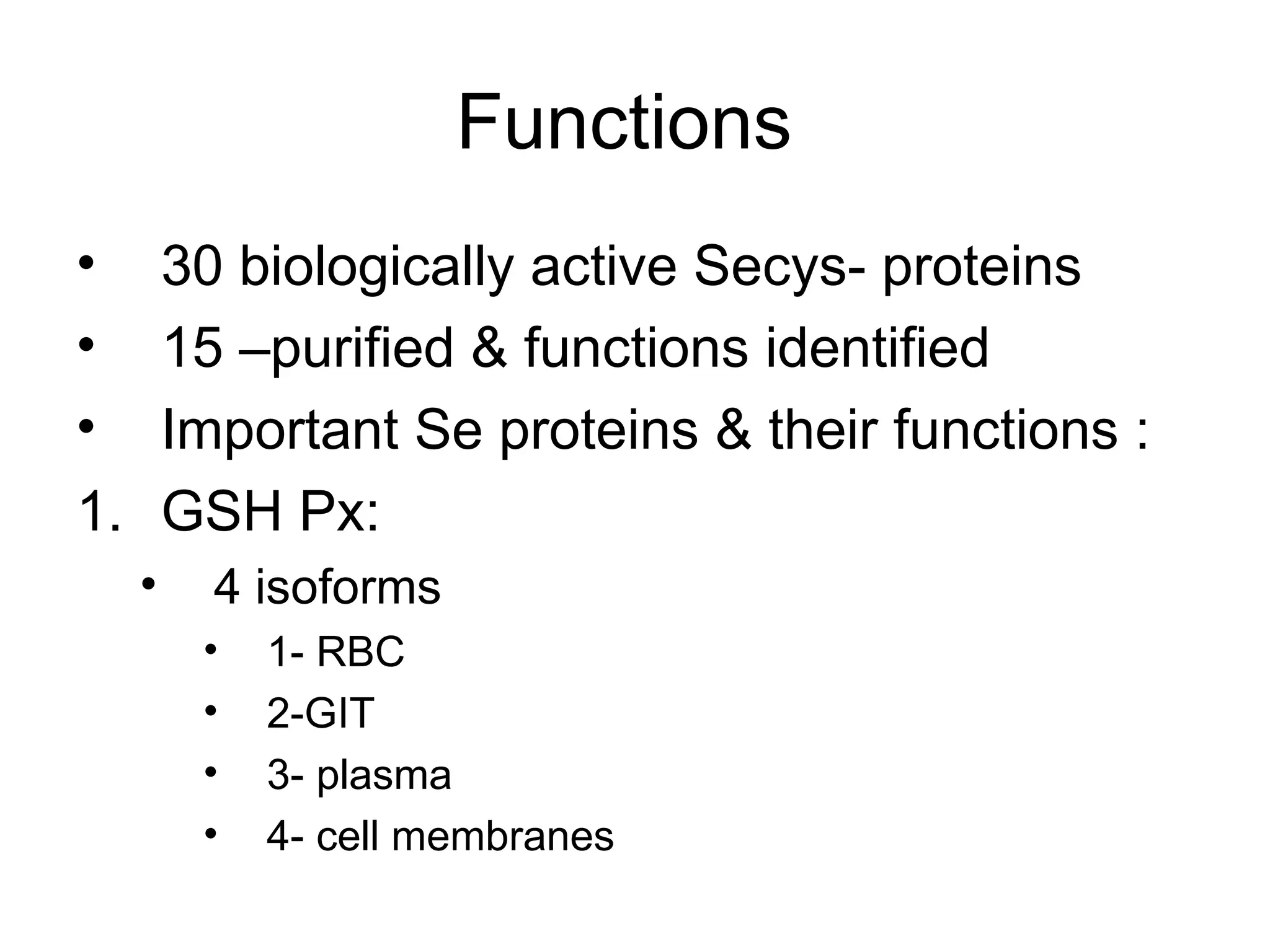
• 30 biologically active Secys- proteins
• 15 –purified & functions identified
• Important Se proteins & their functions :
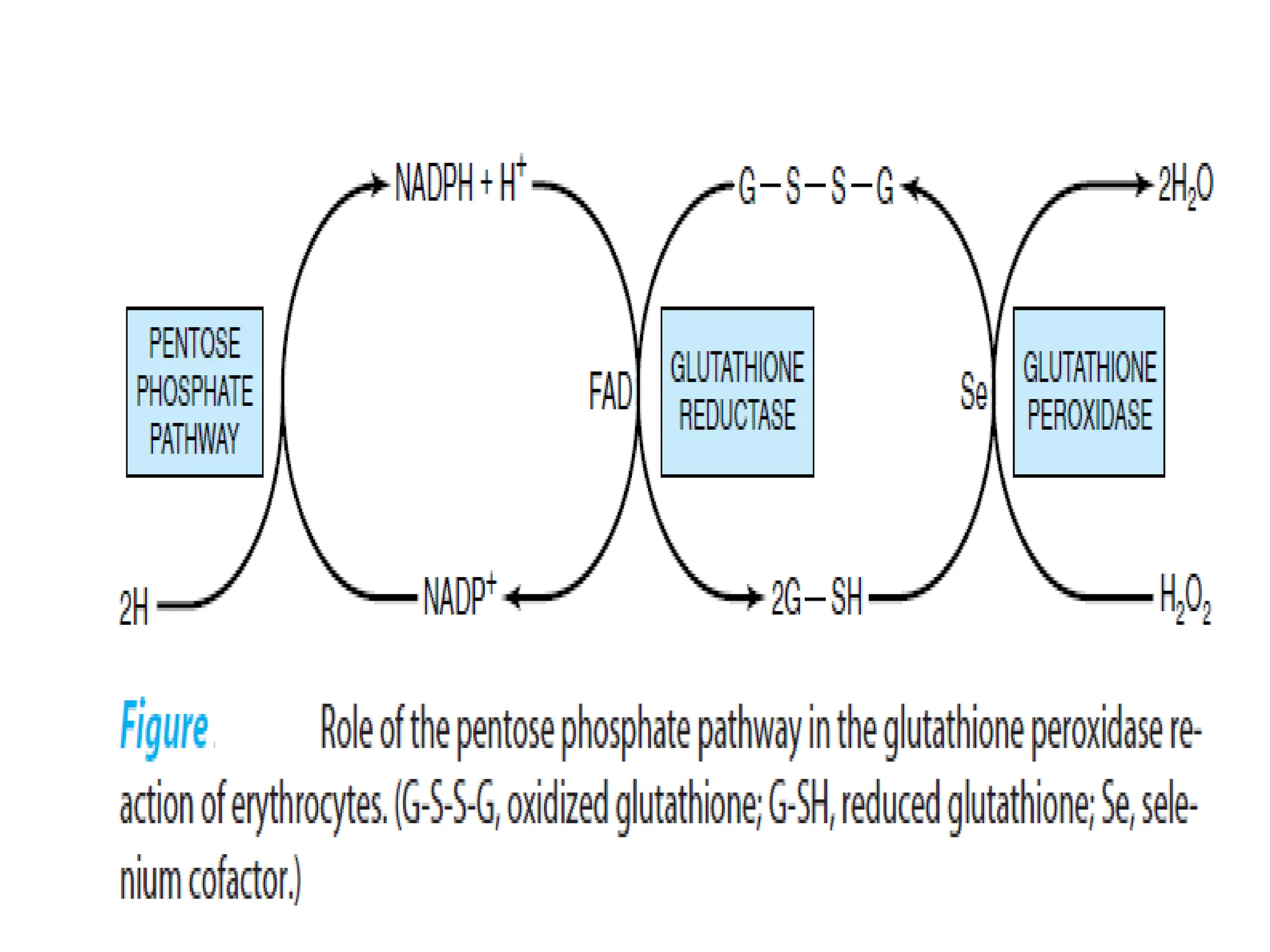
1. GSH Px:
• 4 isoforms
• 1- RBC
• 2-GIT
• 3- plasma
• 4- cell membranes
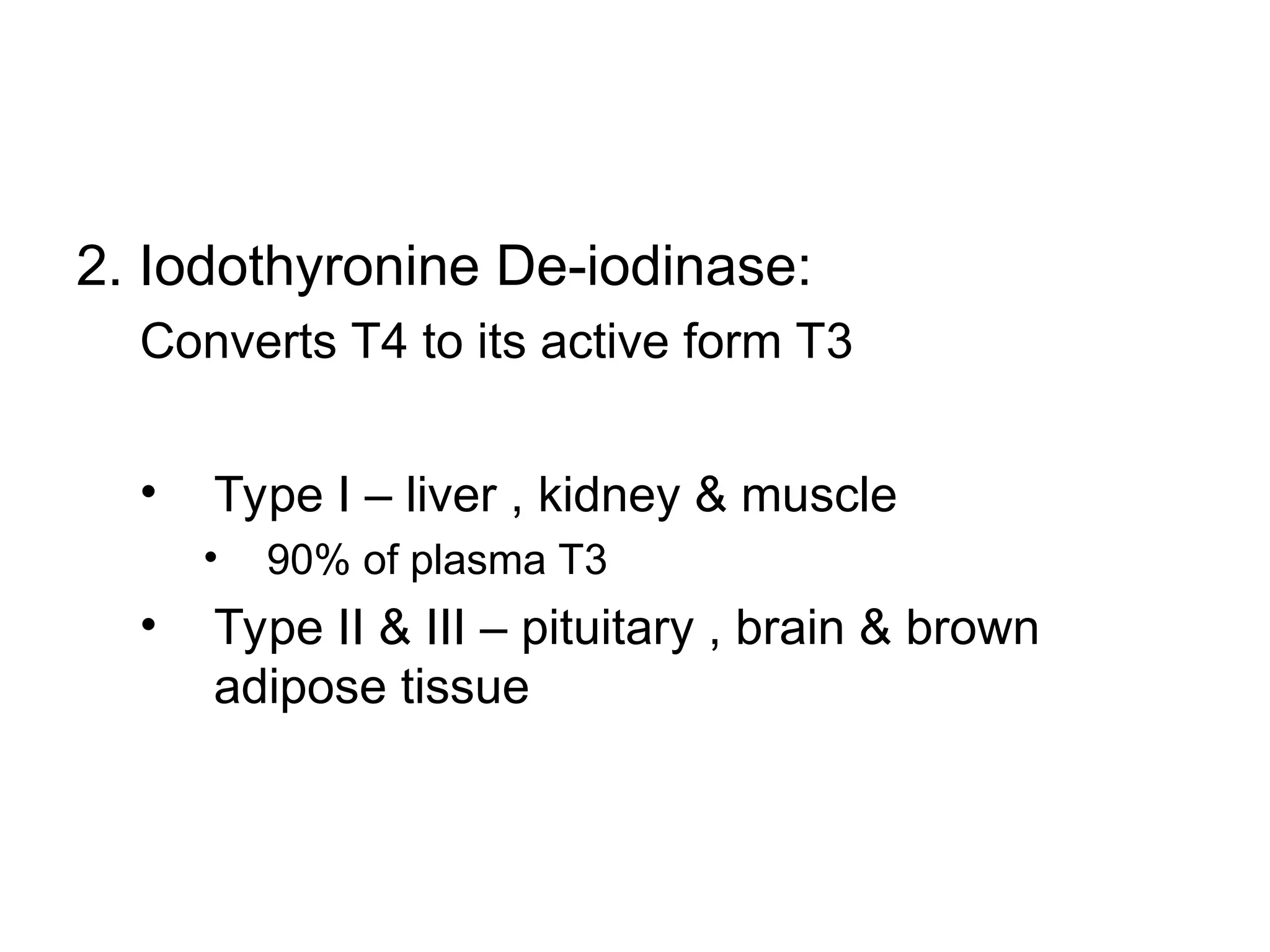
2. Iodothyronine De-iodinase:
Converts T4 to its active form T3
• Type I – liver , kidney & muscle
• 90% of plasma T3
• Type II & III – pituitary , brain & brown
adipose tissue
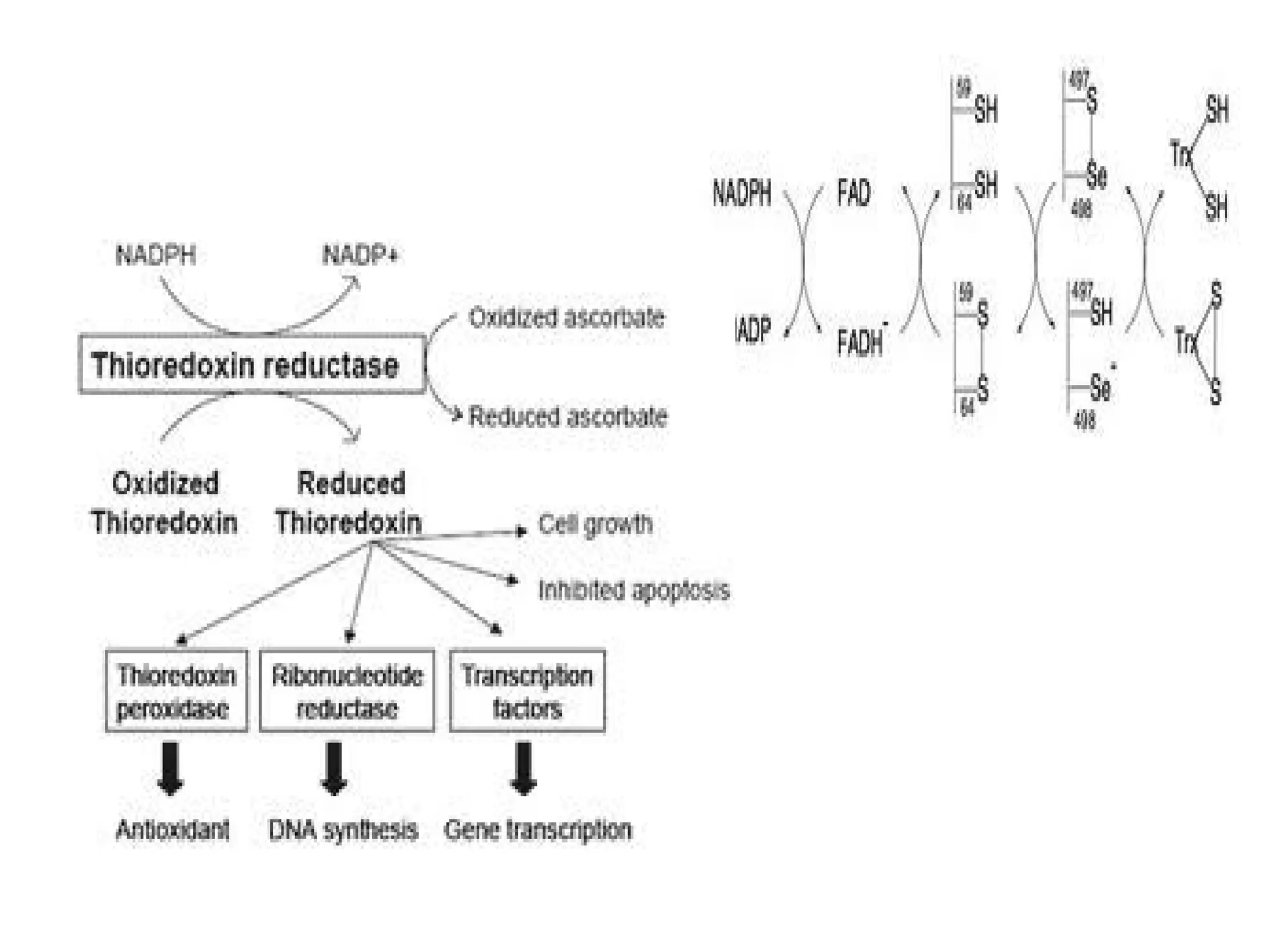
3. Thioredoxin reductase :
– maintains intracellular redox state
– Catalyses NADPH dep. Reduction of
thioredoxin
– 2 isoforms
5. Reproduction :
– Concentration in testis is highest in in adult
tissue
• Required for normal development of spermatozoa
• Present in mid-piece as a selenoprotein in
mitochondria
– Necessary for testosterone synthesis
– Maintains sperm viability
6. Non-specific antioxidant :
– Availability of vit.E  Se requirement
7. Role in cancer chemoprevention
Deficiency
• Deficiency in selenoprotein production esp. GSH Px – signs
and symptoms of se. deficiency disease
1. KESHAN DISEASE:Endemic cardiomyopathy
-Reported from Keshan province in china, where soil is
deficient in selenium.
-This disease is characterised by multifocal myocardial
necrosis, reduced serum selenium level, cardiac
arrythmias & cardiac enlargement.
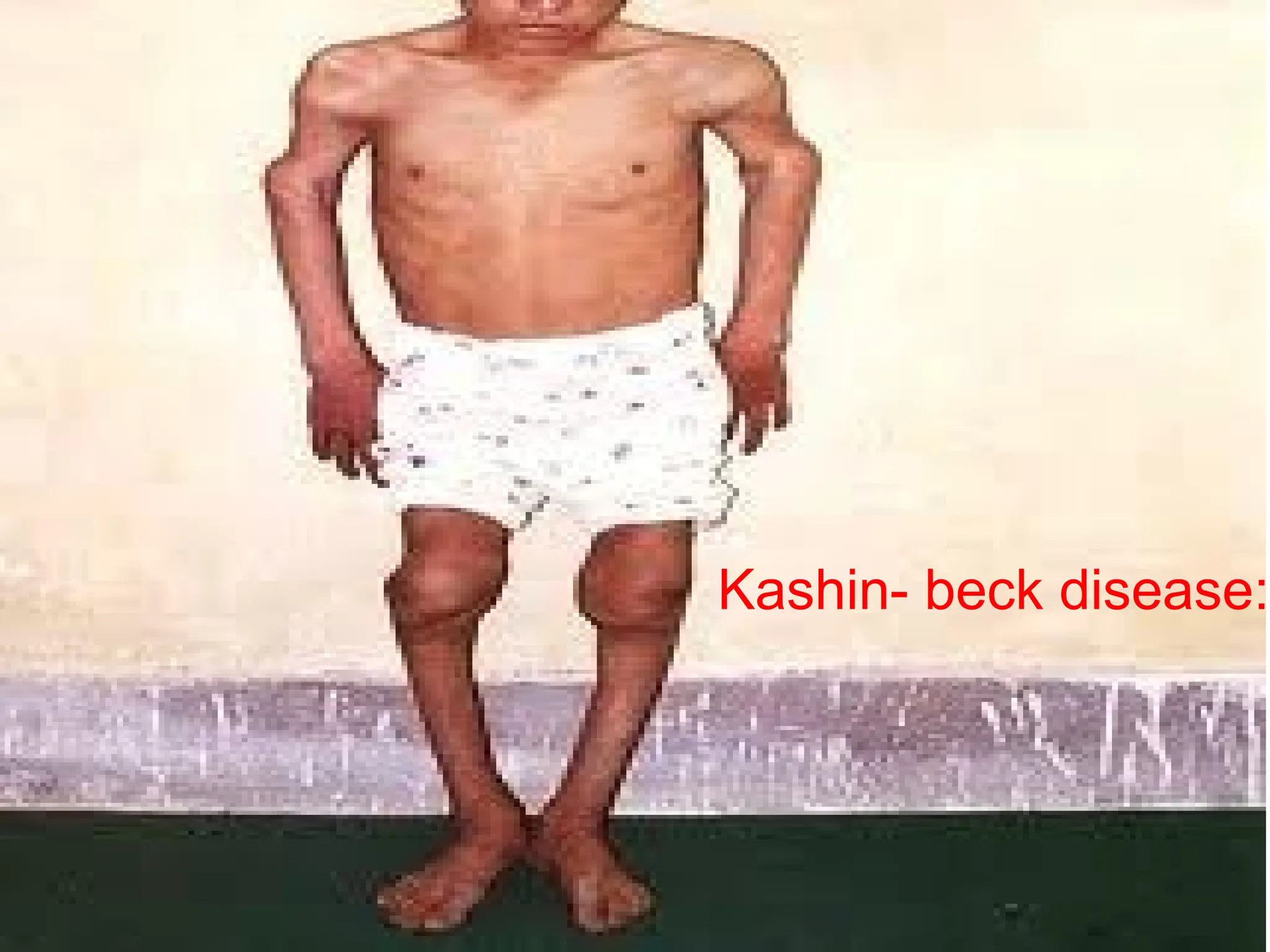
2.KASHIN- BECK DISEASE:
– Severe degenerative osteo arthrosis
– particularly affecting children between 5 to 13 yrs
age.
Kashin- beck disease:
• 3. Nutritional deficiency in hospital
patients:
– Muscle weakness
– Cardiomyopathy
– Pseudoalbinism
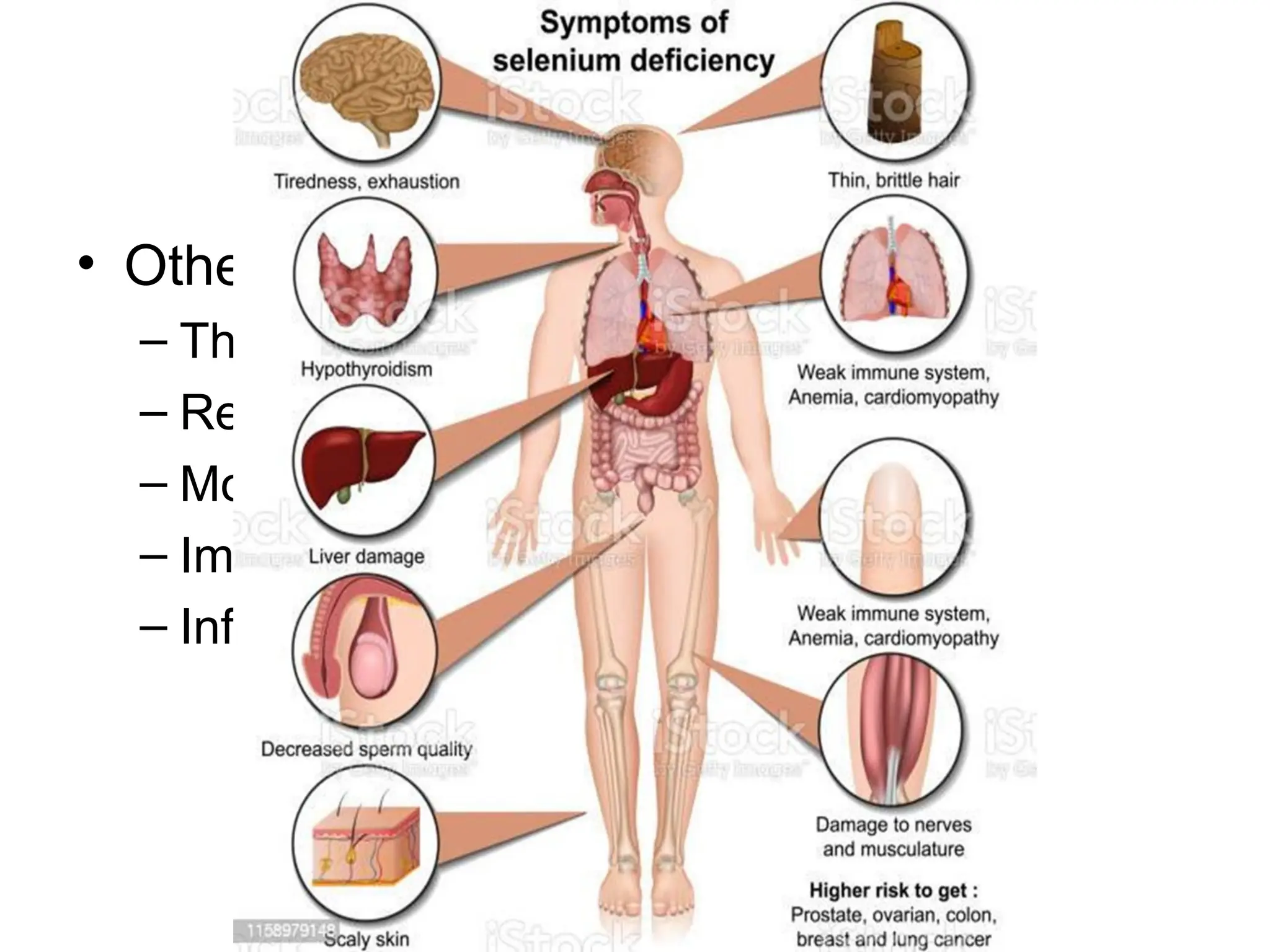
• Other deficiency effects
– Thyroid function
– Reproductive disorders
– Mood disorders
– Immune functions
– Infections cause deficiency
Toxicity
• Selenosis
• Toxic dose is 900µg/day.
• China & US – soil has excess Se and hence
foods contain more Se
• Signs :
– Garlic odor in breath( due to the presence of
dimethyl selenide in expired air).
– Hair loss
– Nail damage
• Metal polishes & anti-rust compounds

selenium metabolism in human body for mbbs students

  • 2.
    Selenium • Essential element •Chemistry : – Non-metal – Biologically active compounds contain Secys. • Se is substituted for S in Cys • UGA – co-translational insertion – SeMet. – only in plants • Identical to Met
  • 3.
    Selenium • Powerful antioxidant,works closely with Vitamin E to protect body from oxidation. • Total body content of selenium is about 4 to 10mg. • Highest concentration – liver, kidney & finger nails.
  • 4.
    • Non-specifically incorporatedinto protein pool • Is present in major proteins – albumin & Hb • Selenium in SeMet constitutes ½ the total dietary intake • Contributes to Secys. synthesis
  • 5.
    Sources Dairy products, vegetables,fruits, Cereals (good sources) Daily Requirement: Adults: 50 - 100µg/day Children: 20 - 120µg/day Infants get their selenium through breast milk. Se intake depends on the nature of the soil in which food crops are grown. Se is a well-known growth stimulant in agriculture.
  • 6.
  • 7.
    • Se isabsorbed from the duodenum & transported bound to β-lipoproteins in the form of seleno methionine. • Body Se – 15 mg Normal serum level is 50 - 100µg/dl. • 50% -60% of plasma selenium is present as selenoprotein P --Transport protein for se – Basic protein--Multiple His residues – 10atoms Se/molecule • 30% is present in GSH Px • Remainder in albumin as SeMet Absorption, Metabolism & Excretion(contd)
  • 8.
    • Powerful antioxidant,works closely with Vitamin E to protect body from oxidation. • Highest concentration – liver, kidney & finger nails. • Excretion : – Urinary output – Depends on intake Absorption, Metabolism & Excretion(contd)
  • 9.
    Selenophosphate synthetase: – Requiredfor intracellular synthesis of selenoproteins
  • 11.
    Functions • 30 biologicallyactive Secys- proteins • 15 –purified & functions identified • Important Se proteins & their functions : 1. GSH Px: • 4 isoforms • 1- RBC • 2-GIT • 3- plasma • 4- cell membranes
  • 13.
    2. Iodothyronine De-iodinase: ConvertsT4 to its active form T3 • Type I – liver , kidney & muscle • 90% of plasma T3 • Type II & III – pituitary , brain & brown adipose tissue
  • 14.
    3. Thioredoxin reductase: – maintains intracellular redox state – Catalyses NADPH dep. Reduction of thioredoxin – 2 isoforms
  • 16.
    5. Reproduction : –Concentration in testis is highest in in adult tissue • Required for normal development of spermatozoa • Present in mid-piece as a selenoprotein in mitochondria – Necessary for testosterone synthesis – Maintains sperm viability
  • 17.
    6. Non-specific antioxidant: – Availability of vit.E  Se requirement 7. Role in cancer chemoprevention
  • 18.
    Deficiency • Deficiency inselenoprotein production esp. GSH Px – signs and symptoms of se. deficiency disease 1. KESHAN DISEASE:Endemic cardiomyopathy -Reported from Keshan province in china, where soil is deficient in selenium. -This disease is characterised by multifocal myocardial necrosis, reduced serum selenium level, cardiac arrythmias & cardiac enlargement. 2.KASHIN- BECK DISEASE: – Severe degenerative osteo arthrosis – particularly affecting children between 5 to 13 yrs age.
  • 19.
  • 20.
    • 3. Nutritionaldeficiency in hospital patients: – Muscle weakness – Cardiomyopathy – Pseudoalbinism
  • 21.
    • Other deficiencyeffects – Thyroid function – Reproductive disorders – Mood disorders – Immune functions – Infections cause deficiency
  • 22.
    Toxicity • Selenosis • Toxicdose is 900µg/day. • China & US – soil has excess Se and hence foods contain more Se • Signs : – Garlic odor in breath( due to the presence of dimethyl selenide in expired air). – Hair loss – Nail damage • Metal polishes & anti-rust compounds

Editor's Notes

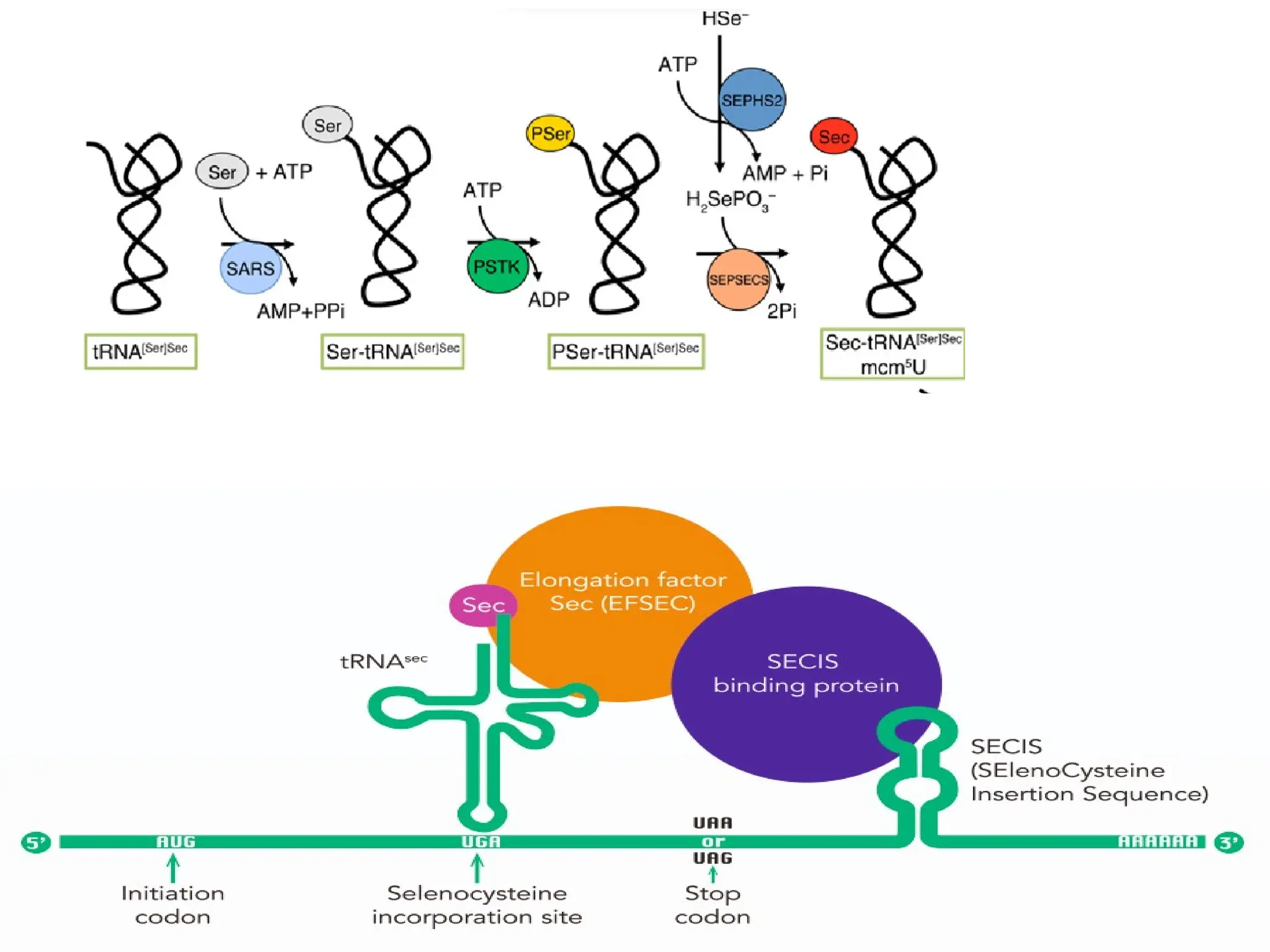
  • #6 Absorption is efficientSelenite & selanate Se from inorganic salts is incorporated into GSH Px and other proteins than from organic sources Ingested Se is in the form of selenite, selenate, SeCys. & SeMet. Metabolised Via selenide to form Seleno phosphate – important precursor in the synthesis of SeCys proteins
  • #10 seryl-tRNA synthetase (SARS), phosphoseryl-tRNA kinase (PSTK), subsequent conversion of this phosphoserine (PSer) to an intermediate by SEPSECS, and acceptance of selenophosphate to generate Sec-tRNA[Ser]Sec mcm5U. Selenophosphate is synthesized from selenide and ATP by selenophosphate synthetase 2 (SEPHS2)