




How to…
      SELECT
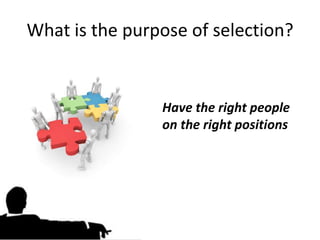
What is the purpose of selection?


                Have the right people
                on the right positions
Why is selection important?

• Without the right people in the organization
  we won’t be able to achieve our ambition

• If we don’t recruit the people suited for our
  organization they will quit
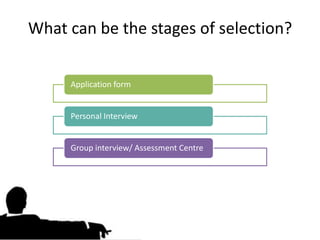
What can be the stages of selection?


     Application form


     Personal Interview


     Group interview/ Assessment Centre
• First interaction with the candidates

• What do you want to find out from the AF?

• Based on this, what should the AF contain?
Example
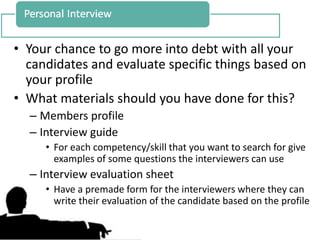
• Your chance to go more into debt with all your
  candidates and evaluate specific things based on
  your profile
• What materials should you have done for this?
  – Members profile
  – Interview guide
     • For each competency/skill that you want to search for give
       examples of some questions the interviewers can use
  – Interview evaluation sheet
     • Have a premade form for the interviewers where they can
       write their evaluation of the candidate based on the profile
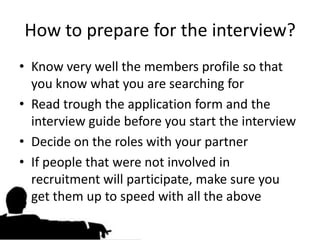
How to prepare for the interview?
• Know very well the members profile so that
  you know what you are searching for
• Read trough the application form and the
  interview guide before you start the interview
• Decide on the roles with your partner
• If people that were not involved in
  recruitment will participate, make sure you
  get them up to speed with all the above
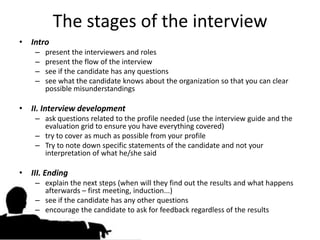
The stages of the interview
• Intro
    –   present the interviewers and roles
    –   present the flow of the interview
    –   see if the candidate has any questions
    –   see what the candidate knows about the organization so that you can clear
        possible misunderstandings

• II. Interview development
    – ask questions related to the profile needed (use the interview guide and the
      evaluation grid to ensure you have everything covered)
    – try to cover as much as possible from your profile
    – Try to note down specific statements of the candidate and not your
      interpretation of what he/she said

• III. Ending
    – explain the next steps (when will they find out the results and what happens
      afterwards – first meeting, induction...)
    – see if the candidate has any other questions
    – encourage the candidate to ask for feedback regardless of the results
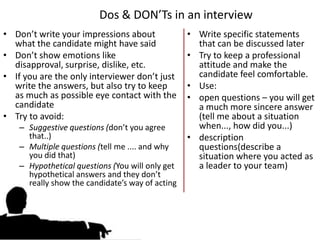
Dos & DON’Ts in an interview
• Don’t write your impressions about              • Write specific statements
  what the candidate might have said                that can be discussed later
• Don’t show emotions like                        • Try to keep a professional
  disapproval, surprise, dislike, etc.              attitude and make the
• If you are the only interviewer don’t just        candidate feel comfortable.
  write the answers, but also try to keep         • Use:
  as much as possible eye contact with the        • open questions – you will get
  candidate                                         a much more sincere answer
• Try to avoid:                                     (tell me about a situation
    – Suggestive questions (don’t you agree         when..., how did you...)
      that..)                                     • description
    – Multiple questions (tell me .... and why      questions(describe a
      you did that)                                 situation where you acted as
    – Hypothetical questions (You will only get     a leader to your team)
      hypothetical answers and they don’t
      really show the candidate’s way of acting
Example
• This stage is only relevant if you know exactly what you want to
  test in the participants.
• Give them a clear task and make sure that the people who are
  evaluating understand and know how to evaluate their
  performance.
• You can also use this stage to explain again what AIESEC is

• What materials should you have done for this?
   – Assessment guide
       • Explain the tasks/games and outline their relevance for the evaluation of the
         candidate
       • Give some guidelines of what the evaluators should look for
   – Assessment evaluation sheet
       • Have a premade form for the assessment where they can write their
         evaluation of the candidate based on what they observe during the
         assessment
How to prepare for the assessment
      centre/group interview ?
• Know very well the members profile so that you
  know what you are searching for
• Read trough the assessment guide before you
  start
• Understand the tasks and games that the
  candidates will run

• If people that were not involved in recruitment
  will participate, make sure you get them up to
  speed with all the above
Example
Tracking in the selection period
• Make sure you have a clear, simple tracking for
  all the candidates
• Make this tracking available to everyone
  involved in recruitment

• Why is this relevant?
  – Help YOU have an OVERVIEW of the candidates
Don’t forget !
• Keep a clear communication with your
  candidates

• Give feedback and let them know if they were
  not selected.

• PREPARE the people who will attend the
  selection and make them realize how
  important this stage is.
Interview simulation

Selection

  • 1.
    How to… SELECT
  • 2.
    What is thepurpose of selection? Have the right people on the right positions
  • 3.
    Why is selectionimportant? • Without the right people in the organization we won’t be able to achieve our ambition • If we don’t recruit the people suited for our organization they will quit
  • 4.
    What can bethe stages of selection? Application form Personal Interview Group interview/ Assessment Centre
  • 5.
    • First interactionwith the candidates • What do you want to find out from the AF? • Based on this, what should the AF contain?
  • 6.
  • 7.
    • Your chanceto go more into debt with all your candidates and evaluate specific things based on your profile • What materials should you have done for this? – Members profile – Interview guide • For each competency/skill that you want to search for give examples of some questions the interviewers can use – Interview evaluation sheet • Have a premade form for the interviewers where they can write their evaluation of the candidate based on the profile
  • 8.
    How to preparefor the interview? • Know very well the members profile so that you know what you are searching for • Read trough the application form and the interview guide before you start the interview • Decide on the roles with your partner • If people that were not involved in recruitment will participate, make sure you get them up to speed with all the above
  • 9.
    The stages ofthe interview • Intro – present the interviewers and roles – present the flow of the interview – see if the candidate has any questions – see what the candidate knows about the organization so that you can clear possible misunderstandings • II. Interview development – ask questions related to the profile needed (use the interview guide and the evaluation grid to ensure you have everything covered) – try to cover as much as possible from your profile – Try to note down specific statements of the candidate and not your interpretation of what he/she said • III. Ending – explain the next steps (when will they find out the results and what happens afterwards – first meeting, induction...) – see if the candidate has any other questions – encourage the candidate to ask for feedback regardless of the results
  • 10.
    Dos & DON’Tsin an interview • Don’t write your impressions about • Write specific statements what the candidate might have said that can be discussed later • Don’t show emotions like • Try to keep a professional disapproval, surprise, dislike, etc. attitude and make the • If you are the only interviewer don’t just candidate feel comfortable. write the answers, but also try to keep • Use: as much as possible eye contact with the • open questions – you will get candidate a much more sincere answer • Try to avoid: (tell me about a situation – Suggestive questions (don’t you agree when..., how did you...) that..) • description – Multiple questions (tell me .... and why questions(describe a you did that) situation where you acted as – Hypothetical questions (You will only get a leader to your team) hypothetical answers and they don’t really show the candidate’s way of acting
  • 11.
  • 12.
    • This stageis only relevant if you know exactly what you want to test in the participants. • Give them a clear task and make sure that the people who are evaluating understand and know how to evaluate their performance. • You can also use this stage to explain again what AIESEC is • What materials should you have done for this? – Assessment guide • Explain the tasks/games and outline their relevance for the evaluation of the candidate • Give some guidelines of what the evaluators should look for – Assessment evaluation sheet • Have a premade form for the assessment where they can write their evaluation of the candidate based on what they observe during the assessment
  • 13.
    How to preparefor the assessment centre/group interview ? • Know very well the members profile so that you know what you are searching for • Read trough the assessment guide before you start • Understand the tasks and games that the candidates will run • If people that were not involved in recruitment will participate, make sure you get them up to speed with all the above
  • 14.
  • 15.
    Tracking in theselection period • Make sure you have a clear, simple tracking for all the candidates • Make this tracking available to everyone involved in recruitment • Why is this relevant? – Help YOU have an OVERVIEW of the candidates
  • 16.
    Don’t forget ! •Keep a clear communication with your candidates • Give feedback and let them know if they were not selected. • PREPARE the people who will attend the selection and make them realize how important this stage is.
  • 17.