The History of Zionism
Ethnicity, Nationalism and the
origins of Zionism
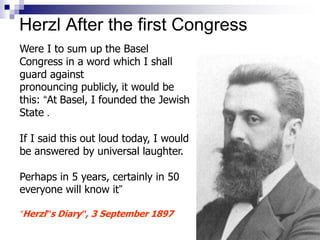
Herzl After the first Congress
Were I to sum up the Basel
Congress in a word which I shall
guard against
pronouncing publicly, it would be
this: “At Basel, I founded the Jewish
State .
If I said this out loud today, I would
be answered by universal laughter.
Perhaps in 5 years, certainly in 50
everyone will know it”
“Herzl”s Diary”, 3 September 1897
Zionism -
Definition
Zionism= From the biblical word "Zion", often used as a
synonym for Jerusalem and the Land of Israel (Eretz
Yisrael).
 Encyclopedia Britannica : A Jewish nationalist
movement that has had as its goal the creation and
support of a Jewish national state in Palestine, the
ancient homeland of the Jews
 The Basel Program( program determined by the first
Zionist Congress in Basel in August 1897) : Zionism
strive to create for the Jewish people a home in
Palestine secured by public law.
Two Fundamental Problems
 Are the Jews a Nation or a
Religious/Cultural Group ?
 The Right of the Jews to the Land – Do
they have a right to establish a
homeland in Palestine?
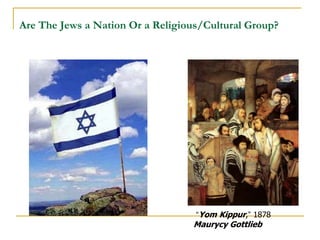
Are The Jews a Nation Or a Religious/Cultural Group?
“Yom Kippur,” 1878
Maurycy Gottlieb
Nation and Nationalism
► Nation: a named human population (“The French
People”, “British”) possessing a myth of common
descent, common historical memories, elements of
shared culture, an association with particular
territory and sense of solidarity.
► Nationalism – An Ideology which requires
political independence, self determination within
the nation unit’s own territory. It holds that
political and national unit should be identical.
( Anthony D. Smith, The Ethnic Origins of
Nations; G. Simony, The Zionist Ideology)
Nationalism and Nations
 Primordial and perennial phenomena
 Modern and even an invented phenomena
Nation and Nationalism
 “ I am driven to the conclusion that no
‘scientific definition’ of nation can be
devised; yet the phenomenon has exited
and exits. All that I can find to say is that a
nation exists when a significant number of
people in a community consider
themselves to form a nation, or to behave
as if they form one”
Hugh Seton-Watson
Ethno-symbolic hypothesis
Anthony Smith
 Ethnicity
 Ethnicism
 Nationalism
Ethno-Symbolic hypothesis
 Ethnicity – The mere presence of ethnic
attributes such as consciousness of common
origin (whether mythic or actual) religion
and territory (or association with territory)
Ethno-Symbolic hypothesis
 Ethnicism – A state of mind, the conversion
of such attributes of ethnicity into highly
ranked attributes/values
Ethno-Symbolic hypothesis
 Nationalism – Aspires to political self
determination for the ethnic group in its own
land
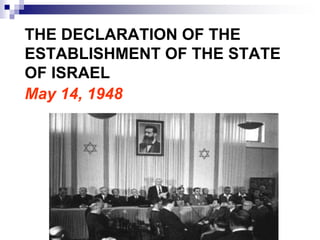
THE DECLARATION OF THE
ESTABLISHMENT OF THE STATE
OF ISRAEL
May 14, 1948
The right to the land
From: THE DECLARATION OF THE
ESTABLISHMENT OF THE STATE OF
ISRAEL
"The Land of Israel was the birthplace of the Jewish people. Here
their spiritual, religious and political identity was shaped. Here they first
attained to statehood, created cultural values of national and universal
significance and gave to the world the eternal Book of Books.”
“After being forcibly exiled from their land, the people kept faith with it
throughout their dispersion and never ceased to pray and hope for
their return to it and for the restoration in it of their political freedom.“
“Impelled by this historic and traditional attachment, Jews strove in
every successive generation to re-establish themselves in their
ancient homeland.”
Main Zionist’s Argumentations
Regarding the Right to the Land
1. The Land of Israel is the birthplace of the Jewish people. Here their
spiritual, religious and National identity was shaped.
2. They were forcibly exiled from their country
3. Nevertheless while in exile they pray and did not lose faith and hope
to return and to restore the sovereignty
4. Despite all manner of restrictions, and persecution and insecurity, Jews
continued to maintain some presence in Palestine and Jews as groups
and Individuals never ceased to return.
5. Since the destruction of the Jewish Commonwealth by Rome
it became a backward province of successive empires, but never
been an “indigenous statehood” and until the 20 century the Jews were
the only people who regarded Palestine as their homeland
The Divine Promise
And the lord appeared unto Abram and said unto
him. I am God Almighty…I will established my
covenant between me and thee and thy seed
after thee throughout the generations for the
everlasting covenant to be a God unto thee and
thy seed after thee. And I will give unto thee and
to thy seed after thee…the land of Canaan for
the everlasting holding: and I will be their God
(Gen 17:1 7,8)
Israel’s Ancient History – From
Kingdom to Destruction and Exile
The First Temple built
 1000 BC Isreal’s tribes became a monarchy (According to the
bible: Kings Saul, David and Salomon). First Temple built
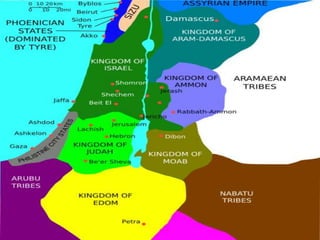
 925 BC — Partition of ancient Israel into the Kingdoms of Judah
and Israel
 722 BC - Assyrians invaded northern kingdom – The end of the
Kingdom of Israel. Part of the population was deported to the
eastern frontier of Assyrian. many people fled south to Judah who
became much more populated
 587 BCE Judah fell to the Babylonians, Temple
destroyed, Main Babylonian exile begins. Large part
of the population of Judah (the upper and the middle
class was deported) to Babylon. Part of the Jewish
population fled to Egypt, Syria, Mesopotamia – the
beginning of the Jewish Diaspora
 537 BCE After the overthrow of Babylonia by the Persian
Empire, in the Persian ruler Cyrus the Great gave the
Jews a permission to return to their native land. A
post exiled Jewish community was established in Judah
comprised of 125,000 to 130,000 souls
 516 BCE Second temple built
Second Temple
 331 BCE - Defeat of The Persian Empire by Alexander
the Great. Judah part of the new empire
 323 BCE – Death of Alexander. The division of the
empire between Alexander’s generals
 174-163 BCE – Judah part of the Seleucid Empire
(established by Seleucus, one of the Generals)
attempts to impose the Greek culture (Hellenization)
on the Jews instead of Judaism
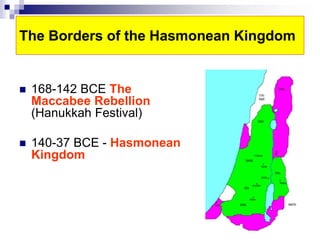
The Borders of the Hasmonean Kingdom
 168-142 BCE The
Maccabee Rebellion
(Hanukkah Festival)
 140-37 BCE - Hasmonean
Kingdom
 63 BCE - The Roman Empire enforced its rule on
Judah made it a Roman province
 66-73 CE- Jewish Revolt against the Roman Empire.
The destruction of the Second Temple. It is estimated
that over 100,000 Jews were killed, and nearly 100,000
were taken to Rome as slaves. Many Jews fled to
countries around the Mediterranean
 132-135 - the Bar-Kochba revolt began led by Simon
bar Kokhba . 135 the revolt was crushed. The end of
Jewish Sovereignty.
 The Roman Suppress any remnants of Jewish
Sovereignty changing the name of the whole
country to Palestine. From now on it will be
referred by all its future rulers as part of Syria,
called Syria-Palestine. (After Philistines
mentioned In the Bible, the area inhabited by
them was known as Pleshet, in cities along the
coast (Gaza Ashkelon Ashdod)
 (330–640 CE) - Byzantine (Eastern Roman
Empire) rule
 (638–1099 CE) - Arab (Islamic) Caliphate rule
Hope of Redemption In the Land of
Israel
By the Rivers of Babylon, there we sat
down, yea, we wept when we remembered
Zion…,
If I forget you, Jerusalem, let my right
hand forget its skill; Let my tongue stick to
the roof of my mouth if I don't remember
you, if I don't prefer Jerusalem above my
chief joy".
The Messiah
"The anointed King is destined to stand up and
restore the Davidic Kingdom to its antiquity, to the
first sovereignty. He will build the Temple in
Jerusalem and gather the strayed ones of Israel
together“

"
‫פי‬ ‫על‬ ‫ואף‬ ‫המשיח‬ ‫בביאת‬ ‫שלמה‬ ‫באמונה‬ ‫מאמין‬ ‫אני‬
‫שיתמהמה‬
,
‫שיבוא‬ ‫יום‬ ‫בכל‬ ‫לו‬ ‫אחכה‬ ‫זה‬ ‫כל‬ ‫עם‬
."
 "I believe with full faith in the coming of the Messiah.
And even though he tarries, with all that, I await his
arrival with every day"
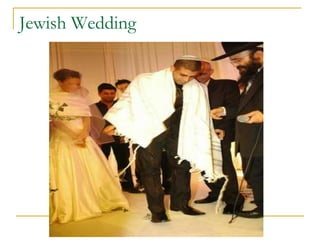
Jewish Wedding
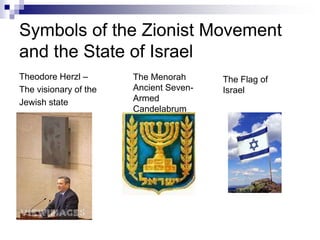
Symbols of the Zionist Movement
and the State of Israel
Theodore Herzl –
The visionary of the
Jewish state
The Menorah
Ancient Seven-
Armed
Candelabrum
The Flag of
Israel
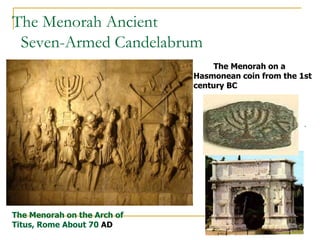
The Menorah Ancient
Seven-Armed Candelabrum
.
The Menorah on the Arch of
Titus, Rome About 70 AD
The Menorah on a
Hasmonean coin from the 1st
century BC
Language
 The revival of the Hebrew Language
The prefix ‘re’, :
‘rebuilding’,
‘renewing’,
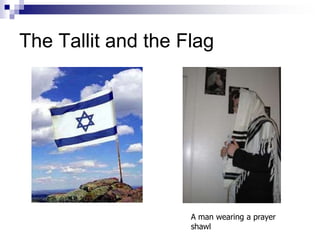
The Tallit and the Flag
A man wearing a prayer
shawl
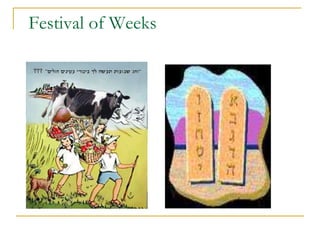
Festival of Weeks
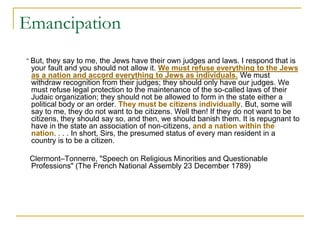
Emancipation
“ But, they say to me, the Jews have their own judges and laws. I respond that is
your fault and you should not allow it. We must refuse everything to the Jews
as a nation and accord everything to Jews as individuals. We must
withdraw recognition from their judges; they should only have our judges. We
must refuse legal protection to the maintenance of the so-called laws of their
Judaic organization; they should not be allowed to form in the state either a
political body or an order. They must be citizens individually. But, some will
say to me, they do not want to be citizens. Well then! If they do not want to be
citizens, they should say so, and then, we should banish them. It is repugnant to
have in the state an association of non-citizens, and a nation within the
nation. . . . In short, Sirs, the presumed status of every man resident in a
country is to be a citizen.
Clermont–Tonnerre, "Speech on Religious Minorities and Questionable
Professions" (The French National Assembly 23 December 1789)
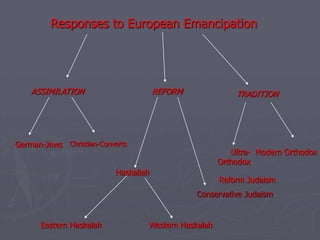
Responses to European Emancipation
ASSIMILATION REFORM TRADITION
Christian-Converts
German-Jews
Reform Judaism
Conservative Judaism
Modern Orthodox
Ultra-
Orthodox
Haskallah
Western Haskalah
Eastern Haskalah
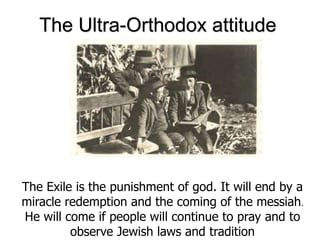
The Ultra-Orthodox attitude
The Exile is the punishment of god. It will end by a
miracle redemption and the coming of the messiah.
He will come if people will continue to pray and to
observe Jewish laws and tradition
Haskalah ( Sekhel)
, learnedness scholarliness, enlightenment
 Mskilim- enlightened, learned, scholarly
 Haskalah movement advocated adopting
enlightenment values, pressing for better integration
into European society, and increasing education in
secular studies
and Jewish studies in a modern way
Precursors of Zionism
 A person who expressed ideas that precede
in time the emergence of social movement
aroused by much the same ideas
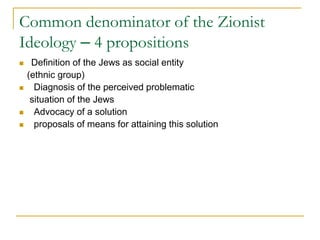
Common denominator of the Zionist
Ideology – 4 propositions
 Definition of the Jews as social entity
(ethnic group)
 Diagnosis of the perceived problematic
situation of the Jews
 Advocacy of a solution
 proposals of means for attaining this solution

SEJARAH ZIONIS

  • 1.
    The History ofZionism Ethnicity, Nationalism and the origins of Zionism
  • 2.
    Herzl After thefirst Congress Were I to sum up the Basel Congress in a word which I shall guard against pronouncing publicly, it would be this: “At Basel, I founded the Jewish State . If I said this out loud today, I would be answered by universal laughter. Perhaps in 5 years, certainly in 50 everyone will know it” “Herzl”s Diary”, 3 September 1897
  • 3.
    Zionism - Definition Zionism= Fromthe biblical word "Zion", often used as a synonym for Jerusalem and the Land of Israel (Eretz Yisrael).  Encyclopedia Britannica : A Jewish nationalist movement that has had as its goal the creation and support of a Jewish national state in Palestine, the ancient homeland of the Jews  The Basel Program( program determined by the first Zionist Congress in Basel in August 1897) : Zionism strive to create for the Jewish people a home in Palestine secured by public law.
  • 4.
    Two Fundamental Problems Are the Jews a Nation or a Religious/Cultural Group ?  The Right of the Jews to the Land – Do they have a right to establish a homeland in Palestine?
  • 5.
    Are The Jewsa Nation Or a Religious/Cultural Group? “Yom Kippur,” 1878 Maurycy Gottlieb
  • 6.
    Nation and Nationalism ►Nation: a named human population (“The French People”, “British”) possessing a myth of common descent, common historical memories, elements of shared culture, an association with particular territory and sense of solidarity. ► Nationalism – An Ideology which requires political independence, self determination within the nation unit’s own territory. It holds that political and national unit should be identical. ( Anthony D. Smith, The Ethnic Origins of Nations; G. Simony, The Zionist Ideology)
  • 7.
    Nationalism and Nations Primordial and perennial phenomena  Modern and even an invented phenomena
  • 8.
    Nation and Nationalism “ I am driven to the conclusion that no ‘scientific definition’ of nation can be devised; yet the phenomenon has exited and exits. All that I can find to say is that a nation exists when a significant number of people in a community consider themselves to form a nation, or to behave as if they form one” Hugh Seton-Watson
  • 9.
    Ethno-symbolic hypothesis Anthony Smith Ethnicity  Ethnicism  Nationalism
  • 10.
    Ethno-Symbolic hypothesis  Ethnicity– The mere presence of ethnic attributes such as consciousness of common origin (whether mythic or actual) religion and territory (or association with territory)
  • 11.
    Ethno-Symbolic hypothesis  Ethnicism– A state of mind, the conversion of such attributes of ethnicity into highly ranked attributes/values
  • 12.
    Ethno-Symbolic hypothesis  Nationalism– Aspires to political self determination for the ethnic group in its own land
  • 14.
    THE DECLARATION OFTHE ESTABLISHMENT OF THE STATE OF ISRAEL May 14, 1948
  • 15.
    The right tothe land From: THE DECLARATION OF THE ESTABLISHMENT OF THE STATE OF ISRAEL "The Land of Israel was the birthplace of the Jewish people. Here their spiritual, religious and political identity was shaped. Here they first attained to statehood, created cultural values of national and universal significance and gave to the world the eternal Book of Books.” “After being forcibly exiled from their land, the people kept faith with it throughout their dispersion and never ceased to pray and hope for their return to it and for the restoration in it of their political freedom.“ “Impelled by this historic and traditional attachment, Jews strove in every successive generation to re-establish themselves in their ancient homeland.”
  • 16.
    Main Zionist’s Argumentations Regardingthe Right to the Land 1. The Land of Israel is the birthplace of the Jewish people. Here their spiritual, religious and National identity was shaped. 2. They were forcibly exiled from their country 3. Nevertheless while in exile they pray and did not lose faith and hope to return and to restore the sovereignty
  • 17.
    4. Despite allmanner of restrictions, and persecution and insecurity, Jews continued to maintain some presence in Palestine and Jews as groups and Individuals never ceased to return. 5. Since the destruction of the Jewish Commonwealth by Rome it became a backward province of successive empires, but never been an “indigenous statehood” and until the 20 century the Jews were the only people who regarded Palestine as their homeland
  • 18.
    The Divine Promise Andthe lord appeared unto Abram and said unto him. I am God Almighty…I will established my covenant between me and thee and thy seed after thee throughout the generations for the everlasting covenant to be a God unto thee and thy seed after thee. And I will give unto thee and to thy seed after thee…the land of Canaan for the everlasting holding: and I will be their God (Gen 17:1 7,8)
  • 19.
    Israel’s Ancient History– From Kingdom to Destruction and Exile The First Temple built  1000 BC Isreal’s tribes became a monarchy (According to the bible: Kings Saul, David and Salomon). First Temple built  925 BC — Partition of ancient Israel into the Kingdoms of Judah and Israel  722 BC - Assyrians invaded northern kingdom – The end of the Kingdom of Israel. Part of the population was deported to the eastern frontier of Assyrian. many people fled south to Judah who became much more populated
  • 21.
     587 BCEJudah fell to the Babylonians, Temple destroyed, Main Babylonian exile begins. Large part of the population of Judah (the upper and the middle class was deported) to Babylon. Part of the Jewish population fled to Egypt, Syria, Mesopotamia – the beginning of the Jewish Diaspora  537 BCE After the overthrow of Babylonia by the Persian Empire, in the Persian ruler Cyrus the Great gave the Jews a permission to return to their native land. A post exiled Jewish community was established in Judah comprised of 125,000 to 130,000 souls  516 BCE Second temple built
  • 22.
    Second Temple  331BCE - Defeat of The Persian Empire by Alexander the Great. Judah part of the new empire  323 BCE – Death of Alexander. The division of the empire between Alexander’s generals  174-163 BCE – Judah part of the Seleucid Empire (established by Seleucus, one of the Generals) attempts to impose the Greek culture (Hellenization) on the Jews instead of Judaism
  • 23.
    The Borders ofthe Hasmonean Kingdom  168-142 BCE The Maccabee Rebellion (Hanukkah Festival)  140-37 BCE - Hasmonean Kingdom
  • 24.
     63 BCE- The Roman Empire enforced its rule on Judah made it a Roman province  66-73 CE- Jewish Revolt against the Roman Empire. The destruction of the Second Temple. It is estimated that over 100,000 Jews were killed, and nearly 100,000 were taken to Rome as slaves. Many Jews fled to countries around the Mediterranean  132-135 - the Bar-Kochba revolt began led by Simon bar Kokhba . 135 the revolt was crushed. The end of Jewish Sovereignty.
  • 25.
     The RomanSuppress any remnants of Jewish Sovereignty changing the name of the whole country to Palestine. From now on it will be referred by all its future rulers as part of Syria, called Syria-Palestine. (After Philistines mentioned In the Bible, the area inhabited by them was known as Pleshet, in cities along the coast (Gaza Ashkelon Ashdod)  (330–640 CE) - Byzantine (Eastern Roman Empire) rule  (638–1099 CE) - Arab (Islamic) Caliphate rule
  • 26.
    Hope of RedemptionIn the Land of Israel By the Rivers of Babylon, there we sat down, yea, we wept when we remembered Zion…, If I forget you, Jerusalem, let my right hand forget its skill; Let my tongue stick to the roof of my mouth if I don't remember you, if I don't prefer Jerusalem above my chief joy".
  • 27.
    The Messiah "The anointedKing is destined to stand up and restore the Davidic Kingdom to its antiquity, to the first sovereignty. He will build the Temple in Jerusalem and gather the strayed ones of Israel together“  " ‫פי‬ ‫על‬ ‫ואף‬ ‫המשיח‬ ‫בביאת‬ ‫שלמה‬ ‫באמונה‬ ‫מאמין‬ ‫אני‬ ‫שיתמהמה‬ , ‫שיבוא‬ ‫יום‬ ‫בכל‬ ‫לו‬ ‫אחכה‬ ‫זה‬ ‫כל‬ ‫עם‬ ."  "I believe with full faith in the coming of the Messiah. And even though he tarries, with all that, I await his arrival with every day"
  • 28.
  • 29.
    Symbols of theZionist Movement and the State of Israel Theodore Herzl – The visionary of the Jewish state The Menorah Ancient Seven- Armed Candelabrum The Flag of Israel
  • 30.
    The Menorah Ancient Seven-ArmedCandelabrum . The Menorah on the Arch of Titus, Rome About 70 AD The Menorah on a Hasmonean coin from the 1st century BC
  • 31.
    Language  The revivalof the Hebrew Language The prefix ‘re’, : ‘rebuilding’, ‘renewing’,
  • 32.
    The Tallit andthe Flag A man wearing a prayer shawl
  • 33.
  • 34.
    Emancipation “ But, theysay to me, the Jews have their own judges and laws. I respond that is your fault and you should not allow it. We must refuse everything to the Jews as a nation and accord everything to Jews as individuals. We must withdraw recognition from their judges; they should only have our judges. We must refuse legal protection to the maintenance of the so-called laws of their Judaic organization; they should not be allowed to form in the state either a political body or an order. They must be citizens individually. But, some will say to me, they do not want to be citizens. Well then! If they do not want to be citizens, they should say so, and then, we should banish them. It is repugnant to have in the state an association of non-citizens, and a nation within the nation. . . . In short, Sirs, the presumed status of every man resident in a country is to be a citizen. Clermont–Tonnerre, "Speech on Religious Minorities and Questionable Professions" (The French National Assembly 23 December 1789)
  • 35.
    Responses to EuropeanEmancipation ASSIMILATION REFORM TRADITION Christian-Converts German-Jews Reform Judaism Conservative Judaism Modern Orthodox Ultra- Orthodox Haskallah Western Haskalah Eastern Haskalah
  • 36.
    The Ultra-Orthodox attitude TheExile is the punishment of god. It will end by a miracle redemption and the coming of the messiah. He will come if people will continue to pray and to observe Jewish laws and tradition
  • 37.
    Haskalah ( Sekhel) ,learnedness scholarliness, enlightenment  Mskilim- enlightened, learned, scholarly  Haskalah movement advocated adopting enlightenment values, pressing for better integration into European society, and increasing education in secular studies and Jewish studies in a modern way
  • 38.
    Precursors of Zionism A person who expressed ideas that precede in time the emergence of social movement aroused by much the same ideas
  • 39.
    Common denominator ofthe Zionist Ideology – 4 propositions  Definition of the Jews as social entity (ethnic group)  Diagnosis of the perceived problematic situation of the Jews  Advocacy of a solution  proposals of means for attaining this solution