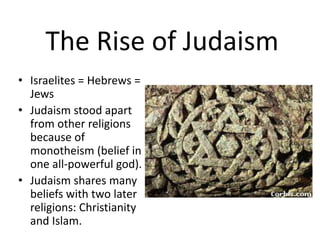
The Rise of JudaismIsraelites = Hebrews = JewsJudaism stood apart from other religions because of monotheism (belief in one all‐powerful god).Judaism shares many beliefs with two later religions: Christianity and Islam.
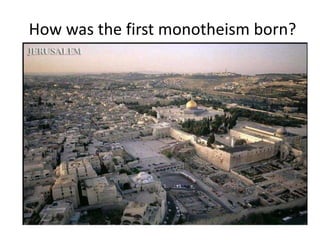
How was the first monotheismborn?
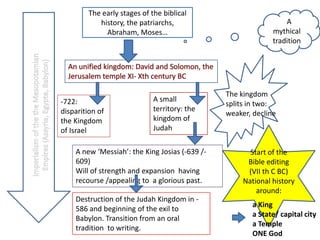
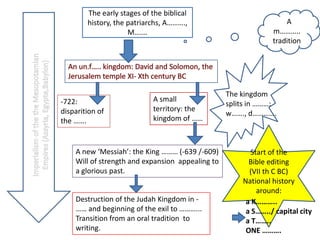
The early stages of the biblicalhistory, the patriarchs, Abraham, Moses…AA mythical traditionImperialism of the theMesopotamian Empires (Assyria, Egypte, Babylon)An unifiedkingdom: David and Solomon, the Jerusalem temple XI- Xthcentury BCThe kingdomsplits in two: weaker, declineA smallterritory: the kingdom of Judah-722: disparition of the Kingdom of IsraelStart of the Bible editing (VII th C BC)National historyaround: A new ‘Messiah’: the King Josias (-639 /-609)Will of strength and expansion  havingrecourse /appealing to  a gloriouspast.Destruction of the JudahKingdom in -586 and beginning of the exil to Babylon. Transition from an oral tradition  to writing.a Kinga State/ capital citya TempleONE God
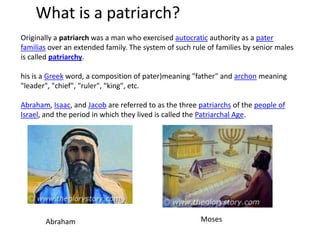
Whatis a patriarch? Originally a patriarch was a man who exercised autocratic authority as a paterfamilias over an extended family. The system of such rule of families by senior males is called patriarchy. his is a Greek word, a composition of pater)meaning "father" and archon meaning "leader", "chief", "ruler", "king", etc.Abraham, Isaac, and Jacob are referred to as the three patriarchs of the people of Israel, and the period in which they lived is called the Patriarchal Age. MosesAbraham
Abraham’s Journey to Canaan
Abraham is regarded as the first Jew.He and his followers left Mesopotamia and settled in Canaan (now Lebanon, Israel and Jordan) at the commandment of God, in 1900 BC.Abraham’s grandson, Jacob (Israel), had 12 sons who each led his own tribe.Slavery and ExodusFamine caused the Israelites to migrate to Egypt, where Jacob’s son, Joseph, lived. They were eventually enslaved.Many of the monuments of Egypt’s New Kingdom were built by Israelite slaves.Moses’story:http://www.youtube.com/watch?v=BEOMFjGFS7M
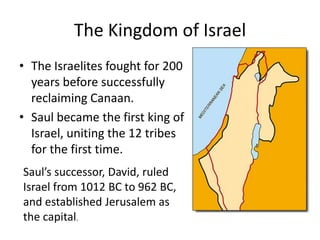
The Kingdom of IsraelThe Israelites fought for 200 years before successfully reclaiming Canaan.Saul became the first king of Israel, uniting the 12 tribes for the first time.Saul’s successor, David, ruled Israel from 1012 BC to 962 BC, and established Jerusalem as the capital.
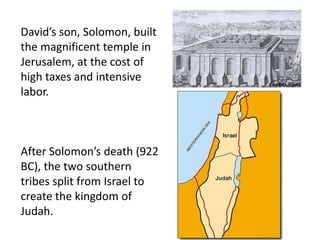
David’s son, Solomon, built the magnificent temple in Jerusalem, at the cost of high taxes and intensive labor.After Solomon’s death (922 BC), the two southern tribes split from Israel to create the kingdom of Judah.
                 Exile      1-Israel was conquered in 722 BC by the Assyrians,      who scattered the Israelites throughout their empire.2-Judah was conquered in 597 BC by the Chaldeans, under King Nebuchadnezzar.3-In 586 BC, after a rebellion, they destroyed the Temple in Jerusalem and captured many Jews to be slaves in Babylon.
                      ExileJews continued to maintain their religion while in exile.The Chaldeans were conquered in 539 BC by the Persians, under Cyrus the Great. He allowed the Jews to return to Jerusalem and rebuild the Temple.
                     After ExileJudah/Israel would eventually be ruled by:-the Greeks (Alexander the Great)-the Romans-the Islamic Empire (when it became known as Palestine)-the Ottoman EmpireIsrael would not be an independent state until 1948.
The early stages of the biblicalhistory, the patriarchs, A………., M….…AA m……….. traditionImperialism of the theMesopotamian Empires (Assyria, Egypte,Babylon)An un.f….. kingdom: David and Solomon, the Jerusalem temple XI- Xthcentury BCThe kingdomsplits in ………: w……., d…………. A smallterritory: the kingdom of ……-722: disparition of the …….Start of the Bible editing (VII th C BC)National historyaround: A new ‘Messiah’: the King ……… (-639 /-609)Will of strength and expansion  appealing to  a gloriouspast.Destruction of the JudahKingdom in -…… and beginning of the exil to ………... Transition from an oral tradition  to writing.a K………..a S……../ capital citya T……..ONE ……….
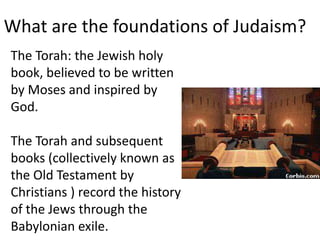
What are the foundations of Judaism?The Torah: the Jewish holy book, believed to be written by Moses and inspired by God.The Torah and subsequent books (collectively known as the Old Testament by Christians ) record the history of the Jews through the Babylonian exile.
Whowrote the Bible and why?The editing of the Bible startedat the time of Josias. The main goal was to introducehim as a new messia by writing down a tradition and a gloriousheritage. Itsediting continues during the exile to Babylon then, alsowhile the diaspora in order to build a commonhistory and common practices. The Bible isbefore all a book of faith. This « recomposedpast »  aims to give  to the hebrews and then the jews  the conviction thatYahweh (God) protectsthem: hesavedthem in the past, gave them the Promised Land, tookitfromthembecause of theirunfaithfulness. But hewill free them one day. The Bible has been written  to preserve and develop a national feeling., the  national celebrations are designated   to commemorateeachyearsomespecificevents.  From  the moment the Jewslosttheirindependence, and for a large number of them, left the Promised land., « the Bible, written Torah, has become the true homeland for the Jews. »     (R. Nouailhat)
Whatis the Bible?The  foundingtext of the first monotheistin History: Judaism.This textwillalsobeused as a foundation to othermonotheist religions: Christianity and Islam.
Whatis the diaspora? Where are the main Jewishcommunities?
The menorah: the symbol of this diasporaa seven-branched candelabrum which has been a symbol of Judaism for almost 3000 years and is the emblem of Israel. It was used in the ancient Holy Temple in Jerusalem.
What are the causes of this diaspora?The immediate cause of the dispersal of the Jewish people was the destruction of their Temple and their exile by their conquerors, the Romans.
Detail of the TriumphalArch in Rome representing the  destruction of the  Jerusalem Temple in 70 BC.Jerusalem's fall certainly marked the beginning of the end of a Jewish homeland, for the Diaspora soon saw Jews spreading across the world as their political and religious capital was no more.
What are the consequences of this diaspora?The grouping of the jewsaround the synagogue and the rabbis. The Jews are a people who do not have theirown homeland and theirnationalitygets mixed up withtheir religion as the latter becomestheironlyway to express theiridentity: « the Bible, written Torah, has become the true homeland for the Jews. » until 1948 and the independence of the Israel.

Judaism Full Unit

  • 1.
    The Rise ofJudaismIsraelites = Hebrews = JewsJudaism stood apart from other religions because of monotheism (belief in one all‐powerful god).Judaism shares many beliefs with two later religions: Christianity and Islam.
  • 2.
    How was thefirst monotheismborn?
  • 3.
    The early stagesof the biblicalhistory, the patriarchs, Abraham, Moses…AA mythical traditionImperialism of the theMesopotamian Empires (Assyria, Egypte, Babylon)An unifiedkingdom: David and Solomon, the Jerusalem temple XI- Xthcentury BCThe kingdomsplits in two: weaker, declineA smallterritory: the kingdom of Judah-722: disparition of the Kingdom of IsraelStart of the Bible editing (VII th C BC)National historyaround: A new ‘Messiah’: the King Josias (-639 /-609)Will of strength and expansion havingrecourse /appealing to a gloriouspast.Destruction of the JudahKingdom in -586 and beginning of the exil to Babylon. Transition from an oral tradition to writing.a Kinga State/ capital citya TempleONE God
  • 4.
    Whatis a patriarch?Originally a patriarch was a man who exercised autocratic authority as a paterfamilias over an extended family. The system of such rule of families by senior males is called patriarchy. his is a Greek word, a composition of pater)meaning "father" and archon meaning "leader", "chief", "ruler", "king", etc.Abraham, Isaac, and Jacob are referred to as the three patriarchs of the people of Israel, and the period in which they lived is called the Patriarchal Age. MosesAbraham
  • 5.
  • 6.
    Abraham is regardedas the first Jew.He and his followers left Mesopotamia and settled in Canaan (now Lebanon, Israel and Jordan) at the commandment of God, in 1900 BC.Abraham’s grandson, Jacob (Israel), had 12 sons who each led his own tribe.Slavery and ExodusFamine caused the Israelites to migrate to Egypt, where Jacob’s son, Joseph, lived. They were eventually enslaved.Many of the monuments of Egypt’s New Kingdom were built by Israelite slaves.Moses’story:http://www.youtube.com/watch?v=BEOMFjGFS7M
  • 7.
    The Kingdom ofIsraelThe Israelites fought for 200 years before successfully reclaiming Canaan.Saul became the first king of Israel, uniting the 12 tribes for the first time.Saul’s successor, David, ruled Israel from 1012 BC to 962 BC, and established Jerusalem as the capital.
  • 8.
    David’s son, Solomon,built the magnificent temple in Jerusalem, at the cost of high taxes and intensive labor.After Solomon’s death (922 BC), the two southern tribes split from Israel to create the kingdom of Judah.
  • 9.
    Exile 1-Israel was conquered in 722 BC by the Assyrians, who scattered the Israelites throughout their empire.2-Judah was conquered in 597 BC by the Chaldeans, under King Nebuchadnezzar.3-In 586 BC, after a rebellion, they destroyed the Temple in Jerusalem and captured many Jews to be slaves in Babylon.
  • 10.
    ExileJews continued to maintain their religion while in exile.The Chaldeans were conquered in 539 BC by the Persians, under Cyrus the Great. He allowed the Jews to return to Jerusalem and rebuild the Temple.
  • 11.
    After ExileJudah/Israel would eventually be ruled by:-the Greeks (Alexander the Great)-the Romans-the Islamic Empire (when it became known as Palestine)-the Ottoman EmpireIsrael would not be an independent state until 1948.
  • 12.
    The early stagesof the biblicalhistory, the patriarchs, A………., M….…AA m……….. traditionImperialism of the theMesopotamian Empires (Assyria, Egypte,Babylon)An un.f….. kingdom: David and Solomon, the Jerusalem temple XI- Xthcentury BCThe kingdomsplits in ………: w……., d…………. A smallterritory: the kingdom of ……-722: disparition of the …….Start of the Bible editing (VII th C BC)National historyaround: A new ‘Messiah’: the King ……… (-639 /-609)Will of strength and expansion appealing to a gloriouspast.Destruction of the JudahKingdom in -…… and beginning of the exil to ………... Transition from an oral tradition to writing.a K………..a S……../ capital citya T……..ONE ……….
  • 13.
    What are thefoundations of Judaism?The Torah: the Jewish holy book, believed to be written by Moses and inspired by God.The Torah and subsequent books (collectively known as the Old Testament by Christians ) record the history of the Jews through the Babylonian exile.
  • 14.
    Whowrote the Bibleand why?The editing of the Bible startedat the time of Josias. The main goal was to introducehim as a new messia by writing down a tradition and a gloriousheritage. Itsediting continues during the exile to Babylon then, alsowhile the diaspora in order to build a commonhistory and common practices. The Bible isbefore all a book of faith. This « recomposedpast » aims to give to the hebrews and then the jews the conviction thatYahweh (God) protectsthem: hesavedthem in the past, gave them the Promised Land, tookitfromthembecause of theirunfaithfulness. But hewill free them one day. The Bible has been written to preserve and develop a national feeling., the national celebrations are designated to commemorateeachyearsomespecificevents. From the moment the Jewslosttheirindependence, and for a large number of them, left the Promised land., « the Bible, written Torah, has become the true homeland for the Jews. » (R. Nouailhat)
  • 15.
    Whatis the Bible?The foundingtext of the first monotheistin History: Judaism.This textwillalsobeused as a foundation to othermonotheist religions: Christianity and Islam.
  • 16.
    Whatis the diaspora?Where are the main Jewishcommunities?
  • 17.
    The menorah: thesymbol of this diasporaa seven-branched candelabrum which has been a symbol of Judaism for almost 3000 years and is the emblem of Israel. It was used in the ancient Holy Temple in Jerusalem.
  • 18.
    What are thecauses of this diaspora?The immediate cause of the dispersal of the Jewish people was the destruction of their Temple and their exile by their conquerors, the Romans.
  • 19.
    Detail of theTriumphalArch in Rome representing the destruction of the Jerusalem Temple in 70 BC.Jerusalem's fall certainly marked the beginning of the end of a Jewish homeland, for the Diaspora soon saw Jews spreading across the world as their political and religious capital was no more.
  • 20.
    What are theconsequences of this diaspora?The grouping of the jewsaround the synagogue and the rabbis. The Jews are a people who do not have theirown homeland and theirnationalitygets mixed up withtheir religion as the latter becomestheironlyway to express theiridentity: « the Bible, written Torah, has become the true homeland for the Jews. » until 1948 and the independence of the Israel.