The Art of Clouds

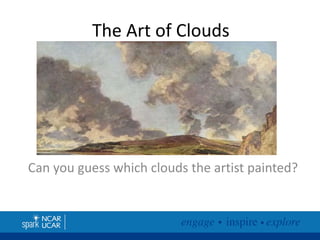
Can you guess which clouds the artist painted?
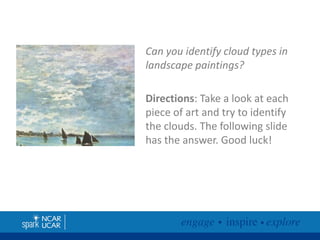
Can you identify cloud types in
landscape paintings?
Directions: Take a look at each
piece of art and try to identify
the clouds. The following slide
has the answer. Good luck!
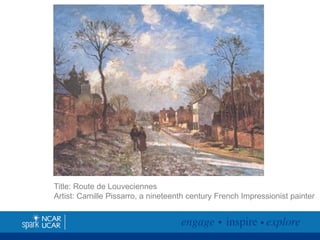
Title: Route de Louveciennes
Artist: Camille Pissarro, a nineteenth century French Impressionist painter
There are cumulus clouds. The clouds have
distinct edges and puffy shapes.

Photo: Carlye Calvin/UCAR
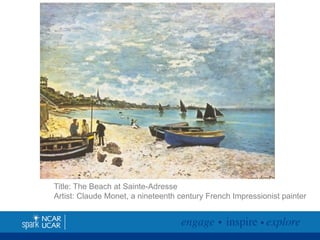
Title: The Beach at Sainte-Adresse
Artist: Claude Monet, a nineteenth century French Impressionist painter
Altocumulus clouds that look like little puffs
are painted with large brushstrokes of soft
white and blue.

Photo: Carlye Calvin/UCAR
Title: Field of Poppies
Artist: Claude Monet, a nineteenth century French Impressionist painter
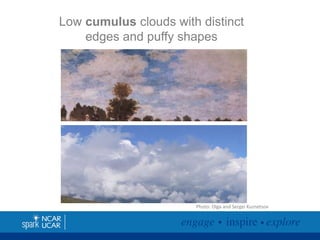
Low cumulus clouds with distinct
edges and puffy shapes

Photo: Olga and Sergei Kuznetsov
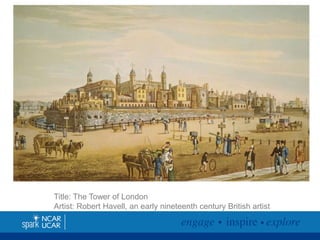
Title: The Tower of London
Artist: Robert Havell, an early nineteenth century British artist
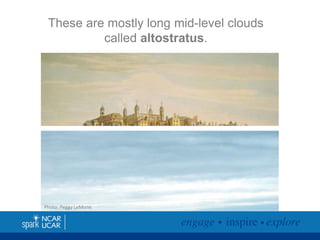
These are mostly long mid-level clouds
called altostratus.

Photo: Peggy LeMone
Title: Seascape Study with Rain Cloud
Artist: John Constable, a ninteenth century British artist
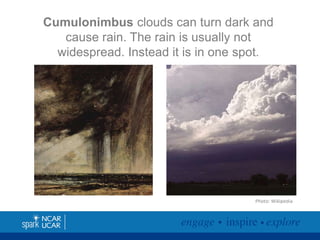
Cumulonimbus clouds can turn dark and
cause rain. The rain is usually not
widespread. Instead it is in one spot.

Photo: Wikipedia
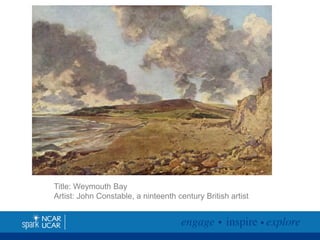
Title: Weymouth Bay
Artist: John Constable, a ninteenth century British artist
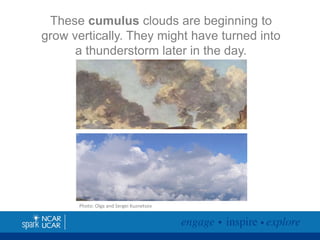
These cumulus clouds are beginning to
grow vertically. They might have turned into
a thunderstorm later in the day.

Photo: Olga and Sergei Kuznetsov
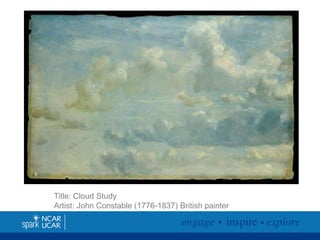
Title: Cloud Study
Artist: John Constable (1776-1837) British painter
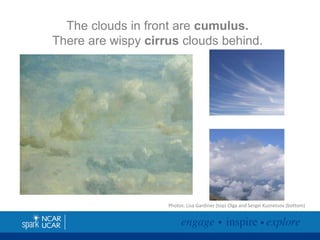
The clouds in front are cumulus.
There are wispy cirrus clouds behind.

Photos: Lisa Gardiner (top) Olga and Sergei Kuznetsov (bottom)
Title: Place Saint-Marc a Venise, Vue du Grand Canal
Artist: Eugene Bourdin, a nineteenth century French painter
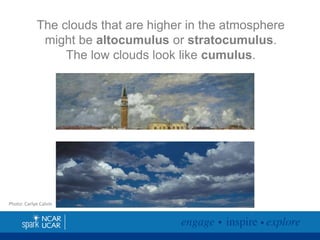
The clouds that are higher in the atmosphere
might be altocumulus or stratocumulus.
The low clouds look like cumulus.

Photo: Carlye Calvin
Title: The Grand Canal, Venice
Artist: Joseph Mallord William Turner, a ninteenth century British artist
This type of altocumulus cloud is sometimes
called a mackerel sky because the cloud looks
like the markings on a mackerel fish.

Photo: Peggy LeMone
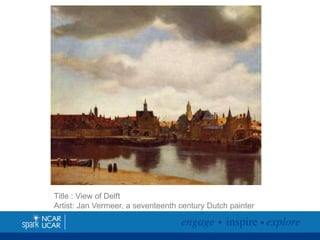
Title : View of Delft
Artist: Jan Vermeer, a seventeenth century Dutch painter
The clouds in this painting look like
stratocumulus.

Photo: Olga and Sergei Kuznetsov
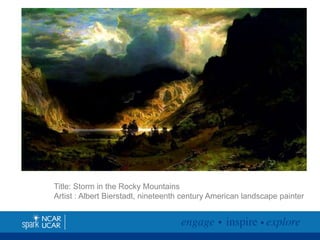
Title: Storm in the Rocky Mountains
Artist : Albert Bierstadt, nineteenth century American landscape painter
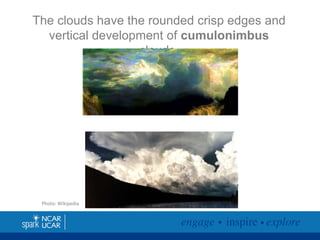
The clouds have the rounded crisp edges and
vertical development of cumulonimbus
clouds.

Photo: Wikipedia
Title: The Lackawanna Valley
Artist: George Inness, a nineteenth century American painter
There is a low and uniform layer of stratus
clouds. Note that the smoke from the chimney is
going straight up so there must not be much wind.

Photo: Sara Martin
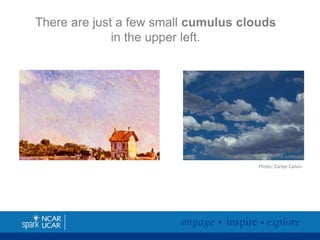
Title: Saint-Mammes
Artist: Alfred Sisley, nineteenth century English Impressionist painter
There are just a few small cumulus clouds
in the upper left.

Photo: Carlye Calvin
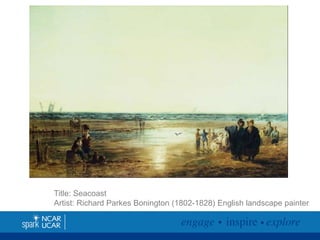
Title: Seacoast
Artist: Richard Parkes Bonington (1802-1828) English landscape painter
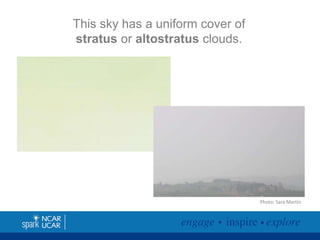
This sky has a uniform cover of
stratus or altostratus clouds.

Photo: Sara Martin
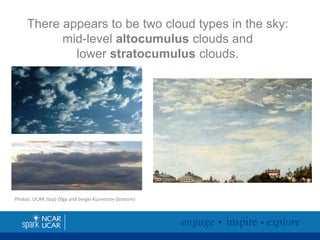
Title: Le Pont des Arts
Artist: Pierre-Auguste Renoir (1841-1919) French painter
There appears to be two cloud types in the sky:
mid-level altocumulus clouds and
lower stratocumulus clouds.

Photos: UCAR (top) Olga and Sergei Kuznetsov (bottom)
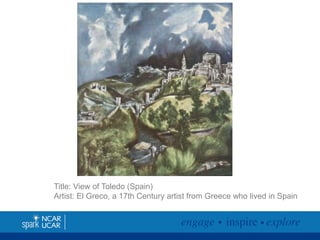
Title: View of Toledo (Spain)
Artist: El Greco, a 17th Century artist from Greece who lived in Spain
The towering dark clouds in the sky look like
thunderstorm clouds called cumulonimbus.

Photo: Wikipedia
Title: Evening on the Volga
Artist: Issac Levitan, a ninteenth century Russian landscape painter
These are large stratocumulus clouds.

Photo: Peggy LeMone
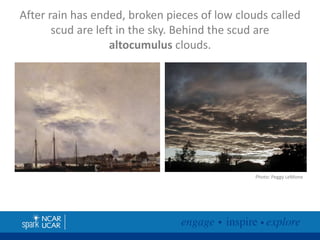
Title: After the Rain The Lake of Terni
Artist: Issac Levitan, a ninteenth century Russian landscape painter
After rain has ended, broken pieces of low clouds called
scud are left in the sky. Behind the scud are
altocumulus clouds.

Photo: Peggy LeMone
,

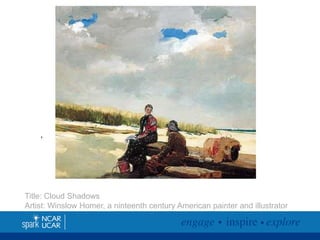
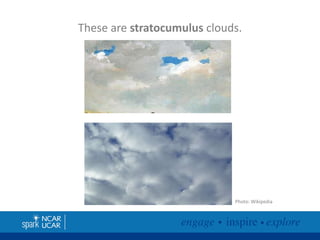
Title: Cloud Shadows
Artist: Winslow Homer, a ninteenth century American painter and illustrator
These are stratocumulus clouds.

Photo: Wikipedia
,

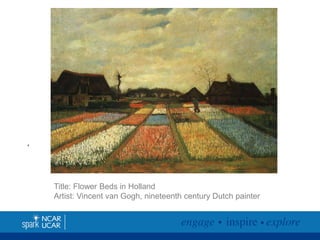
Title: Flower Beds in Holland
Artist: Vincent van Gogh, nineteenth century Dutch painter
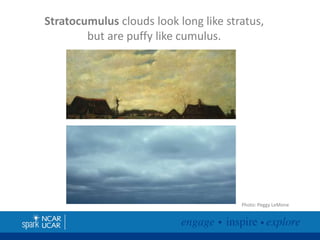
Stratocumulus clouds look long like stratus,
but are puffy like cumulus.

Photo: Peggy LeMone
,

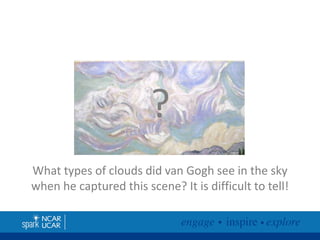
Title: Wheat Field with Cypress Trees
Artist: Vincent van Gogh, a nineteenth century Dutch painter
?
What types of clouds did van Gogh see in the sky
when he captured this scene? It is difficult to tell!
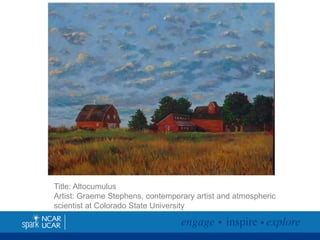
Title: Altocumulus
Artist: Graeme Stephens, contemporary artist and atmospheric
scientist at Colorado State University
He painted altocumulus clouds!

Photo: UCAR
•
•
•

A teacher’s guide for using The Art of Clouds with students is
available at https://spark.ucar.edu/activity/seeing-clouds-artist
This educational resource was developed by Lisa Gardiner with
art review help from Becca Hatheway, Peggy LeMone, and Julia
Genyuk, and cloud type identification by Peggy LeMone.
The Art of Clouds is made possible with funding from the Center
for Multi-Scale Modeling of Atmospheric Processes (CMMAP)
and the National Center for Atmospheric Research (NCAR) to the
Windows to the Universe project at UCAR.

© 2011 NESTA with modifications by UCAR

The Art of Clouds

  • 1.
    The Art ofClouds Can you guess which clouds the artist painted?
  • 2.
    Can you identifycloud types in landscape paintings? Directions: Take a look at each piece of art and try to identify the clouds. The following slide has the answer. Good luck!
  • 3.
    Title: Route deLouveciennes Artist: Camille Pissarro, a nineteenth century French Impressionist painter
  • 4.
    There are cumulusclouds. The clouds have distinct edges and puffy shapes. Photo: Carlye Calvin/UCAR
  • 5.
    Title: The Beachat Sainte-Adresse Artist: Claude Monet, a nineteenth century French Impressionist painter
  • 6.
    Altocumulus clouds thatlook like little puffs are painted with large brushstrokes of soft white and blue. Photo: Carlye Calvin/UCAR
  • 7.
    Title: Field ofPoppies Artist: Claude Monet, a nineteenth century French Impressionist painter
  • 8.
    Low cumulus cloudswith distinct edges and puffy shapes Photo: Olga and Sergei Kuznetsov
  • 9.
    Title: The Towerof London Artist: Robert Havell, an early nineteenth century British artist
  • 10.
    These are mostlylong mid-level clouds called altostratus. Photo: Peggy LeMone
  • 11.
    Title: Seascape Studywith Rain Cloud Artist: John Constable, a ninteenth century British artist
  • 12.
    Cumulonimbus clouds canturn dark and cause rain. The rain is usually not widespread. Instead it is in one spot. Photo: Wikipedia
  • 13.
    Title: Weymouth Bay Artist:John Constable, a ninteenth century British artist
  • 14.
    These cumulus cloudsare beginning to grow vertically. They might have turned into a thunderstorm later in the day. Photo: Olga and Sergei Kuznetsov
  • 15.
    Title: Cloud Study Artist:John Constable (1776-1837) British painter
  • 16.
    The clouds infront are cumulus. There are wispy cirrus clouds behind. Photos: Lisa Gardiner (top) Olga and Sergei Kuznetsov (bottom)
  • 17.
    Title: Place Saint-Marca Venise, Vue du Grand Canal Artist: Eugene Bourdin, a nineteenth century French painter
  • 18.
    The clouds thatare higher in the atmosphere might be altocumulus or stratocumulus. The low clouds look like cumulus. Photo: Carlye Calvin
  • 19.
    Title: The GrandCanal, Venice Artist: Joseph Mallord William Turner, a ninteenth century British artist
  • 20.
    This type ofaltocumulus cloud is sometimes called a mackerel sky because the cloud looks like the markings on a mackerel fish. Photo: Peggy LeMone
  • 21.
    Title : Viewof Delft Artist: Jan Vermeer, a seventeenth century Dutch painter
  • 22.
    The clouds inthis painting look like stratocumulus. Photo: Olga and Sergei Kuznetsov
  • 23.
    Title: Storm inthe Rocky Mountains Artist : Albert Bierstadt, nineteenth century American landscape painter
  • 24.
    The clouds havethe rounded crisp edges and vertical development of cumulonimbus clouds. Photo: Wikipedia
  • 25.
    Title: The LackawannaValley Artist: George Inness, a nineteenth century American painter
  • 26.
    There is alow and uniform layer of stratus clouds. Note that the smoke from the chimney is going straight up so there must not be much wind. Photo: Sara Martin
  • 27.
    Title: Saint-Mammes Artist: AlfredSisley, nineteenth century English Impressionist painter
  • 28.
    There are justa few small cumulus clouds in the upper left. Photo: Carlye Calvin
  • 29.
    Title: Seacoast Artist: RichardParkes Bonington (1802-1828) English landscape painter
  • 30.
    This sky hasa uniform cover of stratus or altostratus clouds. Photo: Sara Martin
  • 31.
    Title: Le Pontdes Arts Artist: Pierre-Auguste Renoir (1841-1919) French painter
  • 32.
    There appears tobe two cloud types in the sky: mid-level altocumulus clouds and lower stratocumulus clouds. Photos: UCAR (top) Olga and Sergei Kuznetsov (bottom)
  • 33.
    Title: View ofToledo (Spain) Artist: El Greco, a 17th Century artist from Greece who lived in Spain
  • 34.
    The towering darkclouds in the sky look like thunderstorm clouds called cumulonimbus. Photo: Wikipedia
  • 35.
    Title: Evening onthe Volga Artist: Issac Levitan, a ninteenth century Russian landscape painter
  • 36.
    These are largestratocumulus clouds. Photo: Peggy LeMone
  • 37.
    Title: After theRain The Lake of Terni Artist: Issac Levitan, a ninteenth century Russian landscape painter
  • 38.
    After rain hasended, broken pieces of low clouds called scud are left in the sky. Behind the scud are altocumulus clouds. Photo: Peggy LeMone
  • 39.
    , Title: Cloud Shadows Artist:Winslow Homer, a ninteenth century American painter and illustrator
  • 40.
    These are stratocumulusclouds. Photo: Wikipedia
  • 41.
    , Title: Flower Bedsin Holland Artist: Vincent van Gogh, nineteenth century Dutch painter
  • 42.
    Stratocumulus clouds looklong like stratus, but are puffy like cumulus. Photo: Peggy LeMone
  • 43.
    , Title: Wheat Fieldwith Cypress Trees Artist: Vincent van Gogh, a nineteenth century Dutch painter
  • 44.
    ? What types ofclouds did van Gogh see in the sky when he captured this scene? It is difficult to tell!
  • 45.
    Title: Altocumulus Artist: GraemeStephens, contemporary artist and atmospheric scientist at Colorado State University
  • 46.
    He painted altocumulusclouds! Photo: UCAR
  • 47.
    • • • A teacher’s guidefor using The Art of Clouds with students is available at https://spark.ucar.edu/activity/seeing-clouds-artist This educational resource was developed by Lisa Gardiner with art review help from Becca Hatheway, Peggy LeMone, and Julia Genyuk, and cloud type identification by Peggy LeMone. The Art of Clouds is made possible with funding from the Center for Multi-Scale Modeling of Atmospheric Processes (CMMAP) and the National Center for Atmospheric Research (NCAR) to the Windows to the Universe project at UCAR. © 2011 NESTA with modifications by UCAR

Editor's Notes