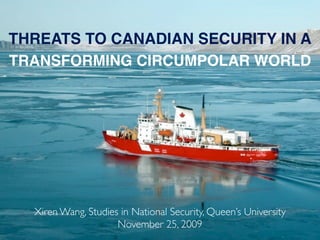
THREATS TO CANADIAN SECURITY IN A
TRANSFORMING CIRCUMPOLAR WORLD


  Xiren Wang, Studies in National Security, Queen’s University
                     November 25, 2009
OVERVIEW
•Actors within the circumpolar world
•Transformations of the region
•Threats to Canadian security
•Canada’s responses to threats
•Recommendations


                                                2


                                   Xiren Wang
ACTORS
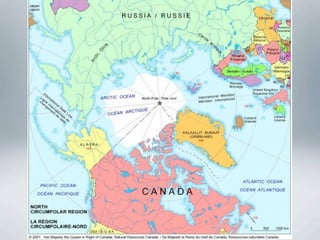
• 8 Arctic states
    – Canada, Denmark, Finland, Iceland, Norway, The
      Russian Federation, Sweden and the United
      States.
• International Institutions
    – The Arctic Council (Canadian initiative)
    – The Barents Euro-Arctic Council
    – The Council of the Baltic States

                                                              4


                                                 Xiren Wang
TRANSFORMATIONS

  •Climate change
  •Resource development
  •Geopolitical change
    – the realization that United Nations Convention on Law of the
      Sea (UNCLOS) allows most of the Arctic nations to claim the
      majority of the Arctic Ocean seabed


                                                                       5


                                                          Xiren Wang
UNCERTAINTY
• Factors reshaping the north do not proceed in a linear,
 progressive manner

• Events occur at a rapidly increasing rate that defies
 prediction

• The duration of these changes is unknown

• It is also unknown if or when the impact of climate
 change will stop
                                                              9


                                                 Xiren Wang
MILITARY PRESENCE
 • The Canadian effort to maintain military control over its Arctic ended
   almost as soon as the Cold War ended.
 • 1989: The navy ceased its Northern Deployments (NORPLOYs)
 • 1995: The air force reduced its northern sovereignty overflights from a
   high of 22 in 1987 to 2.
 • The only current land force presence in Canada’s Arctic is the Canadian
   Rangers Units.
 • 1999: Members of the CF seriously reconsidered their role in the Arctic.
 • 2001: Post- 9/11, the entire Canadian government began to take security
   issues much more seriously.
 • 2002: Canada resumed military training operations in the north.
                                                                            10


                                                              Xiren Wang
THREATS
 •Sovereignty & Control
 •Environmental security
 •Food security
 •Cooperation
 •Nature:
  nebulous, multi-dimensional, evolving
                                              11


                                 Xiren Wang
SOVEREIGNTY
• Interdependent concepts:
    – Sovereignty & security
    – Sovereignty & control
    – Security & control
• Existence of an accepted Governance System
  Competing states and competing interests undermine sovereignty
• A Defined Territory:
  The littoral states are engaged in various stages of demonstrating
  the limits of their continental shelves beyond 200 nautical miles from
  their declared baselines in accordance with Article 76, paragraph 8,
  of the United Nations Convention on the Law of the Sea (UNCLOS)
• Population:
  Hans Island                                                              12


                                                            Xiren Wang
CONTROL
                    3 Zones of Controls established by UNCLOS

Zone 1: Territorial Sea
Zone 2: The Exclusive Economic Zone (EEZ)
Zone 3: The Continental Shelf


                                                                         13


                                                            Xiren Wang
ENVIRONMENT
    	 Industrial Development - destruction and pollution of
      environment
•	 long-range transport of contaminants
    • persistent organic pollutants (pesticides, fertilizers)
    •changes in atmospheric gases
     •increases/decreases in global temperature
        (Arctic Climate Impact Assessment)
•	 Domestic pollution: many settlements lack waste processing
   facilities
•	 The environmental security and rich biological diversity of the
   Canadian north needed protection.
• Transboundary & local pollutants contaminate food                          14


                                                                Xiren Wang
FOOD SECURITY
• Defined as: the requirement of adequate amounts of safe,
  nutritious, culturally acceptable food, accessible to all in a
  dignified and affordable manner (Koc and MacRae, 2001)
• Requires the fulfillment of 4 needs:
    –   Availability
    –   Accessibility
    –   Acceptability
    –   Adequacy

• Food insecurity due to:
    – changes in species’ ranges and availability
    – access to these species
    – perceived and real changes in travel safety/changing weather conditions

• Indigenous communities face major cultural & health impacts
                                                                                 15


                                                                    Xiren Wang
COOPERATION
«If we make the geopolitical choice of putting the Arctic in a
central position - not the only region of concern, but in a
central position - in our thinking on our foreign policy, that
will mean that we will concentrate a whole series of problems
that we are dealing with separately, such as, to begin with, the
management of our relations with all of the countries of the
circumpolar region.»
  – The Seventh Report to the House of Commons, Canada and the Circumpolar World:
    Meeting the Challenges of Cooperation into the Twenty-First Century
                                                                                 16


                                                                    Xiren Wang
ADAPTIVE RESPONSES
  • Arctic Security Intergovernmental Work Group
     – interdepartmental (federal - territorial) security work group
  • DND review of its Arctic capabilities
  • Canada’s Integrated Northern Strategy, August 2007
     –   strengthen Canada's sovereignty
     –   protect our environmental heritage
     –   promote economic and social development
     –   improve Northern governance


                                                                        17


                                                           Xiren Wang
RECOMMENDATIONS
 1.Decision-making process on Arctic affairs must be improved.
    • The creation of a Cabinet Committee, focused solely on the
      Arctic

 2.Canadian surveillance and enforcement capability must be
  improved.
    • acquire, build, and maintain infrastructure and equipment

 3.Canada must cooperate better with its Arctic neighbours.
    • esp. US and Russia

                                                                    18


                                                       Xiren Wang
CA’S AIMS
 In the future, aims to:

• Enhancing the marine regime for Arctic shipping

• Options for regulatory improvement in the North

• Expanding broadband connectivity in the NWT and Nunavut

• Advancing devolution in Nunavut and the Northwest Territories

 and,

• Engagement on the Northern Strategy with northerners,

 stakeholders, Aboriginal groups and the Canadian public.           19


                                                       Xiren Wang
Thank You

Q&A

Security in the Circumpolar World

  • 1.
    THREATS TO CANADIANSECURITY IN A TRANSFORMING CIRCUMPOLAR WORLD Xiren Wang, Studies in National Security, Queen’s University November 25, 2009
  • 2.
    OVERVIEW •Actors within thecircumpolar world •Transformations of the region •Threats to Canadian security •Canada’s responses to threats •Recommendations 2 Xiren Wang
  • 4.
    ACTORS • 8 Arcticstates – Canada, Denmark, Finland, Iceland, Norway, The Russian Federation, Sweden and the United States. • International Institutions – The Arctic Council (Canadian initiative) – The Barents Euro-Arctic Council – The Council of the Baltic States 4 Xiren Wang
  • 5.
    TRANSFORMATIONS •Climatechange •Resource development •Geopolitical change – the realization that United Nations Convention on Law of the Sea (UNCLOS) allows most of the Arctic nations to claim the majority of the Arctic Ocean seabed 5 Xiren Wang
  • 9.
    UNCERTAINTY • Factors reshapingthe north do not proceed in a linear, progressive manner • Events occur at a rapidly increasing rate that defies prediction • The duration of these changes is unknown • It is also unknown if or when the impact of climate change will stop 9 Xiren Wang
  • 10.
    MILITARY PRESENCE •The Canadian effort to maintain military control over its Arctic ended almost as soon as the Cold War ended. • 1989: The navy ceased its Northern Deployments (NORPLOYs) • 1995: The air force reduced its northern sovereignty overflights from a high of 22 in 1987 to 2. • The only current land force presence in Canada’s Arctic is the Canadian Rangers Units. • 1999: Members of the CF seriously reconsidered their role in the Arctic. • 2001: Post- 9/11, the entire Canadian government began to take security issues much more seriously. • 2002: Canada resumed military training operations in the north. 10 Xiren Wang
  • 11.
    THREATS •Sovereignty &Control •Environmental security •Food security •Cooperation •Nature: nebulous, multi-dimensional, evolving 11 Xiren Wang
  • 12.
    SOVEREIGNTY • Interdependent concepts: – Sovereignty & security – Sovereignty & control – Security & control • Existence of an accepted Governance System Competing states and competing interests undermine sovereignty • A Defined Territory: The littoral states are engaged in various stages of demonstrating the limits of their continental shelves beyond 200 nautical miles from their declared baselines in accordance with Article 76, paragraph 8, of the United Nations Convention on the Law of the Sea (UNCLOS) • Population: Hans Island 12 Xiren Wang
  • 13.
    CONTROL 3 Zones of Controls established by UNCLOS Zone 1: Territorial Sea Zone 2: The Exclusive Economic Zone (EEZ) Zone 3: The Continental Shelf 13 Xiren Wang
  • 14.
    ENVIRONMENT Industrial Development - destruction and pollution of environment • long-range transport of contaminants • persistent organic pollutants (pesticides, fertilizers) •changes in atmospheric gases •increases/decreases in global temperature (Arctic Climate Impact Assessment) • Domestic pollution: many settlements lack waste processing facilities • The environmental security and rich biological diversity of the Canadian north needed protection. • Transboundary & local pollutants contaminate food 14 Xiren Wang
  • 15.
    FOOD SECURITY • Definedas: the requirement of adequate amounts of safe, nutritious, culturally acceptable food, accessible to all in a dignified and affordable manner (Koc and MacRae, 2001) • Requires the fulfillment of 4 needs: – Availability – Accessibility – Acceptability – Adequacy • Food insecurity due to: – changes in species’ ranges and availability – access to these species – perceived and real changes in travel safety/changing weather conditions • Indigenous communities face major cultural & health impacts 15 Xiren Wang
  • 16.
    COOPERATION «If we makethe geopolitical choice of putting the Arctic in a central position - not the only region of concern, but in a central position - in our thinking on our foreign policy, that will mean that we will concentrate a whole series of problems that we are dealing with separately, such as, to begin with, the management of our relations with all of the countries of the circumpolar region.» – The Seventh Report to the House of Commons, Canada and the Circumpolar World: Meeting the Challenges of Cooperation into the Twenty-First Century 16 Xiren Wang
  • 17.
    ADAPTIVE RESPONSES • Arctic Security Intergovernmental Work Group – interdepartmental (federal - territorial) security work group • DND review of its Arctic capabilities • Canada’s Integrated Northern Strategy, August 2007 – strengthen Canada's sovereignty – protect our environmental heritage – promote economic and social development – improve Northern governance 17 Xiren Wang
  • 18.
    RECOMMENDATIONS 1.Decision-making processon Arctic affairs must be improved. • The creation of a Cabinet Committee, focused solely on the Arctic 2.Canadian surveillance and enforcement capability must be improved. • acquire, build, and maintain infrastructure and equipment 3.Canada must cooperate better with its Arctic neighbours. • esp. US and Russia 18 Xiren Wang
  • 19.
    CA’S AIMS Inthe future, aims to: • Enhancing the marine regime for Arctic shipping • Options for regulatory improvement in the North • Expanding broadband connectivity in the NWT and Nunavut • Advancing devolution in Nunavut and the Northwest Territories and, • Engagement on the Northern Strategy with northerners, stakeholders, Aboriginal groups and the Canadian public. 19 Xiren Wang
  • 20.