
Sanjay Sahay, IPS.,
ADGP, Police Computer Wing,
Bangalore
Text
Presentation Structure
• Introduction
• Attack Methods
• Hacking groups
• Best Security model
• KSP Security model
• Tool and technology in use
• Challenges / Bottleneck
• Gaps
• Wish list
• Conclusion.
•
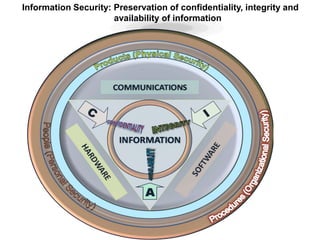
Information Security: Preservation of confidentiality, integrity and
availability of information
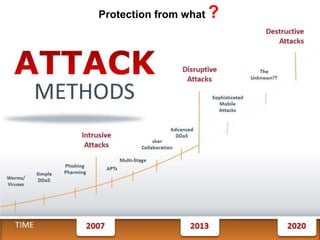
Protection from what ?
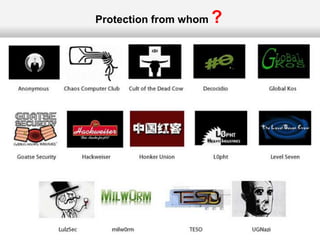
Protection from whom ?
Text
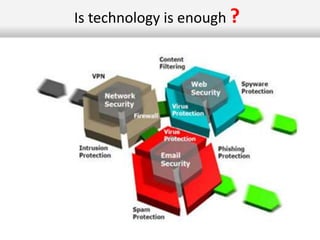
Is technology is enough ?
Text
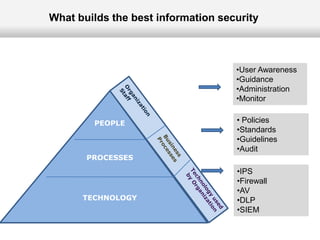
PEOPLE
PROCESSES
TECHNOLOGY
•User Awareness
•Guidance
•Administration
•Monitor
• Policies
•Standards
•Guidelines
•Audit
•IPS
•Firewall
•AV
•DLP
•SIEM
What builds the best information security
Text
KSP Infrastructure and Security solution
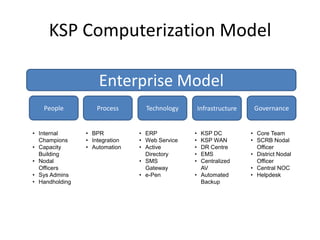
KSP Computerization Model
Enterprise Model
People Process Technology Infrastructure Governance
• Internal
Champions
• Capacity
Building
• Nodal
Officers
• Sys Admins
• Handholding
• BPR
• Integration
• Automation
• ERP
• Web Service
• Active
Directory
• SMS
Gateway
• e-Pen
• KSP DC
• KSP WAN
• DR Centre
• EMS
• Centralized
AV
• Automated
Backup
• Core Team
• SCRB Nodal
Officer
• District Nodal
Officer
• Central NOC
• Helpdesk
Text
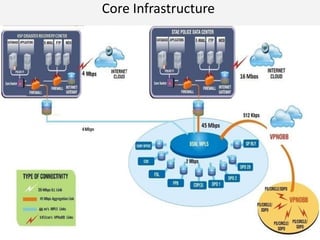
Core Infrastructure
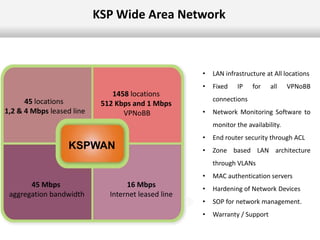
KSP Wide Area Network
Text
45 locations
1,2 & 4 Mbps leased line
1458 locations
512 Kbps and 1 Mbps
VPNoBB
45 Mbps
aggregation bandwidth
16 Mbps
Internet leased line
KSPWAN
• LAN infrastructure at All locations
• Fixed IP for all VPNoBB
connections
• Network Monitoring Software to
monitor the availability.
• End router security through ACL
• Zone based LAN architecture
through VLANs
• MAC authentication servers
• Hardening of Network Devices
• SOP for network management.
• Warranty / Support
Text
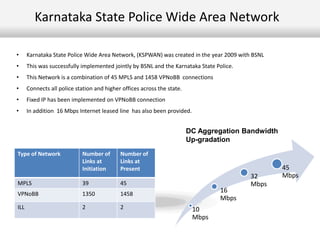
Karnataka State Police Wide Area Network
Type of Network Number of
Links at
Initiation
Number of
Links at
Present
MPLS 39 45
VPNoBB 1350 1458
ILL 2 2
• Karnataka State Police Wide Area Network, (KSPWAN) was created in the year 2009 with BSNL
• This was successfully implemented jointly by BSNL and the Karnataka State Police.
• This Network is a combination of 45 MPLS and 1458 VPNoBB connections
• Connects all police station and higher offices across the state.
• Fixed IP has been implemented on VPNoBB connection
• In addition 16 Mbps Internet leased line has also been provided.
10
Mbps
16
Mbps
32
Mbps
45
Mbps
DC Aggregation Bandwidth
Up-gradation
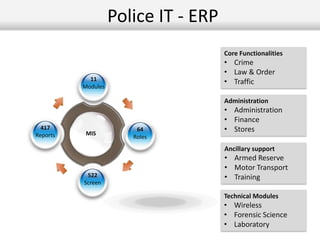
Core Functionalities
• Crime
• Law & Order
• Traffic
Administration
• Administration
• Finance
• Stores
Ancillary support
• Armed Reserve
• Motor Transport
• Training
Technical Modules
• Wireless
• Forensic Science
• Laboratory
Police IT - ERP
11
Modules
64
Roles
522
Screen
417
Reports MIS
Police IT - ERP
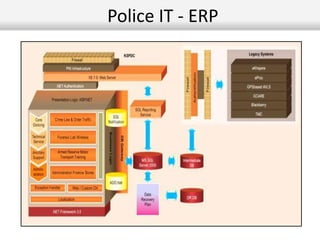
Police IT - ERP
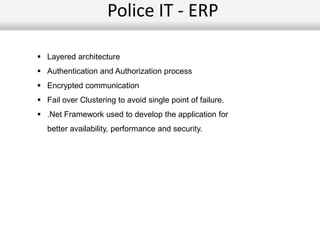
 Layered architecture
 Authentication and Authorization process
 Encrypted communication
 Fail over Clustering to avoid single point of failure.
 .Net Framework used to develop the application for
better availability, performance and security.
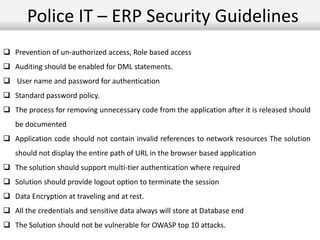
Police IT – ERP Security Guidelines
 Prevention of un-authorized access, Role based access
 Auditing should be enabled for DML statements.
 User name and password for authentication
 Standard password policy.
 The process for removing unnecessary code from the application after it is released should
be documented
 Application code should not contain invalid references to network resources The solution
should not display the entire path of URL in the browser based application
 The solution should support multi-tier authentication where required
 Solution should provide logout option to terminate the session
 Data Encryption at traveling and at rest.
 All the credentials and sensitive data always will store at Database end
 The Solution should not be vulnerable for OWASP top 10 attacks.
Text
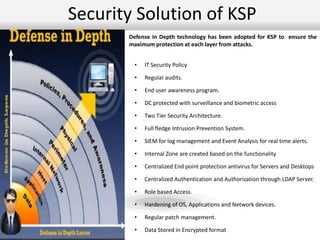
Security Solution of KSP
Defense in Depth technology has been adopted for KSP to ensure the
maximum protection at each layer from attacks.
• IT Security Policy
• Regular audits.
• End user awareness program.
• DC protected with surveillance and biometric access
• Two Tier Security Architecture.
• Full fledge Intrusion Prevention System.
• SIEM for log management and Event Analysis for real time alerts.
• Internal Zone are created based on the functionality
• Centralized End point protection antivirus for Servers and Desktops
• Centralized Authentication and Authorization through LDAP Server.
• Role based Access.
• Hardening of OS, Applications and Network devices.
• Regular patch management.
• Data Stored in Encrypted format
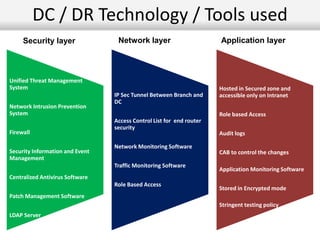
DC / DR Technology / Tools used
Unified Threat Management
System
Network Intrusion Prevention
System
Firewall
Security Information and Event
Management
Centralized Antivirus Software
Patch Management Software
LDAP Server
IP Sec Tunnel Between Branch and
DC
Access Control List for end router
security
Network Monitoring Software
Traffic Monitoring Software
Role Based Access
Hosted in Secured zone and
accessible only on Intranet
Role based Access
Audit logs
CAB to control the changes
Application Monitoring Software
Stored in Encrypted mode
Stringent testing policy
Security layer Network layer Application layer
End Computer/ User Security
• Computers are under the supervision of LDAP Server
• Centralized Authentication, Authorization and Accounting through LDAP Server
• Computers are operated with least Privileged account.
• Local administrator and user accounts are restricted.
• End Point Protection installed on all computers to battle against the advance threat.
• Stringent Policies to enforce end computer security through LDAP and Centralize AV
Management Server.
• Regular patch management to fix the OS and application level Vulnerabilities.
• SOP for computer usage
• Usage of External Device is strictly prohibited.
• Authorized / Approved applications are allowed to use.
• Centralized Log monitoring through SIEM to identify and mitigate the internal threats.
• Computer security is a part of Basic computer training program.
• Regular Security awareness program to end users.
Text
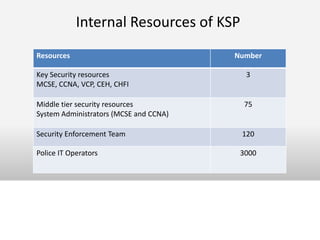
Internal Resources of KSP
Resources Number
Key Security resources
MCSE, CCNA, VCP, CEH, CHFI
3
Middle tier security resources
System Administrators (MCSE and CCNA)
75
Security Enforcement Team 120
Police IT Operators 3000
Text
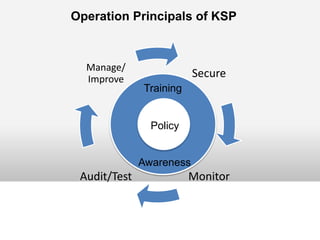
Operation Principals of KSP
Secure
MonitorAudit/Test
Manage/
Improve
Policy
Training
Awareness
Text
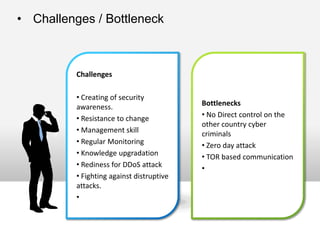
• Challenges / Bottleneck
Challenges
• Creating of security
awareness.
• Resistance to change
• Management skill
• Regular Monitoring
• Knowledge upgradation
• Rediness for DDoS attack
• Fighting against distruptive
attacks.
•
Bottlenecks
• No Direct control on the
other country cyber
criminals
• Zero day attack
• TOR based communication
•
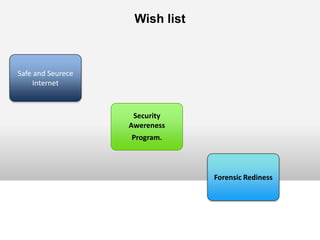
Safe and Seurece
Internet
Forensic Rediness
Security
Awereness
Program.
Wish list
 Security architecture should be a dynamic process that
consistently enforces security among all users to protect
corporate information.
 Regular IT security audit would help the organization to find the
vulnerabilities and gaps to fix it proactively before it get
exploited by an hacker.
 People are the major pillar of the security, should be trained
regularly better security.
 As 100% security is impossible, you need to decide what
needs to be secured and how well it needs to be secured.
Conclusion
Secure IT 2014

Secure IT 2014

  • 1.
    Sanjay Sahay, IPS., ADGP,Police Computer Wing, Bangalore
  • 2.
    Text Presentation Structure • Introduction •Attack Methods • Hacking groups • Best Security model • KSP Security model • Tool and technology in use • Challenges / Bottleneck • Gaps • Wish list • Conclusion. •
  • 3.
    Information Security: Preservationof confidentiality, integrity and availability of information
  • 4.
  • 5.
  • 6.
  • 7.
  • 8.
    Text KSP Infrastructure andSecurity solution
  • 9.
    KSP Computerization Model EnterpriseModel People Process Technology Infrastructure Governance • Internal Champions • Capacity Building • Nodal Officers • Sys Admins • Handholding • BPR • Integration • Automation • ERP • Web Service • Active Directory • SMS Gateway • e-Pen • KSP DC • KSP WAN • DR Centre • EMS • Centralized AV • Automated Backup • Core Team • SCRB Nodal Officer • District Nodal Officer • Central NOC • Helpdesk
  • 10.
  • 11.
    KSP Wide AreaNetwork Text 45 locations 1,2 & 4 Mbps leased line 1458 locations 512 Kbps and 1 Mbps VPNoBB 45 Mbps aggregation bandwidth 16 Mbps Internet leased line KSPWAN • LAN infrastructure at All locations • Fixed IP for all VPNoBB connections • Network Monitoring Software to monitor the availability. • End router security through ACL • Zone based LAN architecture through VLANs • MAC authentication servers • Hardening of Network Devices • SOP for network management. • Warranty / Support
  • 12.
    Text Karnataka State PoliceWide Area Network Type of Network Number of Links at Initiation Number of Links at Present MPLS 39 45 VPNoBB 1350 1458 ILL 2 2 • Karnataka State Police Wide Area Network, (KSPWAN) was created in the year 2009 with BSNL • This was successfully implemented jointly by BSNL and the Karnataka State Police. • This Network is a combination of 45 MPLS and 1458 VPNoBB connections • Connects all police station and higher offices across the state. • Fixed IP has been implemented on VPNoBB connection • In addition 16 Mbps Internet leased line has also been provided. 10 Mbps 16 Mbps 32 Mbps 45 Mbps DC Aggregation Bandwidth Up-gradation
  • 13.
    Core Functionalities • Crime •Law & Order • Traffic Administration • Administration • Finance • Stores Ancillary support • Armed Reserve • Motor Transport • Training Technical Modules • Wireless • Forensic Science • Laboratory Police IT - ERP 11 Modules 64 Roles 522 Screen 417 Reports MIS
  • 14.
  • 15.
    Police IT -ERP  Layered architecture  Authentication and Authorization process  Encrypted communication  Fail over Clustering to avoid single point of failure.  .Net Framework used to develop the application for better availability, performance and security.
  • 16.
    Police IT –ERP Security Guidelines  Prevention of un-authorized access, Role based access  Auditing should be enabled for DML statements.  User name and password for authentication  Standard password policy.  The process for removing unnecessary code from the application after it is released should be documented  Application code should not contain invalid references to network resources The solution should not display the entire path of URL in the browser based application  The solution should support multi-tier authentication where required  Solution should provide logout option to terminate the session  Data Encryption at traveling and at rest.  All the credentials and sensitive data always will store at Database end  The Solution should not be vulnerable for OWASP top 10 attacks.
  • 17.
    Text Security Solution ofKSP Defense in Depth technology has been adopted for KSP to ensure the maximum protection at each layer from attacks. • IT Security Policy • Regular audits. • End user awareness program. • DC protected with surveillance and biometric access • Two Tier Security Architecture. • Full fledge Intrusion Prevention System. • SIEM for log management and Event Analysis for real time alerts. • Internal Zone are created based on the functionality • Centralized End point protection antivirus for Servers and Desktops • Centralized Authentication and Authorization through LDAP Server. • Role based Access. • Hardening of OS, Applications and Network devices. • Regular patch management. • Data Stored in Encrypted format
  • 18.
    DC / DRTechnology / Tools used Unified Threat Management System Network Intrusion Prevention System Firewall Security Information and Event Management Centralized Antivirus Software Patch Management Software LDAP Server IP Sec Tunnel Between Branch and DC Access Control List for end router security Network Monitoring Software Traffic Monitoring Software Role Based Access Hosted in Secured zone and accessible only on Intranet Role based Access Audit logs CAB to control the changes Application Monitoring Software Stored in Encrypted mode Stringent testing policy Security layer Network layer Application layer
  • 19.
    End Computer/ UserSecurity • Computers are under the supervision of LDAP Server • Centralized Authentication, Authorization and Accounting through LDAP Server • Computers are operated with least Privileged account. • Local administrator and user accounts are restricted. • End Point Protection installed on all computers to battle against the advance threat. • Stringent Policies to enforce end computer security through LDAP and Centralize AV Management Server. • Regular patch management to fix the OS and application level Vulnerabilities. • SOP for computer usage • Usage of External Device is strictly prohibited. • Authorized / Approved applications are allowed to use. • Centralized Log monitoring through SIEM to identify and mitigate the internal threats. • Computer security is a part of Basic computer training program. • Regular Security awareness program to end users.
  • 20.
    Text Internal Resources ofKSP Resources Number Key Security resources MCSE, CCNA, VCP, CEH, CHFI 3 Middle tier security resources System Administrators (MCSE and CCNA) 75 Security Enforcement Team 120 Police IT Operators 3000
  • 21.
    Text Operation Principals ofKSP Secure MonitorAudit/Test Manage/ Improve Policy Training Awareness
  • 22.
    Text • Challenges /Bottleneck Challenges • Creating of security awareness. • Resistance to change • Management skill • Regular Monitoring • Knowledge upgradation • Rediness for DDoS attack • Fighting against distruptive attacks. • Bottlenecks • No Direct control on the other country cyber criminals • Zero day attack • TOR based communication •
  • 23.
    Safe and Seurece Internet ForensicRediness Security Awereness Program. Wish list
  • 24.
     Security architectureshould be a dynamic process that consistently enforces security among all users to protect corporate information.  Regular IT security audit would help the organization to find the vulnerabilities and gaps to fix it proactively before it get exploited by an hacker.  People are the major pillar of the security, should be trained regularly better security.  As 100% security is impossible, you need to decide what needs to be secured and how well it needs to be secured. Conclusion