
SECULARISM
Seminar on Development and Global Issues
Secular, Secularization
& Secularism
‘Secular’ defined
• ‘Secular’ from the Latin ‘saeculum’.
• Marks dual connotation of time
and location:
– Time: referring to now or present
– Location: referring to the ‘world’ or
‘worldly’
‘Secularization’ defined
• Secularization: the deliverance of man ’first
from religious and then from metaphysical
control over his reason and his language’.
• It denotes the disappearance of religious
determination of the symbols of culture
integration.
Origin of secularization (1)
• A fruit of the long history of philosophical
and metaphysical conflict in the religious
and purely rationalistic worldview of
Western man.
• Impact of ‘westernization’ of Christianity
(began with the shift of its centre from
Jerusalem to Rome).
• The western elements had diluted the
original and true teachings of Christianity.
Origin of secularization (2)
• Early Christianity consistently opposed to
secularization, and this opposition, endangered
by the demeaning of nature and divesting of it
of its spiritual and theological significance,
continued throughout its history of losing
battle against the secularizing forces.
Origin of secularization (3)
• The separation of Church and State, was the
result of secular Western philosophical
attitude set against what is considered as the
anti-secular encroachment of the ambivalent
Church based on the teaching of the eclectic
religion.
• Moreover, the Church when it wielded power
was always vigilant in acting against scientific
enquiry and purely rational investigation of
truth.
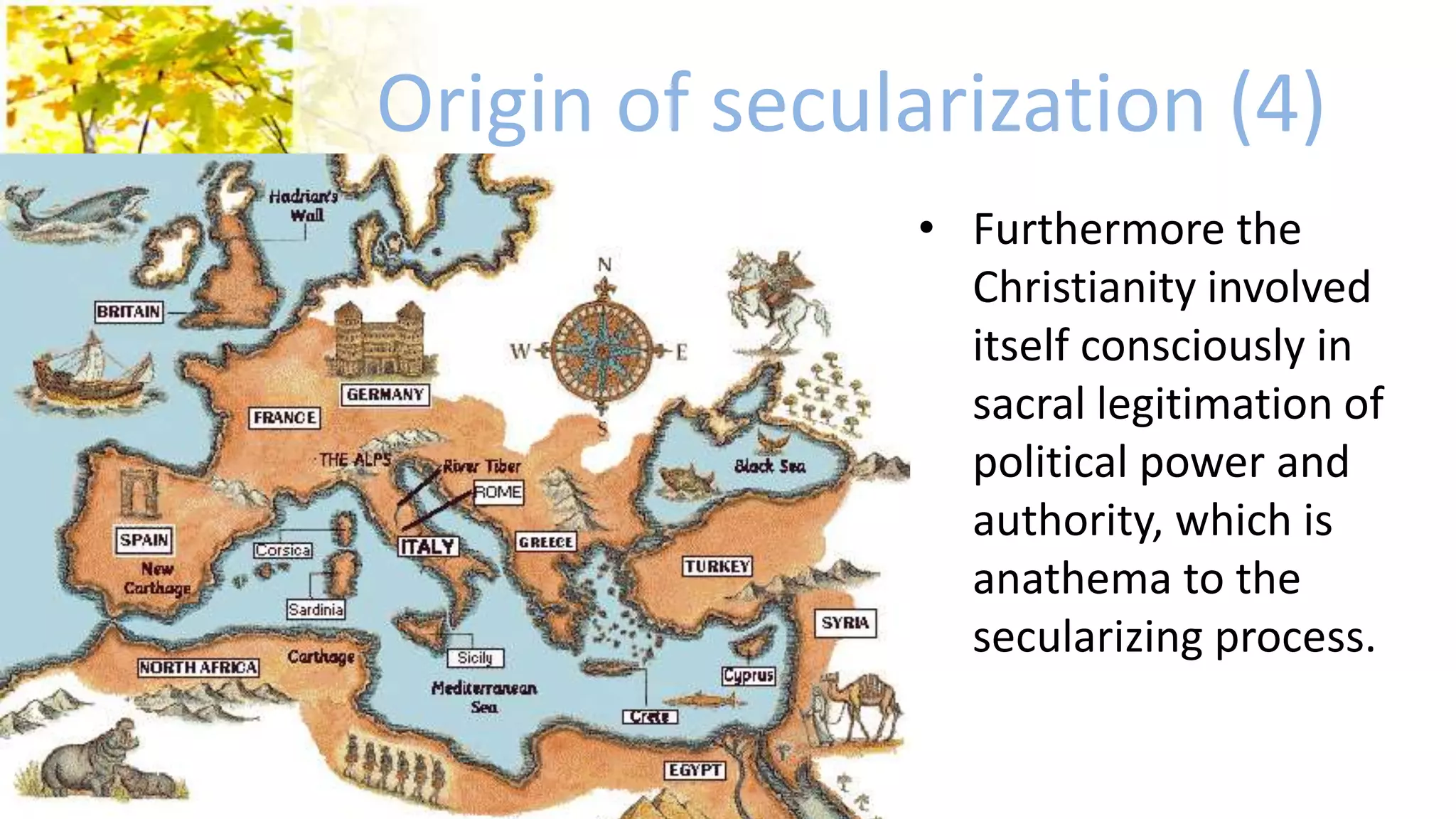
Origin of secularization (4)
• Furthermore the
Christianity involved
itself consciously in
sacral legitimation of
political power and
authority, which is
anathema to the
secularizing process.
Origin of secularization (5)
• Christianity has
attempted to resist
secularization but has
failed, and danger is that
having failed to contain
it the influential
modernist theologians
are now urging Christian
to join it.
Secularization and religion
What is ‘religion’?
Apa maksud ‘agama’?
‘Secularization’ explained
• Three integral components in the dimensions
of secularization:
1. The disenchancement of nature
2. The desacralization of politics
3. The deconsecration of values
# disenchancement : To free from illusion or false belief * desacralization : To divest of sacred or religious significance
^ deconsecration: remove the consecration (-a solemn commitment of your life or your time to some cherished purpose ) from a person or
an object
The disenchancement of nature
• Freeing the nature from its religious overtones.
• Dispelling of animistic spirits and gods, and magic
from the natural world.
• Separating nature from God and distinguishing man
from God.
• Man no longer regard nature as a divine entity.
• So, man may act freely upon nature, to make use of
it according to his needs and plans.
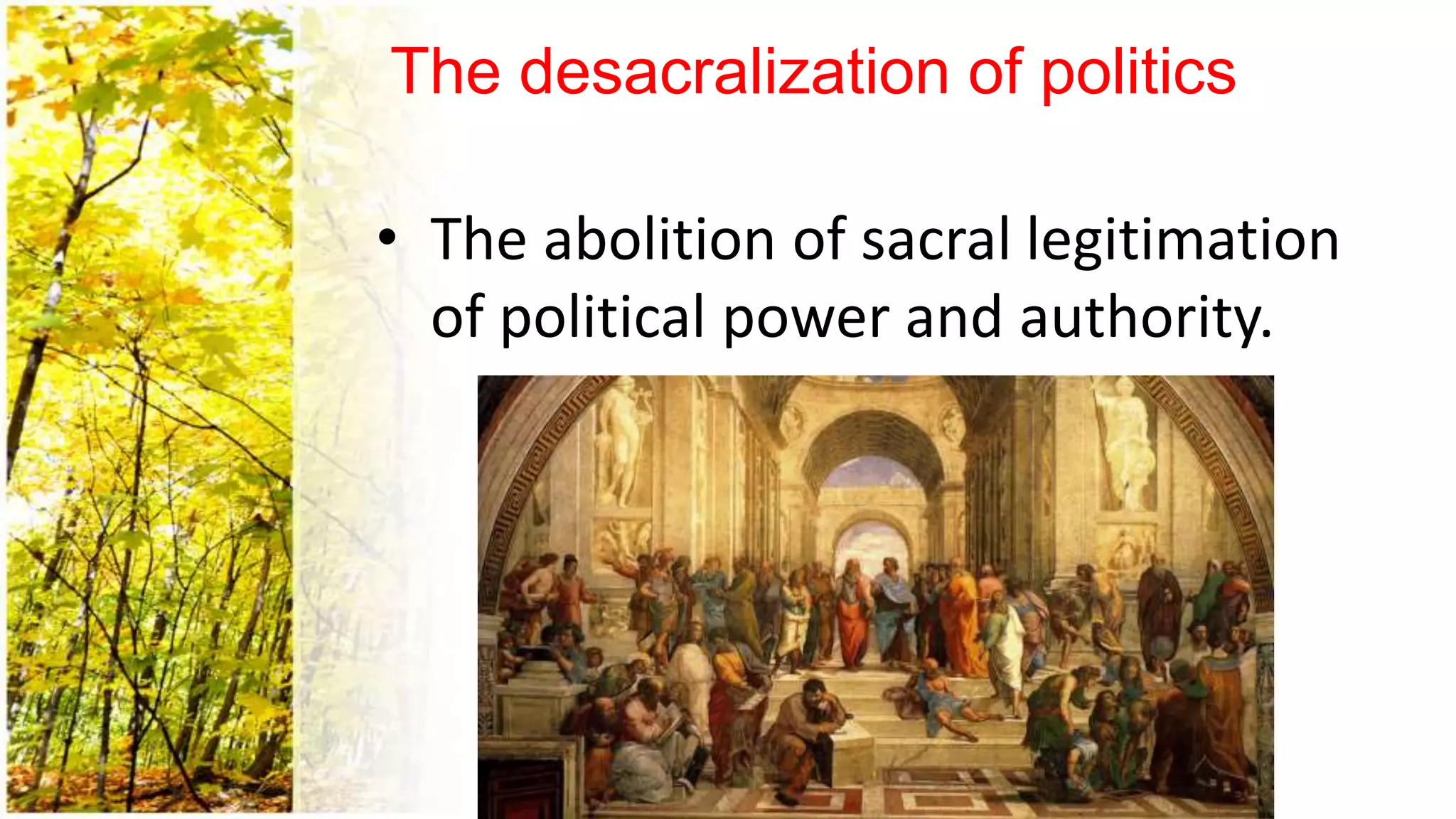
The desacralization of politics
• The abolition of sacral legitimation
of political power and authority.
The deconsecration of values
• The rendering transient and relative all
cultural creations and every value system
which for them includes religion.
• Worldviews having ultimate and final
significance, so that in this way history,
the future, is open to change.
• Man is free to create the change and
immerse himself in the evolutionary
process.
‘Secularism’ explained
• An ideology
• Like religion, project a closed
worldview and an absolute set of
values in line with an ultimate
historical purpose of having a final
significance for man.
Secularization and religion
• Under western understanding: religion from the
Latin word ‘religio’, which vaguely refers to a ‘bond
between man and gods’.
• Under Islamic understanding:
– More precise word is ‘deen’. Islam as the deen.
– It means that Islam is the subjective, personal
religion of the individual as well as the objective,
pervading self-same religion of the Community –
that it operates as the same religion in the individual
as a single entity as well as the society composed
collectively of such entities.
Islam and secularization
• Islam as a revealed religion is complete and
perfect in its adequacy for mankind from the
very beginning.
• The values embodied in Islam are absolute– it
has its own absolute vision of God, the
Universe, of Reality, of Man, its own
ontological, cosmological, psychological
interpretation of reality; its own worldview
and vision of the Hereafter having a final
significance for mankind.
Religion, rationality and reasoning
• ‘Rational’ in should not merely pertain to the mind’s
systematic and logical interpretation of the facts of
experience; or its rendering intelligible and manageable
to reason the data of experience; or its abstraction of
facts and data and their relationships.
• ‘Reason’ is actually a projection of the intellect,
therefore it functions in conformity with the intellect,
which is a spiritual substance inherent in the spiritual
organ of cognition known as the heart. (al-qalb)
• Hence the understanding of spiritual realities is also
within the province of reason and is not necessarily
divorced from rational understanding of them.
Religion and nature
• In religious understanding the nature is an
open ‘Book’ to be understood and
interpreted.
• Nature has cosmic meaning, and must be
respected because of its symbolical
connection with God.
• Man is God’s vicegerent and inheritor of
the Kingdom of Nature—so must look
after it and make legitimate use of it, and
not ruin and spread chaos over it.
Religion and State
• Theocracy is the rule of clergymen of Middle Ages.
It based on the notion of unconditional submission
and a blind obedience to clergymen.
• In the original religious teaching, there is no
theocratic way of government. No religious scholar
may claim authority in the state administration.
• No religion teach unconditional submission or blind
obedience to state leader. People are not only
allowed but, required to call state leader into
account on the administration of the State.
Thank you

Secular, Secularization and Islam

  • 1.
  • 2.
  • 3.
    ‘Secular’ defined • ‘Secular’from the Latin ‘saeculum’. • Marks dual connotation of time and location: – Time: referring to now or present – Location: referring to the ‘world’ or ‘worldly’
  • 4.
    ‘Secularization’ defined • Secularization:the deliverance of man ’first from religious and then from metaphysical control over his reason and his language’. • It denotes the disappearance of religious determination of the symbols of culture integration.
  • 5.
    Origin of secularization(1) • A fruit of the long history of philosophical and metaphysical conflict in the religious and purely rationalistic worldview of Western man. • Impact of ‘westernization’ of Christianity (began with the shift of its centre from Jerusalem to Rome). • The western elements had diluted the original and true teachings of Christianity.
  • 6.
    Origin of secularization(2) • Early Christianity consistently opposed to secularization, and this opposition, endangered by the demeaning of nature and divesting of it of its spiritual and theological significance, continued throughout its history of losing battle against the secularizing forces.
  • 7.
    Origin of secularization(3) • The separation of Church and State, was the result of secular Western philosophical attitude set against what is considered as the anti-secular encroachment of the ambivalent Church based on the teaching of the eclectic religion. • Moreover, the Church when it wielded power was always vigilant in acting against scientific enquiry and purely rational investigation of truth.
  • 8.
    Origin of secularization(4) • Furthermore the Christianity involved itself consciously in sacral legitimation of political power and authority, which is anathema to the secularizing process.
  • 9.
    Origin of secularization(5) • Christianity has attempted to resist secularization but has failed, and danger is that having failed to contain it the influential modernist theologians are now urging Christian to join it.
  • 10.
    Secularization and religion Whatis ‘religion’? Apa maksud ‘agama’?
  • 11.
    ‘Secularization’ explained • Threeintegral components in the dimensions of secularization: 1. The disenchancement of nature 2. The desacralization of politics 3. The deconsecration of values # disenchancement : To free from illusion or false belief * desacralization : To divest of sacred or religious significance ^ deconsecration: remove the consecration (-a solemn commitment of your life or your time to some cherished purpose ) from a person or an object
  • 12.
    The disenchancement ofnature • Freeing the nature from its religious overtones. • Dispelling of animistic spirits and gods, and magic from the natural world. • Separating nature from God and distinguishing man from God. • Man no longer regard nature as a divine entity. • So, man may act freely upon nature, to make use of it according to his needs and plans.
  • 13.
    The desacralization ofpolitics • The abolition of sacral legitimation of political power and authority.
  • 14.
    The deconsecration ofvalues • The rendering transient and relative all cultural creations and every value system which for them includes religion. • Worldviews having ultimate and final significance, so that in this way history, the future, is open to change. • Man is free to create the change and immerse himself in the evolutionary process.
  • 15.
    ‘Secularism’ explained • Anideology • Like religion, project a closed worldview and an absolute set of values in line with an ultimate historical purpose of having a final significance for man.
  • 16.
    Secularization and religion •Under western understanding: religion from the Latin word ‘religio’, which vaguely refers to a ‘bond between man and gods’. • Under Islamic understanding: – More precise word is ‘deen’. Islam as the deen. – It means that Islam is the subjective, personal religion of the individual as well as the objective, pervading self-same religion of the Community – that it operates as the same religion in the individual as a single entity as well as the society composed collectively of such entities.
  • 17.
    Islam and secularization •Islam as a revealed religion is complete and perfect in its adequacy for mankind from the very beginning. • The values embodied in Islam are absolute– it has its own absolute vision of God, the Universe, of Reality, of Man, its own ontological, cosmological, psychological interpretation of reality; its own worldview and vision of the Hereafter having a final significance for mankind.
  • 18.
    Religion, rationality andreasoning • ‘Rational’ in should not merely pertain to the mind’s systematic and logical interpretation of the facts of experience; or its rendering intelligible and manageable to reason the data of experience; or its abstraction of facts and data and their relationships. • ‘Reason’ is actually a projection of the intellect, therefore it functions in conformity with the intellect, which is a spiritual substance inherent in the spiritual organ of cognition known as the heart. (al-qalb) • Hence the understanding of spiritual realities is also within the province of reason and is not necessarily divorced from rational understanding of them.
  • 19.
    Religion and nature •In religious understanding the nature is an open ‘Book’ to be understood and interpreted. • Nature has cosmic meaning, and must be respected because of its symbolical connection with God. • Man is God’s vicegerent and inheritor of the Kingdom of Nature—so must look after it and make legitimate use of it, and not ruin and spread chaos over it.
  • 20.
    Religion and State •Theocracy is the rule of clergymen of Middle Ages. It based on the notion of unconditional submission and a blind obedience to clergymen. • In the original religious teaching, there is no theocratic way of government. No religious scholar may claim authority in the state administration. • No religion teach unconditional submission or blind obedience to state leader. People are not only allowed but, required to call state leader into account on the administration of the State.
  • 21.