SECTION 6 CyclicGroups
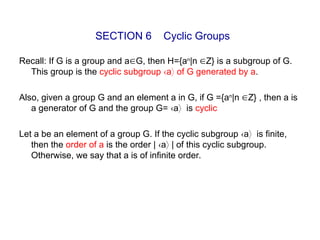
Recall: If G is a group and aG, then H={an
|n Z} is a subgroup of G.
This group is the cyclic subgroup a of G generated by a.
Also, given a group G and an element a in G, if G ={an
|n Z} , then a is
a generator of G and the group G= a is cyclic
Let a be an element of a group G. If the cyclic subgroup a is finite,
then the order of a is the order | a | of this cyclic subgroup.
Otherwise, we say that a is of infinite order.
2.
Elementary Properties ofCyclic Groups
Theorem
Every cyclic group is abelian.
Proof: Let G be a cyclic group and let a be a generator of G so that
G = a ={an
|n Z}.
If g1 and g2 are any two elements of G, there exists integers r and s
such that g1=ar
and g2=as
. Then
g1g2= ar
as
= ar+s
= as+r
= as
ar
= g2g1,
So G is abelian.
3.
Division Algorithm forZ
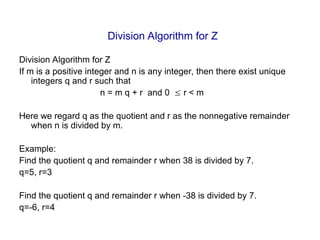
Division Algorithm for Z
If m is a positive integer and n is any integer, then there exist unique
integers q and r such that
n = m q + r and 0 r < m
Here we regard q as the quotient and r as the nonnegative remainder
when n is divided by m.
Example:
Find the quotient q and remainder r when 38 is divided by 7.
q=5, r=3
Find the quotient q and remainder r when -38 is divided by 7.
q=-6, r=4
4.
Theorem
Theorem
A subgroup ofa cyclic group is cyclic.
Proof: by the division algorithm.
Corollary
The subgroups of Z under addition are precisely the groups nZ under
addition for nZ.
5.
Greatest common divisor
Letr and s be two positive integers. The positive generator d of the
cyclic group
H={ nr + ms |n, m Z}
Under addition is the greatest common divisor (gcd) of r and s. W write
d = gcd (r, s).
Note that d=nr+ms for some integers n and m. Every integer dividing
both r and s divides the right-hand side of the equation, and hence
must be a divisor of d also. Thus d must be the largest number
dividing both r and s.
Example: Find the gcd of 42 andf 72.
6
6.
Relatively Prime
Two positiveintegers are relatively prime if their gcd is 1.
Fact
If r and s are relatively prime and if r divides sm, then r must divide m.
7.
The structure ofCyclic Groups
We can now describe all cyclic groups, up to an isomorphism.
Theorem
Let G be a cyclic group with generator a. If the order of G is infinite,
then G is isomorphic to Z, + . If G has finite order n, then G is
isomorphic to Zn, +n .
8.
Subgroups of FiniteCyclic Groups
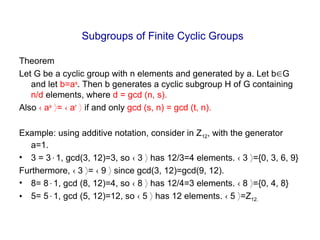
Theorem
Let G be a cyclic group with n elements and generated by a. Let bG
and let b=as
. Then b generates a cyclic subgroup H of G containing
n/d elements, where d = gcd (n, s).
Also as
= ar
if and only gcd (s, n) = gcd (t, n).
Example: using additive notation, consider in Z12, with the generator
a=1.
• 3 = 31, gcd(3, 12)=3, so 3 has 12/3=4 elements. 3 ={0, 3, 6, 9}
Furthermore, 3 = 9 since gcd(3, 12)=gcd(9, 12).
• 8= 81, gcd (8, 12)=4, so 8 has 12/4=3 elements. 8 ={0, 4, 8}
• 5= 51, gcd (5, 12)=12, so 5 has 12 elements. 5 =Z12.
9.
Subgroup Diagram ofZ18
Corollary
If a is a generator of a finite cyclic group G of order n, then the other
generators of G are the elements of the form ar
, where r is relatively
prime to n.
Example: Find all subgroups of Z18 and give their subgroup diagram.
• All subgroups are cyclic
• By Corollary, 1 is the generator of Z18, so is 5, 7, 11, 13, and 17.
• Starting with 2, 2 ={0, 2, 4, 6, 8, 10, 12, 14, 16 }is of order 9, and
gcd(2, 18)=2=gcd(k, 18) where k is 2, 4, 8, 10, 14, and 16. Thus 2,
4, 8, 10, 14, and 16 are all generators of 2.
• 3={0, 3, 6, 9, 12, 15} is of order 6, and gcd(3, 18)=3=gcd(k, 18)
where k=15
6={0, 6, 12} is of order 3, so is 12
9={0, 9} is of order 2