Common Mechanical Operation
Section 5
Eng. Kareem H. Mokhtar
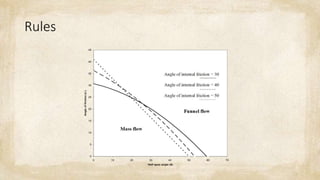
Rules
• Volume of cone= pi/12 * D2 * H
• Mass flow rate= C* (bulk density) * 𝑔 ∗ 𝐷5/2
• C= (pi/6) *
(1−𝐶𝑜𝑠1.5(ℎ𝑎𝑙𝑓 𝑎𝑝𝑒𝑥 𝑎𝑛𝑔𝑙𝑒)
sin2.5(ℎ𝑎𝑙𝑓 𝑎𝑝𝑒𝑥 𝑎𝑛𝑔𝑙𝑒)
• Pv=
𝐷∗𝑔∗𝑏𝑢𝑙𝑘 𝑑𝑒𝑛𝑠𝑖𝑡𝑦
4 (tan 𝑎𝑛𝑔𝑙𝑒 𝑜𝑓 𝑓𝑟𝑖𝑐𝑡𝑖𝑜𝑛 ∗ 𝑘
∗ (1 − 𝑒−4∗tan 𝑎𝑛𝑔𝑙𝑒 𝑜𝑓 𝑓𝑟𝑖𝑐𝑡𝑖𝑜𝑛 ∗𝑘∗
𝐻
𝐷)
• Pl = k *Pv
• K=
1−sin(𝑎𝑙𝑝ℎ𝑎 𝑖𝑛𝑡𝑒𝑟𝑛𝑎𝑙 𝑓𝑟𝑖𝑐𝑡𝑖𝑜𝑛 )
1+sin(𝑎𝑙𝑝ℎ𝑎 𝑖𝑛𝑡𝑒𝑟𝑛𝑎𝑙 𝑓𝑟𝑖𝑐𝑡𝑖𝑜𝑛 )
Rules
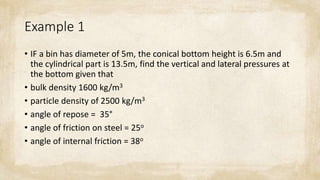
Example 1
• IF a bin has diameter of 5m, the conical bottom height is 6.5m and
the cylindrical part is 13.5m, find the vertical and lateral pressures at
the bottom given that
• bulk density 1600 kg/m3
• particle density of 2500 kg/m3
• angle of repose = 35°
• angle of friction on steel = 25o
• angle of internal friction = 38o
Answer
• K= K=
1−sin(𝑎𝑙𝑝ℎ𝑎 𝑖𝑛𝑡𝑒𝑟𝑛𝑎𝑙 𝑓𝑟𝑖𝑐𝑡𝑖𝑜𝑛 )
1+sin(𝑎𝑙𝑝ℎ𝑎 𝑖𝑛𝑡𝑒𝑟𝑛𝑎𝑙 𝑓𝑟𝑖𝑐𝑡𝑖𝑜𝑛 )
• K=
1−sin(38 )
1+sin(38 )
= 0.238
• Pv=
𝐷∗𝑔∗𝑏𝑢𝑙𝑘 𝑑𝑒𝑛𝑠𝑖𝑡𝑦
4 (tan 𝑎𝑛𝑔𝑙𝑒 𝑜𝑓 𝑓𝑟𝑖𝑐𝑡𝑖𝑜𝑛 ∗ 𝑘
∗ (1 − 𝑒−4∗tan 𝑎𝑛𝑔𝑙𝑒 𝑜𝑓 𝑓𝑟𝑖𝑐𝑡𝑖𝑜𝑛 ∗𝑘∗
𝐻
𝐷)
• Pv =
5∗9.81∗1600
4 (tan 25 ∗0.238
∗ (1 − 𝑒−4∗tan 25 ∗0.238∗
𝐻
5 ) = 123 kPa
• Pl = 29300 Pa
• P liquid
Example 2
• If the previous question had a fluid inside it, what would be the
pressure at the bottom of the cylindrical part?
• P = density * g * h = 1600*9.81*13.5 = 211 kPa
Belt conveyor - Bridth
(4 mm)
(2 mm)
Belt conveyor- no of rollers
• Idlers spacing
• If 2000 kg/m3  1100 mm to 1500 mm
• If heavier  1000, 1300 mm
• No of idler rollers on one side= [length of belt/spacing]-1
Belt conveyor- power calculations
F= 0.02 – 0.04
T3 = 1.1 T2
So we need to calculate mb (mass of belt), midlers (mass of idlers), and m(mass of solid) Per unit length
(If not given= pi, if given do not forget to transform it)
Belt conveyor – masses per unit length
Midlers (mass of one idler) =
7800 kg/m3
Mass of idler per unit length =
𝑚𝑎𝑠𝑠 𝑜𝑓 𝑖𝑑𝑙𝑒𝑟 ∗ 𝑁𝑜.𝑜𝑓 𝑖𝑑𝑙𝑒𝑟
𝐿𝑒𝑛𝑔𝑡ℎ
Mb (mass of belt per unit length) = B * x * density of belt
1000 - 1500 kg/m3
Mass of solids per unit length = mass flow rate / velocity
Velocity  assume 1 m/s if not stated
Belt conveyor
Example 3
• A belt conveyor is used to transport solids to a bin, the rate of
transportation of solid is 50 tons per hour, find the driving motor
power needed then find the diameter needed for the bin to store a 9
hour production of crushed material.
• bulk density 1600 kg/m3
a particle density of 2500 kg/m3
an angle of repose = 35°
angle of friction on steel = 25o
angle of internal friction = 38o.
Answer
• B = 0.323 m = 350 mm
• X total = 14mm
• Mass of belt = 6.37 kg
• At spacing 1300mm  no. of rollers = 32 roller
• Mass of idler roller per length = 9.8 kg/m
• Mass of solid per unit length = 13.889 kg/ m
• Power = 7 Hp
Answer
• Bin diameter= 5 m
• Top section  h = 1.75 and Volume at top= 11.45 m3
• Bottom section (Mass flow)  Hb= 6.5 m and Volume = 42.5m3
• Cylinder = 11.57 m
• So the dimensions are
• Dia= 5m, the conical bottom height is 6.5m and the cylindrical part is
13.5m
section 5.pptx

section 5.pptx

  • 1.
    Common Mechanical Operation Section5 Eng. Kareem H. Mokhtar
  • 2.
    Rules • Volume ofcone= pi/12 * D2 * H • Mass flow rate= C* (bulk density) * 𝑔 ∗ 𝐷5/2 • C= (pi/6) * (1−𝐶𝑜𝑠1.5(ℎ𝑎𝑙𝑓 𝑎𝑝𝑒𝑥 𝑎𝑛𝑔𝑙𝑒) sin2.5(ℎ𝑎𝑙𝑓 𝑎𝑝𝑒𝑥 𝑎𝑛𝑔𝑙𝑒) • Pv= 𝐷∗𝑔∗𝑏𝑢𝑙𝑘 𝑑𝑒𝑛𝑠𝑖𝑡𝑦 4 (tan 𝑎𝑛𝑔𝑙𝑒 𝑜𝑓 𝑓𝑟𝑖𝑐𝑡𝑖𝑜𝑛 ∗ 𝑘 ∗ (1 − 𝑒−4∗tan 𝑎𝑛𝑔𝑙𝑒 𝑜𝑓 𝑓𝑟𝑖𝑐𝑡𝑖𝑜𝑛 ∗𝑘∗ 𝐻 𝐷) • Pl = k *Pv • K= 1−sin(𝑎𝑙𝑝ℎ𝑎 𝑖𝑛𝑡𝑒𝑟𝑛𝑎𝑙 𝑓𝑟𝑖𝑐𝑡𝑖𝑜𝑛 ) 1+sin(𝑎𝑙𝑝ℎ𝑎 𝑖𝑛𝑡𝑒𝑟𝑛𝑎𝑙 𝑓𝑟𝑖𝑐𝑡𝑖𝑜𝑛 )
  • 3.
  • 4.
    Example 1 • IFa bin has diameter of 5m, the conical bottom height is 6.5m and the cylindrical part is 13.5m, find the vertical and lateral pressures at the bottom given that • bulk density 1600 kg/m3 • particle density of 2500 kg/m3 • angle of repose = 35° • angle of friction on steel = 25o • angle of internal friction = 38o
  • 5.
    Answer • K= K= 1−sin(𝑎𝑙𝑝ℎ𝑎𝑖𝑛𝑡𝑒𝑟𝑛𝑎𝑙 𝑓𝑟𝑖𝑐𝑡𝑖𝑜𝑛 ) 1+sin(𝑎𝑙𝑝ℎ𝑎 𝑖𝑛𝑡𝑒𝑟𝑛𝑎𝑙 𝑓𝑟𝑖𝑐𝑡𝑖𝑜𝑛 ) • K= 1−sin(38 ) 1+sin(38 ) = 0.238 • Pv= 𝐷∗𝑔∗𝑏𝑢𝑙𝑘 𝑑𝑒𝑛𝑠𝑖𝑡𝑦 4 (tan 𝑎𝑛𝑔𝑙𝑒 𝑜𝑓 𝑓𝑟𝑖𝑐𝑡𝑖𝑜𝑛 ∗ 𝑘 ∗ (1 − 𝑒−4∗tan 𝑎𝑛𝑔𝑙𝑒 𝑜𝑓 𝑓𝑟𝑖𝑐𝑡𝑖𝑜𝑛 ∗𝑘∗ 𝐻 𝐷) • Pv = 5∗9.81∗1600 4 (tan 25 ∗0.238 ∗ (1 − 𝑒−4∗tan 25 ∗0.238∗ 𝐻 5 ) = 123 kPa • Pl = 29300 Pa • P liquid
  • 6.
    Example 2 • Ifthe previous question had a fluid inside it, what would be the pressure at the bottom of the cylindrical part? • P = density * g * h = 1600*9.81*13.5 = 211 kPa
  • 7.
    Belt conveyor -Bridth (4 mm) (2 mm)
  • 8.
    Belt conveyor- noof rollers • Idlers spacing • If 2000 kg/m3  1100 mm to 1500 mm • If heavier  1000, 1300 mm • No of idler rollers on one side= [length of belt/spacing]-1
  • 9.
    Belt conveyor- powercalculations F= 0.02 – 0.04 T3 = 1.1 T2 So we need to calculate mb (mass of belt), midlers (mass of idlers), and m(mass of solid) Per unit length (If not given= pi, if given do not forget to transform it)
  • 10.
    Belt conveyor –masses per unit length Midlers (mass of one idler) = 7800 kg/m3 Mass of idler per unit length = 𝑚𝑎𝑠𝑠 𝑜𝑓 𝑖𝑑𝑙𝑒𝑟 ∗ 𝑁𝑜.𝑜𝑓 𝑖𝑑𝑙𝑒𝑟 𝐿𝑒𝑛𝑔𝑡ℎ Mb (mass of belt per unit length) = B * x * density of belt 1000 - 1500 kg/m3 Mass of solids per unit length = mass flow rate / velocity Velocity  assume 1 m/s if not stated
  • 11.
  • 12.
    Example 3 • Abelt conveyor is used to transport solids to a bin, the rate of transportation of solid is 50 tons per hour, find the driving motor power needed then find the diameter needed for the bin to store a 9 hour production of crushed material. • bulk density 1600 kg/m3 a particle density of 2500 kg/m3 an angle of repose = 35° angle of friction on steel = 25o angle of internal friction = 38o.
  • 13.
    Answer • B =0.323 m = 350 mm • X total = 14mm • Mass of belt = 6.37 kg • At spacing 1300mm  no. of rollers = 32 roller • Mass of idler roller per length = 9.8 kg/m • Mass of solid per unit length = 13.889 kg/ m • Power = 7 Hp
  • 14.
    Answer • Bin diameter=5 m • Top section  h = 1.75 and Volume at top= 11.45 m3 • Bottom section (Mass flow)  Hb= 6.5 m and Volume = 42.5m3 • Cylinder = 11.57 m • So the dimensions are • Dia= 5m, the conical bottom height is 6.5m and the cylindrical part is 13.5m