 Heterotrophy
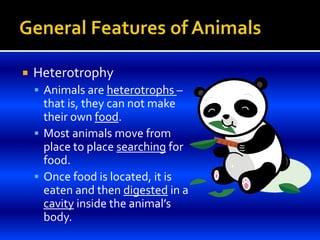
 Animals are heterotrophs –
that is, they can not make
their own food.
 Most animals move from
place to place searching for
food.
 Once food is located, it is
eaten and then digested in a
cavity inside the animal’s
body.
 Mobility
 Animals are unique among
living things in being able
to perform rapid, complex
movements.
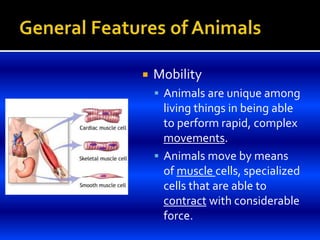
 Animals move by means
of muscle cells, specialized
cells that are able to
contract with considerable
force.
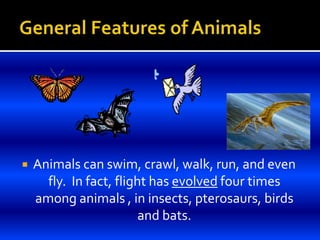
 Animals can swim, crawl, walk, run, and even
fly. In fact, flight has evolved four times
among animals , in insects, pterosaurs, birds
and bats.
• Multicellularity
• All animals are
multicellular.
• In spite of differences
in body size, there is
little difference in
the size of most cells
that make up these
animals
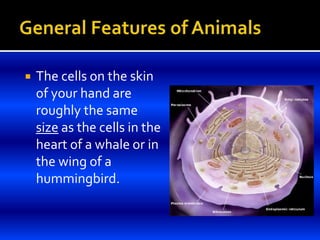
 The cells on the skin
of your hand are
roughly the same
size as the cells in the
heart of a whale or in
the wing of a
hummingbird.
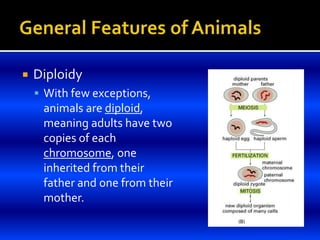
 Diploidy
 With few exceptions,
animals are diploid,
meaning adults have two
copies of each
chromosome, one
inherited from their
father and one from their
mother.
 Only their gametes (egg
and sperm) are haploid.
 A great advantage of
diploidy is that it permits
an animal to exchange
genes between the two
copies of a set of
chromosomes, creating
new combinations of
genes.
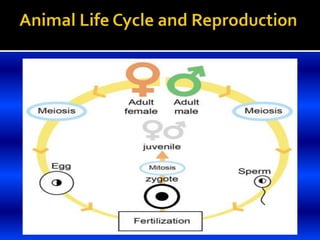
 Many animals have a relatively simple life
cycle. Most animals spend the majority of
their life as diploid organisms. Just about all
animals reproduce sexually. Diploid adults
undergo meiosis to produce sperm or eggs
Fertilization occurs when a sperm and an egg
fuse.The zygote that forms develops into an
embryo.The embryo eventually develops into
an adult.
 Sexual Reproduction
 Almost all animals reproduce
sexually by producing gametes,
as do many plants, fungi, and
protists.
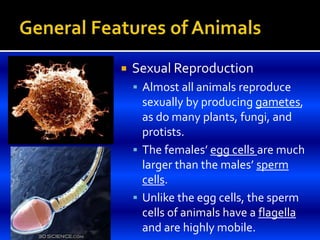
 The females’ egg cells are much
larger than the males’ sperm
cells.
 Unlike the egg cells, the sperm
cells of animals have a flagella
and are highly mobile.
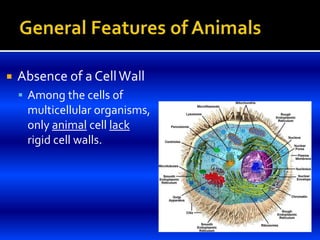
 Absence of a CellWall
 Among the cells of
multicellular organisms,
only animal cell lack
rigid cell walls.
 The absence of a rigid cell wall has allowed
animals mobility that other multicellular
organisms do not have.
 You may not realize this, but there are cells
moving in your body at all time.
 Cells called macrophages, for example, act as
mobile garbage collectors, crawling over
tissues and removing debris.
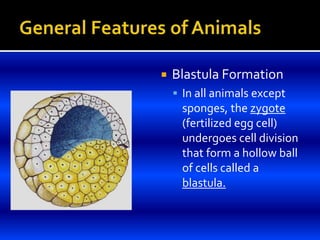
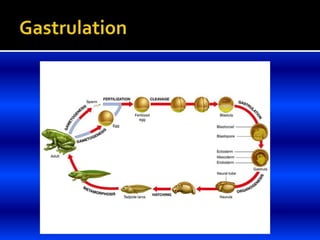
 Blastula Formation
 In all animals except
sponges, the zygote
(fertilized egg cell)
undergoes cell division
that form a hollow ball
of cells called a
blastula.
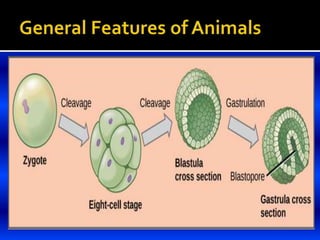
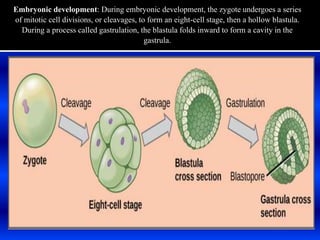
Embryonic development: During embryonic development, the zygote undergoes a series
of mitotic cell divisions, or cleavages, to form an eight-cell stage, then a hollow blastula.
During a process called gastrulation, the blastula folds inward to form a cavity in the
gastrula.
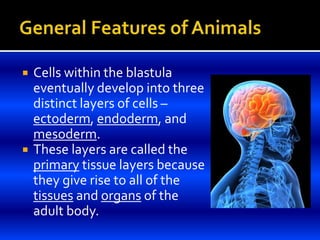
 Cells within the blastula
eventually develop into three
distinct layers of cells –
ectoderm, endoderm, and
mesoderm.
 These layers are called the
primary tissue layers because
they give rise to all of the
tissues and organs of the
adult body.
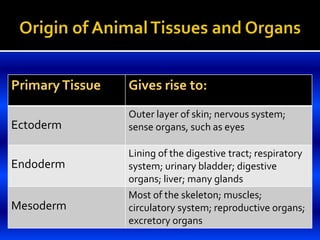
PrimaryTissue Gives rise to:
Ectoderm
Outer layer of skin; nervous system;
sense organs, such as eyes
Endoderm
Lining of the digestive tract; respiratory
system; urinary bladder; digestive
organs; liver; many glands
Mesoderm
Most of the skeleton; muscles;
circulatory system; reproductive organs;
excretory organs
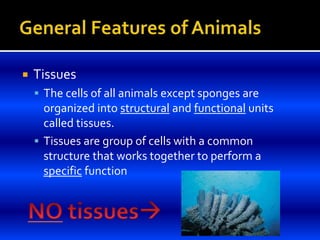
 Tissues
 The cells of all animals except sponges are
organized into structural and functional units
called tissues.
 Tissues are group of cells with a common
structure that works together to perform a
specific function
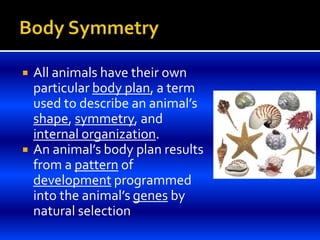
 All animals have their own
particular body plan, a term
used to describe an animal’s
shape, symmetry, and
internal organization.
 An animal’s body plan results
from a pattern of
development programmed
into the animal’s genes by
natural selection
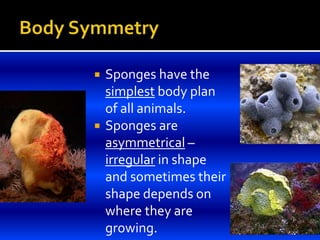
 Sponges have the
simplest body plan
of all animals.
 Sponges are
asymmetrical –
irregular in shape
and sometimes their
shape depends on
where they are
growing.
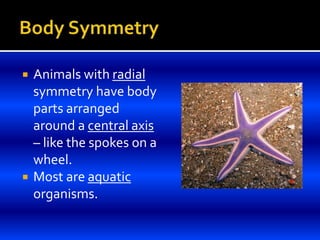
 Animals with radial
symmetry have body
parts arranged
around a central axis
– like the spokes on a
wheel.
 Most are aquatic
organisms.
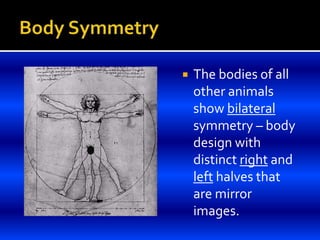
 The bodies of all
other animals
show bilateral
symmetry – body
design with
distinct right and
left halves that
are mirror
images.
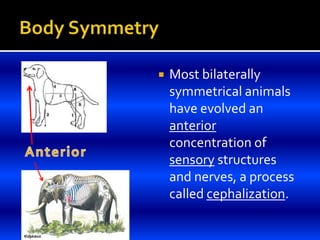
 Most bilaterally
symmetrical animals
have evolved an
anterior
concentration of
sensory structures
and nerves, a process
called cephalization.
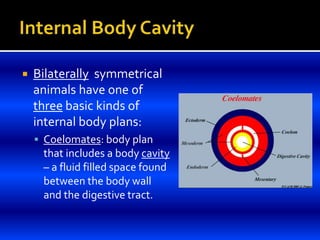
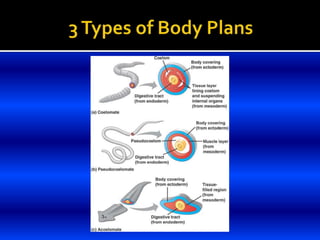
 Bilaterally symmetrical
animals have one of
three basic kinds of
internal body plans:
 Coelomates: body plan
that includes a body cavity
– a fluid filled space found
between the body wall
and the digestive tract.
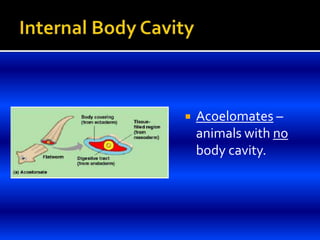
 Acoelomates –
animals with no
body cavity.
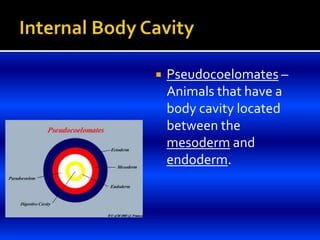
 Pseudocoelomates –
Animals that have a
body cavity located
between the
mesoderm and
endoderm.
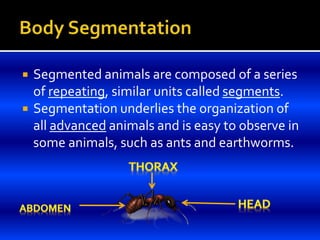
 Segmented animals are composed of a series
of repeating, similar units called segments.
 Segmentation underlies the organization of
all advanced animals and is easy to observe in
some animals, such as ants and earthworms.
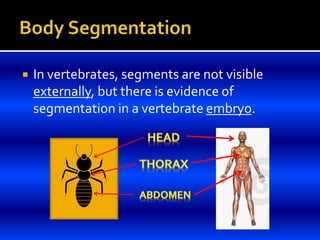
 In vertebrates, segments are not visible
externally, but there is evidence of
segmentation in a vertebrate embryo.
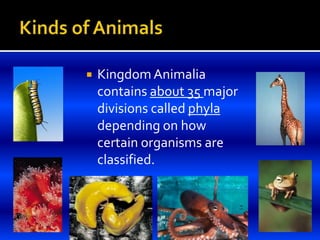
 Kingdom Animalia
contains about 35 major
divisions called phyla
depending on how
certain organisms are
classified.
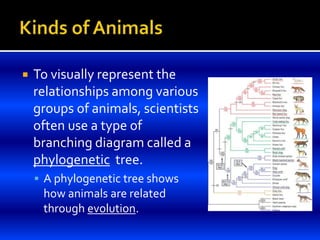
 To visually represent the
relationships among various
groups of animals, scientists
often use a type of
branching diagram called a
phylogenetic tree.
 A phylogenetic tree shows
how animals are related
through evolution.
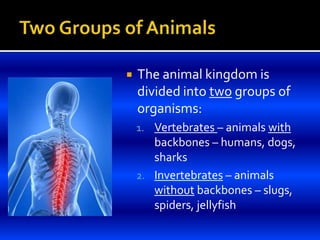
 The animal kingdom is
divided into two groups of
organisms:
1. Vertebrates – animals with
backbones – humans, dogs,
sharks
2. Invertebrates – animals
without backbones – slugs,
spiders, jellyfish

Section 1.pptx

  • 4.
     Heterotrophy  Animalsare heterotrophs – that is, they can not make their own food.  Most animals move from place to place searching for food.  Once food is located, it is eaten and then digested in a cavity inside the animal’s body.
  • 5.
     Mobility  Animalsare unique among living things in being able to perform rapid, complex movements.  Animals move by means of muscle cells, specialized cells that are able to contract with considerable force.
  • 6.
     Animals canswim, crawl, walk, run, and even fly. In fact, flight has evolved four times among animals , in insects, pterosaurs, birds and bats.
  • 7.
    • Multicellularity • Allanimals are multicellular. • In spite of differences in body size, there is little difference in the size of most cells that make up these animals
  • 8.
     The cellson the skin of your hand are roughly the same size as the cells in the heart of a whale or in the wing of a hummingbird.
  • 9.
     Diploidy  Withfew exceptions, animals are diploid, meaning adults have two copies of each chromosome, one inherited from their father and one from their mother.
  • 10.
     Only theirgametes (egg and sperm) are haploid.  A great advantage of diploidy is that it permits an animal to exchange genes between the two copies of a set of chromosomes, creating new combinations of genes.
  • 12.
     Many animalshave a relatively simple life cycle. Most animals spend the majority of their life as diploid organisms. Just about all animals reproduce sexually. Diploid adults undergo meiosis to produce sperm or eggs Fertilization occurs when a sperm and an egg fuse.The zygote that forms develops into an embryo.The embryo eventually develops into an adult.
  • 13.
     Sexual Reproduction Almost all animals reproduce sexually by producing gametes, as do many plants, fungi, and protists.  The females’ egg cells are much larger than the males’ sperm cells.  Unlike the egg cells, the sperm cells of animals have a flagella and are highly mobile.
  • 15.
     Absence ofa CellWall  Among the cells of multicellular organisms, only animal cell lack rigid cell walls.
  • 16.
     The absenceof a rigid cell wall has allowed animals mobility that other multicellular organisms do not have.  You may not realize this, but there are cells moving in your body at all time.  Cells called macrophages, for example, act as mobile garbage collectors, crawling over tissues and removing debris.
  • 17.
     Blastula Formation In all animals except sponges, the zygote (fertilized egg cell) undergoes cell division that form a hollow ball of cells called a blastula.
  • 19.
    Embryonic development: Duringembryonic development, the zygote undergoes a series of mitotic cell divisions, or cleavages, to form an eight-cell stage, then a hollow blastula. During a process called gastrulation, the blastula folds inward to form a cavity in the gastrula.
  • 20.
     Cells withinthe blastula eventually develop into three distinct layers of cells – ectoderm, endoderm, and mesoderm.  These layers are called the primary tissue layers because they give rise to all of the tissues and organs of the adult body.
  • 21.
    PrimaryTissue Gives riseto: Ectoderm Outer layer of skin; nervous system; sense organs, such as eyes Endoderm Lining of the digestive tract; respiratory system; urinary bladder; digestive organs; liver; many glands Mesoderm Most of the skeleton; muscles; circulatory system; reproductive organs; excretory organs
  • 23.
     Tissues  Thecells of all animals except sponges are organized into structural and functional units called tissues.  Tissues are group of cells with a common structure that works together to perform a specific function
  • 24.
     All animalshave their own particular body plan, a term used to describe an animal’s shape, symmetry, and internal organization.  An animal’s body plan results from a pattern of development programmed into the animal’s genes by natural selection
  • 25.
     Sponges havethe simplest body plan of all animals.  Sponges are asymmetrical – irregular in shape and sometimes their shape depends on where they are growing.
  • 26.
     Animals withradial symmetry have body parts arranged around a central axis – like the spokes on a wheel.  Most are aquatic organisms.
  • 27.
     The bodiesof all other animals show bilateral symmetry – body design with distinct right and left halves that are mirror images.
  • 28.
     Most bilaterally symmetricalanimals have evolved an anterior concentration of sensory structures and nerves, a process called cephalization.
  • 29.
     Bilaterally symmetrical animalshave one of three basic kinds of internal body plans:  Coelomates: body plan that includes a body cavity – a fluid filled space found between the body wall and the digestive tract.
  • 30.
     Acoelomates – animalswith no body cavity.
  • 31.
     Pseudocoelomates – Animalsthat have a body cavity located between the mesoderm and endoderm.
  • 33.
     Segmented animalsare composed of a series of repeating, similar units called segments.  Segmentation underlies the organization of all advanced animals and is easy to observe in some animals, such as ants and earthworms.
  • 34.
     In vertebrates,segments are not visible externally, but there is evidence of segmentation in a vertebrate embryo.
  • 35.
     Kingdom Animalia containsabout 35 major divisions called phyla depending on how certain organisms are classified.
  • 36.
     To visuallyrepresent the relationships among various groups of animals, scientists often use a type of branching diagram called a phylogenetic tree.  A phylogenetic tree shows how animals are related through evolution.
  • 37.
     The animalkingdom is divided into two groups of organisms: 1. Vertebrates – animals with backbones – humans, dogs, sharks 2. Invertebrates – animals without backbones – slugs, spiders, jellyfish