ENGINEERING PHYSICS CHEM IA
(PHYSCA1) 2022
You are welcome to the
Engineering Physics Chem IA
(PHYSCA1) Module for
B. Eng. Tech. (Chemical
Engineering)
2024/07/17
1
Section 1: Mathematical Basics
Units of measurement
Scientific Notation
Prefixes of Ten
Trigonometry
Logarithms
Unit Conversion
Dimensional Analysis
Significant Figures
2024/07/17
2
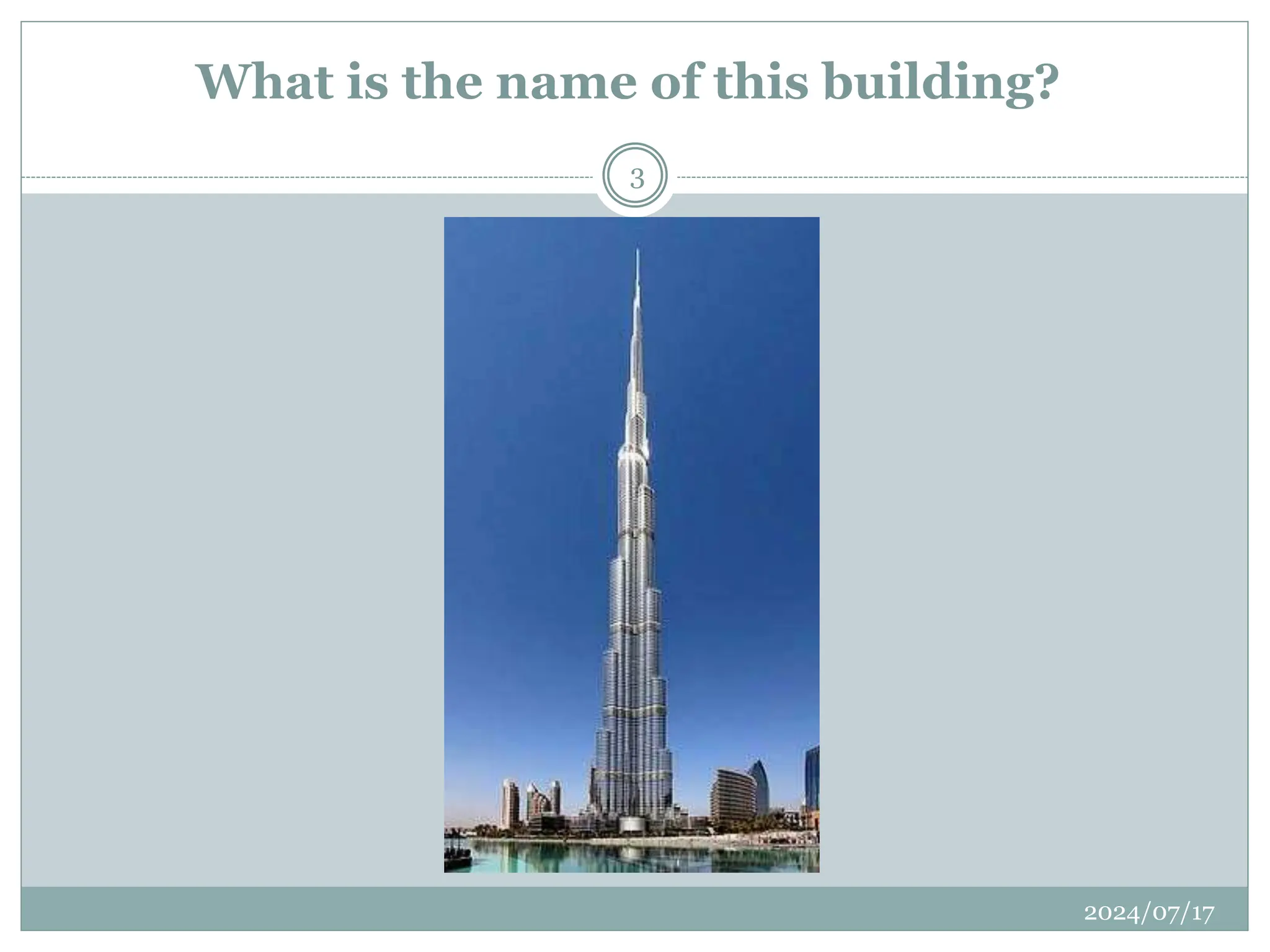
What is the name of this building?
2024/07/17
3
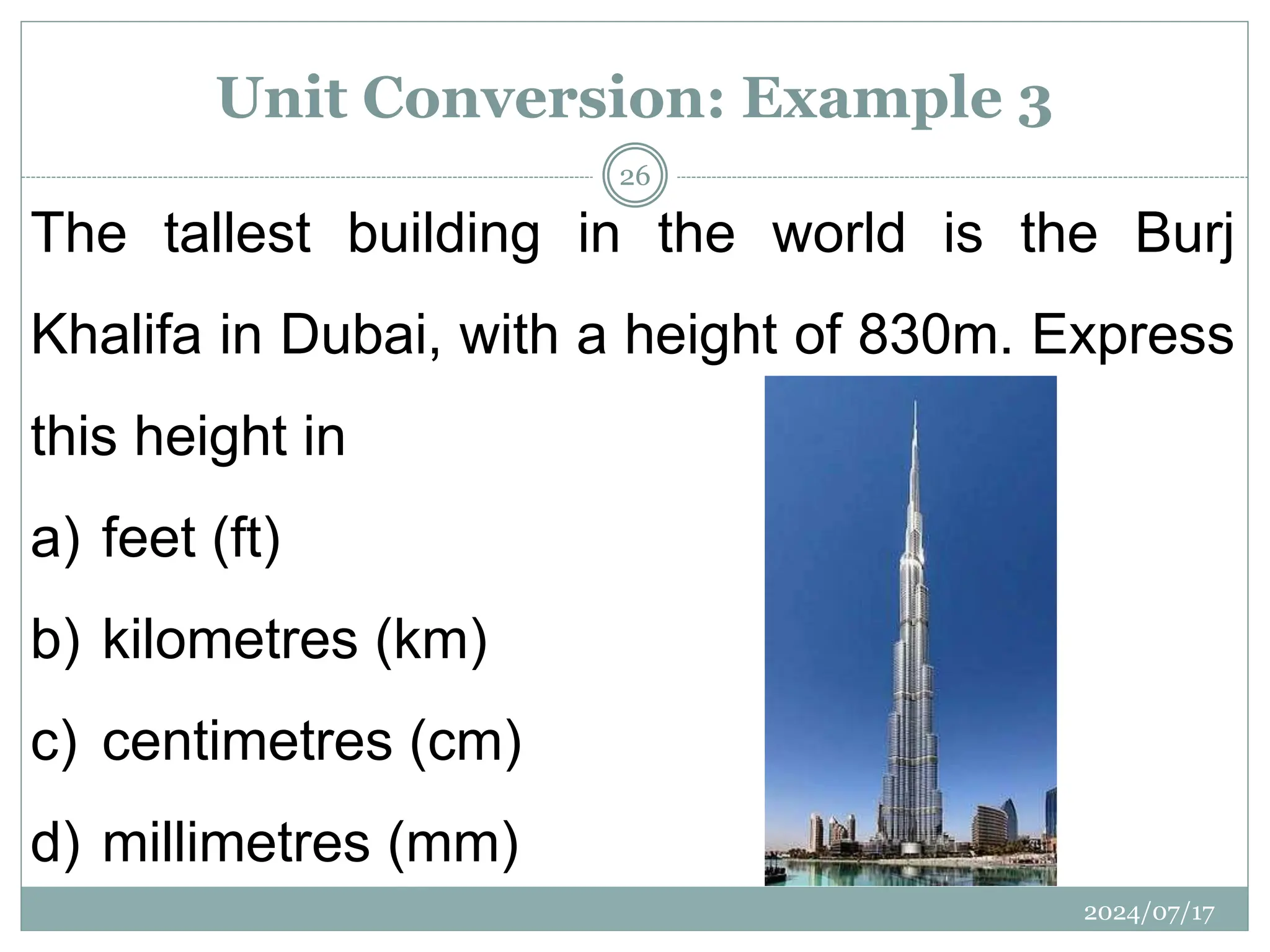
The Burj Khalifa
2024/07/17
4
 Located in Dubai, UAE
 830 m tall (to the tip)
 163 floors
 Took almost 5 yrs to construct
 Tallest building in the world
SPOT TEST
Question 1
Define the term “Physics”.
Question 2
Why do you think Physics is relevant to your
intended programme of study (Chemical
Engineering) ? Give FIVE reasons.
2024/07/17
5
Definition of Physics
The word Physics originates from the Greek word
“phusis” (modern Greek), which means NATURE.
In ancient Greek: “phusike”, which means
“KNOWLEDGE OF NATURE”.
In Latin: “physica”, which means “NATURAL
SCIENCE”.
2024/07/17
6
PHYSICS is the study of the laws and
principles that govern the behaviour of nature
or the natural world in which we live.
Physics encompasses a remarkable variety of
phenomena such as:
 planetary orbits
 radio and TV waves
 fluid dynamics/statics
 colour and many more!
Definition of Physics
2024/07/17
7
Units of measurement
• Physics is an empirical science.
• It involves observation, analysis and
experiment.
• Physics experiments involve the measurement
of a variety of physical quantities.
• These measurements must be accurate and
reproducible.
• The first step in ensuring accuracy and
reproducibility is defining the units in which
the measurements are made.
2024/07/17
8
Units of measurement
How is reproducibility ensured?
The General Conference on
Weights & Measures.
2024/07/17
9
There are THREE systems of units used worldwide,
namely
1) The SI system (Systeme’ Internationale)
2) The c.g.s. system
3) The British Engineering (BE) system
Units of measurement
2024/07/17
10
Units of measurement
There are TWO types of units,
namely:
1) Base Units
2) Derived Units
2024/07/17
11
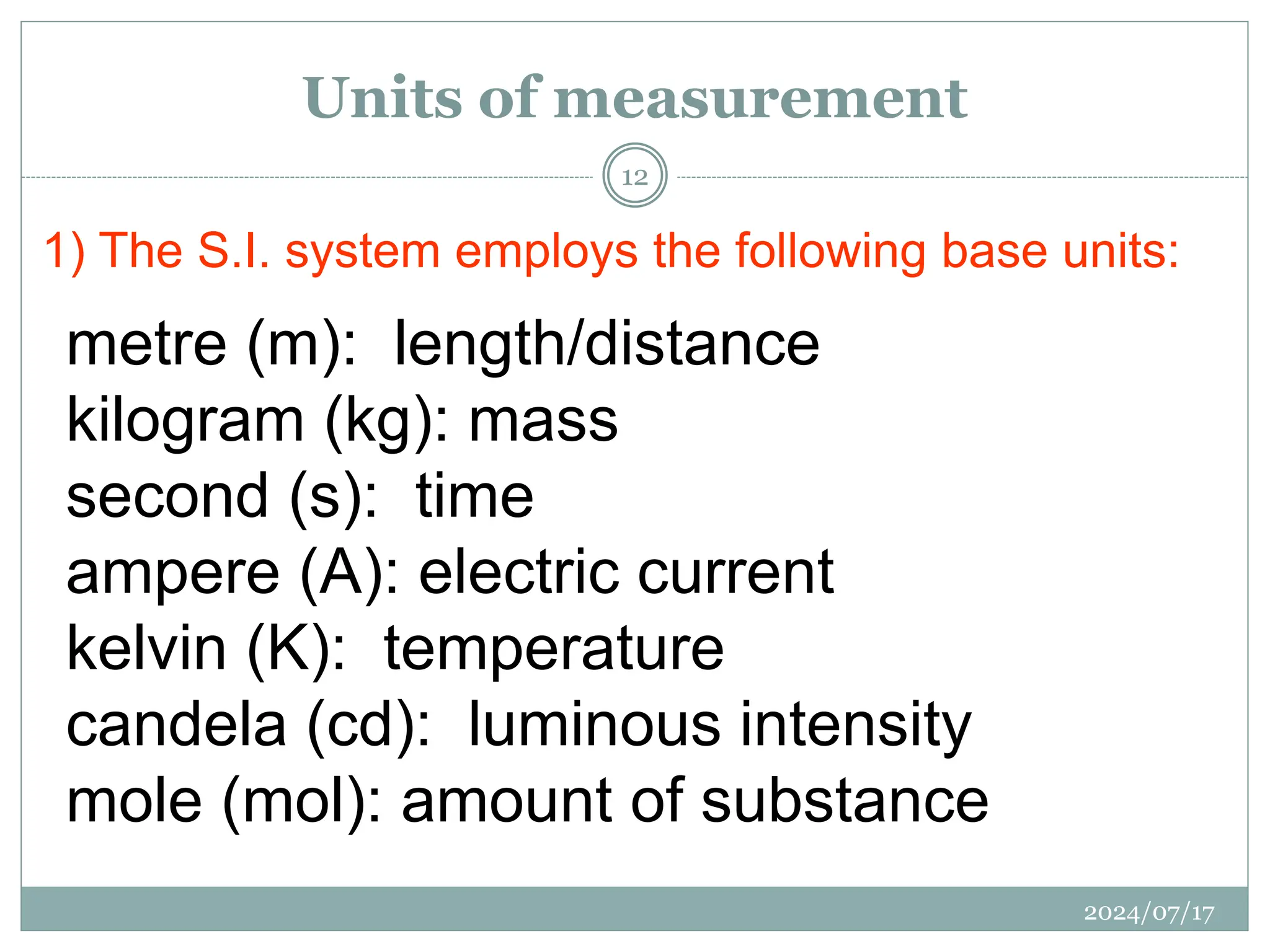
1) The S.I. system employs the following base units:
metre (m): length/distance
kilogram (kg): mass
second (s): time
ampere (A): electric current
kelvin (K): temperature
candela (cd): luminous intensity
mole (mol): amount of substance
Units of measurement
2024/07/17
12
NOTE: Units named after people are abbreviated
using capital letters otherwise lower cases are
used.
Base units are used in combination to define additional
units for other important physical quantities. Such units
are referred to as DERIVED units.
Units of measurement
2024/07/17
13
Name as many derived units as you
can and also provide their
respective physical quantities.
Units of measurement: Class Exercise
2024/07/17
14
2) The c.g.s. system employs the following:
centimetre, gram and second.
3) The BE system employs the following:
Force/Weight: pound (lb).
Mass: slug (sl), ounce (oz).
Length: inch (in), mile (mi), foot (ft).
Temperature: degrees Fahrenheit (oF).
Units of measurement
2024/07/17
15
State whether the following units are S.I. or B.E.
Mention the physical quantity each one measures.
a) ton h) Btu
b) yard i) horsepower
c) furlong j) calorie
d) pint k) atomic mass unit
e) quart l) torr
f) gallon m) watt
g) acre n) electron volt
Units of measurement: HOMEWORK
2024/07/17
16
SECTION 1: Introduction to Basics
Units of measurement √
Scientific Notation
Prefixes of Ten
Trigonometry
Logarithms
Unit Conversion
Dimensional Analysis
Significant Figures
2024/07/17
17
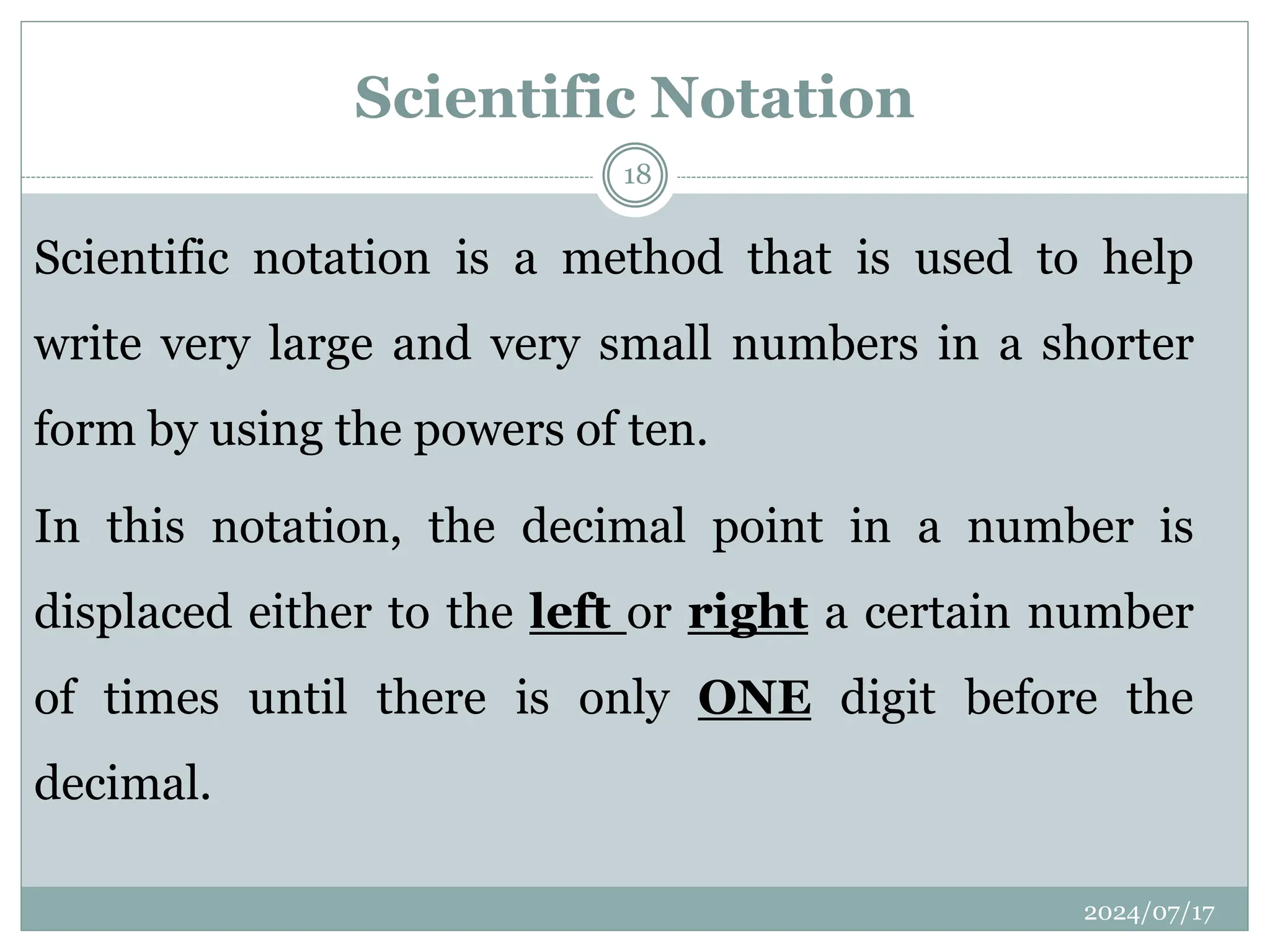
Scientific notation is a method that is used to help
write very large and very small numbers in a shorter
form by using the powers of ten.
In this notation, the decimal point in a number is
displaced either to the left or right a certain number
of times until there is only ONE digit before the
decimal.
Scientific Notation
2024/07/17
18
Scientific Notation: Example 1
2024/07/17
19
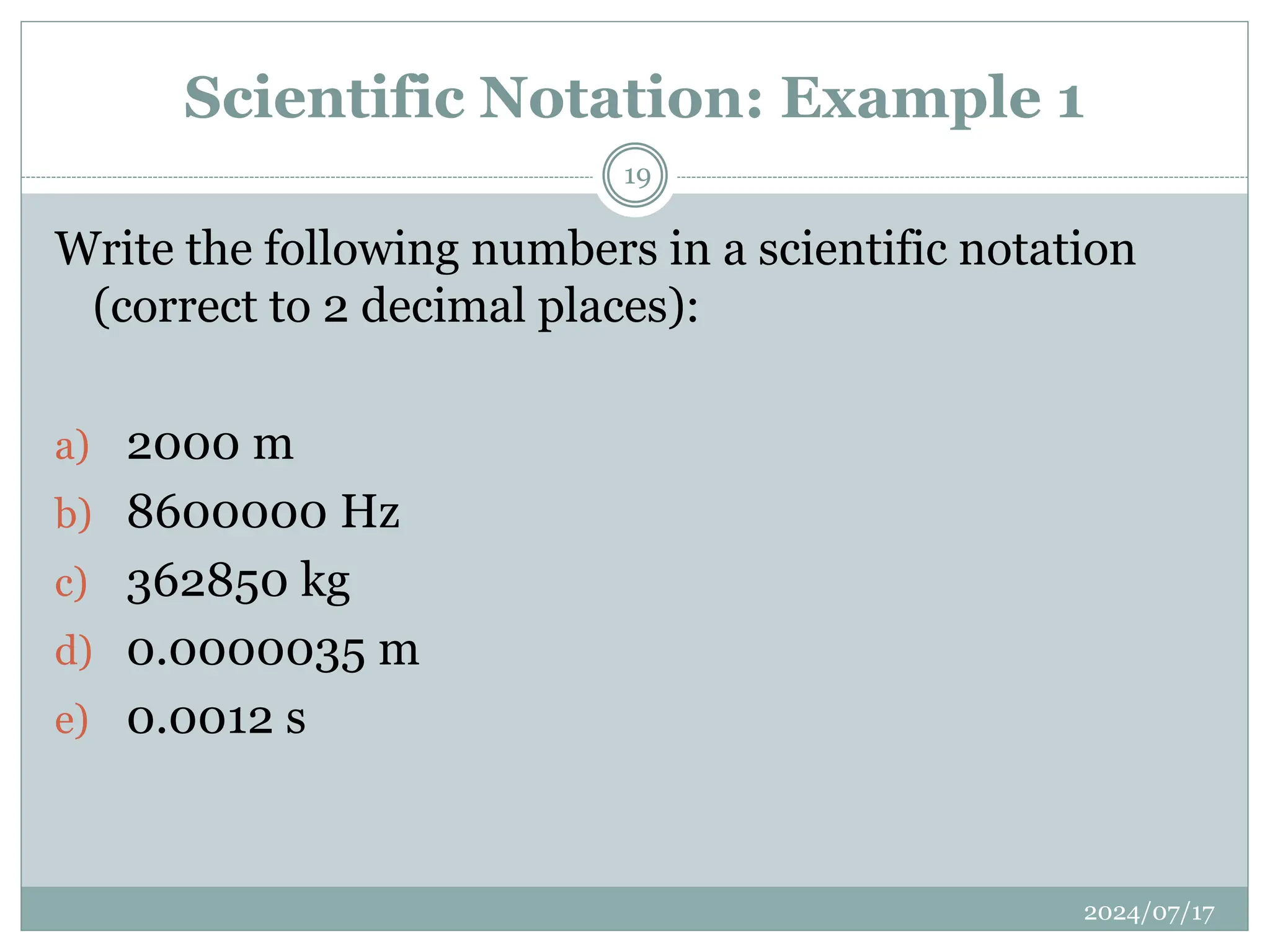
Write the following numbers in a scientific notation
(correct to 2 decimal places):
a) 2000 m
b) 8600000 Hz
c) 362850 kg
d) 0.0000035 m
e) 0.0012 s
SECTION 1: Introduction to Basics
Units of measurement √
Scientific Notation √
Prefixes of Ten
Trigonometry
Logarithms
Unit Conversion
Dimensional Analysis
Significant Figures
2024/07/17
20
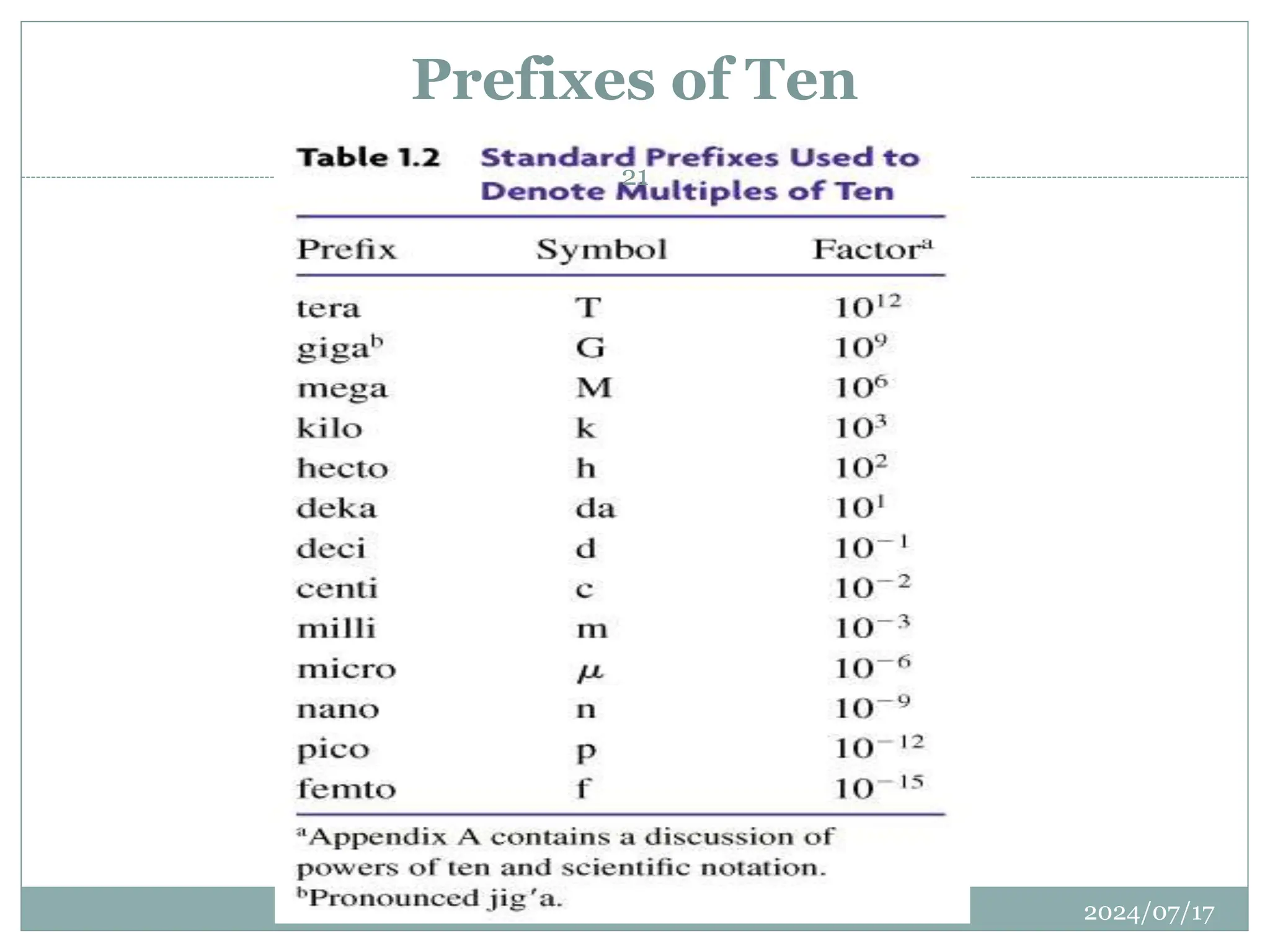
Prefixes of Ten
2024/07/17
21
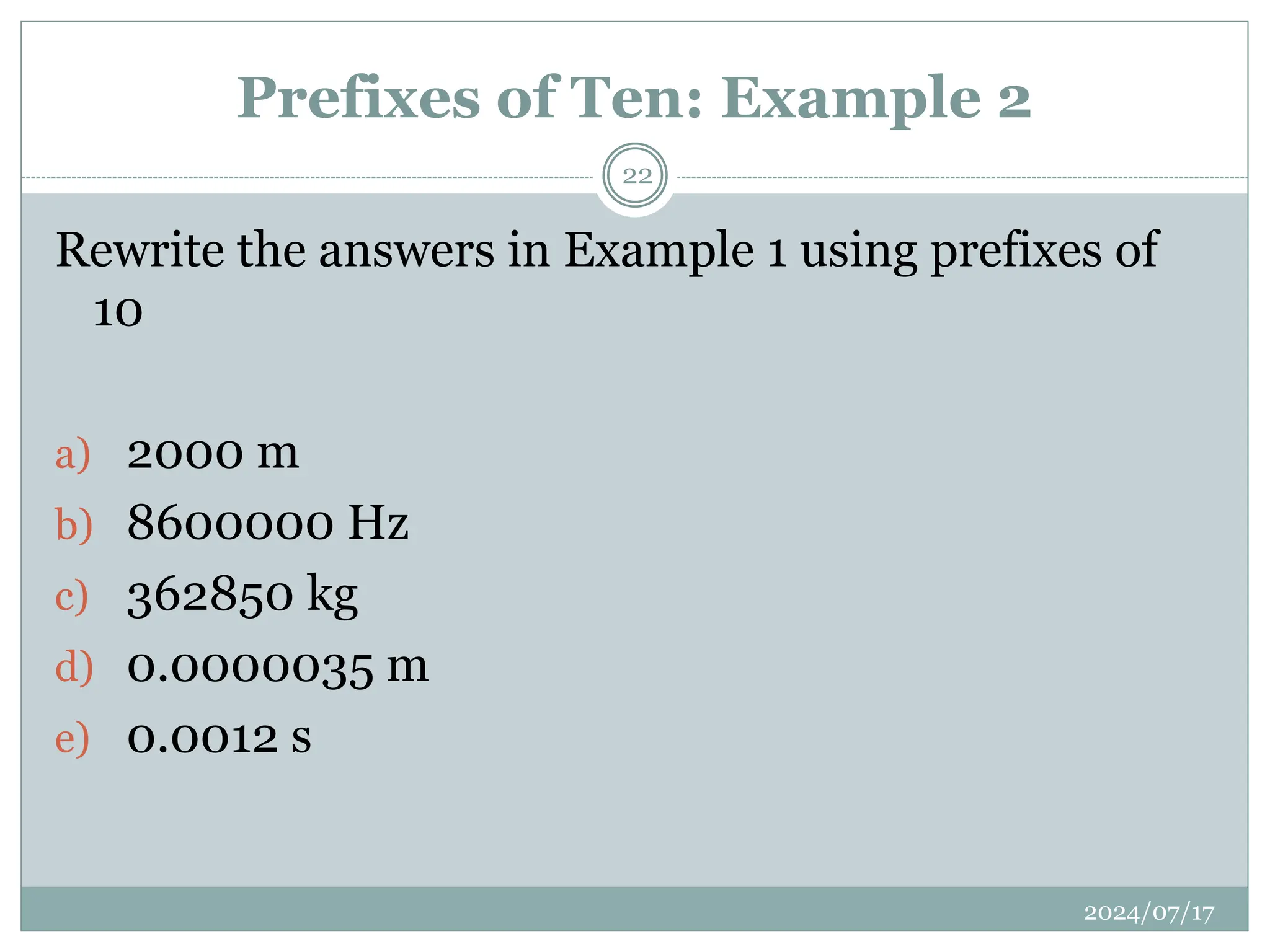
Prefixes of Ten: Example 2
2024/07/17
22
Rewrite the answers in Example 1 using prefixes of
10
a) 2000 m
b) 8600000 Hz
c) 362850 kg
d) 0.0000035 m
e) 0.0012 s
SECTION 1: Introduction to Basics
Units of measurement √
Scientific Notation √
Prefixes of Ten √
Trigonometry
Logarithms
Unit Conversion
Dimensional Analysis
Significant Figures
2024/07/17
23
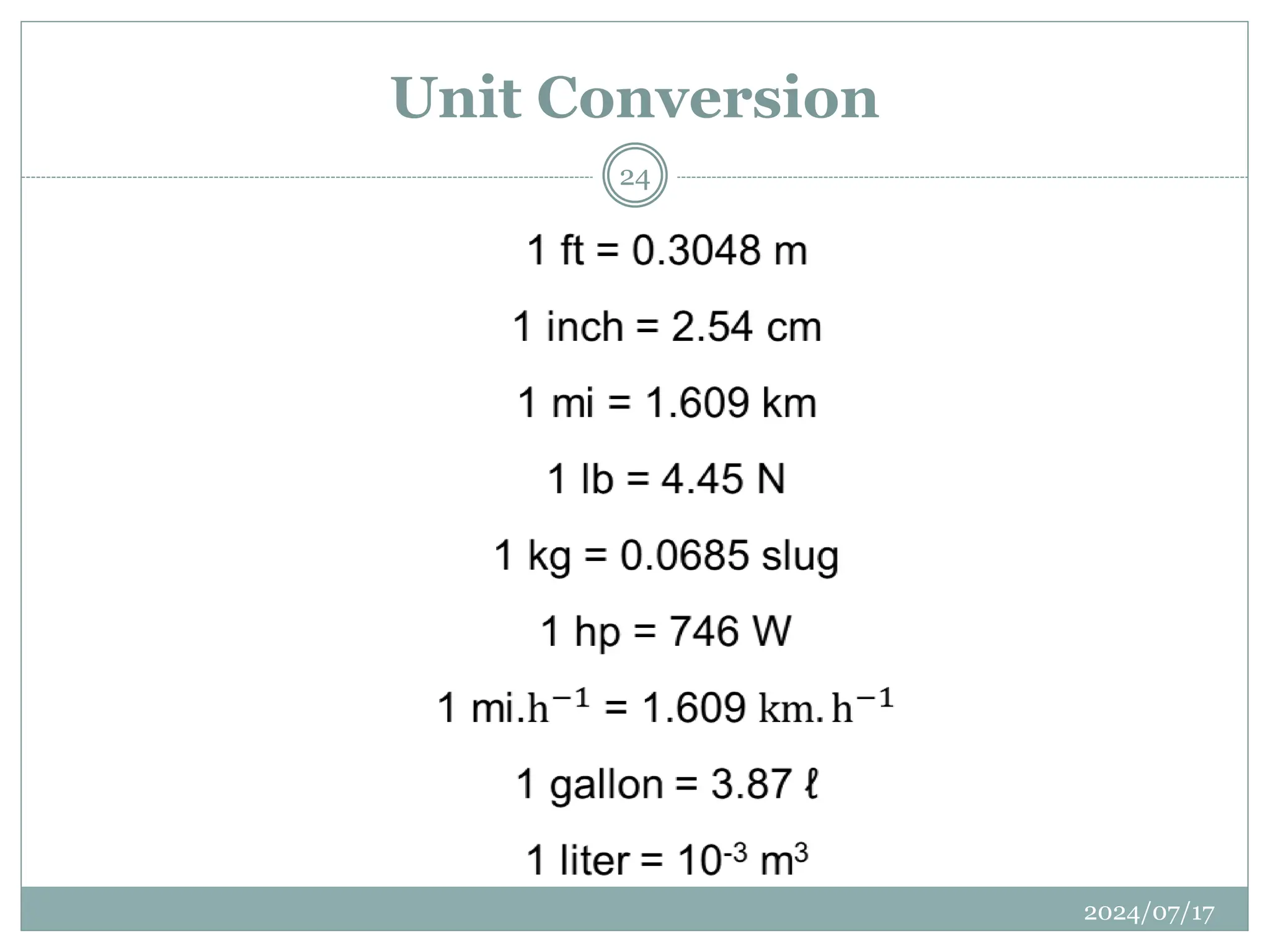
Unit Conversion
2024/07/17
24
1. In all calculations, write down the units
explicitly.
2. Treat all units as algebraic quantities. When
identical units are divided, they are
eliminated algebraically.
3. Be guided by the fact that multiplying or
dividing an equation by a factor of 1, does not
alter the equation.
Unit Conversion: Reasoning Strategy
2024/07/17
25
The tallest building in the world is the Burj
Khalifa in Dubai, with a height of 830m. Express
this height in
a) feet (ft)
b) kilometres (km)
c) centimetres (cm)
d) millimetres (mm)
2024/07/17
26
Unit Conversion: Example 3
GENERAL KNOWLEDGE
2024/07/17
27
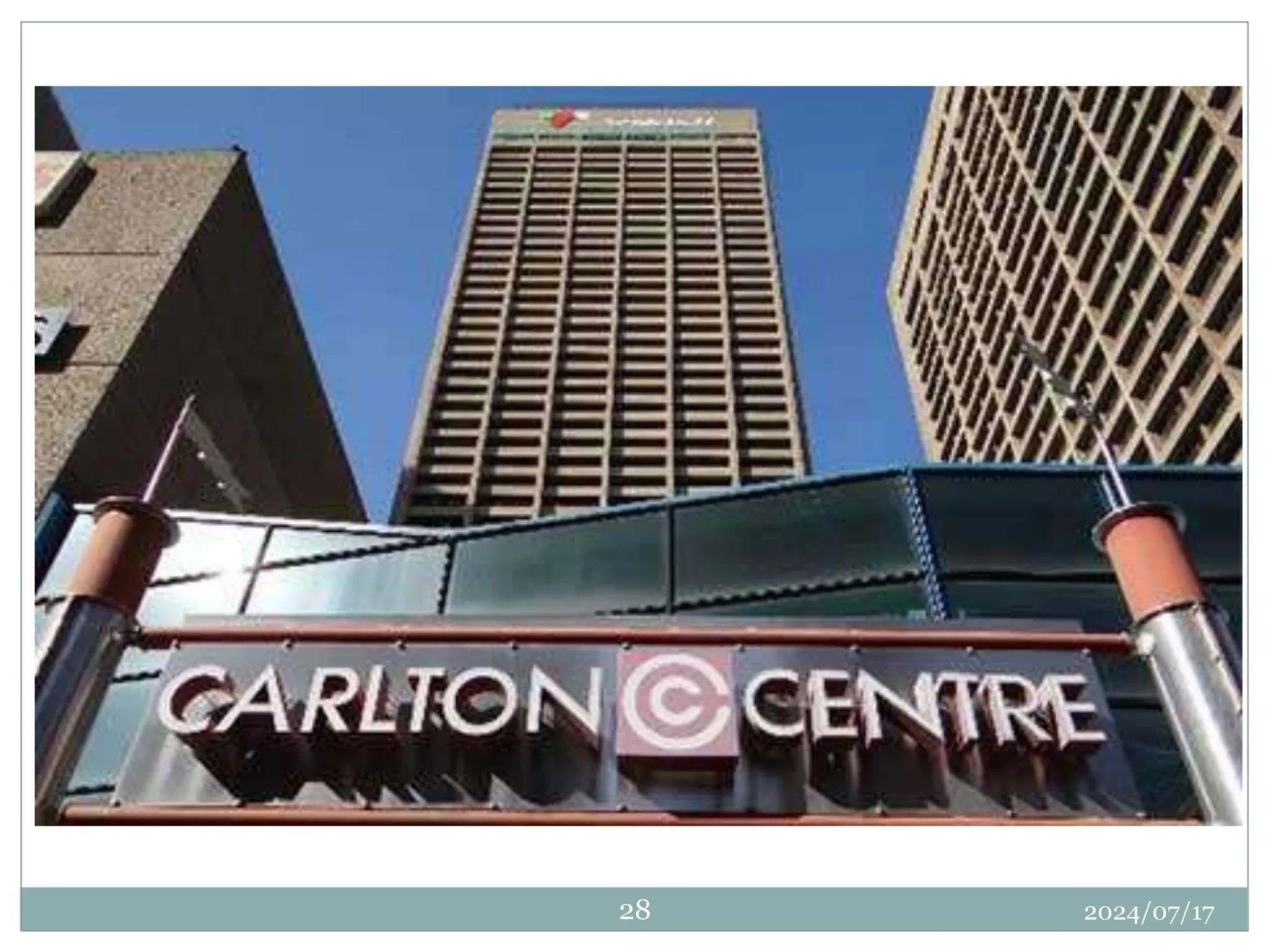
1) Which building is the tallest in
Africa and in which country is it
located?
2024/07/17
28
GENERAL KNOWLEDGE
2024/07/17
29
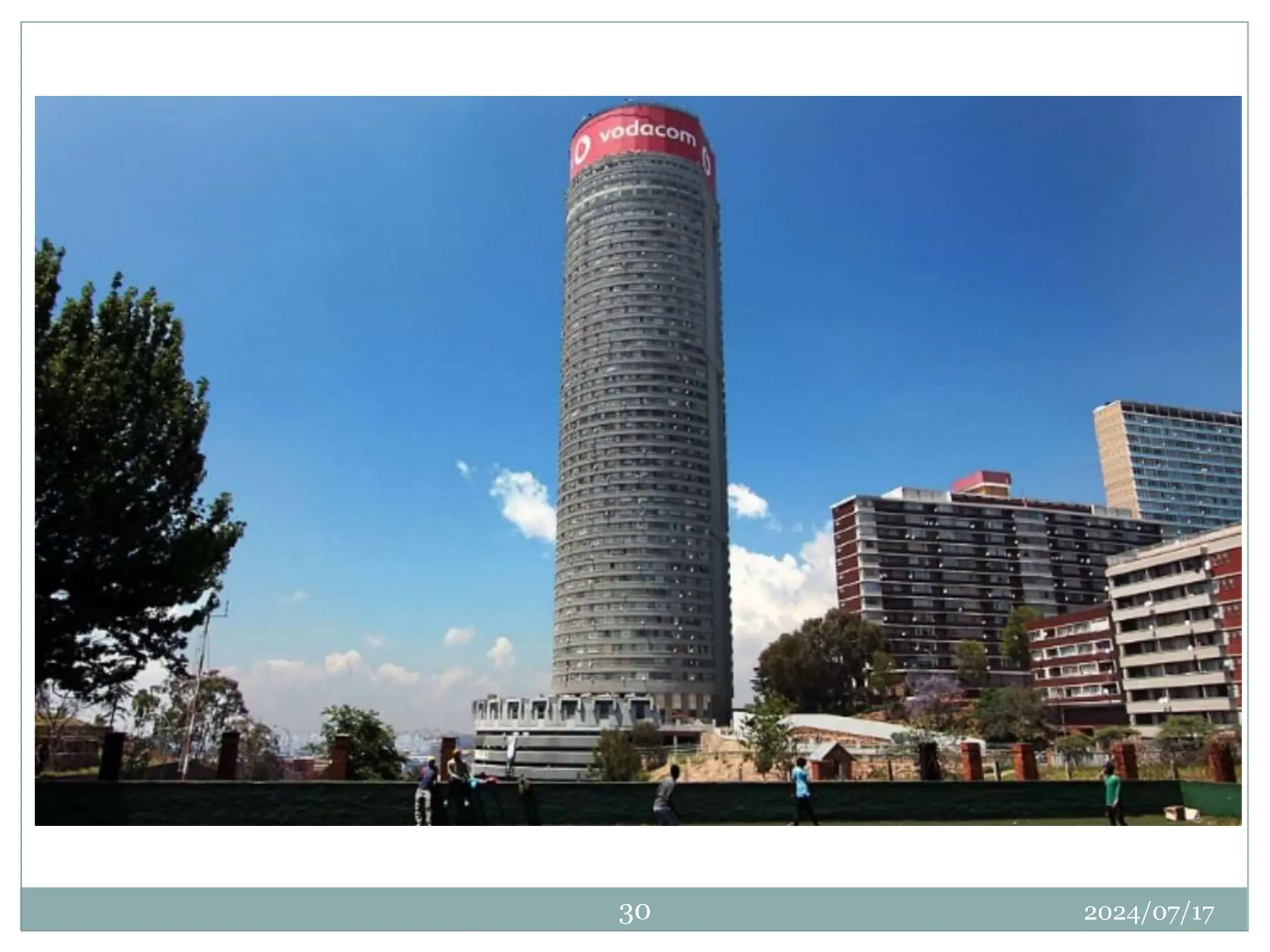
2) Which building is the tallest
residential building in Africa and
in which country is it located?
2024/07/17
30
GENERAL KNOWLEDGE
2024/07/17
31
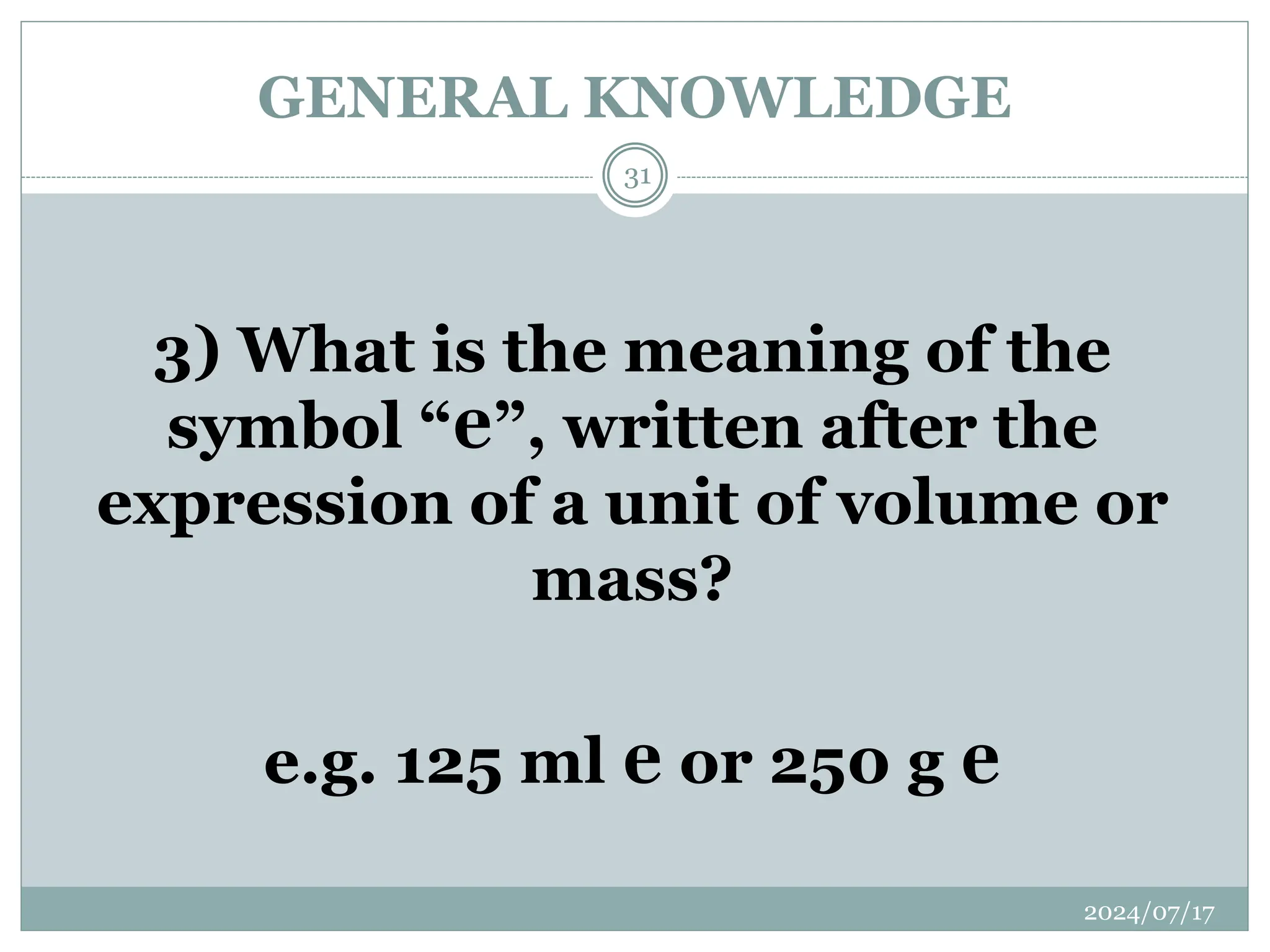
3) What is the meaning of the
symbol “℮”, written after the
expression of a unit of volume or
mass?
e.g. 125 ml ℮ or 250 g ℮
2024/07/17
32
Do problems 1, 2, 4, 5, and 6
in Chapter 1 on pages 18-19 (Cutnell 10th
Edition)
Estimate your age in seconds
(Use fact that a year has 365 days & do
your calculation to the day)
Self Assessment
2024/07/17
33
SECTION 1: Introduction to Basics
Units of measurement √
Scientific Notation √
Prefixes of Ten √
Unit Conversion √
Dimensional Analysis
Significant Figures
2024/07/17
34
x= displacement [m],
v = velocity [m.s−1]
t= time [s]
NOTE: The constant
1
2
, must not be considered in
dimensional analysis.
2
2
1
vt
x 
Is the following equation dimensionally correct?
Dimensional Analysis: Example 4
2024/07/17
35
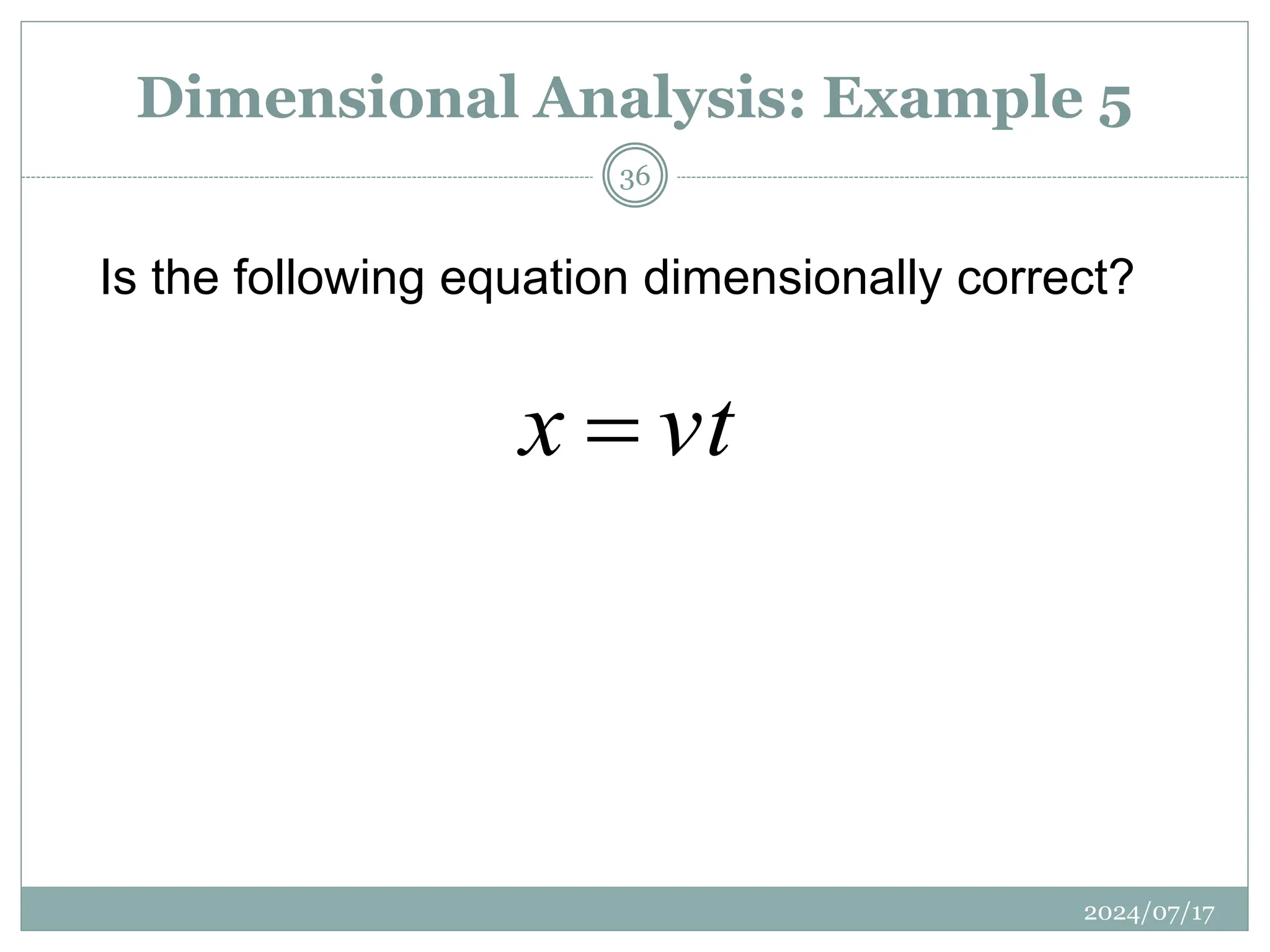
Is the following equation dimensionally correct?
vt
x 
Dimensional Analysis: Example 5
2024/07/17
36
Do problems 3 and 7
in Chapter 1 on page 19
Self Assessment: Cutnell (10th Edition)
2024/07/17
37
SECTION 1: Introduction to Basics
Units of measurement √
Scientific Notation √
Prefixes of Ten √
Unit Conversion √
Dimensional Analysis √
Significant Figures
2024/07/17
38
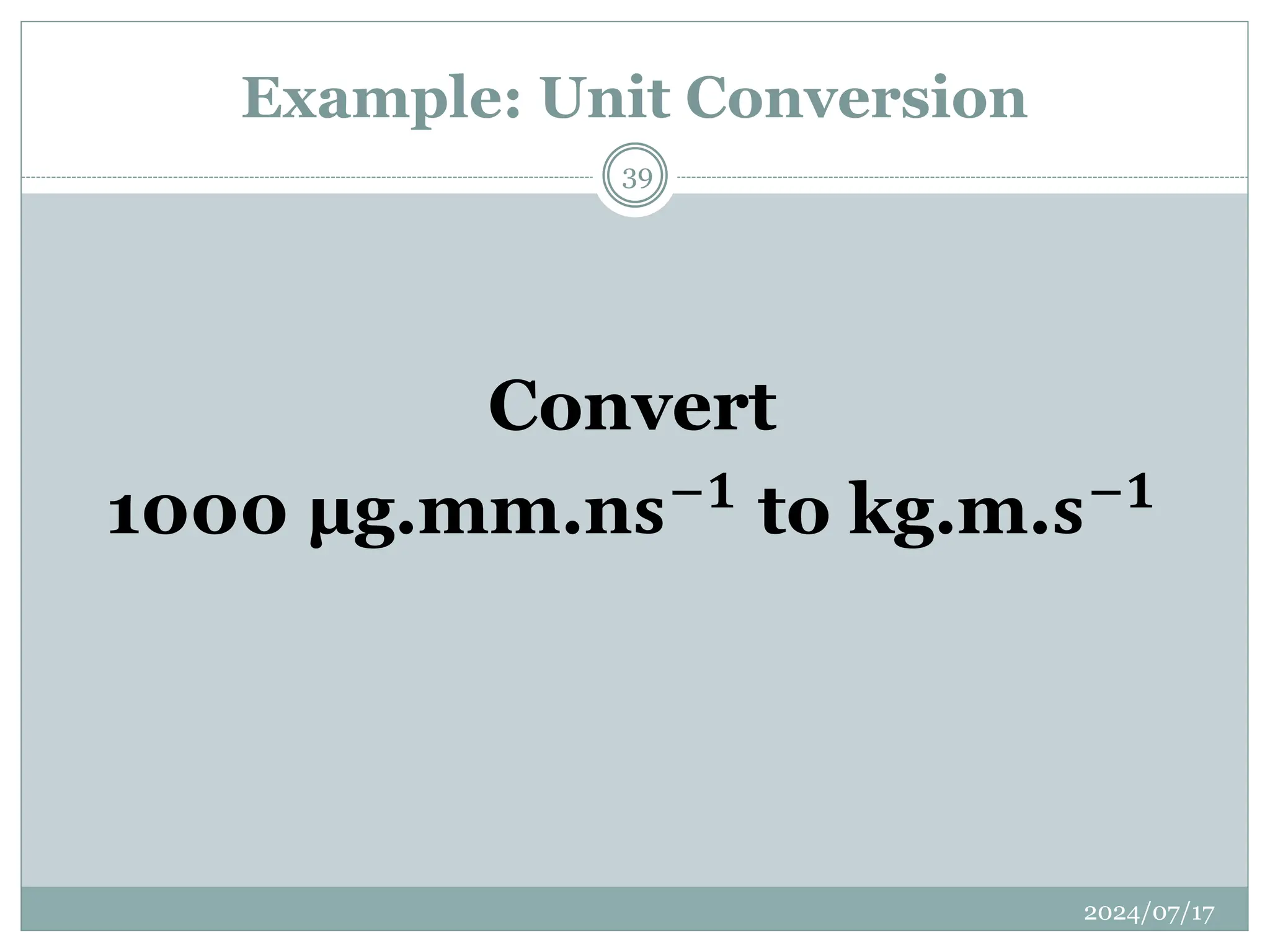
Example: Unit Conversion
2024/07/17
39
Convert
1000 μg.mm.n𝐬−𝟏
to kg.m.𝐬−𝟏
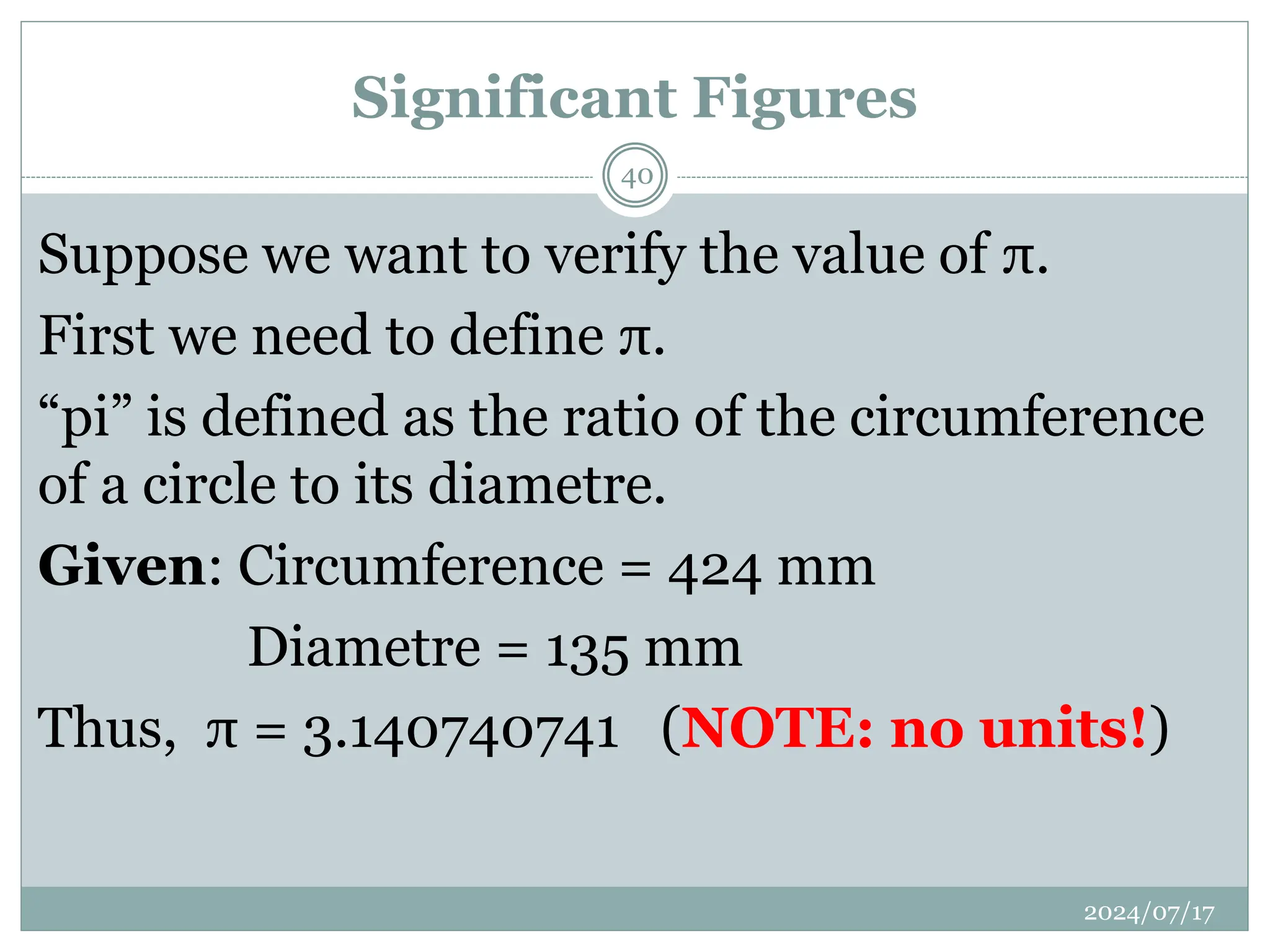
Significant Figures
Suppose we want to verify the value of π.
First we need to define π.
“pi” is defined as the ratio of the circumference
of a circle to its diametre.
Given: Circumference = 424 mm
Diametre = 135 mm
Thus, π = 3.140740741 (NOTE: no units!)
2024/07/17
40
Significant Figures
In terms of the correct number of significant
figures, how would you express the final
answer?
Answer: 3.14
2024/07/17
41
Significant Figures
The number of significant figures in a
result is simply the number of figures that
are known with some degree of reliability
or precision. Alternatively,
The significant figures of a number are
those digits that carry meaning and are
contributing to its precision.
2024/07/17
42
Significant Figures: Rules
RULE 1: All non-zero digits are significant.
e.g. 34.7 has THREE significant figures.
RULE 2: Zeros appearing anywhere between two
non- zero significant digits are significant.
e.g. 5021 has FOUR significant figures.
RULE 3: Leading zeros are not significant.
e.g. 0.00053 has TWO significant figures.
2024/07/17
43
RULE 4: Trailing zeros in a number
containing a decimal point (i.e. to the right of
the decimal point) are significant.
e.g. 45.00 has FOUR significant figures.
0.00034500 has FIVE significant figures.
RULE 5: Trailing zeros in a whole number
with no decimal shown are not significant.
e.g. 320 has TWO significant figures.
Significant Figures: Rules
2024/07/17
44
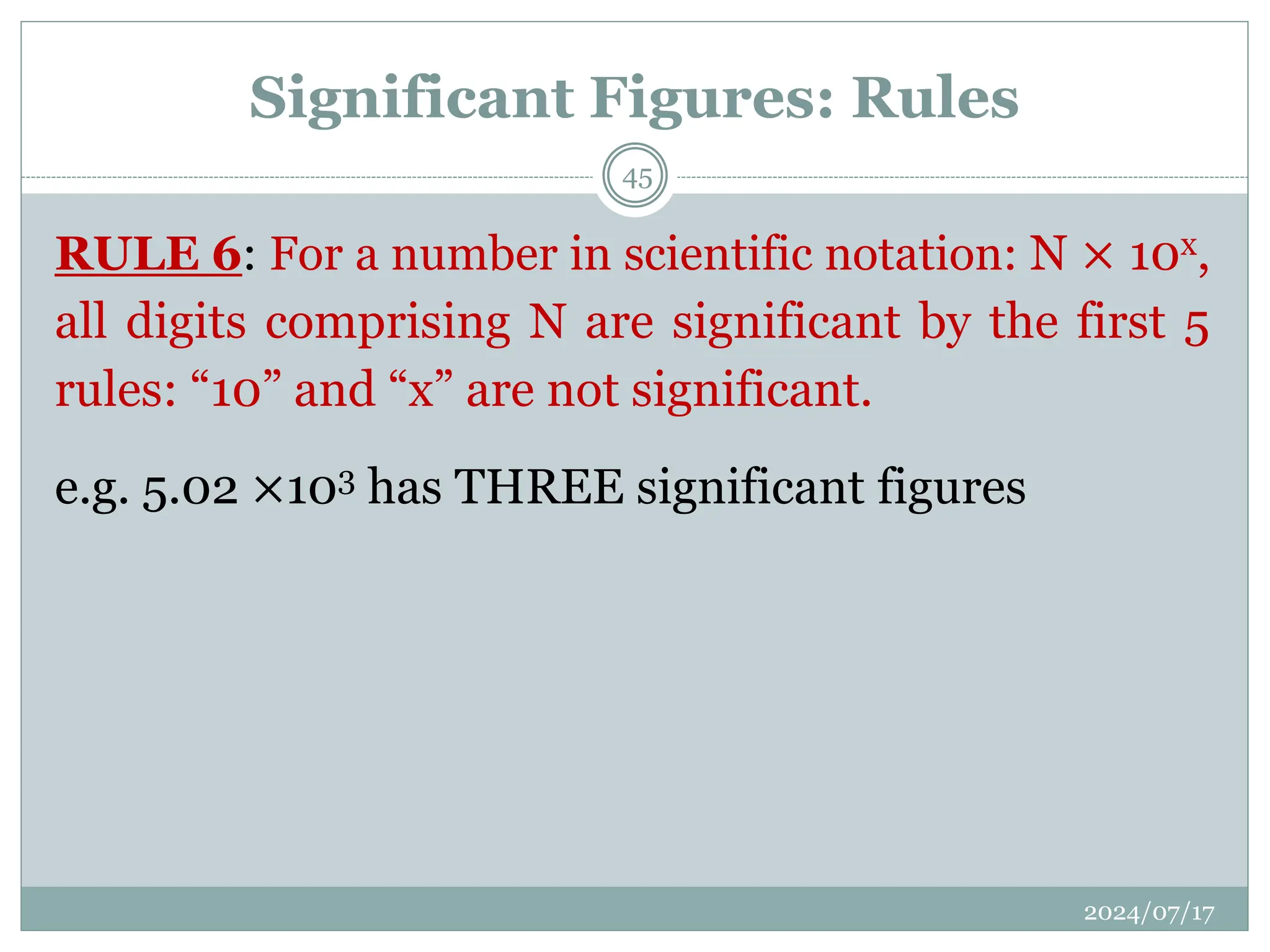
RULE 6: For a number in scientific notation: N × 10x,
all digits comprising N are significant by the first 5
rules: “10” and “x” are not significant.
e.g. 5.02 ×10³ has THREE significant figures
Significant Figures: Rules
2024/07/17
45
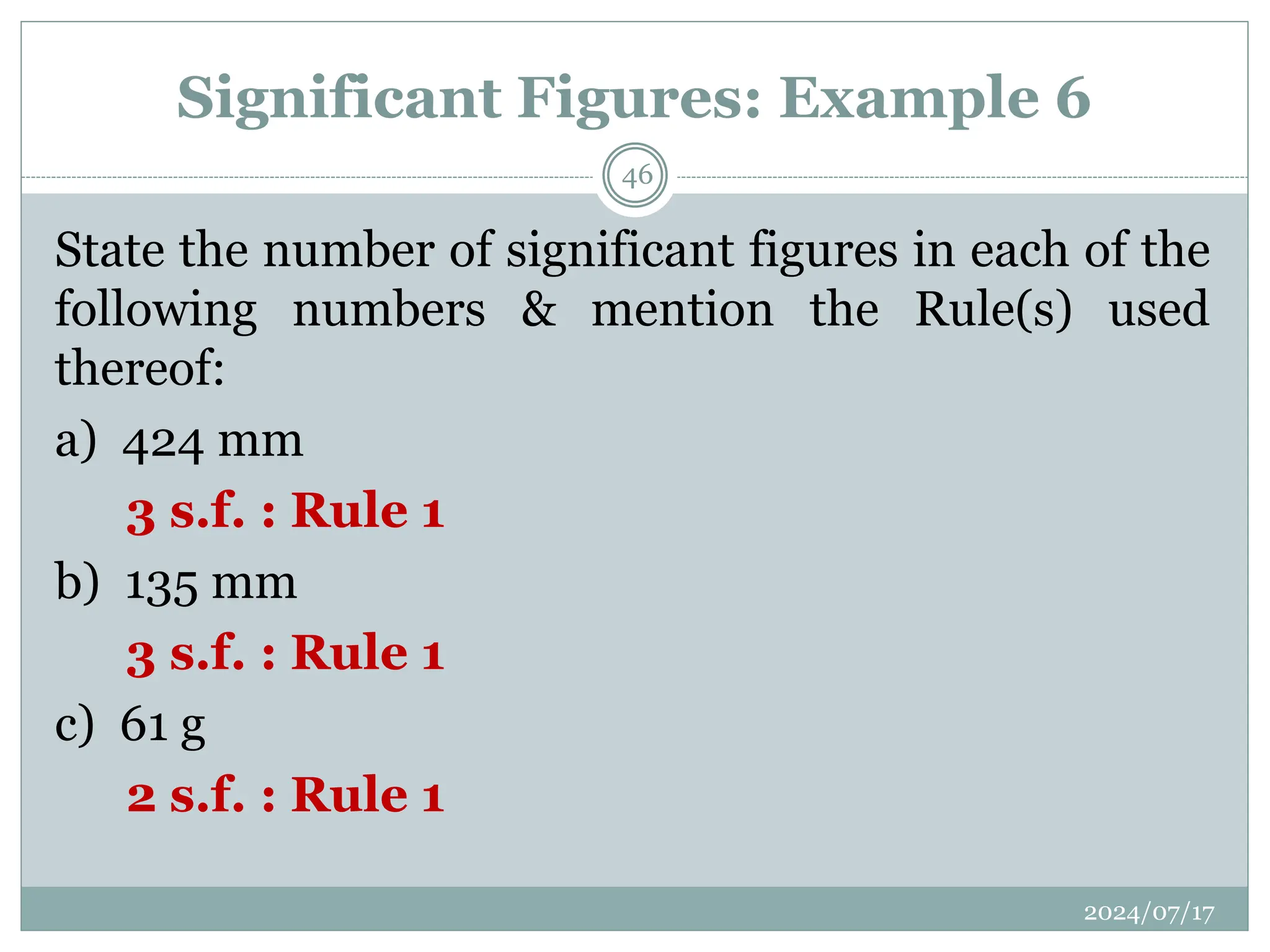
Significant Figures: Example 6
State the number of significant figures in each of the
following numbers & mention the Rule(s) used
thereof:
a) 424 mm
3 s.f. : Rule 1
b) 135 mm
3 s.f. : Rule 1
c) 61 g
2 s.f. : Rule 1
2024/07/17
46
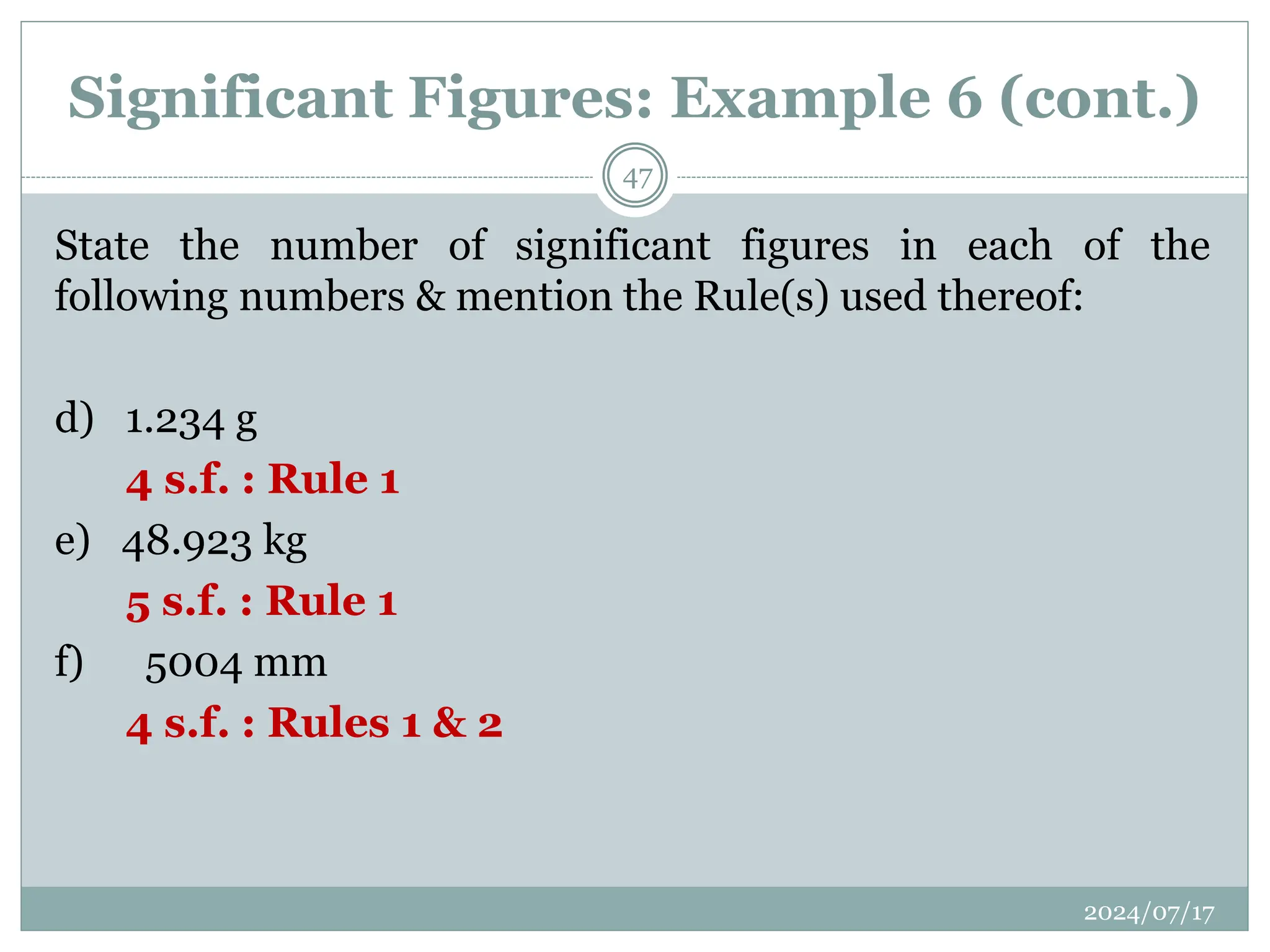
Significant Figures: Example 6 (cont.)
State the number of significant figures in each of the
following numbers & mention the Rule(s) used thereof:
d) 1.234 g
4 s.f. : Rule 1
e) 48.923 kg
5 s.f. : Rule 1
f) 5004 mm
4 s.f. : Rules 1 & 2
2024/07/17
47
Significant Figures: Example 6 (cont.)
State the number of significant figures in each of the
following numbers & mention the Rule(s) used
thereof:
g) 3.07 s
3 s.f. : Rules 1 & 2
h) 0.20 g
2 s.f. : Rules 1, 3 & 4
i) 8.1000 m
5 s.f. : Rules 1 & 4
2024/07/17
48
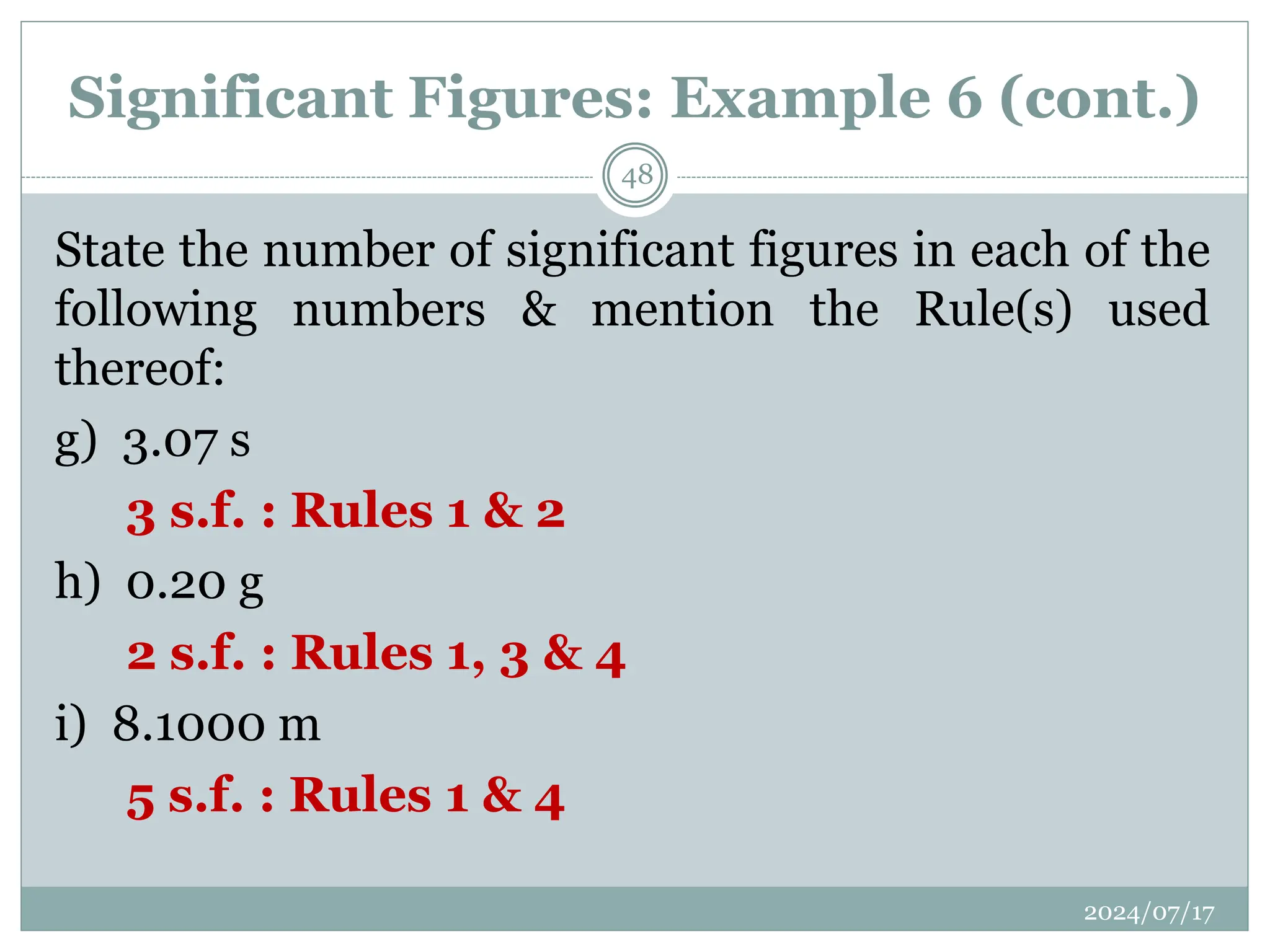
Significant Figures: Example 6 (cont.)
State the number of significant figures in each of the
following numbers & mention the Rule(s) used
thereof:
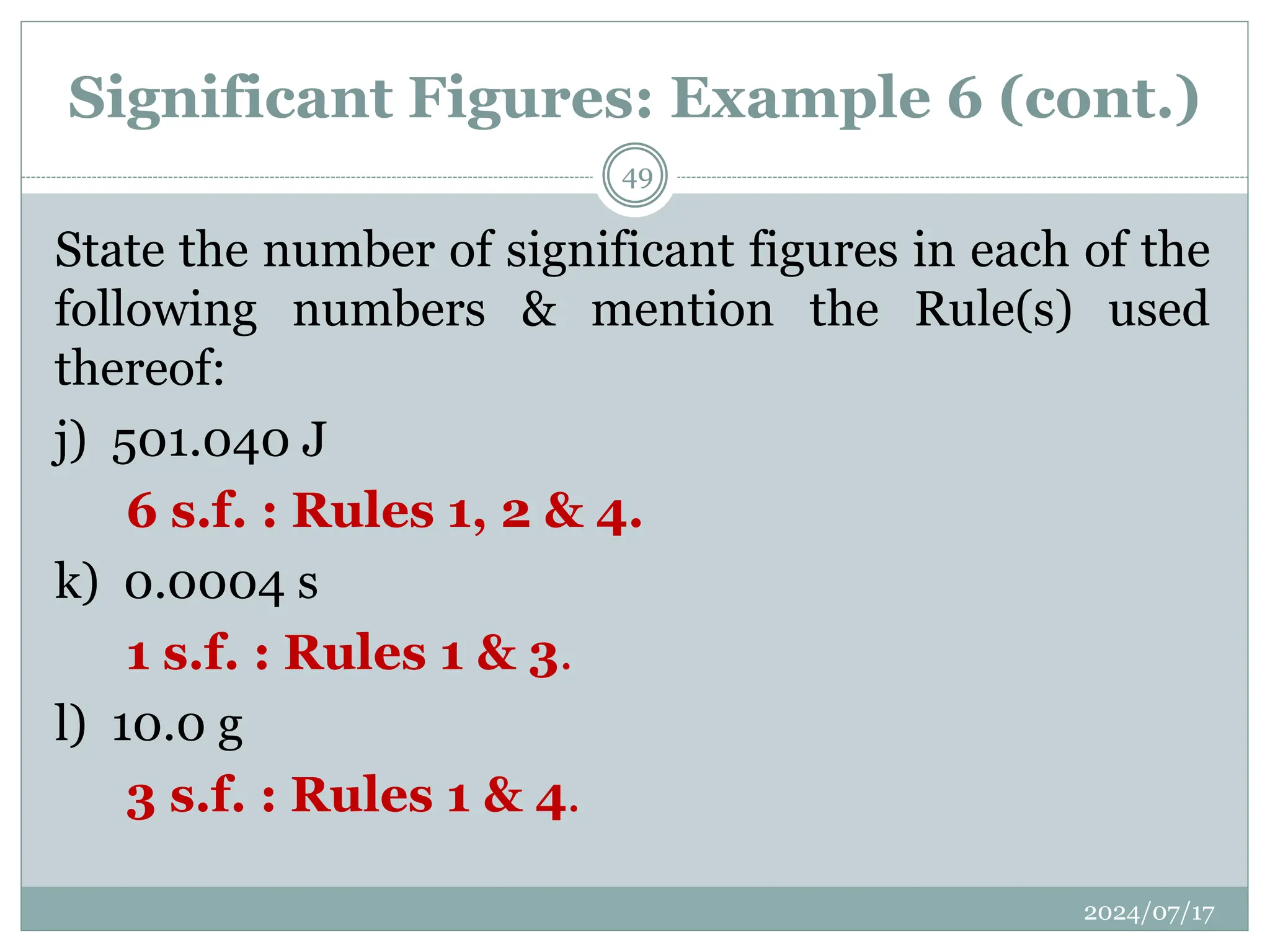
j) 501.040 J
6 s.f. : Rules 1, 2 & 4.
k) 0.0004 s
1 s.f. : Rules 1 & 3.
l) 10.0 g
3 s.f. : Rules 1 & 4.
2024/07/17
49
Significant Figures: Example 6 (cont.)
State the number of significant figures in each of the
following numbers & mention the Rule(s) used
thereof:
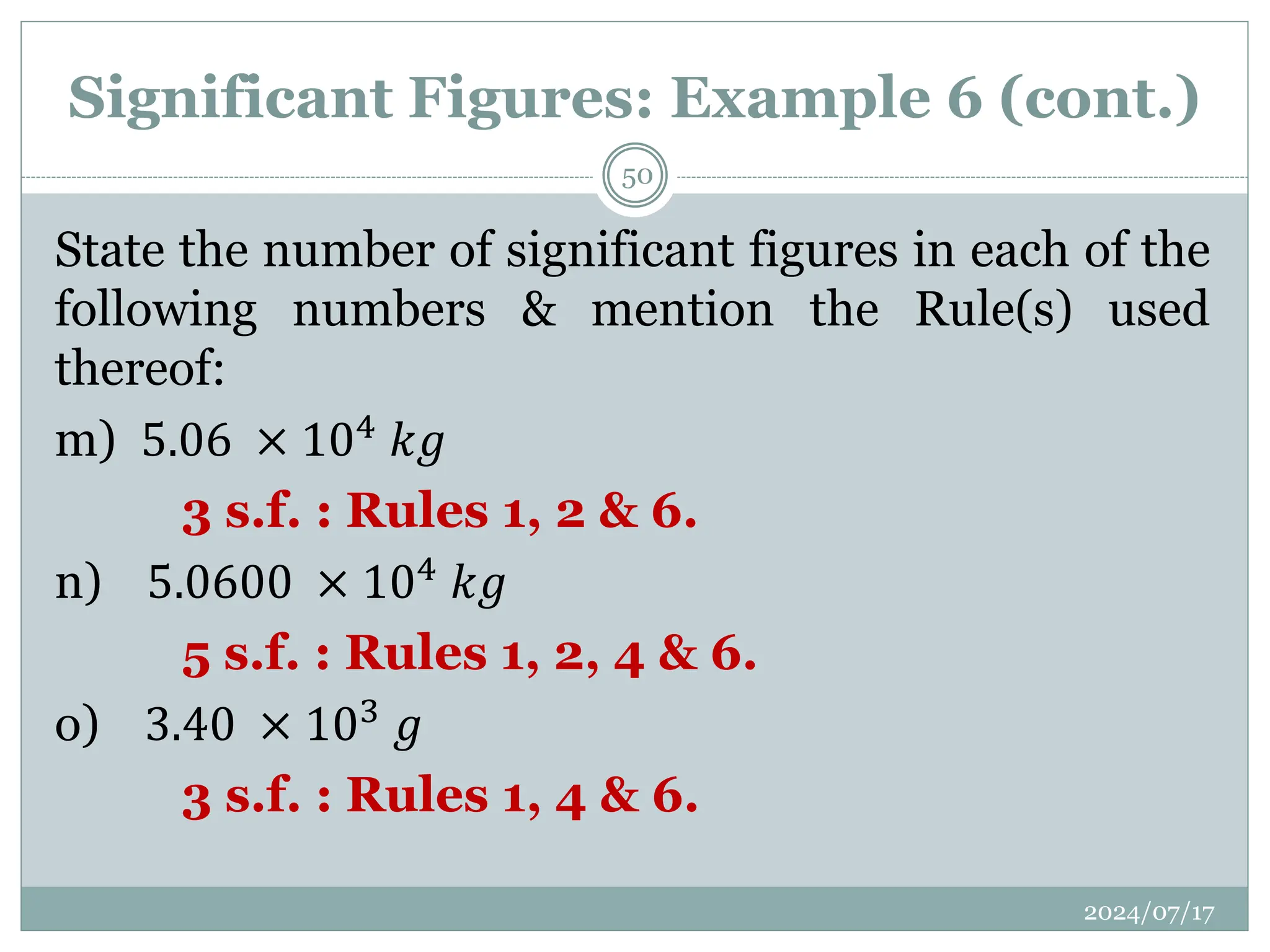
m) 5.06 × 10⁴
𝑘𝑔
3 s.f. : Rules 1, 2 & 6.
n) 5.0600 × 10⁴ 𝑘𝑔
5 s.f. : Rules 1, 2, 4 & 6.
o) 3.40 × 10³ 𝑔
3 s.f. : Rules 1, 4 & 6.
2024/07/17
50
Significant Figures: Example 6 (cont.)
State the number of significant figures in each of the
following numbers & mention the Rule(s) used
thereof:
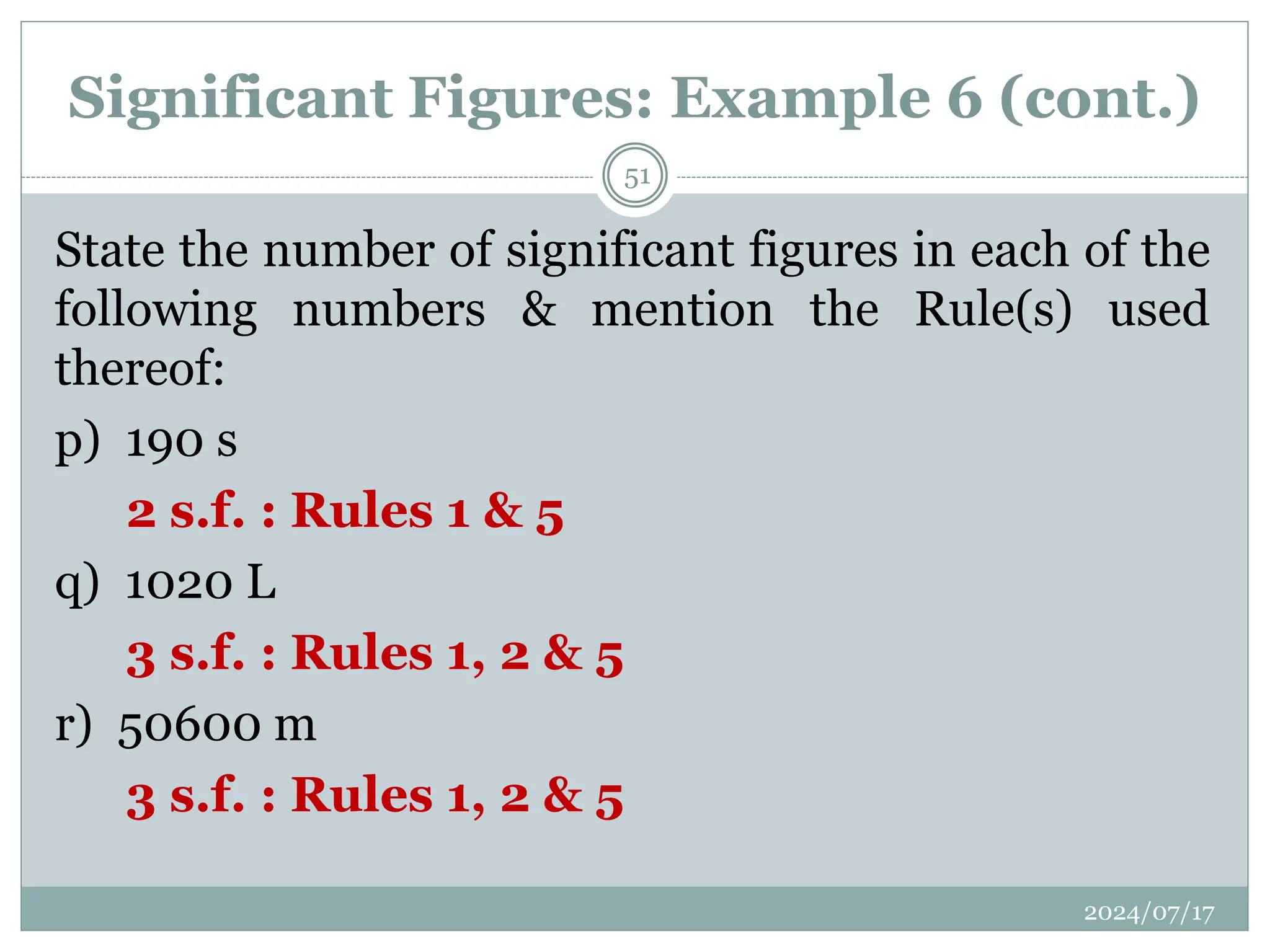
p) 190 s
2 s.f. : Rules 1 & 5
q) 1020 L
3 s.f. : Rules 1, 2 & 5
r) 50600 m
3 s.f. : Rules 1, 2 & 5
2024/07/17
51
Significant Figures: Multiplication/Division
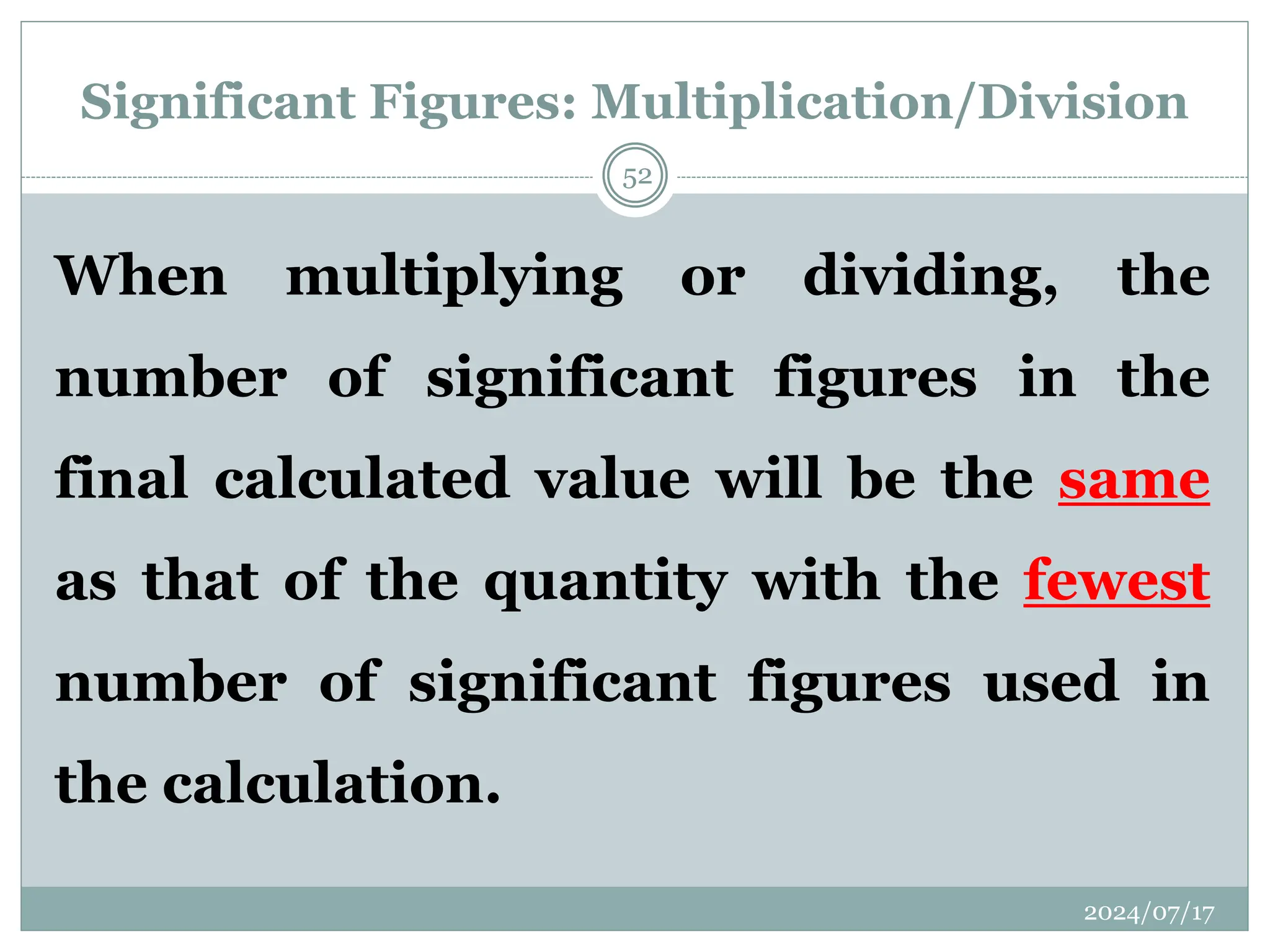
When multiplying or dividing, the
number of significant figures in the
final calculated value will be the same
as that of the quantity with the fewest
number of significant figures used in
the calculation.
2024/07/17
52
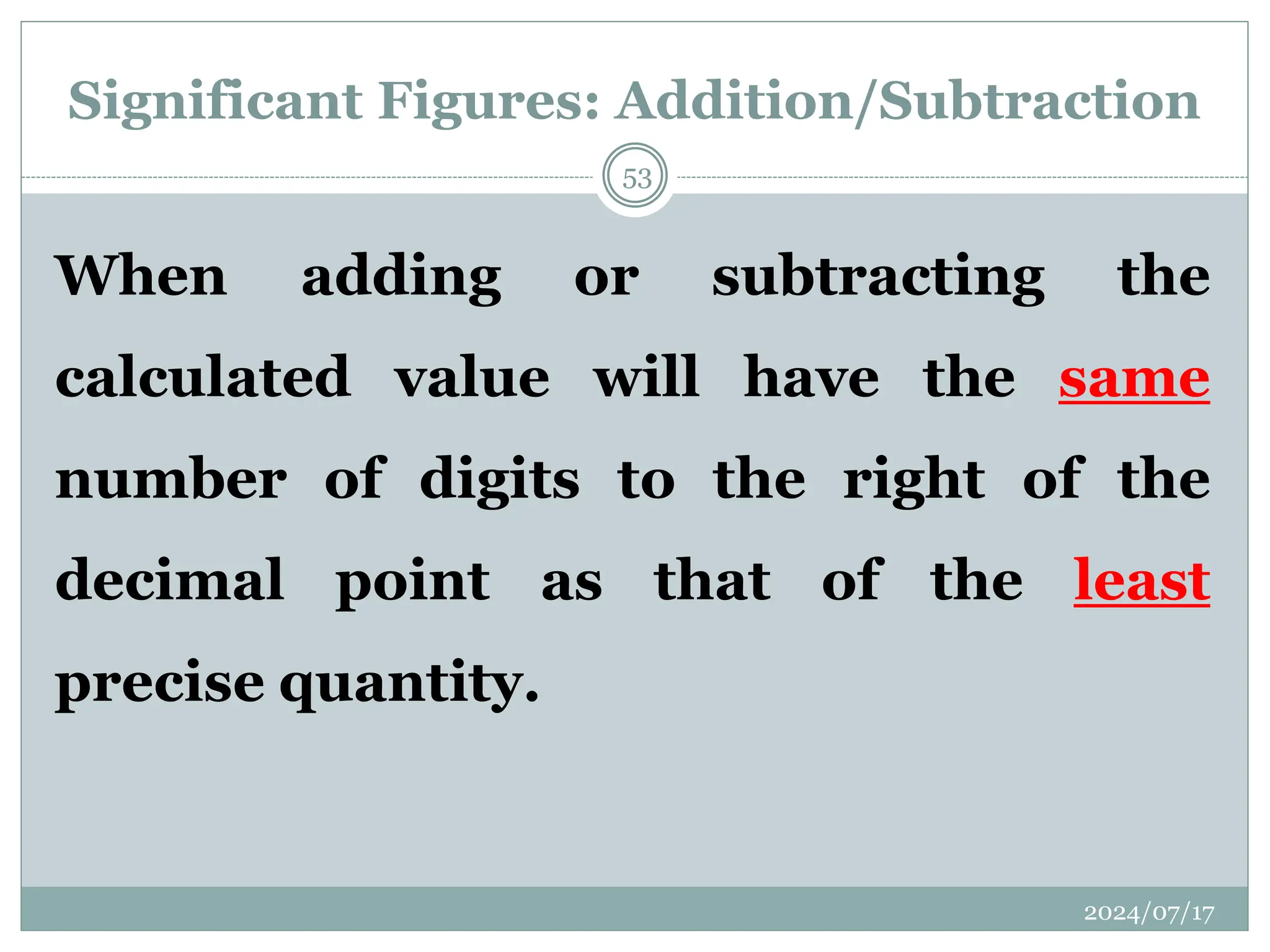
Significant Figures: Addition/Subtraction
When adding or subtracting the
calculated value will have the same
number of digits to the right of the
decimal point as that of the least
precise quantity.
2024/07/17
53
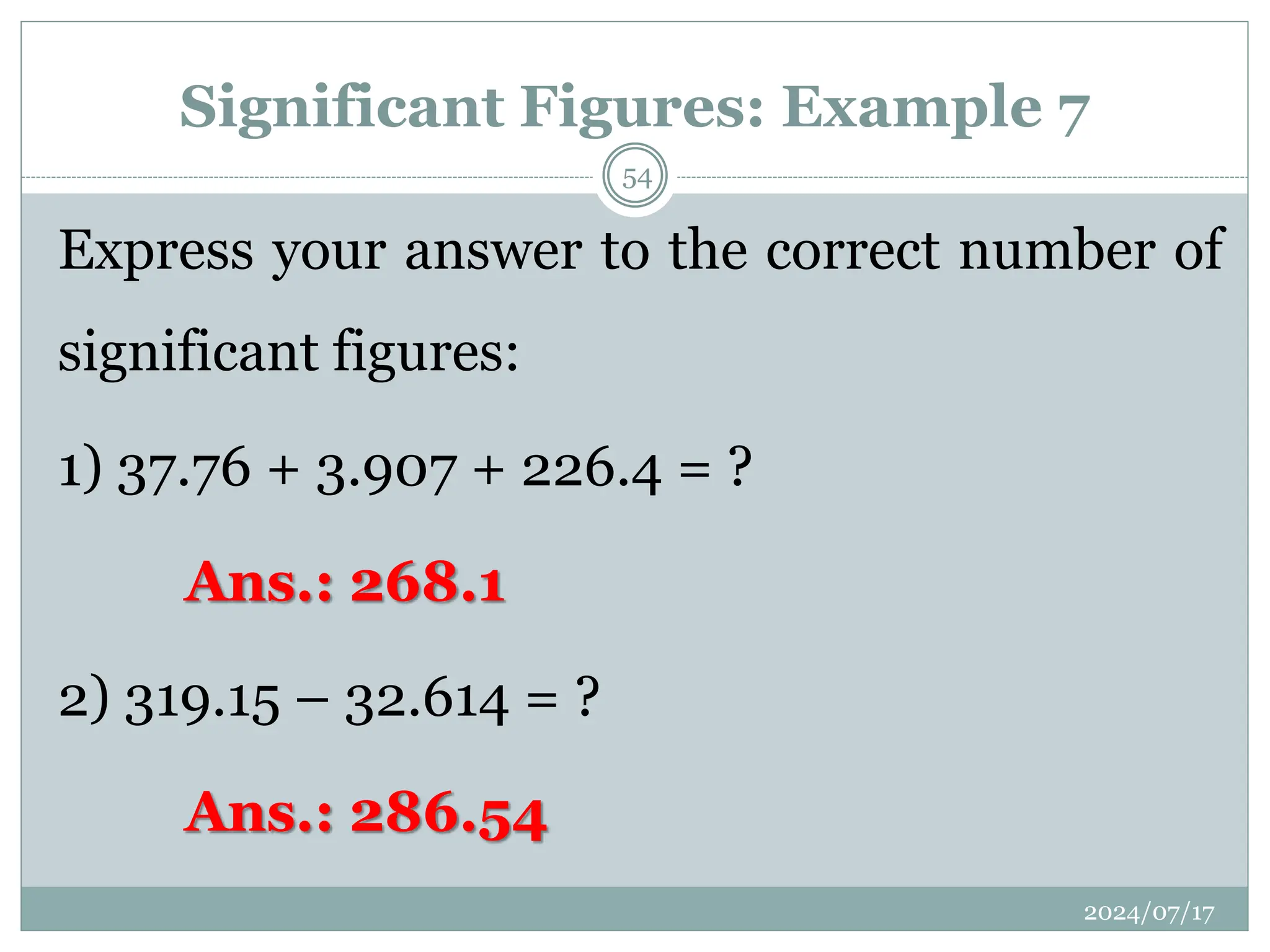
Significant Figures: Example 7
Express your answer to the correct number of
significant figures:
1) 37.76 + 3.907 + 226.4 = ?
Ans.: 268.1
2) 319.15 – 32.614 = ?
Ans.: 286.54
2024/07/17
54
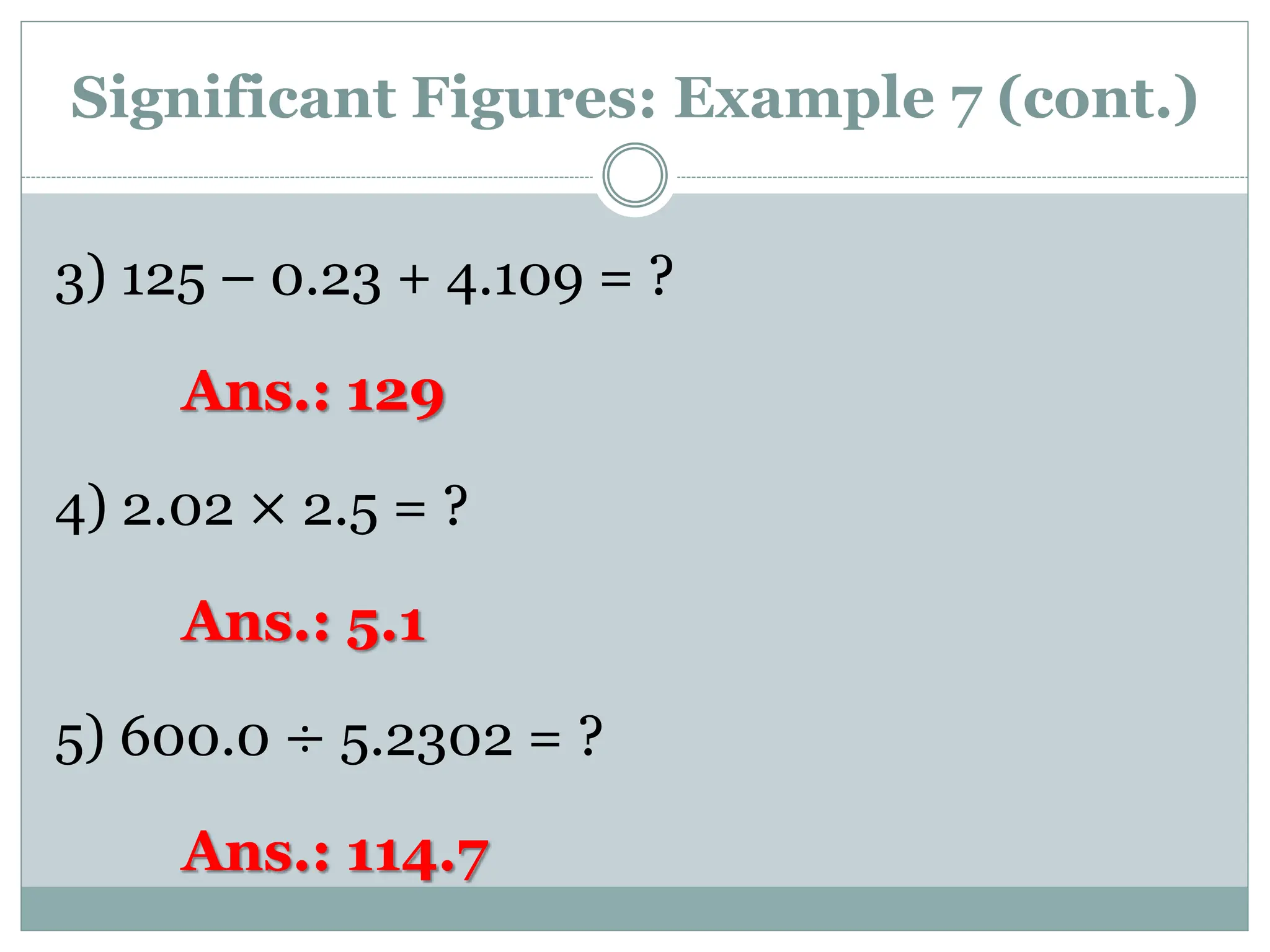
Significant Figures: Example 7 (cont.)
3) 125 – 0.23 + 4.109 = ?
Ans.: 129
4) 2.02 × 2.5 = ?
Ans.: 5.1
5) 600.0 ÷ 5.2302 = ?
Ans.: 114.7
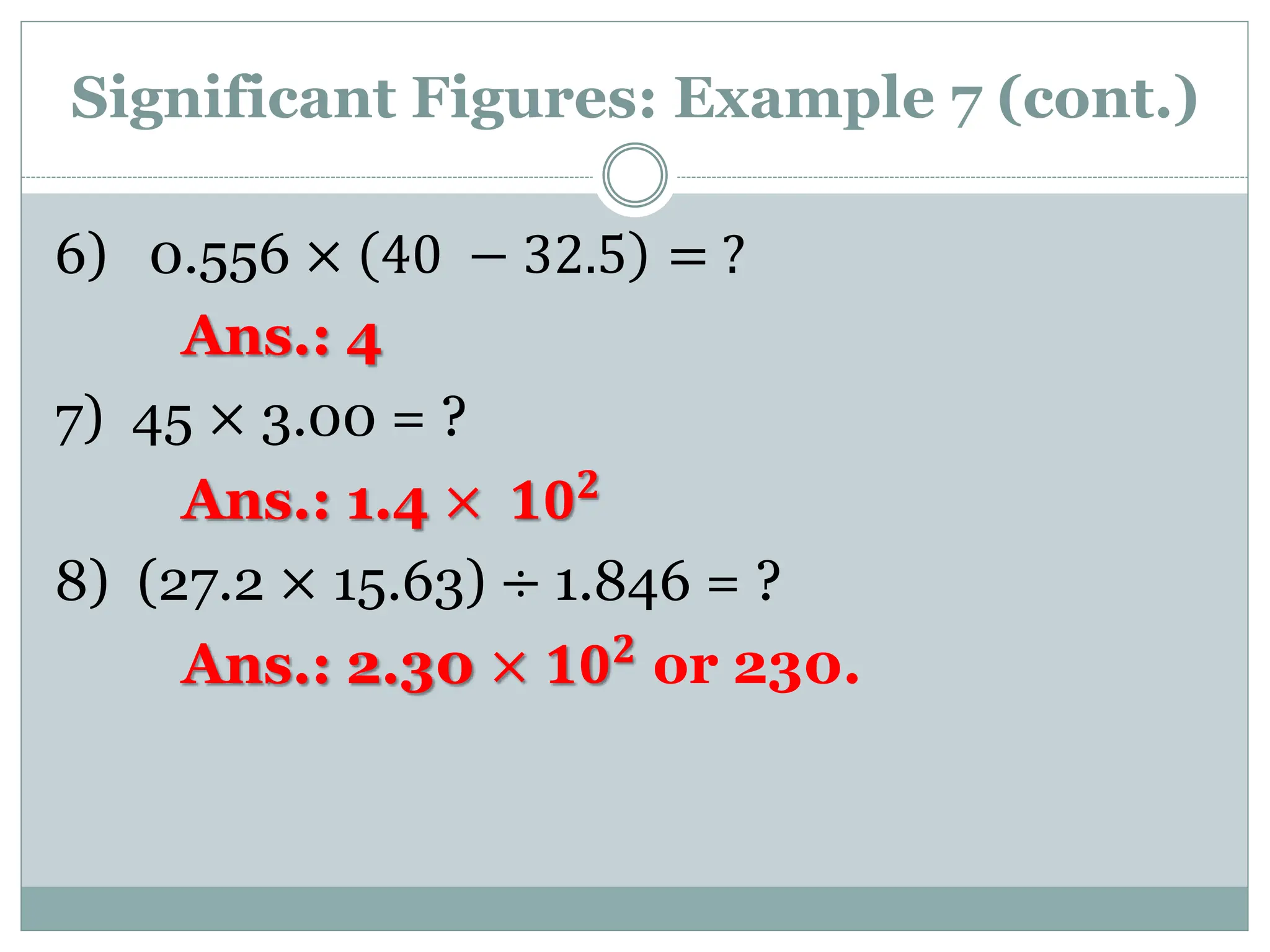
Significant Figures: Example 7 (cont.)
6) 0.556 × 40 − 32.5 = ?
Ans.: 4
7) 45 × 3.00 = ?
Ans.: 1.4 × 𝟏𝟎𝟐
8) (27.2 × 15.63) ÷ 1.846 = ?
Ans.: 2.30 × 𝟏𝟎𝟐
or 230.
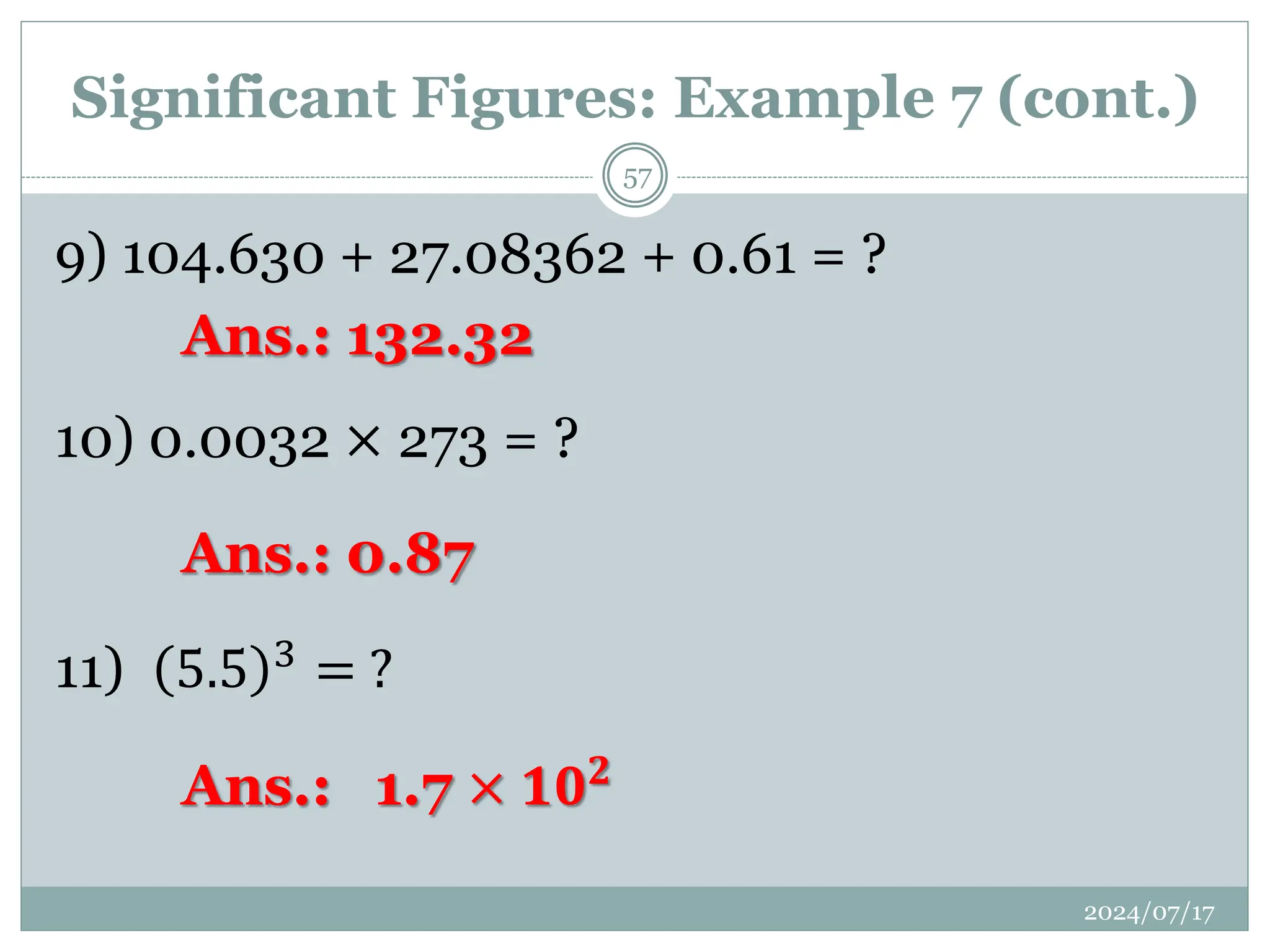
9) 104.630 + 27.08362 + 0.61 = ?
Ans.: 132.32
10) 0.0032 × 273 = ?
Ans.: 0.87
11) 5.5 3
= ?
Ans.: 1.7 × 𝟏𝟎𝟐
Significant Figures: Example 7 (cont.)
2024/07/17
57
12) 3.00 × 10⁵ − 1.5 × 102 = ?
13) [(10.3) + (0.01345)] ÷ [(10.3) × 0.01345)] = ?
Significant Figures: HOMEWORK
2024/07/17
58
SUMMARY
 Units are supposed to be specified in all final
answers. You may not show units during the
substitution steps.
 Very large numbers & very small numbers MUST
be expressed in a scientific notation.
 Significant figures MUST be observed at all times
in all calculations.
 Marks will be deducted if items 1-3 are not
adhered to.
2024/07/17
59
SECTION 1: Introduction to Basics
Units of measurement √
Scientific Notation √
Prefixes of Ten √
Unit Conversion √
Dimensional Analysis √
Significant Figures √
2024/07/17
60

Section 1_Mathematical Basics_Class(1).pptx

  • 1.
    ENGINEERING PHYSICS CHEMIA (PHYSCA1) 2022 You are welcome to the Engineering Physics Chem IA (PHYSCA1) Module for B. Eng. Tech. (Chemical Engineering) 2024/07/17 1
  • 2.
    Section 1: MathematicalBasics Units of measurement Scientific Notation Prefixes of Ten Trigonometry Logarithms Unit Conversion Dimensional Analysis Significant Figures 2024/07/17 2
  • 3.
    What is thename of this building? 2024/07/17 3
  • 4.
    The Burj Khalifa 2024/07/17 4 Located in Dubai, UAE  830 m tall (to the tip)  163 floors  Took almost 5 yrs to construct  Tallest building in the world
  • 5.
    SPOT TEST Question 1 Definethe term “Physics”. Question 2 Why do you think Physics is relevant to your intended programme of study (Chemical Engineering) ? Give FIVE reasons. 2024/07/17 5
  • 6.
    Definition of Physics Theword Physics originates from the Greek word “phusis” (modern Greek), which means NATURE. In ancient Greek: “phusike”, which means “KNOWLEDGE OF NATURE”. In Latin: “physica”, which means “NATURAL SCIENCE”. 2024/07/17 6
  • 7.
    PHYSICS is thestudy of the laws and principles that govern the behaviour of nature or the natural world in which we live. Physics encompasses a remarkable variety of phenomena such as:  planetary orbits  radio and TV waves  fluid dynamics/statics  colour and many more! Definition of Physics 2024/07/17 7
  • 8.
    Units of measurement •Physics is an empirical science. • It involves observation, analysis and experiment. • Physics experiments involve the measurement of a variety of physical quantities. • These measurements must be accurate and reproducible. • The first step in ensuring accuracy and reproducibility is defining the units in which the measurements are made. 2024/07/17 8
  • 9.
    Units of measurement Howis reproducibility ensured? The General Conference on Weights & Measures. 2024/07/17 9
  • 10.
    There are THREEsystems of units used worldwide, namely 1) The SI system (Systeme’ Internationale) 2) The c.g.s. system 3) The British Engineering (BE) system Units of measurement 2024/07/17 10
  • 11.
    Units of measurement Thereare TWO types of units, namely: 1) Base Units 2) Derived Units 2024/07/17 11
  • 12.
    1) The S.I.system employs the following base units: metre (m): length/distance kilogram (kg): mass second (s): time ampere (A): electric current kelvin (K): temperature candela (cd): luminous intensity mole (mol): amount of substance Units of measurement 2024/07/17 12
  • 13.
    NOTE: Units namedafter people are abbreviated using capital letters otherwise lower cases are used. Base units are used in combination to define additional units for other important physical quantities. Such units are referred to as DERIVED units. Units of measurement 2024/07/17 13
  • 14.
    Name as manyderived units as you can and also provide their respective physical quantities. Units of measurement: Class Exercise 2024/07/17 14
  • 15.
    2) The c.g.s.system employs the following: centimetre, gram and second. 3) The BE system employs the following: Force/Weight: pound (lb). Mass: slug (sl), ounce (oz). Length: inch (in), mile (mi), foot (ft). Temperature: degrees Fahrenheit (oF). Units of measurement 2024/07/17 15
  • 16.
    State whether thefollowing units are S.I. or B.E. Mention the physical quantity each one measures. a) ton h) Btu b) yard i) horsepower c) furlong j) calorie d) pint k) atomic mass unit e) quart l) torr f) gallon m) watt g) acre n) electron volt Units of measurement: HOMEWORK 2024/07/17 16
  • 17.
    SECTION 1: Introductionto Basics Units of measurement √ Scientific Notation Prefixes of Ten Trigonometry Logarithms Unit Conversion Dimensional Analysis Significant Figures 2024/07/17 17
  • 18.
    Scientific notation isa method that is used to help write very large and very small numbers in a shorter form by using the powers of ten. In this notation, the decimal point in a number is displaced either to the left or right a certain number of times until there is only ONE digit before the decimal. Scientific Notation 2024/07/17 18
  • 19.
    Scientific Notation: Example1 2024/07/17 19 Write the following numbers in a scientific notation (correct to 2 decimal places): a) 2000 m b) 8600000 Hz c) 362850 kg d) 0.0000035 m e) 0.0012 s
  • 20.
    SECTION 1: Introductionto Basics Units of measurement √ Scientific Notation √ Prefixes of Ten Trigonometry Logarithms Unit Conversion Dimensional Analysis Significant Figures 2024/07/17 20
  • 21.
  • 22.
    Prefixes of Ten:Example 2 2024/07/17 22 Rewrite the answers in Example 1 using prefixes of 10 a) 2000 m b) 8600000 Hz c) 362850 kg d) 0.0000035 m e) 0.0012 s
  • 23.
    SECTION 1: Introductionto Basics Units of measurement √ Scientific Notation √ Prefixes of Ten √ Trigonometry Logarithms Unit Conversion Dimensional Analysis Significant Figures 2024/07/17 23
  • 24.
  • 25.
    1. In allcalculations, write down the units explicitly. 2. Treat all units as algebraic quantities. When identical units are divided, they are eliminated algebraically. 3. Be guided by the fact that multiplying or dividing an equation by a factor of 1, does not alter the equation. Unit Conversion: Reasoning Strategy 2024/07/17 25
  • 26.
    The tallest buildingin the world is the Burj Khalifa in Dubai, with a height of 830m. Express this height in a) feet (ft) b) kilometres (km) c) centimetres (cm) d) millimetres (mm) 2024/07/17 26 Unit Conversion: Example 3
  • 27.
    GENERAL KNOWLEDGE 2024/07/17 27 1) Whichbuilding is the tallest in Africa and in which country is it located?
  • 28.
  • 29.
    GENERAL KNOWLEDGE 2024/07/17 29 2) Whichbuilding is the tallest residential building in Africa and in which country is it located?
  • 30.
  • 31.
    GENERAL KNOWLEDGE 2024/07/17 31 3) Whatis the meaning of the symbol “℮”, written after the expression of a unit of volume or mass? e.g. 125 ml ℮ or 250 g ℮
  • 32.
  • 33.
    Do problems 1,2, 4, 5, and 6 in Chapter 1 on pages 18-19 (Cutnell 10th Edition) Estimate your age in seconds (Use fact that a year has 365 days & do your calculation to the day) Self Assessment 2024/07/17 33
  • 34.
    SECTION 1: Introductionto Basics Units of measurement √ Scientific Notation √ Prefixes of Ten √ Unit Conversion √ Dimensional Analysis Significant Figures 2024/07/17 34
  • 35.
    x= displacement [m], v= velocity [m.s−1] t= time [s] NOTE: The constant 1 2 , must not be considered in dimensional analysis. 2 2 1 vt x  Is the following equation dimensionally correct? Dimensional Analysis: Example 4 2024/07/17 35
  • 36.
    Is the followingequation dimensionally correct? vt x  Dimensional Analysis: Example 5 2024/07/17 36
  • 37.
    Do problems 3and 7 in Chapter 1 on page 19 Self Assessment: Cutnell (10th Edition) 2024/07/17 37
  • 38.
    SECTION 1: Introductionto Basics Units of measurement √ Scientific Notation √ Prefixes of Ten √ Unit Conversion √ Dimensional Analysis √ Significant Figures 2024/07/17 38
  • 39.
    Example: Unit Conversion 2024/07/17 39 Convert 1000μg.mm.n𝐬−𝟏 to kg.m.𝐬−𝟏
  • 40.
    Significant Figures Suppose wewant to verify the value of π. First we need to define π. “pi” is defined as the ratio of the circumference of a circle to its diametre. Given: Circumference = 424 mm Diametre = 135 mm Thus, π = 3.140740741 (NOTE: no units!) 2024/07/17 40
  • 41.
    Significant Figures In termsof the correct number of significant figures, how would you express the final answer? Answer: 3.14 2024/07/17 41
  • 42.
    Significant Figures The numberof significant figures in a result is simply the number of figures that are known with some degree of reliability or precision. Alternatively, The significant figures of a number are those digits that carry meaning and are contributing to its precision. 2024/07/17 42
  • 43.
    Significant Figures: Rules RULE1: All non-zero digits are significant. e.g. 34.7 has THREE significant figures. RULE 2: Zeros appearing anywhere between two non- zero significant digits are significant. e.g. 5021 has FOUR significant figures. RULE 3: Leading zeros are not significant. e.g. 0.00053 has TWO significant figures. 2024/07/17 43
  • 44.
    RULE 4: Trailingzeros in a number containing a decimal point (i.e. to the right of the decimal point) are significant. e.g. 45.00 has FOUR significant figures. 0.00034500 has FIVE significant figures. RULE 5: Trailing zeros in a whole number with no decimal shown are not significant. e.g. 320 has TWO significant figures. Significant Figures: Rules 2024/07/17 44
  • 45.
    RULE 6: Fora number in scientific notation: N × 10x, all digits comprising N are significant by the first 5 rules: “10” and “x” are not significant. e.g. 5.02 ×10³ has THREE significant figures Significant Figures: Rules 2024/07/17 45
  • 46.
    Significant Figures: Example6 State the number of significant figures in each of the following numbers & mention the Rule(s) used thereof: a) 424 mm 3 s.f. : Rule 1 b) 135 mm 3 s.f. : Rule 1 c) 61 g 2 s.f. : Rule 1 2024/07/17 46
  • 47.
    Significant Figures: Example6 (cont.) State the number of significant figures in each of the following numbers & mention the Rule(s) used thereof: d) 1.234 g 4 s.f. : Rule 1 e) 48.923 kg 5 s.f. : Rule 1 f) 5004 mm 4 s.f. : Rules 1 & 2 2024/07/17 47
  • 48.
    Significant Figures: Example6 (cont.) State the number of significant figures in each of the following numbers & mention the Rule(s) used thereof: g) 3.07 s 3 s.f. : Rules 1 & 2 h) 0.20 g 2 s.f. : Rules 1, 3 & 4 i) 8.1000 m 5 s.f. : Rules 1 & 4 2024/07/17 48
  • 49.
    Significant Figures: Example6 (cont.) State the number of significant figures in each of the following numbers & mention the Rule(s) used thereof: j) 501.040 J 6 s.f. : Rules 1, 2 & 4. k) 0.0004 s 1 s.f. : Rules 1 & 3. l) 10.0 g 3 s.f. : Rules 1 & 4. 2024/07/17 49
  • 50.
    Significant Figures: Example6 (cont.) State the number of significant figures in each of the following numbers & mention the Rule(s) used thereof: m) 5.06 × 10⁴ 𝑘𝑔 3 s.f. : Rules 1, 2 & 6. n) 5.0600 × 10⁴ 𝑘𝑔 5 s.f. : Rules 1, 2, 4 & 6. o) 3.40 × 10³ 𝑔 3 s.f. : Rules 1, 4 & 6. 2024/07/17 50
  • 51.
    Significant Figures: Example6 (cont.) State the number of significant figures in each of the following numbers & mention the Rule(s) used thereof: p) 190 s 2 s.f. : Rules 1 & 5 q) 1020 L 3 s.f. : Rules 1, 2 & 5 r) 50600 m 3 s.f. : Rules 1, 2 & 5 2024/07/17 51
  • 52.
    Significant Figures: Multiplication/Division Whenmultiplying or dividing, the number of significant figures in the final calculated value will be the same as that of the quantity with the fewest number of significant figures used in the calculation. 2024/07/17 52
  • 53.
    Significant Figures: Addition/Subtraction Whenadding or subtracting the calculated value will have the same number of digits to the right of the decimal point as that of the least precise quantity. 2024/07/17 53
  • 54.
    Significant Figures: Example7 Express your answer to the correct number of significant figures: 1) 37.76 + 3.907 + 226.4 = ? Ans.: 268.1 2) 319.15 – 32.614 = ? Ans.: 286.54 2024/07/17 54
  • 55.
    Significant Figures: Example7 (cont.) 3) 125 – 0.23 + 4.109 = ? Ans.: 129 4) 2.02 × 2.5 = ? Ans.: 5.1 5) 600.0 ÷ 5.2302 = ? Ans.: 114.7
  • 56.
    Significant Figures: Example7 (cont.) 6) 0.556 × 40 − 32.5 = ? Ans.: 4 7) 45 × 3.00 = ? Ans.: 1.4 × 𝟏𝟎𝟐 8) (27.2 × 15.63) ÷ 1.846 = ? Ans.: 2.30 × 𝟏𝟎𝟐 or 230.
  • 57.
    9) 104.630 +27.08362 + 0.61 = ? Ans.: 132.32 10) 0.0032 × 273 = ? Ans.: 0.87 11) 5.5 3 = ? Ans.: 1.7 × 𝟏𝟎𝟐 Significant Figures: Example 7 (cont.) 2024/07/17 57
  • 58.
    12) 3.00 ×10⁵ − 1.5 × 102 = ? 13) [(10.3) + (0.01345)] ÷ [(10.3) × 0.01345)] = ? Significant Figures: HOMEWORK 2024/07/17 58
  • 59.
    SUMMARY  Units aresupposed to be specified in all final answers. You may not show units during the substitution steps.  Very large numbers & very small numbers MUST be expressed in a scientific notation.  Significant figures MUST be observed at all times in all calculations.  Marks will be deducted if items 1-3 are not adhered to. 2024/07/17 59
  • 60.
    SECTION 1: Introductionto Basics Units of measurement √ Scientific Notation √ Prefixes of Ten √ Unit Conversion √ Dimensional Analysis √ Significant Figures √ 2024/07/17 60