TEAM-PLAYER SURVEY
PURPOSE
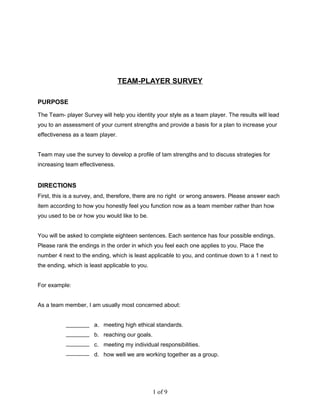
The Team- player Survey will help you identity your style as a team player. The results will lead
you to an assessment of your current strengths and provide a basis for a plan to increase your
effectiveness as a team player.
Team may use the survey to develop a profile of tam strengths and to discuss strategies for
increasing team effectiveness.
DIRECTIONS
First, this is a survey, and, therefore, there are no right or wrong answers. Please answer each
item according to how you honestly feel you function now as a team member rather than how
you used to be or how you would like to be.
You will be asked to complete eighteen sentences. Each sentence has four possible endings.
Please rank the endings in the order in which you feel each one applies to you. Place the
number 4 next to the ending, which is least applicable to you, and continue down to a 1 next to
the ending, which is least applicable to you.
For example:
As a team member, I am usually most concerned about:
a. meeting high ethical standards.
b. reaching our goals.
c. meeting my individual responsibilities.
d. how well we are working together as a group.
1 of 9
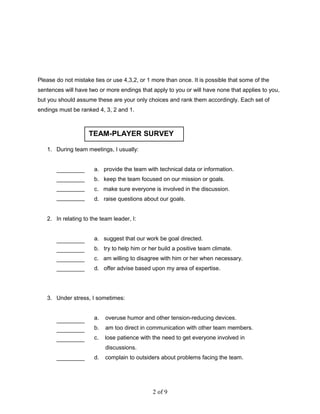
Please do not mistake ties or use 4,3,2, or 1 more than once. It is possible that some of the
sentences will have two or more endings that apply to you or will have none that applies to you,
but you should assume these are your only choices and rank them accordingly. Each set of
endings must be ranked 4, 3, 2 and 1.
1. During team meetings, I usually:
a. provide the team with technical data or information.
b. keep the team focused on our mission or goals.
c. make sure everyone is involved in the discussion.
d. raise questions about our goals.
2. In relating to the team leader, I:
a. suggest that our work be goal directed.
b. try to help him or her build a positive team climate.
c. am willing to disagree with him or her when necessary.
d. offer advise based upon my area of expertise.
3. Under stress, I sometimes:
a. overuse humor and other tension-reducing devices.
b. am too direct in communication with other team members.
c. lose patience with the need to get everyone involved in
discussions.
d. complain to outsiders about problems facing the team.
2 of 9
TEAM-PLAYER SURVEY
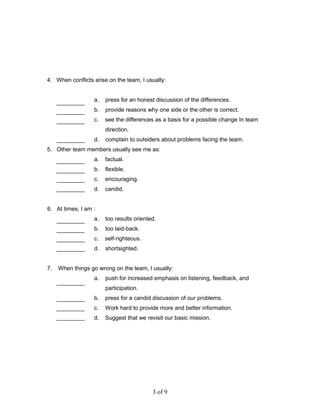
4. When conflicts arise on the team, I usually:
a. press for an honest discussion of the differences.
b. provide reasons why one side or the other is correct.
c. see the differences as a basis for a possible change In team
direction.
d. complain to outsiders about problems facing the team.
5. Other team members usually see me as:
a. factual.
b. flexible.
c. encouraging.
d. candid.
6. At times, I am :
a. too results oriented.
b. too laid-back.
c. self-righteous.
d. shortsighted.
7. When things go wrong on the team, I usually:
a. push for increased emphasis on listening, feedback, and
participation.
b. press for a candid discussion of our problems.
c. Work hard to provide more and better information.
d. Suggest that we revisit our basic mission.
3 of 9
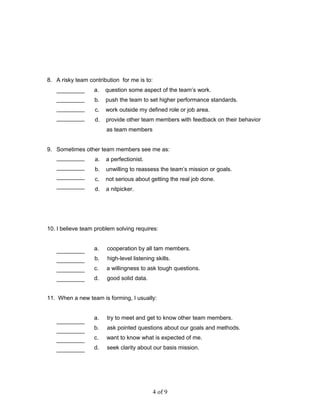
8. A risky team contribution for me is to:
a. question some aspect of the team’s work.
b. push the team to set higher performance standards.
c. work outside my defined role or job area.
d. provide other team members with feedback on their behavior
as team members
9. Sometimes other team members see me as:
a. a perfectionist.
b. unwilling to reassess the team’s mission or goals.
c. not serious about getting the real job done.
d. a nitpicker.
10. I believe team problem solving requires:
a. cooperation by all tam members.
b. high-level listening skills.
c. a willingness to ask tough questions.
d. good solid data.
11. When a new team is forming, I usually:
a. try to meet and get to know other team members.
b. ask pointed questions about our goals and methods.
c. want to know what is expected of me.
d. seek clarity about our basis mission.
4 of 9
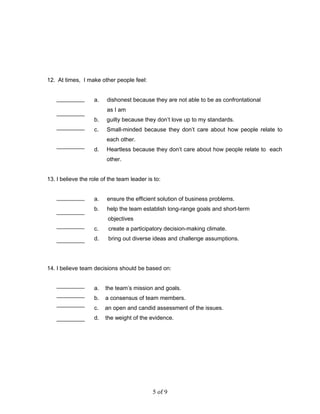
12. At times, I make other people feel:
a. dishonest because they are not able to be as confrontational
as I am
b. guilty because they don’t love up to my standards.
c. Small-minded because they don’t care about how people relate to
each other.
d. Heartless because they don’t care about how people relate to each
other.
13. I believe the role of the team leader is to:
a. ensure the efficient solution of business problems.
b. help the team establish long-range goals and short-term
objectives
c. create a participatory decision-making climate.
d. bring out diverse ideas and challenge assumptions.
14. I believe team decisions should be based on:
a. the team’s mission and goals.
b. a consensus of team members.
c. an open and candid assessment of the issues.
d. the weight of the evidence.
5 of 9
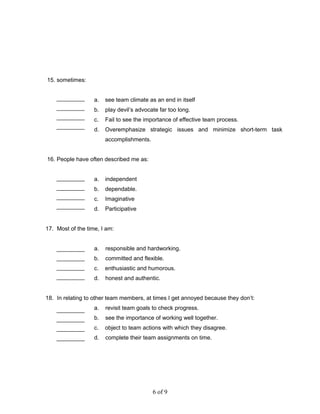
15. sometimes:
a. see team climate as an end in itself
b. play devil’s advocate far too long.
c. Fail to see the importance of effective team process.
d. Overemphasize strategic issues and minimize short-term task
accomplishments.
16. People have often described me as:
a. independent
b. dependable.
c. Imaginative
d. Participative
17. Most of the time, I am:
a. responsible and hardworking.
b. committed and flexible.
c. enthusiastic and humorous.
d. honest and authentic.
18. In relating to other team members, at times I get annoyed because they don’t:
a. revisit team goals to check progress.
b. see the importance of working well together.
c. object to team actions with which they disagree.
d. complete their team assignments on time.
6 of 9
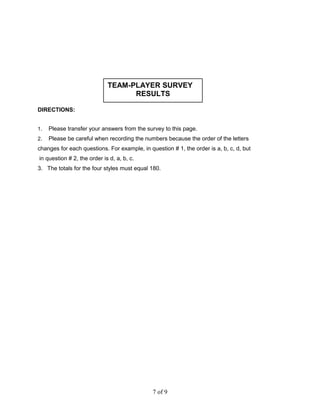
DIRECTIONS:
1. Please transfer your answers from the survey to this page.
2. Please be careful when recording the numbers because the order of the letters
changes for each questions. For example, in question # 1, the order is a, b, c, d, but
in question # 2, the order is d, a, b, c.
3. The totals for the four styles must equal 180.
7 of 9
TEAM-PLAYER SURVEY
RESULTS
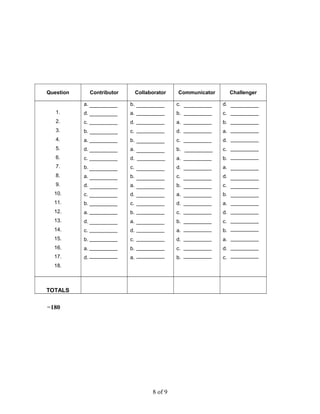
Question Contributor Collaborator Communicator Challenger
1.
2.
3.
4.
5.
6.
7.
8.
9.
10.
11.
12.
13.
14.
15.
16.
17.
18.
a.
d.
c.
b.
a.
d.
c.
b.
a.
d.
c.
b.
a.
d.
c.
b.
a.
d.
b.
a.
d.
c.
b.
a.
d.
c.
b.
a.
d.
c.
b.
a.
d.
c.
b.
a.
c.
b.
a.
d.
c.
b.
a.
d.
c.
b.
a.
d.
c.
b.
a.
d.
c.
b.
d.
c.
b.
a.
d.
c.
b.
a.
d.
c.
b.
a.
d.
c.
b.
a.
d.
c.
TOTALS
8 of 9
=180
The highest number designates your primary team-player style. If your highest numbers are the
same or within three points of each other, consider them both as your primary style. The lowest
total indicates your least active team-player style.
Your primary team-player style defines a set of behaviors that you use most often as a member
of a team. it does not mean that it is the only style you use. All of us have the capacity to use
any one of the four styles. we simply use one style- our primary style –most often.
9 of 9
TEAM-PLAYER SURVEY
RESULTS….contd…
The highest number designates your primary team-player style. If your highest numbers are the
same or within three points of each other, consider them both as your primary style. The lowest
total indicates your least active team-player style.
Your primary team-player style defines a set of behaviors that you use most often as a member
of a team. it does not mean that it is the only style you use. All of us have the capacity to use
any one of the four styles. we simply use one style- our primary style –most often.
9 of 9
TEAM-PLAYER SURVEY
RESULTS….contd…

Section 07 exercise team player

  • 1.
    TEAM-PLAYER SURVEY PURPOSE The Team-player Survey will help you identity your style as a team player. The results will lead you to an assessment of your current strengths and provide a basis for a plan to increase your effectiveness as a team player. Team may use the survey to develop a profile of tam strengths and to discuss strategies for increasing team effectiveness. DIRECTIONS First, this is a survey, and, therefore, there are no right or wrong answers. Please answer each item according to how you honestly feel you function now as a team member rather than how you used to be or how you would like to be. You will be asked to complete eighteen sentences. Each sentence has four possible endings. Please rank the endings in the order in which you feel each one applies to you. Place the number 4 next to the ending, which is least applicable to you, and continue down to a 1 next to the ending, which is least applicable to you. For example: As a team member, I am usually most concerned about: a. meeting high ethical standards. b. reaching our goals. c. meeting my individual responsibilities. d. how well we are working together as a group. 1 of 9
  • 2.
    Please do notmistake ties or use 4,3,2, or 1 more than once. It is possible that some of the sentences will have two or more endings that apply to you or will have none that applies to you, but you should assume these are your only choices and rank them accordingly. Each set of endings must be ranked 4, 3, 2 and 1. 1. During team meetings, I usually: a. provide the team with technical data or information. b. keep the team focused on our mission or goals. c. make sure everyone is involved in the discussion. d. raise questions about our goals. 2. In relating to the team leader, I: a. suggest that our work be goal directed. b. try to help him or her build a positive team climate. c. am willing to disagree with him or her when necessary. d. offer advise based upon my area of expertise. 3. Under stress, I sometimes: a. overuse humor and other tension-reducing devices. b. am too direct in communication with other team members. c. lose patience with the need to get everyone involved in discussions. d. complain to outsiders about problems facing the team. 2 of 9 TEAM-PLAYER SURVEY
  • 3.
    4. When conflictsarise on the team, I usually: a. press for an honest discussion of the differences. b. provide reasons why one side or the other is correct. c. see the differences as a basis for a possible change In team direction. d. complain to outsiders about problems facing the team. 5. Other team members usually see me as: a. factual. b. flexible. c. encouraging. d. candid. 6. At times, I am : a. too results oriented. b. too laid-back. c. self-righteous. d. shortsighted. 7. When things go wrong on the team, I usually: a. push for increased emphasis on listening, feedback, and participation. b. press for a candid discussion of our problems. c. Work hard to provide more and better information. d. Suggest that we revisit our basic mission. 3 of 9
  • 4.
    8. A riskyteam contribution for me is to: a. question some aspect of the team’s work. b. push the team to set higher performance standards. c. work outside my defined role or job area. d. provide other team members with feedback on their behavior as team members 9. Sometimes other team members see me as: a. a perfectionist. b. unwilling to reassess the team’s mission or goals. c. not serious about getting the real job done. d. a nitpicker. 10. I believe team problem solving requires: a. cooperation by all tam members. b. high-level listening skills. c. a willingness to ask tough questions. d. good solid data. 11. When a new team is forming, I usually: a. try to meet and get to know other team members. b. ask pointed questions about our goals and methods. c. want to know what is expected of me. d. seek clarity about our basis mission. 4 of 9
  • 5.
    12. At times,I make other people feel: a. dishonest because they are not able to be as confrontational as I am b. guilty because they don’t love up to my standards. c. Small-minded because they don’t care about how people relate to each other. d. Heartless because they don’t care about how people relate to each other. 13. I believe the role of the team leader is to: a. ensure the efficient solution of business problems. b. help the team establish long-range goals and short-term objectives c. create a participatory decision-making climate. d. bring out diverse ideas and challenge assumptions. 14. I believe team decisions should be based on: a. the team’s mission and goals. b. a consensus of team members. c. an open and candid assessment of the issues. d. the weight of the evidence. 5 of 9
  • 6.
    15. sometimes: a. seeteam climate as an end in itself b. play devil’s advocate far too long. c. Fail to see the importance of effective team process. d. Overemphasize strategic issues and minimize short-term task accomplishments. 16. People have often described me as: a. independent b. dependable. c. Imaginative d. Participative 17. Most of the time, I am: a. responsible and hardworking. b. committed and flexible. c. enthusiastic and humorous. d. honest and authentic. 18. In relating to other team members, at times I get annoyed because they don’t: a. revisit team goals to check progress. b. see the importance of working well together. c. object to team actions with which they disagree. d. complete their team assignments on time. 6 of 9
  • 7.
    DIRECTIONS: 1. Please transferyour answers from the survey to this page. 2. Please be careful when recording the numbers because the order of the letters changes for each questions. For example, in question # 1, the order is a, b, c, d, but in question # 2, the order is d, a, b, c. 3. The totals for the four styles must equal 180. 7 of 9 TEAM-PLAYER SURVEY RESULTS
  • 8.
    Question Contributor CollaboratorCommunicator Challenger 1. 2. 3. 4. 5. 6. 7. 8. 9. 10. 11. 12. 13. 14. 15. 16. 17. 18. a. d. c. b. a. d. c. b. a. d. c. b. a. d. c. b. a. d. b. a. d. c. b. a. d. c. b. a. d. c. b. a. d. c. b. a. c. b. a. d. c. b. a. d. c. b. a. d. c. b. a. d. c. b. d. c. b. a. d. c. b. a. d. c. b. a. d. c. b. a. d. c. TOTALS 8 of 9 =180
  • 9.
    The highest numberdesignates your primary team-player style. If your highest numbers are the same or within three points of each other, consider them both as your primary style. The lowest total indicates your least active team-player style. Your primary team-player style defines a set of behaviors that you use most often as a member of a team. it does not mean that it is the only style you use. All of us have the capacity to use any one of the four styles. we simply use one style- our primary style –most often. 9 of 9 TEAM-PLAYER SURVEY RESULTS….contd…
  • 10.
    The highest numberdesignates your primary team-player style. If your highest numbers are the same or within three points of each other, consider them both as your primary style. The lowest total indicates your least active team-player style. Your primary team-player style defines a set of behaviors that you use most often as a member of a team. it does not mean that it is the only style you use. All of us have the capacity to use any one of the four styles. we simply use one style- our primary style –most often. 9 of 9 TEAM-PLAYER SURVEY RESULTS….contd…