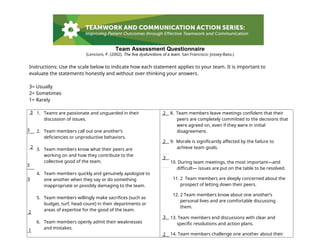
Team Assessment Questionnaire
(Lencioni, P. (2002). The five dysfunctions of a team. San Francisco: Jossey-Bass.)
Instructions: Use the scale below to indicate how each statement applies to your team. It is important to
evaluate the statements honestly and without over-thinking your answers.
3= Usually
2= Sometimes
1= Rarely
3
3
1. Teams are passionate and unguarded in their
discussion of issues.
2. Team members call out one another’s
deficiencies or unproductive behaviors.
3. Team members know what their peers are
working on and how they contribute to the
collective good of the team.
4. Team members quickly and genuinely apologize to
one another when they say or do something
inappropriate or possibly damaging to the team.
5. Team members willingly make sacrifices (such as
budget, turf, head count) in their departments or
areas of expertise for the good of the team.
6. Team members openly admit their weaknesses
and mistakes.
2 8. Team members leave meetings confident that their
peers are completely committed to the decisions that
were agreed on, even if they were in initial
disagreement.
2 9. Morale is significantly affected by the failure to
achieve team goals.
3
10. During team meetings, the most important—and
difficult— issues are put on the table to be resolved.
11. 2 Team members are deeply concerned about the
prospect of letting down their peers.
12. 2 Team members know about one another’s
personal lives and are comfortable discussing
them.
3 13. Team members end discussions with clear and
specific resolutions and action plans.
2 14. Team members challenge one another about their
2
3
3
2
1
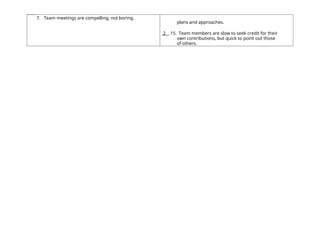
7. Team meetings are compelling, not boring.
plans and approaches.
2 15. Team members are slow to seek credit for their
own contributions, but quick to point out those
of others.
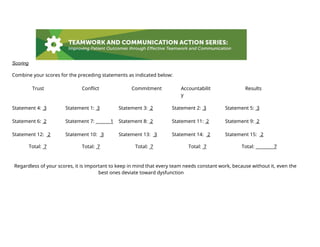
Scoring
Combine your scores for the preceding statements as indicated below:
Trust
Statement 4: 3
Statement 6: 2
Statement 12: 2
Total: 7
Conflict
Statement 1: 3
Statement 7: 1
Statement 10: 3
Total: 7
Commitment
Statement 3: 2
Statement 8: 2
Statement 13: 3
Total: 7
Accountabilit
y
Statement 2: 3
Statement 11: 2
Statement 14: 2
Total: 7
Results
Statement 5: 3
Statement 9: 2
Statement 15: 2
Total: 7
Regardless of your scores, it is important to keep in mind that every team needs constant work, because without it, even the
best ones deviate toward dysfunction

1.0-Team-Assessment-Questionnaire (1).docx

  • 1.
    Team Assessment Questionnaire (Lencioni,P. (2002). The five dysfunctions of a team. San Francisco: Jossey-Bass.) Instructions: Use the scale below to indicate how each statement applies to your team. It is important to evaluate the statements honestly and without over-thinking your answers. 3= Usually 2= Sometimes 1= Rarely 3 3 1. Teams are passionate and unguarded in their discussion of issues. 2. Team members call out one another’s deficiencies or unproductive behaviors. 3. Team members know what their peers are working on and how they contribute to the collective good of the team. 4. Team members quickly and genuinely apologize to one another when they say or do something inappropriate or possibly damaging to the team. 5. Team members willingly make sacrifices (such as budget, turf, head count) in their departments or areas of expertise for the good of the team. 6. Team members openly admit their weaknesses and mistakes. 2 8. Team members leave meetings confident that their peers are completely committed to the decisions that were agreed on, even if they were in initial disagreement. 2 9. Morale is significantly affected by the failure to achieve team goals. 3 10. During team meetings, the most important—and difficult— issues are put on the table to be resolved. 11. 2 Team members are deeply concerned about the prospect of letting down their peers. 12. 2 Team members know about one another’s personal lives and are comfortable discussing them. 3 13. Team members end discussions with clear and specific resolutions and action plans. 2 14. Team members challenge one another about their 2 3 3 2 1
  • 2.
    7. Team meetingsare compelling, not boring. plans and approaches. 2 15. Team members are slow to seek credit for their own contributions, but quick to point out those of others.
  • 3.
    Scoring Combine your scoresfor the preceding statements as indicated below: Trust Statement 4: 3 Statement 6: 2 Statement 12: 2 Total: 7 Conflict Statement 1: 3 Statement 7: 1 Statement 10: 3 Total: 7 Commitment Statement 3: 2 Statement 8: 2 Statement 13: 3 Total: 7 Accountabilit y Statement 2: 3 Statement 11: 2 Statement 14: 2 Total: 7 Results Statement 5: 3 Statement 9: 2 Statement 15: 2 Total: 7 Regardless of your scores, it is important to keep in mind that every team needs constant work, because without it, even the best ones deviate toward dysfunction