Secrets in Kubernetes Across
Cloud
“Life is really simple, but we insist on making it complicated..”
Confucius
@jthan24
Jhonny Pong (Jhonnatan Gil)
Contents
aws-ssm
azure-keyvault
gcp-secret-manager
hashicorp-vault
Kubernetes
Secrets
external secrets
demo
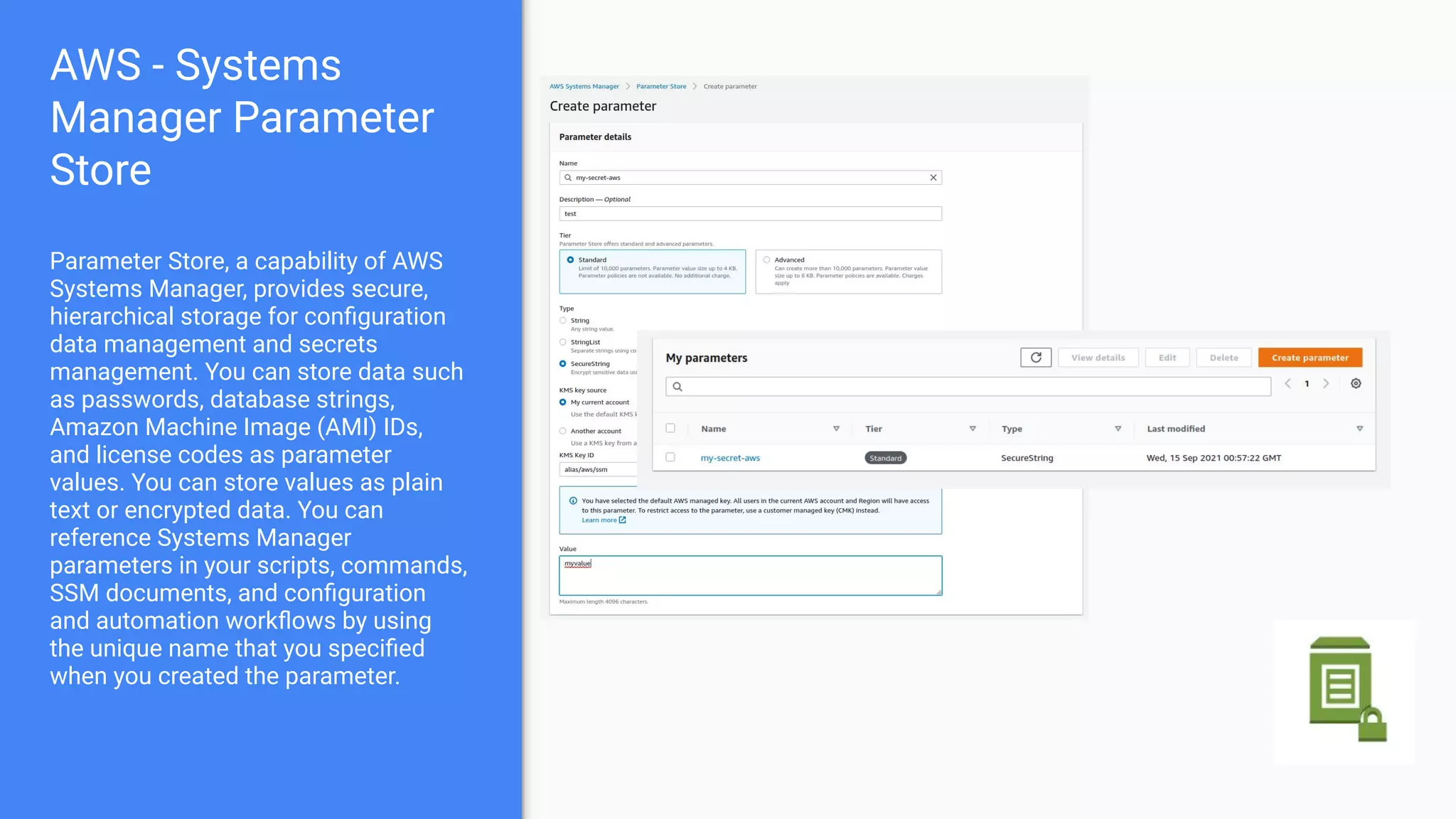
AWS - Systems
Manager Parameter
Store
Parameter Store, a capability of AWS
Systems Manager, provides secure,
hierarchical storage for configuration
data management and secrets
management. You can store data such
as passwords, database strings,
Amazon Machine Image (AMI) IDs,
and license codes as parameter
values. You can store values as plain
text or encrypted data. You can
reference Systems Manager
parameters in your scripts, commands,
SSM documents, and configuration
and automation workflows by using
the unique name that you specified
when you created the parameter.
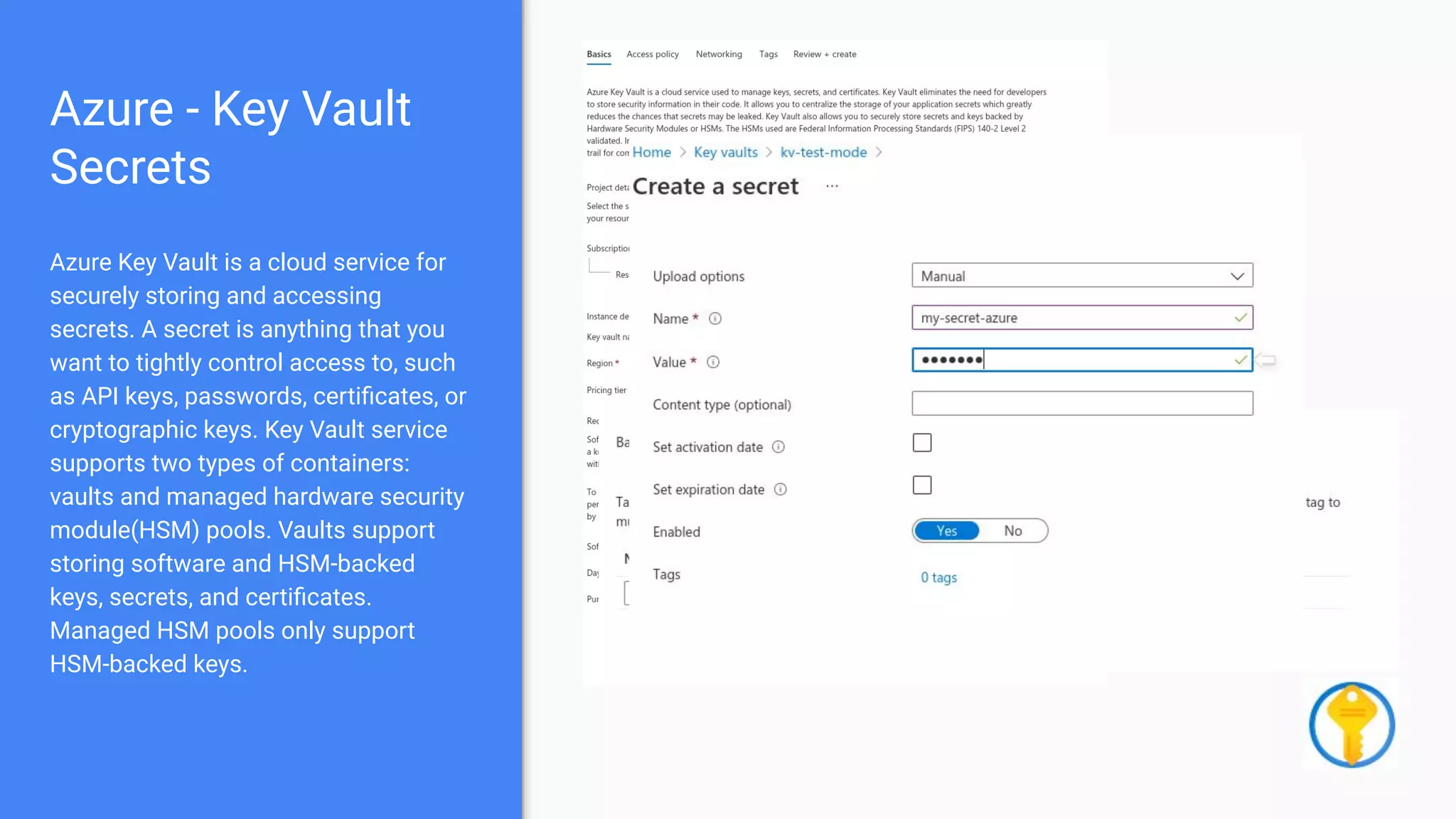
Azure - Key Vault
Secrets
Azure Key Vault is a cloud service for
securely storing and accessing
secrets. A secret is anything that you
want to tightly control access to, such
as API keys, passwords, certificates, or
cryptographic keys. Key Vault service
supports two types of containers:
vaults and managed hardware security
module(HSM) pools. Vaults support
storing software and HSM-backed
keys, secrets, and certificates.
Managed HSM pools only support
HSM-backed keys.
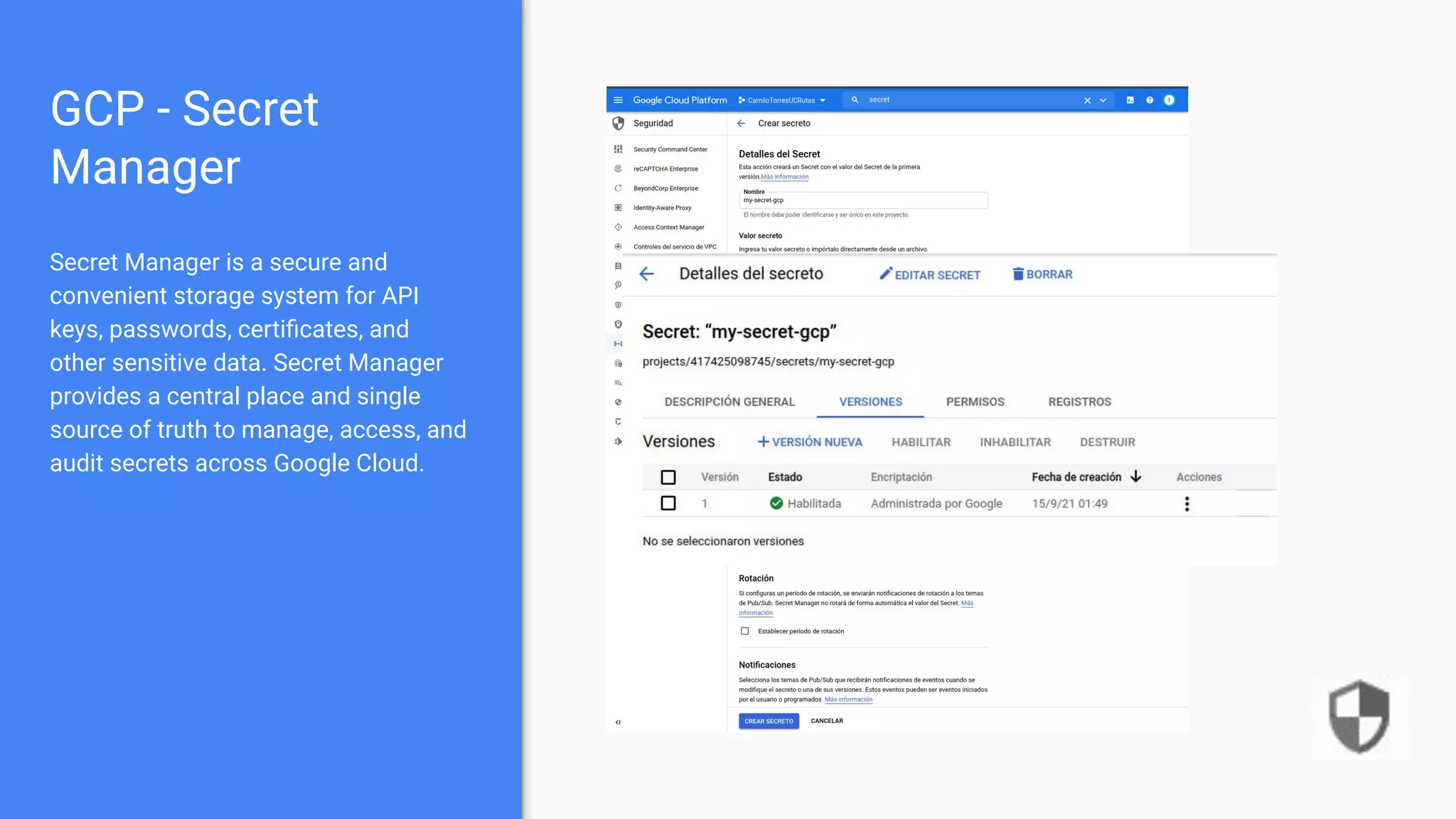
GCP - Secret
Manager
Secret Manager is a secure and
convenient storage system for API
keys, passwords, certificates, and
other sensitive data. Secret Manager
provides a central place and single
source of truth to manage, access, and
audit secrets across Google Cloud.
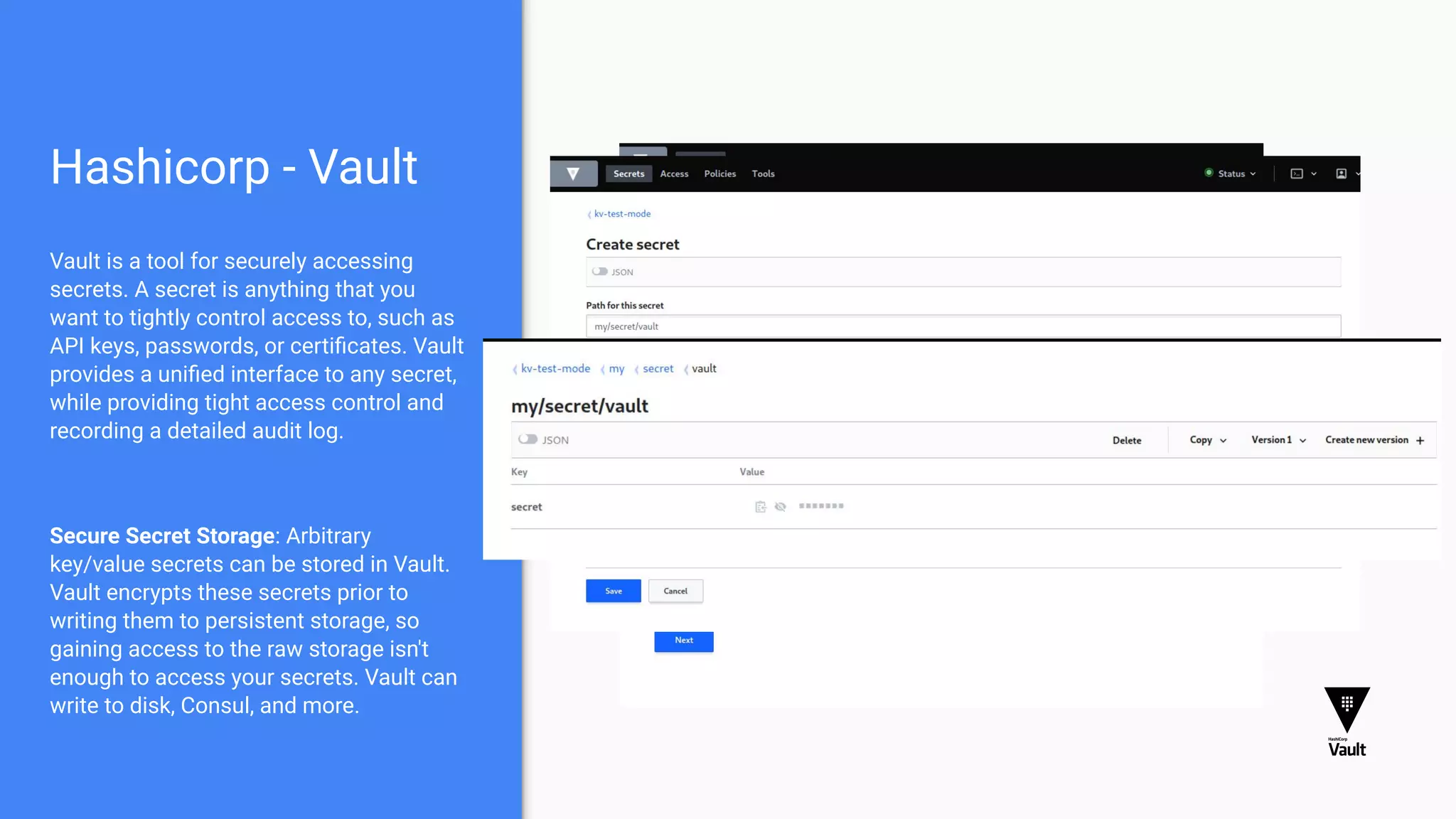
Hashicorp - Vault
Vault is a tool for securely accessing
secrets. A secret is anything that you
want to tightly control access to, such as
API keys, passwords, or certificates. Vault
provides a unified interface to any secret,
while providing tight access control and
recording a detailed audit log.
Secure Secret Storage: Arbitrary
key/value secrets can be stored in Vault.
Vault encrypts these secrets prior to
writing them to persistent storage, so
gaining access to the raw storage isn't
enough to access your secrets. Vault can
write to disk, Consul, and more.
Kubernetes
What is kubernetes
Kubernetes is a portable, extensible, open-source platform for managing
containerized workloads and services, that facilitates both declarative
configuration and automation. It has a large, rapidly growing ecosystem.
Kubernetes services, support, and tools are widely available.
Secrets
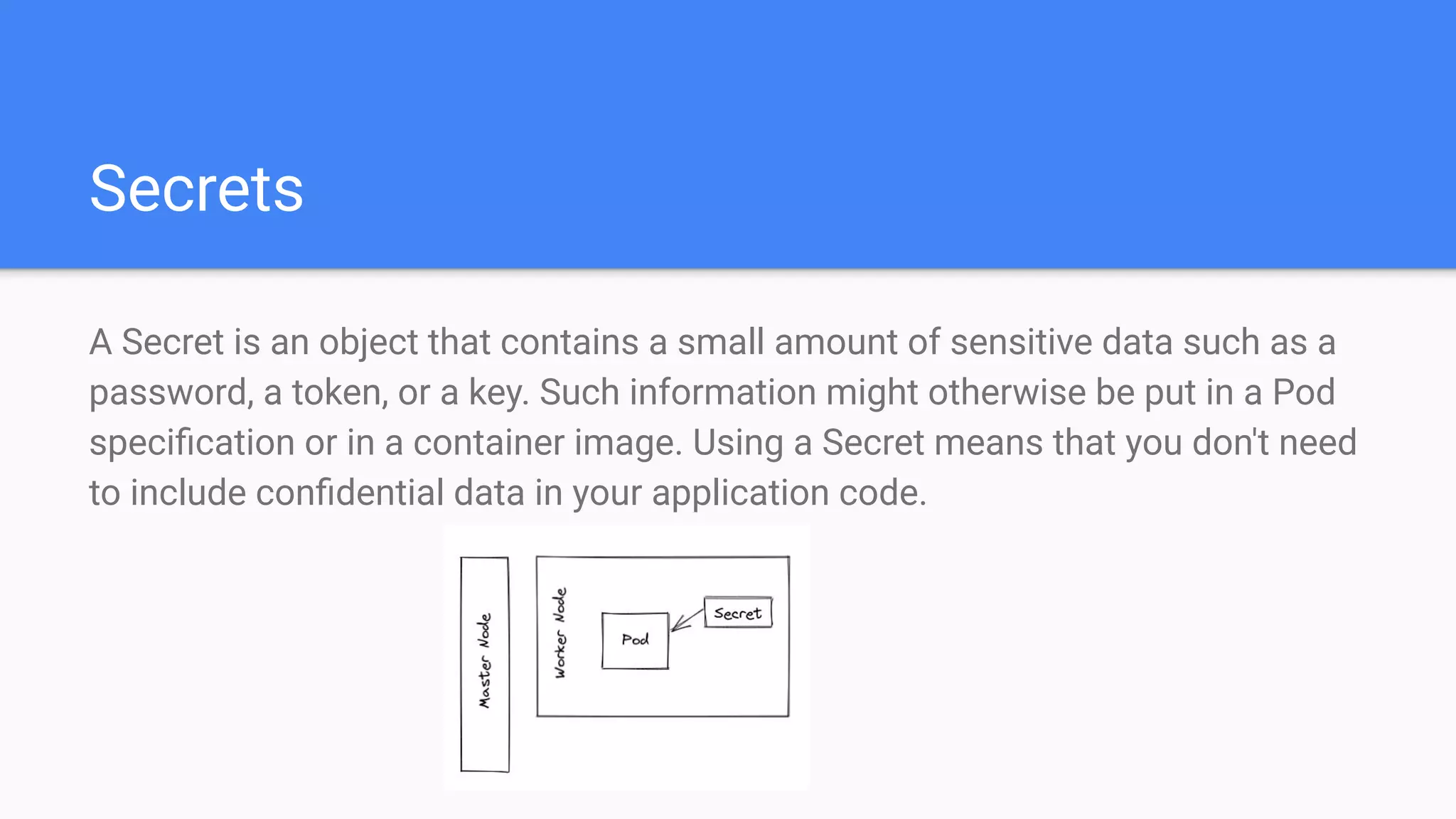
A Secret is an object that contains a small amount of sensitive data such as a
password, a token, or a key. Such information might otherwise be put in a Pod
specification or in a container image. Using a Secret means that you don't need
to include confidential data in your application code.
External Secrets
External Secrets Operator is a
Kubernetes operator that integrates
external secret management systems
like AWS Secrets Manager, HashiCorp
Vault, Google Secrets Manager, Azure
Key Vault and many more. The
operator reads information from
external APIs and automatically injects
the values into a Kubernetes Secret.
What, ¿operator?
Operators are software extensions to
Kubernetes that make use of custom
resources to manage applications and
their components. Operators follow
Kubernetes principles, notably the
control loop.
External Secrets - Architecture
First, define secret in your
cloud or on premise (Bare
Metal) provider.
Second, write your YAML
config file to obtain secret.
Third, use the secret in your
Cluster.
Demo Time
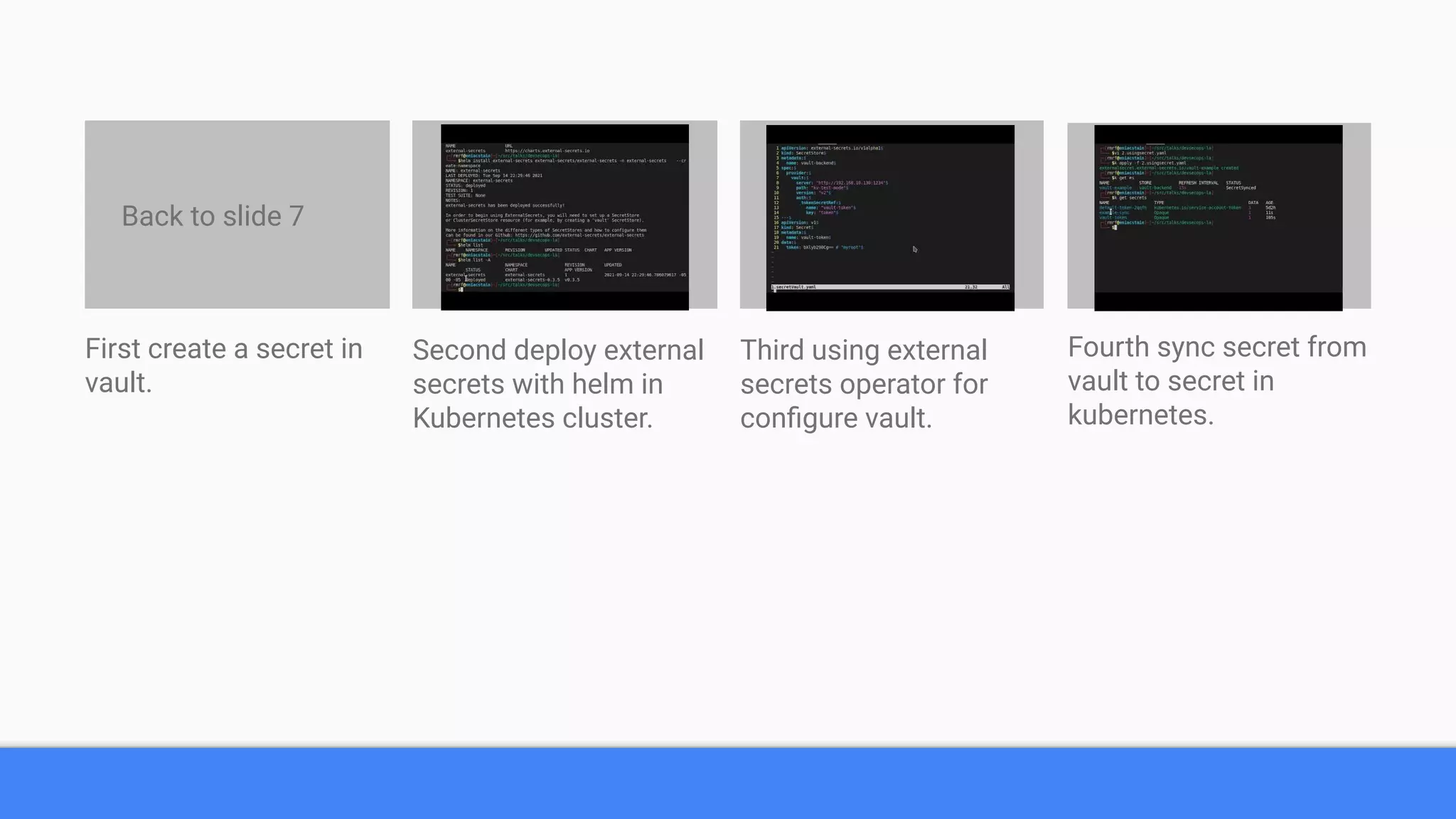
First create a secret in
vault.
Second deploy external
secrets with helm in
Kubernetes cluster.
Third using external
secrets operator for
configure vault.
Fourth sync secret from
vault to secret in
kubernetes.
Back to slide 7
Questions ¿?
Thank you!!
Thank you for your time!!
I hope you learn something
new!! @jthan24

Secrets acrosscloudk8s

  • 1.
    Secrets in KubernetesAcross Cloud “Life is really simple, but we insist on making it complicated..” Confucius @jthan24 Jhonny Pong (Jhonnatan Gil)
  • 3.
  • 4.
    AWS - Systems ManagerParameter Store Parameter Store, a capability of AWS Systems Manager, provides secure, hierarchical storage for configuration data management and secrets management. You can store data such as passwords, database strings, Amazon Machine Image (AMI) IDs, and license codes as parameter values. You can store values as plain text or encrypted data. You can reference Systems Manager parameters in your scripts, commands, SSM documents, and configuration and automation workflows by using the unique name that you specified when you created the parameter.
  • 5.
    Azure - KeyVault Secrets Azure Key Vault is a cloud service for securely storing and accessing secrets. A secret is anything that you want to tightly control access to, such as API keys, passwords, certificates, or cryptographic keys. Key Vault service supports two types of containers: vaults and managed hardware security module(HSM) pools. Vaults support storing software and HSM-backed keys, secrets, and certificates. Managed HSM pools only support HSM-backed keys.
  • 6.
    GCP - Secret Manager SecretManager is a secure and convenient storage system for API keys, passwords, certificates, and other sensitive data. Secret Manager provides a central place and single source of truth to manage, access, and audit secrets across Google Cloud.
  • 7.
    Hashicorp - Vault Vaultis a tool for securely accessing secrets. A secret is anything that you want to tightly control access to, such as API keys, passwords, or certificates. Vault provides a unified interface to any secret, while providing tight access control and recording a detailed audit log. Secure Secret Storage: Arbitrary key/value secrets can be stored in Vault. Vault encrypts these secrets prior to writing them to persistent storage, so gaining access to the raw storage isn't enough to access your secrets. Vault can write to disk, Consul, and more.
  • 8.
  • 9.
    What is kubernetes Kubernetesis a portable, extensible, open-source platform for managing containerized workloads and services, that facilitates both declarative configuration and automation. It has a large, rapidly growing ecosystem. Kubernetes services, support, and tools are widely available.
  • 10.
    Secrets A Secret isan object that contains a small amount of sensitive data such as a password, a token, or a key. Such information might otherwise be put in a Pod specification or in a container image. Using a Secret means that you don't need to include confidential data in your application code.
  • 11.
    External Secrets External SecretsOperator is a Kubernetes operator that integrates external secret management systems like AWS Secrets Manager, HashiCorp Vault, Google Secrets Manager, Azure Key Vault and many more. The operator reads information from external APIs and automatically injects the values into a Kubernetes Secret.
  • 12.
    What, ¿operator? Operators aresoftware extensions to Kubernetes that make use of custom resources to manage applications and their components. Operators follow Kubernetes principles, notably the control loop.
  • 13.
    External Secrets -Architecture First, define secret in your cloud or on premise (Bare Metal) provider. Second, write your YAML config file to obtain secret. Third, use the secret in your Cluster.
  • 14.
  • 15.
    First create asecret in vault. Second deploy external secrets with helm in Kubernetes cluster. Third using external secrets operator for configure vault. Fourth sync secret from vault to secret in kubernetes. Back to slide 7
  • 16.
  • 17.
    Thank you!! Thank youfor your time!! I hope you learn something new!! @jthan24