




TOP 20 Improved Learning Questions for Caroline P. Quarte April 2011 http://carolinequarte.blogspot.com/ Kotler’s 20 Chapters
TOP 10 Learning Questions for Chapter 1: Defining Marketing for the 21 st  Century Ria Abendan / Caroline P. Quarte April 2011
2. Promoting a visit to Star City is an example of marketing what? A place An experience A property An organization None of the above
2. What are you marketing when you promote a visit to Star City? A place An experience A property An organization None of the above Question http://carolinequarte.blogspot.com/
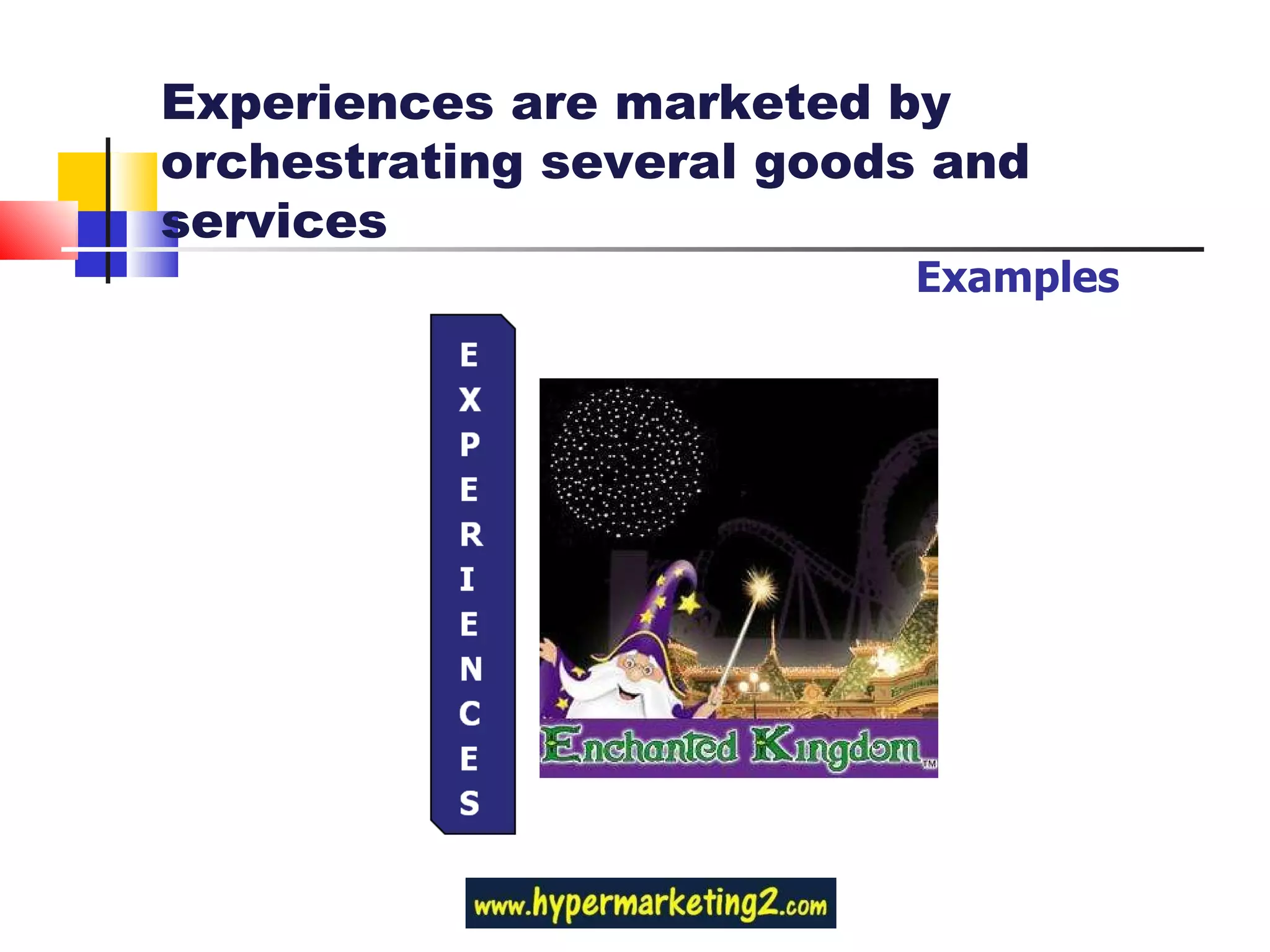
Examples Experiences are marketed by orchestrating several goods and services
2. What are you marketing when you promote a visit to Star City? A place An experience A property An organization None of the above Answer http://carolinequarte.blogspot.com/
10 Questions Chapter 2: Developing Marketing Strategies and Plans Steven Michael Y. Andrada / Caroline P. Quarte April 15, 2011 www.stevenandrada.blogspot.com 1/73
5. What kind of business orientation that puts the customer at the heart of the business? Product orientation Geographical orientation Market orientation Competence orientation None of the above 31/73 www.stevenandrada.blogspot.com
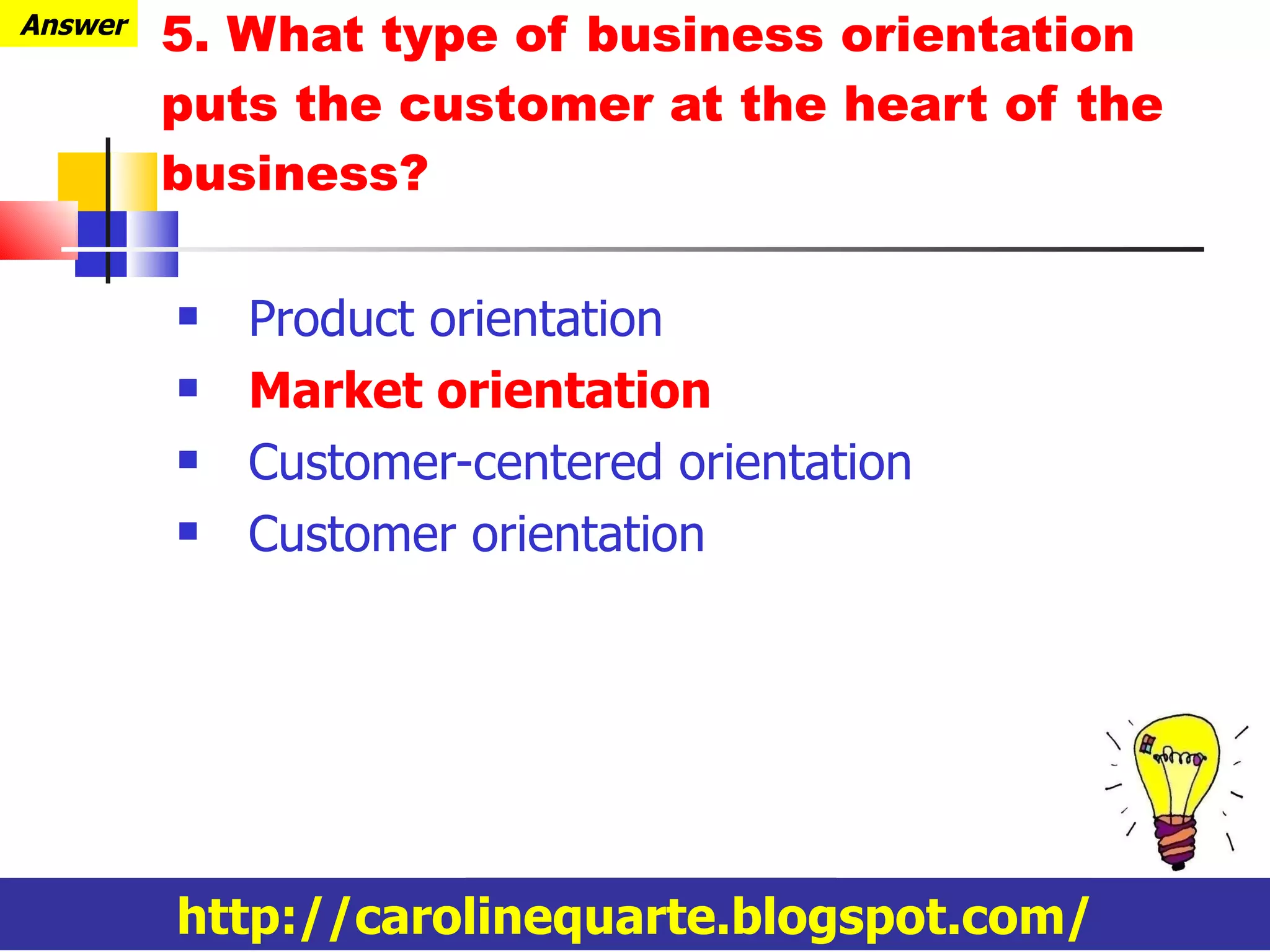
5. What type of business orientation puts the customer at the heart of the business? Product orientation Market orientation Customer-centered orientation Customer orientation Question http://carolinequarte.blogspot.com/
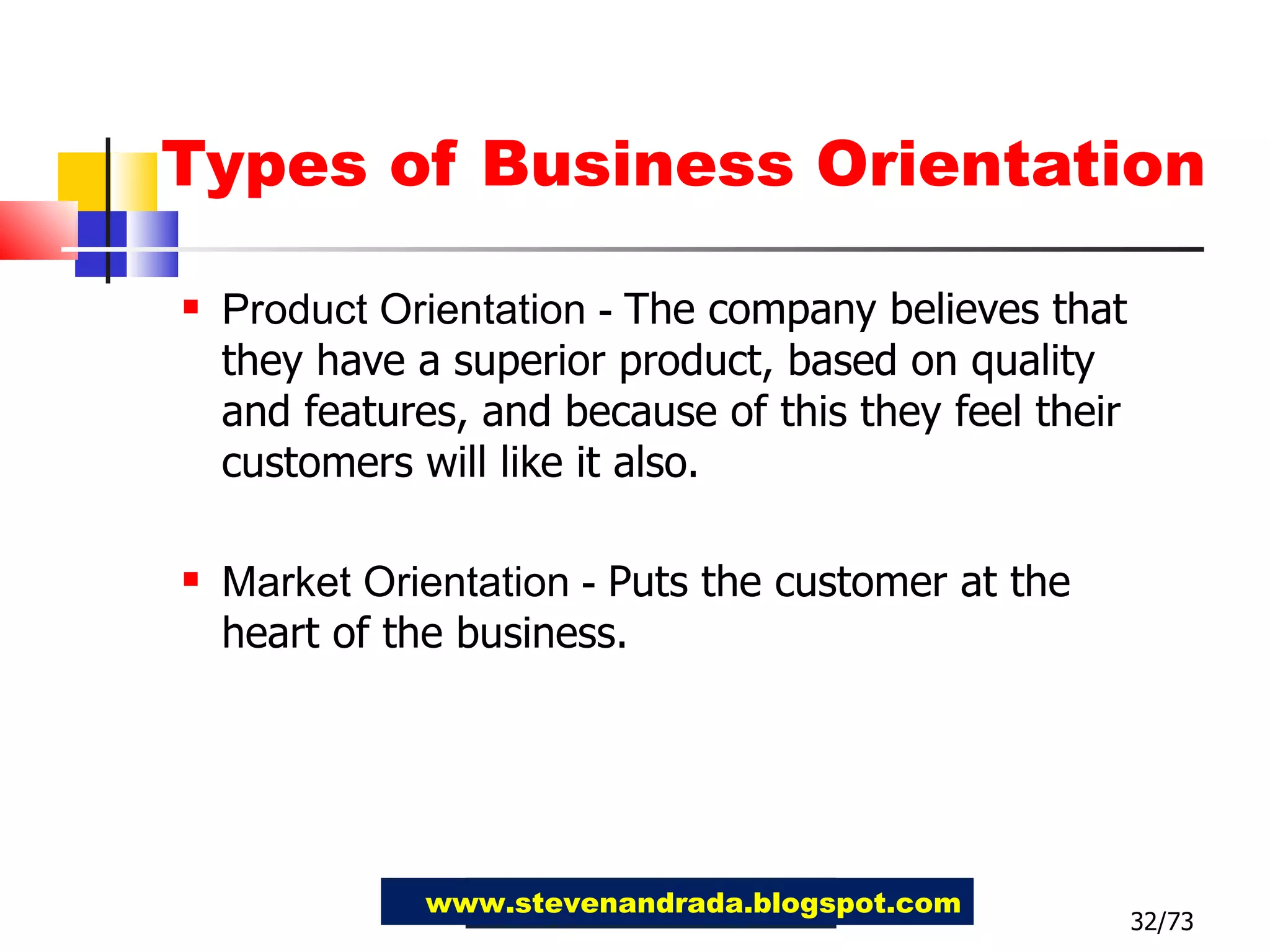
Types of Business Orientation Product Orientation -  The company believes that they have a superior product, based on quality and features, and because of this they feel their customers will like it also. Market Orientation -  Puts the customer at the heart of the business.   32/73 www.stevenandrada.blogspot.com
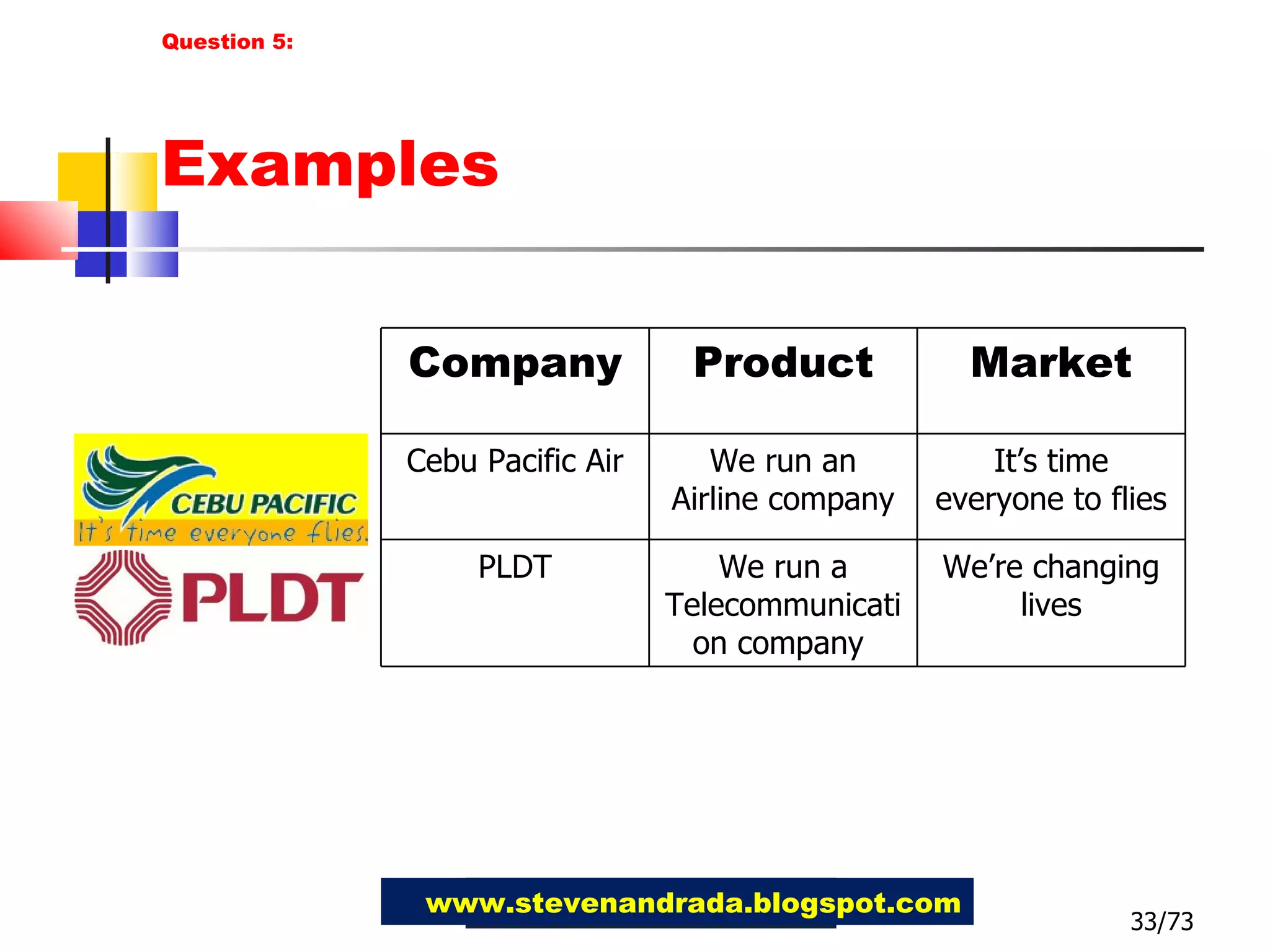
Examples 33/73 www.stevenandrada.blogspot.com Question 5: Company Product Market Cebu Pacific Air We run an Airline company It’s time everyone to flies PLDT We run a Telecommunication company  We’re changing lives
5. What type of business orientation puts the customer at the heart of the business? Product orientation Market orientation Customer-centered orientation Customer orientation Answer http://carolinequarte.blogspot.com/
TOP 10 Learning Questions  Ch 3: Gathering Information and Scanning the Environment Ma. Katrina S. Avellana / Caroline P. Quarte April 2011 http://kavellana.blogspot.com
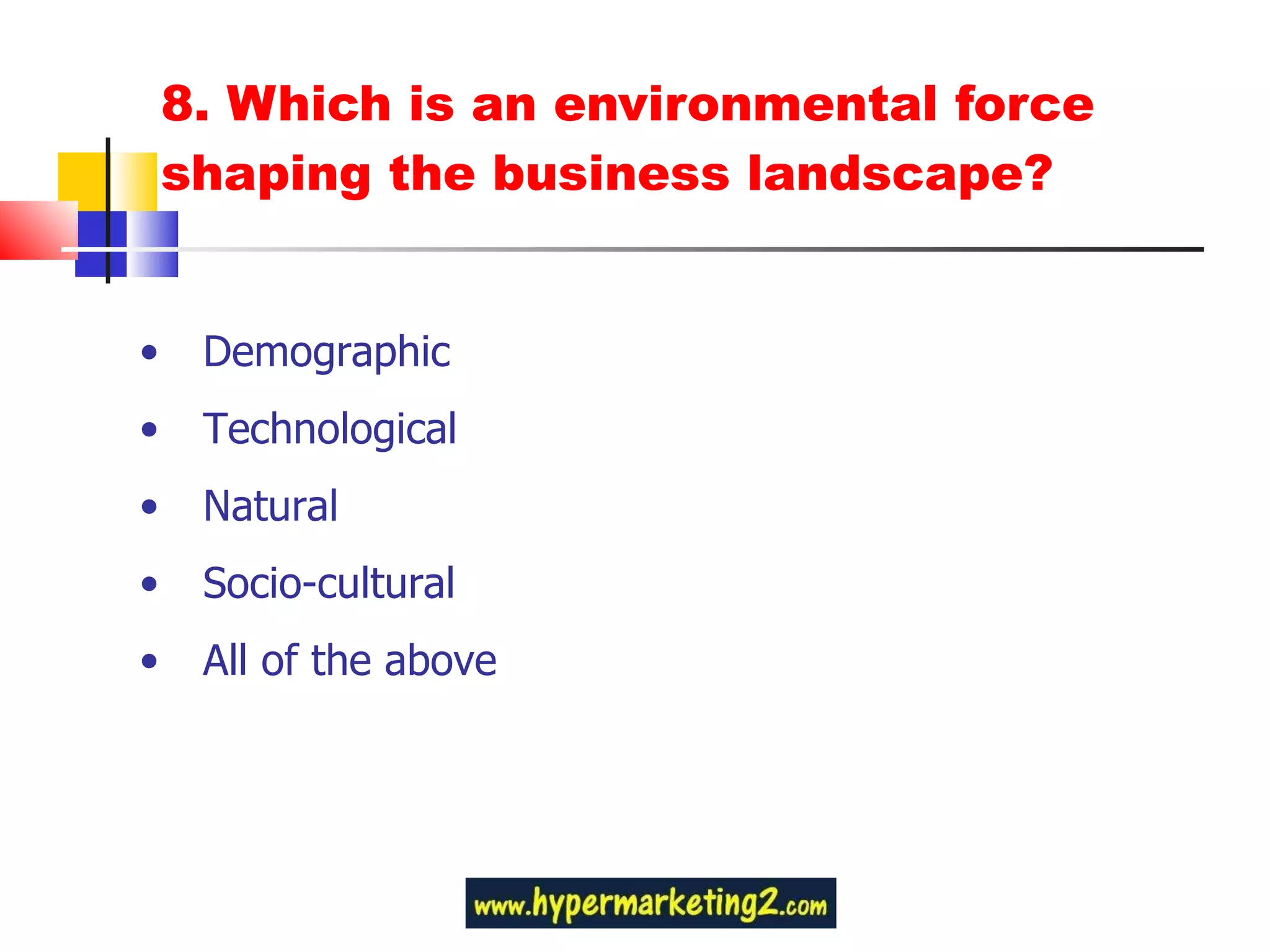
8. Which is an environmental force shaping the business landscape? Demographic Technological Natural Socio-cultural All of the above
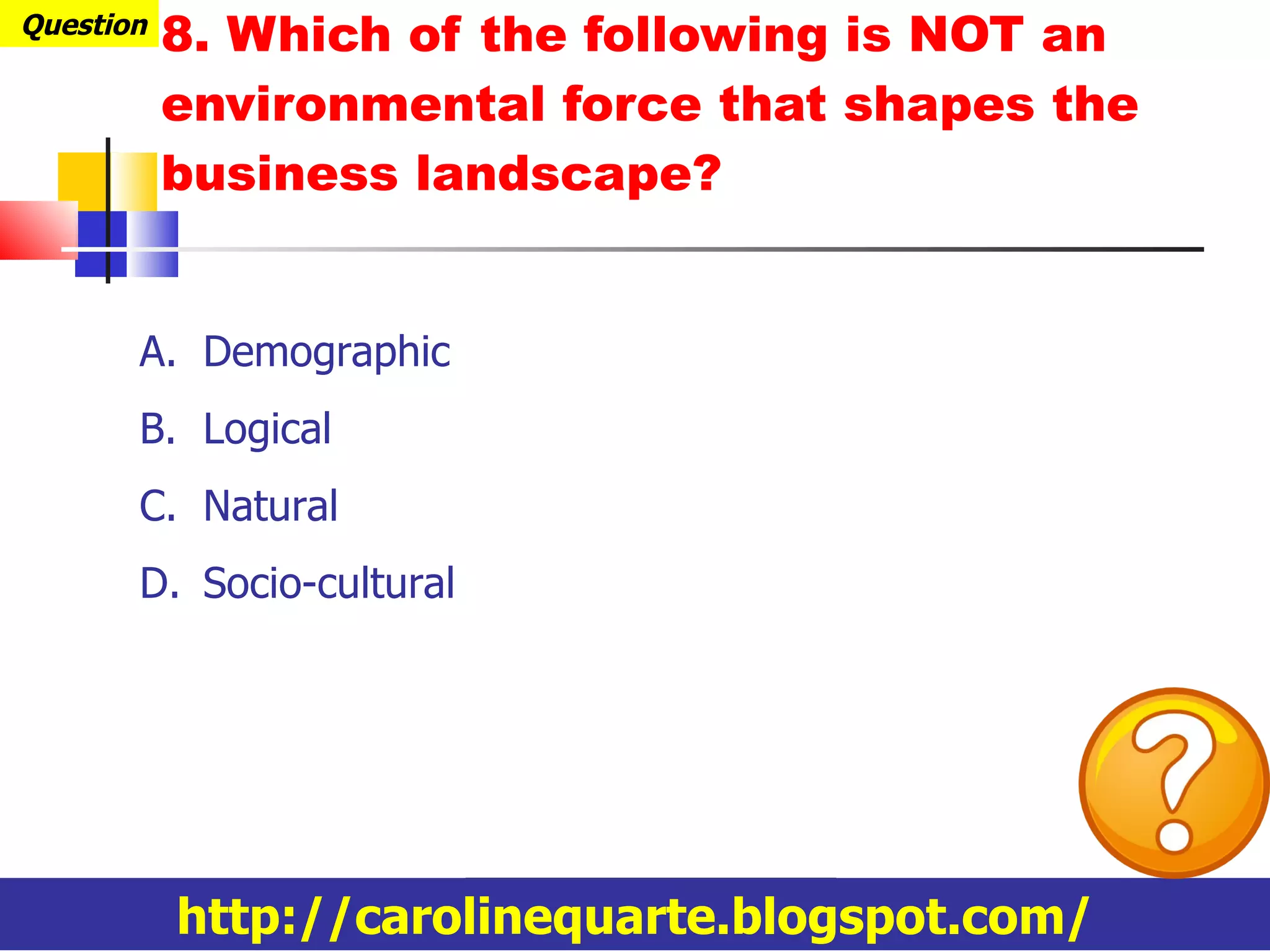
8. Which of the following is NOT an environmental force that shapes the business landscape? Question http://carolinequarte.blogspot.com/ Demographic Logical Natural Socio-cultural
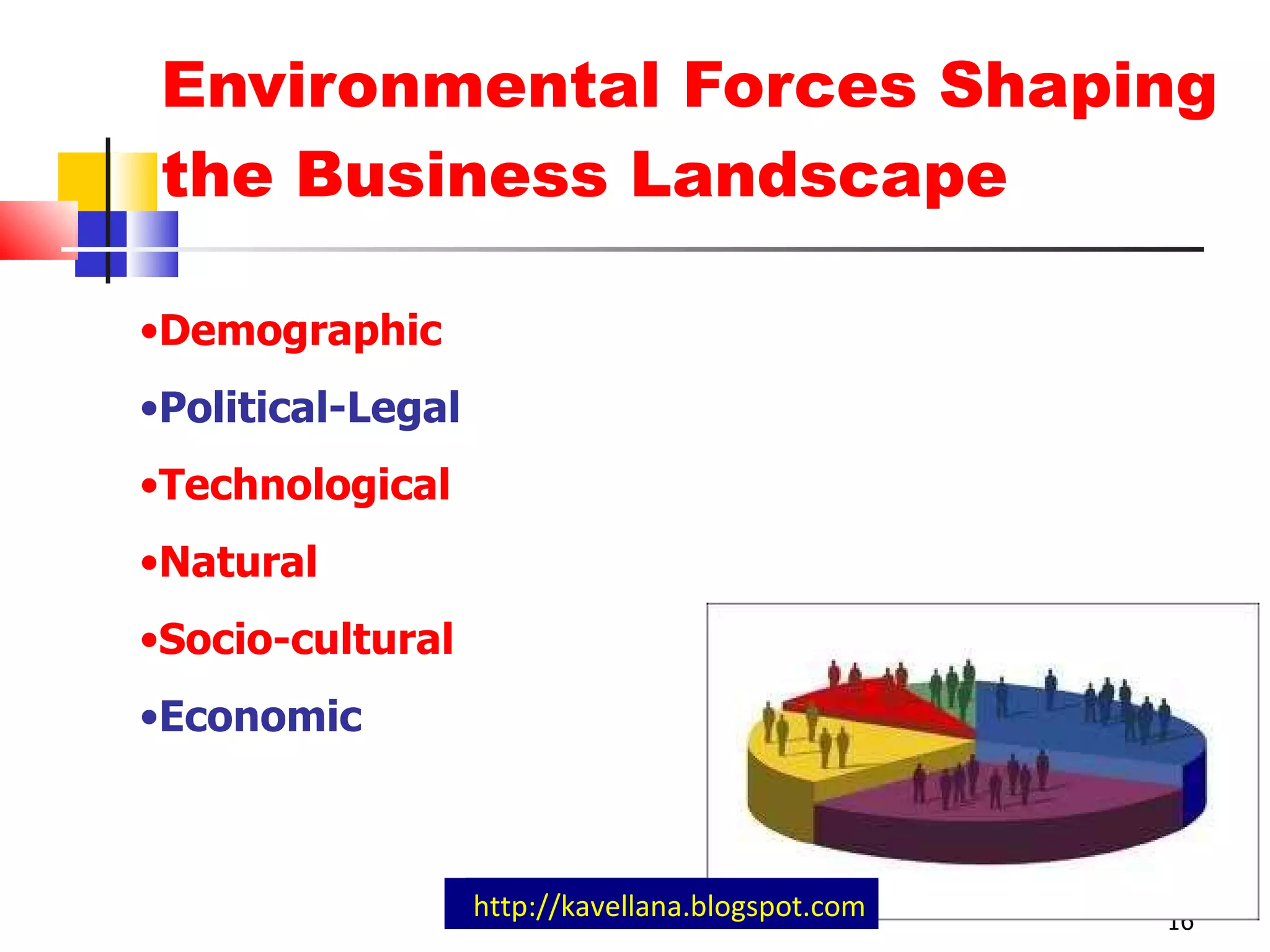
Environmental Forces Shaping the Business Landscape Demographic Political-Legal Technological Natural Socio-cultural Economic http://kavellana.blogspot.com
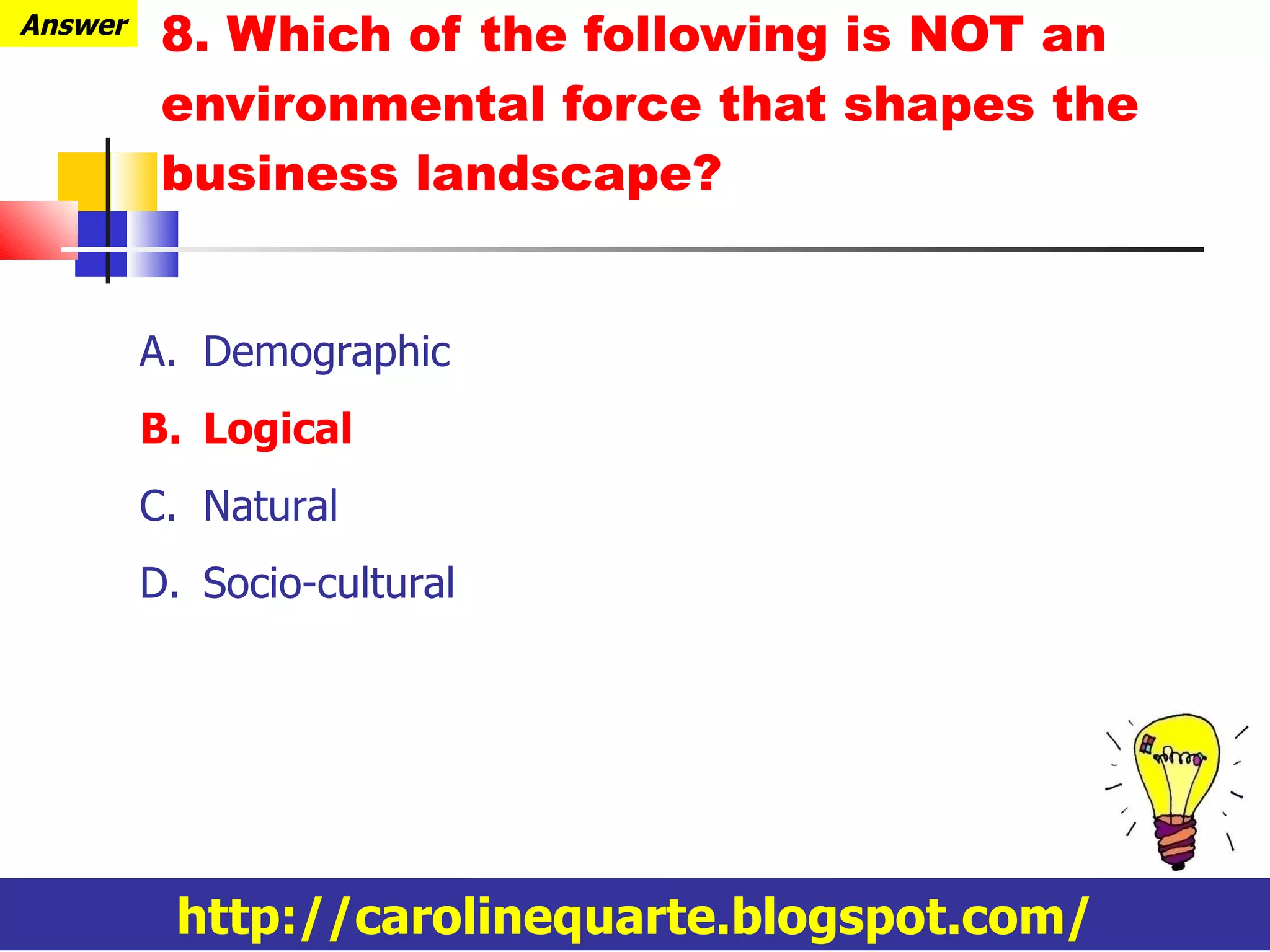
8. Which of the following is NOT an environmental force that shapes the business landscape? http://carolinequarte.blogspot.com/ Answer Demographic Logical Natural Socio-cultural
TOP 10 Learning Questions for Chapter 4: Conducting Marketing Research and Forecasting Demand Megha Behani / Caroline P. Quarte April 2011
#4: ____ is the set of consumers who have interest and access to a market offer. A. Potential market B. Available market C. Target market D. Penetrated market E. None of the above
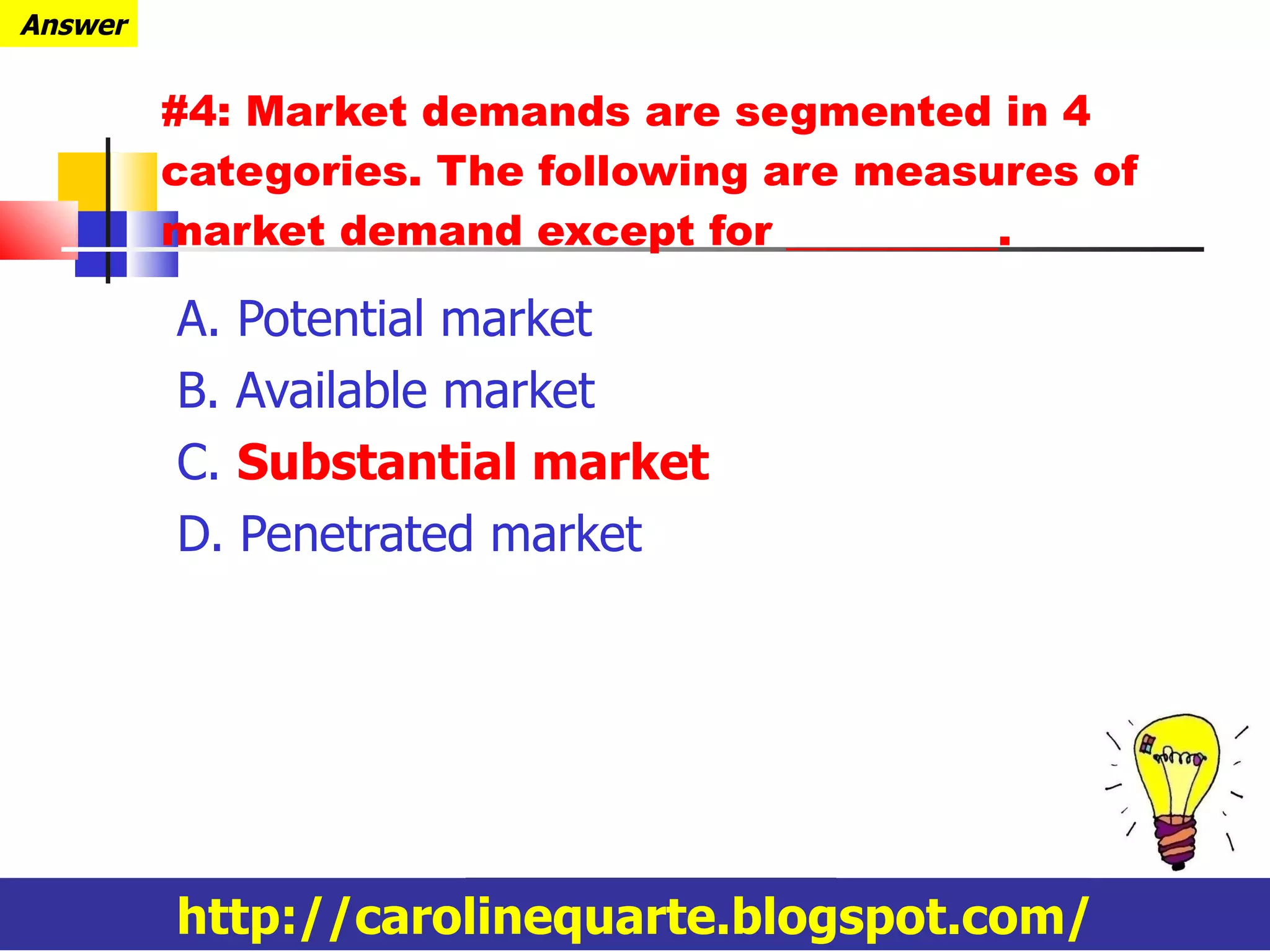
#4: Market demands are segmented in 4 categories. The following are measures of market demand except for __________. A. Potential market B. Available market C. Substantial market D. Penetrated market Question http://carolinequarte.blogspot.com/
Concept : What are the measures of market demand? Potential Market Target  Market Penetrated  Market Available  Market consumers having interest, income and access  consumers buying company’s product! qualified available market company decides to pursue consumers  professing sufficient level of interest
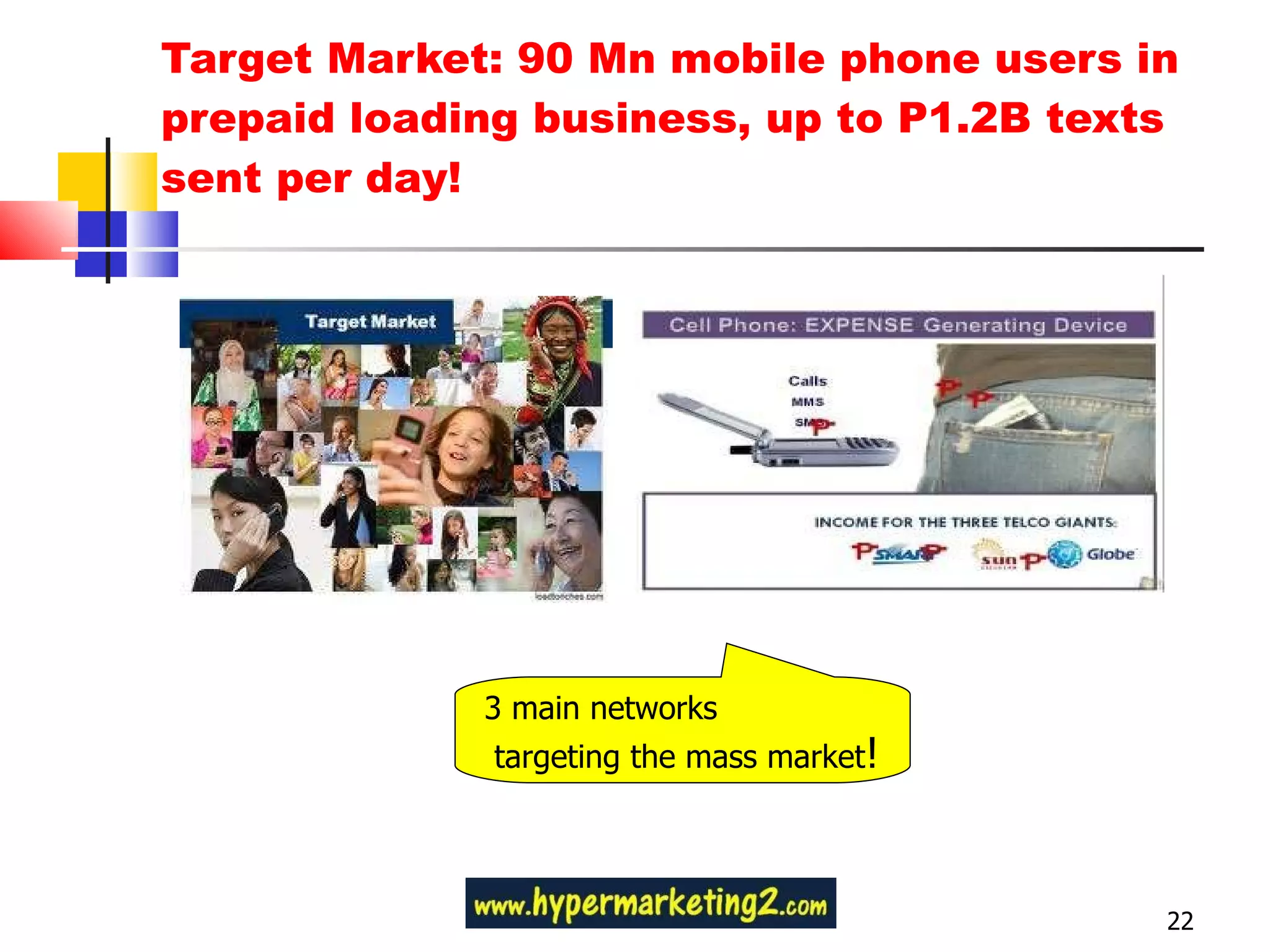
Target Market: 90 Mn mobile phone users in prepaid loading business, up to P1.2B texts sent per day! 3 main networks targeting the mass market !
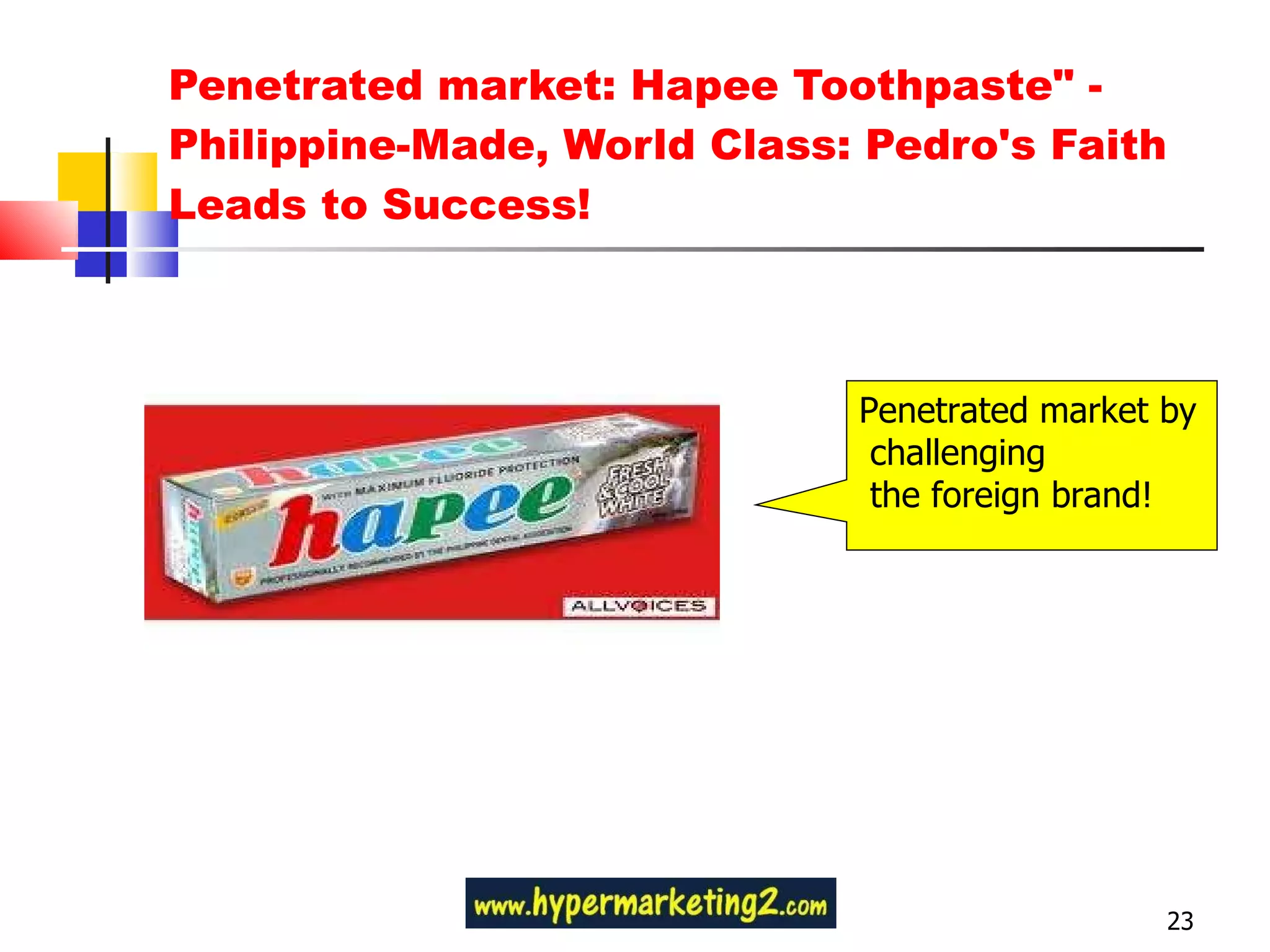
Penetrated market: Hapee Toothpaste" - Philippine-Made, World Class: Pedro's Faith Leads to Success! Penetrated market by challenging the foreign brand!
Available market: People belonging to different income group can assess the supermarkets… Available market: Supermarket!!!
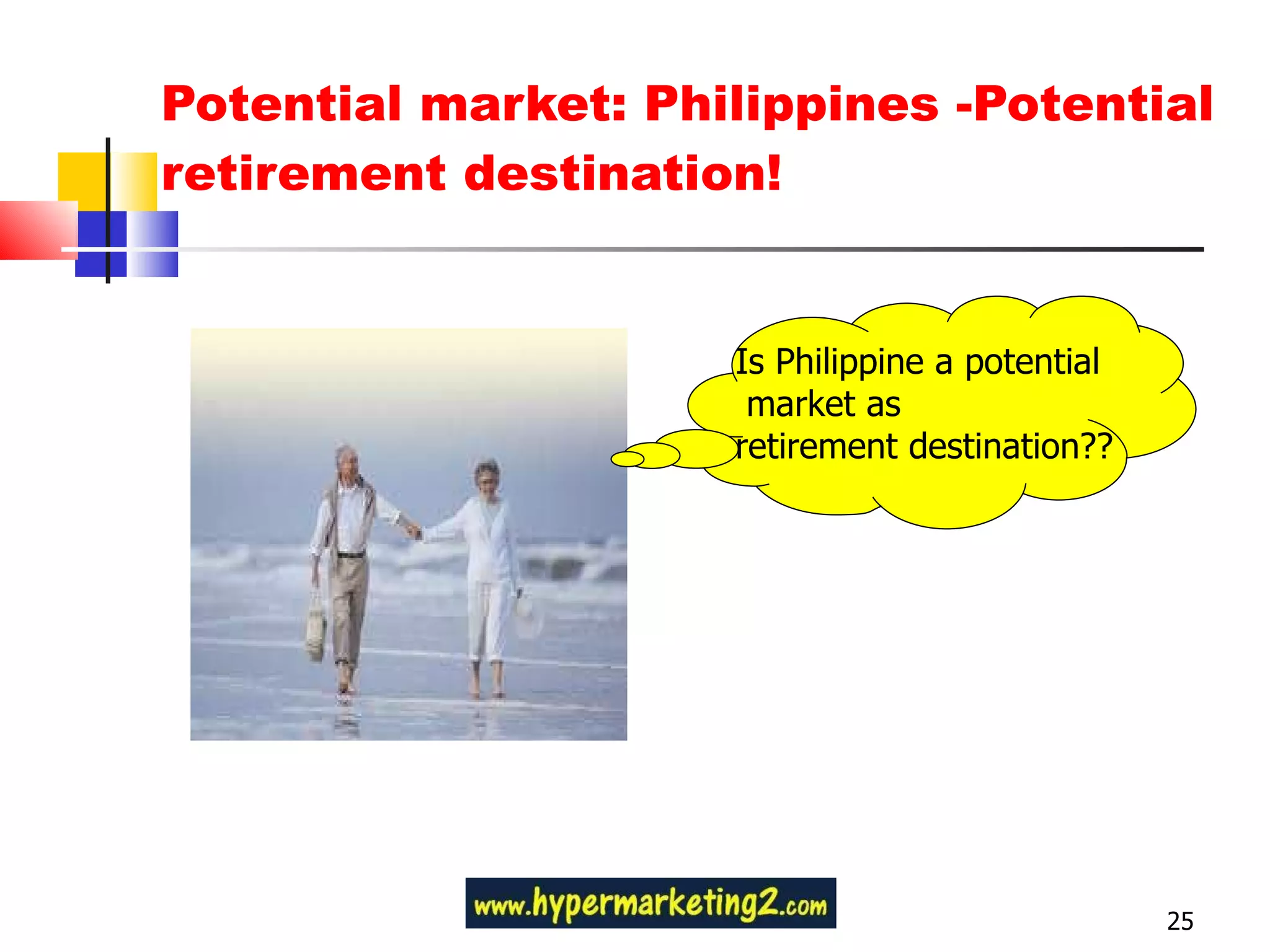
Potential market: Philippines -Potential retirement destination! Is Philippine a potential market as retirement destination??
#4: Market demands are segmented in 4 categories. The following are measures of market demand except for __________. A. Potential market B. Available market C.  Substantial market D. Penetrated market http://carolinequarte.blogspot.com/ Answer
Joan Soliven / Caroline P. Quarte April 15, 2011 http://joansoliven.blogspot.com/ TOP 10 Learning Questions for Creating Customer Value, Satisfaction, and Loyalty and Ch 5
1. Difference between what the customer gets and what he or she gives for different possible choices. A. Customer Satisfaction  B. Good Service  C. Quality D. Customer Perceived Value E. Product  http://joansoliven.blogspot.com/
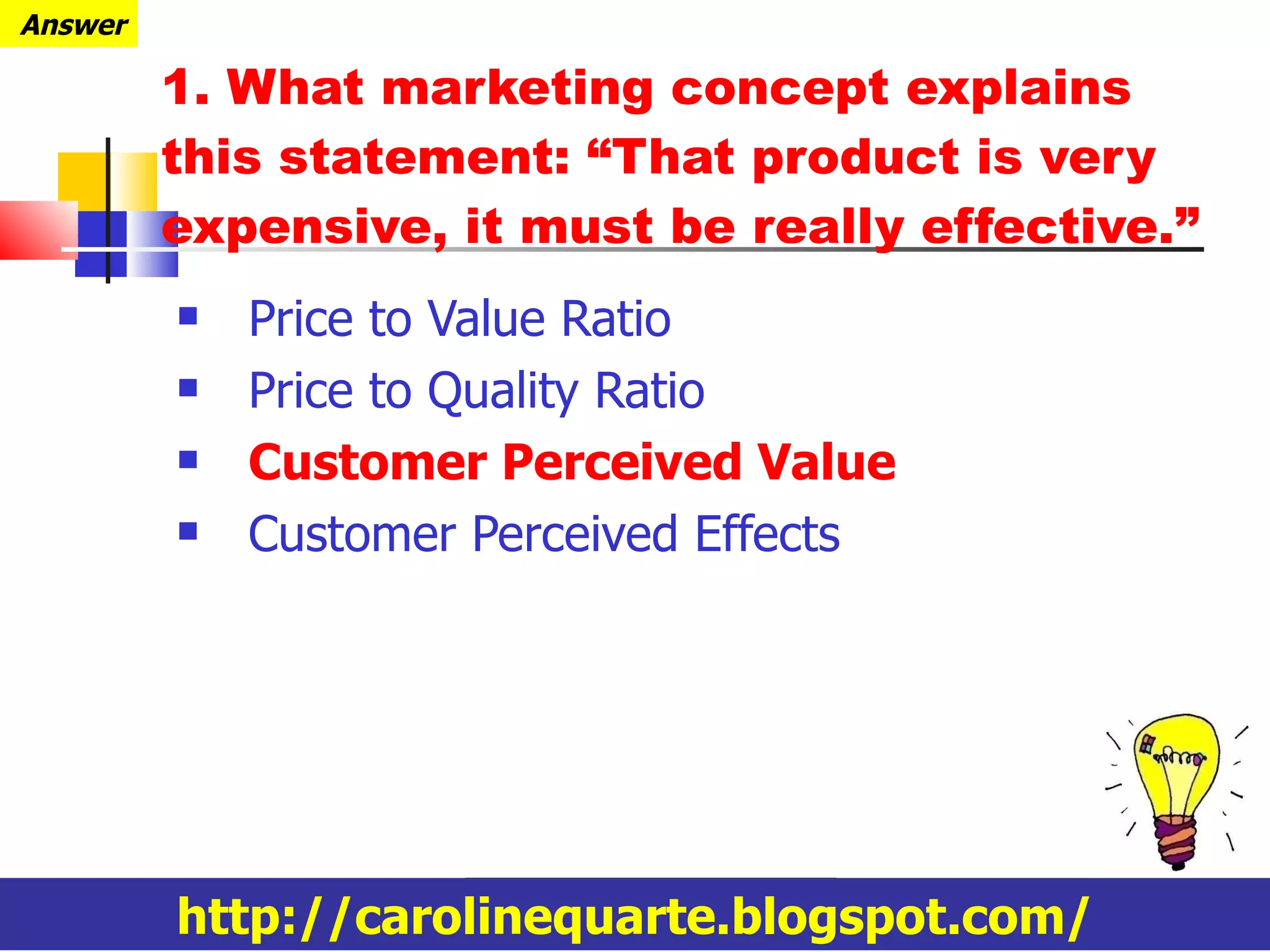
Price to Value Ratio Price to Quality Ratio Customer Perceived Value Customer Perceived Effects 1. What marketing concept explains this statement: “That product is very expensive, it must be really effective.” Question http://carolinequarte.blogspot.com/
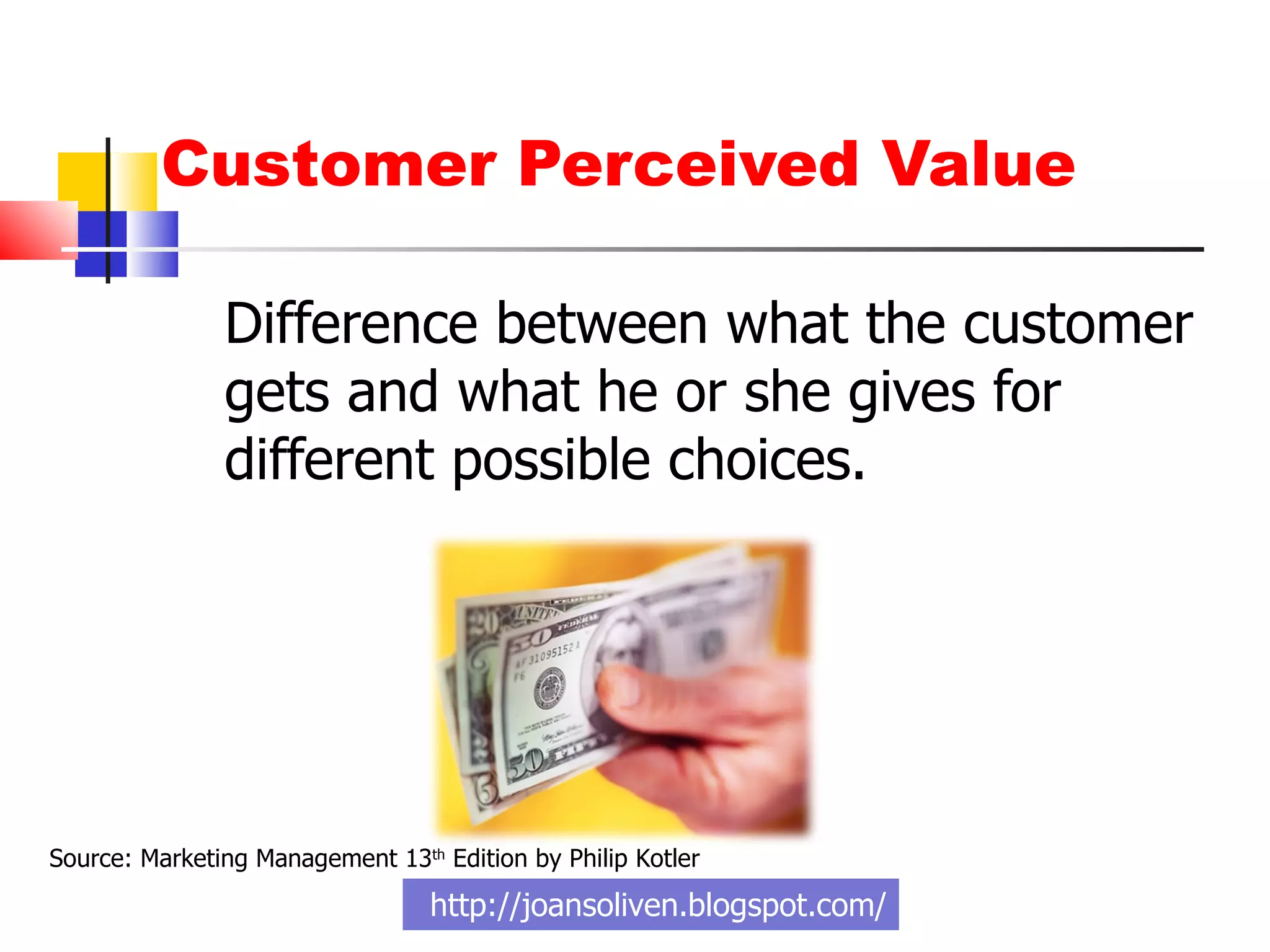
Customer Perceived Value  Difference between what the customer gets and what he or she gives for different possible choices. http://joansoliven.blogspot.com/ Source: Marketing Management 13 th  Edition by Philip Kotler
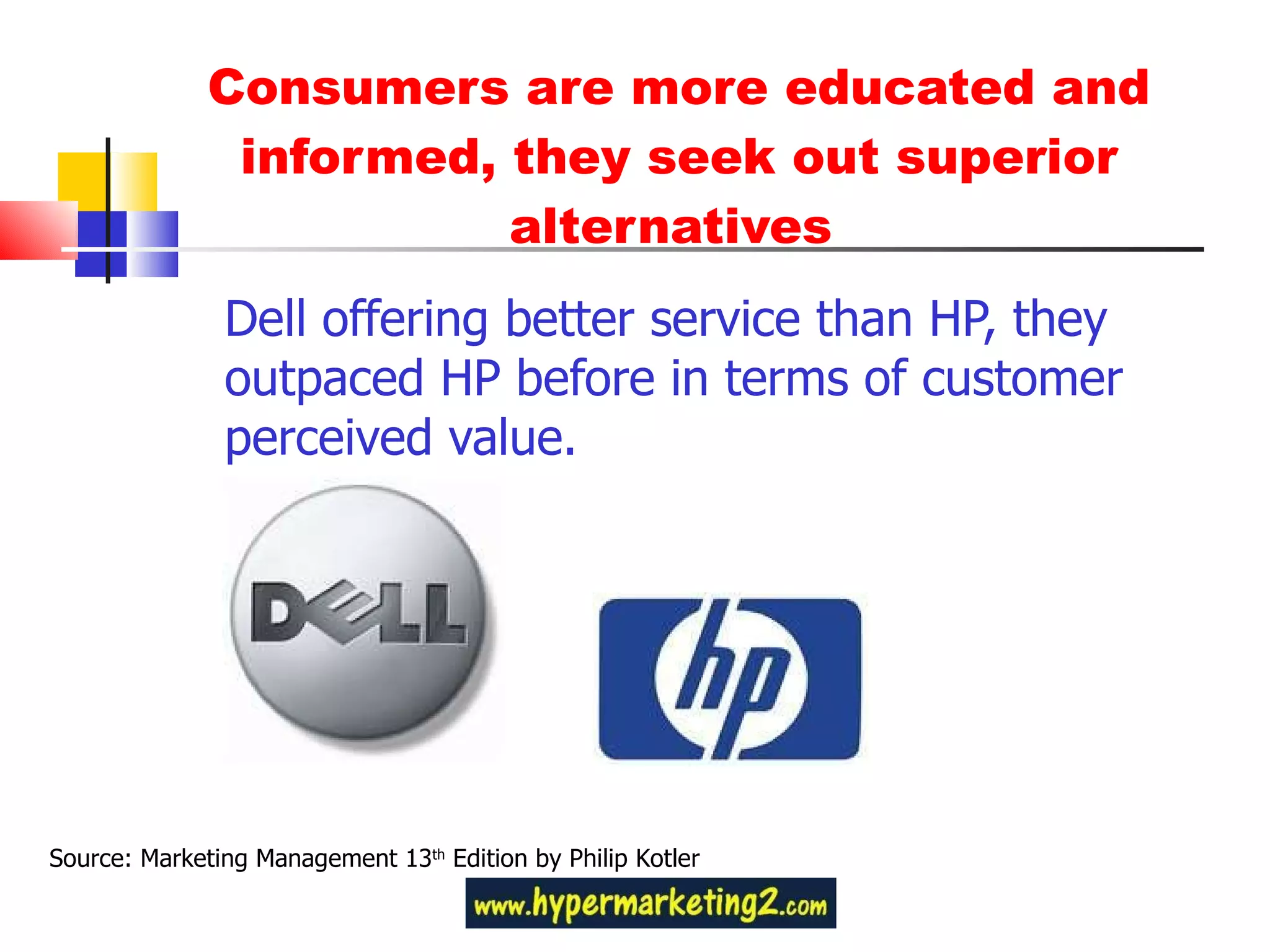
Consumers are more educated and informed, they seek out superior alternatives  Dell offering better service than HP, they  outpaced HP before in terms of customer perceived value. Source: Marketing Management 13 th  Edition by Philip Kotler
Price to Value Ratio Price to Quality Ratio Customer Perceived Value Customer Perceived Effects 1. What marketing concept explains this statement: “That product is very expensive, it must be really effective.” http://carolinequarte.blogspot.com/ Answer
TOP 10 Learning Questions for Ch6: Analyzing Consumer Markets Roleigh “Rolly” Tuazon / Caroline P. Quarte 15 April 2011
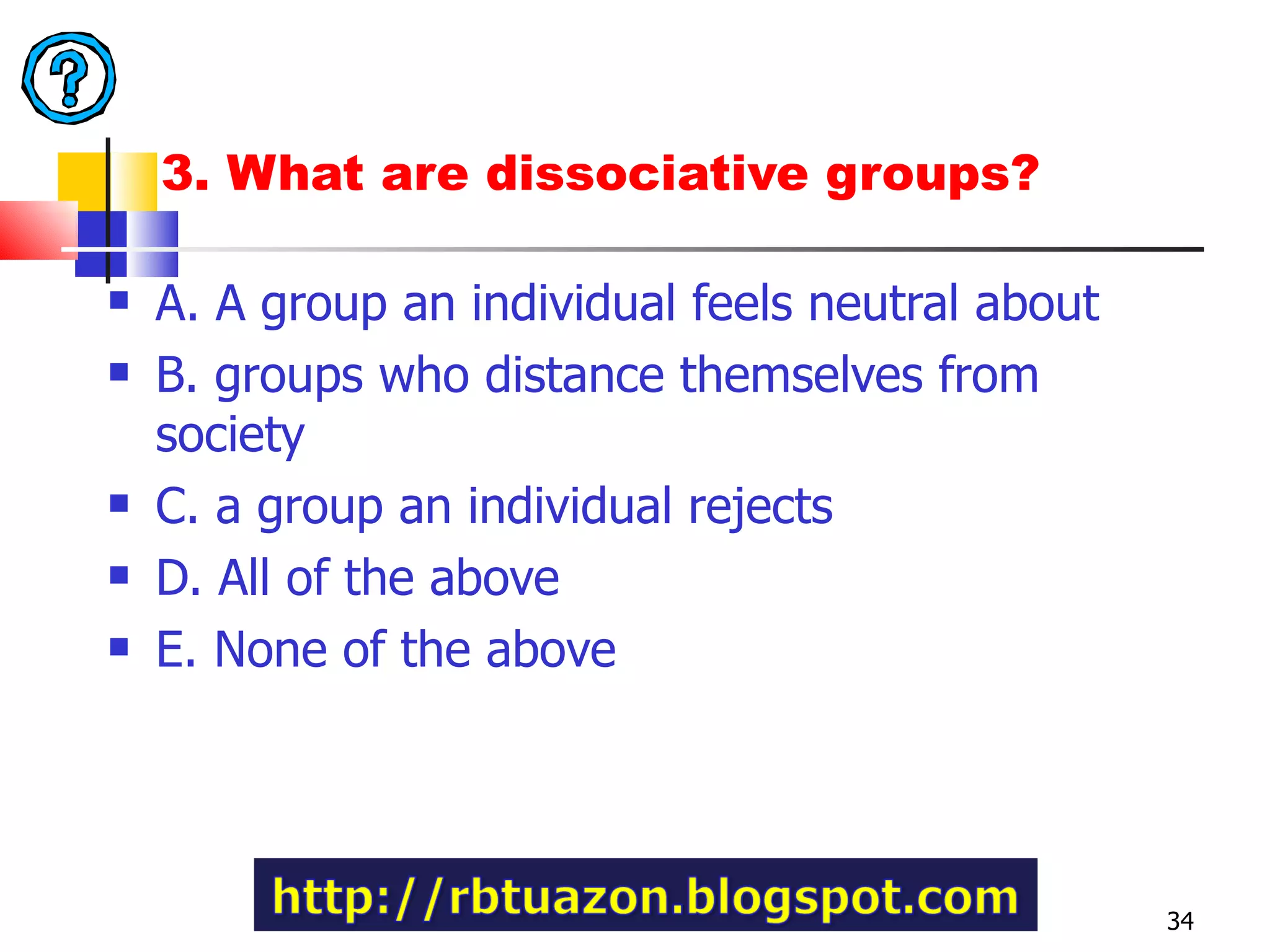
3. What are dissociative groups?  A. A group an individual feels neutral about B. groups who distance themselves from  society C. a group an individual rejects D. All of the above E. None of the above
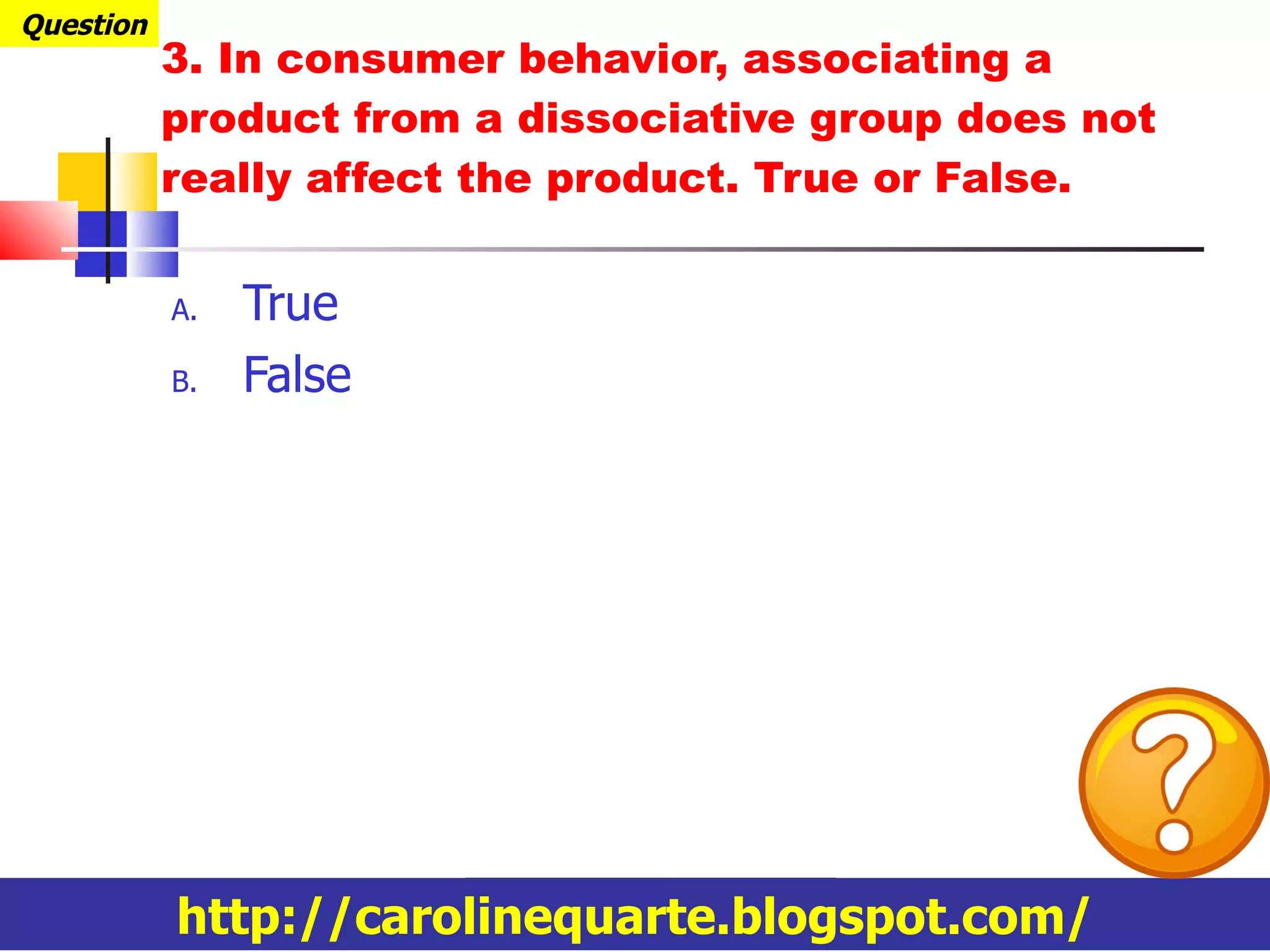
3. In consumer behavior, associating a product from a dissociative group does not really affect the product. True or False. True False Question http://carolinequarte.blogspot.com/
Reference Groups Dissociative Groups Groups one rejects: i.e., racists, anti-semites Kotler, Keller. Marketing Management, 13 th  Edition.  Concept 2:
Reference Groups Dissociative Groups Groups one rejects: i.e., racists, anti-semites Kotler, Keller. Marketing Management, 13 th  Edition.  Concept 2: These are groups one does not wish to be associated with.
3. In consumer behavior, associating a product from a dissociative group does not really affect the product. True or False. True False http://carolinequarte.blogspot.com/ Answer
Caroline P. Quarte
 
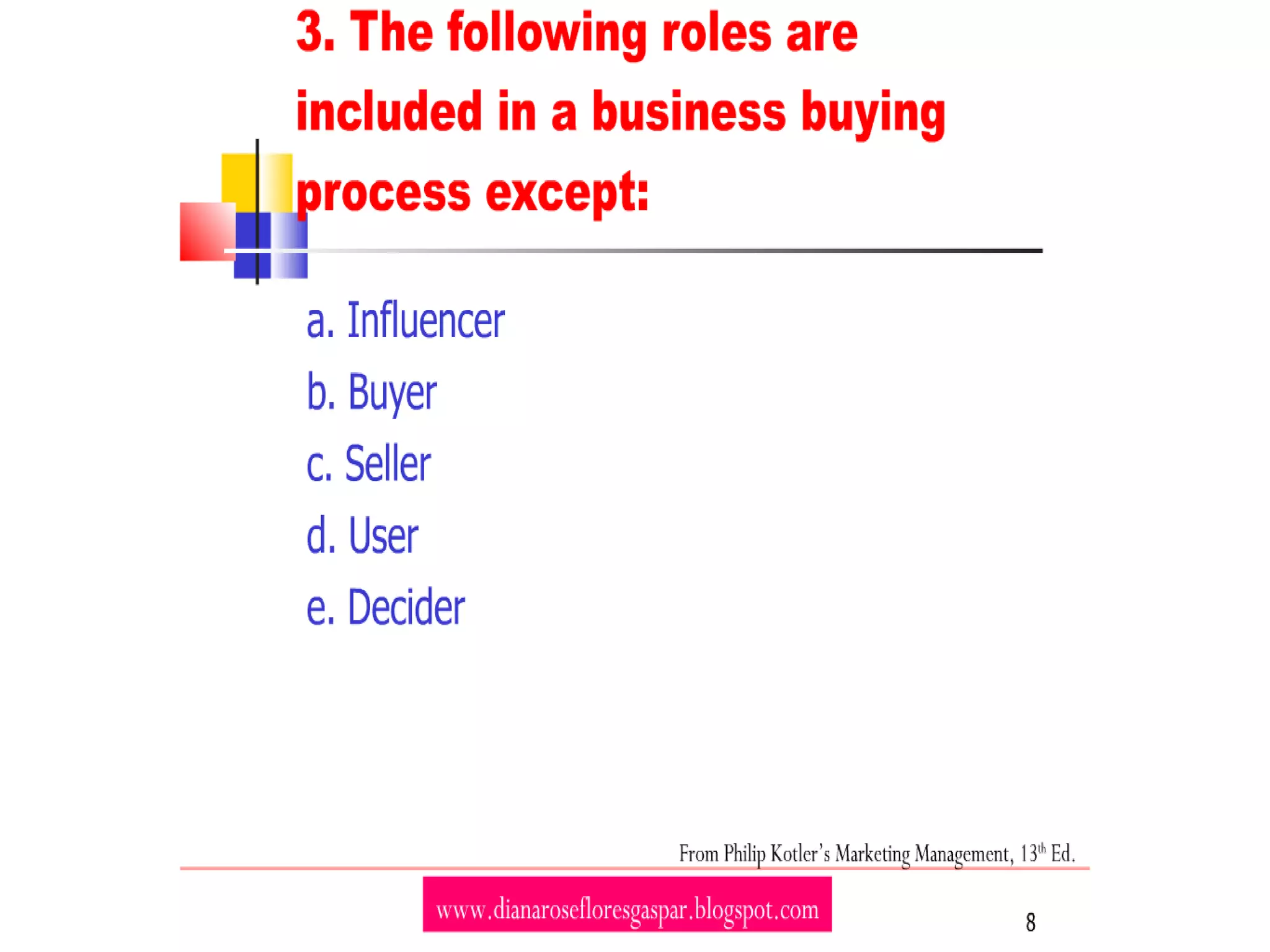
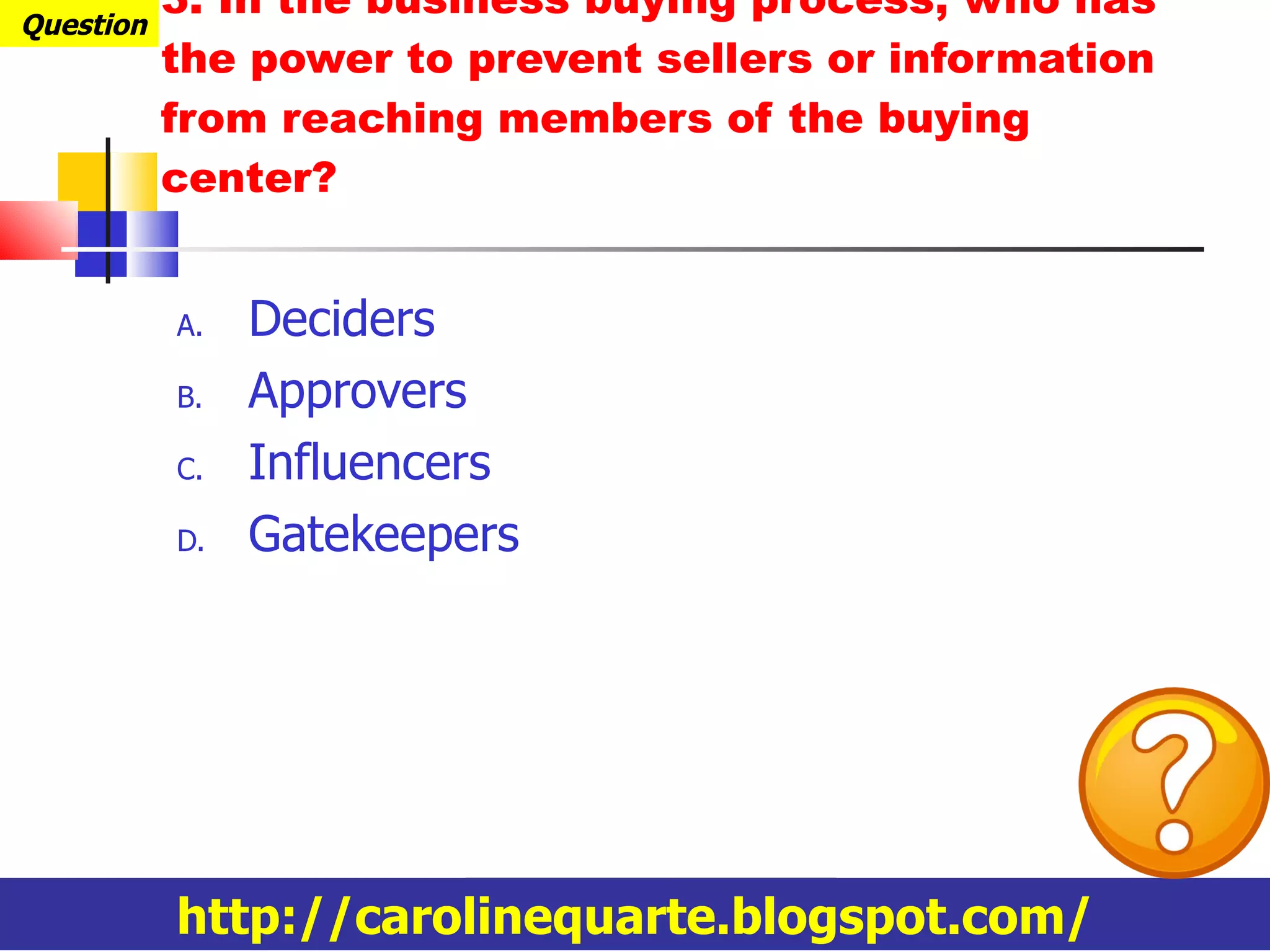
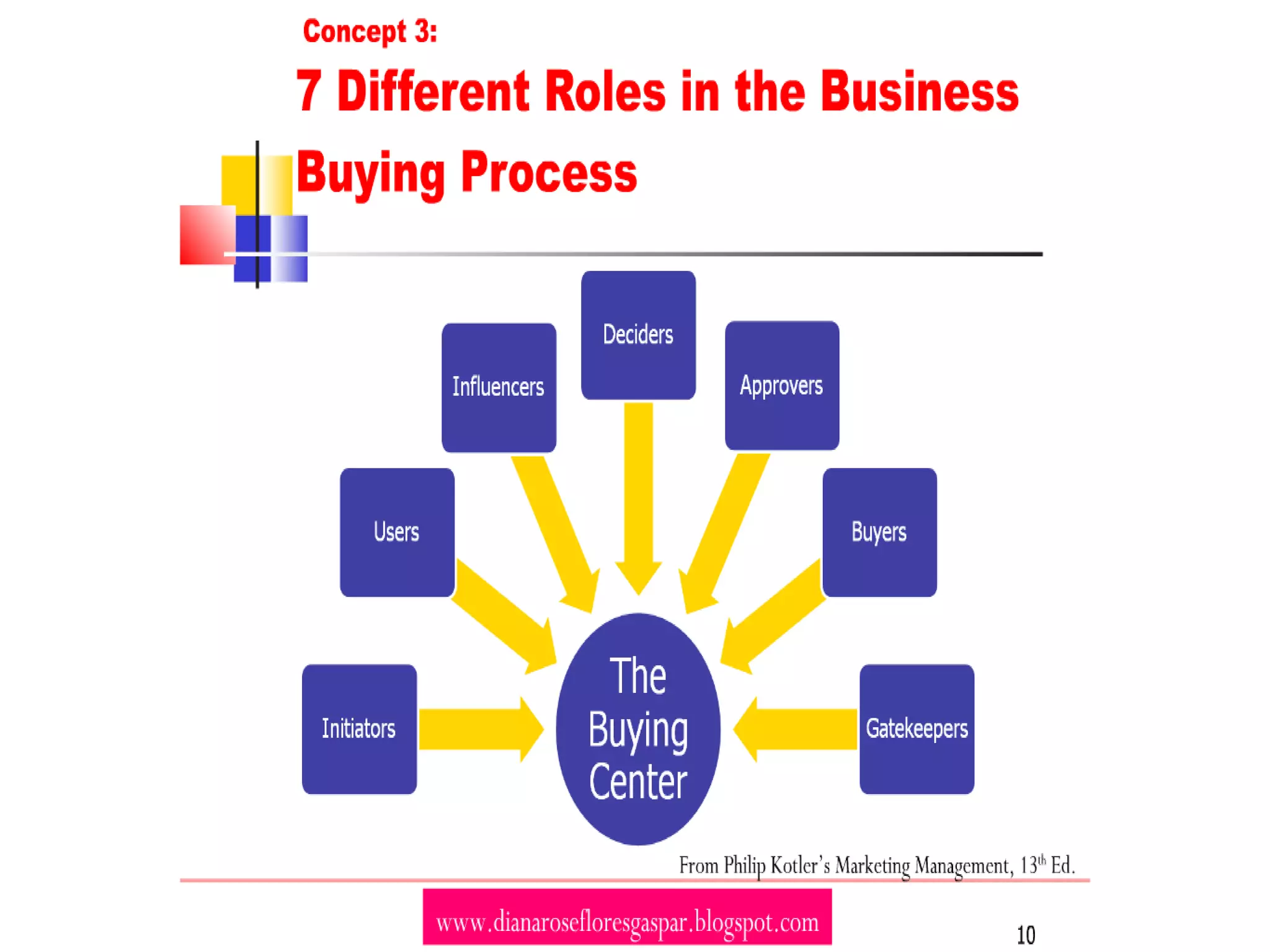
3. In the business buying process, who has the power to prevent sellers or information from reaching members of the buying center? Deciders Approvers Influencers Gatekeepers Question http://carolinequarte.blogspot.com/
 
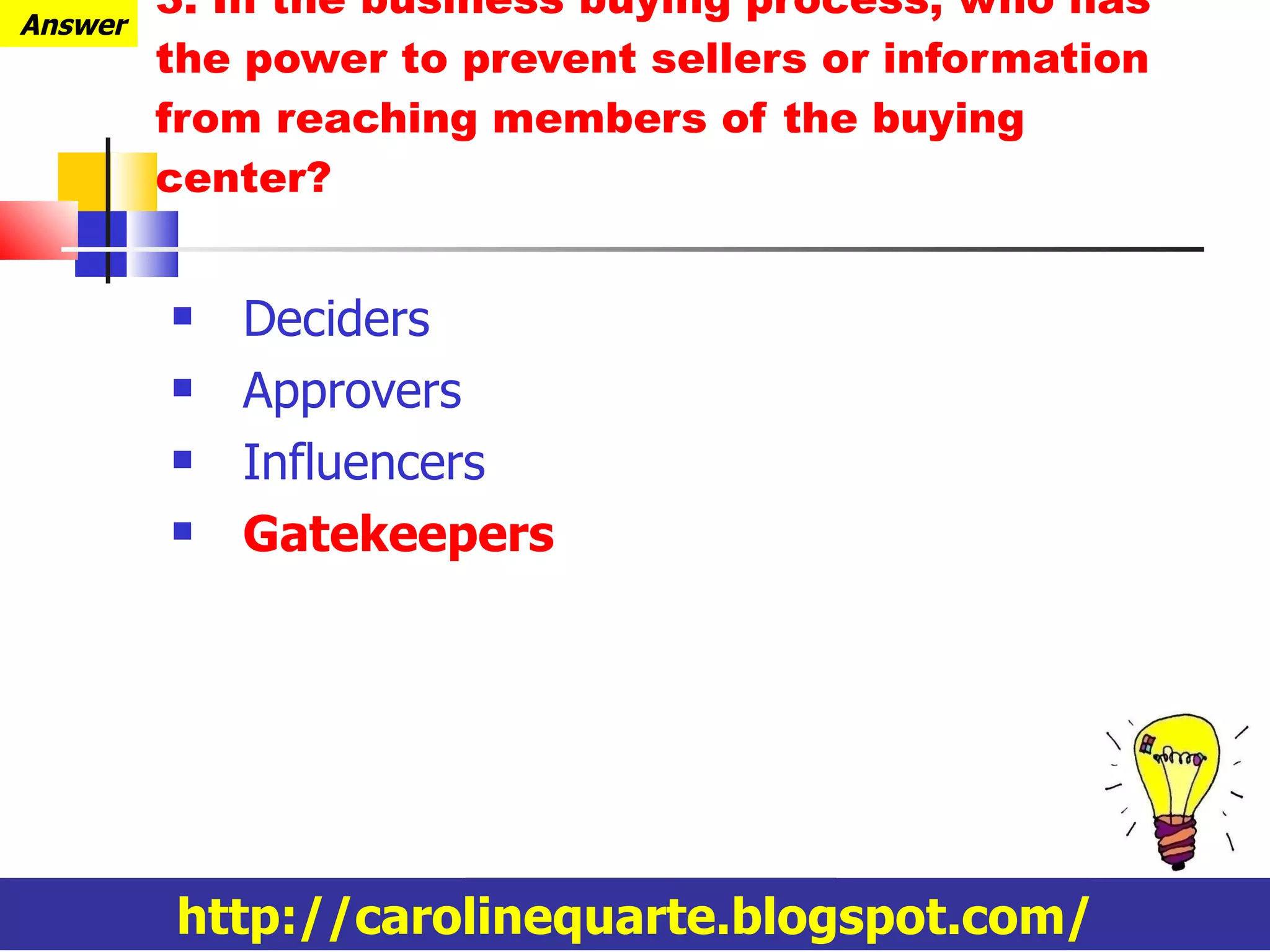
3. In the business buying process, who has the power to prevent sellers or information from reaching members of the buying center? Deciders Approvers Influencers Gatekeepers http://carolinequarte.blogspot.com/ Answer
TOP 10 Learning Questions  Ch 8: Identifying Market Segments and Targets Myrtle Frantilla / Caroline P. Quarte April 14, 2011 http://myrtlefrantilla.blogspot.com /
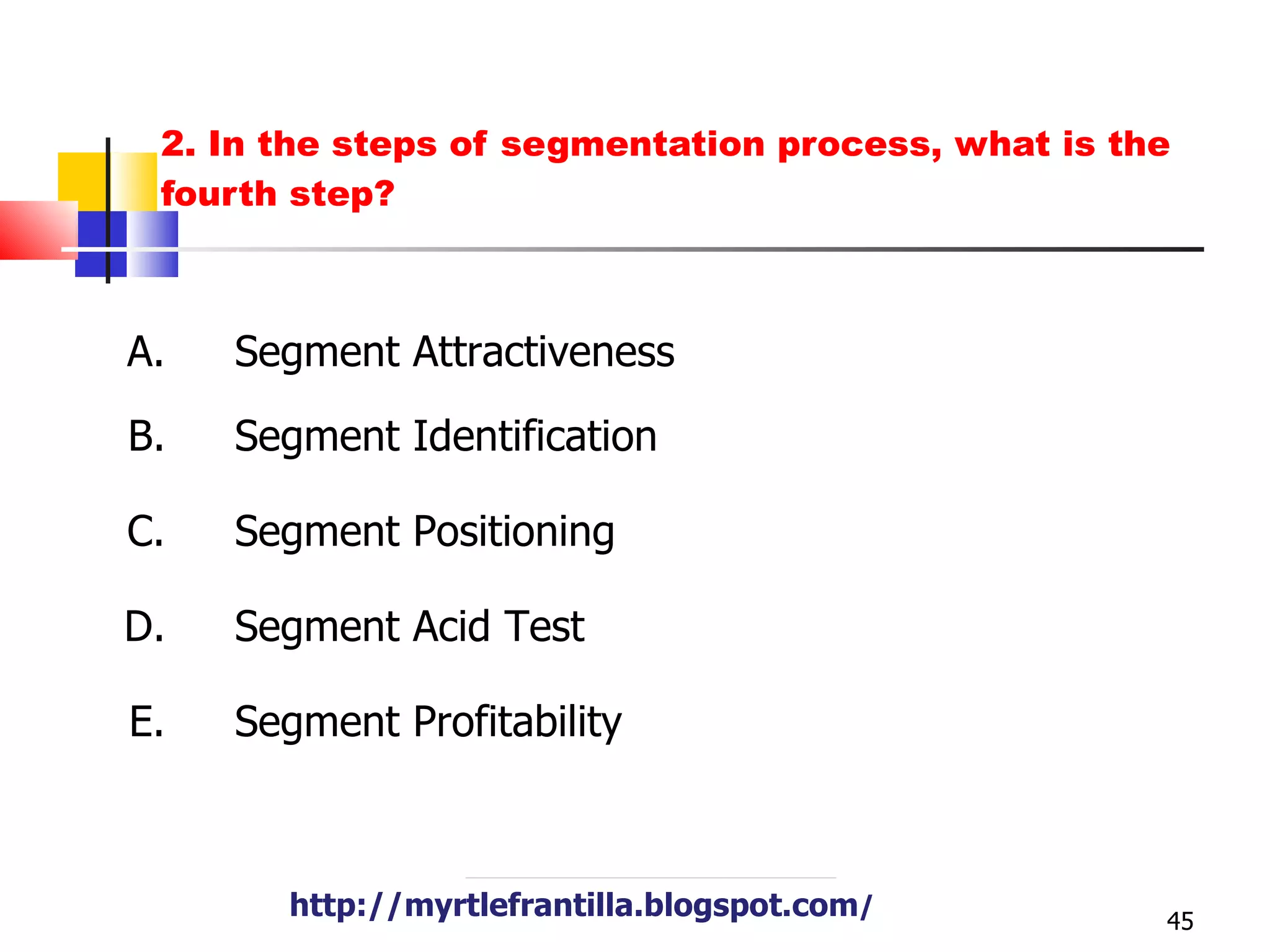
2. In the steps of segmentation process, what is the fourth step? http://myrtlefrantilla.blogspot.com / http://myrtlefrantilla.blogspot.com / A. B. C. D. E. Segment Attractiveness Segment Identification Segment Positioning Segment Acid Test Segment Profitability
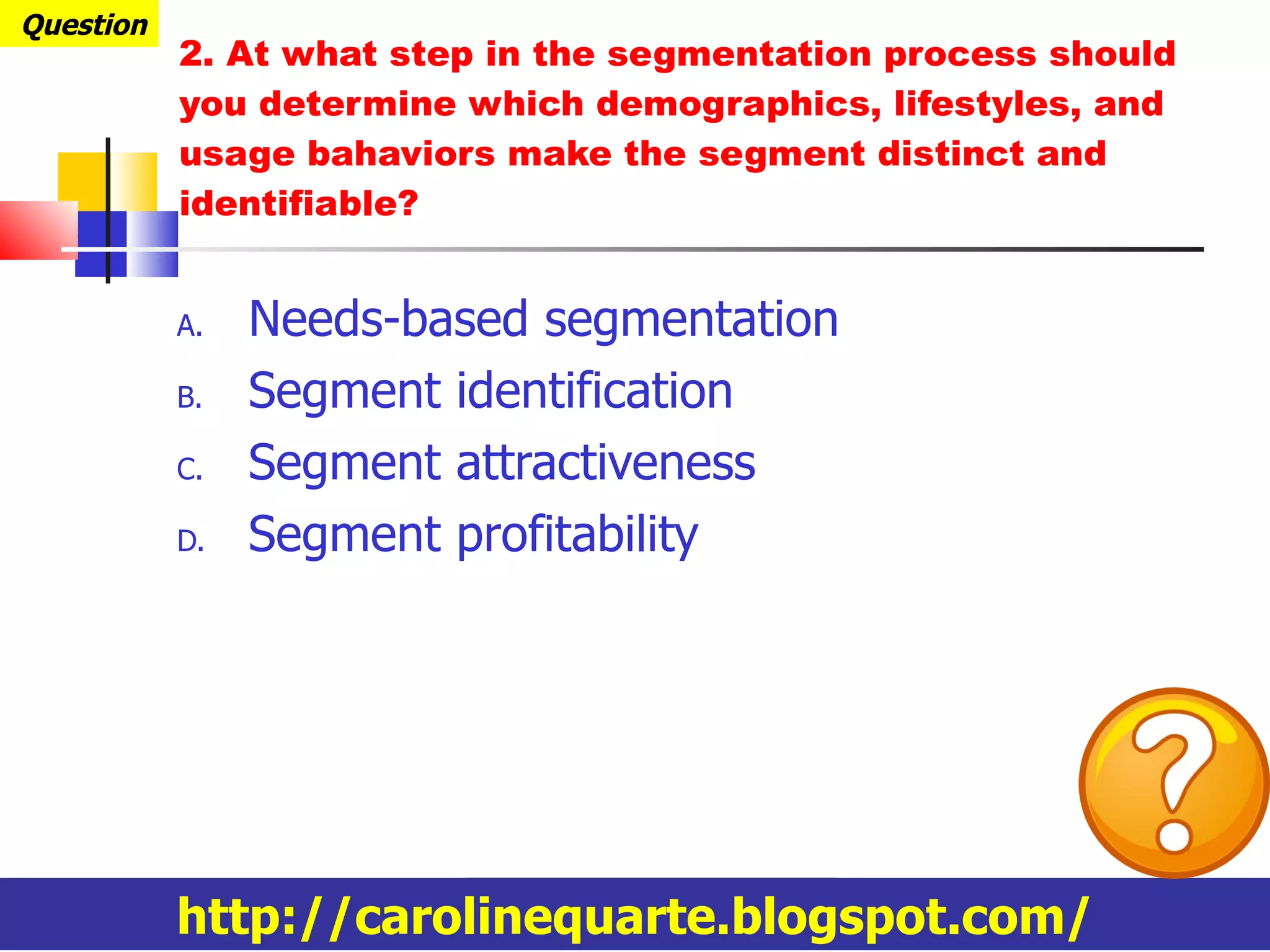
Needs-based segmentation Segment identification Segment attractiveness Segment profitability 2. At what step in the segmentation process should you determine which demographics, lifestyles, and usage bahaviors make the segment distinct and identifiable? Question http://carolinequarte.blogspot.com/
Steps in Segmentation Process Segment Identification http://myrtlefrantilla.blogspot.com / http://myrtlefrantilla.blogspot.com / Segment Attractiveness Needs-based Segmentation Segment Profitability Segment Positioning Segment Acid Test Marketing Mix Strategy
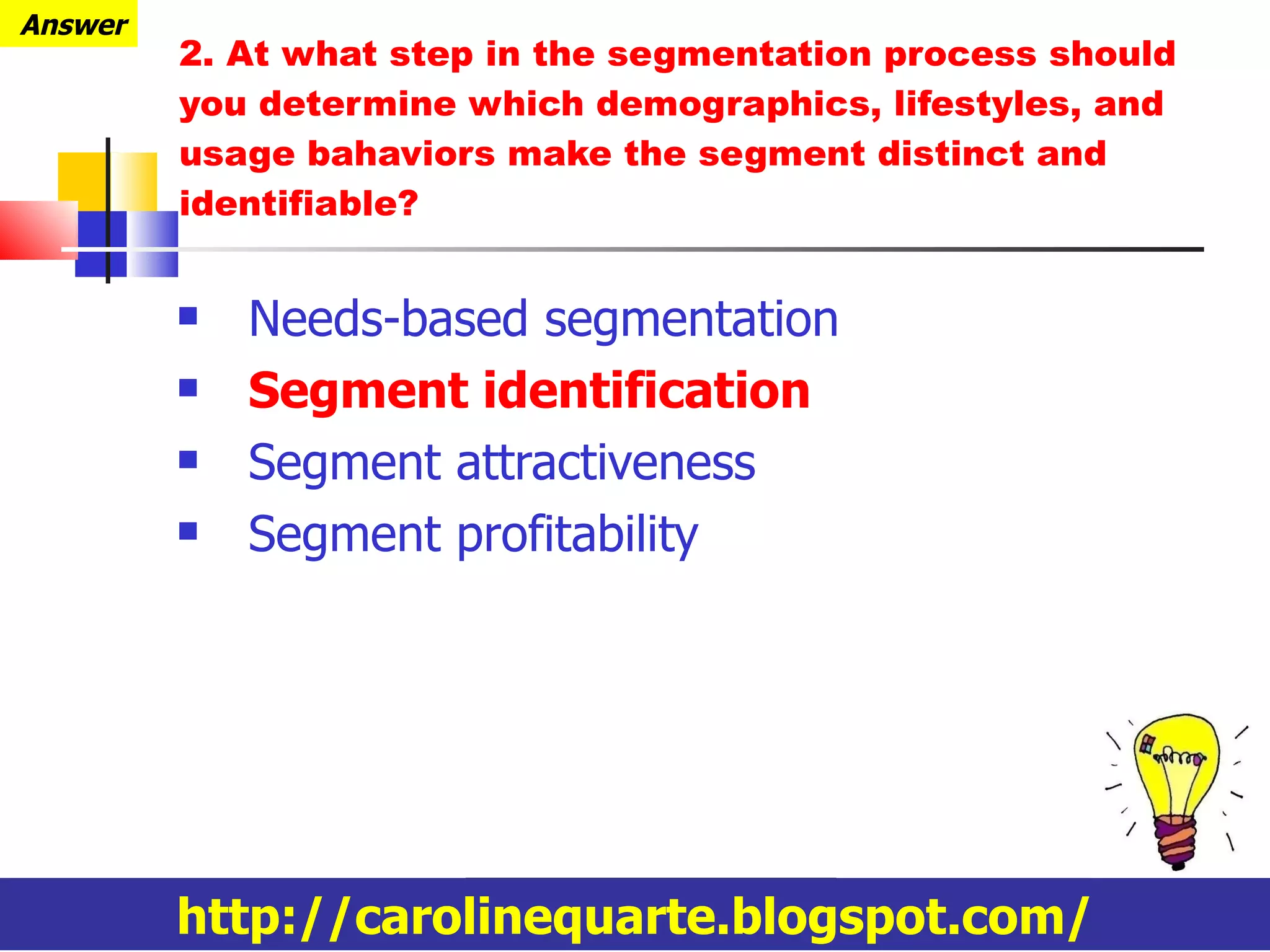
Needs-based segmentation Segment identification Segment attractiveness Segment profitability 2. At what step in the segmentation process should you determine which demographics, lifestyles, and usage bahaviors make the segment distinct and identifiable? http://carolinequarte.blogspot.com/ Answer
TOP 10 Learning Questions for Ch 9: Creating Brand Equity Soleil Gan / Caroline P. Quarte April 2011 http://taeyangxinyi.blogspot.com
10. Which of the following is not a role on a brand portfolio?  Cash Cows Flankers Low-End Entry Level Niche Marketer High-End Prestige http://taeyangxinyi.blogspot.com 39
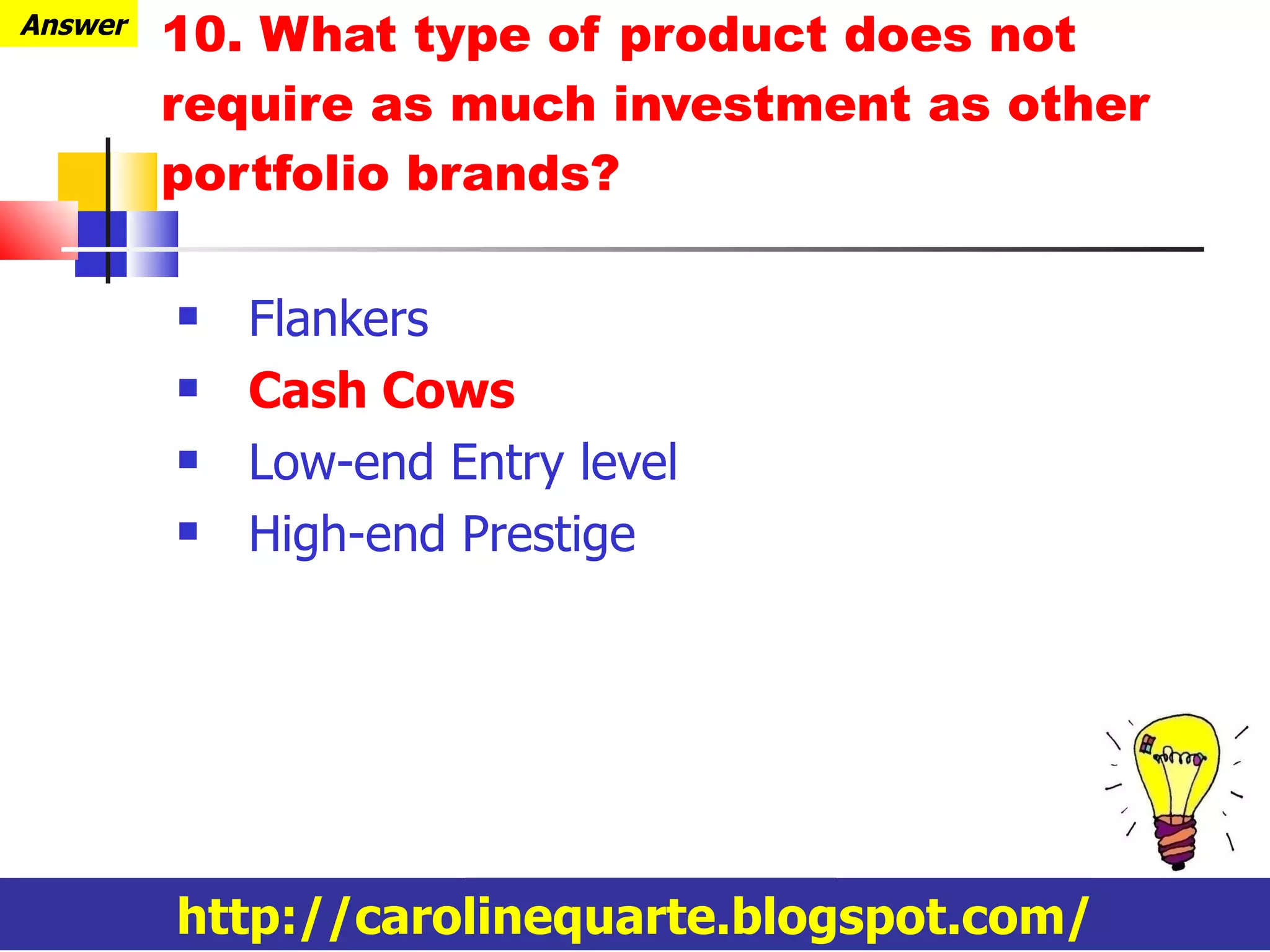
Flankers Cash Cows Low-end Entry level High-end Prestige 10. What type of product does not require as much investment as other portfolio brands? Question http://carolinequarte.blogspot.com/
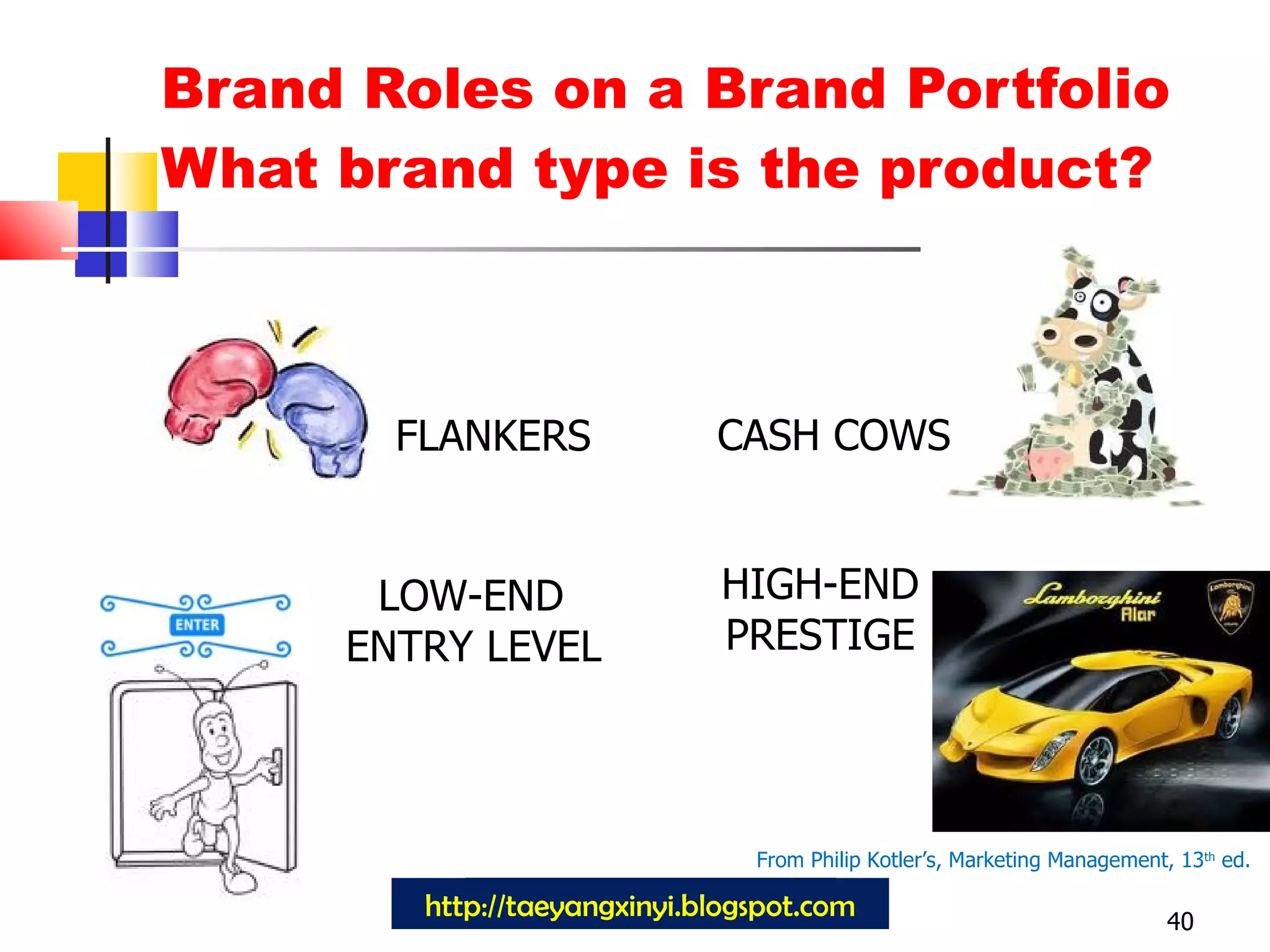
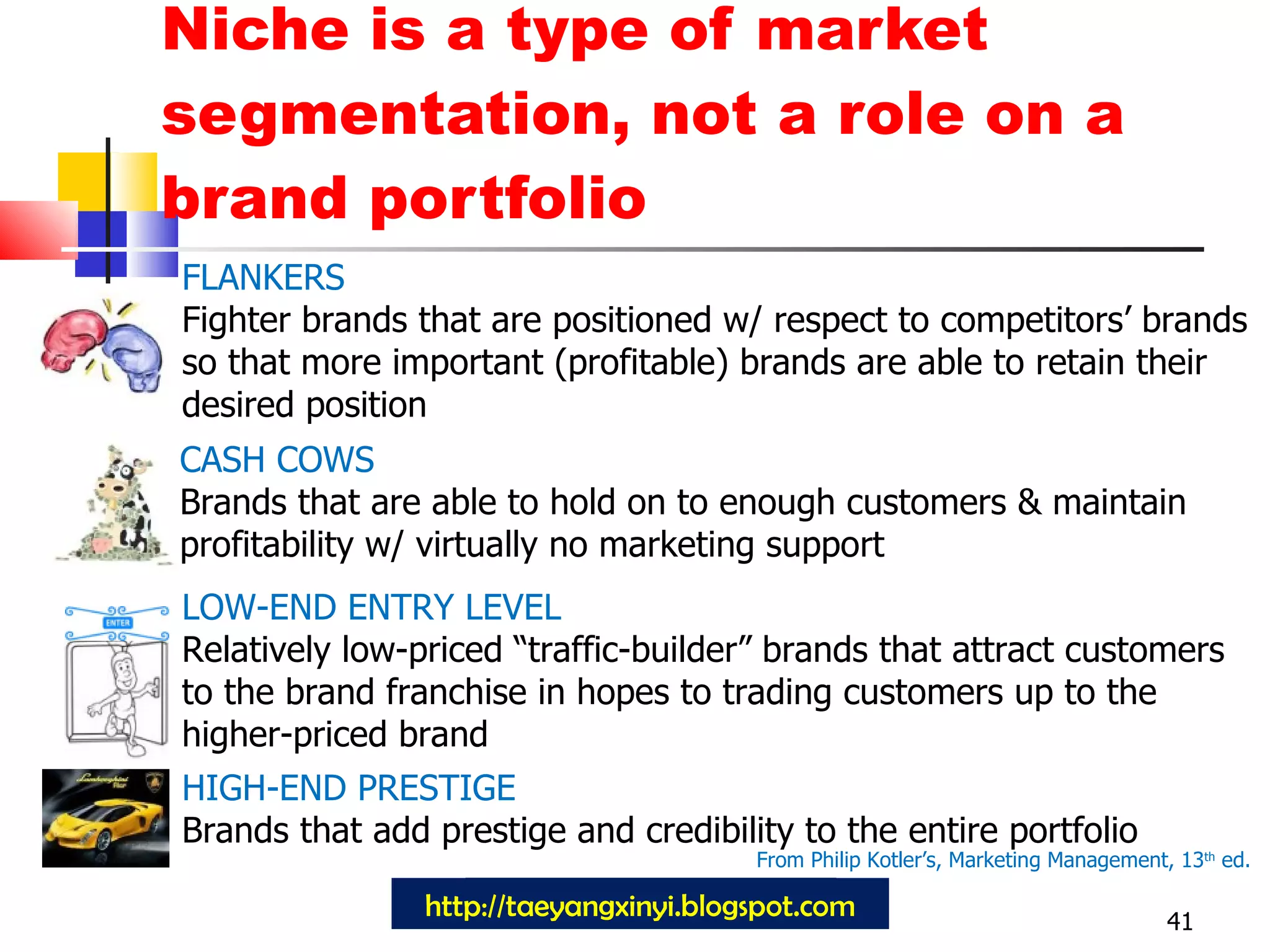
Brand Roles on a Brand Portfolio What brand type is the product? 40 http://taeyangxinyi.blogspot.com From Philip Kotler’s, Marketing Management, 13 th  ed.  FLANKERS CASH COWS LOW-END ENTRY LEVEL HIGH-END PRESTIGE
Niche is a type of market segmentation, not a role on a brand portfolio 41 http://taeyangxinyi.blogspot.com From Philip Kotler’s, Marketing Management, 13 th  ed.  FLANKERS Fighter brands that are positioned w/ respect to competitors’ brands so that more important (profitable) brands are able to retain their desired position CASH COWS Brands that are able to hold on to enough customers & maintain profitability w/ virtually no marketing support LOW-END ENTRY LEVEL Relatively low-priced “traffic-builder” brands that attract customers to the brand franchise in hopes to trading customers up to the higher-priced brand HIGH-END PRESTIGE Brands that add prestige and credibility to the entire portfolio
Flankers Cash Cows Low-end Entry level High-end Prestige 10. What type of product does not require as much investment as other portfolio brands? http://carolinequarte.blogspot.com/ Answer
TOP 10 Questions for Chapter 10: Crafting the Brand Positioning Anna Katrina L. Guray / Caroline P. Quarte April 15, 2011 http://annaguray06.blogspot.com
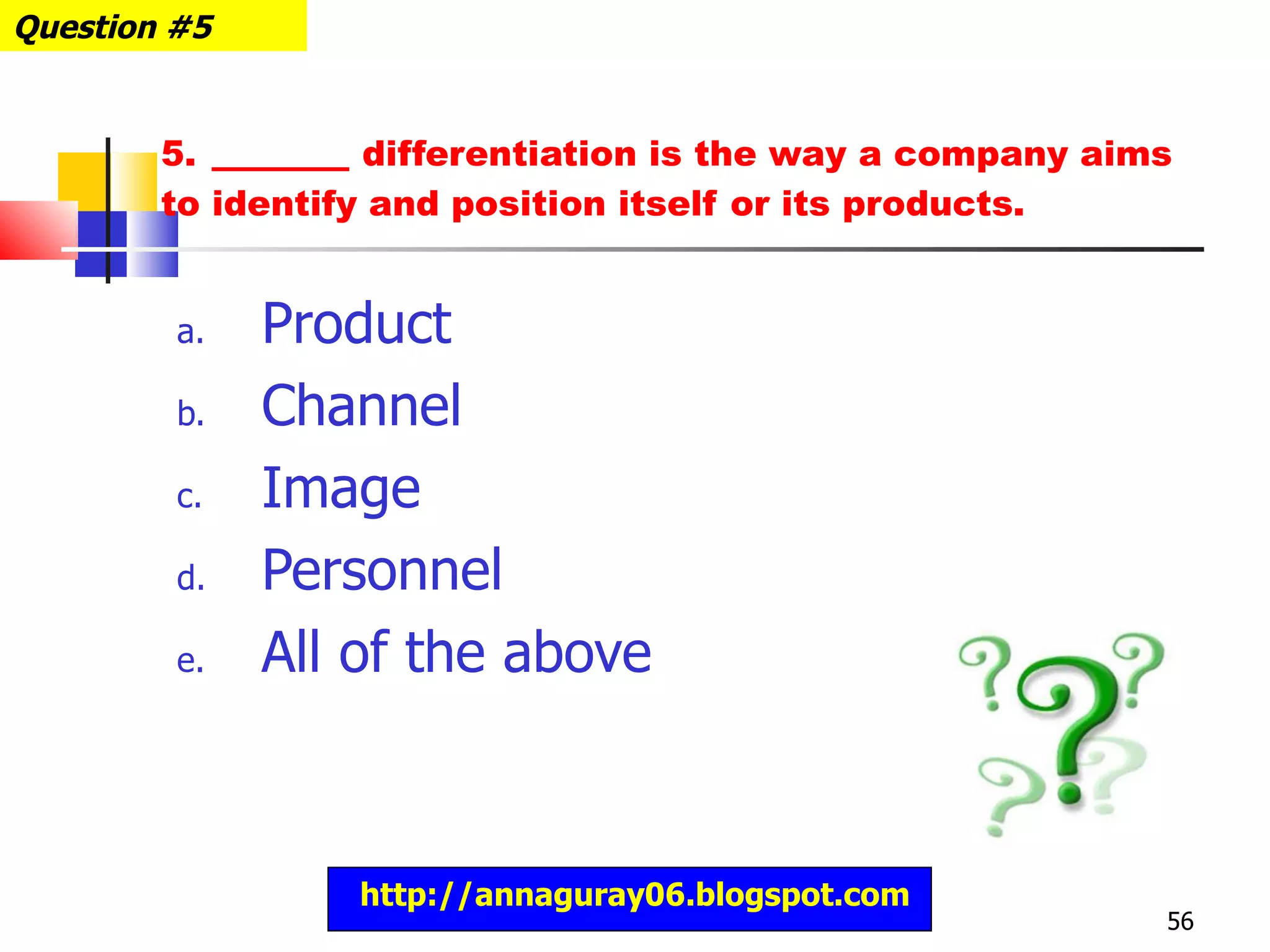
Product Channel Image Personnel All of the above 5.  differentiation is the way a company aims to identify and position itself or its products. Question #5 http://annaguray06.blogspot.com
Product differentiation Personnel differentiation Channel differentiation Image differentiation 5. _____________________ if done effectively establishes the product’s character and value proposition. Question http://carolinequarte.blogspot.com/
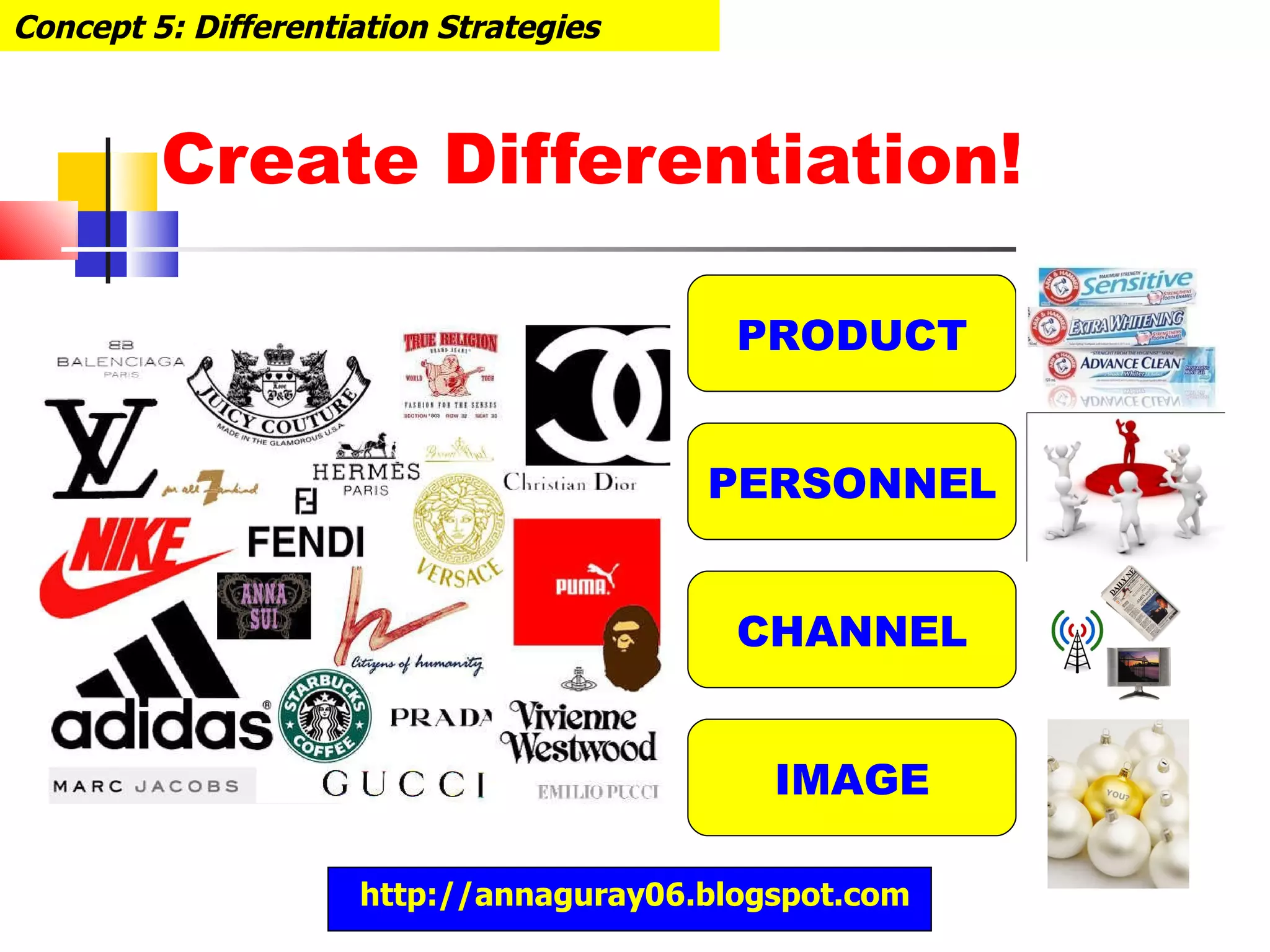
Create Differentiation! Concept 5: Differentiation Strategies PRODUCT PERSONNEL CHANNEL IMAGE http://annaguray06.blogspot.com
Product differentiation Personnel differentiation Channel differentiation Image differentiation 5. _____________________ if done effectively establishes the product’s character and value proposition. http://carolinequarte.blogspot.com/ Answer
TOP 10 Learning Concepts for Chapter 11: Dealing with Competition Lady Charmayne Hao / Caroline P. Quarte April 2011
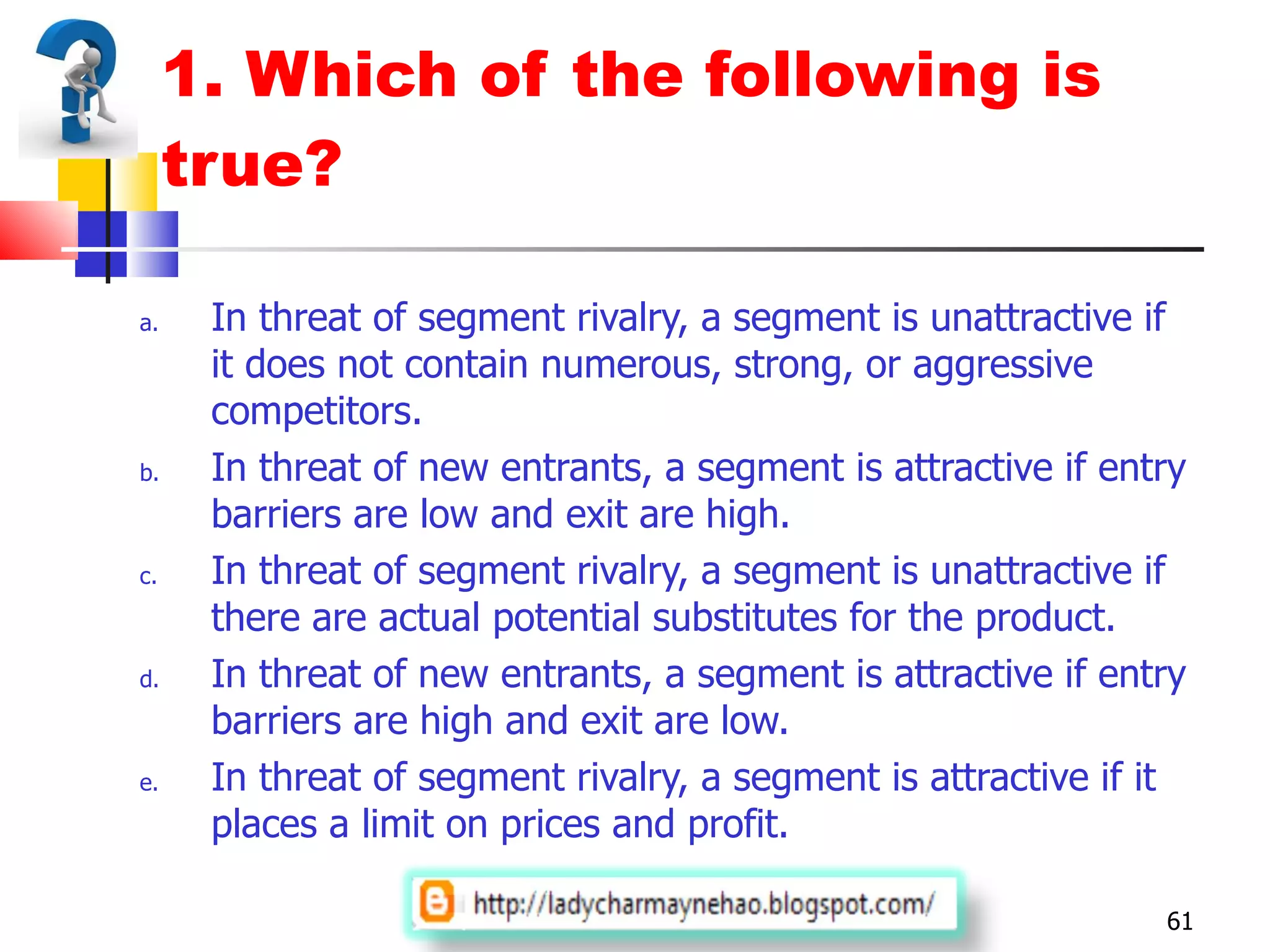
1. Which of the following is true? In threat of segment rivalry, a segment is unattractive if it does not contain numerous, strong, or aggressive competitors. In threat of new entrants, a segment is attractive if entry barriers are low and exit are high. In threat of segment rivalry, a segment is unattractive if there are actual potential substitutes for the product. In threat of new entrants, a segment is attractive if entry barriers are high and exit are low. In threat of segment rivalry, a segment is attractive if it places a limit on prices and profit.
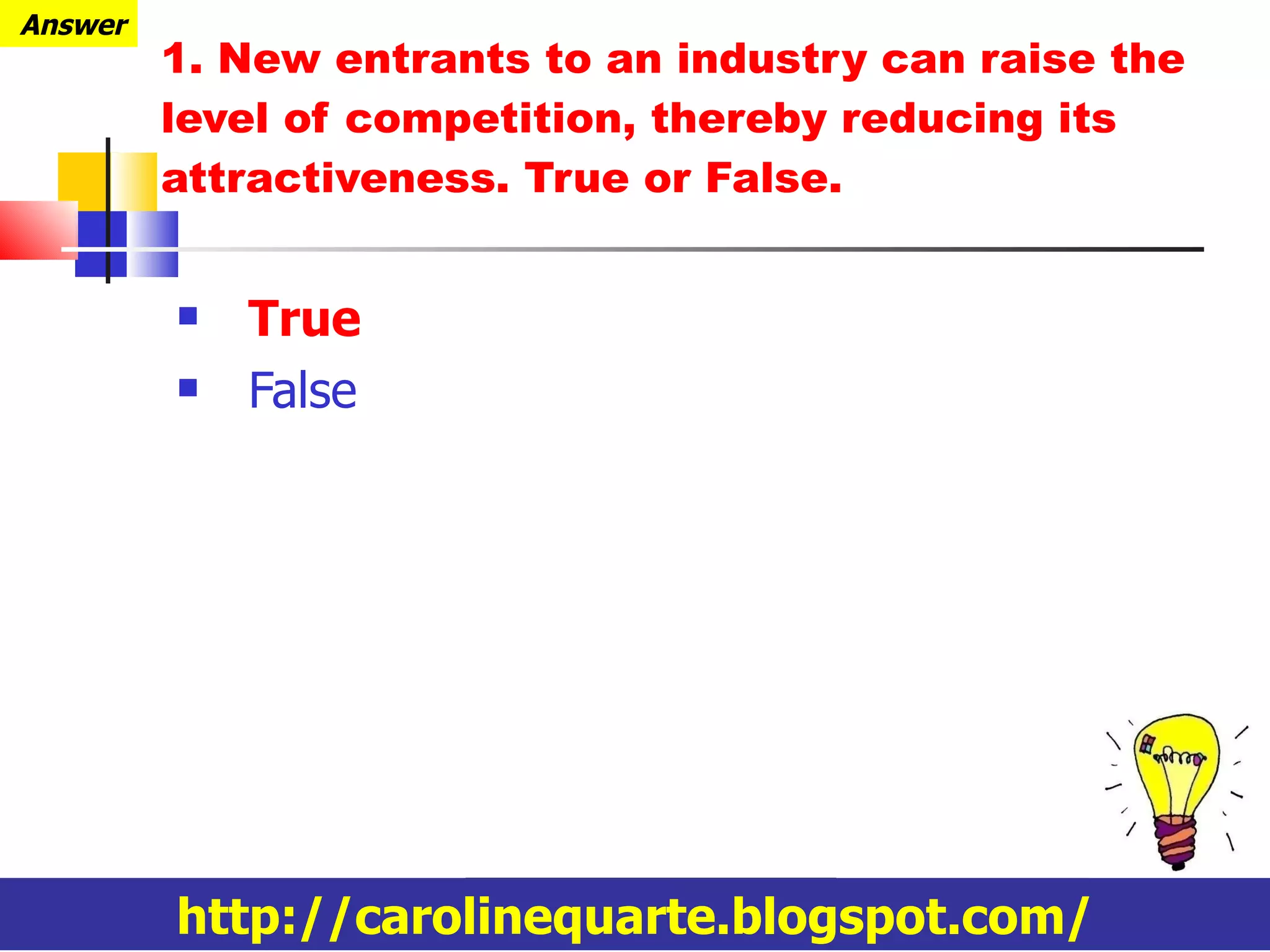
1.  New entrants to an industry can raise the level of competition, thereby reducing its attractiveness. True or False. True False Question http://carolinequarte.blogspot.com/
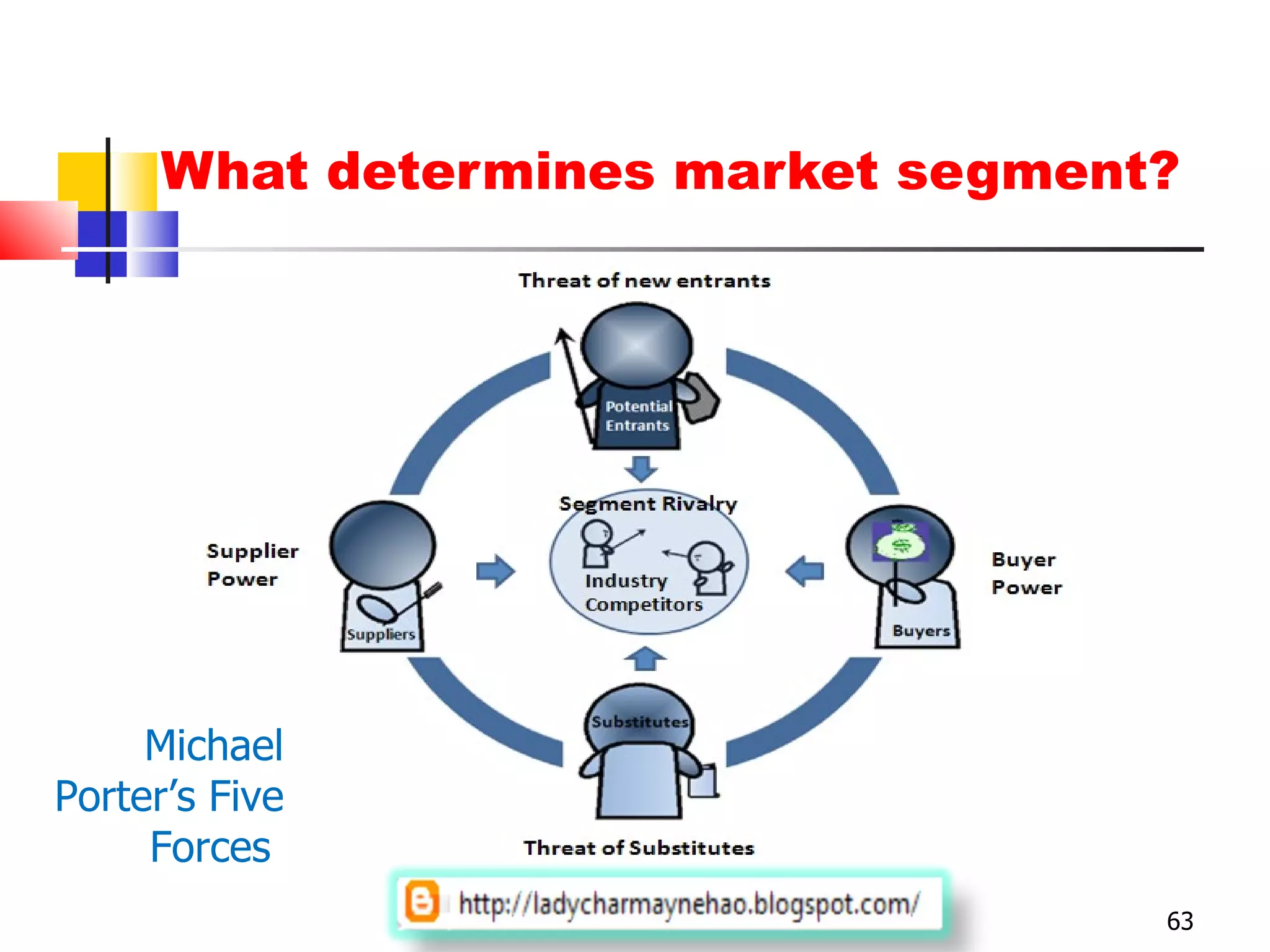
What determines market segment? Michael Porter’s Five Forces
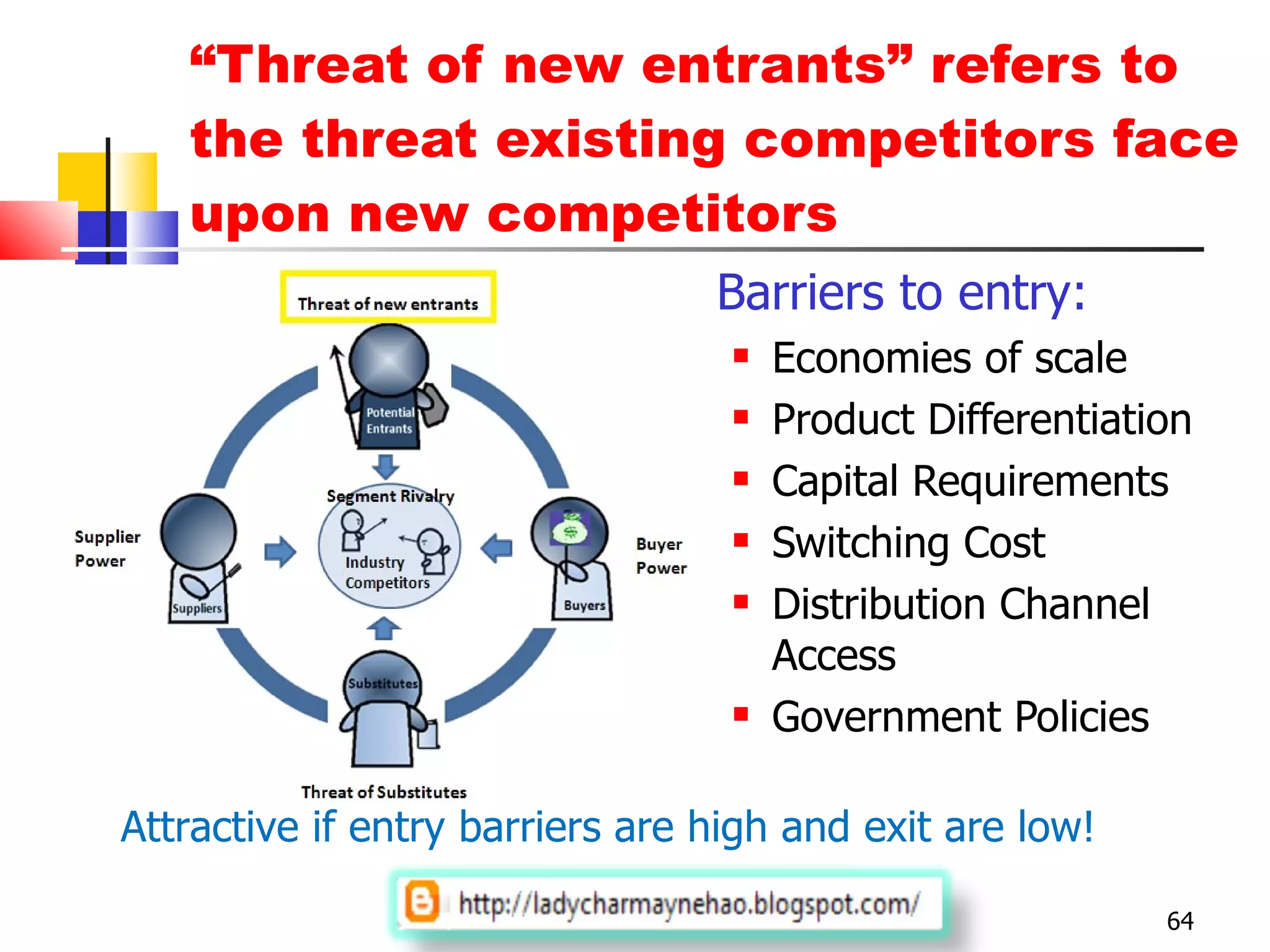
“ Threat of new entrants” refers to the  threat existing competitors face upon new competitors Barriers to entry: Economies of scale Product Differentiation Capital Requirements Switching Cost Distribution Channel Access Government Policies Attractive if entry barriers are high and exit are low!
1.  New entrants to an industry can raise the level of competition, thereby reducing its attractiveness. True or False. True False http://carolinequarte.blogspot.com/ Answer
TOP 10 Learning Questions for Ch. 12 Setting Product Strategy #28 Ivy Villamor /  Caroline P. Quarte   April 14, 2011
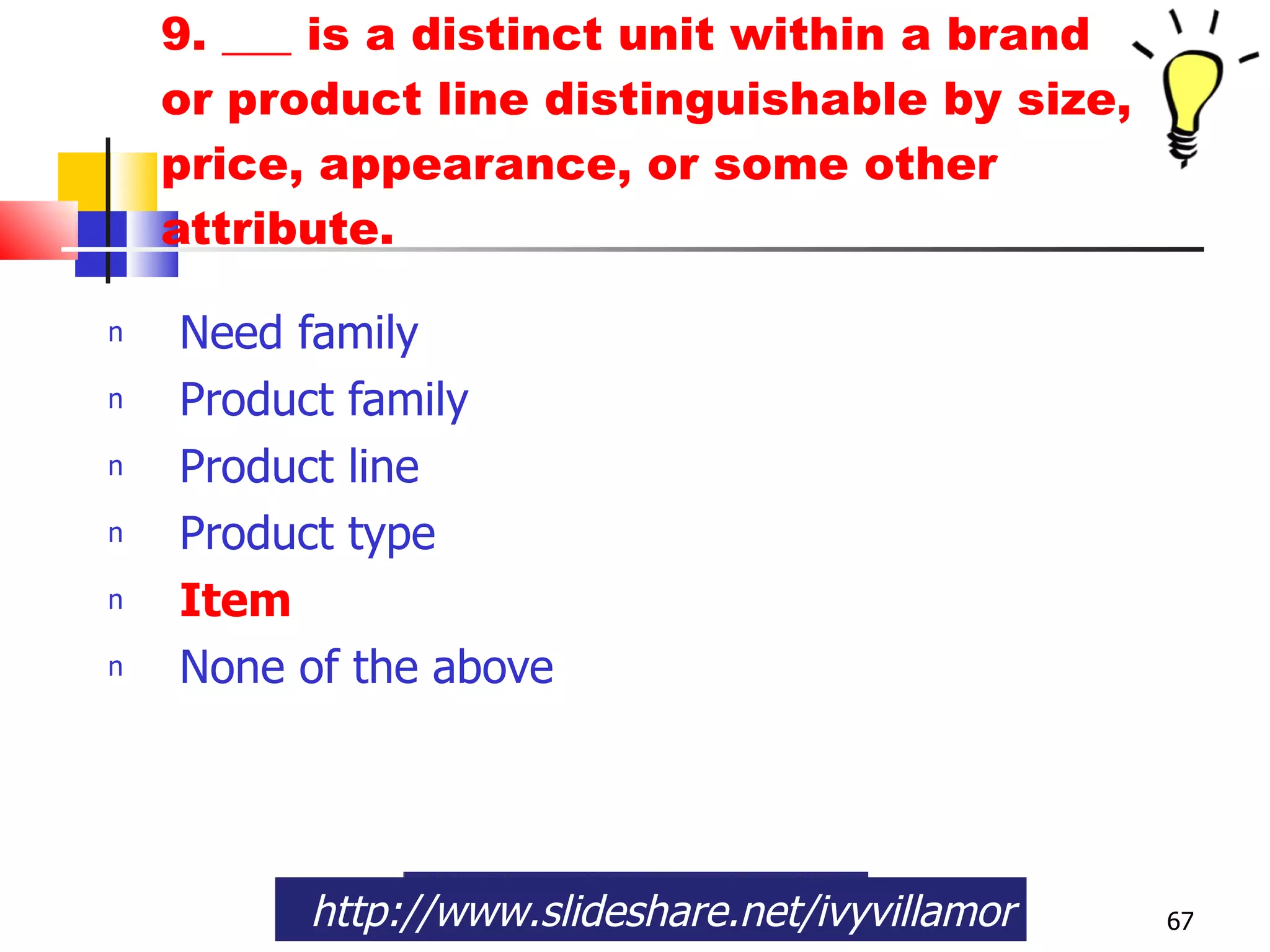
9. ___ is a distinct unit within a brand or product line distinguishable by size, price, appearance, or some other attribute. Need family Product family Product line Product type Item None of the above http://www.slideshare.net/ivyvillamor
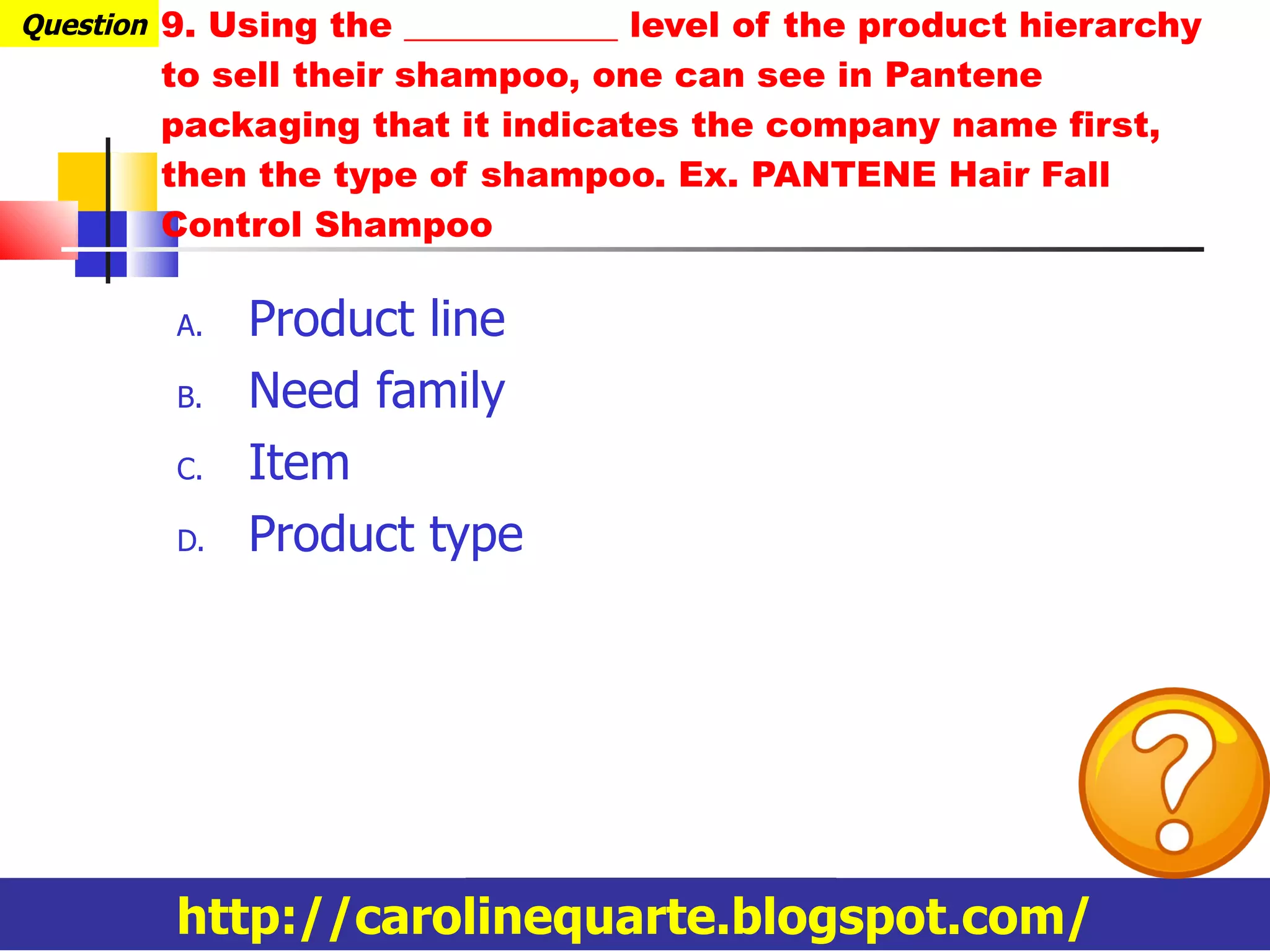
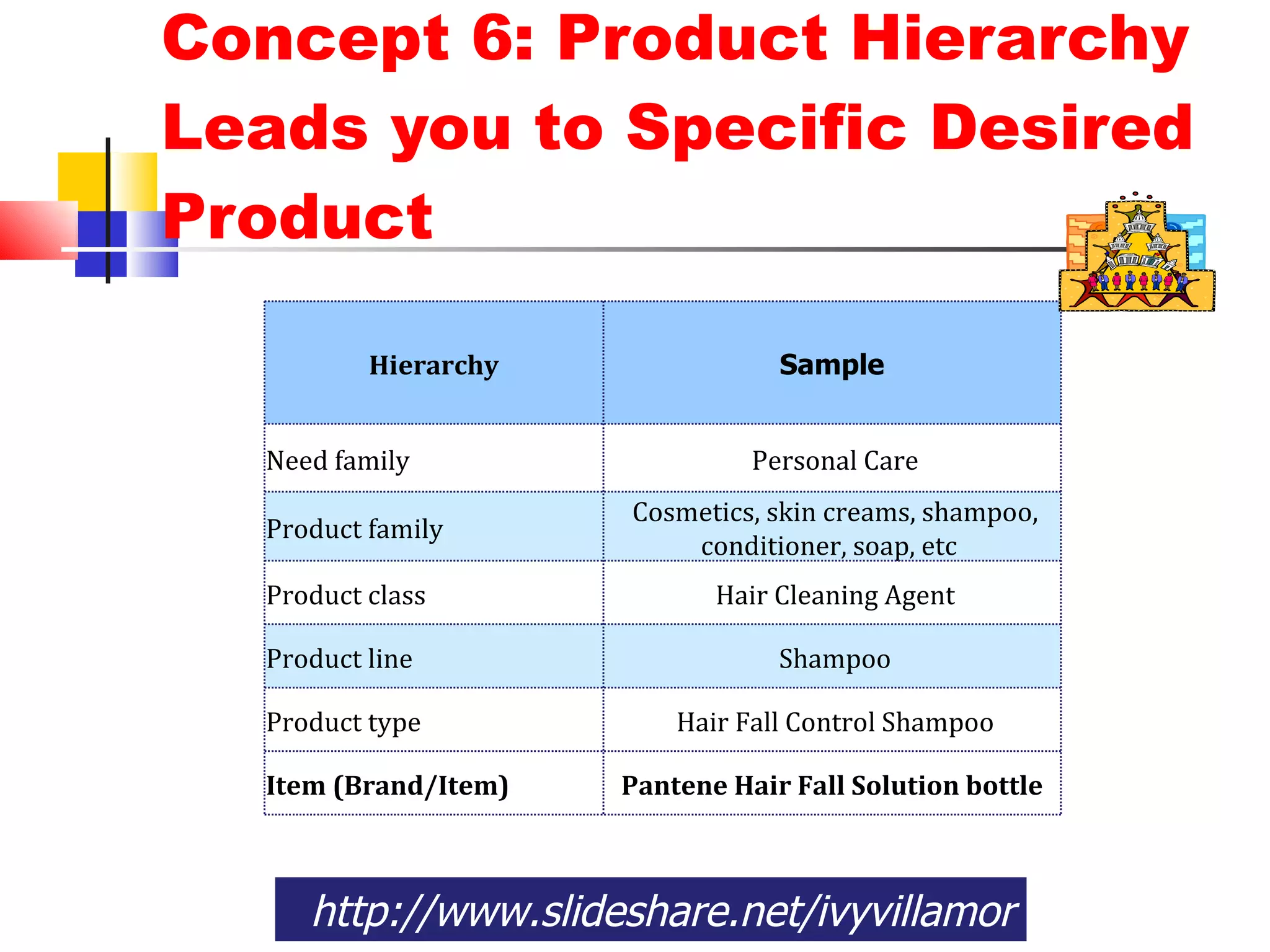
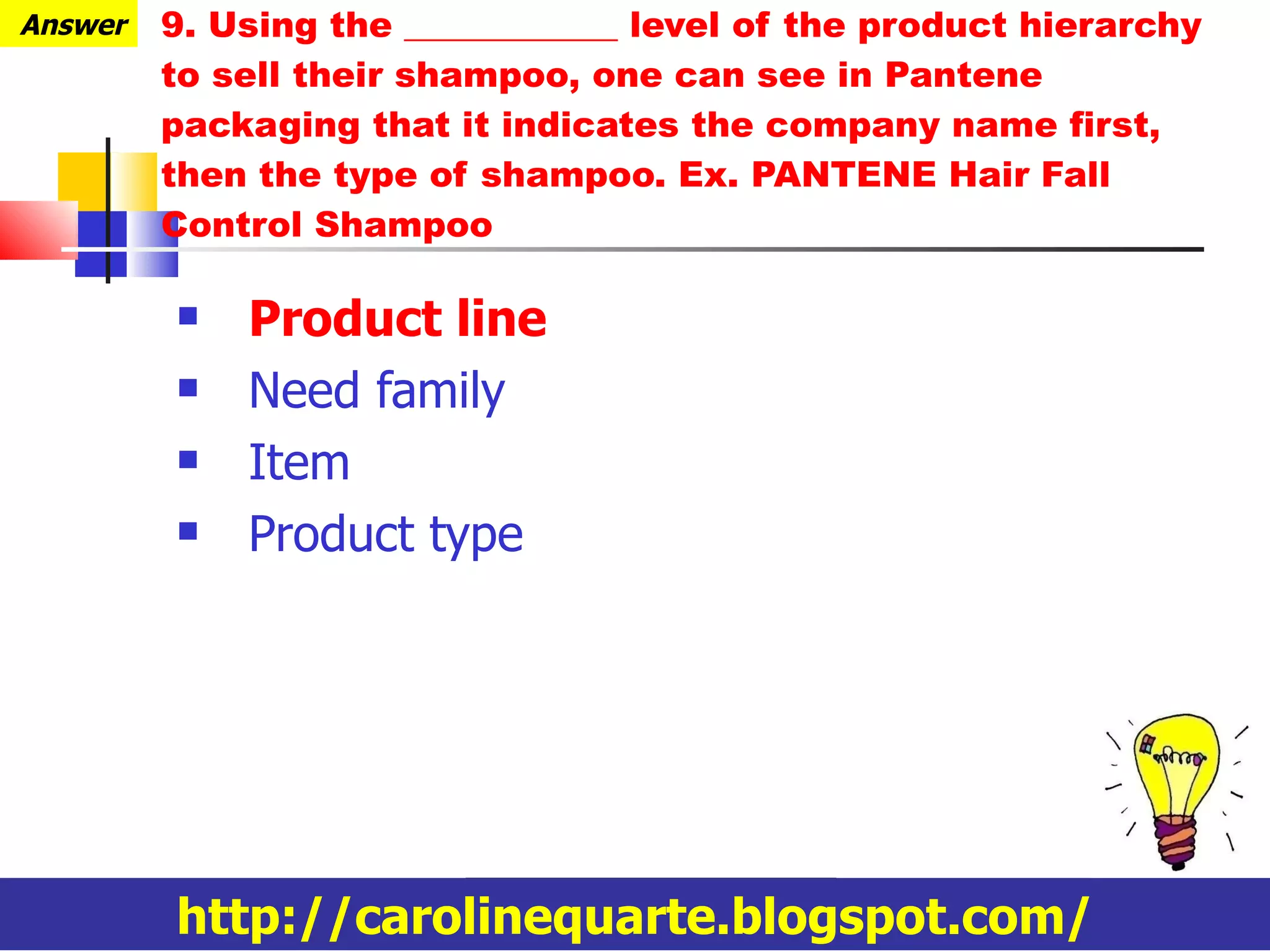
9. Using the ____________ level of the product hierarchy to sell their shampoo, one can see in Pantene packaging that it indicates the company name first, then the type of shampoo. Ex. PANTENE Hair Fall Control Shampoo Product line Need family Item Product type Question http://carolinequarte.blogspot.com/
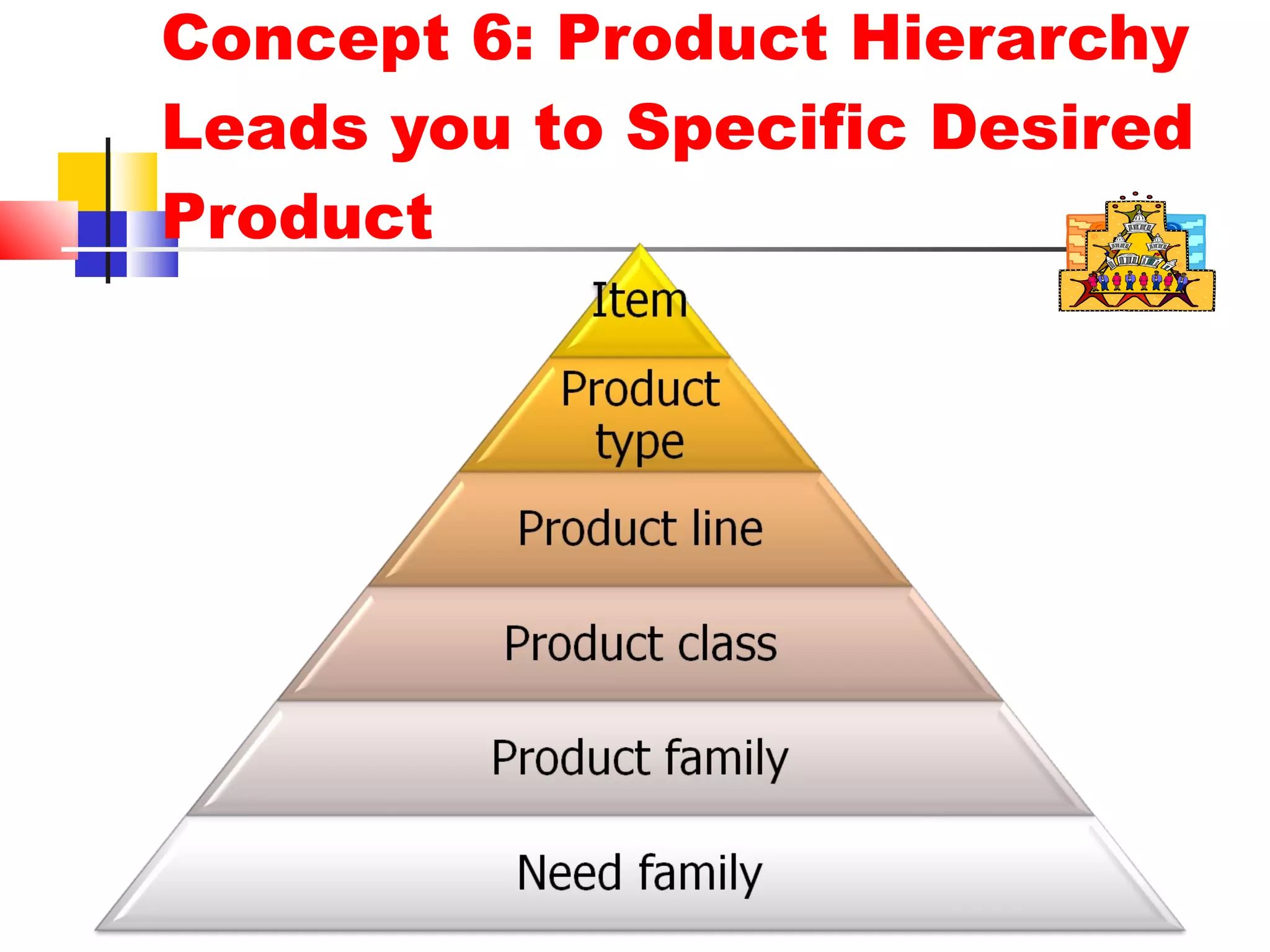
Concept 6: Product Hierarchy Leads you to Specific Desired Product
Concept 6: Product Hierarchy Leads you to Specific Desired Product http://www.slideshare.net/ivyvillamor Hierarchy Sample Need family   Personal Care Product family   Cosmetics, skin creams, shampoo, conditioner, soap, etc  Product class   Hair Cleaning Agent Product line   Shampoo Product type   Hair Fall Control Shampoo Item (Brand/Item) Pantene Hair Fall Solution bottle
9. Using the ____________ level of the product hierarchy to sell their shampoo, one can see in Pantene packaging that it indicates the company name first, then the type of shampoo. Ex. PANTENE Hair Fall Control Shampoo Product line Need family Item Product type http://carolinequarte.blogspot.com/ Answer
TOP 10 Learning Questions Ch 13 Designing and Managing Services Ronald Patrick G. Wenceslao Caroline P. Quarte April 2011 rgwenceslao.blogspot.com
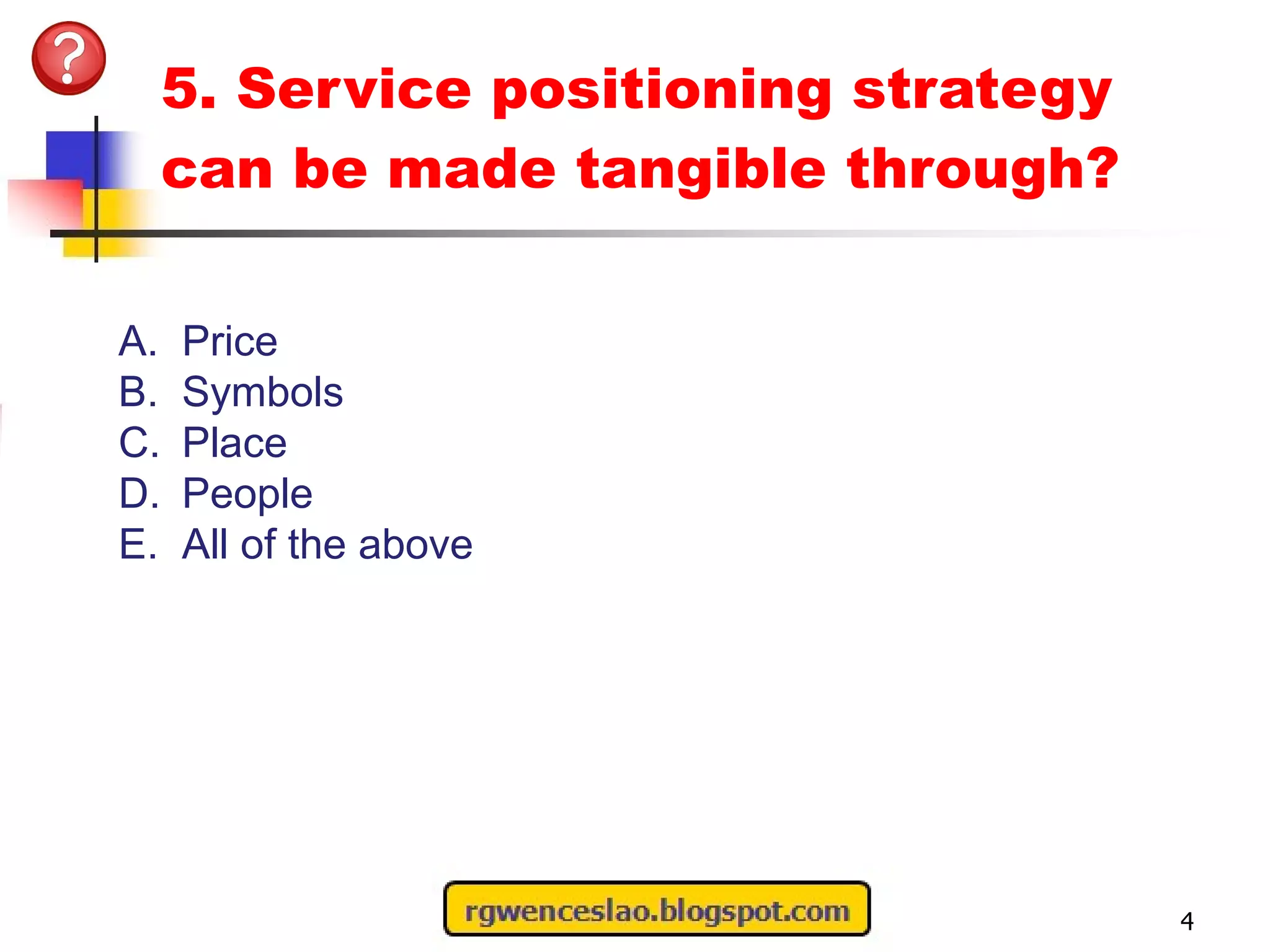
5. Service positioning strategy can be made tangible through? 4 Price Symbols Place People All of the above
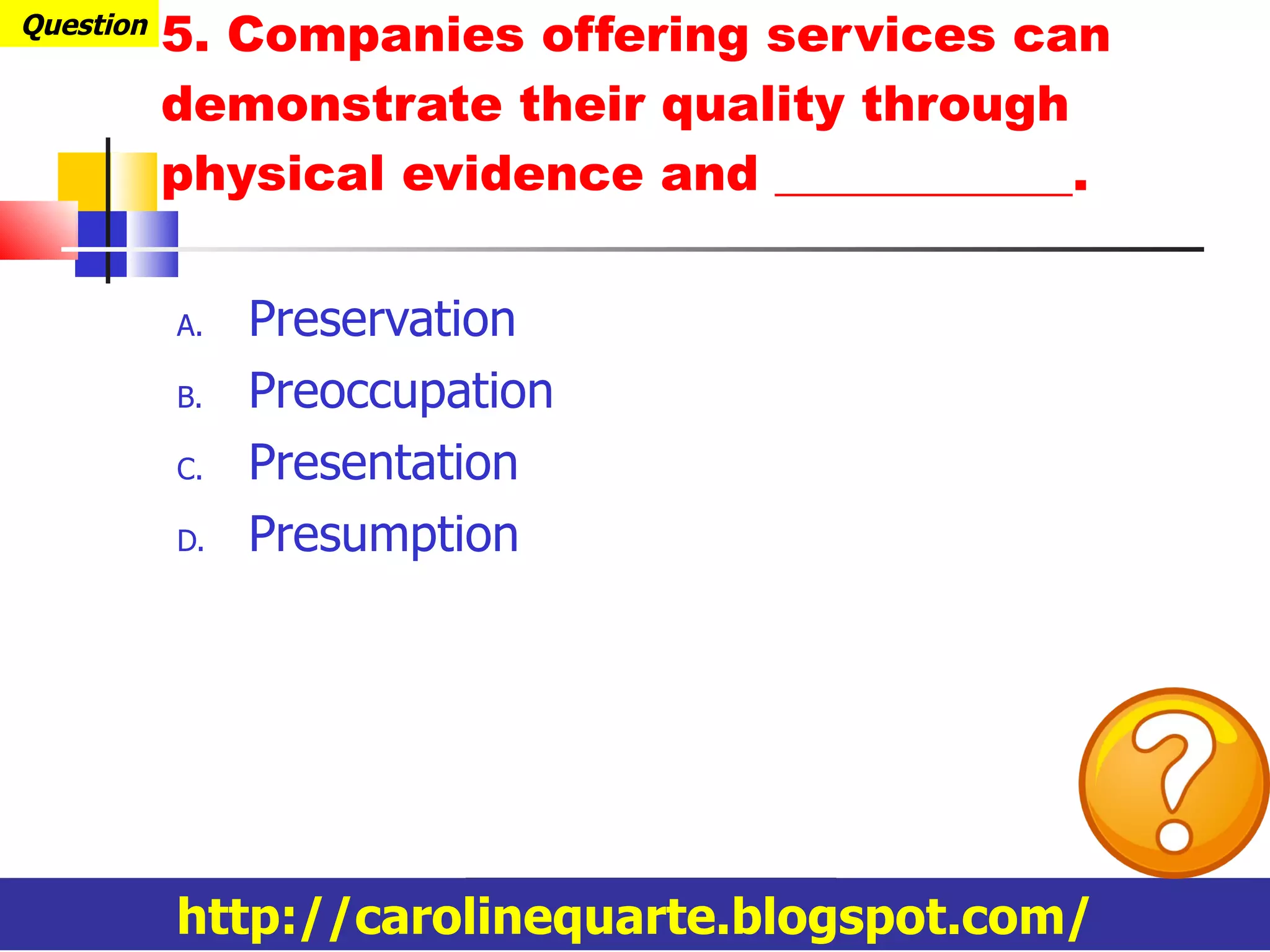
5. Companies offering services can demonstrate their quality through physical evidence and ____________. Preservation Preoccupation Presentation Presumption Question http://carolinequarte.blogspot.com/
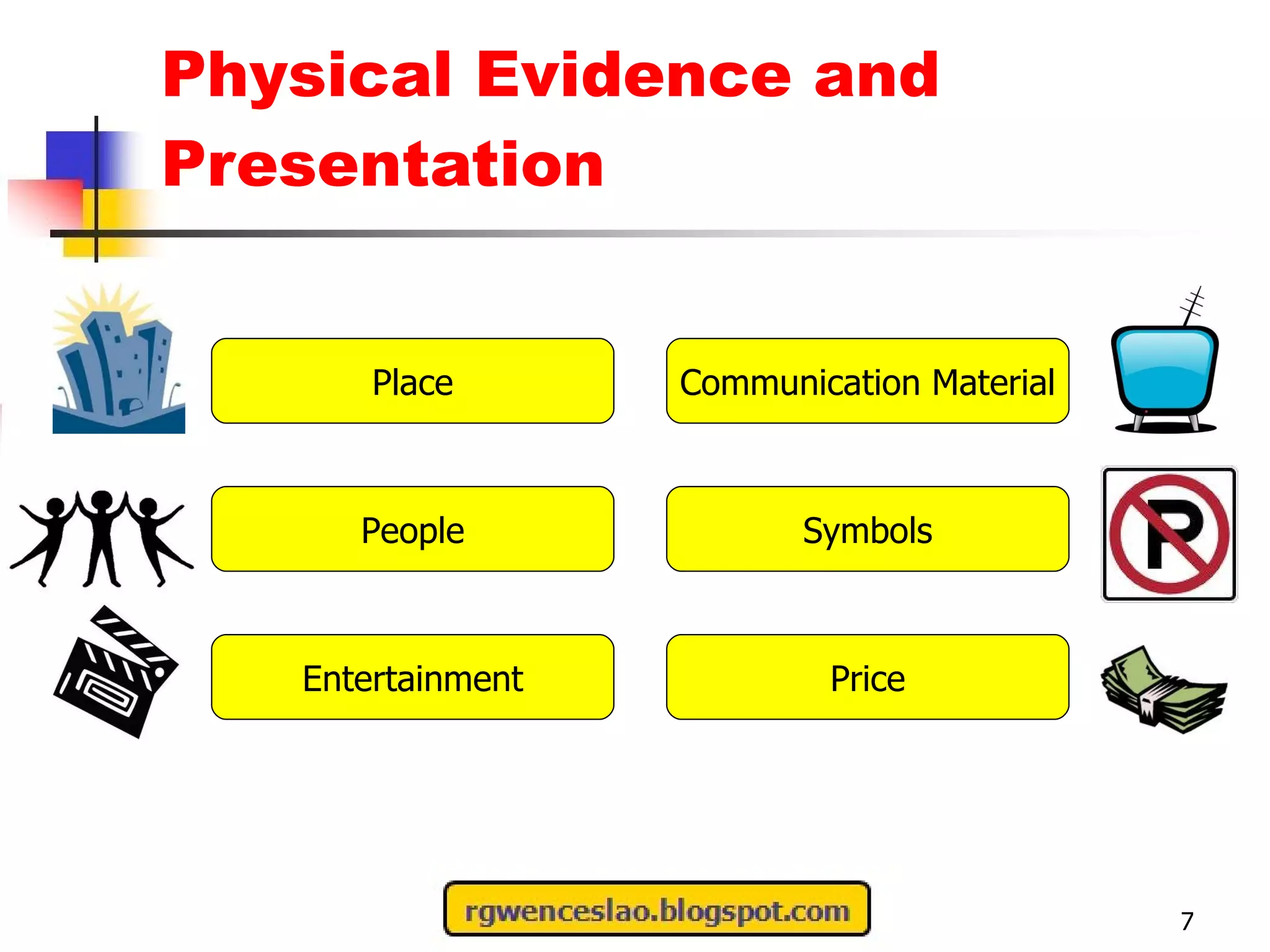
Physical Evidence and Presentation 7 Place People Entertainment Communication Material Symbols Price
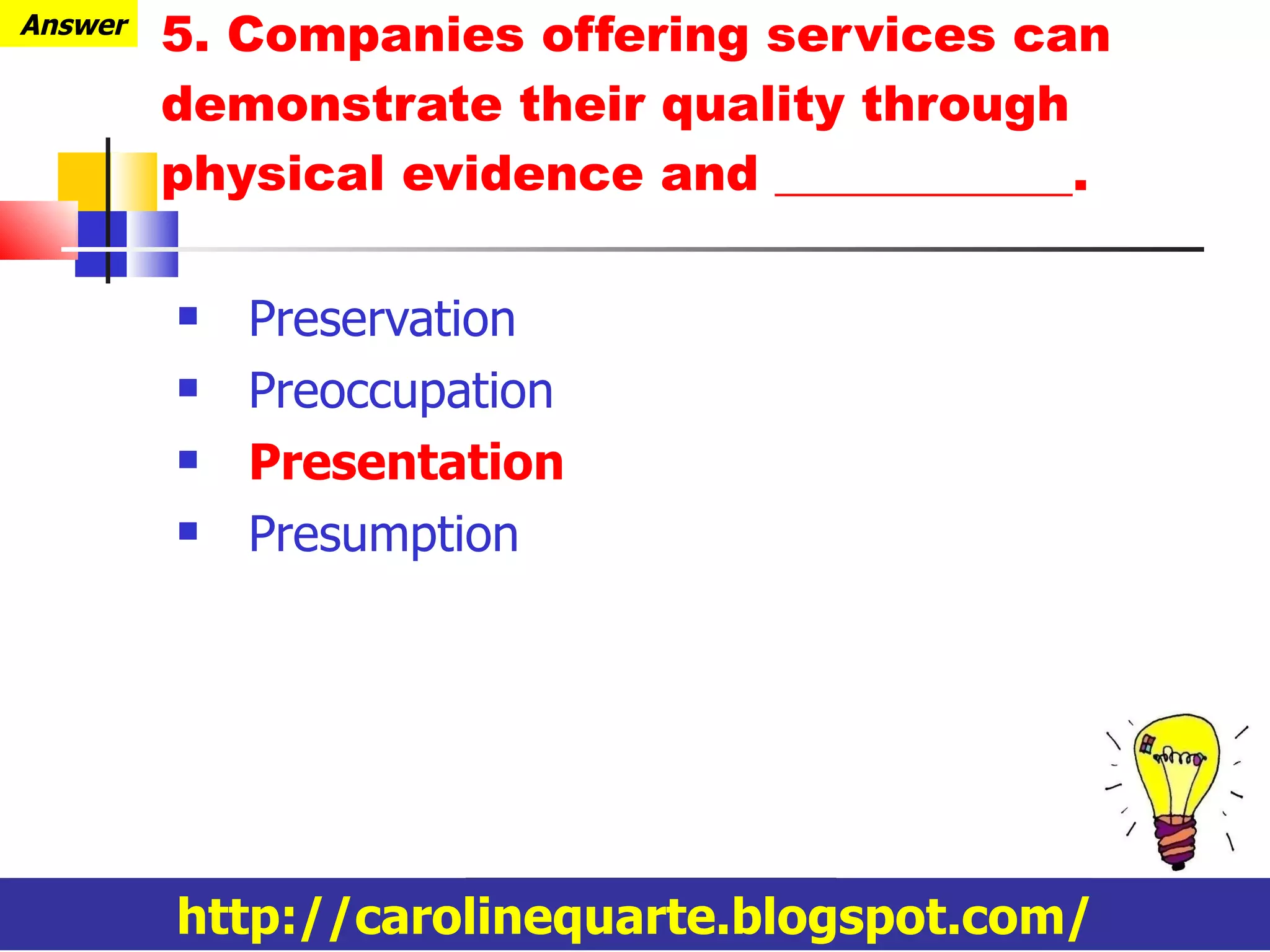
5. Companies offering services can demonstrate their quality through physical evidence and ____________. Preservation Preoccupation Presentation Presumption http://carolinequarte.blogspot.com/ Answer
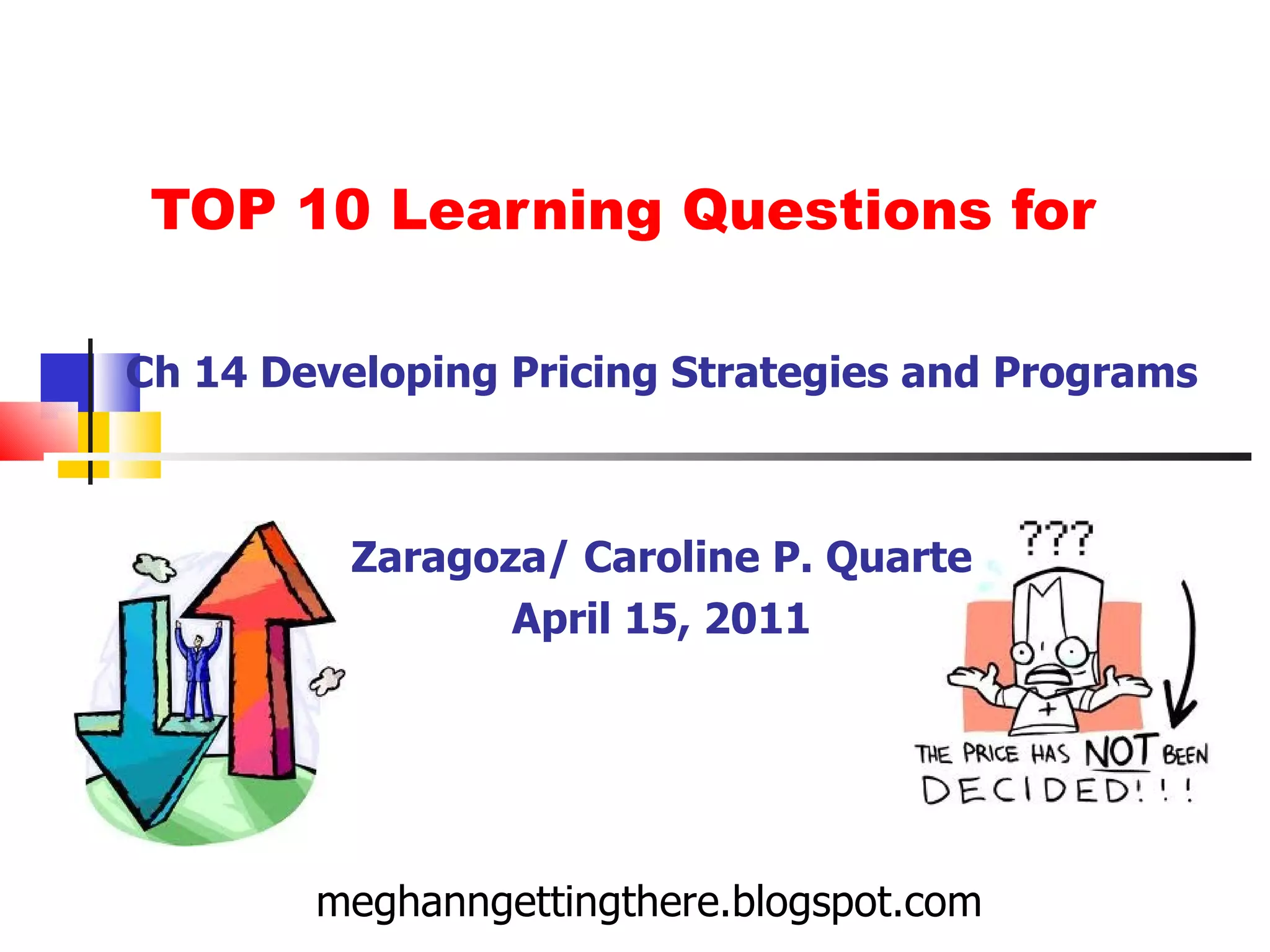
TOP 10 Learning Questions for Ch 14 Developing Pricing Strategies and Programs Zaragoza/ Caroline P. Quarte April 15, 2011 meghanngettingthere.blogspot.com
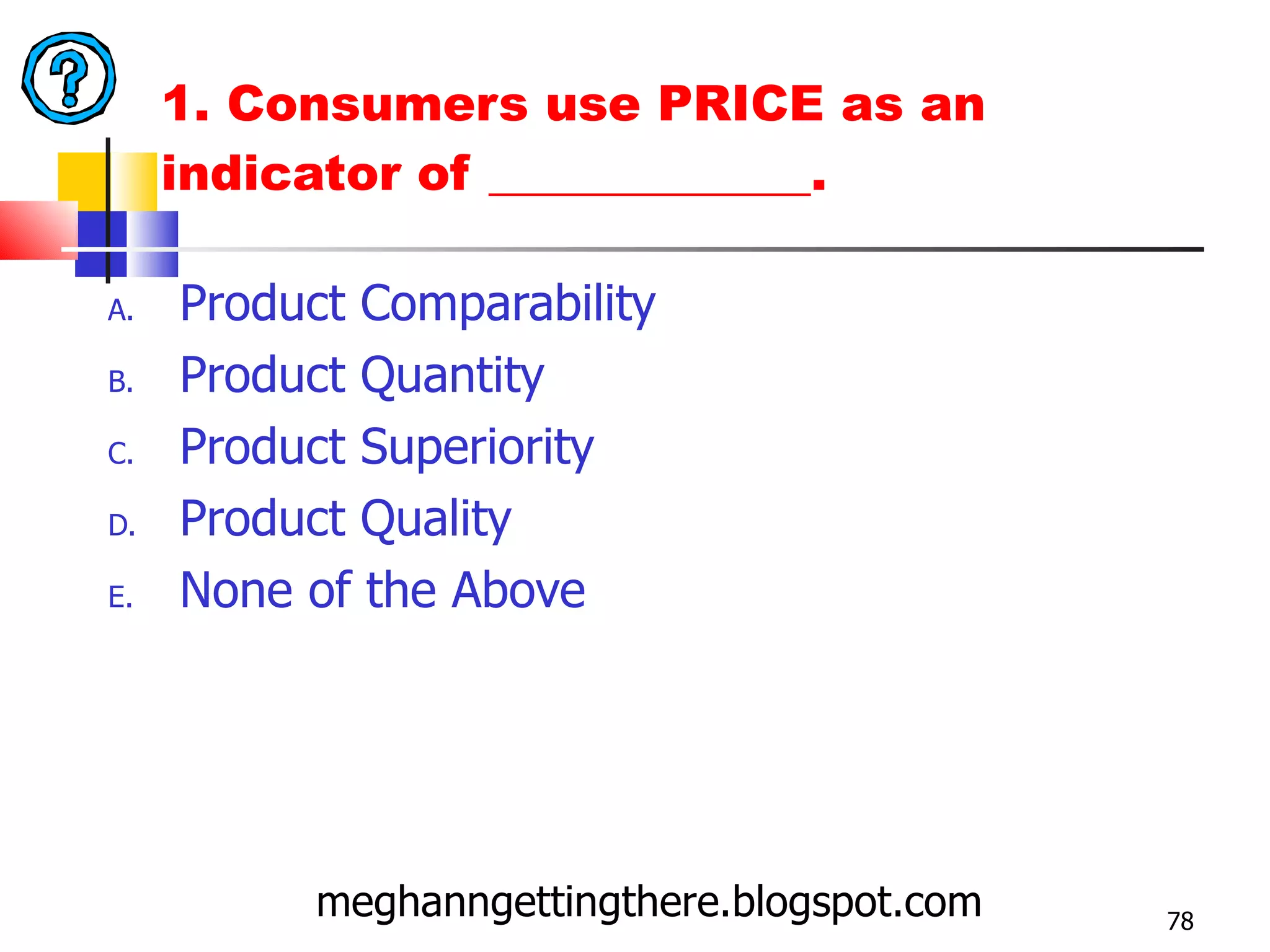
1. Consumers use PRICE as an indicator of _____________. Product Comparability Product Quantity Product Superiority Product Quality None of the Above meghanngettingthere.blogspot.com
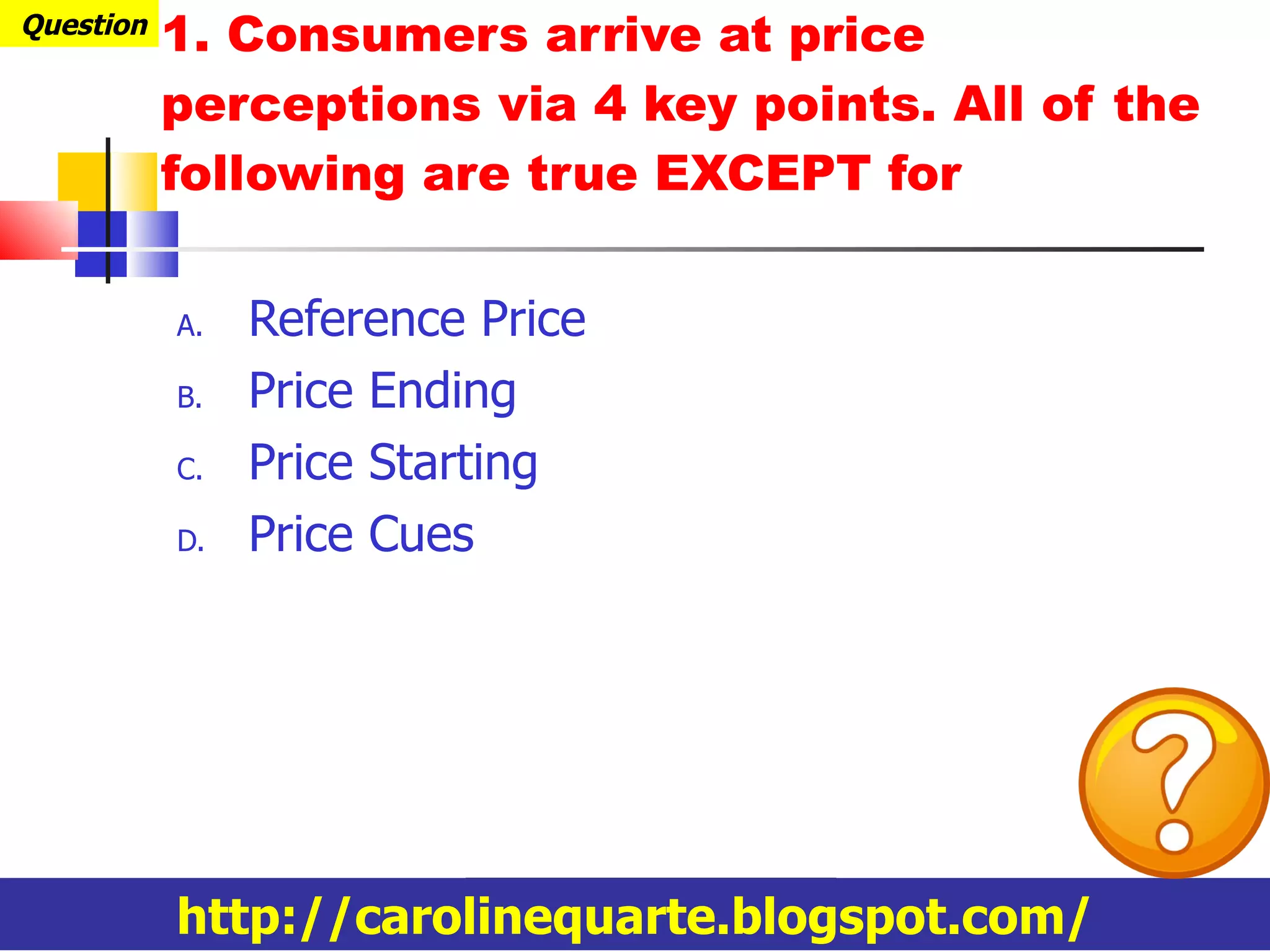
Reference Price Price Ending Price Starting Price Cues 1. Consumers arrive at price perceptions via 4 key points. All of the following are true EXCEPT for  Question http://carolinequarte.blogspot.com/
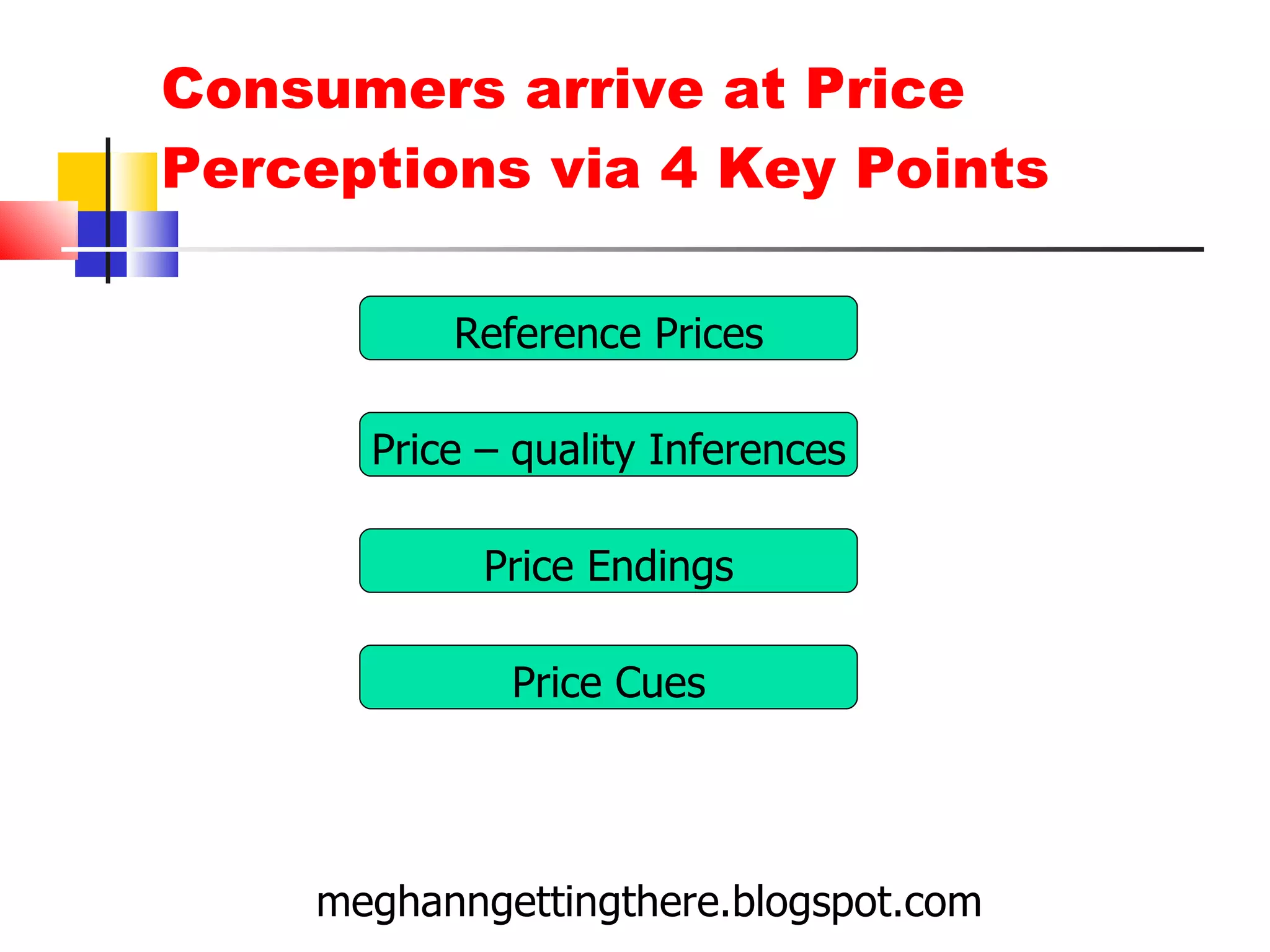
Consumers arrive at Price Perceptions via 4 Key Points meghanngettingthere.blogspot.com Reference Prices Price – quality Inferences Price Endings Price Cues
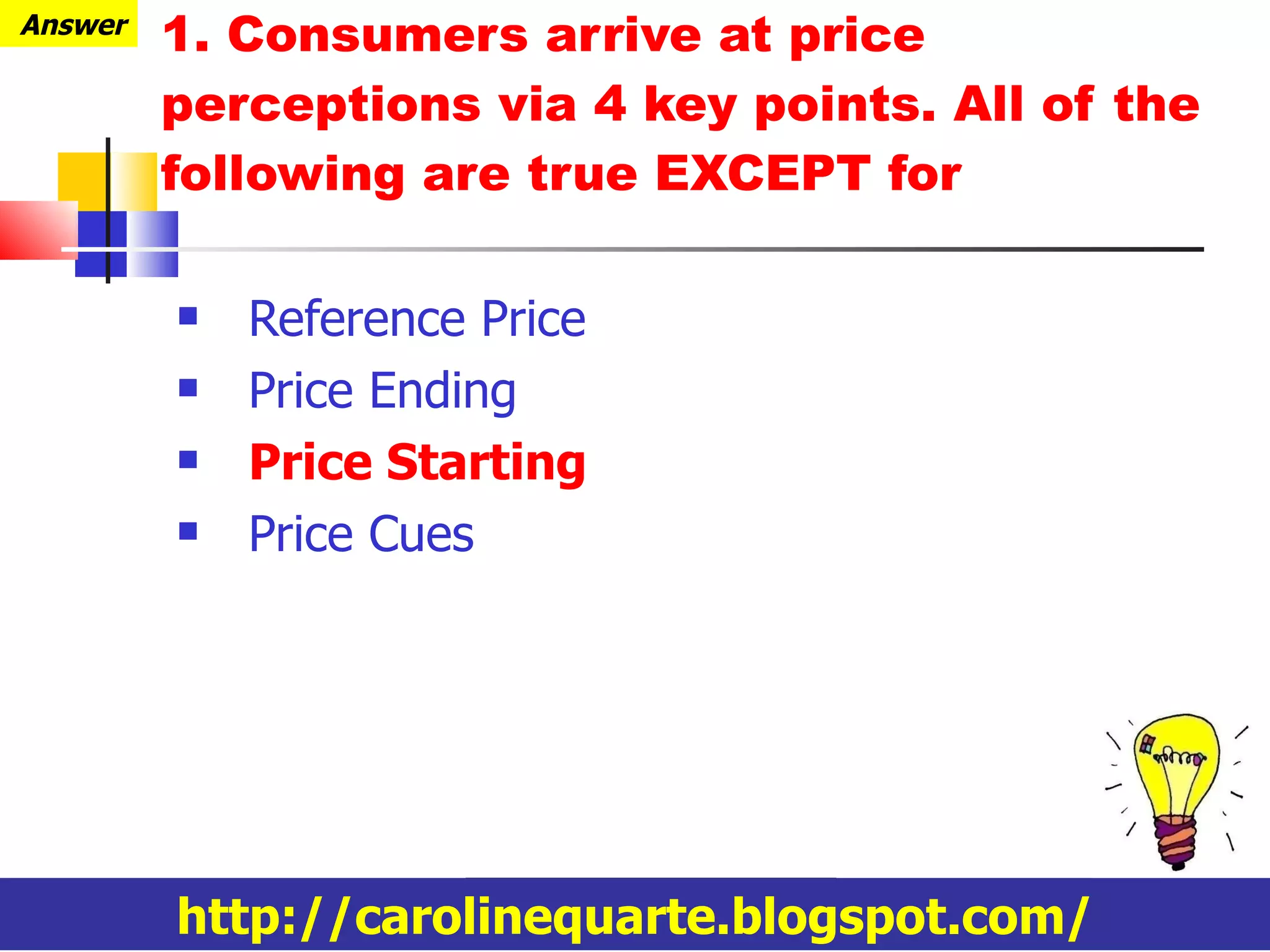
Reference Price Price Ending Price Starting Price Cues 1. Consumers arrive at price perceptions via 4 key points. All of the following are true EXCEPT for  http://carolinequarte.blogspot.com/ Answer
TOP 10 Learning Questions for Chapter 16 – Managing Retailing, Wholesaling, and Logistics Joseph Gabriel N. Morales /  Caroline P. Quarte April 14, 2011
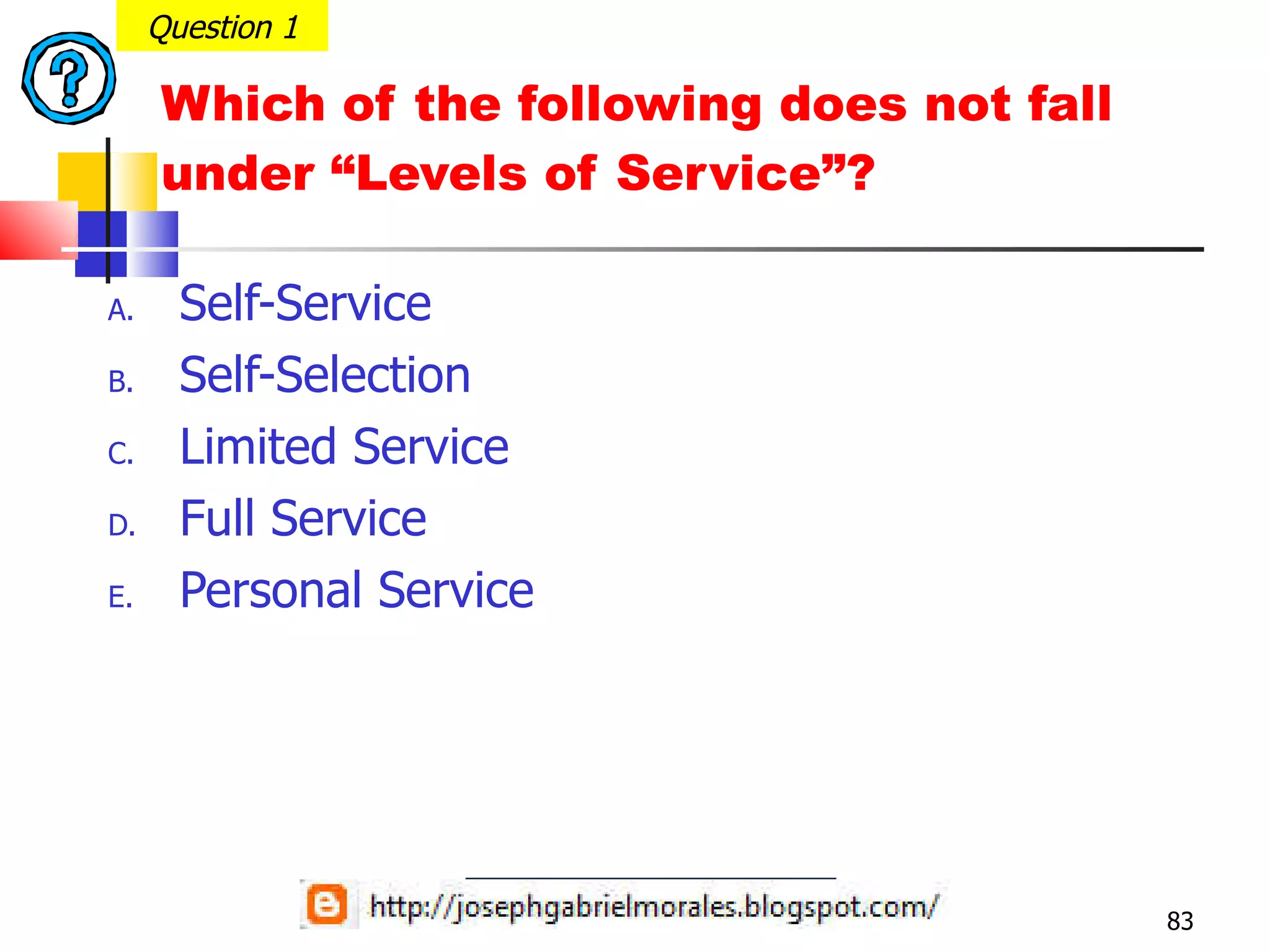
Which of the following does not fall under “Levels of Service”? Self-Service Self-Selection Limited Service Full Service Personal Service Question 1
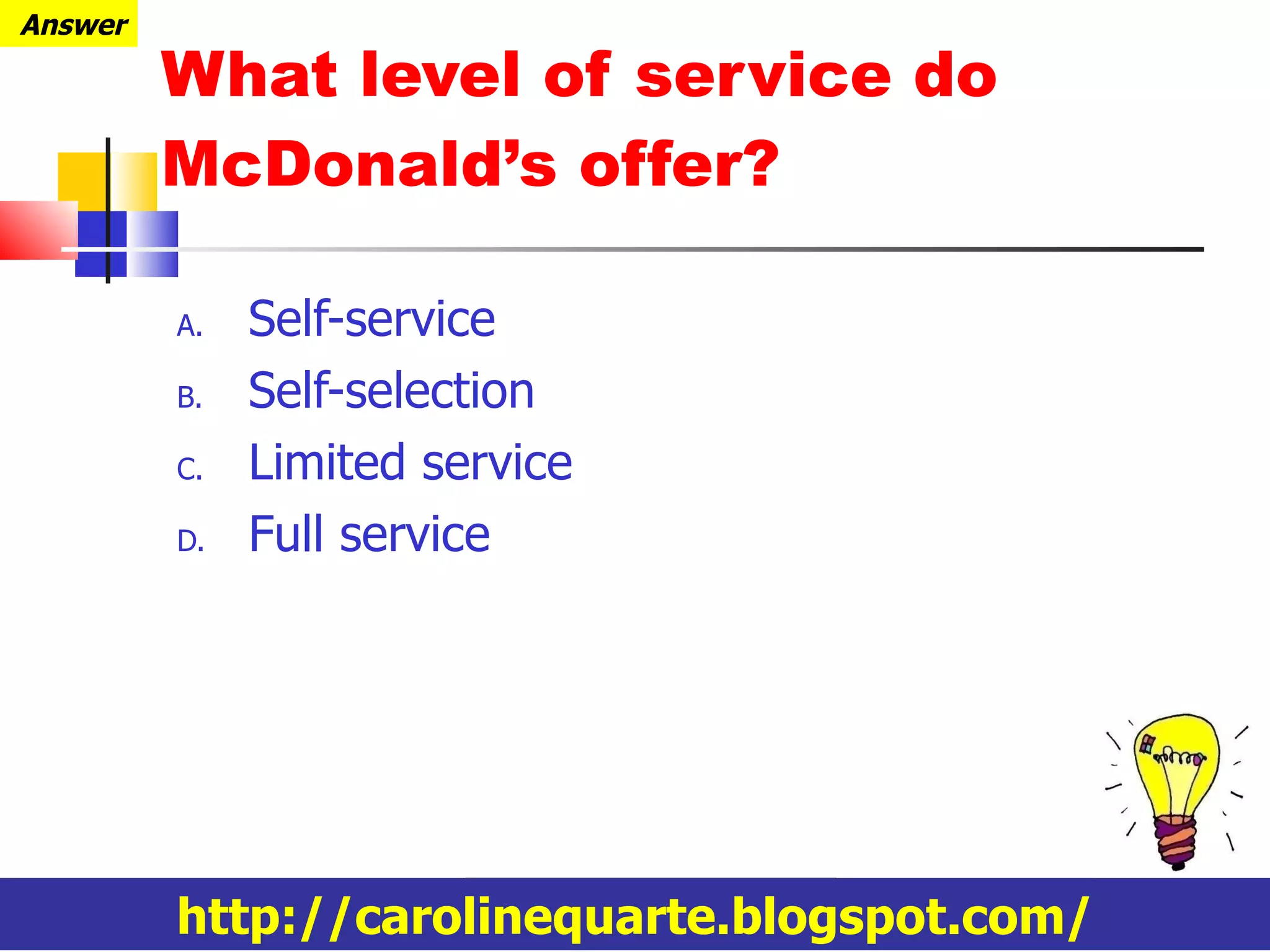
What level of service do McDonald’s offer? Self-service Self-selection Limited service Full service Question http://carolinequarte.blogspot.com/
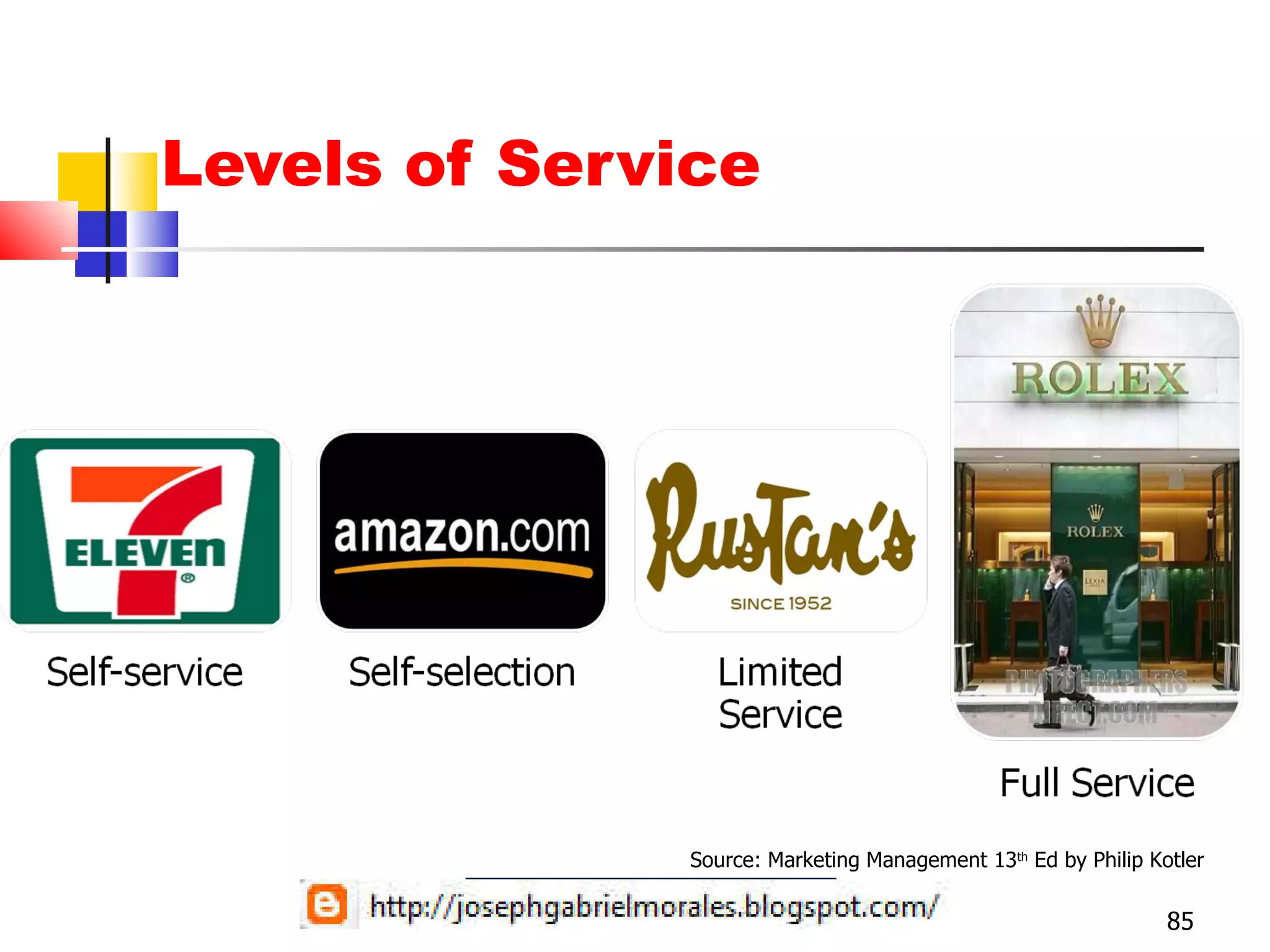
Levels of Service Source: Marketing Management 13 th  Ed by Philip Kotler
What level of service do McDonald’s offer? Self-service Self-selection Limited service Full service http://carolinequarte.blogspot.com/ Answer
  Chapter 17 Designing and Managing Integrated Marketing Yang Zhao/ Caroline P. Quarte Apr. 5.2011 http://zhaointote.blogspot.com/
1.How many modes of marketing communication mix? A. 2 B. 4 C. 6 D. 8 E. 10 http://zhaointote.blogspot.com/
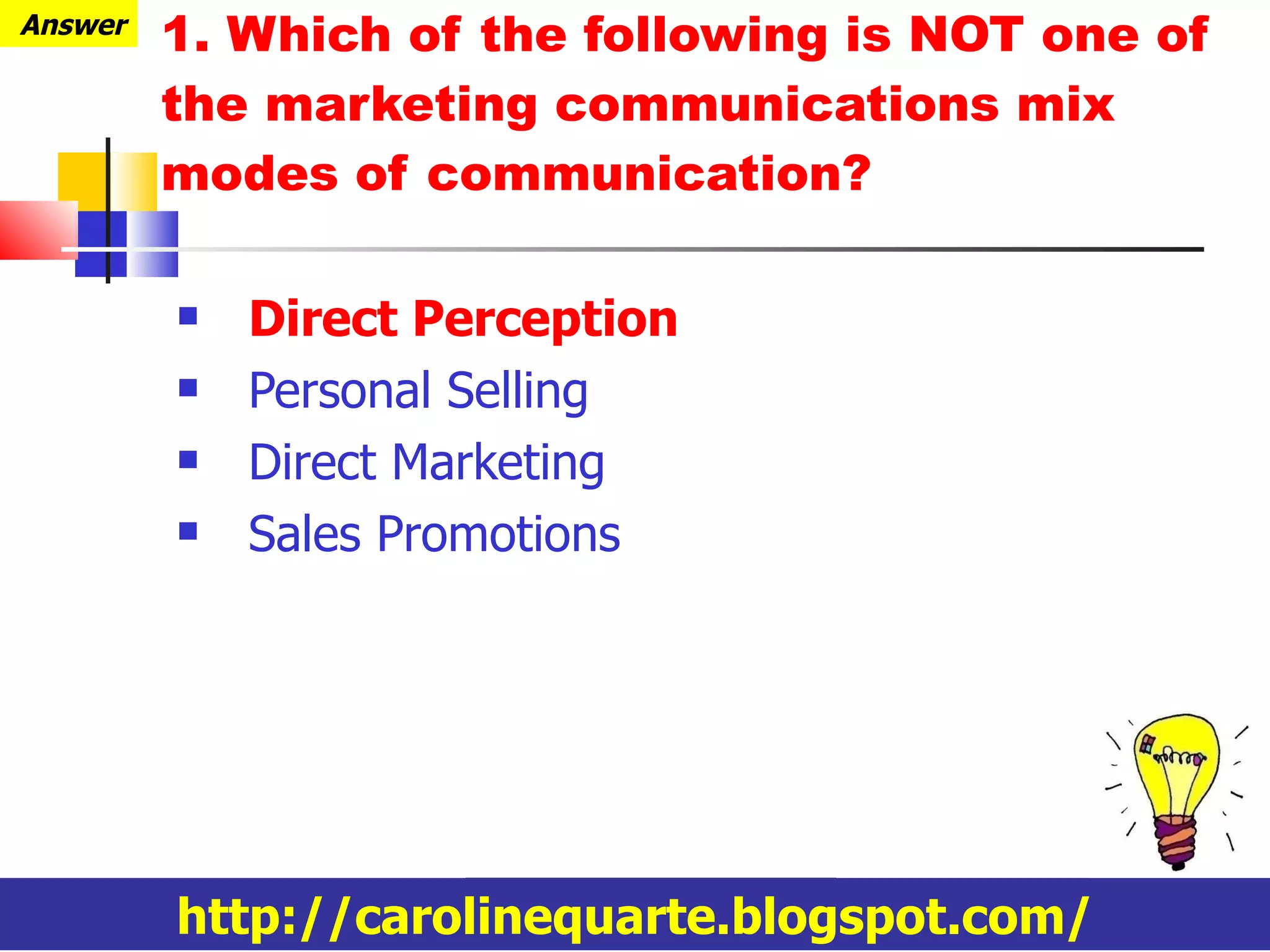
1. Which of the following is NOT one of the marketing communications mix modes of communication? Direct Perception Personal Selling Direct Marketing Sales Promotions Question http://carolinequarte.blogspot.com/
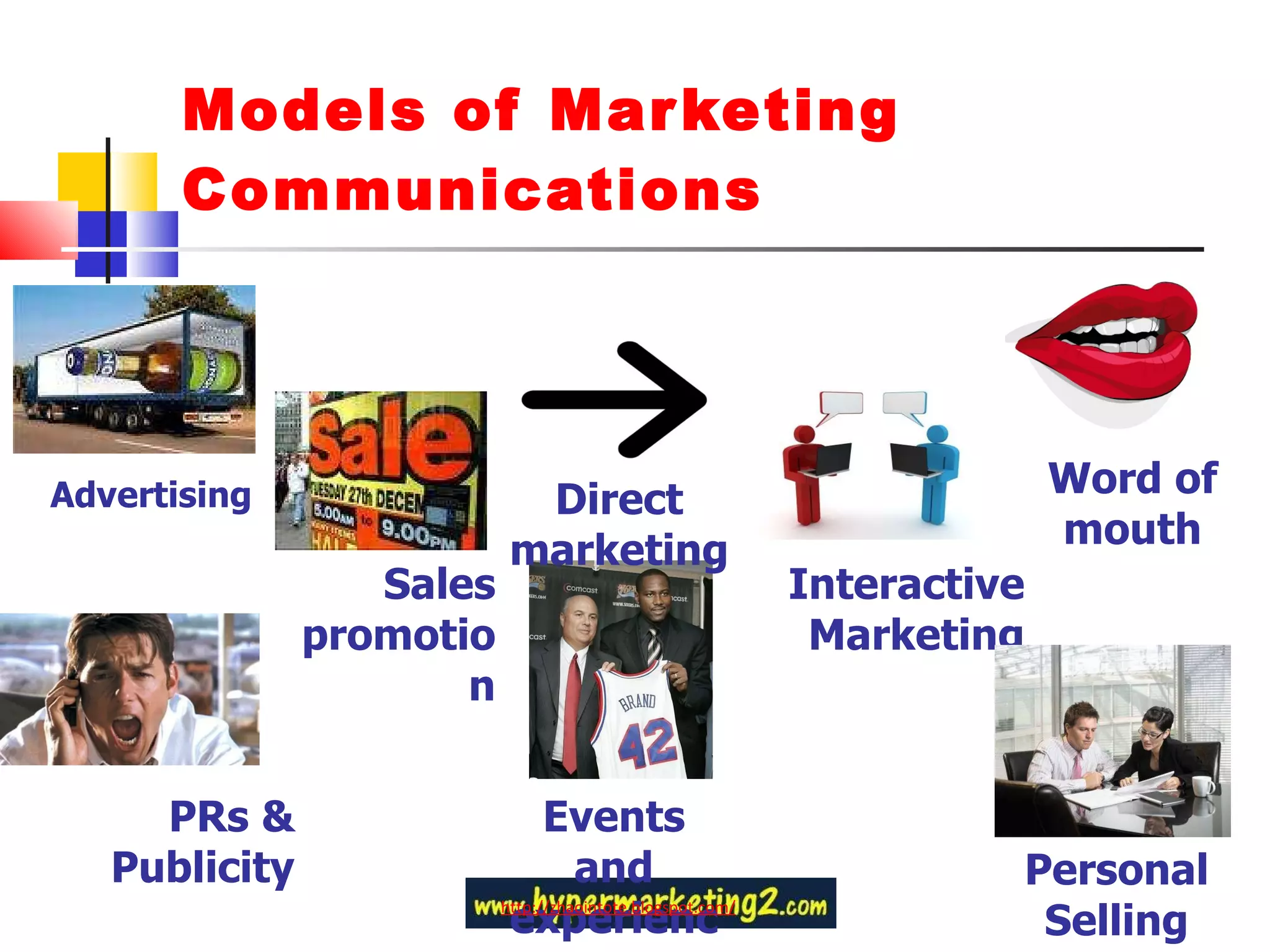
Models of Marketing Communications Direct marketing Word of mouth Advertising Sales promotion Events and experiences PRs & Publicity Interactive Marketing Personal Selling http://zhaointote.blogspot.com/
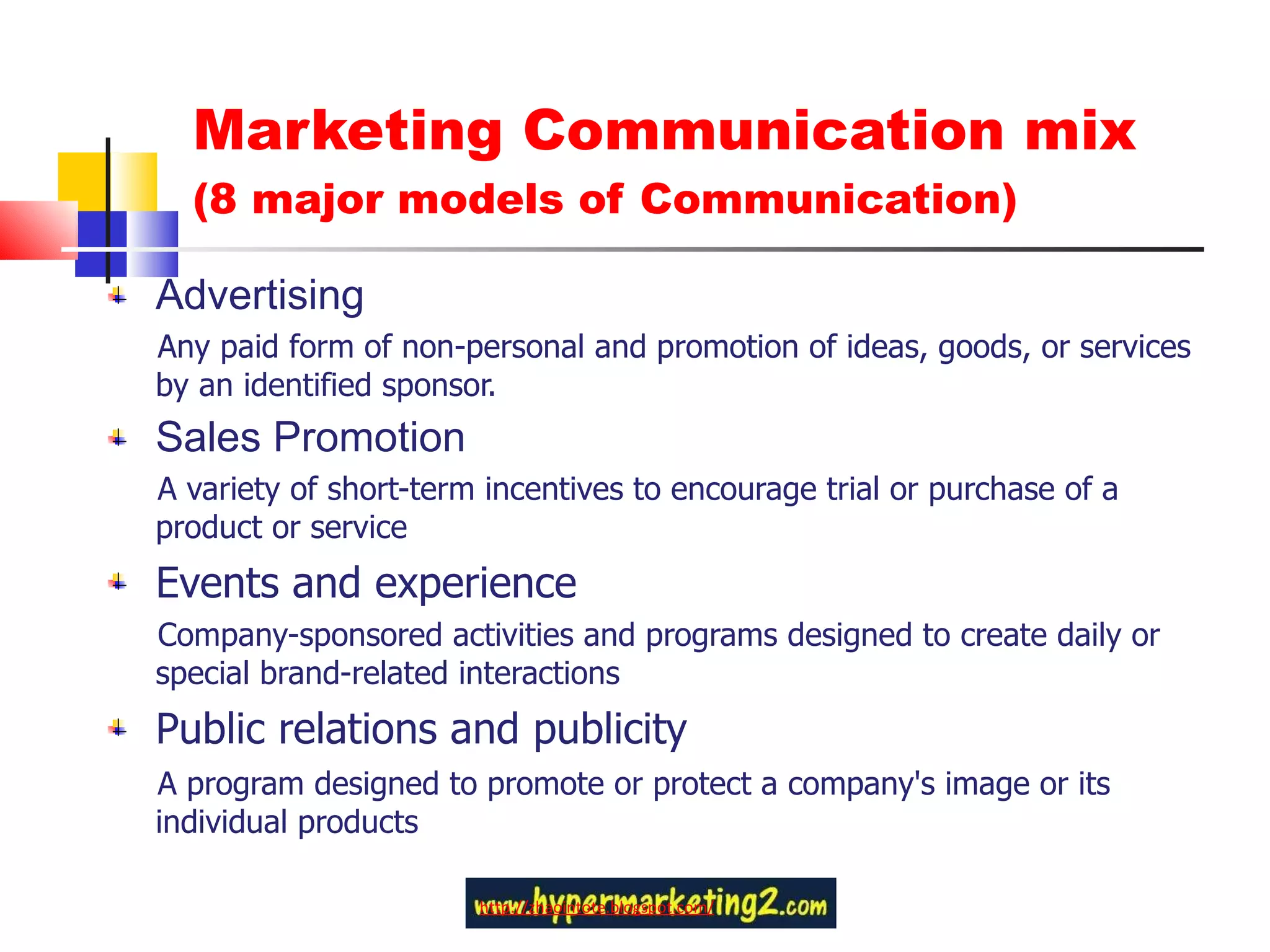
Marketing Communication mix  (8 major models of Communication) Advertising Any paid form of non-personal and promotion of ideas, goods, or services by an identified sponsor. Sales Promotion A variety of short-term incentives to encourage trial or purchase of a product or service Events and experience Company-sponsored activities and programs designed to create daily or special brand-related interactions Public relations and publicity A program designed to promote or protect a company's image or its individual products http://zhaointote.blogspot.com/
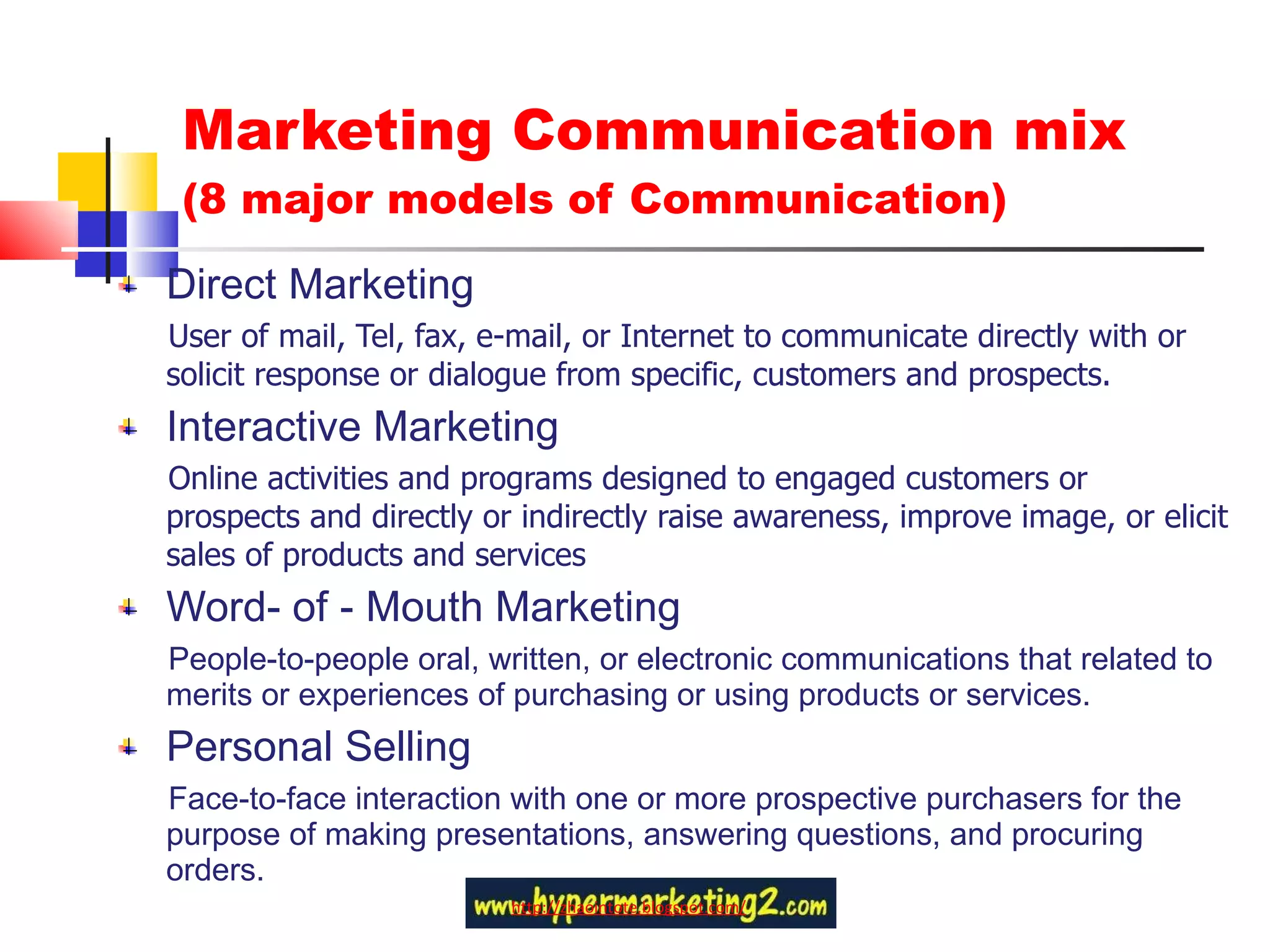
Marketing Communication mix  (8 major models of Communication) Direct Marketing User of mail, Tel, fax, e-mail, or Internet to communicate directly with or solicit response or dialogue from specific, customers and prospects. Interactive Marketing Online activities and programs designed to engaged customers or prospects and directly or indirectly raise awareness, improve image, or elicit sales of products and services Word- of - Mouth Marketing People-to-people oral, written, or electronic communications that related to merits or experiences of purchasing or using products or services. Personal Selling Face-to-face interaction with one or more prospective purchasers for the purpose of making presentations, answering questions, and procuring orders. http://zhaointote.blogspot.com/
1. Which of the following is NOT one of the marketing communications mix modes of communication? Direct Perception Personal Selling Direct Marketing Sales Promotions http://carolinequarte.blogspot.com/ Answer
TOP 10 Learning Questions for Ch18: Managing Mass Communications Ira A. Ong / Caroline P. Quarte April 2011
4. In developing an advertising campaign, legal and social issues are assessed during _________. Message Generation Message Evaluation Creative Development and Execution Social Responsibility Review All of the above
4. Only message generation and creative development are important in developing an advertising campaign. True or False. True False http://carolinequarte.blogspot.com/ Question
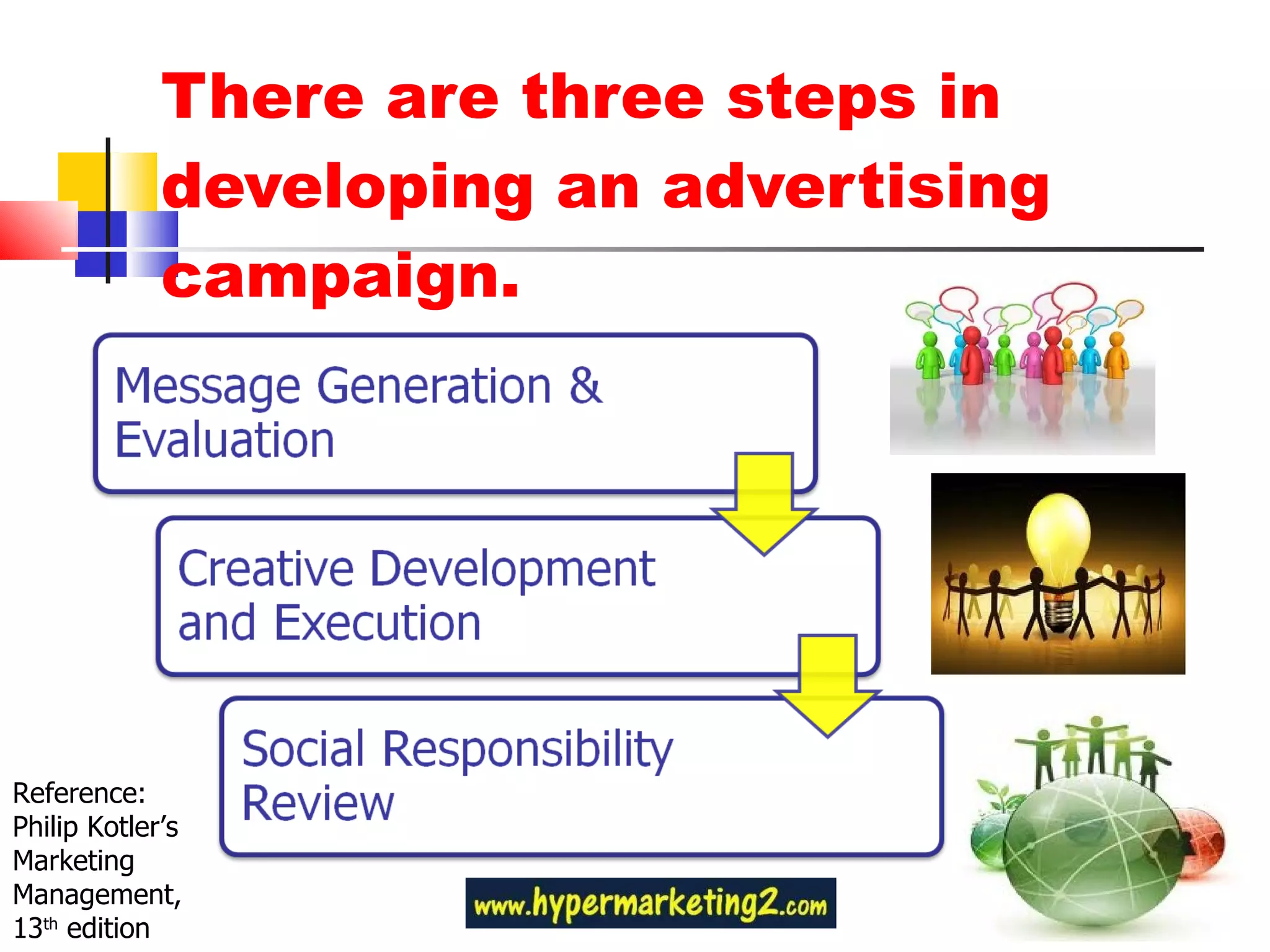
There are three steps in developing an advertising campaign. Reference: Philip Kotler’s Marketing Management, 13 th  edition
4. Only message generation and creative development are important in developing an advertising campaign. True or False. True False http://carolinequarte.blogspot.com/ Answer
TOP 10 Learning Questions for Chapter 20 Introducing New Market Offerings Louie Mark Quizon / Caroline P. Quarte April 15, 2011 http://louiemarkquizon.blogspot.com
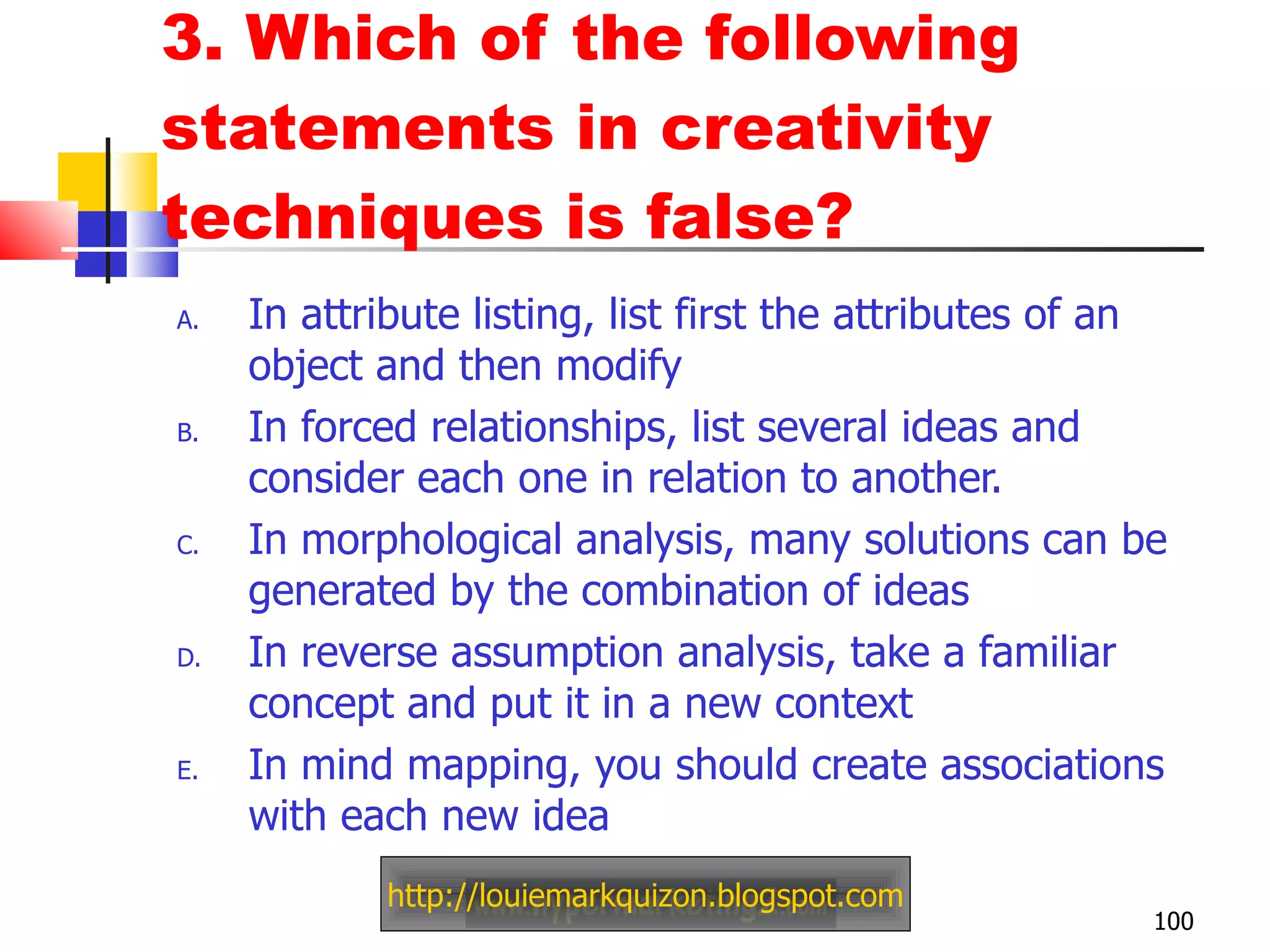
3. Which of the following statements in creativity techniques is false?  In attribute listing, list first the attributes of an object and then modify In forced relationships, list several ideas and consider each one in relation to another. In morphological analysis, many solutions can be generated by the combination of ideas In reverse assumption analysis, take a familiar concept and put it in a new context In mind mapping, you should create associations with each new idea http://louiemarkquizon.blogspot.com
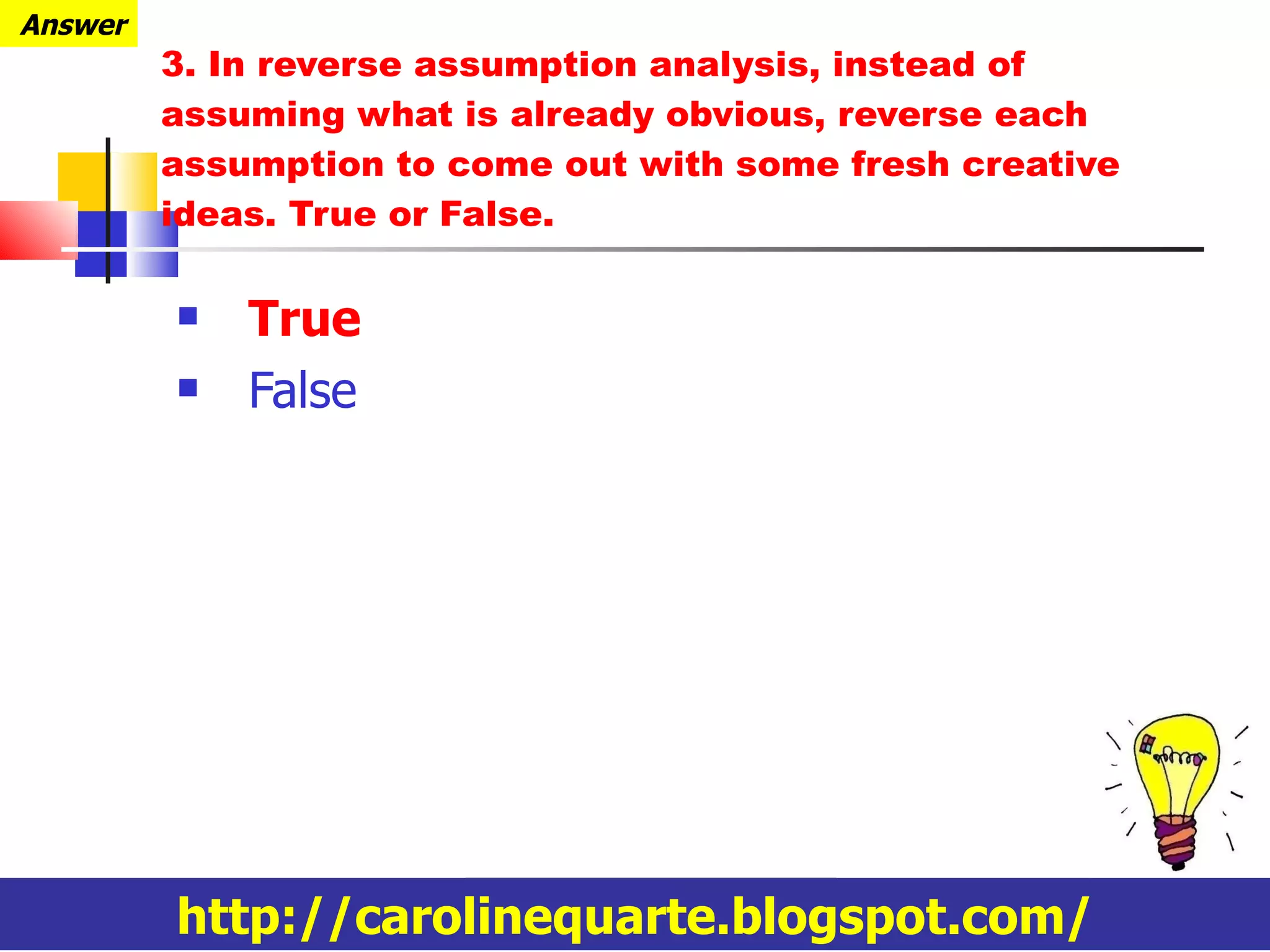
3.  In reverse assumption analysis,  instead of assuming what is already obvious, reverse each assumption to come out with some fresh creative ideas.  True or False. True False http://carolinequarte.blogspot.com/ Question
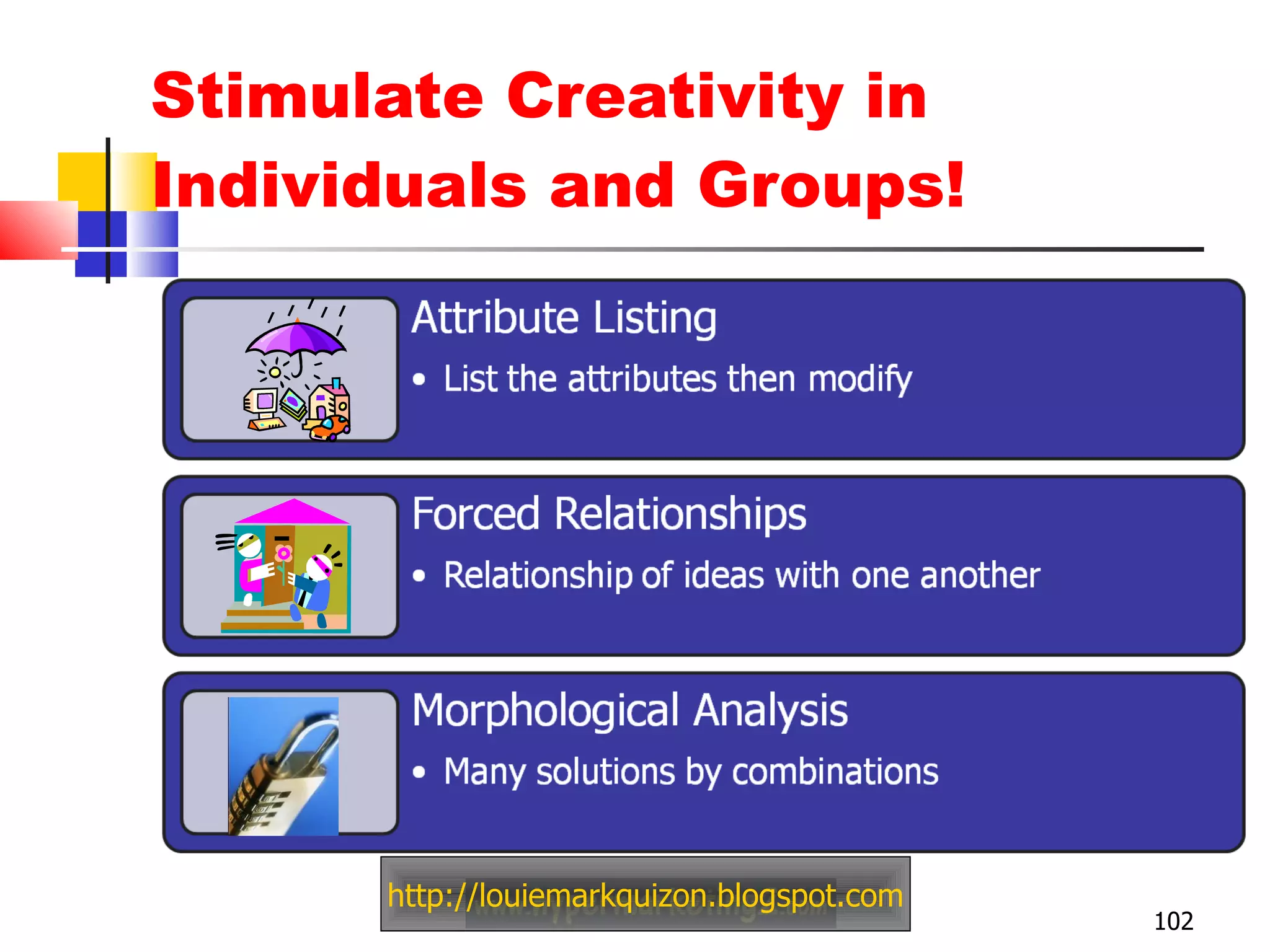
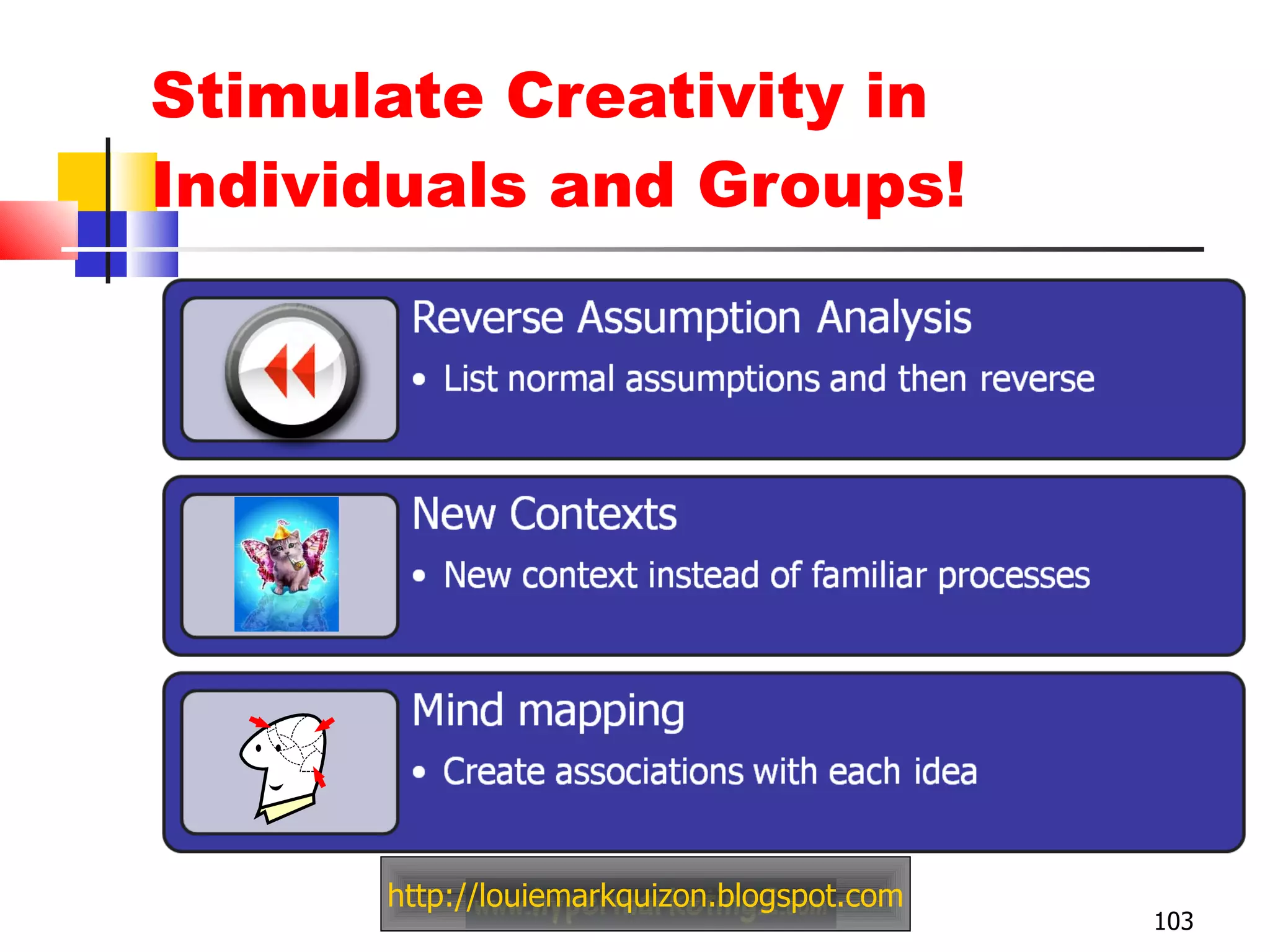
Stimulate Creativity in Individuals and Groups! http://louiemarkquizon.blogspot.com
3.  In reverse assumption analysis,  instead of assuming what is already obvious, reverse each assumption to come out with some fresh creative ideas.  True or False. True False http://carolinequarte.blogspot.com/ Answer
TOP 10 Learning Questions for Tapping into Global Markets 21 Sandel, Lee Aizabel L. / Caroline P. Quarte April 14, 2011 www.leeaizabelsandel.blogspot.com
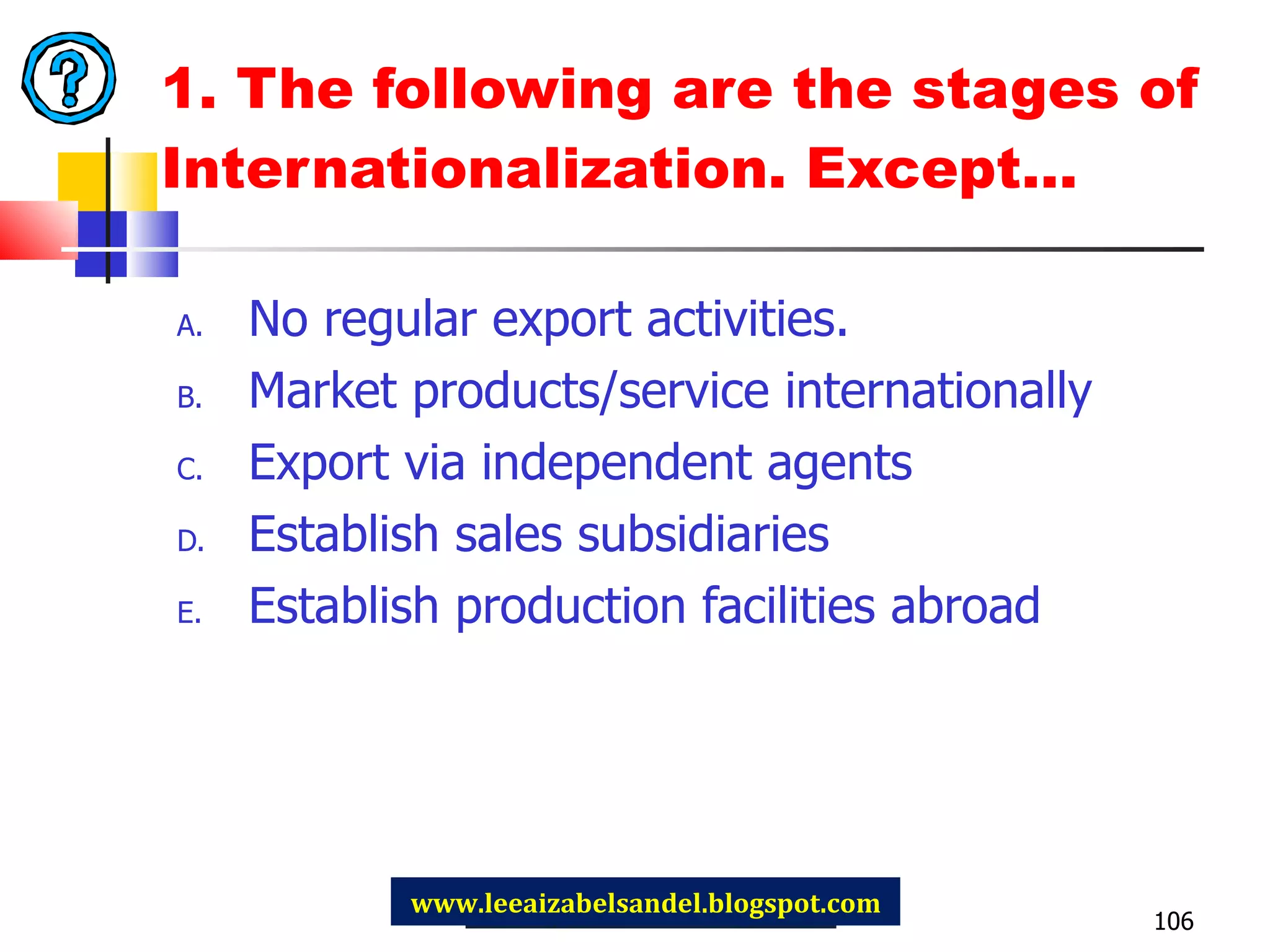
1. The following are the stages of Internationalization. Except… No regular export activities. Market products/service internationally Export via independent agents Establish sales subsidiaries Establish production facilities abroad www.leeaizabelsandel.blogspot.com
1. What’s the third stage of internationalization? No regular export activities Establishment of one or more sales subsidiaries Export via independent representatives Establishment of production facilities abroad Question http://carolinequarte.blogspot.com/
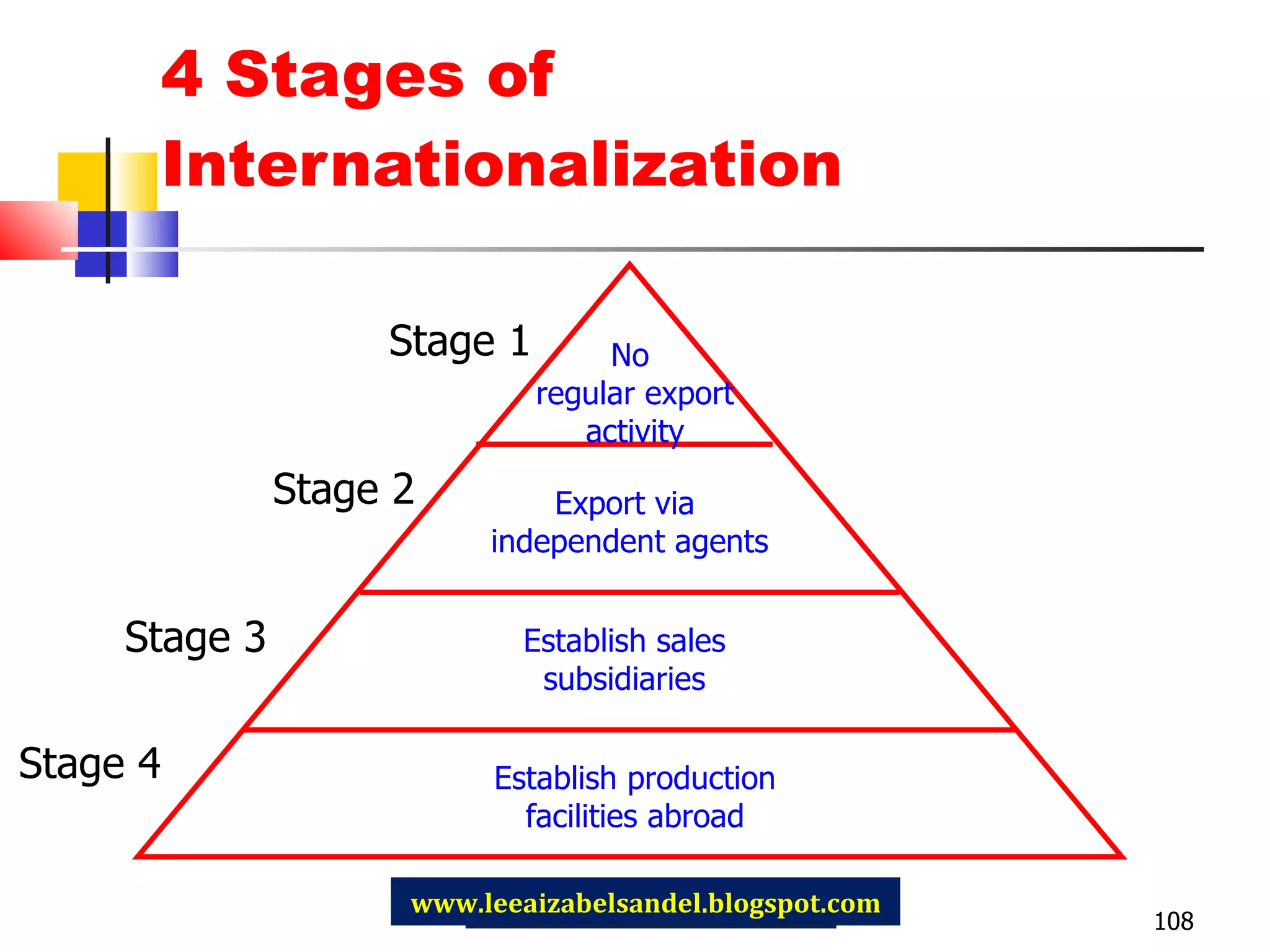
4 Stages of Internationalization Establish sales subsidiaries No  regular export activity Export via  independent agents Establish production facilities abroad Stage 1 Stage 2 Stage 3 Stage 4 www.leeaizabelsandel.blogspot.com
1. What’s the third stage of internationalization? No regular export activities Establishment of one or more sales subsidiaries Export via independent representatives Establishment of production facilities abroad http://carolinequarte.blogspot.com/ Answer
TOP 10 Learning Questions for Chapter 22: Managing A Holistic Marketing Organization For The Long Run Mira Lynn Serrano / Caroline P. Quarte April 14, 2011 miralynnserrano.blogspot.com
3.  Product- or Brand-Management Organization can also be in the form of the following types of product teams   Horizontal and Vertical product teams Straight and Curved product teams Horizontal, Vertical, Triangular product teams Straight, Curved and Triangular product teams None of the above miralynnserrano.blogspot.com
3. There are three types of potential product –team structures. These are… Horizontal, Diagonal, Vertical product teams Horizontal, Triangular, Vertical product teams Horizontal, Circular, Vertical product teams Independent, Interdependent, Social product teams Question http://carolinequarte.blogspot.com/
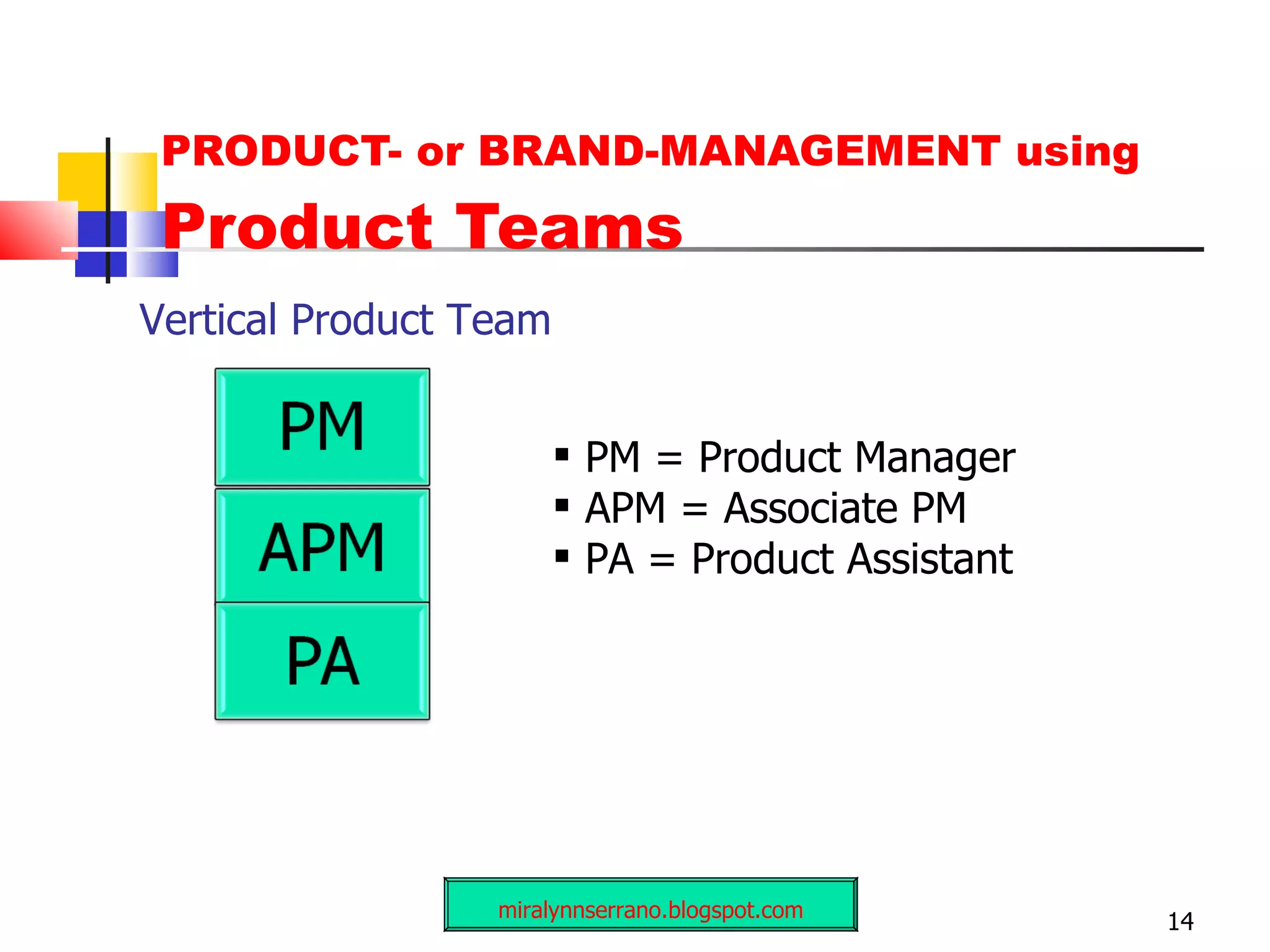
PRODUCT- or BRAND-MANAGEMENT using  Product Teams 14 miralynnserrano.blogspot.com PM = Product Manager APM = Associate PM PA = Product Assistant Vertical Product Team
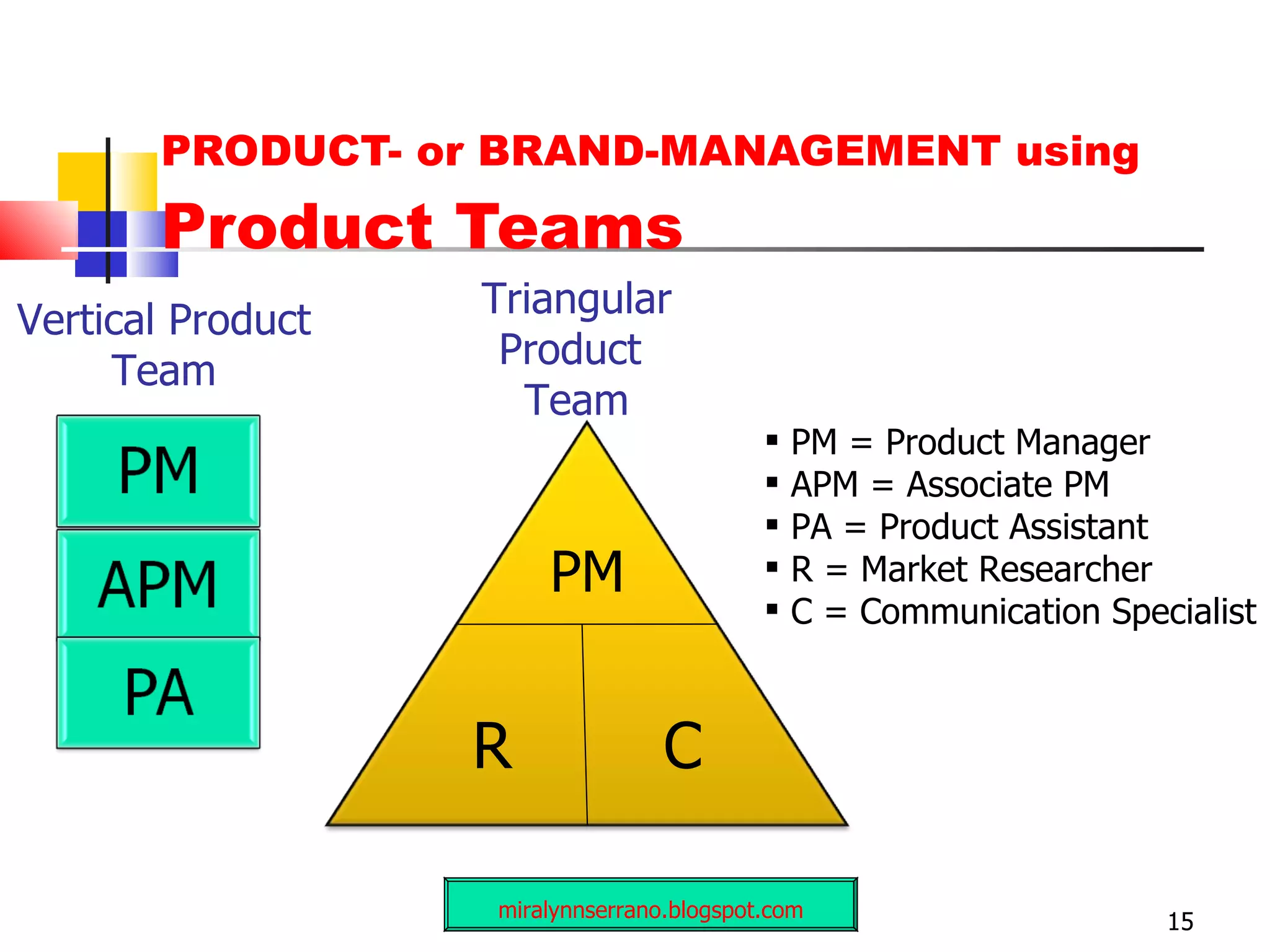
PRODUCT- or BRAND-MANAGEMENT using  Product Teams 15 miralynnserrano.blogspot.com PM = Product Manager APM = Associate PM PA = Product Assistant R = Market Researcher C = Communication Specialist Vertical Product  Team PM R C Triangular Product  Team
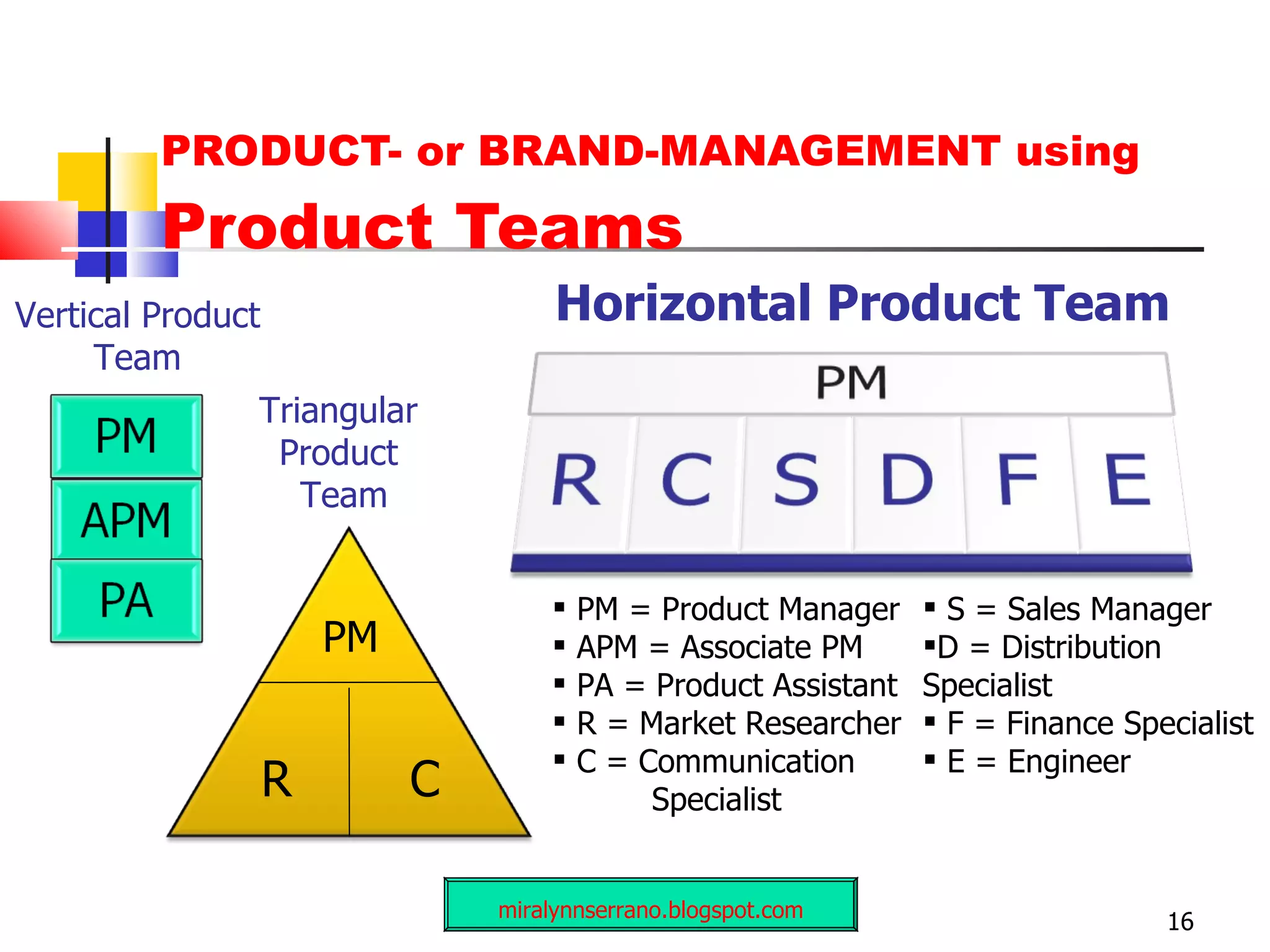
PRODUCT- or BRAND-MANAGEMENT using  Product Teams 16 miralynnserrano.blogspot.com PM = Product Manager APM = Associate PM PA = Product Assistant R = Market Researcher C = Communication  Specialist Vertical Product  Team PM R C Triangular  Product  Team Horizontal Product Team S = Sales Manager D = Distribution  Specialist F = Finance Specialist E = Engineer
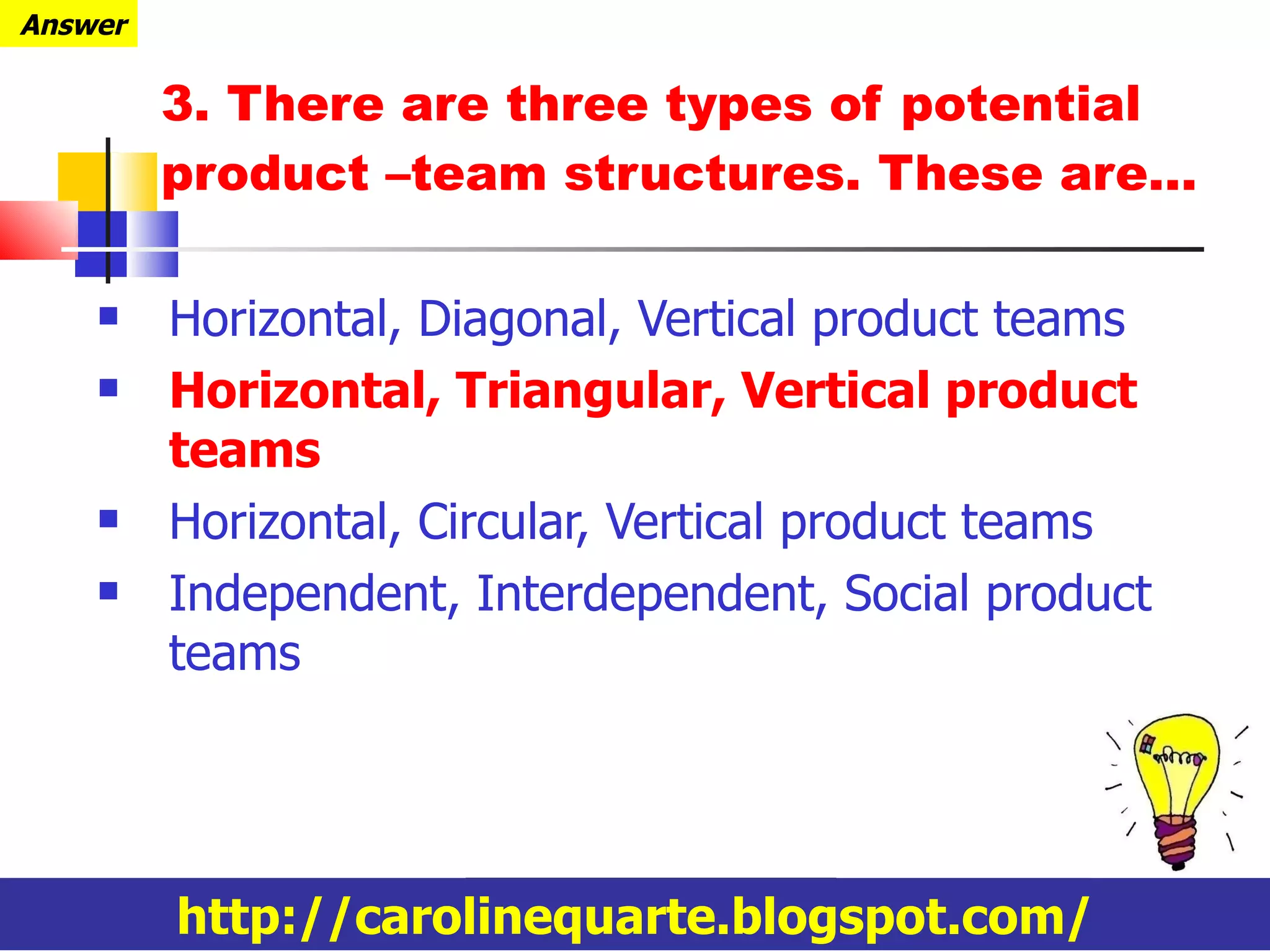
3. There are three types of potential product –team structures. These are… Horizontal, Diagonal, Vertical product teams Horizontal, Triangular, Vertical product teams Horizontal, Circular, Vertical product teams Independent, Interdependent, Social product teams http://carolinequarte.blogspot.com/ Answer

Improved questions for kotler's 20 chapter quarte

  • 1.
    TOP 20 ImprovedLearning Questions for Caroline P. Quarte April 2011 http://carolinequarte.blogspot.com/ Kotler’s 20 Chapters
  • 2.
    TOP 10 LearningQuestions for Chapter 1: Defining Marketing for the 21 st Century Ria Abendan / Caroline P. Quarte April 2011
  • 3.
    2. Promoting avisit to Star City is an example of marketing what? A place An experience A property An organization None of the above
  • 4.
    2. What areyou marketing when you promote a visit to Star City? A place An experience A property An organization None of the above Question http://carolinequarte.blogspot.com/
  • 5.
    Examples Experiences aremarketed by orchestrating several goods and services
  • 6.
    2. What areyou marketing when you promote a visit to Star City? A place An experience A property An organization None of the above Answer http://carolinequarte.blogspot.com/
  • 7.
    10 Questions Chapter2: Developing Marketing Strategies and Plans Steven Michael Y. Andrada / Caroline P. Quarte April 15, 2011 www.stevenandrada.blogspot.com 1/73
  • 8.
    5. What kindof business orientation that puts the customer at the heart of the business? Product orientation Geographical orientation Market orientation Competence orientation None of the above 31/73 www.stevenandrada.blogspot.com
  • 9.
    5. What typeof business orientation puts the customer at the heart of the business? Product orientation Market orientation Customer-centered orientation Customer orientation Question http://carolinequarte.blogspot.com/
  • 10.
    Types of BusinessOrientation Product Orientation - The company believes that they have a superior product, based on quality and features, and because of this they feel their customers will like it also. Market Orientation - Puts the customer at the heart of the business. 32/73 www.stevenandrada.blogspot.com
  • 11.
    Examples 33/73 www.stevenandrada.blogspot.comQuestion 5: Company Product Market Cebu Pacific Air We run an Airline company It’s time everyone to flies PLDT We run a Telecommunication company We’re changing lives
  • 12.
    5. What typeof business orientation puts the customer at the heart of the business? Product orientation Market orientation Customer-centered orientation Customer orientation Answer http://carolinequarte.blogspot.com/
  • 13.
    TOP 10 LearningQuestions Ch 3: Gathering Information and Scanning the Environment Ma. Katrina S. Avellana / Caroline P. Quarte April 2011 http://kavellana.blogspot.com
  • 14.
    8. Which isan environmental force shaping the business landscape? Demographic Technological Natural Socio-cultural All of the above
  • 15.
    8. Which ofthe following is NOT an environmental force that shapes the business landscape? Question http://carolinequarte.blogspot.com/ Demographic Logical Natural Socio-cultural
  • 16.
    Environmental Forces Shapingthe Business Landscape Demographic Political-Legal Technological Natural Socio-cultural Economic http://kavellana.blogspot.com
  • 17.
    8. Which ofthe following is NOT an environmental force that shapes the business landscape? http://carolinequarte.blogspot.com/ Answer Demographic Logical Natural Socio-cultural
  • 18.
    TOP 10 LearningQuestions for Chapter 4: Conducting Marketing Research and Forecasting Demand Megha Behani / Caroline P. Quarte April 2011
  • 19.
    #4: ____ isthe set of consumers who have interest and access to a market offer. A. Potential market B. Available market C. Target market D. Penetrated market E. None of the above
  • 20.
    #4: Market demandsare segmented in 4 categories. The following are measures of market demand except for __________. A. Potential market B. Available market C. Substantial market D. Penetrated market Question http://carolinequarte.blogspot.com/
  • 21.
    Concept : Whatare the measures of market demand? Potential Market Target Market Penetrated Market Available Market consumers having interest, income and access consumers buying company’s product! qualified available market company decides to pursue consumers professing sufficient level of interest
  • 22.
    Target Market: 90Mn mobile phone users in prepaid loading business, up to P1.2B texts sent per day! 3 main networks targeting the mass market !
  • 23.
    Penetrated market: HapeeToothpaste" - Philippine-Made, World Class: Pedro's Faith Leads to Success! Penetrated market by challenging the foreign brand!
  • 24.
    Available market: Peoplebelonging to different income group can assess the supermarkets… Available market: Supermarket!!!
  • 25.
    Potential market: Philippines-Potential retirement destination! Is Philippine a potential market as retirement destination??
  • 26.
    #4: Market demandsare segmented in 4 categories. The following are measures of market demand except for __________. A. Potential market B. Available market C. Substantial market D. Penetrated market http://carolinequarte.blogspot.com/ Answer
  • 27.
    Joan Soliven /Caroline P. Quarte April 15, 2011 http://joansoliven.blogspot.com/ TOP 10 Learning Questions for Creating Customer Value, Satisfaction, and Loyalty and Ch 5
  • 28.
    1. Difference betweenwhat the customer gets and what he or she gives for different possible choices. A. Customer Satisfaction B. Good Service C. Quality D. Customer Perceived Value E. Product http://joansoliven.blogspot.com/
  • 29.
    Price to ValueRatio Price to Quality Ratio Customer Perceived Value Customer Perceived Effects 1. What marketing concept explains this statement: “That product is very expensive, it must be really effective.” Question http://carolinequarte.blogspot.com/
  • 30.
    Customer Perceived Value Difference between what the customer gets and what he or she gives for different possible choices. http://joansoliven.blogspot.com/ Source: Marketing Management 13 th Edition by Philip Kotler
  • 31.
    Consumers are moreeducated and informed, they seek out superior alternatives Dell offering better service than HP, they outpaced HP before in terms of customer perceived value. Source: Marketing Management 13 th Edition by Philip Kotler
  • 32.
    Price to ValueRatio Price to Quality Ratio Customer Perceived Value Customer Perceived Effects 1. What marketing concept explains this statement: “That product is very expensive, it must be really effective.” http://carolinequarte.blogspot.com/ Answer
  • 33.
    TOP 10 LearningQuestions for Ch6: Analyzing Consumer Markets Roleigh “Rolly” Tuazon / Caroline P. Quarte 15 April 2011
  • 34.
    3. What aredissociative groups? A. A group an individual feels neutral about B. groups who distance themselves from society C. a group an individual rejects D. All of the above E. None of the above
  • 35.
    3. In consumerbehavior, associating a product from a dissociative group does not really affect the product. True or False. True False Question http://carolinequarte.blogspot.com/
  • 36.
    Reference Groups DissociativeGroups Groups one rejects: i.e., racists, anti-semites Kotler, Keller. Marketing Management, 13 th Edition. Concept 2:
  • 37.
    Reference Groups DissociativeGroups Groups one rejects: i.e., racists, anti-semites Kotler, Keller. Marketing Management, 13 th Edition. Concept 2: These are groups one does not wish to be associated with.
  • 38.
    3. In consumerbehavior, associating a product from a dissociative group does not really affect the product. True or False. True False http://carolinequarte.blogspot.com/ Answer
  • 39.
  • 40.
  • 41.
    3. In thebusiness buying process, who has the power to prevent sellers or information from reaching members of the buying center? Deciders Approvers Influencers Gatekeepers Question http://carolinequarte.blogspot.com/
  • 42.
  • 43.
    3. In thebusiness buying process, who has the power to prevent sellers or information from reaching members of the buying center? Deciders Approvers Influencers Gatekeepers http://carolinequarte.blogspot.com/ Answer
  • 44.
    TOP 10 LearningQuestions Ch 8: Identifying Market Segments and Targets Myrtle Frantilla / Caroline P. Quarte April 14, 2011 http://myrtlefrantilla.blogspot.com /
  • 45.
    2. In thesteps of segmentation process, what is the fourth step? http://myrtlefrantilla.blogspot.com / http://myrtlefrantilla.blogspot.com / A. B. C. D. E. Segment Attractiveness Segment Identification Segment Positioning Segment Acid Test Segment Profitability
  • 46.
    Needs-based segmentation Segmentidentification Segment attractiveness Segment profitability 2. At what step in the segmentation process should you determine which demographics, lifestyles, and usage bahaviors make the segment distinct and identifiable? Question http://carolinequarte.blogspot.com/
  • 47.
    Steps in SegmentationProcess Segment Identification http://myrtlefrantilla.blogspot.com / http://myrtlefrantilla.blogspot.com / Segment Attractiveness Needs-based Segmentation Segment Profitability Segment Positioning Segment Acid Test Marketing Mix Strategy
  • 48.
    Needs-based segmentation Segmentidentification Segment attractiveness Segment profitability 2. At what step in the segmentation process should you determine which demographics, lifestyles, and usage bahaviors make the segment distinct and identifiable? http://carolinequarte.blogspot.com/ Answer
  • 49.
    TOP 10 LearningQuestions for Ch 9: Creating Brand Equity Soleil Gan / Caroline P. Quarte April 2011 http://taeyangxinyi.blogspot.com
  • 50.
    10. Which ofthe following is not a role on a brand portfolio? Cash Cows Flankers Low-End Entry Level Niche Marketer High-End Prestige http://taeyangxinyi.blogspot.com 39
  • 51.
    Flankers Cash CowsLow-end Entry level High-end Prestige 10. What type of product does not require as much investment as other portfolio brands? Question http://carolinequarte.blogspot.com/
  • 52.
    Brand Roles ona Brand Portfolio What brand type is the product? 40 http://taeyangxinyi.blogspot.com From Philip Kotler’s, Marketing Management, 13 th ed. FLANKERS CASH COWS LOW-END ENTRY LEVEL HIGH-END PRESTIGE
  • 53.
    Niche is atype of market segmentation, not a role on a brand portfolio 41 http://taeyangxinyi.blogspot.com From Philip Kotler’s, Marketing Management, 13 th ed. FLANKERS Fighter brands that are positioned w/ respect to competitors’ brands so that more important (profitable) brands are able to retain their desired position CASH COWS Brands that are able to hold on to enough customers & maintain profitability w/ virtually no marketing support LOW-END ENTRY LEVEL Relatively low-priced “traffic-builder” brands that attract customers to the brand franchise in hopes to trading customers up to the higher-priced brand HIGH-END PRESTIGE Brands that add prestige and credibility to the entire portfolio
  • 54.
    Flankers Cash CowsLow-end Entry level High-end Prestige 10. What type of product does not require as much investment as other portfolio brands? http://carolinequarte.blogspot.com/ Answer
  • 55.
    TOP 10 Questionsfor Chapter 10: Crafting the Brand Positioning Anna Katrina L. Guray / Caroline P. Quarte April 15, 2011 http://annaguray06.blogspot.com
  • 56.
    Product Channel ImagePersonnel All of the above 5. differentiation is the way a company aims to identify and position itself or its products. Question #5 http://annaguray06.blogspot.com
  • 57.
    Product differentiation Personneldifferentiation Channel differentiation Image differentiation 5. _____________________ if done effectively establishes the product’s character and value proposition. Question http://carolinequarte.blogspot.com/
  • 58.
    Create Differentiation! Concept5: Differentiation Strategies PRODUCT PERSONNEL CHANNEL IMAGE http://annaguray06.blogspot.com
  • 59.
    Product differentiation Personneldifferentiation Channel differentiation Image differentiation 5. _____________________ if done effectively establishes the product’s character and value proposition. http://carolinequarte.blogspot.com/ Answer
  • 60.
    TOP 10 LearningConcepts for Chapter 11: Dealing with Competition Lady Charmayne Hao / Caroline P. Quarte April 2011
  • 61.
    1. Which ofthe following is true? In threat of segment rivalry, a segment is unattractive if it does not contain numerous, strong, or aggressive competitors. In threat of new entrants, a segment is attractive if entry barriers are low and exit are high. In threat of segment rivalry, a segment is unattractive if there are actual potential substitutes for the product. In threat of new entrants, a segment is attractive if entry barriers are high and exit are low. In threat of segment rivalry, a segment is attractive if it places a limit on prices and profit.
  • 62.
    1. Newentrants to an industry can raise the level of competition, thereby reducing its attractiveness. True or False. True False Question http://carolinequarte.blogspot.com/
  • 63.
    What determines marketsegment? Michael Porter’s Five Forces
  • 64.
    “ Threat ofnew entrants” refers to the threat existing competitors face upon new competitors Barriers to entry: Economies of scale Product Differentiation Capital Requirements Switching Cost Distribution Channel Access Government Policies Attractive if entry barriers are high and exit are low!
  • 65.
    1. Newentrants to an industry can raise the level of competition, thereby reducing its attractiveness. True or False. True False http://carolinequarte.blogspot.com/ Answer
  • 66.
    TOP 10 LearningQuestions for Ch. 12 Setting Product Strategy #28 Ivy Villamor / Caroline P. Quarte April 14, 2011
  • 67.
    9. ___ isa distinct unit within a brand or product line distinguishable by size, price, appearance, or some other attribute. Need family Product family Product line Product type Item None of the above http://www.slideshare.net/ivyvillamor
  • 68.
    9. Using the____________ level of the product hierarchy to sell their shampoo, one can see in Pantene packaging that it indicates the company name first, then the type of shampoo. Ex. PANTENE Hair Fall Control Shampoo Product line Need family Item Product type Question http://carolinequarte.blogspot.com/
  • 69.
    Concept 6: ProductHierarchy Leads you to Specific Desired Product
  • 70.
    Concept 6: ProductHierarchy Leads you to Specific Desired Product http://www.slideshare.net/ivyvillamor Hierarchy Sample Need family   Personal Care Product family   Cosmetics, skin creams, shampoo, conditioner, soap, etc Product class   Hair Cleaning Agent Product line   Shampoo Product type   Hair Fall Control Shampoo Item (Brand/Item) Pantene Hair Fall Solution bottle
  • 71.
    9. Using the____________ level of the product hierarchy to sell their shampoo, one can see in Pantene packaging that it indicates the company name first, then the type of shampoo. Ex. PANTENE Hair Fall Control Shampoo Product line Need family Item Product type http://carolinequarte.blogspot.com/ Answer
  • 72.
    TOP 10 LearningQuestions Ch 13 Designing and Managing Services Ronald Patrick G. Wenceslao Caroline P. Quarte April 2011 rgwenceslao.blogspot.com
  • 73.
    5. Service positioningstrategy can be made tangible through? 4 Price Symbols Place People All of the above
  • 74.
    5. Companies offeringservices can demonstrate their quality through physical evidence and ____________. Preservation Preoccupation Presentation Presumption Question http://carolinequarte.blogspot.com/
  • 75.
    Physical Evidence andPresentation 7 Place People Entertainment Communication Material Symbols Price
  • 76.
    5. Companies offeringservices can demonstrate their quality through physical evidence and ____________. Preservation Preoccupation Presentation Presumption http://carolinequarte.blogspot.com/ Answer
  • 77.
    TOP 10 LearningQuestions for Ch 14 Developing Pricing Strategies and Programs Zaragoza/ Caroline P. Quarte April 15, 2011 meghanngettingthere.blogspot.com
  • 78.
    1. Consumers usePRICE as an indicator of _____________. Product Comparability Product Quantity Product Superiority Product Quality None of the Above meghanngettingthere.blogspot.com
  • 79.
    Reference Price PriceEnding Price Starting Price Cues 1. Consumers arrive at price perceptions via 4 key points. All of the following are true EXCEPT for Question http://carolinequarte.blogspot.com/
  • 80.
    Consumers arrive atPrice Perceptions via 4 Key Points meghanngettingthere.blogspot.com Reference Prices Price – quality Inferences Price Endings Price Cues
  • 81.
    Reference Price PriceEnding Price Starting Price Cues 1. Consumers arrive at price perceptions via 4 key points. All of the following are true EXCEPT for http://carolinequarte.blogspot.com/ Answer
  • 82.
    TOP 10 LearningQuestions for Chapter 16 – Managing Retailing, Wholesaling, and Logistics Joseph Gabriel N. Morales / Caroline P. Quarte April 14, 2011
  • 83.
    Which of thefollowing does not fall under “Levels of Service”? Self-Service Self-Selection Limited Service Full Service Personal Service Question 1
  • 84.
    What level ofservice do McDonald’s offer? Self-service Self-selection Limited service Full service Question http://carolinequarte.blogspot.com/
  • 85.
    Levels of ServiceSource: Marketing Management 13 th Ed by Philip Kotler
  • 86.
    What level ofservice do McDonald’s offer? Self-service Self-selection Limited service Full service http://carolinequarte.blogspot.com/ Answer
  • 87.
    Chapter17 Designing and Managing Integrated Marketing Yang Zhao/ Caroline P. Quarte Apr. 5.2011 http://zhaointote.blogspot.com/
  • 88.
    1.How many modesof marketing communication mix? A. 2 B. 4 C. 6 D. 8 E. 10 http://zhaointote.blogspot.com/
  • 89.
    1. Which ofthe following is NOT one of the marketing communications mix modes of communication? Direct Perception Personal Selling Direct Marketing Sales Promotions Question http://carolinequarte.blogspot.com/
  • 90.
    Models of MarketingCommunications Direct marketing Word of mouth Advertising Sales promotion Events and experiences PRs & Publicity Interactive Marketing Personal Selling http://zhaointote.blogspot.com/
  • 91.
    Marketing Communication mix (8 major models of Communication) Advertising Any paid form of non-personal and promotion of ideas, goods, or services by an identified sponsor. Sales Promotion A variety of short-term incentives to encourage trial or purchase of a product or service Events and experience Company-sponsored activities and programs designed to create daily or special brand-related interactions Public relations and publicity A program designed to promote or protect a company's image or its individual products http://zhaointote.blogspot.com/
  • 92.
    Marketing Communication mix (8 major models of Communication) Direct Marketing User of mail, Tel, fax, e-mail, or Internet to communicate directly with or solicit response or dialogue from specific, customers and prospects. Interactive Marketing Online activities and programs designed to engaged customers or prospects and directly or indirectly raise awareness, improve image, or elicit sales of products and services Word- of - Mouth Marketing People-to-people oral, written, or electronic communications that related to merits or experiences of purchasing or using products or services. Personal Selling Face-to-face interaction with one or more prospective purchasers for the purpose of making presentations, answering questions, and procuring orders. http://zhaointote.blogspot.com/
  • 93.
    1. Which ofthe following is NOT one of the marketing communications mix modes of communication? Direct Perception Personal Selling Direct Marketing Sales Promotions http://carolinequarte.blogspot.com/ Answer
  • 94.
    TOP 10 LearningQuestions for Ch18: Managing Mass Communications Ira A. Ong / Caroline P. Quarte April 2011
  • 95.
    4. In developingan advertising campaign, legal and social issues are assessed during _________. Message Generation Message Evaluation Creative Development and Execution Social Responsibility Review All of the above
  • 96.
    4. Only messagegeneration and creative development are important in developing an advertising campaign. True or False. True False http://carolinequarte.blogspot.com/ Question
  • 97.
    There are threesteps in developing an advertising campaign. Reference: Philip Kotler’s Marketing Management, 13 th edition
  • 98.
    4. Only messagegeneration and creative development are important in developing an advertising campaign. True or False. True False http://carolinequarte.blogspot.com/ Answer
  • 99.
    TOP 10 LearningQuestions for Chapter 20 Introducing New Market Offerings Louie Mark Quizon / Caroline P. Quarte April 15, 2011 http://louiemarkquizon.blogspot.com
  • 100.
    3. Which ofthe following statements in creativity techniques is false? In attribute listing, list first the attributes of an object and then modify In forced relationships, list several ideas and consider each one in relation to another. In morphological analysis, many solutions can be generated by the combination of ideas In reverse assumption analysis, take a familiar concept and put it in a new context In mind mapping, you should create associations with each new idea http://louiemarkquizon.blogspot.com
  • 101.
    3. Inreverse assumption analysis, instead of assuming what is already obvious, reverse each assumption to come out with some fresh creative ideas. True or False. True False http://carolinequarte.blogspot.com/ Question
  • 102.
    Stimulate Creativity inIndividuals and Groups! http://louiemarkquizon.blogspot.com
  • 103.
    Stimulate Creativity inIndividuals and Groups! http://louiemarkquizon.blogspot.com
  • 104.
    3. Inreverse assumption analysis, instead of assuming what is already obvious, reverse each assumption to come out with some fresh creative ideas. True or False. True False http://carolinequarte.blogspot.com/ Answer
  • 105.
    TOP 10 LearningQuestions for Tapping into Global Markets 21 Sandel, Lee Aizabel L. / Caroline P. Quarte April 14, 2011 www.leeaizabelsandel.blogspot.com
  • 106.
    1. The followingare the stages of Internationalization. Except… No regular export activities. Market products/service internationally Export via independent agents Establish sales subsidiaries Establish production facilities abroad www.leeaizabelsandel.blogspot.com
  • 107.
    1. What’s thethird stage of internationalization? No regular export activities Establishment of one or more sales subsidiaries Export via independent representatives Establishment of production facilities abroad Question http://carolinequarte.blogspot.com/
  • 108.
    4 Stages ofInternationalization Establish sales subsidiaries No regular export activity Export via independent agents Establish production facilities abroad Stage 1 Stage 2 Stage 3 Stage 4 www.leeaizabelsandel.blogspot.com
  • 109.
    1. What’s thethird stage of internationalization? No regular export activities Establishment of one or more sales subsidiaries Export via independent representatives Establishment of production facilities abroad http://carolinequarte.blogspot.com/ Answer
  • 110.
    TOP 10 LearningQuestions for Chapter 22: Managing A Holistic Marketing Organization For The Long Run Mira Lynn Serrano / Caroline P. Quarte April 14, 2011 miralynnserrano.blogspot.com
  • 111.
    3. Product-or Brand-Management Organization can also be in the form of the following types of product teams Horizontal and Vertical product teams Straight and Curved product teams Horizontal, Vertical, Triangular product teams Straight, Curved and Triangular product teams None of the above miralynnserrano.blogspot.com
  • 112.
    3. There arethree types of potential product –team structures. These are… Horizontal, Diagonal, Vertical product teams Horizontal, Triangular, Vertical product teams Horizontal, Circular, Vertical product teams Independent, Interdependent, Social product teams Question http://carolinequarte.blogspot.com/
  • 113.
    PRODUCT- or BRAND-MANAGEMENTusing Product Teams 14 miralynnserrano.blogspot.com PM = Product Manager APM = Associate PM PA = Product Assistant Vertical Product Team
  • 114.
    PRODUCT- or BRAND-MANAGEMENTusing Product Teams 15 miralynnserrano.blogspot.com PM = Product Manager APM = Associate PM PA = Product Assistant R = Market Researcher C = Communication Specialist Vertical Product Team PM R C Triangular Product Team
  • 115.
    PRODUCT- or BRAND-MANAGEMENTusing Product Teams 16 miralynnserrano.blogspot.com PM = Product Manager APM = Associate PM PA = Product Assistant R = Market Researcher C = Communication Specialist Vertical Product Team PM R C Triangular Product Team Horizontal Product Team S = Sales Manager D = Distribution Specialist F = Finance Specialist E = Engineer
  • 116.
    3. There arethree types of potential product –team structures. These are… Horizontal, Diagonal, Vertical product teams Horizontal, Triangular, Vertical product teams Horizontal, Circular, Vertical product teams Independent, Interdependent, Social product teams http://carolinequarte.blogspot.com/ Answer