@matthewbarby
Everything You Need
to Know Before Scaling
SEO Internationally
#SearchLeeds@matthewbarby
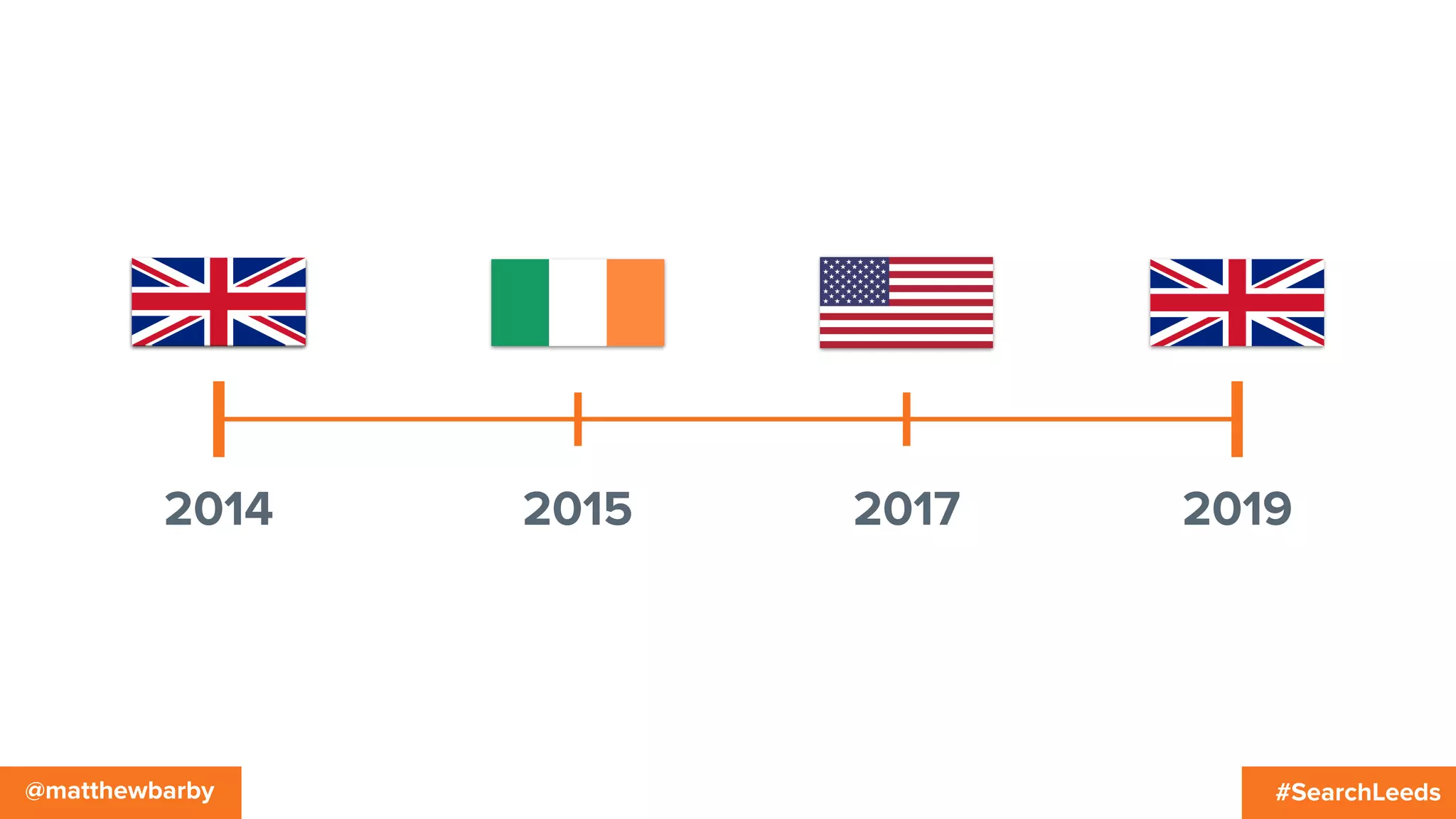
2014 201920172015
#SearchLeeds@matthewbarby
“Optimization”
#SearchLeeds@matthewbarby
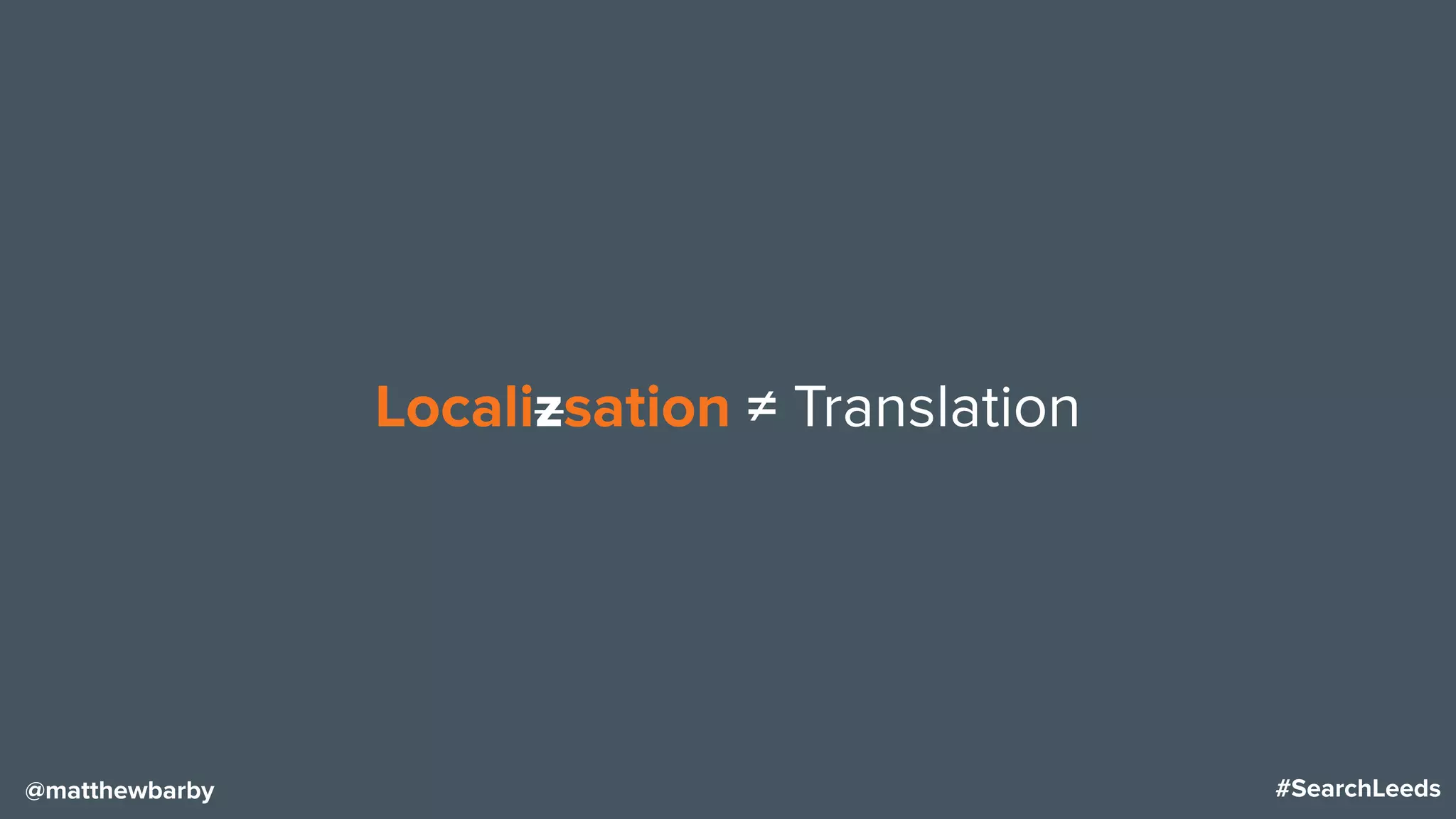
Localizsation ≠ Translation
#SearchLeeds@matthewbarby
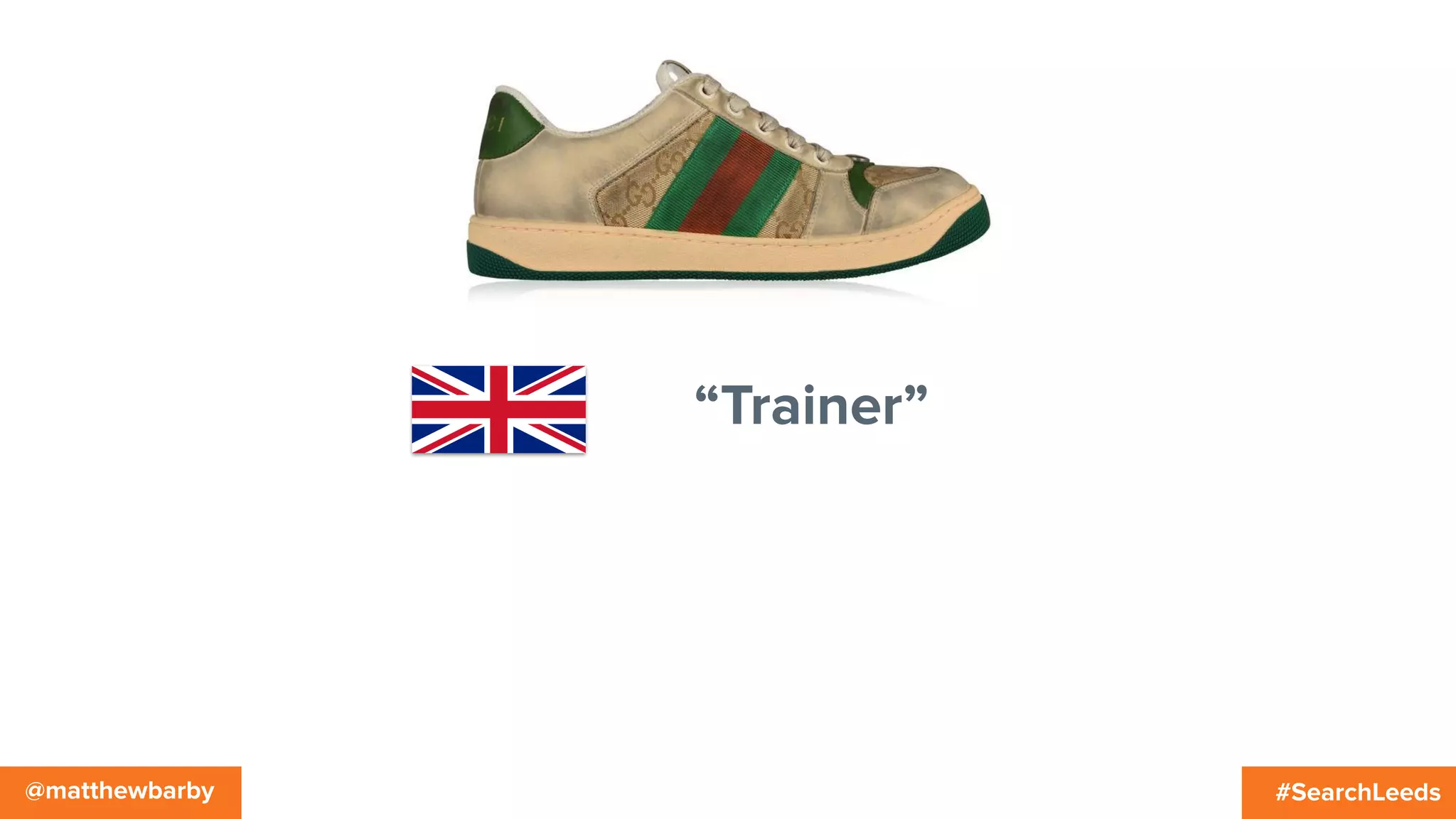
“Trainer”
#SearchLeeds@matthewbarby
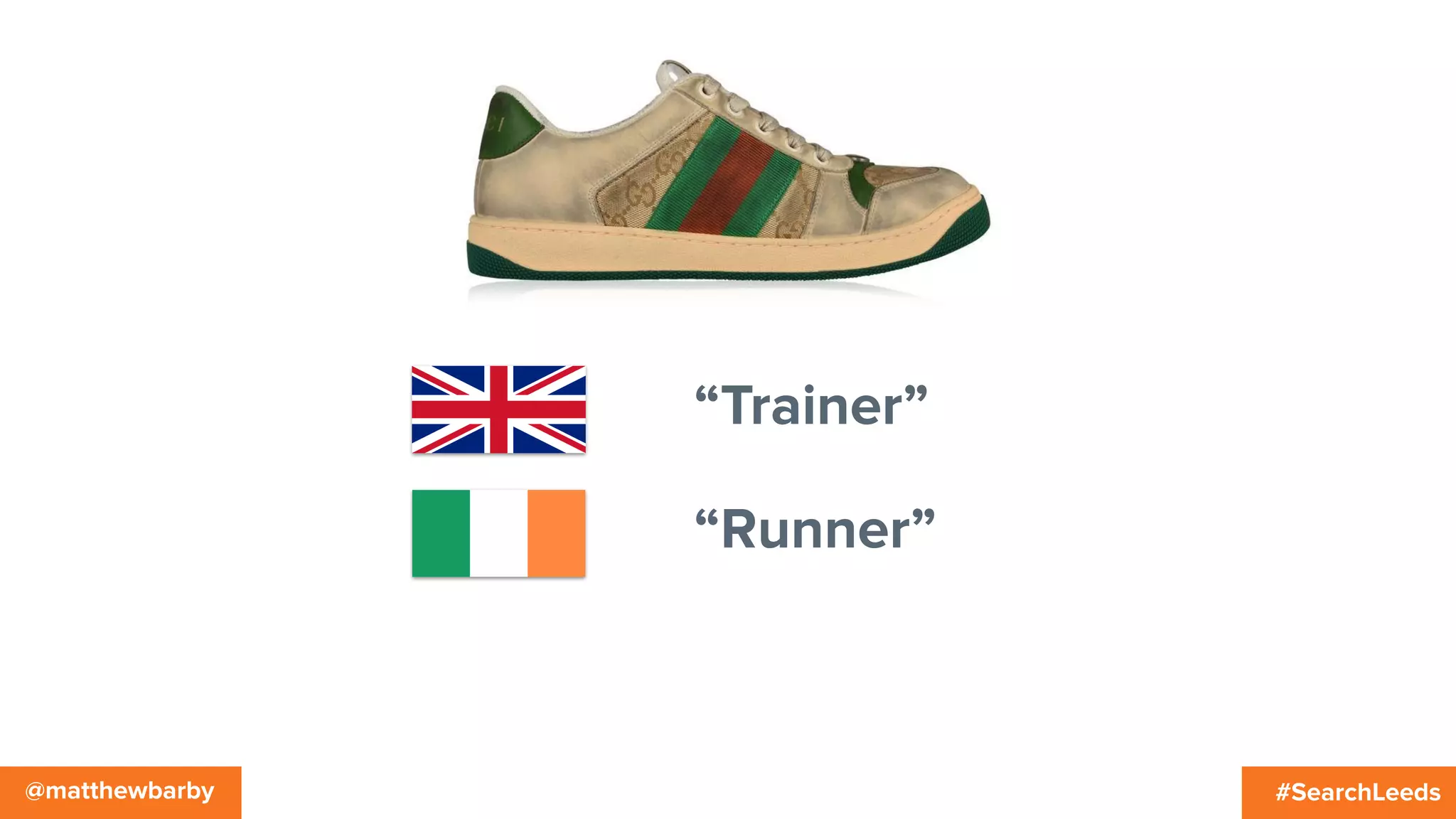
“Trainer”
“Runner”
#SearchLeeds@matthewbarby
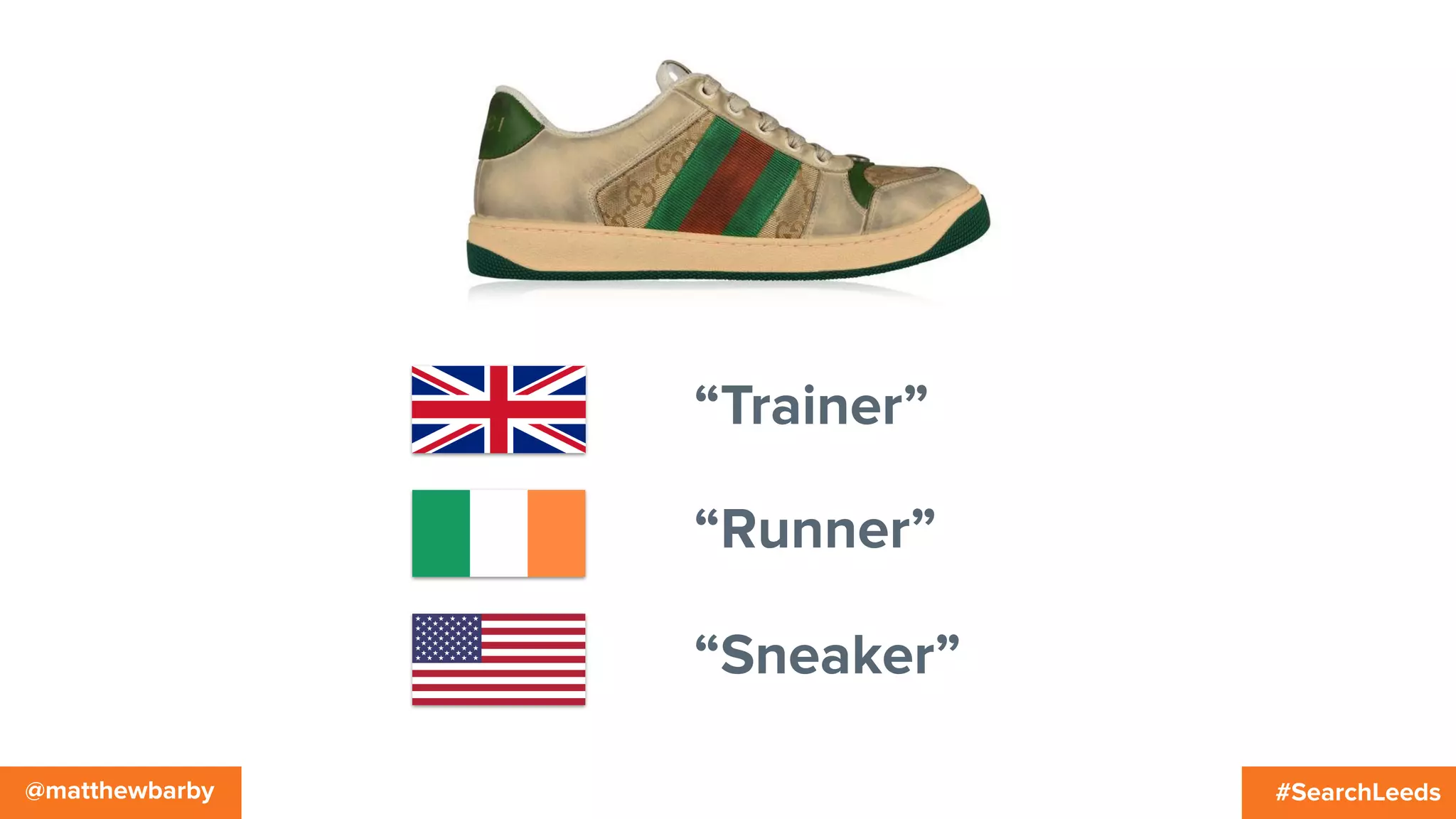
“Trainer”
“Runner”
“Sneaker”
#SearchLeeds@matthewbarby
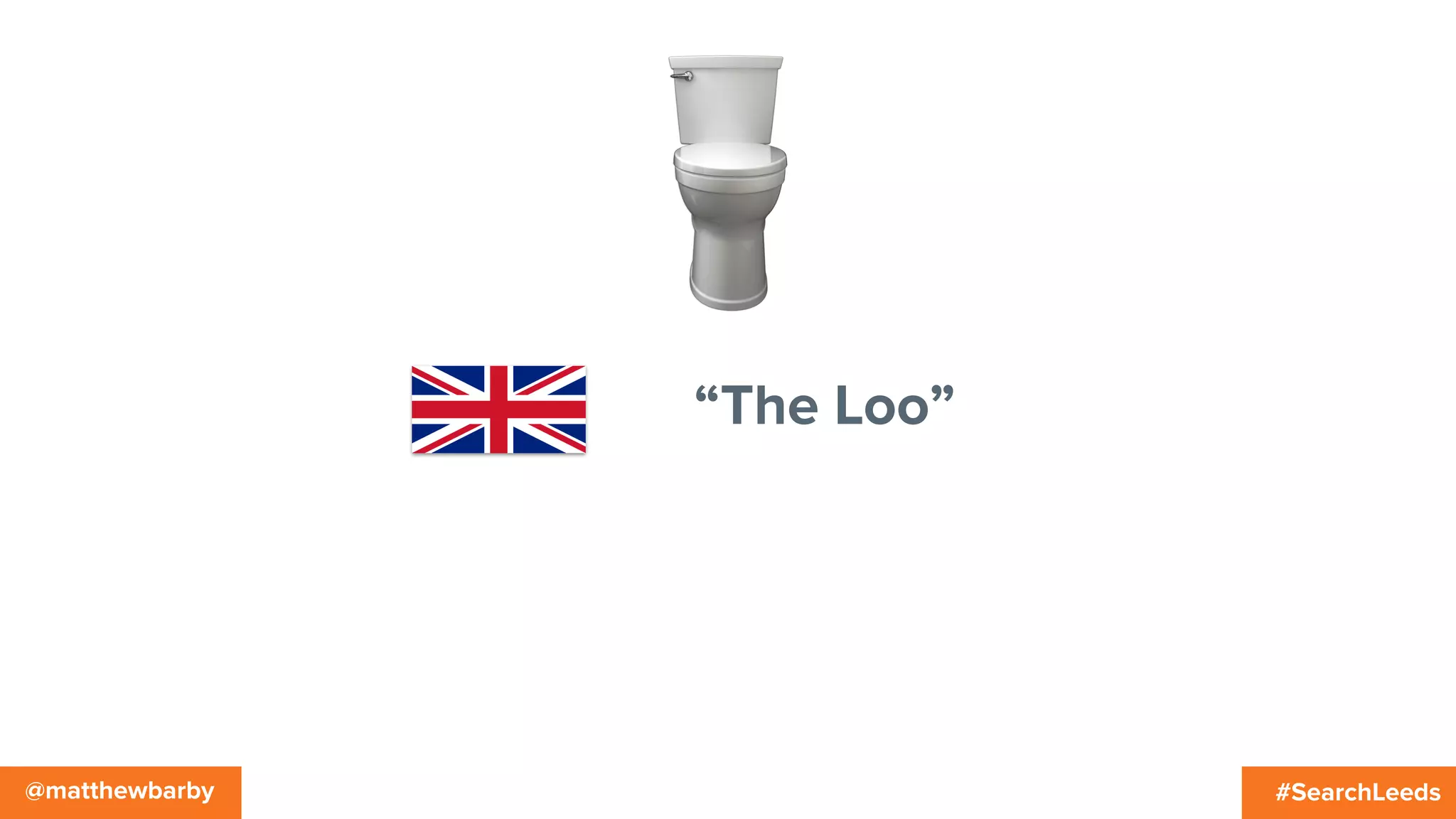
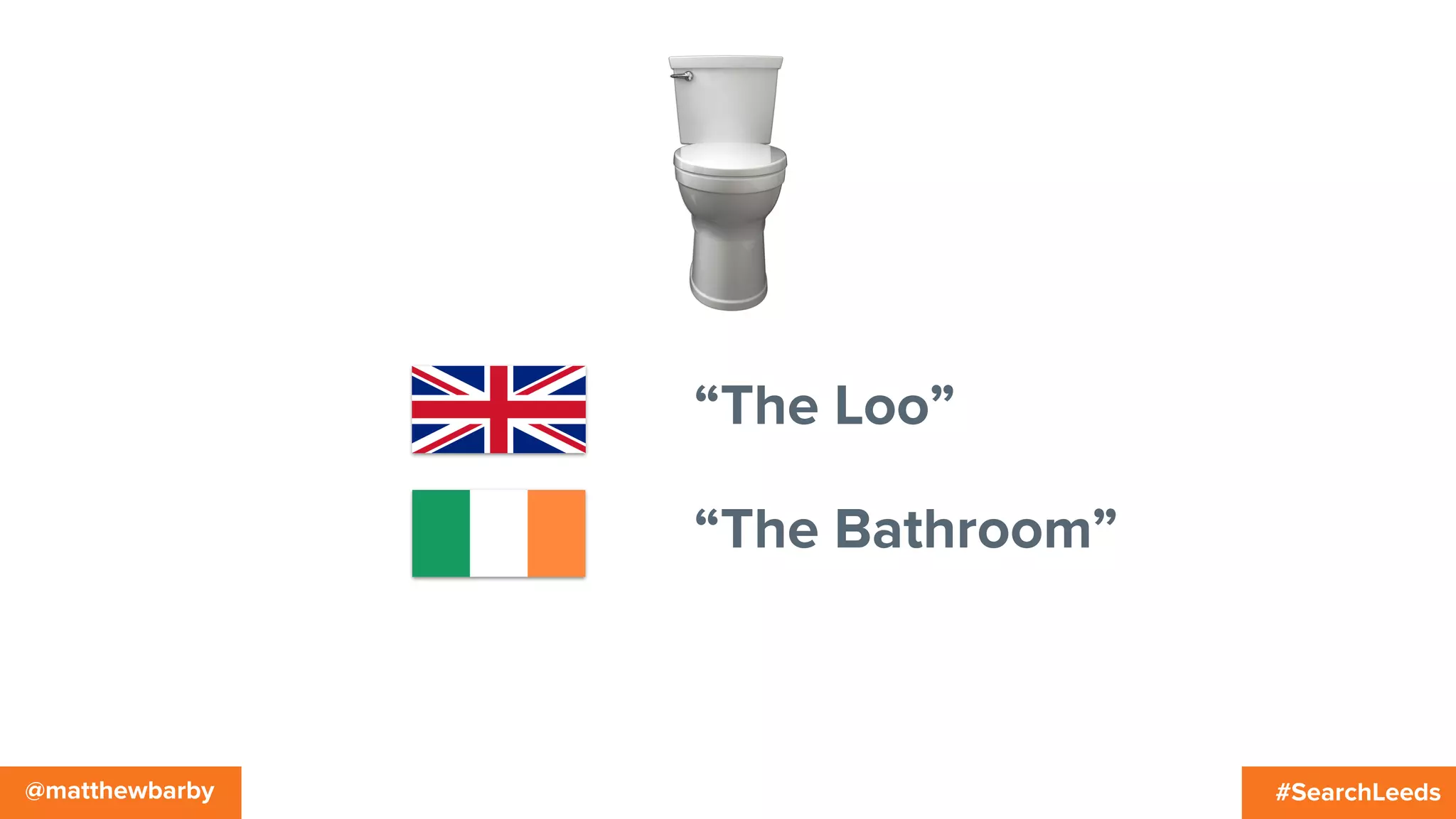
“The Loo”
#SearchLeeds@matthewbarby
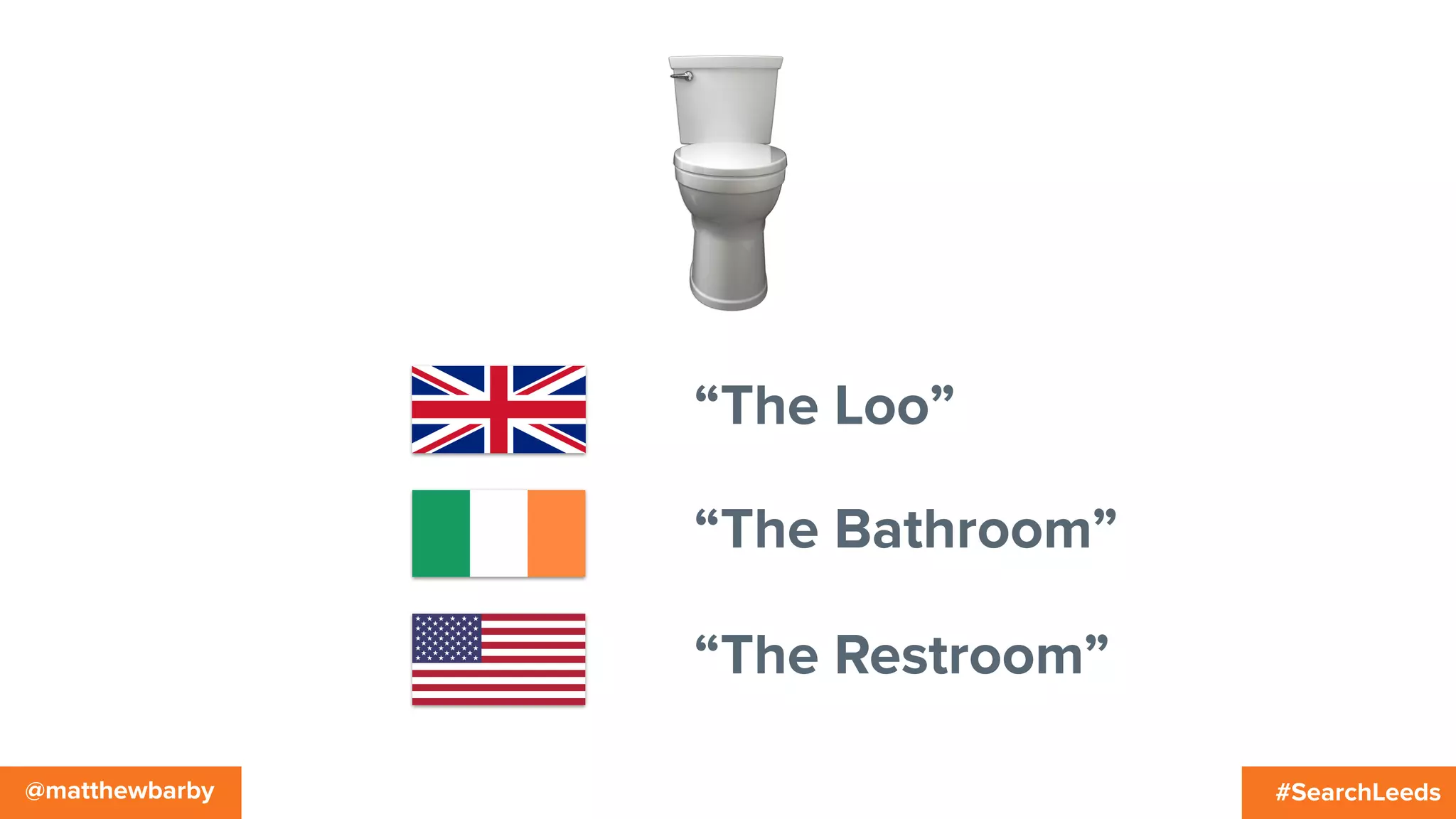
“The Loo”
“The Bathroom”
#SearchLeeds@matthewbarby
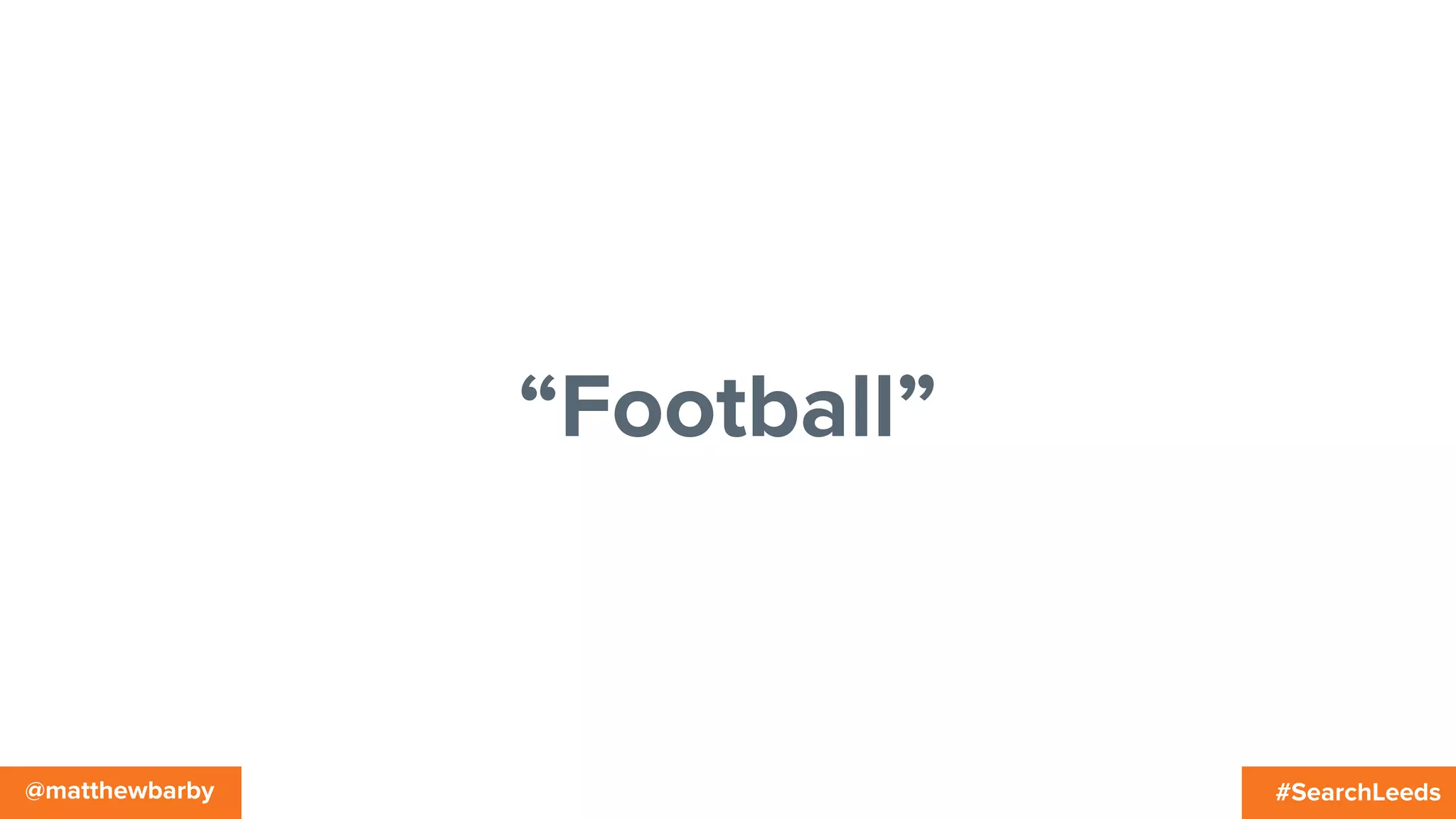
“The Loo”
“The Bathroom”
“The Restroom”
#SearchLeeds@matthewbarby
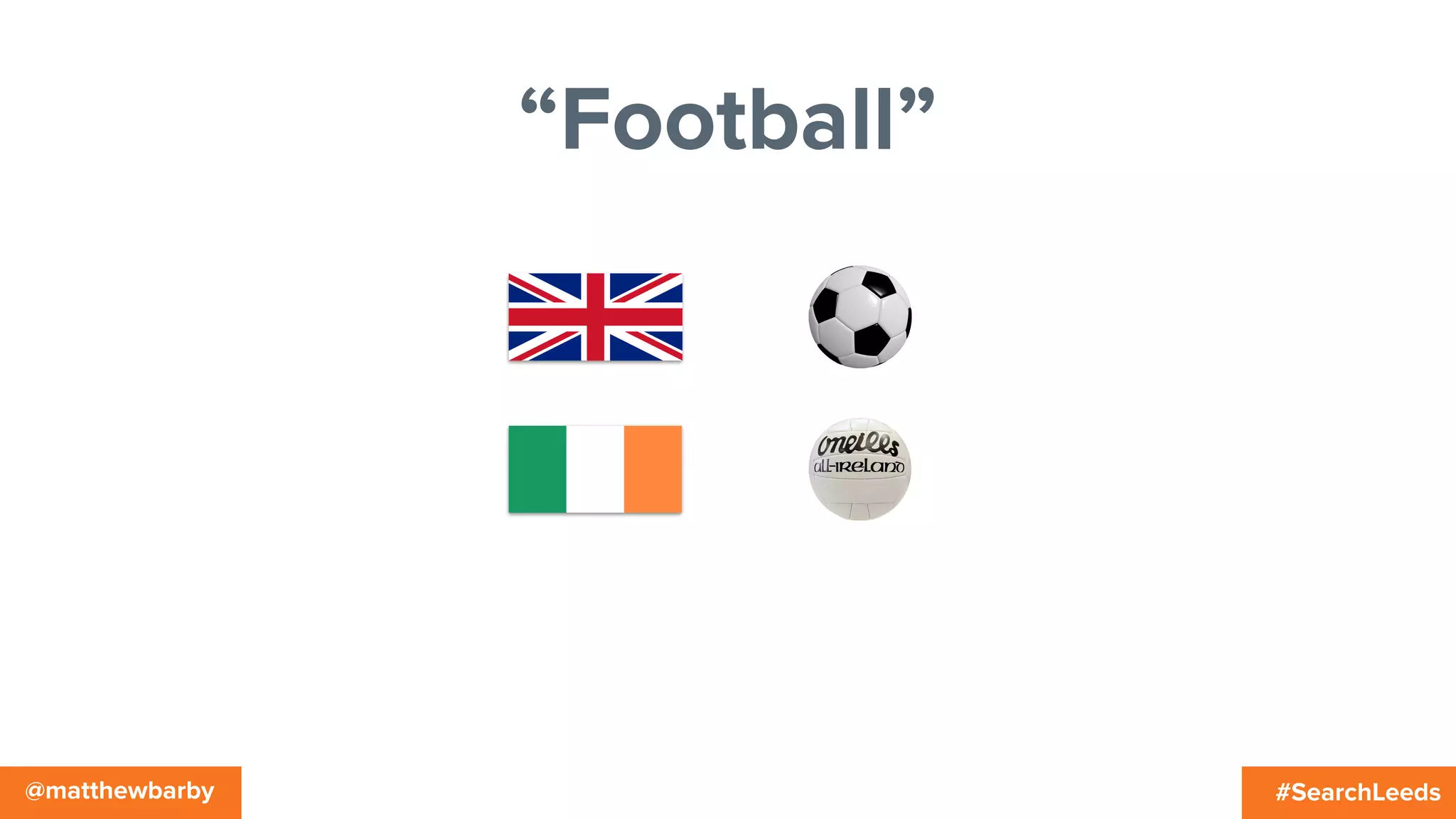
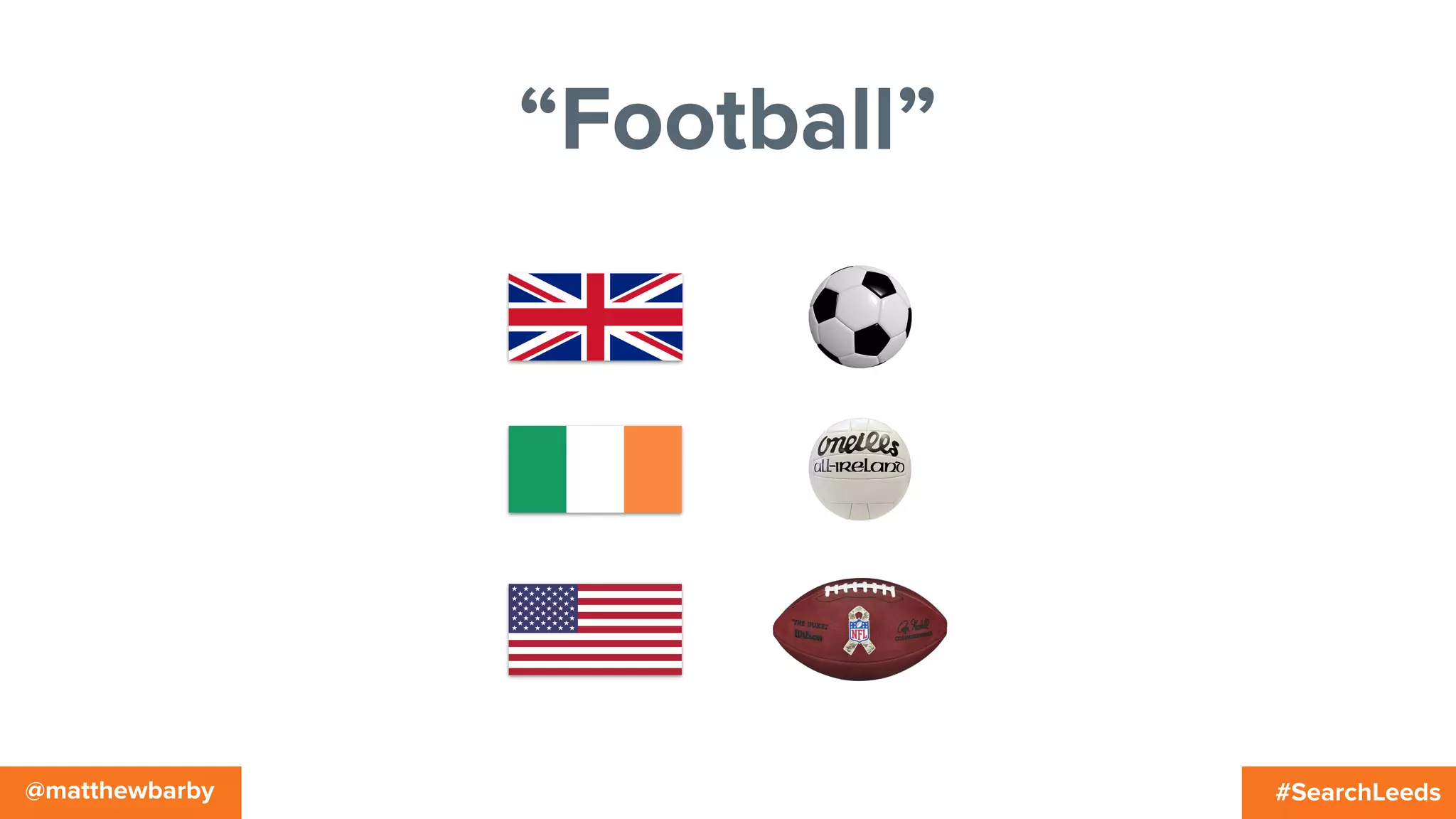
“Football”
#SearchLeeds@matthewbarby
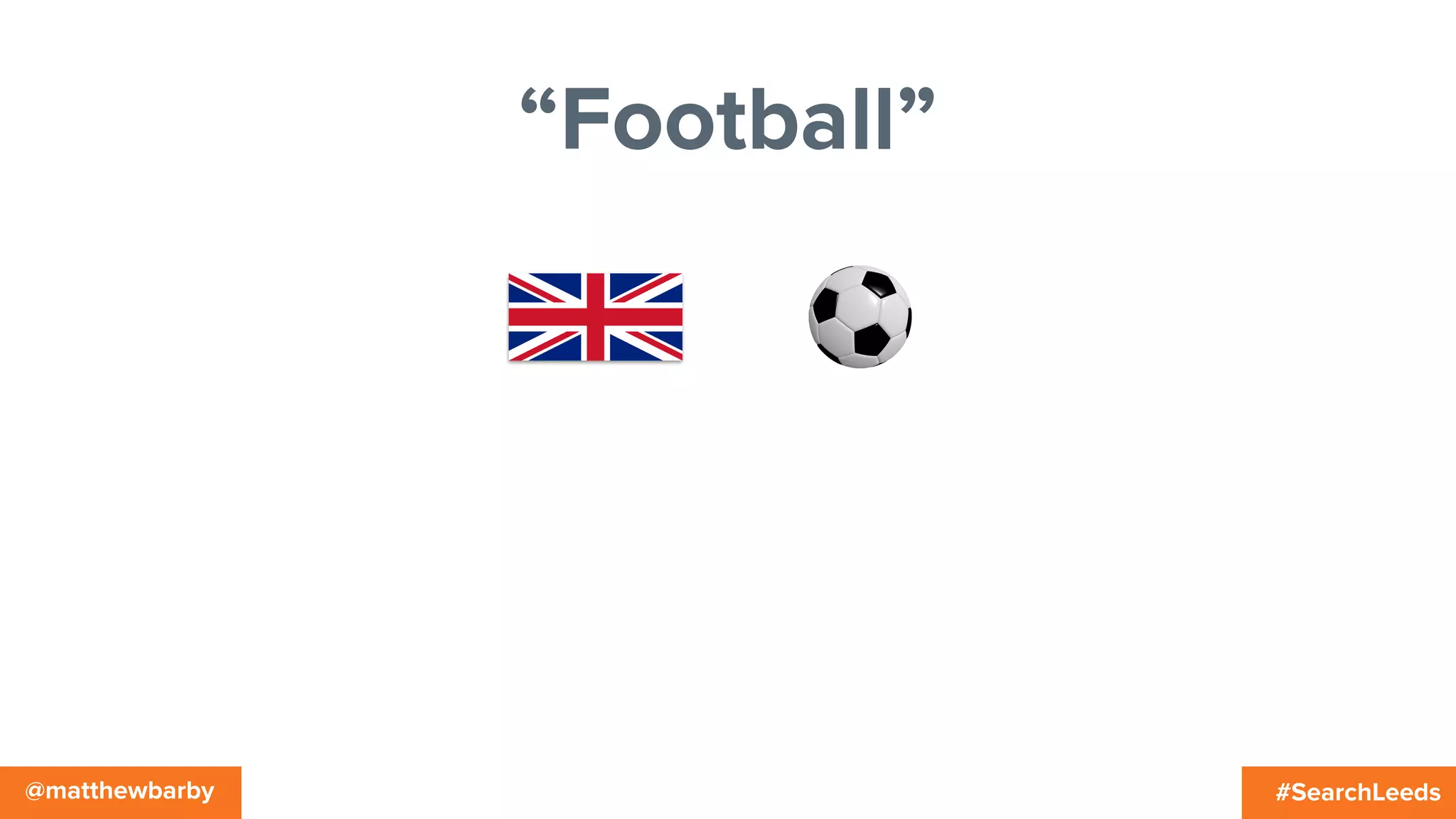
“Football”
#SearchLeeds@matthewbarby
“Football”
#SearchLeeds@matthewbarby
“Football”
#SearchLeeds@matthewbarby
“Soccer”
#SearchLeeds@matthewbarby
And this is just English.
#SearchLeeds@matthewbarby
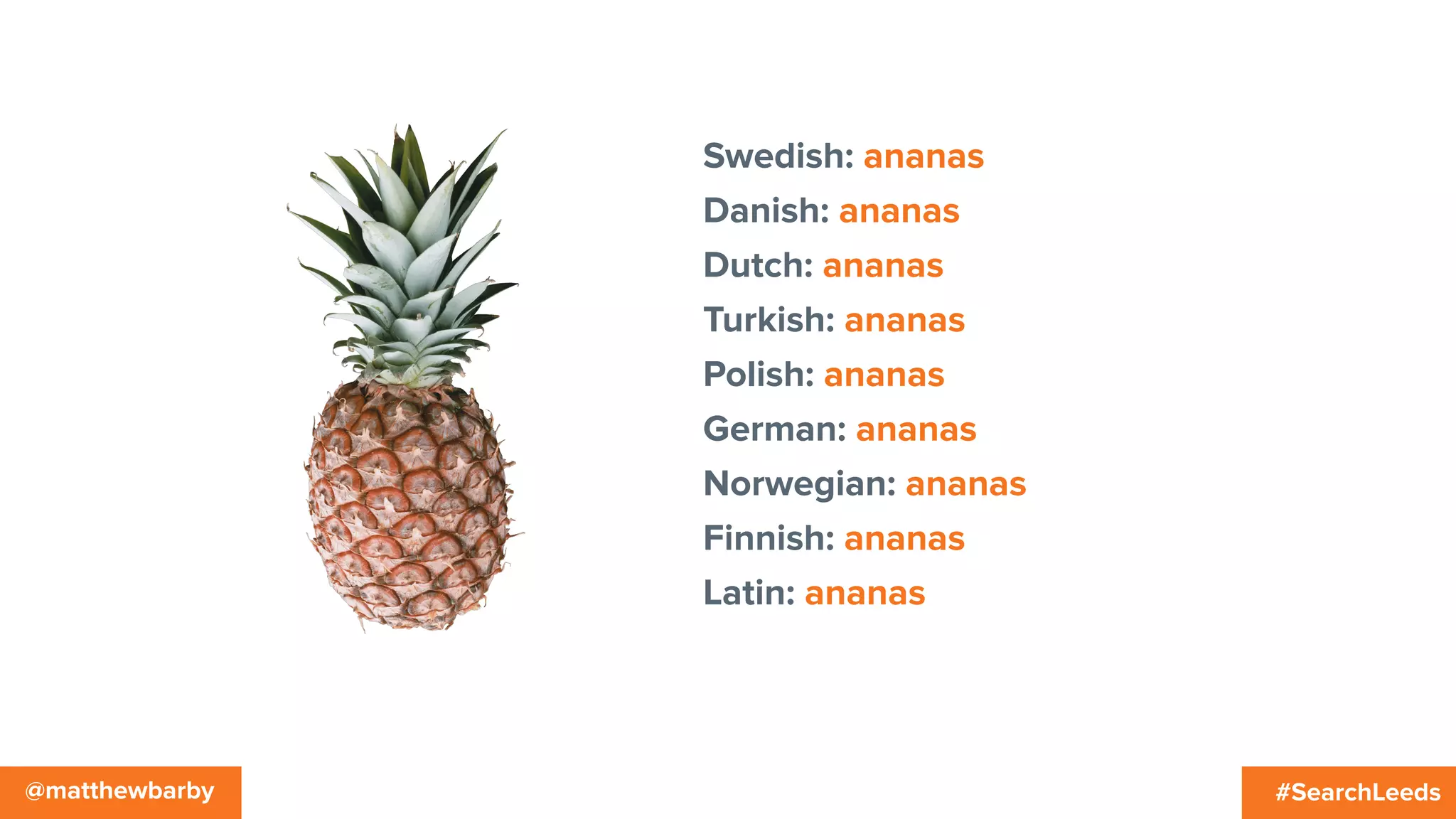
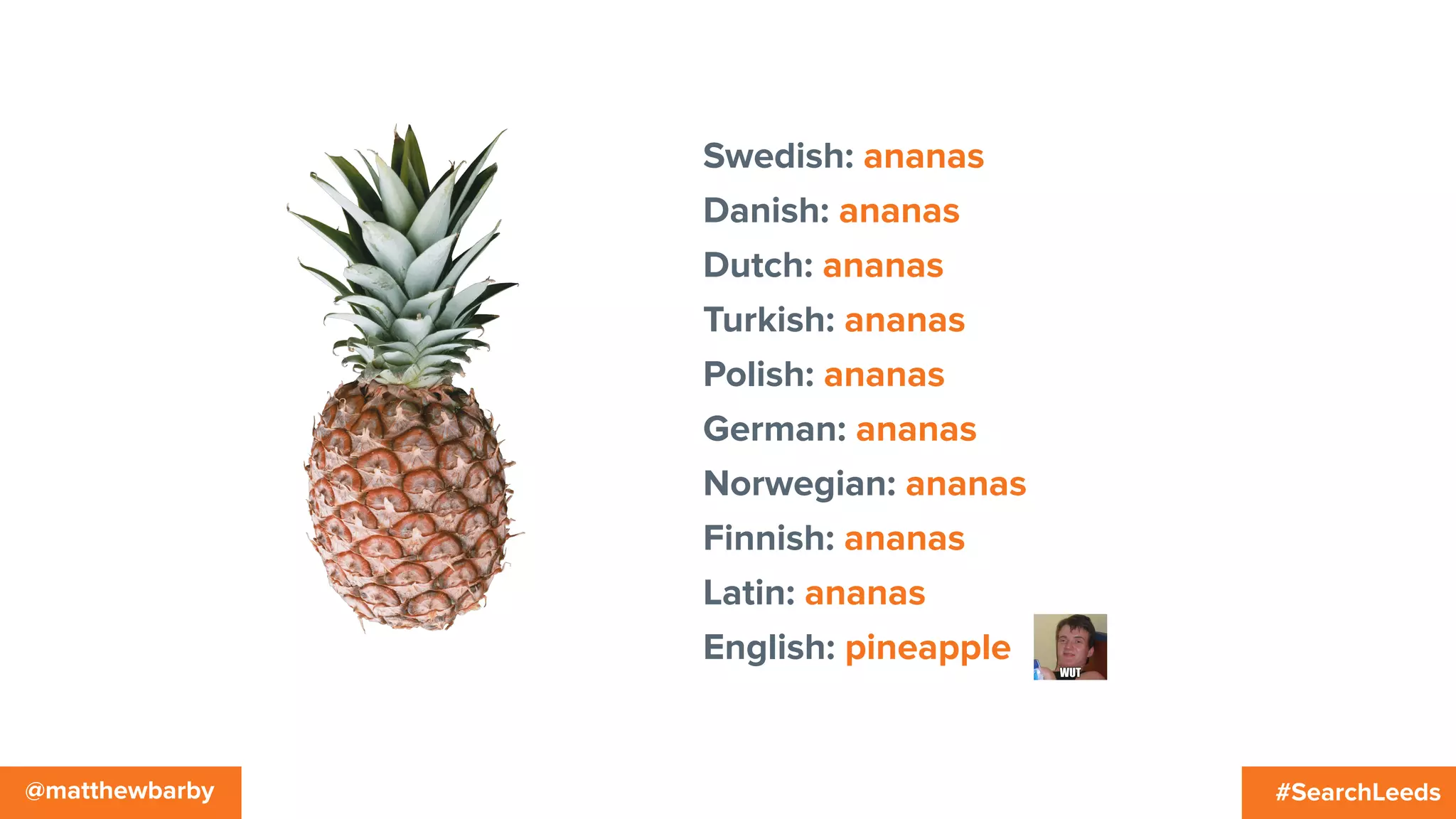
Swedish: ananas
Danish: ananas
Dutch: ananas
Turkish: ananas
Polish: ananas
German: ananas
Norwegian: ananas
Finnish: ananas
Latin: ananas
#SearchLeeds@matthewbarby
Swedish: ananas
Danish: ananas
Dutch: ananas
Turkish: ananas
Polish: ananas
German: ananas
Norwegian: ananas
Finnish: ananas
Latin: ananas
English: pineapple
#SearchLeeds@matthewbarby
Do I need to be a polyglot to do International SEO?
#SearchLeeds@matthewbarby
Do I need to be a polyglot to do International SEO?
If a Brit can do it, anyone can.
#SearchLeeds@matthewbarby
There’s no “one correct way” to do
international SEO.
#SearchLeeds@matthewbarby
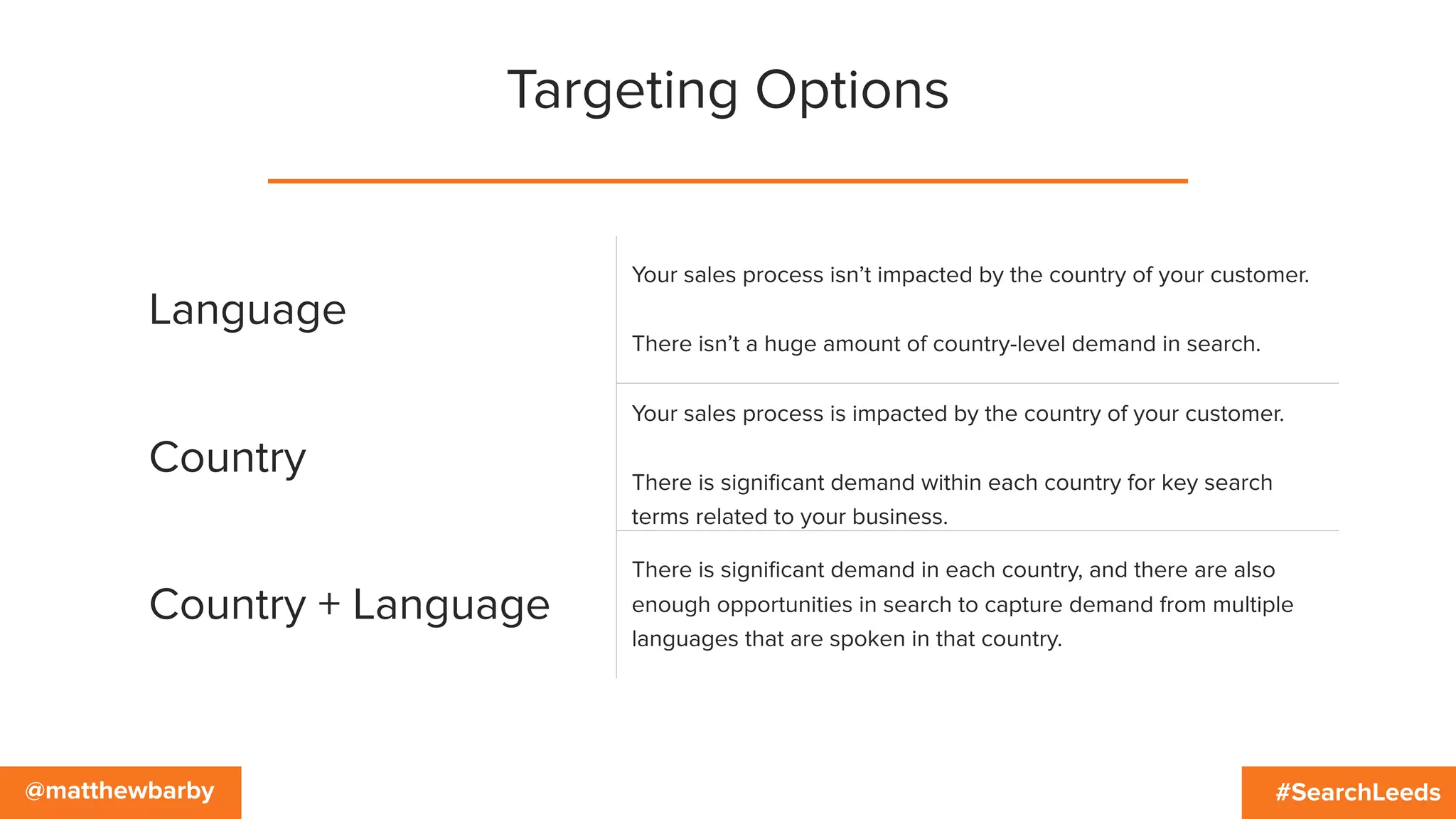
Targeting Options
Language
Your sales process isn’t impacted by the country of your customer.
There isn’t a huge amount of country-level demand in search.
Country
Your sales process is impacted by the country of your customer.
There is significant demand within each country for key search
terms related to your business.
Country + Language
There is significant demand in each country, and there are also
enough opportunities in search to capture demand from multiple
languages that are spoken in that country.
#SearchLeeds@matthewbarby
ccTLDs
(domain.es)
*not applicable for language targeting
1
#SearchLeeds@matthewbarby
Subdirectories
(domain.com/es/)
2
#SearchLeeds@matthewbarby
Subdomains
(es.domain.com)
3
#SearchLeeds@matthewbarby
Do not mix and match.
#SearchLeeds@matthewbarby
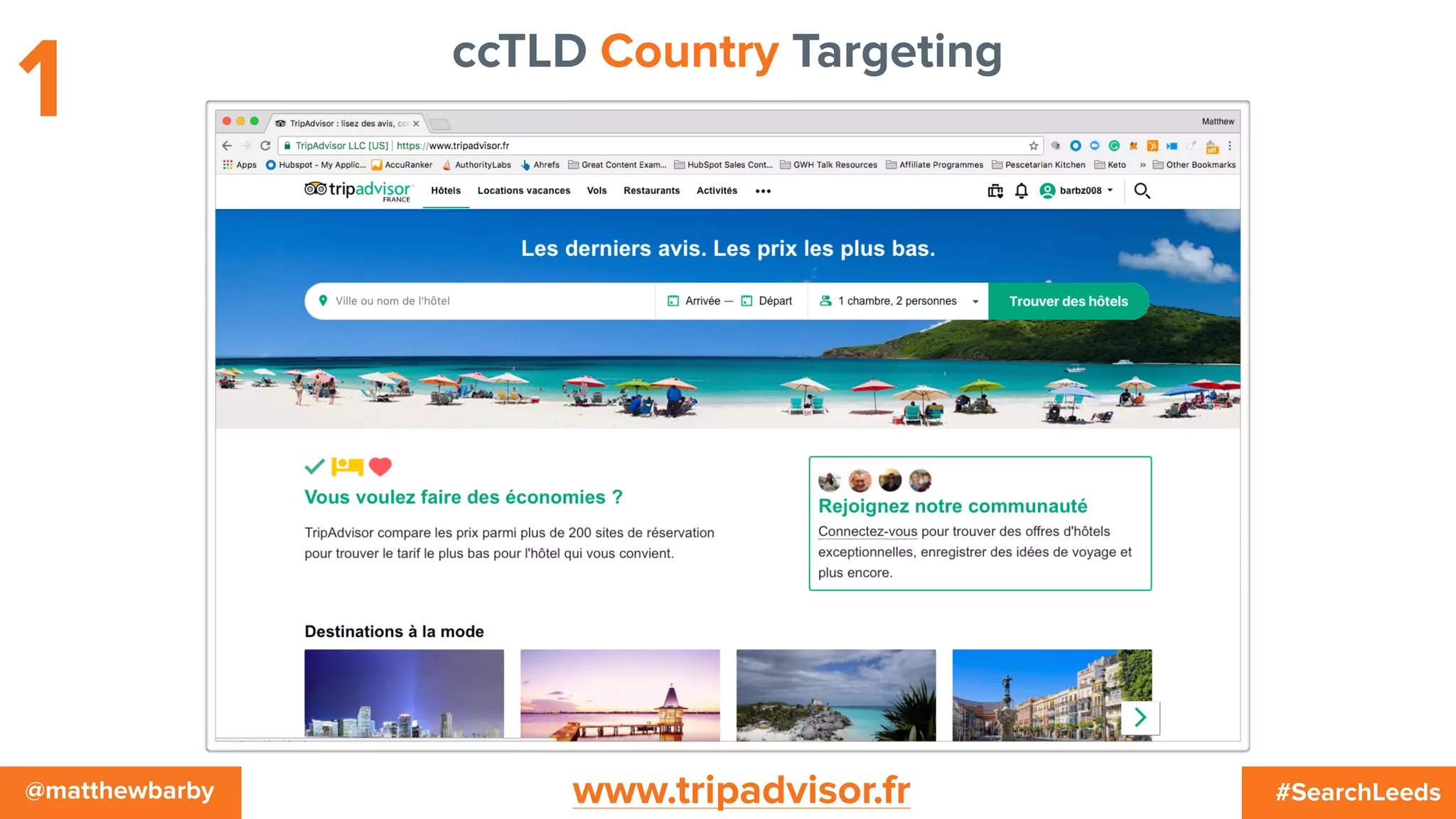
ccTLD Country Targeting
1
www.tripadvisor.fr
#SearchLeeds@matthewbarby
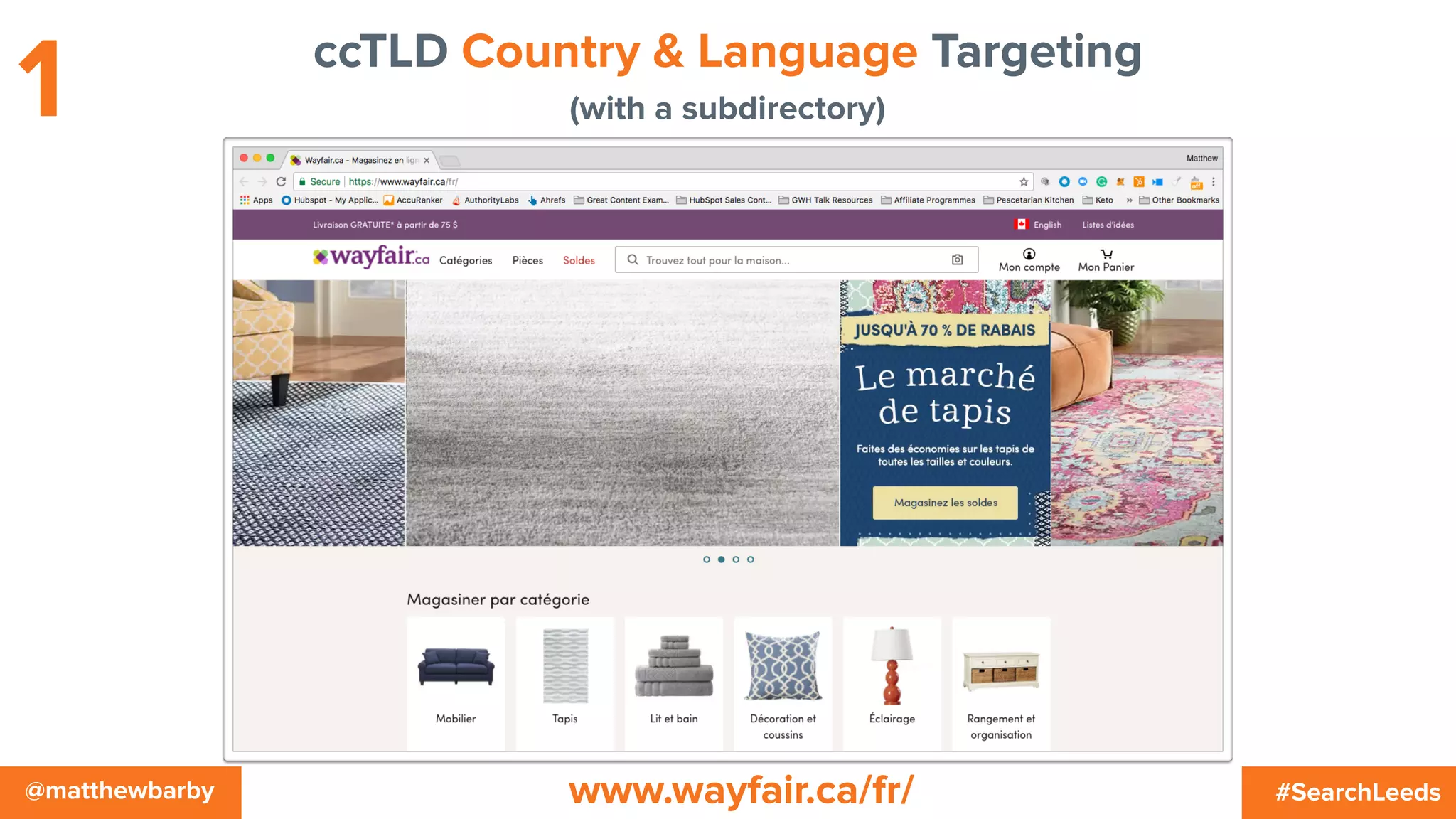
ccTLD Country & Language Targeting
(with a subdirectory)1
www.wayfair.ca/fr/
#SearchLeeds@matthewbarby
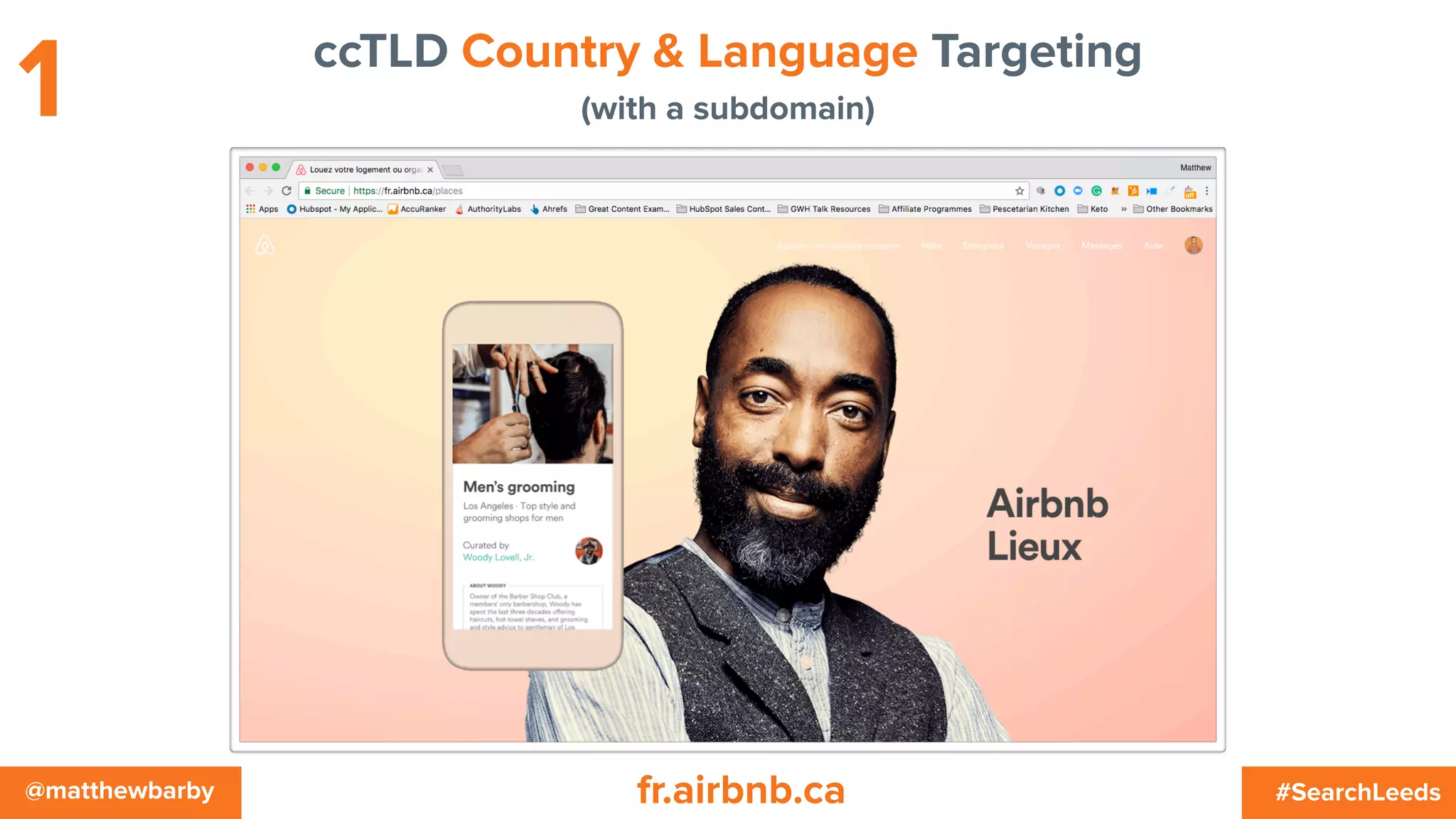
ccTLD Country & Language Targeting
(with a subdomain)1
fr.airbnb.ca
#SearchLeeds@matthewbarby
When to Use ccTLDs
You have large audiences in each target country.
Resources to develop and maintain multiple web properties.
Resources to run local link building campaigns.
You want to boost the appearance of a local sales presence.
You want to build your brand presence in each target country.
You have different product/service offering in each region.
Resources to develop localized content for each target country.
#SearchLeeds@matthewbarby
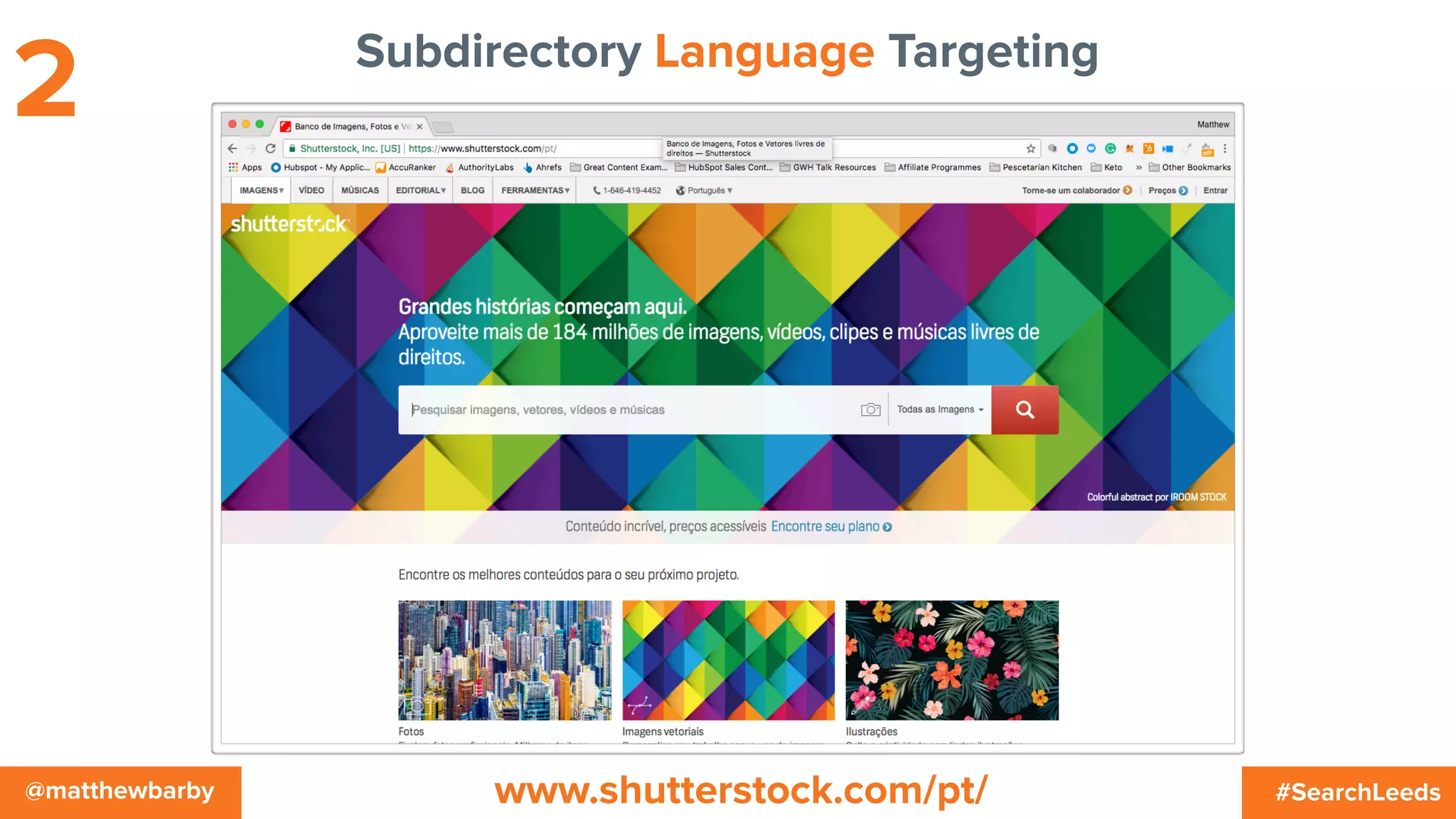
Subdirectory Language Targeting
2
www.shutterstock.com/pt/
#SearchLeeds@matthewbarby
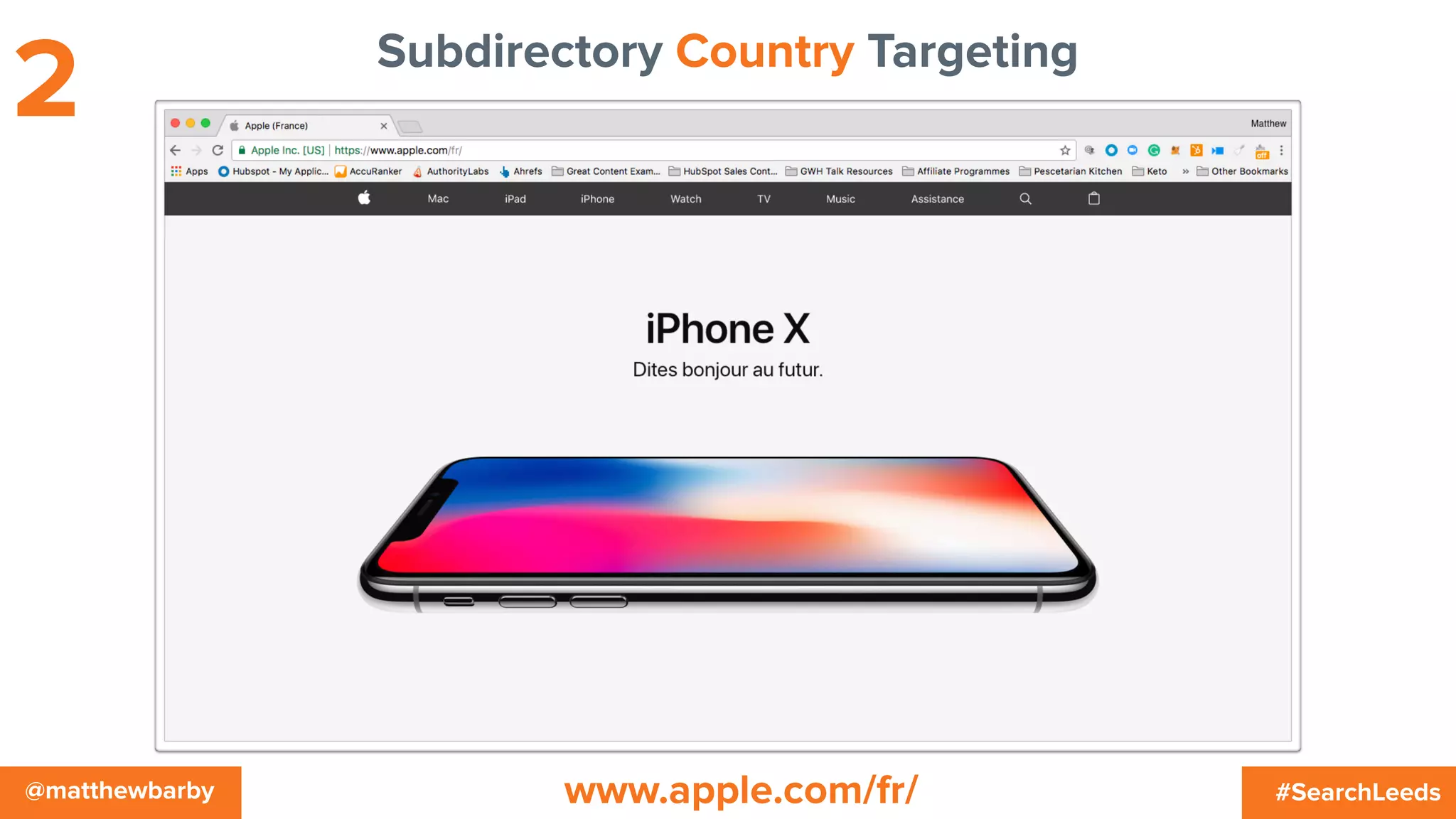
Subdirectory Country Targeting
2
www.apple.com/fr/
#SearchLeeds@matthewbarby
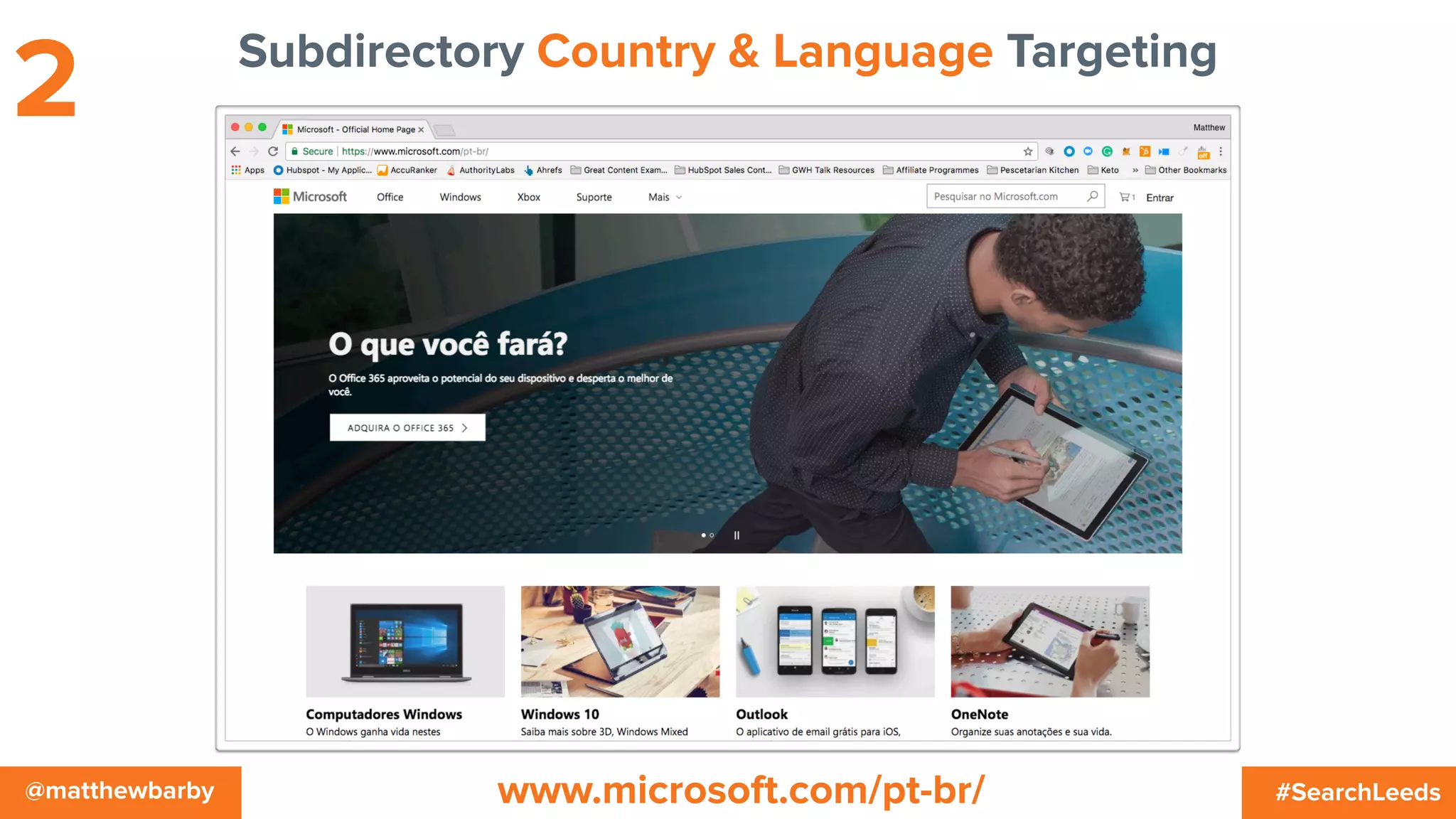
Subdirectory Country & Language Targeting
2
www.microsoft.com/pt-br/
#SearchLeeds@matthewbarby
When to Use Subdirectories
You don’t have the resources to build and maintain individual sites.
You don’t have the resources for local link building.
Your product/service offering doesn’t differ much by region.
You want to keep costs low.
#SearchLeeds@matthewbarby
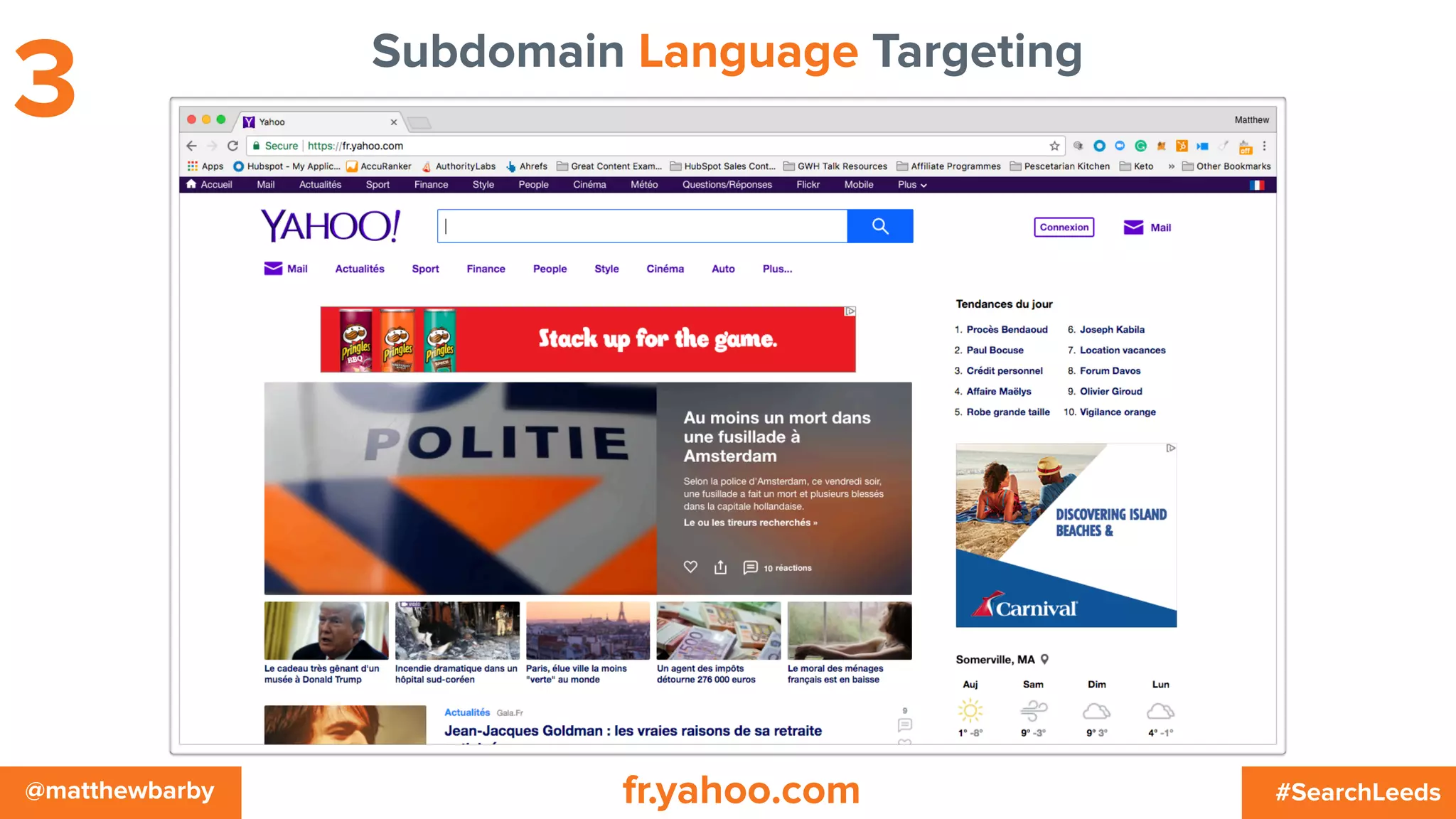
Subdomain Language Targeting
3
fr.yahoo.com
#SearchLeeds@matthewbarby
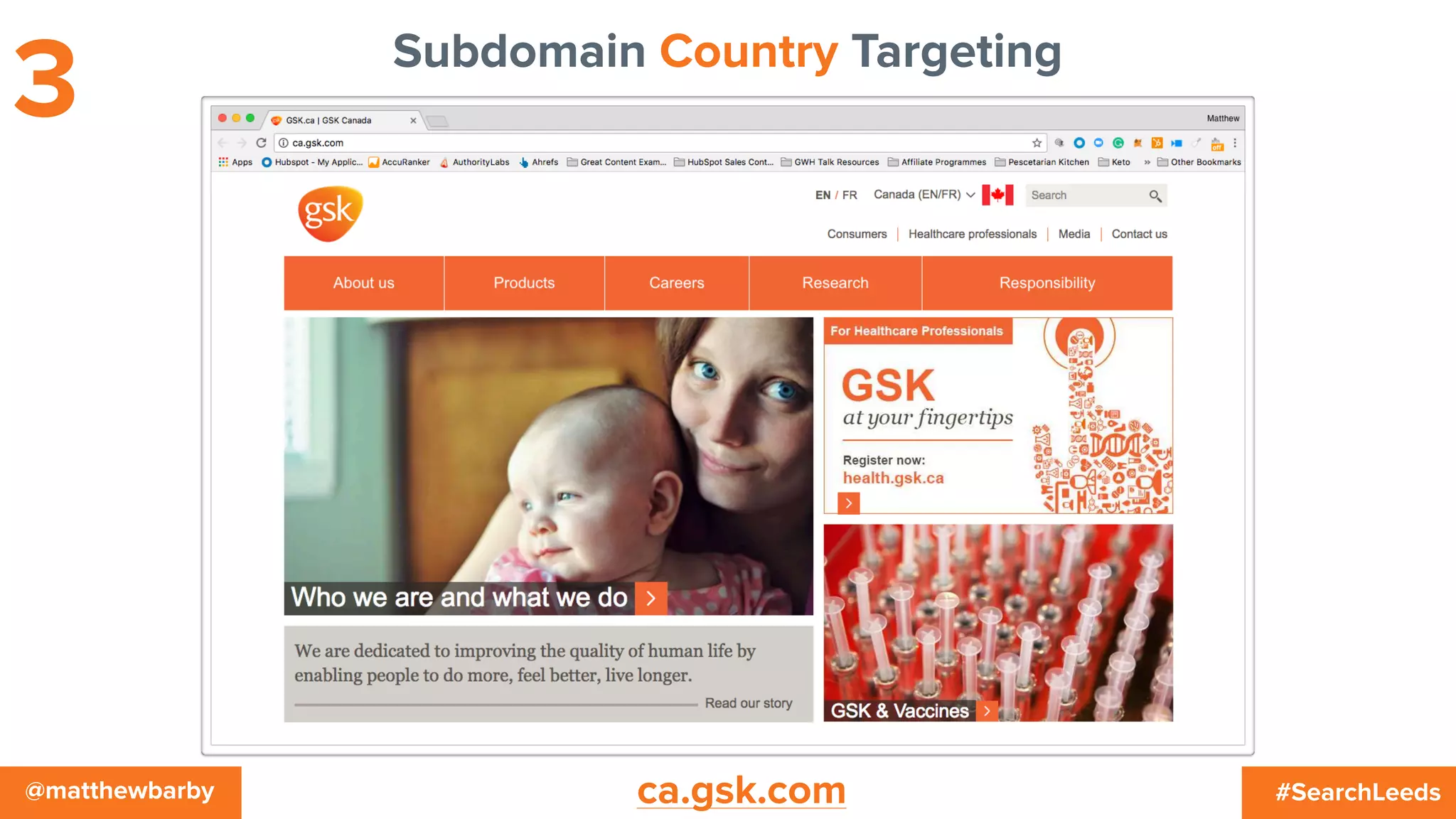
Subdomain Country Targeting
3
ca.gsk.com
#SearchLeeds@matthewbarby
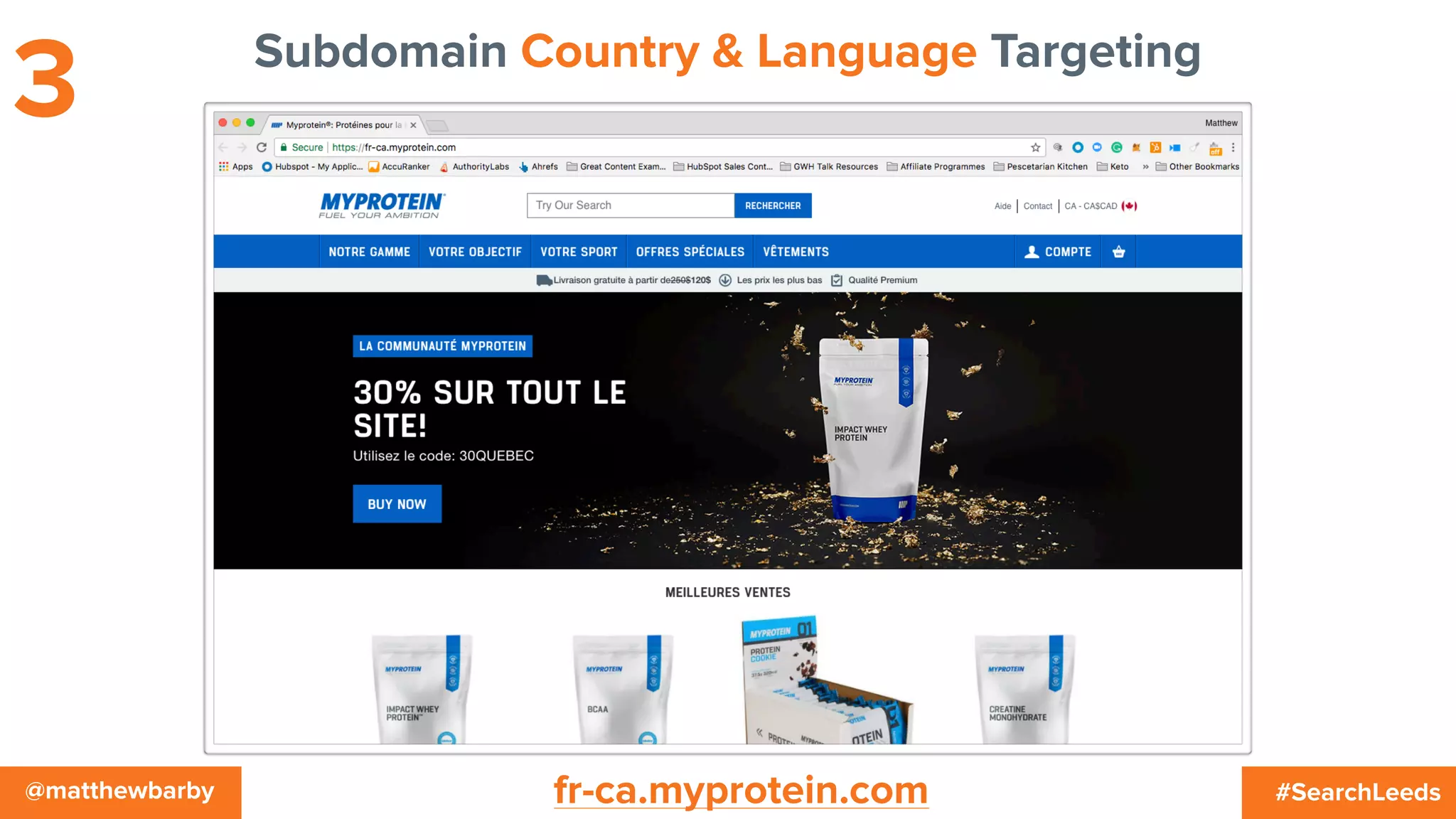
Subdomain Country & Language Targeting
3
fr-ca.myprotein.com
#SearchLeeds@matthewbarby
When to Use Subdirectories
You don’t have the resources/ability to acquire and manage
individual ccTLDs.
You aren’t able (for tech reasons) to go with subdirectories.
#SearchLeeds@matthewbarby
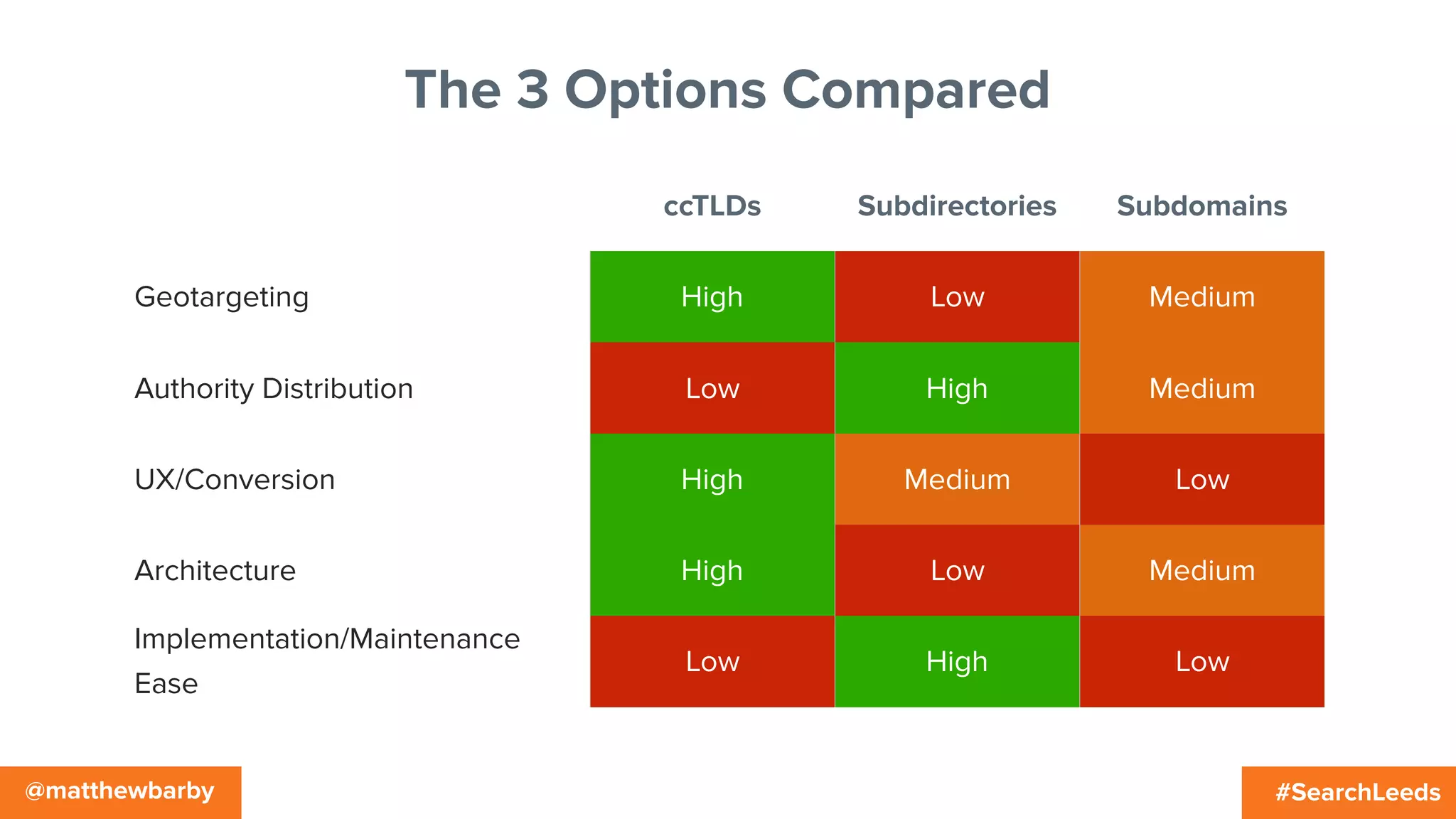
ccTLDs Subdirectories Subdomains
Geotargeting High Low Medium
Authority Distribution Low High Medium
UX/Conversion High Medium Low
Architecture High Low Medium
Implementation/Maintenance
Ease
Low High Low
The 3 Options Compared
#SearchLeeds@matthewbarby
Hreflang.
#SearchLeeds@matthewbarby
Hreflang
Needs to be set up no matter how you chose to structure your
international site(s) - i.e. ccTLDs, subdomains, subdirectories,
etc.
Used to tell Google which pages are translated/localized
versions of each of your pages.
You can also assign a version as the default URL for all other
country/language variations not specified.
Prevents duplicate content issues across localized content.
It’s very easy to mess this up.
#SearchLeeds@matthewbarby
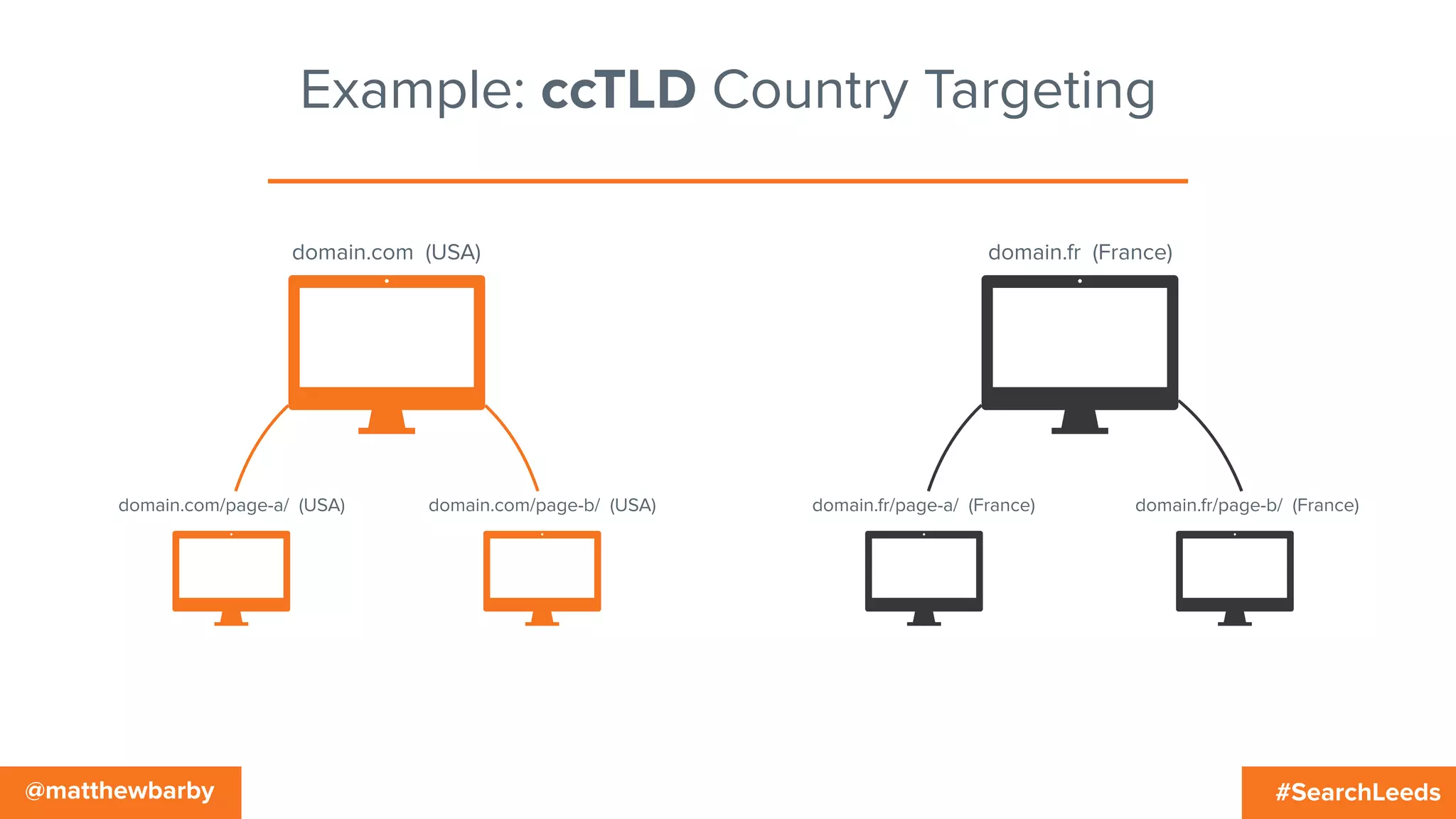
Example: ccTLD Country Targeting
domain.com (USA)
domain.com/page-b/ (USA)domain.com/page-a/ (USA)
domain.fr (France)
domain.fr/page-a/ (France) domain.fr/page-b/ (France)
#SearchLeeds@matthewbarby
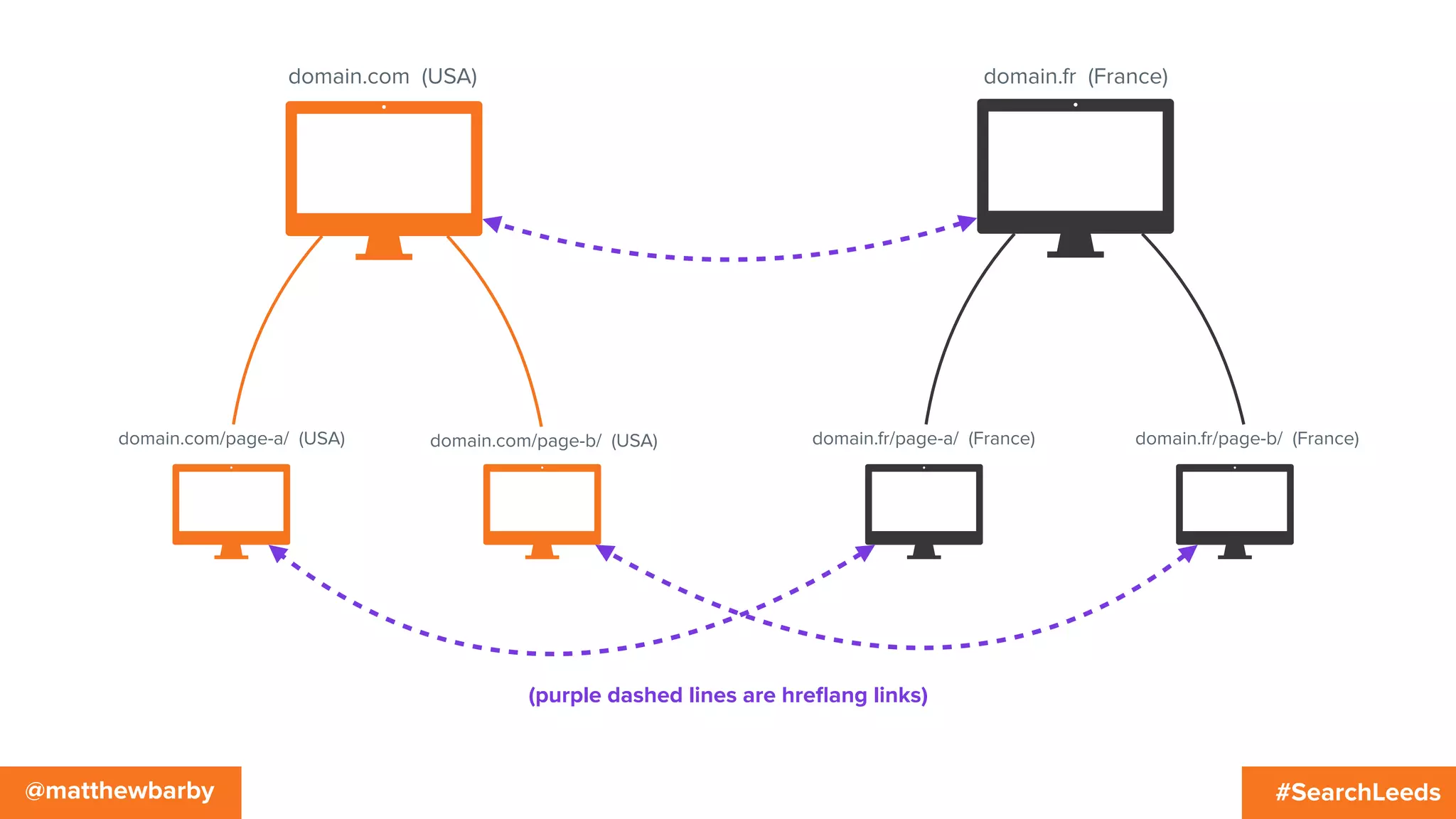
domain.com (USA)
domain.com/page-b/ (USA)domain.com/page-a/ (USA)
domain.fr (France)
domain.fr/page-a/ (France) domain.fr/page-b/ (France)
(purple dashed lines are hreflang links)
#SearchLeeds@matthewbarby
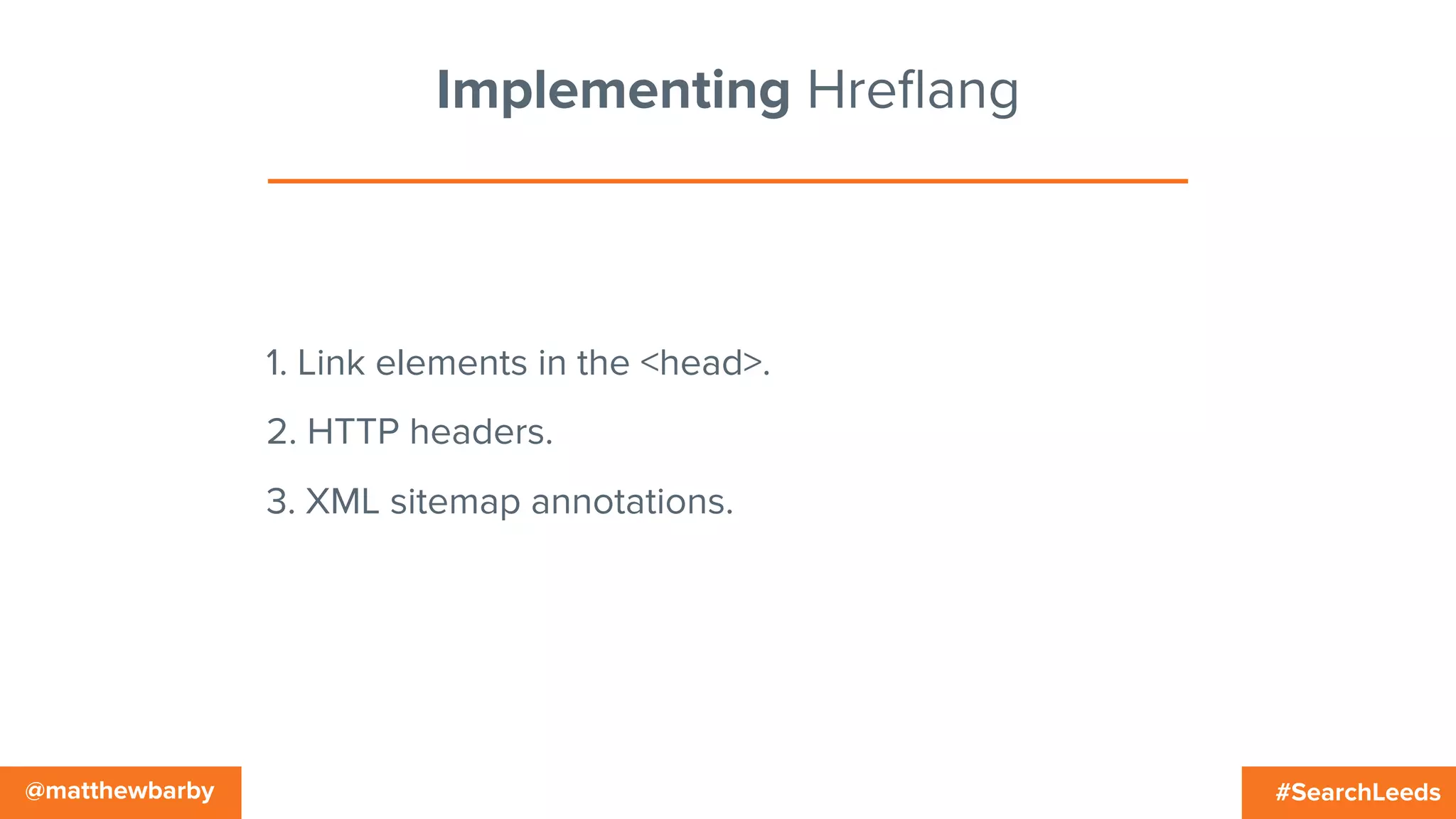
Implementing Hreflang
1. Link elements in the <head>.
2. HTTP headers.
3. XML sitemap annotations.
#SearchLeeds@matthewbarby
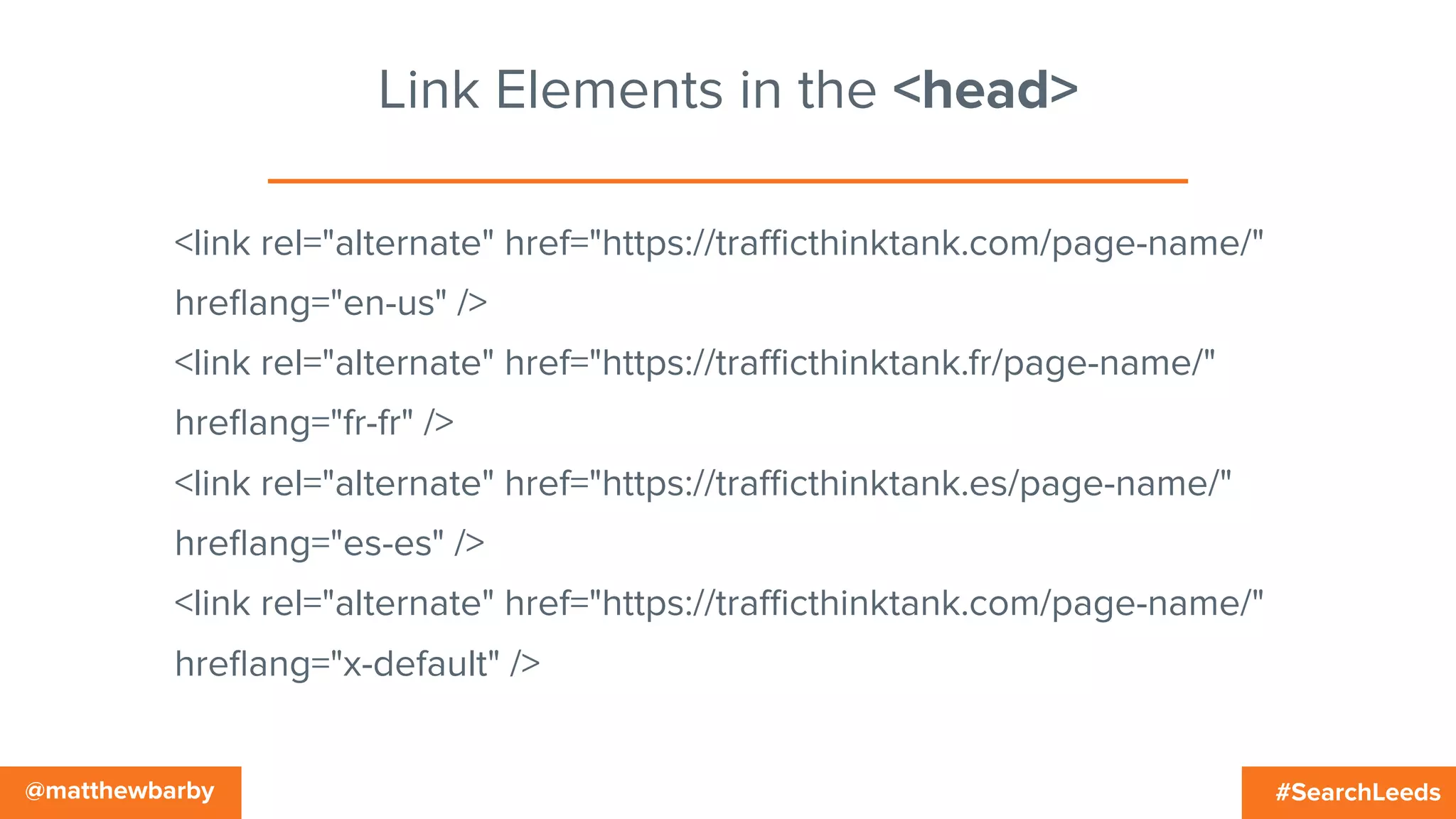
Link Elements in the <head>
<link rel="alternate" href="https://trafficthinktank.com/page-name/"
hreflang="en-us" />
<link rel="alternate" href="https://trafficthinktank.fr/page-name/"
hreflang="fr-fr" />
<link rel="alternate" href="https://trafficthinktank.es/page-name/"
hreflang="es-es" />
<link rel="alternate" href="https://trafficthinktank.com/page-name/"
hreflang="x-default" />
#SearchLeeds@matthewbarby
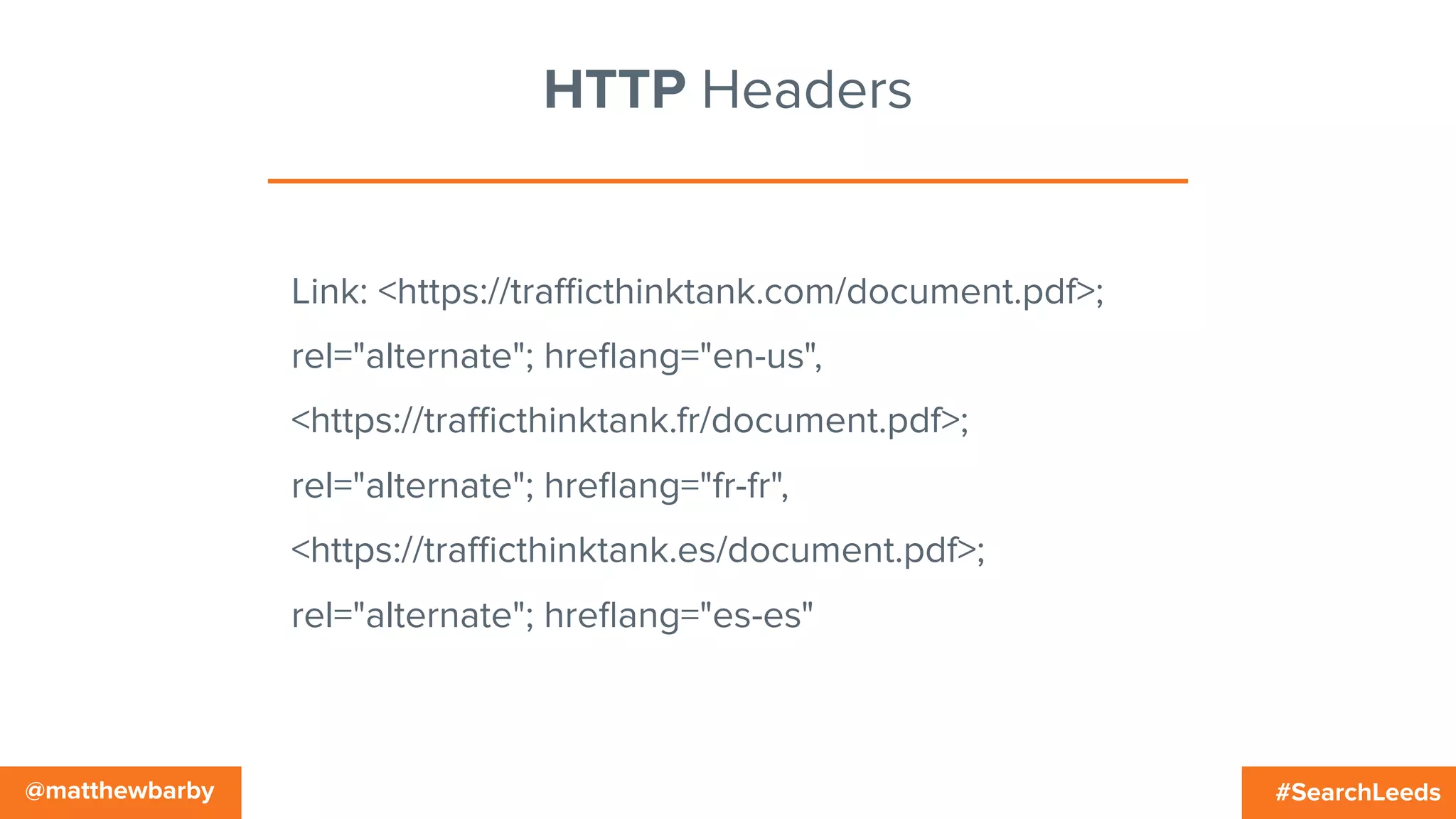
HTTP Headers
Link: <https://trafficthinktank.com/document.pdf>;
rel="alternate"; hreflang="en-us",
<https://trafficthinktank.fr/document.pdf>;
rel="alternate"; hreflang="fr-fr",
<https://trafficthinktank.es/document.pdf>;
rel="alternate"; hreflang="es-es"
#SearchLeeds@matthewbarby
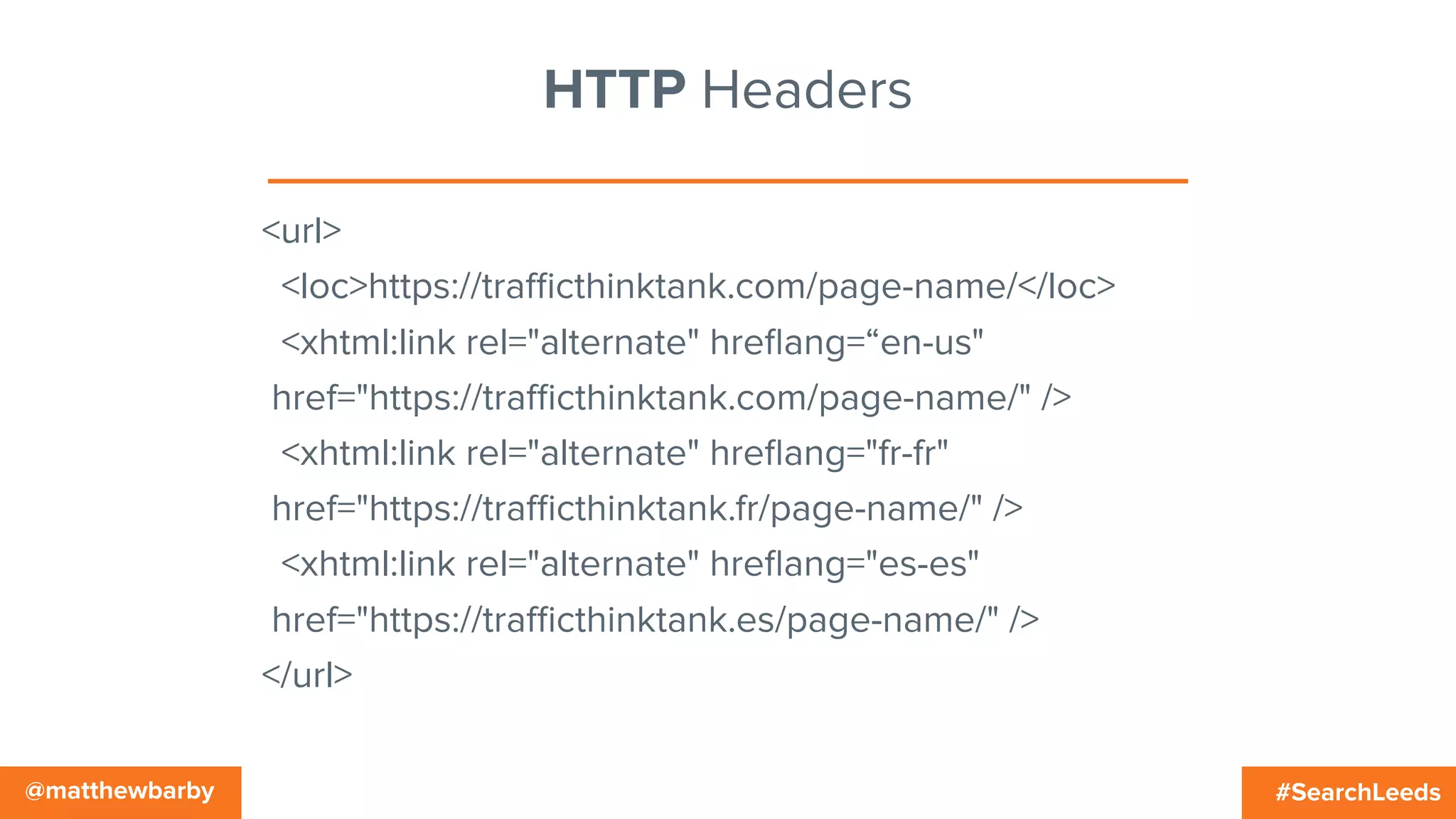
HTTP Headers
<url>
<loc>https://trafficthinktank.com/page-name/</loc>
<xhtml:link rel="alternate" hreflang=“en-us"
href="https://trafficthinktank.com/page-name/" />
<xhtml:link rel="alternate" hreflang="fr-fr"
href="https://trafficthinktank.fr/page-name/" />
<xhtml:link rel="alternate" hreflang="es-es"
href="https://trafficthinktank.es/page-name/" />
</url>
#SearchLeeds@matthewbarby
Hreflang: Implementation rules.
#SearchLeeds@matthewbarby
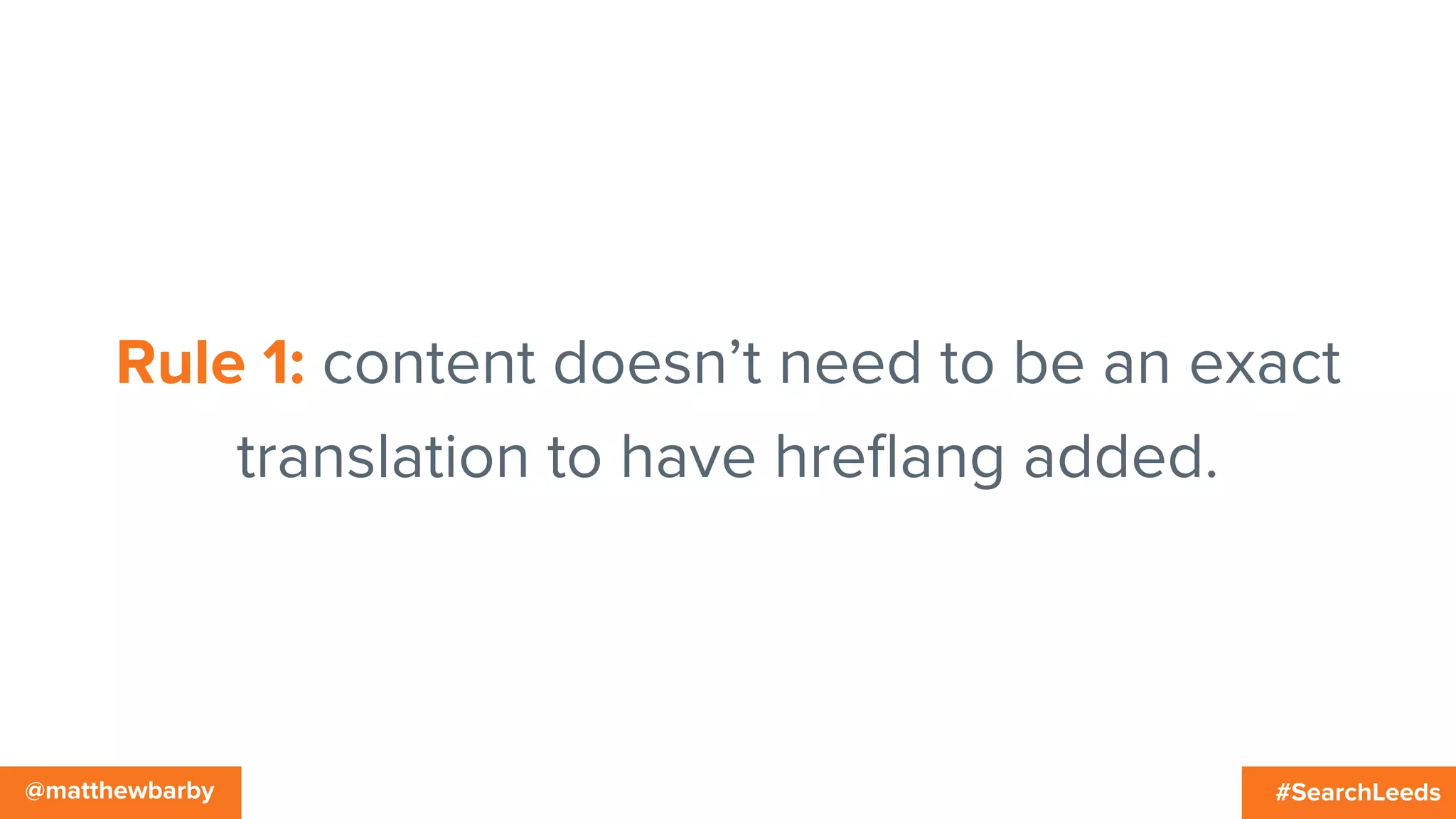
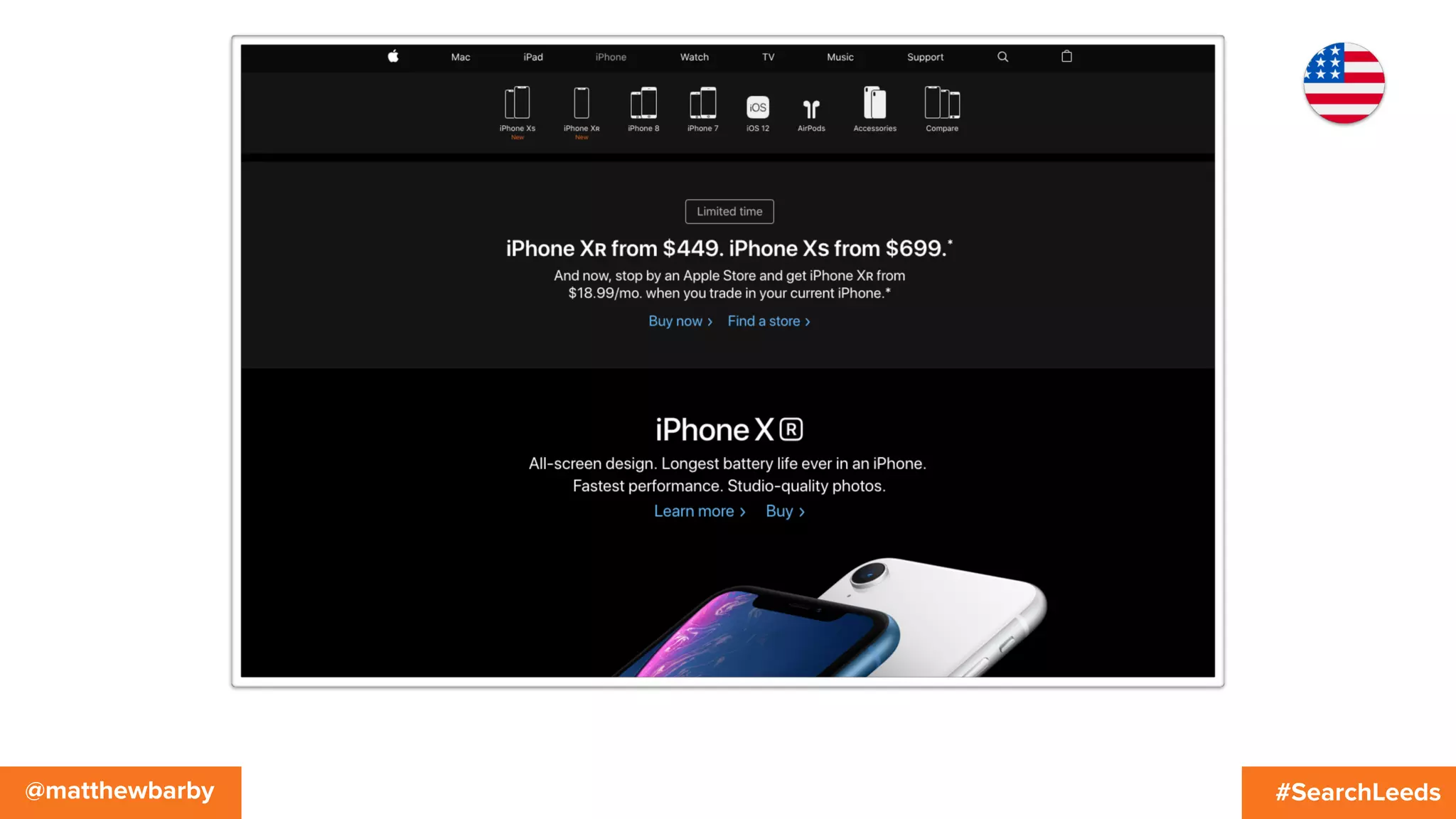
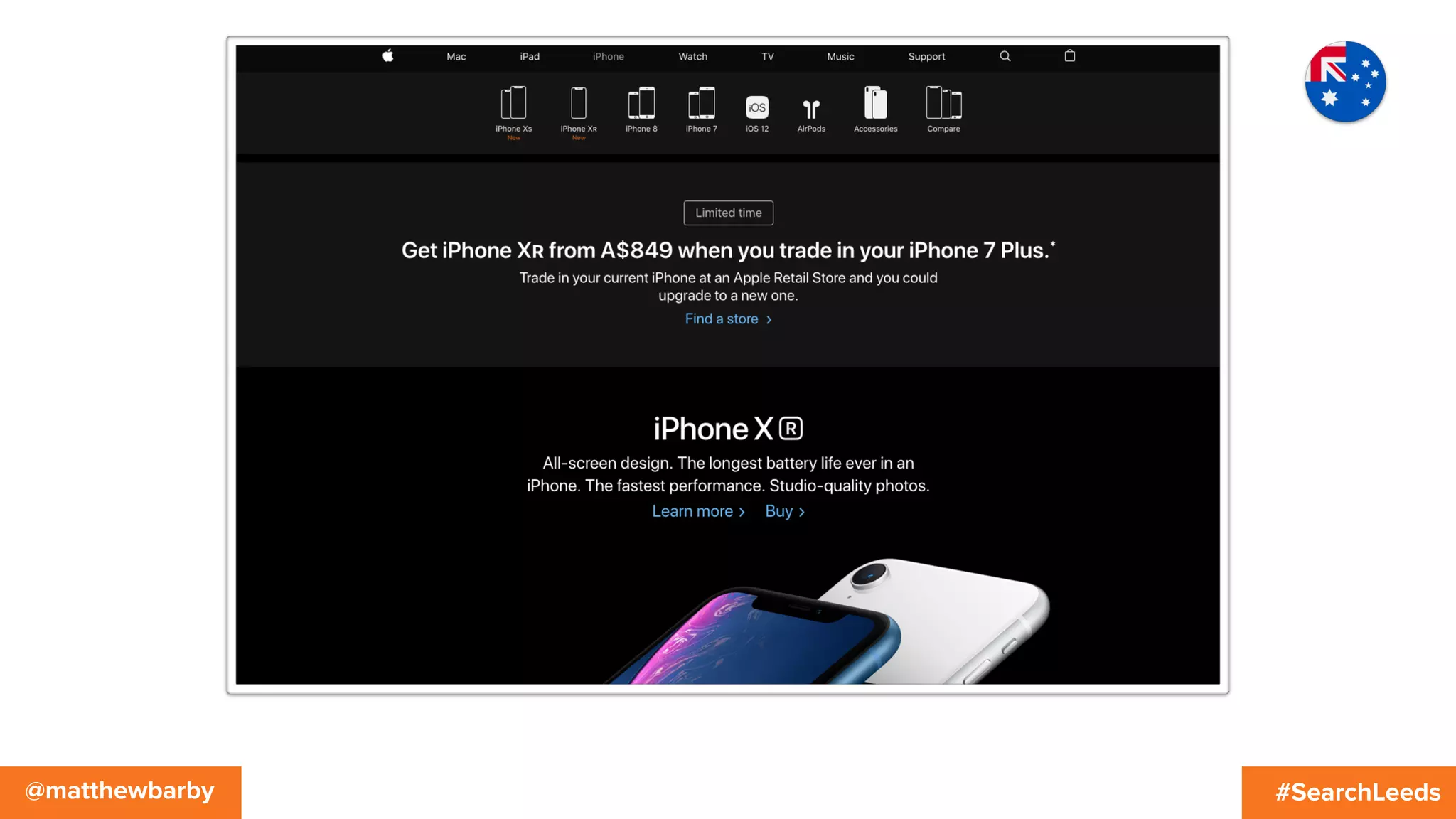
Rule 1: content doesn’t need to be an exact
translation to have hreflang added.
#SearchLeeds@matthewbarby
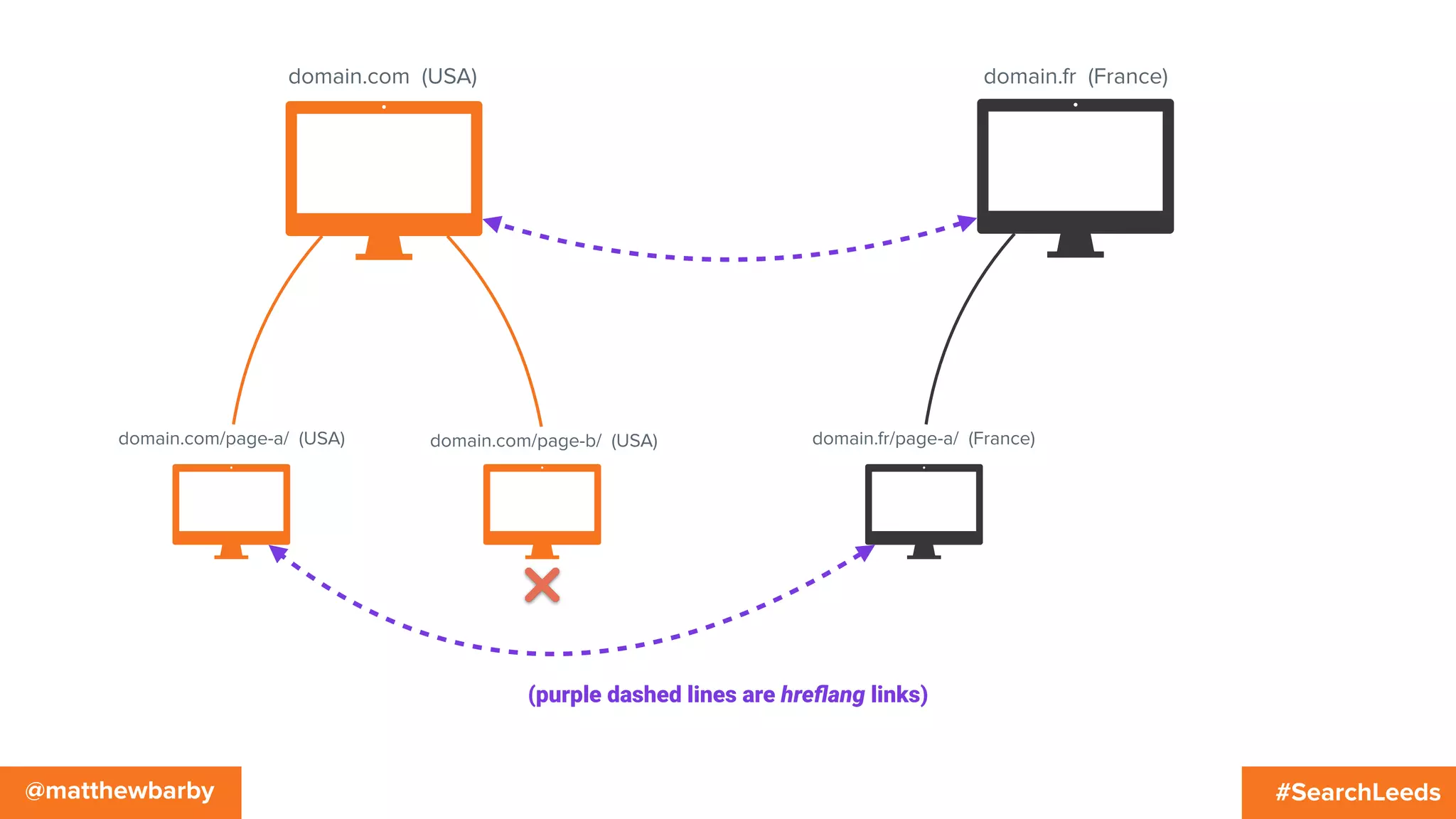
Rule 2: you only need to add hreflang on
pages where you have an alternative.
#SearchLeeds@matthewbarby
domain.com (USA)
domain.com/page-b/ (USA)domain.com/page-a/ (USA)
domain.fr (France)
domain.fr/page-a/ (France)
(purple dashed lines are hreflang links)
#SearchLeeds@matthewbarby
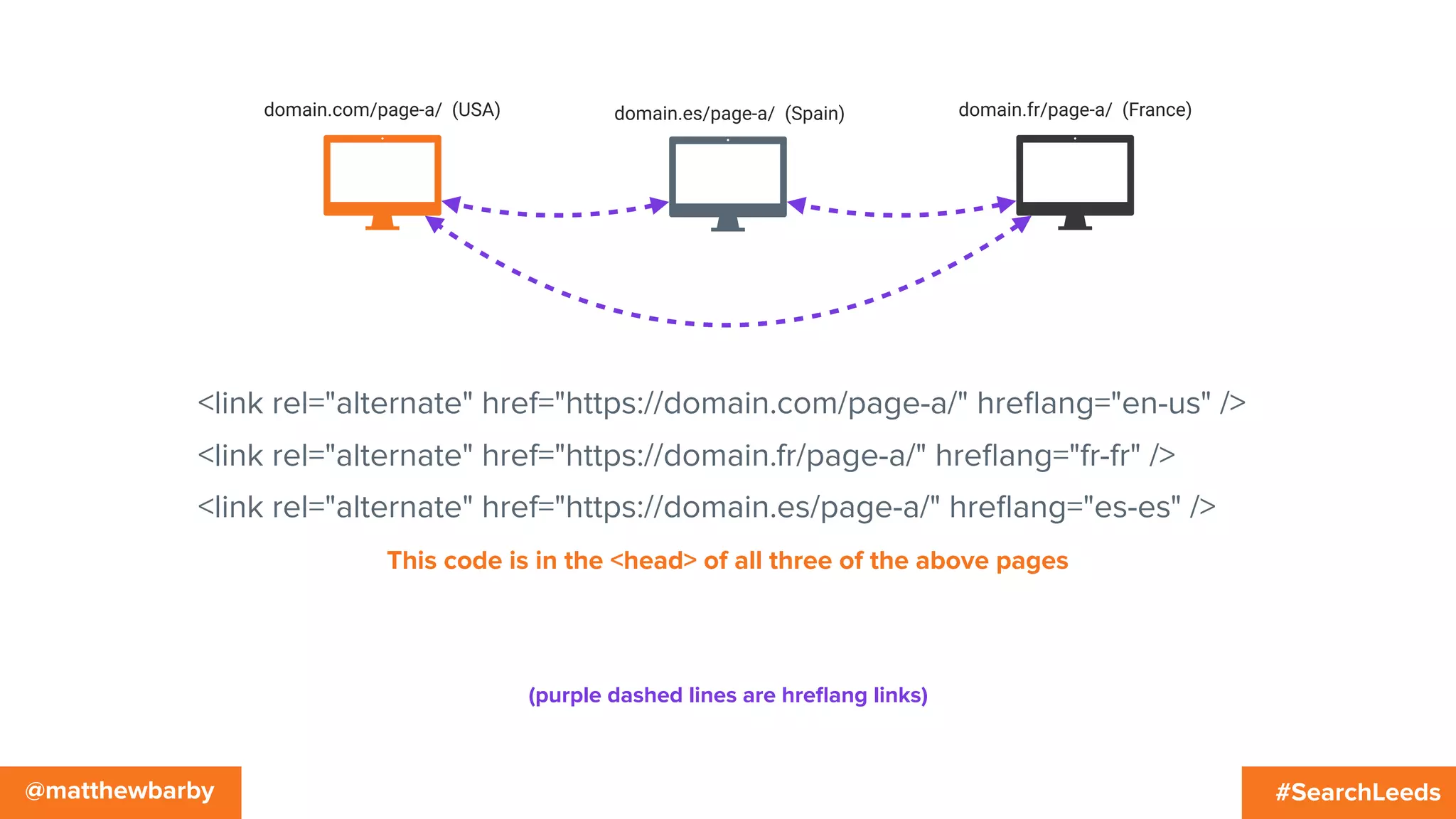
Rule 3: the same hreflang code must be
present on all alternate versions of the page.
#SearchLeeds@matthewbarby
domain.es/page-a/ (Spain)domain.com/page-a/ (USA) domain.fr/page-a/ (France)
(purple dashed lines are hreflang links)
<link rel="alternate" href="https://domain.com/page-a/" hreflang="en-us" />
<link rel="alternate" href="https://domain.fr/page-a/" hreflang="fr-fr" />
<link rel="alternate" href="https://domain.es/page-a/" hreflang="es-es" />
This code is in the <head> of all three of the above pages
#SearchLeeds@matthewbarby
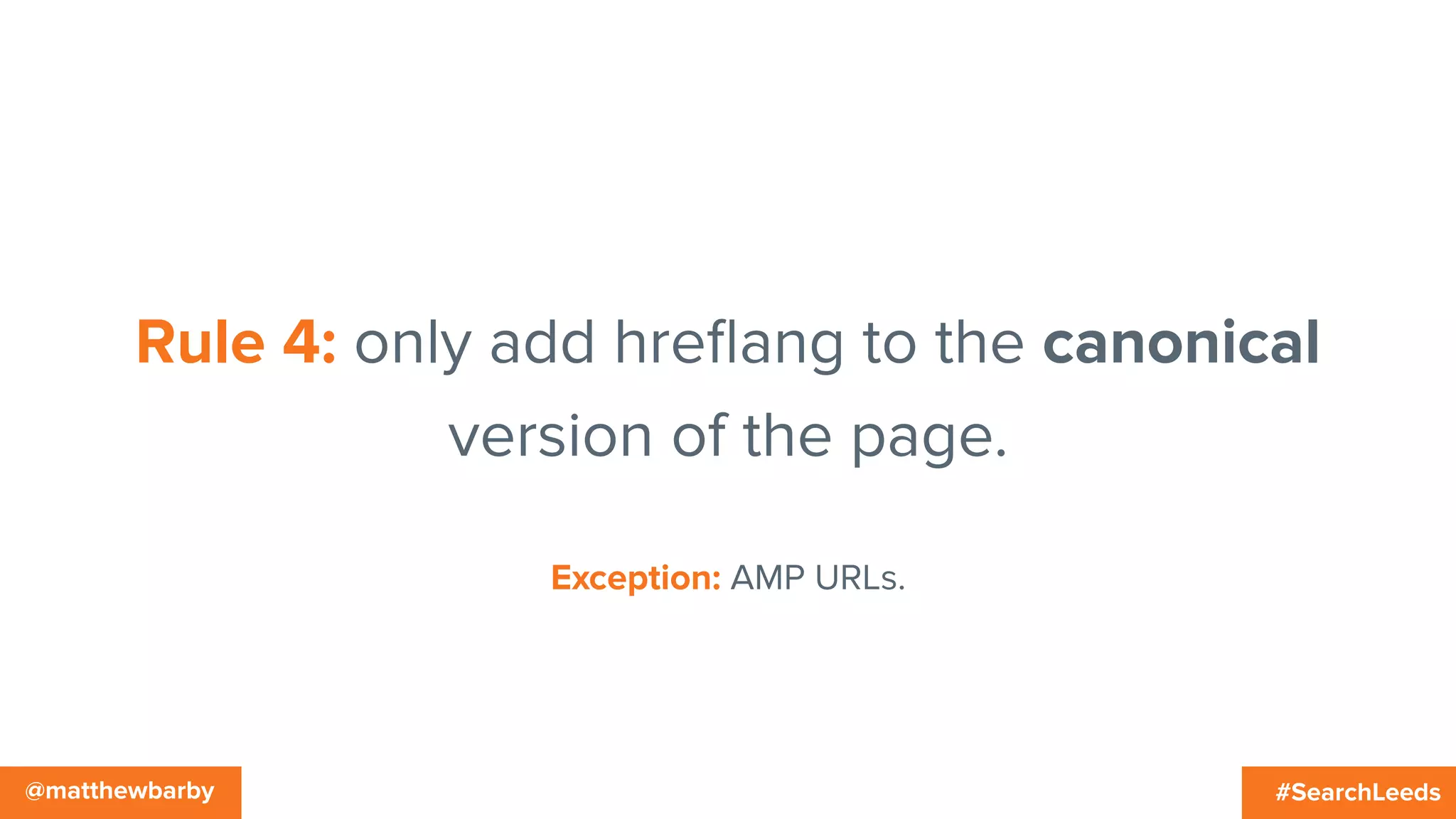
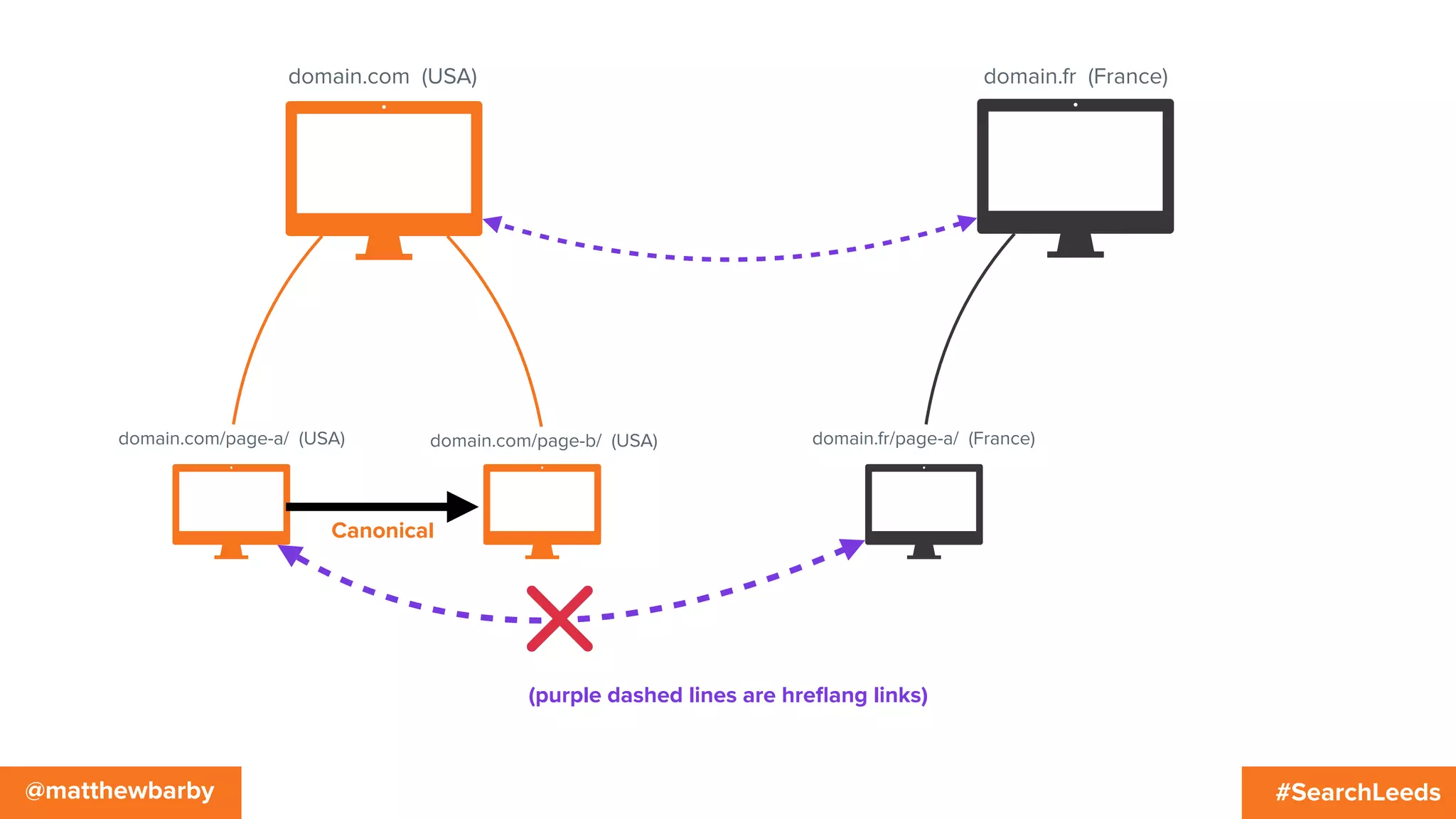
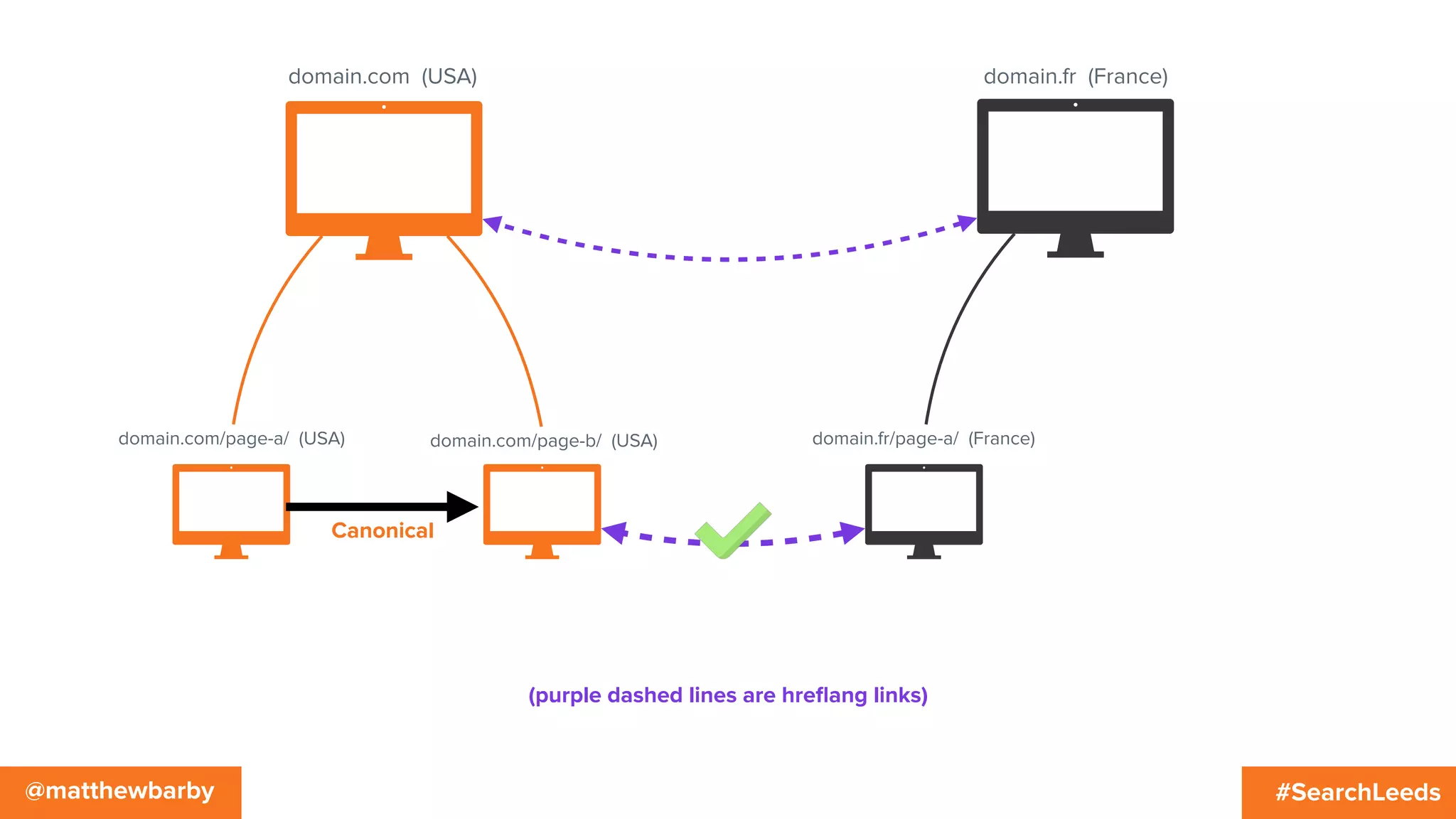
Rule 4: only add hreflang to the canonical
version of the page.
Exception: AMP URLs.
#SearchLeeds@matthewbarby
domain.com (USA)
domain.com/page-b/ (USA)domain.com/page-a/ (USA)
domain.fr (France)
domain.fr/page-a/ (France)
(purple dashed lines are hreflang links)
Canonical
#SearchLeeds@matthewbarby
domain.com (USA)
domain.com/page-b/ (USA)domain.com/page-a/ (USA)
domain.fr (France)
domain.fr/page-a/ (France)
(purple dashed lines are hreflang links)
Canonical
#SearchLeeds@matthewbarby
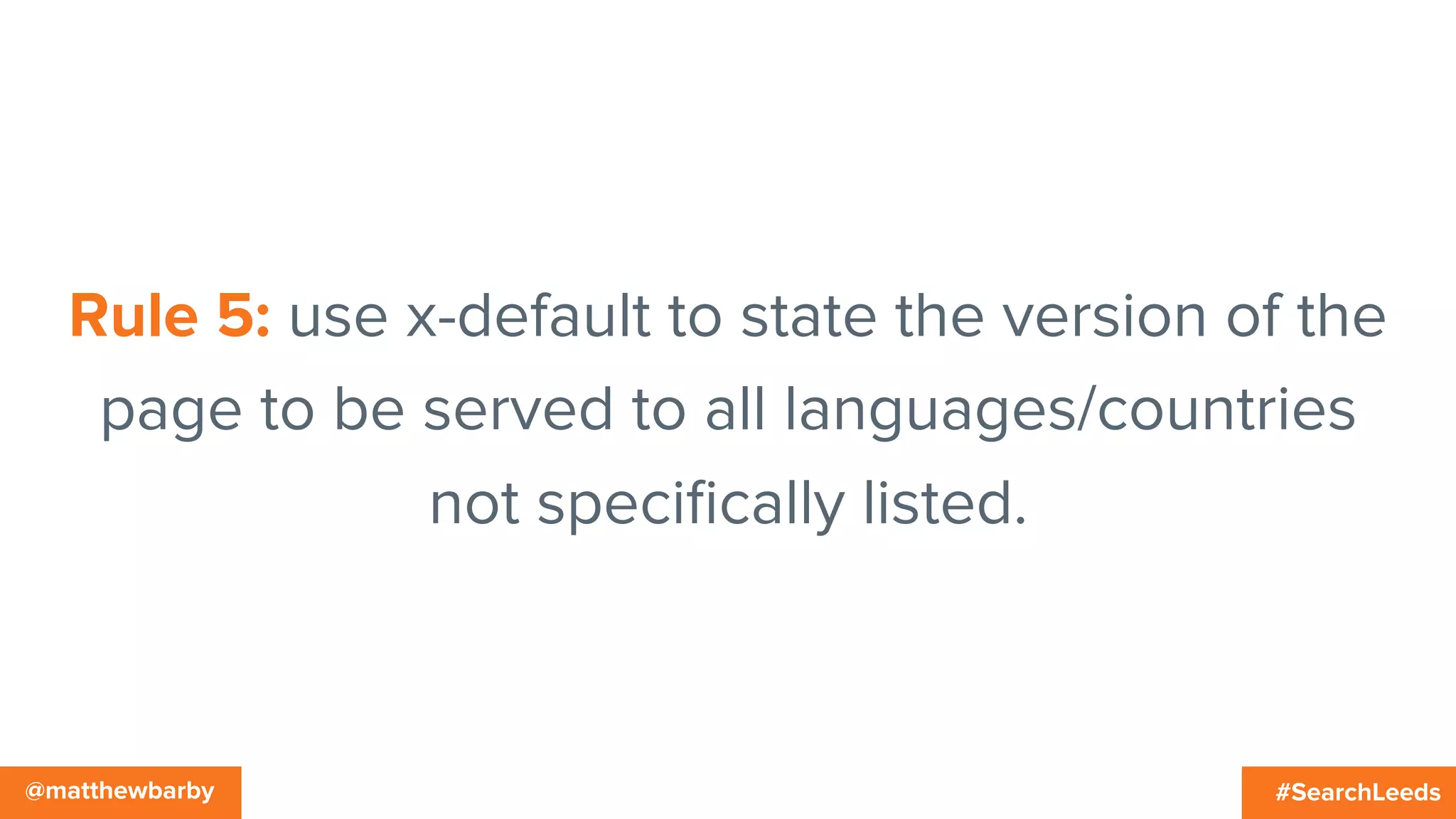
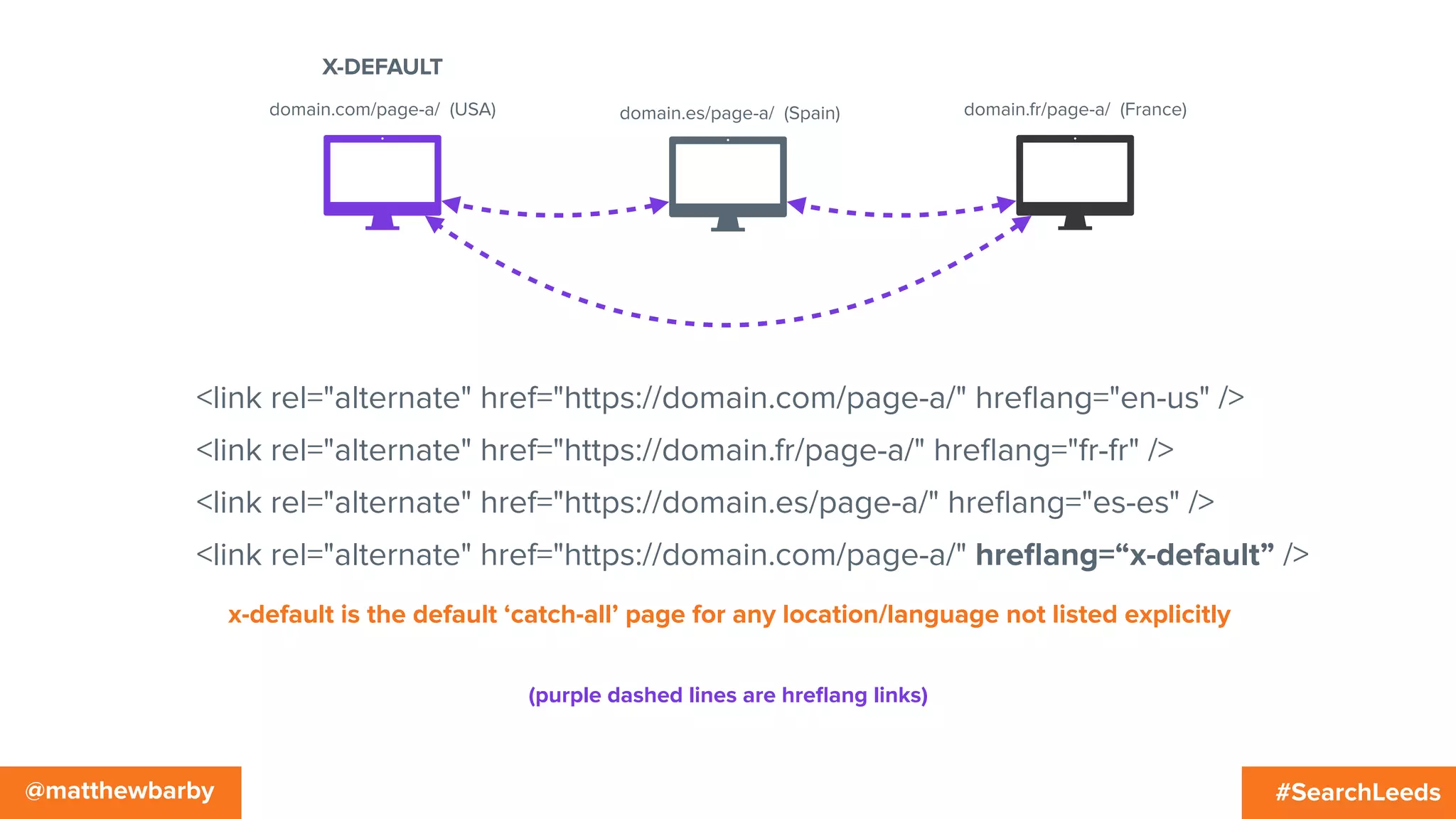
Rule 5: use x-default to state the version of the
page to be served to all languages/countries
not specifically listed.
#SearchLeeds@matthewbarby
domain.es/page-a/ (Spain)domain.com/page-a/ (USA) domain.fr/page-a/ (France)
(purple dashed lines are hreflang links)
<link rel="alternate" href="https://domain.com/page-a/" hreflang="en-us" />
<link rel="alternate" href="https://domain.fr/page-a/" hreflang="fr-fr" />
<link rel="alternate" href="https://domain.es/page-a/" hreflang="es-es" />
<link rel="alternate" href="https://domain.com/page-a/" hreflang=“x-default” />
x-default is the default ‘catch-all’ page for any location/language not listed explicitly
X-DEFAULT
#SearchLeeds@matthewbarby
Remember: There’s no “one correct way”
to do international SEO.
@matthewbarby
Where you can find me:

SearchLeeds 2019 - Matt Howells-Barby - Everything you need to know before scaling SEO internationally