
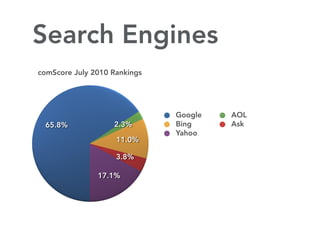

Search Engines
comScore July 2010 Rankings


                              Google   AOL
 65.8%             2.3%       Bing     Ask
                              Yahoo
                    11.0%

                    3.8%

               17.1%
Why?
“SEO Expert”
== “Spammer”
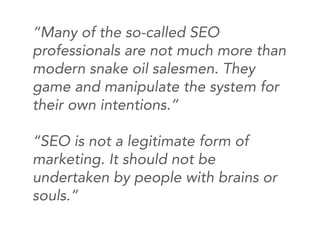
“Many of the so-called SEO
professionals are not much more than
modern snake oil salesmen. They
game and manipulate the system for
their own intentions.”

“SEO is not a legitimate form of
marketing. It should not be
undertaken by people with brains or
souls.”
“I'm not an SEO expert, but [it]
seems like SEO is something spam
sites do. If you are trying to create a
high quality destination site, just
write good content and let Google
do its job.”

- Sachin Agarwal, CEO Posterous
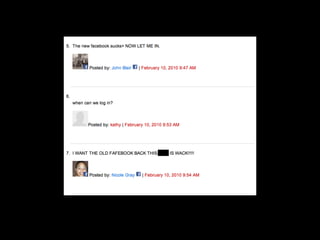
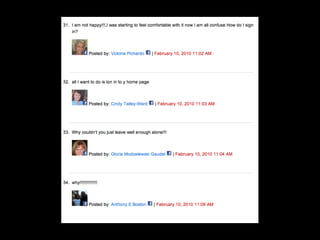
“Let FastCGI do its job”.
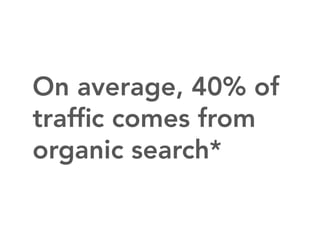
On average, 40% of
traffic comes from
organic search*
“Not my audience!”
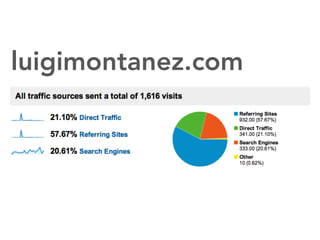
luigimontanez.com
“Experts” Not Needed
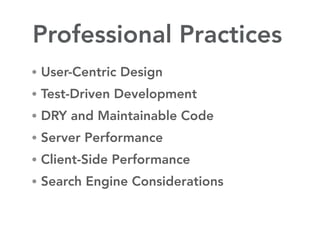
Professional Practices
• User-Centric Design
• Test-Driven Development
• DRY and Maintainable Code
• Server Performance
• Client-Side Performance
• Search Engine Considerations
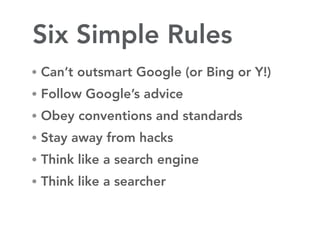
Six Simple Rules
• Can’t outsmart Google (or Bing or Y!)
• Follow Google’s advice
• Obey conventions and standards
• Stay away from hacks
• Think like a search engine
• Think like a searcher
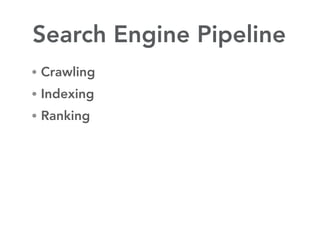
Search Engine Pipeline
• Crawling
• Indexing
• Ranking
<crawling>
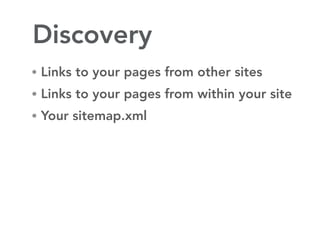
Discovery
• Links to your pages from other sites
• Links to your pages from within your site
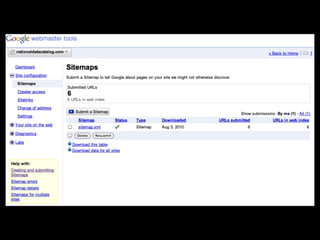
• Your sitemap.xml
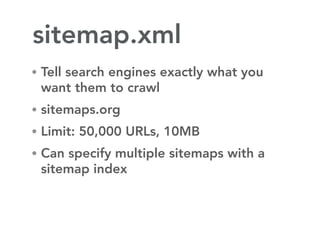
sitemap.xml
• Tell search engines exactly what you
 want them to crawl
• sitemaps.org
• Limit: 50,000 URLs, 10MB
• Can specify multiple sitemaps with a
 sitemap index
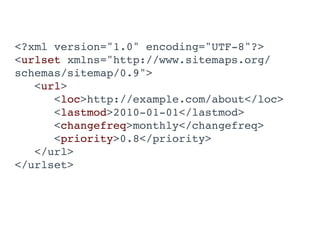
<?xml version="1.0" encoding="UTF-8"?>
<urlset xmlns="http://www.sitemaps.org/
schemas/sitemap/0.9">
   <url>
      <loc>http://example.com/about</loc>
      <lastmod>2010-01-01</lastmod>
      <changefreq>monthly</changefreq>
      <priority>0.8</priority>
   </url>
</urlset>
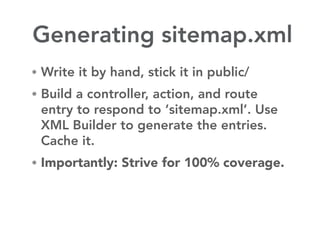
Generating sitemap.xml
• Write it by hand, stick it in public/
• Build a controller, action, and route
 entry to respond to ‘sitemap.xml’. Use
 XML Builder to generate the entries.
 Cache it.
• Importantly: Strive for 100% coverage.
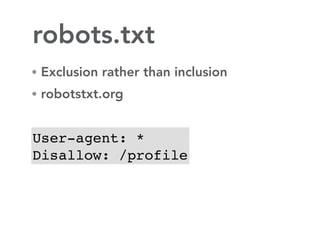
robots.txt
• Exclusion rather than inclusion
• robotstxt.org


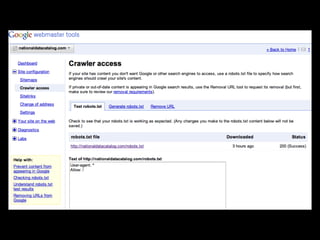
User-agent: *
Disallow: /profile
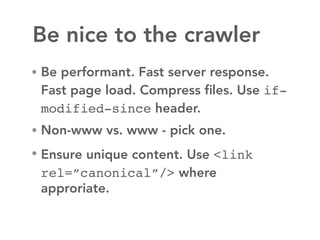
Be nice to the crawler
• Be performant. Fast server response.
 Fast page load. Compress files. Use if-
 modified-since header.
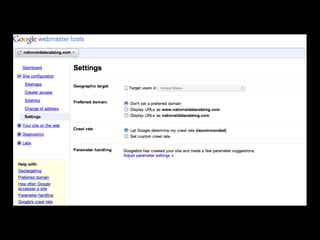
• Non-www vs. www - pick one.

• Ensure unique content. Use <link
 rel=”canonical”/> where
 approriate.
</crawling>
<indexing>
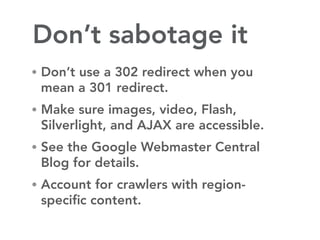
Don’t sabotage it
• Don’t use a 302 redirect when you
 mean a 301 redirect.
• Make sure images, video, Flash,
 Silverlight, and AJAX are accessible.
• See the Google Webmaster Central
 Blog for details.
• Account for crawlers with region-
 specific content.
</indexing>
<ranking>
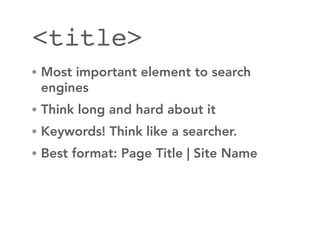
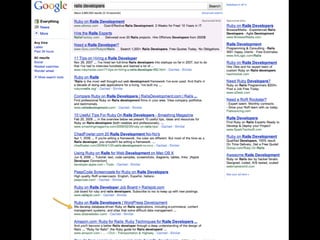
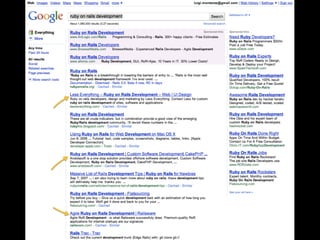
<title>
• Most important element to search
 engines
• Think long and hard about it
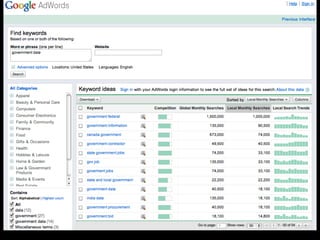
• Keywords! Think like a searcher.
• Best format: Page Title | Site Name
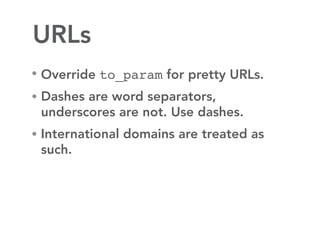
URLs
• Override to_param for pretty URLs.

• Dashes are word separators,
 underscores are not. Use dashes.
• International domains are treated as
 such.
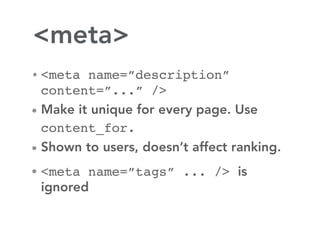
<meta>
• <meta name=”description”
  content=”...” />
• Make it unique for every page. Use
  content_for.
• Shown to users, doesn’t affect ranking.

• <meta name=”tags” ... /> is
 ignored
Headings and Content
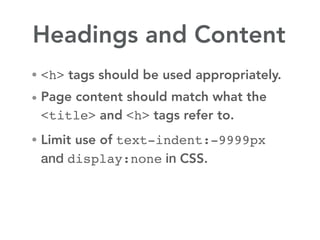
• <h> tags should be used appropriately.

• Page content should match what the
 <title> and <h> tags refer to.
• Limit use of text-indent:-9999px
 and display:none in CSS.
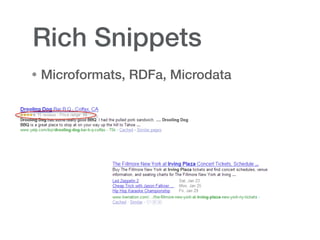
Rich Snippets
• Microformats, RDFa, Microdata
</ranking>
Tools
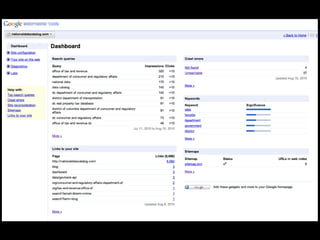
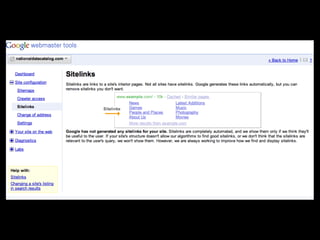
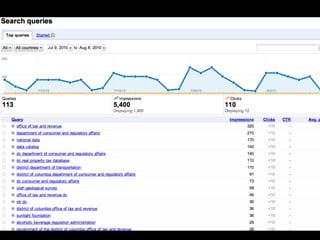
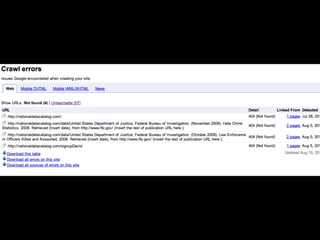
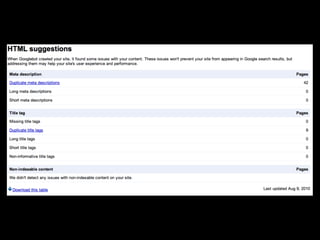
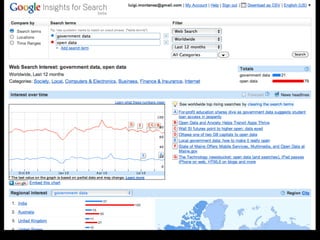
• Google Webmaster Tools
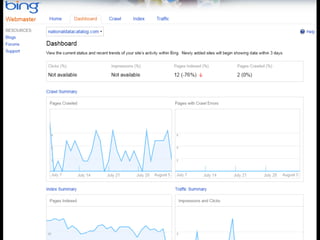
• Bing Webmaster Tools
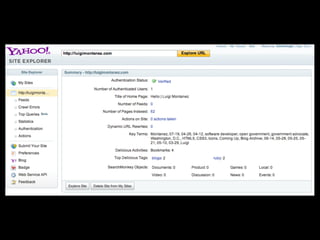
• Yahoo! Site Explorer
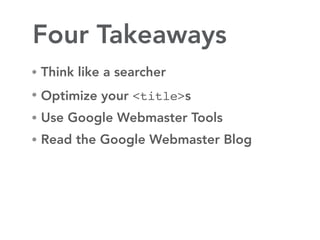
Four Takeaways
• Think like a searcher

• Optimize your <title>s

• Use Google Webmaster Tools
• Read the Google Webmaster Blog
Search-Friendly Web Development @ Ruby|Web Conference 2010

Search-Friendly Web Development @ Ruby|Web Conference 2010

  • 2.
    Search Engines comScore July2010 Rankings Google AOL 65.8% 2.3% Bing Ask Yahoo 11.0% 3.8% 17.1%
  • 3.
  • 4.
  • 5.
  • 6.
    “Many of theso-called SEO professionals are not much more than modern snake oil salesmen. They game and manipulate the system for their own intentions.” “SEO is not a legitimate form of marketing. It should not be undertaken by people with brains or souls.”
  • 7.
    “I'm not anSEO expert, but [it] seems like SEO is something spam sites do. If you are trying to create a high quality destination site, just write good content and let Google do its job.” - Sachin Agarwal, CEO Posterous
  • 8.
    “Let FastCGI doits job”.
  • 9.
    On average, 40%of traffic comes from organic search*
  • 16.
  • 17.
  • 18.
  • 19.
    Professional Practices • User-CentricDesign • Test-Driven Development • DRY and Maintainable Code • Server Performance • Client-Side Performance • Search Engine Considerations
  • 20.
    Six Simple Rules •Can’t outsmart Google (or Bing or Y!) • Follow Google’s advice • Obey conventions and standards • Stay away from hacks • Think like a search engine • Think like a searcher
  • 21.
    Search Engine Pipeline •Crawling • Indexing • Ranking
  • 22.
  • 23.
    Discovery • Links toyour pages from other sites • Links to your pages from within your site • Your sitemap.xml
  • 24.
    sitemap.xml • Tell searchengines exactly what you want them to crawl • sitemaps.org • Limit: 50,000 URLs, 10MB • Can specify multiple sitemaps with a sitemap index
  • 25.
    <?xml version="1.0" encoding="UTF-8"?> <urlsetxmlns="http://www.sitemaps.org/ schemas/sitemap/0.9">    <url>       <loc>http://example.com/about</loc>       <lastmod>2010-01-01</lastmod>       <changefreq>monthly</changefreq>       <priority>0.8</priority>    </url> </urlset>
  • 26.
    Generating sitemap.xml • Writeit by hand, stick it in public/ • Build a controller, action, and route entry to respond to ‘sitemap.xml’. Use XML Builder to generate the entries. Cache it. • Importantly: Strive for 100% coverage.
  • 27.
    robots.txt • Exclusion ratherthan inclusion • robotstxt.org User-agent: * Disallow: /profile
  • 28.
    Be nice tothe crawler • Be performant. Fast server response. Fast page load. Compress files. Use if- modified-since header. • Non-www vs. www - pick one. • Ensure unique content. Use <link rel=”canonical”/> where approriate.
  • 29.
  • 30.
  • 31.
    Don’t sabotage it •Don’t use a 302 redirect when you mean a 301 redirect. • Make sure images, video, Flash, Silverlight, and AJAX are accessible. • See the Google Webmaster Central Blog for details. • Account for crawlers with region- specific content.
  • 32.
  • 33.
  • 34.
    <title> • Most importantelement to search engines • Think long and hard about it • Keywords! Think like a searcher. • Best format: Page Title | Site Name
  • 38.
    URLs • Override to_paramfor pretty URLs. • Dashes are word separators, underscores are not. Use dashes. • International domains are treated as such.
  • 39.
    <meta> • <meta name=”description” content=”...” /> • Make it unique for every page. Use content_for. • Shown to users, doesn’t affect ranking. • <meta name=”tags” ... /> is ignored
  • 40.
    Headings and Content •<h> tags should be used appropriately. • Page content should match what the <title> and <h> tags refer to. • Limit use of text-indent:-9999px and display:none in CSS.
  • 41.
  • 42.
  • 43.
    Tools • Google WebmasterTools • Bing Webmaster Tools • Yahoo! Site Explorer
  • 56.
    Four Takeaways • Thinklike a searcher • Optimize your <title>s • Use Google Webmaster Tools • Read the Google Webmaster Blog