HABITAT & ENVIRONMENT PLANNING
GUIDED BY Dr. ARPAN PAUL SINGH
KEERTHI | ROHIT | VYAS | HEMANTH
NO
POVERTY
01 SUSTAINABLE DEVELOPMENT GOAL
ASSIGNMENT-1
SUSTAINABLE DEVELOPMENT GOAL - 1 DEPARTMENT OF PLANNING|SPAV
HABITAT & ENVIRONMENT
PLANNING GROUP - 1 01
SUSTAINABLE DEVELOPMENT GOALS
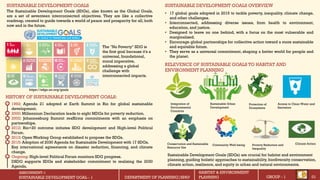
The Sustainable Development Goals (SDGs), also known as the Global Goals,
are a set of seventeen interconnected objectives. They are like a collective
roadmap, created to guide towards a world of peace and prosperity for all, both
now and in the future.
HISTORY OF SUSTAINABLE DEVELOPMENT GOALS:
1992: Agenda 21 adopted at Earth Summit in Rio for global sustainable
development.
2000: Millennium Declaration leads to eight MDGs for poverty reduction.
2002: Johannesburg Summit reaffirms commitments with an emphasis on
partnerships.
2012: Rio+20 outcome initiates SDG development and High-level Political
Forum.
2013: Open Working Group established to propose the SDGs.
2015: Adoption of 2030 Agenda for Sustainable Development with 17 SDGs.
Key international agreements on disaster reduction, financing, and climate
change.
Ongoing: High-level Political Forum monitors SDG progress.
DSDG supports SDGs and stakeholder commitment to realizing the 2030
Agenda.
SUSTAINABLE DEVELOPMENT GOALS OVERVIEW
https://sdgs.un.org/goals
The "No Poverty" SDG is
the first goal because it's a
universal, foundational,
moral imperative,
addressing a global
challenge with
interconnected impacts.
• 17 global goals adopted in 2015 to tackle poverty, inequality, climate change,
and other challenges.
• Interconnected, addressing diverse issues, from health to environment,
education, and justice.
• Designed to leave no one behind, with a focus on the most vulnerable and
marginalized.
• Encourage global partnerships for collective action toward a more sustainable
and equitable future.
• They serve as a universal commitment, shaping a better world for people and
the planet.
RELEVENCE OF SUSTAINABLE GOALS TO HABITAT AND
ENVIRONMENT PLANNING
Integration of
Environmental
Concerns
Sustainable Urban
Development
Protection of
Ecosystems
Conservation and Sustainable
Resource Use
Poverty Reduction and
Inequality
Community Well-being
Access to Clean Water and
Sanitation
Climate Action
Sustainable Development Goals (SDGs) are crucial for habitat and environment
planning, guiding holistic approaches to sustainability, biodiversity conservation,
climate action, resilience, and equity in urban and natural environments.
ASSIGNMENT-1
SUSTAINABLE DEVELOPMENT GOAL - 1 DEPARTMENT OF PLANNING|SPAV
HABITAT & ENVIRONMENT
PLANNING GROUP - 1 02
RELEVENCE OF SDG–1 TO HABITAT AND ENVIRONMENT PLANNING
Access to
Adequate Housing
Access to Basic
Services
Rural
Development
Climate Resilience and
Vulnerability Reduction Natural Resource
Management
Access to Green Spaces
SDG-1 : NO POVERTY
SDG – 1 OVERVIEW
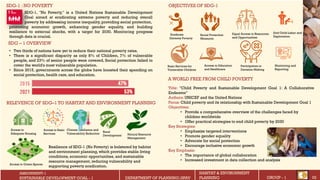
SDG-1, "No Poverty," is a United Nations Sustainable Development
Goal aimed at eradicating extreme poverty and reducing overall
poverty by addressing income inequality, providing social protection,
promoting economic growth, enhancing gender equality, and building
resilience to external shocks, with a target for 2030. Monitoring progress
through data is crucial.
• Two thirds of nations have yet to reduce their national poverty rates.
• There is a significant disparity as only 8% of Children, 7% of vulnerable
people, and 23% of senior people were covered, Social protection failed to
cover the world's most vulnerable population.
• Since 2015, governments across the globe have boosted their spending on
social protection, health care, and education.
Resilience of SDG-1 (No Poverty) is bolstered by habitat
and environment planning, which provides stable living
conditions, economic opportunities, and sustainable
resource management, reducing vulnerability and
supporting poverty eradication.
A WORLD FREE FROM CHILD POVERTY
Title: "Child Poverty and Sustainable Development Goal 1: A Collaborative
Endeavor"
Authors: UNICEF and the United Nations
Focus: Child poverty and its relationship with Sustainable Development Goal 1
Objectives:
• Provide a comprehensive overview of the challenges faced by
children worldwide
• Offer practical strategies to end child poverty by 2030
Key Strategies:
• Emphasize targeted interventions
• Promote gender equality
• Advocate for social protection
• Encourage inclusive economic growth
Key Emphasis:
• The importance of global collaboration
• Increased investment in data collection and analysis
OBJECTIVES OF SDG-1
Monitoring and
Reporting
Eradicate
Extreme Poverty
Social Protection
Measures
Equal Access to Resources
and Opportunities
End Child Labor and
Exploitation
Basic Services for
Vulnerable Children
Access to Education
and Healthcare
Participation in
Decision-Making
ASSIGNMENT-1
SUSTAINABLE DEVELOPMENT GOAL - 1 DEPARTMENT OF PLANNING|SPAV
HABITAT & ENVIRONMENT
PLANNING GROUP - 12 03
Lack of Explicit Focus: Many countries lack a clear focus on
measuring, analyzing, and responding to child poverty,
leading to insufficient attention to this critical issue.
SDG Targets : The Sustainable Development Goals (SDGs) do
include targets for reducing child poverty; however, these
targets might not receive adequate attention in some regions
or nations.
Opportunity for Progress: The SDGs offer an opportunity for
stakeholders to assess progress and identify key milestones
in the context of child poverty reduction.
Renewed Purpose: Revisiting these issues provides a chance
to refresh a united sense of purpose and direction among
stakeholders, encouraging collaborative efforts to address
child poverty effectively.
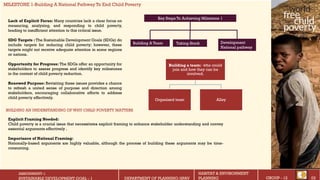
Key Steps To Achieving Milestone 1
Building A Team Taking Stock Development
National pathway
Building a team: who could
join and how they can be
involved.
Organized team Alley
Explicit Framing Needed:
Child poverty is a crucial issue that necessitates explicit framing to enhance stakeholder understanding and convey
essential arguments effectively .
Importance of National Framing:
Nationally-based arguments are highly valuable, although the process of building these arguments may be time-
consuming.
MILESTONE 1-Building A National Pathway To End Child Poverty
BUILDING AN UNDERSTANDING OF WHY CHILD POVERTY MATTERS
ASSIGNMENT-1
SUSTAINABLE DEVELOPMENT GOAL - 1 DEPARTMENT OF PLANNING|SPAV
HABITAT & ENVIRONMENT
PLANNING GROUP - 1 04
DEVELOPING A NATIONAL PATHWAY -TO REDUCE AND
END CHILD POVERTY
GLOBAL EVIDENCE IMPACT:
Global evidence holds significant power within national contexts,
providing valuable insights and perspectives on child poverty.
SEVEN URGENT REASONS:
Seven compelling reasons highlighting the urgency of addressing child
poverty can be customized to specific national contexts, making them more
relevant and impactful.
• SDGs Emphasize Child Poverty
• Diverse Country Contexts
• Country-Specific Approaches
• Contextual Understanding
• Moving Forward
TAKING STOCK: DOES AN INCREASED NATIONAL FOCUS
ON CHILD POVERTY MAKE SENSE?
DETERMINING THE MILESTONES IN THE MIDDLE-
A milestone is “an action or event marking a significant change or stage of
development”.
Defining milestones of progress helps guide immediate actions and monitor
progress with national stakeholders, ensuring the need for different
strategies is effectively monitored.
A POSSIBLE PROCESS FOR IDENTIFYING A NATIONAL
PATHWAY OF PROGRESS
Outlining starting and end points:
Identifying the milestones (activities and indicators):
Revising, learning and flexibility.
Starting point: This will vary by country.
An example might be ‘child poverty not
measured and no analysis of drivers/
causes of child poverty
End point: Halve child
poverty by 2030
according to national
definitions
Examples Of Possible Milestones Or Indicators
1.Social protection Programme designed or adjusted to reduce child poverty.
2.Child poverty routinely measured by government.
3.Evaluation of agricultural Programme included impact on child poverty and
recommendations
4. Chapter on child poverty included in annual progress report on poverty
reduction.
5. Budget process explicitly includes consideration of child poverty .
China aims to lift 70 million people out of poverty by 2020, aligning with the SDGs.
Poverty reduction strategies focus on integrated interventions, addressing multiple
deprivations and disparities, including child poverty, through policy spectrum
measures.
CASE STUDY CHINA
1.Policy makers and stakeholders are committed to eradicating child poverty
2. Local-level Impact -Where poor children live
3. Regional-level Impact- Child poverty action plans
4. National-level Impact -Implementation and monitoring
5. Halve Child Poverty by 2030 Reaching the goals
ASSIGNMENT-1 HABITAT & ENVIRONMENT
GROUP - 1 05
MILESTONE 2 Measuring child poverty
WHY MEASURE CHILD POVERTY?
Measuring child poverty gives vital information for comprehending the extent of
child poverty in the nation and the difficulties encountered.The metrics can reveal:
 Relationship
 Scale
 Adult-to-Child Comparison
 Geographical Groups
 Evaluate Growth and Decline
 Causes and Elements of Poverty
The measurement of child poverty
serves as the foundation for addressing
more focused policy and programmatic
issues that are required to eradicate
extreme child poverty.
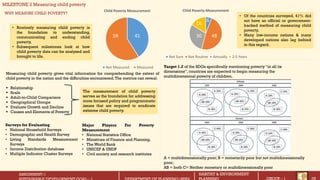
• Of the countries surveyed, 41% did
not have an official or government-
backed method of measuring child
poverty.
• Many low-income nations & many
developed nations also lag behind
in this regard.
Target 1.2 of the SDGs specifically mentioning poverty “in all its
dimensions”, countries are expected to begin measuring the
multidimensional poverty of children.
A = multidimensionally poor; B = monetarily poor but not multidimensionally
poor;
AB = both C= Neither monetary or multidimensionally poor
• Routinely measuring child poverty is
the foundation to understanding,
communicating and ending child
poverty.
• Subsequent milestones look at how
child poverty data can be analyzed and
brought to life.
Surveys for Evaluating
• National Household Surveys
• Demographic and Health Survey
• Living Standards Measurement
Surveys
• Income Distribution database
• Multiple Indicator Cluster Surveys
Major Players For Poverty
Measurement
• National Statistics Office
• Ministries of Finance and Planning.
• The World Bank
• UNICEF & UNDP
• Civil society and research institutes
Child Poverty Measurement
Not Sure Not Routine Annually 2-5 Years
6
48
30
16
Child Poverty Measurement
Not Measured Measured
41
59
ASSIGNMENT-1
SUSTAINABLE DEVELOPMENT GOAL - 1 DEPARTMENT OF PLANNING|SPAV
HABITAT & ENVIRONMENT
PLANNING GROUP - 1 06
MILESTONE 3 - PUTTING CHILD POVERTY ON THE MAP: CHILD
POVERTY ADVOCACY
KEY STEPS TO ACHIEVING MILESTONE 3
• Identifying Advocacy Objectives And Indicators.
• Developing Clear Messages For Child Poverty Using Key Data And Information.
Building advocacy strategies: useful references
• Advocacy Matters: Helping children change their world.
• Advocacy Toolkit.
Examples of how countries have expressed them. These messages can be grouped
into three broad areas:
• What’s the problem?
• Why does it matter?
• What are the solutions?
• Country Approaches To Putting Child Poverty On The Map
Approaches to identifying advocacy objectives and indicators and approaches to
data and messaging.
• Having clear (but flexible) advocacy intentions
• The issue of child poverty can effectively capture national attention.
• Building broad based support to survive political changes.
• General advocacy as foundation for targeted policy and programme change
(considered in Milestone 4).
KEY MESSAGES
An example using the nine advocacy questions (from the UNICEF
advocacy toolkit) for national statistical measurement
ASSIGNMENT-1
SUSTAINABLE DEVELOPMENT GOAL - 1 DEPARTMENT OF PLANNING|SPAV
HABITAT & ENVIRONMENT
PLANNING GROUP - 1 07
MILESTONE 3 Putting child poverty on the map: child poverty advocacy
CASE STUDY - IRELAND
Launch of the regional Report Card on child well-being to promote a stronger collaboration among civil society organizations
THE APPROACH
TIMELINE - Three months from initiation to launch.
DATA NEEDS AND EXPERTISE
• Report Card on child well-being.
• Advocacy skills and experience.
• Network with regional CSOs working on child poverty
STAKEHOLDERS
• Government, Government (Minister for Children and Youth
Affairs).
• CSOs, including Eurochild, European Anti-Poverty
Network (EAPN) and Children’s Rights Alliance.
• UNICEF.
• European Commission.
• Academics and researchers.
The UNICEF Office of
Research, launched the
eleventh Report Card
(RC11).
UNICEF Ireland created a
short film from a panel
discussion of Irish youth.
In 2013, Eurochild, EAPN and
UNICEF coordinated the
launch of the RC11 and the
Eurochild/EAPN Explainer.
The Director of the Office
of Research presented the
results of the report at a
high-level seminar.
This was accompanied
by a training seminar.
Young people in Ireland discuss in a short video clip on YouTube
https://www.youtube.com/watch?v=rTpi6jiu3Ok
ASSIGNMENT-1
SUSTAINABLE DEVELOPMENT GOAL - 1 DEPARTMENT OF PLANNING|SPAV
HABITAT & ENVIRONMENT
PLANNING GROUP - 1 08
MILE STONE 4 –REDUCING CHILD POVERTY THROUGH
POLICY AND PROGRAMME CHANGE
A. AN OVERVIEW OF THE PACKAGE OF POLICIES AND
PROGRAMMES THAT CAN REDUCE CHILD POVERTY
The policies and programmes to address child poverty will:
• "Ensure Access to Vital Child Services“
• "Remove Child Financial Barriers"
Policy or programme – or both?
• Policies impact child poverty significantly.
• Programs translate policies into action.
• Context-specific considerations guide focus.
• Policy and programs are interconnected.
Key considerations to address child poverty
• Overarching approaches that can address both multidimensional
and monetary child poverty.
• Approaches to address multidimensional child poverty.
• Approaches to address monetary child poverty.
OVERARCHING APPROACHES THAT CAN ADDRESS BOTH
MULTIDIMENSIONAL AND MONETARY CHILD POVERTY.
key areas that can address both.These include:
Social stigma and discrimination:
Stigma and discrimination hinder economic, civic participation, and
child well-being; addressing them is crucial to alleviate poverty.
Child-sensitive social protection or social welfare systems:
Social protection systems address various child deprivations,
including monetary, through coordinated programs,connecting
children to suitable assistance.
Budget engagement:
Funding and monitoring are crucial for effective program
implementation and child poverty reduction; budget and finance
engagement is vital in all areas.
Inclusion in national policies:
Incorporate child poverty into national development
plans to enhance impact, focusing on target
assessments, policy selection, and program
implementation for effective child poverty reduction.
Pro-poor economic growth:
Pro-poor growth lifts children from poverty by
improving employment, services, and tax revenues.
These strategies work in growing and stagnant
economies, enhancing long-term economic
resilience.
APPROACHES TO ADDRESSING MULTIDIMENSIONAL
CHILD POVERTY
Multidimensional
child poverty
(Children deprived across a number
of dimensions such as health,
education, etc..)
Monetary Child Poverty
(Children living in households
below the poverty line)
ADDRESSING MONETARY CHILD
POVERTY
EXAMPLES OF POLICIES AND
PROGRAMMES TO AVOID POVERTY
• Livelihood support - training,
savings accounts, life skill
training
• Employment support- , job
search support and
supporting connections with
employers.
• Supporting adolescents - in their
transitions to adulthood,
particularly for young people
who may be disadvantaged due
to lack of educational
background or work experience.
• Laws and regulations- minimum
wage law
• Provision of affordable and
quality childcare services
• Preventing child labour
ASSIGNMENT-1
SUSTAINABLE DEVELOPMENT GOAL - 1 DEPARTMENT OF PLANNING|SPAV
HABITAT & ENVIRONMENT
PLANNING GROUP - 1 09
CASE STUDY - BANGLADESH
MILE STONE 4 –REDUCING CHILD POVERTY
THROUGH POLICY AND PROGRAMME CHANGE
• BRAC's graduation program aids households in
extreme poverty.
• It combines various interventions, including asset
transfer, skills training, and community
mobilization.
• Participants graduate when they achieve economic
and social stability, ensuring food security, income,
savings, and positive behavior changes.
• In 2014, it reached over 53,000 ultra-poor
households, with 88,000 members graduating from
extreme poverty.
• Ongoing aid is provided to vulnerable households
even after graduation.
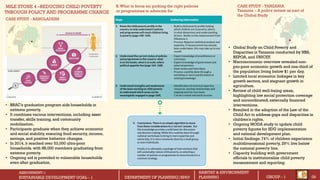
B.What to focus on: picking the right policies
or programmes to advocate for Tanzania – A policy review as part of
the Global Study
CASE STUDY - TANZANIA
• Global Study on Child Poverty and
Disparities in Tanzania conducted by NBS,
REPOA, and UNICEF.
• Macroeconomic overview revealed non-
pro-poor economic growth and one-third of
the population living below $1 per day.
• Limited local economic linkages in key
growth sectors, and stagnant growth in
agriculture.
• Review of child well-being areas,
highlighting low social protection coverage
and uncoordinated, externally financed
interventions.
• Resulted in the adoption of the Law of the
Child Act to address gaps and disparities in
children's rights.
• Ongoing MODA study to update child
poverty figures for SDG implementation
and national development plan.
• Initial findings: 74% of children experience
multidimensional poverty, 29% live below
the national poverty line.
• Capacity building with government
officials to institutionalize child poverty
measurement and reporting.
ASSIGNMENT-1
SUSTAINABLE DEVELOPMENT GOAL - 1 DEPARTMENT OF PLANNING|SPAV
HABITAT & ENVIRONMENT
PLANNING GROUP - 1 10
MILE STONE 4 –REDUCING CHILD POVERTY
THROUGH POLICY AND PROGRAMME CHANGE
C. MAKING THE CHANGE HAPPEN: KEY POLICY
QUESTIONS AND ANALYTICAL APPROACHES TO
ANSWERING THEM
Questions regarding Challenging the status quo:
• Are the policies and programmes reaching the
poorest children?
• Do the existing programmes/policies have an impact
on child poverty?
• Are the poorest households bearing the cost of the
services?
Questions regarding Projecting the potential impacts
• How much impact will a new programme/
policy have on the child poverty rate?
• What are the macroeconomic impacts of a
major policy change on child poverty?
Questions regarding Financing the future
• What are the costs of creating a new
programme or scaling-up the existing one?
• Is the programme/policy cost effective?
• How can the government finance
the cost?
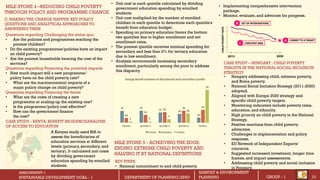
CASE STUDY - KENYA:BENEFIT INCIDENCEANALYSIS
OF ACCESS TO EDUCATION
A Kenyan study used BIA to
assess the beneficiaries of
education services at different
levels (primary, secondary, and
tertiary). It calculated unit costs
by dividing government
education spending by enrolled
students.
• Unit cost in each quintile calculated by dividing
government education spending by enrolled
students.
• Unit cost multiplied by the number of enrolled
children in each quintile to determine each quintile's
benefit from education budget.
• Spending on primary education favors the bottom
two quintiles due to higher enrollment and net
enrollment rates.
• The poorest quintile receives minimal spending for
secondary and less than 2% for tertiary education
due to low enrollment.
• Analysis recommends increasing secondary
enrollment, particularly among the poor to address
this disparity.
MILE STONE 5 - ACHIEVING THE SDGS:
ENDING EXTREME CHILD POVERTY AND
HALVING IT BY NATIONAL DEFINITIONS
KEY STEPS:
• National commitment to end child poverty.
• Implementing comprehensive intervention
package.
• Monitor, evaluate, and advocate for progress.
CASE STUDY – HUNGARY : CHILD POVERTY
TARGETS IN THE NATIONAL SOCIAL INCLUSION
STRATEGY
• Hungary addressing child, extreme poverty,
and Roma poverty.
• National Social Inclusion Strategy (2011-2020)
adopted.
• Aligned with Europe 2020 strategy and
specific child poverty targets.
• Monitoring indicators include poverty rates,
education, and ethnicity.
• High priority on child poverty in the National
Strategy.
• Positive reactions from child poverty
advocates.
• Challenges in implementation and policy
response.
• EU Network of Independent Experts'
concerns.
• Suggested increased investment, longer time
frames, and impact assessments.
• Addressing child poverty and social inclusion
in Hungary.

SDG-1

  • 1.
    HABITAT & ENVIRONMENTPLANNING GUIDED BY Dr. ARPAN PAUL SINGH KEERTHI | ROHIT | VYAS | HEMANTH NO POVERTY 01 SUSTAINABLE DEVELOPMENT GOAL
  • 2.
    ASSIGNMENT-1 SUSTAINABLE DEVELOPMENT GOAL- 1 DEPARTMENT OF PLANNING|SPAV HABITAT & ENVIRONMENT PLANNING GROUP - 1 01 SUSTAINABLE DEVELOPMENT GOALS The Sustainable Development Goals (SDGs), also known as the Global Goals, are a set of seventeen interconnected objectives. They are like a collective roadmap, created to guide towards a world of peace and prosperity for all, both now and in the future. HISTORY OF SUSTAINABLE DEVELOPMENT GOALS: 1992: Agenda 21 adopted at Earth Summit in Rio for global sustainable development. 2000: Millennium Declaration leads to eight MDGs for poverty reduction. 2002: Johannesburg Summit reaffirms commitments with an emphasis on partnerships. 2012: Rio+20 outcome initiates SDG development and High-level Political Forum. 2013: Open Working Group established to propose the SDGs. 2015: Adoption of 2030 Agenda for Sustainable Development with 17 SDGs. Key international agreements on disaster reduction, financing, and climate change. Ongoing: High-level Political Forum monitors SDG progress. DSDG supports SDGs and stakeholder commitment to realizing the 2030 Agenda. SUSTAINABLE DEVELOPMENT GOALS OVERVIEW https://sdgs.un.org/goals The "No Poverty" SDG is the first goal because it's a universal, foundational, moral imperative, addressing a global challenge with interconnected impacts. • 17 global goals adopted in 2015 to tackle poverty, inequality, climate change, and other challenges. • Interconnected, addressing diverse issues, from health to environment, education, and justice. • Designed to leave no one behind, with a focus on the most vulnerable and marginalized. • Encourage global partnerships for collective action toward a more sustainable and equitable future. • They serve as a universal commitment, shaping a better world for people and the planet. RELEVENCE OF SUSTAINABLE GOALS TO HABITAT AND ENVIRONMENT PLANNING Integration of Environmental Concerns Sustainable Urban Development Protection of Ecosystems Conservation and Sustainable Resource Use Poverty Reduction and Inequality Community Well-being Access to Clean Water and Sanitation Climate Action Sustainable Development Goals (SDGs) are crucial for habitat and environment planning, guiding holistic approaches to sustainability, biodiversity conservation, climate action, resilience, and equity in urban and natural environments.
  • 3.
    ASSIGNMENT-1 SUSTAINABLE DEVELOPMENT GOAL- 1 DEPARTMENT OF PLANNING|SPAV HABITAT & ENVIRONMENT PLANNING GROUP - 1 02 RELEVENCE OF SDG–1 TO HABITAT AND ENVIRONMENT PLANNING Access to Adequate Housing Access to Basic Services Rural Development Climate Resilience and Vulnerability Reduction Natural Resource Management Access to Green Spaces SDG-1 : NO POVERTY SDG – 1 OVERVIEW SDG-1, "No Poverty," is a United Nations Sustainable Development Goal aimed at eradicating extreme poverty and reducing overall poverty by addressing income inequality, providing social protection, promoting economic growth, enhancing gender equality, and building resilience to external shocks, with a target for 2030. Monitoring progress through data is crucial. • Two thirds of nations have yet to reduce their national poverty rates. • There is a significant disparity as only 8% of Children, 7% of vulnerable people, and 23% of senior people were covered, Social protection failed to cover the world's most vulnerable population. • Since 2015, governments across the globe have boosted their spending on social protection, health care, and education. Resilience of SDG-1 (No Poverty) is bolstered by habitat and environment planning, which provides stable living conditions, economic opportunities, and sustainable resource management, reducing vulnerability and supporting poverty eradication. A WORLD FREE FROM CHILD POVERTY Title: "Child Poverty and Sustainable Development Goal 1: A Collaborative Endeavor" Authors: UNICEF and the United Nations Focus: Child poverty and its relationship with Sustainable Development Goal 1 Objectives: • Provide a comprehensive overview of the challenges faced by children worldwide • Offer practical strategies to end child poverty by 2030 Key Strategies: • Emphasize targeted interventions • Promote gender equality • Advocate for social protection • Encourage inclusive economic growth Key Emphasis: • The importance of global collaboration • Increased investment in data collection and analysis OBJECTIVES OF SDG-1 Monitoring and Reporting Eradicate Extreme Poverty Social Protection Measures Equal Access to Resources and Opportunities End Child Labor and Exploitation Basic Services for Vulnerable Children Access to Education and Healthcare Participation in Decision-Making
  • 4.
    ASSIGNMENT-1 SUSTAINABLE DEVELOPMENT GOAL- 1 DEPARTMENT OF PLANNING|SPAV HABITAT & ENVIRONMENT PLANNING GROUP - 12 03 Lack of Explicit Focus: Many countries lack a clear focus on measuring, analyzing, and responding to child poverty, leading to insufficient attention to this critical issue. SDG Targets : The Sustainable Development Goals (SDGs) do include targets for reducing child poverty; however, these targets might not receive adequate attention in some regions or nations. Opportunity for Progress: The SDGs offer an opportunity for stakeholders to assess progress and identify key milestones in the context of child poverty reduction. Renewed Purpose: Revisiting these issues provides a chance to refresh a united sense of purpose and direction among stakeholders, encouraging collaborative efforts to address child poverty effectively. Key Steps To Achieving Milestone 1 Building A Team Taking Stock Development National pathway Building a team: who could join and how they can be involved. Organized team Alley Explicit Framing Needed: Child poverty is a crucial issue that necessitates explicit framing to enhance stakeholder understanding and convey essential arguments effectively . Importance of National Framing: Nationally-based arguments are highly valuable, although the process of building these arguments may be time- consuming. MILESTONE 1-Building A National Pathway To End Child Poverty BUILDING AN UNDERSTANDING OF WHY CHILD POVERTY MATTERS
  • 5.
    ASSIGNMENT-1 SUSTAINABLE DEVELOPMENT GOAL- 1 DEPARTMENT OF PLANNING|SPAV HABITAT & ENVIRONMENT PLANNING GROUP - 1 04 DEVELOPING A NATIONAL PATHWAY -TO REDUCE AND END CHILD POVERTY GLOBAL EVIDENCE IMPACT: Global evidence holds significant power within national contexts, providing valuable insights and perspectives on child poverty. SEVEN URGENT REASONS: Seven compelling reasons highlighting the urgency of addressing child poverty can be customized to specific national contexts, making them more relevant and impactful. • SDGs Emphasize Child Poverty • Diverse Country Contexts • Country-Specific Approaches • Contextual Understanding • Moving Forward TAKING STOCK: DOES AN INCREASED NATIONAL FOCUS ON CHILD POVERTY MAKE SENSE? DETERMINING THE MILESTONES IN THE MIDDLE- A milestone is “an action or event marking a significant change or stage of development”. Defining milestones of progress helps guide immediate actions and monitor progress with national stakeholders, ensuring the need for different strategies is effectively monitored. A POSSIBLE PROCESS FOR IDENTIFYING A NATIONAL PATHWAY OF PROGRESS Outlining starting and end points: Identifying the milestones (activities and indicators): Revising, learning and flexibility. Starting point: This will vary by country. An example might be ‘child poverty not measured and no analysis of drivers/ causes of child poverty End point: Halve child poverty by 2030 according to national definitions Examples Of Possible Milestones Or Indicators 1.Social protection Programme designed or adjusted to reduce child poverty. 2.Child poverty routinely measured by government. 3.Evaluation of agricultural Programme included impact on child poverty and recommendations 4. Chapter on child poverty included in annual progress report on poverty reduction. 5. Budget process explicitly includes consideration of child poverty . China aims to lift 70 million people out of poverty by 2020, aligning with the SDGs. Poverty reduction strategies focus on integrated interventions, addressing multiple deprivations and disparities, including child poverty, through policy spectrum measures. CASE STUDY CHINA 1.Policy makers and stakeholders are committed to eradicating child poverty 2. Local-level Impact -Where poor children live 3. Regional-level Impact- Child poverty action plans 4. National-level Impact -Implementation and monitoring 5. Halve Child Poverty by 2030 Reaching the goals
  • 6.
    ASSIGNMENT-1 HABITAT &ENVIRONMENT GROUP - 1 05 MILESTONE 2 Measuring child poverty WHY MEASURE CHILD POVERTY? Measuring child poverty gives vital information for comprehending the extent of child poverty in the nation and the difficulties encountered.The metrics can reveal:  Relationship  Scale  Adult-to-Child Comparison  Geographical Groups  Evaluate Growth and Decline  Causes and Elements of Poverty The measurement of child poverty serves as the foundation for addressing more focused policy and programmatic issues that are required to eradicate extreme child poverty. • Of the countries surveyed, 41% did not have an official or government- backed method of measuring child poverty. • Many low-income nations & many developed nations also lag behind in this regard. Target 1.2 of the SDGs specifically mentioning poverty “in all its dimensions”, countries are expected to begin measuring the multidimensional poverty of children. A = multidimensionally poor; B = monetarily poor but not multidimensionally poor; AB = both C= Neither monetary or multidimensionally poor • Routinely measuring child poverty is the foundation to understanding, communicating and ending child poverty. • Subsequent milestones look at how child poverty data can be analyzed and brought to life. Surveys for Evaluating • National Household Surveys • Demographic and Health Survey • Living Standards Measurement Surveys • Income Distribution database • Multiple Indicator Cluster Surveys Major Players For Poverty Measurement • National Statistics Office • Ministries of Finance and Planning. • The World Bank • UNICEF & UNDP • Civil society and research institutes Child Poverty Measurement Not Sure Not Routine Annually 2-5 Years 6 48 30 16 Child Poverty Measurement Not Measured Measured 41 59
  • 7.
    ASSIGNMENT-1 SUSTAINABLE DEVELOPMENT GOAL- 1 DEPARTMENT OF PLANNING|SPAV HABITAT & ENVIRONMENT PLANNING GROUP - 1 06 MILESTONE 3 - PUTTING CHILD POVERTY ON THE MAP: CHILD POVERTY ADVOCACY KEY STEPS TO ACHIEVING MILESTONE 3 • Identifying Advocacy Objectives And Indicators. • Developing Clear Messages For Child Poverty Using Key Data And Information. Building advocacy strategies: useful references • Advocacy Matters: Helping children change their world. • Advocacy Toolkit. Examples of how countries have expressed them. These messages can be grouped into three broad areas: • What’s the problem? • Why does it matter? • What are the solutions? • Country Approaches To Putting Child Poverty On The Map Approaches to identifying advocacy objectives and indicators and approaches to data and messaging. • Having clear (but flexible) advocacy intentions • The issue of child poverty can effectively capture national attention. • Building broad based support to survive political changes. • General advocacy as foundation for targeted policy and programme change (considered in Milestone 4). KEY MESSAGES An example using the nine advocacy questions (from the UNICEF advocacy toolkit) for national statistical measurement
  • 8.
    ASSIGNMENT-1 SUSTAINABLE DEVELOPMENT GOAL- 1 DEPARTMENT OF PLANNING|SPAV HABITAT & ENVIRONMENT PLANNING GROUP - 1 07 MILESTONE 3 Putting child poverty on the map: child poverty advocacy CASE STUDY - IRELAND Launch of the regional Report Card on child well-being to promote a stronger collaboration among civil society organizations THE APPROACH TIMELINE - Three months from initiation to launch. DATA NEEDS AND EXPERTISE • Report Card on child well-being. • Advocacy skills and experience. • Network with regional CSOs working on child poverty STAKEHOLDERS • Government, Government (Minister for Children and Youth Affairs). • CSOs, including Eurochild, European Anti-Poverty Network (EAPN) and Children’s Rights Alliance. • UNICEF. • European Commission. • Academics and researchers. The UNICEF Office of Research, launched the eleventh Report Card (RC11). UNICEF Ireland created a short film from a panel discussion of Irish youth. In 2013, Eurochild, EAPN and UNICEF coordinated the launch of the RC11 and the Eurochild/EAPN Explainer. The Director of the Office of Research presented the results of the report at a high-level seminar. This was accompanied by a training seminar. Young people in Ireland discuss in a short video clip on YouTube https://www.youtube.com/watch?v=rTpi6jiu3Ok
  • 9.
    ASSIGNMENT-1 SUSTAINABLE DEVELOPMENT GOAL- 1 DEPARTMENT OF PLANNING|SPAV HABITAT & ENVIRONMENT PLANNING GROUP - 1 08 MILE STONE 4 –REDUCING CHILD POVERTY THROUGH POLICY AND PROGRAMME CHANGE A. AN OVERVIEW OF THE PACKAGE OF POLICIES AND PROGRAMMES THAT CAN REDUCE CHILD POVERTY The policies and programmes to address child poverty will: • "Ensure Access to Vital Child Services“ • "Remove Child Financial Barriers" Policy or programme – or both? • Policies impact child poverty significantly. • Programs translate policies into action. • Context-specific considerations guide focus. • Policy and programs are interconnected. Key considerations to address child poverty • Overarching approaches that can address both multidimensional and monetary child poverty. • Approaches to address multidimensional child poverty. • Approaches to address monetary child poverty. OVERARCHING APPROACHES THAT CAN ADDRESS BOTH MULTIDIMENSIONAL AND MONETARY CHILD POVERTY. key areas that can address both.These include: Social stigma and discrimination: Stigma and discrimination hinder economic, civic participation, and child well-being; addressing them is crucial to alleviate poverty. Child-sensitive social protection or social welfare systems: Social protection systems address various child deprivations, including monetary, through coordinated programs,connecting children to suitable assistance. Budget engagement: Funding and monitoring are crucial for effective program implementation and child poverty reduction; budget and finance engagement is vital in all areas. Inclusion in national policies: Incorporate child poverty into national development plans to enhance impact, focusing on target assessments, policy selection, and program implementation for effective child poverty reduction. Pro-poor economic growth: Pro-poor growth lifts children from poverty by improving employment, services, and tax revenues. These strategies work in growing and stagnant economies, enhancing long-term economic resilience. APPROACHES TO ADDRESSING MULTIDIMENSIONAL CHILD POVERTY Multidimensional child poverty (Children deprived across a number of dimensions such as health, education, etc..) Monetary Child Poverty (Children living in households below the poverty line) ADDRESSING MONETARY CHILD POVERTY EXAMPLES OF POLICIES AND PROGRAMMES TO AVOID POVERTY • Livelihood support - training, savings accounts, life skill training • Employment support- , job search support and supporting connections with employers. • Supporting adolescents - in their transitions to adulthood, particularly for young people who may be disadvantaged due to lack of educational background or work experience. • Laws and regulations- minimum wage law • Provision of affordable and quality childcare services • Preventing child labour
  • 10.
    ASSIGNMENT-1 SUSTAINABLE DEVELOPMENT GOAL- 1 DEPARTMENT OF PLANNING|SPAV HABITAT & ENVIRONMENT PLANNING GROUP - 1 09 CASE STUDY - BANGLADESH MILE STONE 4 –REDUCING CHILD POVERTY THROUGH POLICY AND PROGRAMME CHANGE • BRAC's graduation program aids households in extreme poverty. • It combines various interventions, including asset transfer, skills training, and community mobilization. • Participants graduate when they achieve economic and social stability, ensuring food security, income, savings, and positive behavior changes. • In 2014, it reached over 53,000 ultra-poor households, with 88,000 members graduating from extreme poverty. • Ongoing aid is provided to vulnerable households even after graduation. B.What to focus on: picking the right policies or programmes to advocate for Tanzania – A policy review as part of the Global Study CASE STUDY - TANZANIA • Global Study on Child Poverty and Disparities in Tanzania conducted by NBS, REPOA, and UNICEF. • Macroeconomic overview revealed non- pro-poor economic growth and one-third of the population living below $1 per day. • Limited local economic linkages in key growth sectors, and stagnant growth in agriculture. • Review of child well-being areas, highlighting low social protection coverage and uncoordinated, externally financed interventions. • Resulted in the adoption of the Law of the Child Act to address gaps and disparities in children's rights. • Ongoing MODA study to update child poverty figures for SDG implementation and national development plan. • Initial findings: 74% of children experience multidimensional poverty, 29% live below the national poverty line. • Capacity building with government officials to institutionalize child poverty measurement and reporting.
  • 11.
    ASSIGNMENT-1 SUSTAINABLE DEVELOPMENT GOAL- 1 DEPARTMENT OF PLANNING|SPAV HABITAT & ENVIRONMENT PLANNING GROUP - 1 10 MILE STONE 4 –REDUCING CHILD POVERTY THROUGH POLICY AND PROGRAMME CHANGE C. MAKING THE CHANGE HAPPEN: KEY POLICY QUESTIONS AND ANALYTICAL APPROACHES TO ANSWERING THEM Questions regarding Challenging the status quo: • Are the policies and programmes reaching the poorest children? • Do the existing programmes/policies have an impact on child poverty? • Are the poorest households bearing the cost of the services? Questions regarding Projecting the potential impacts • How much impact will a new programme/ policy have on the child poverty rate? • What are the macroeconomic impacts of a major policy change on child poverty? Questions regarding Financing the future • What are the costs of creating a new programme or scaling-up the existing one? • Is the programme/policy cost effective? • How can the government finance the cost? CASE STUDY - KENYA:BENEFIT INCIDENCEANALYSIS OF ACCESS TO EDUCATION A Kenyan study used BIA to assess the beneficiaries of education services at different levels (primary, secondary, and tertiary). It calculated unit costs by dividing government education spending by enrolled students. • Unit cost in each quintile calculated by dividing government education spending by enrolled students. • Unit cost multiplied by the number of enrolled children in each quintile to determine each quintile's benefit from education budget. • Spending on primary education favors the bottom two quintiles due to higher enrollment and net enrollment rates. • The poorest quintile receives minimal spending for secondary and less than 2% for tertiary education due to low enrollment. • Analysis recommends increasing secondary enrollment, particularly among the poor to address this disparity. MILE STONE 5 - ACHIEVING THE SDGS: ENDING EXTREME CHILD POVERTY AND HALVING IT BY NATIONAL DEFINITIONS KEY STEPS: • National commitment to end child poverty. • Implementing comprehensive intervention package. • Monitor, evaluate, and advocate for progress. CASE STUDY – HUNGARY : CHILD POVERTY TARGETS IN THE NATIONAL SOCIAL INCLUSION STRATEGY • Hungary addressing child, extreme poverty, and Roma poverty. • National Social Inclusion Strategy (2011-2020) adopted. • Aligned with Europe 2020 strategy and specific child poverty targets. • Monitoring indicators include poverty rates, education, and ethnicity. • High priority on child poverty in the National Strategy. • Positive reactions from child poverty advocates. • Challenges in implementation and policy response. • EU Network of Independent Experts' concerns. • Suggested increased investment, longer time frames, and impact assessments. • Addressing child poverty and social inclusion in Hungary.