Scutchfield and Kecks Principles of Public
Health Practice 4th Edition Erwin Solutions
Manual download
https://testbankfan.com/product/scutchfield-and-kecks-principles-
of-public-health-practice-4th-edition-erwin-solutions-manual/
Find test banks or solution manuals at testbankfan.com today!
We have selected some products that you may be interested in
Click the link to download now or visit testbankfan.com
for more options!.
Scutchfield and Kecks Principles of Public Health Practice
4th Edition Erwin Test Bank
https://testbankfan.com/product/scutchfield-and-kecks-principles-of-
public-health-practice-4th-edition-erwin-test-bank/
Community Public Health Nursing Practice Health for
families and Populations 5th Edition Maurer Test Bank
https://testbankfan.com/product/community-public-health-nursing-
practice-health-for-families-and-populations-5th-edition-maurer-test-
bank/
Practice of Public Relations 13th Edition Seitel Solutions
Manual
https://testbankfan.com/product/practice-of-public-relations-13th-
edition-seitel-solutions-manual/
Algebra and Trigonometry 10th Edition Sullivan Test Bank
https://testbankfan.com/product/algebra-and-trigonometry-10th-edition-
sullivan-test-bank/
Implementing Organizational Change 3rd Edition Spector
Test Bank
https://testbankfan.com/product/implementing-organizational-
change-3rd-edition-spector-test-bank/
Precalculus 6th Edition Blitzer Test Bank
https://testbankfan.com/product/precalculus-6th-edition-blitzer-test-
bank/
Entrepreneurial Small Business 5th Edition Katz Solutions
Manual
https://testbankfan.com/product/entrepreneurial-small-business-5th-
edition-katz-solutions-manual/
Personal Finance An Integrated Planning Approach 8th
Edition Frasca Test Bank
https://testbankfan.com/product/personal-finance-an-integrated-
planning-approach-8th-edition-frasca-test-bank/
Society Ethics and Technology 5th Edition Winston Test
Bank
https://testbankfan.com/product/society-ethics-and-technology-5th-
edition-winston-test-bank/
Philosophical Foundations of Education 9th Edition Ozmon
Test Bank
https://testbankfan.com/product/philosophical-foundations-of-
education-9th-edition-ozmon-test-bank/
21
© 2017 Cengage Learning. All Rights Reserved. May not be copied, scanned, or duplicated, in whole or in part, except for use as permitted in a license
distributed with a certain product or service or otherwise on a password-protected website for classroom use.
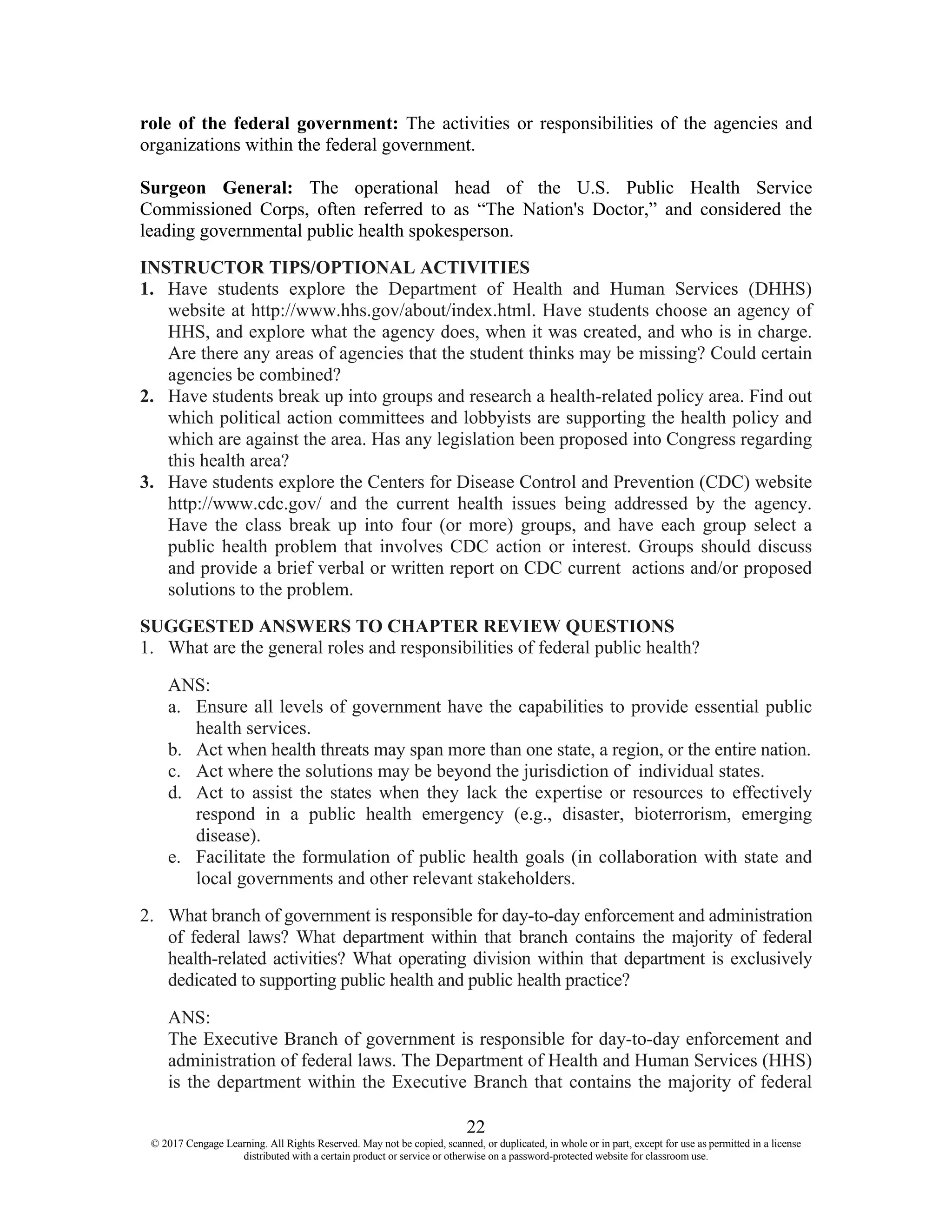
7
The Federal Contribution to
Public Health
Georgia A. Moore, MS • Craig W. Thomas, PhD • Judith A. Monroe, MD
LEARNING OBJECTIVES
Upon completion of this chapter, the reader will be able to:
1. Describe the various components of the federal government as they relate to public
health.
2. Analyze the authorities, roles, and responsibilities of federal agencies in public health.
3. Examine examples of federal influence on and contributions to the public health system.
4. Assess emerging trends and possible future directions for public health from a federal
perspective.
KEY TERMS
federal regulation: A rule or order issued by a federal executive-branch department or
administrative agency, generally under authority granted by statute, which enforces or
amplifies laws enacted by the legislature and has the force of law.
health system transformation: Fundamental changes to the inputs and processes of multiple
levels of health and health care, for the purpose of producing improvements in outcomes.
National Center for Health Statistics (NCHS): NCHS is the primary federal
government agency responsible for collecting, analyzing, and distributing data on health
and health care. NCHS provides free downloadable public-use data files to researchers,
teachers, students, and others through its Public-Use Data Files and Documentation site.
NCHS also houses the Health Indicators Warehouse (HIW), which serves as a federal
data hub for the U.S. Department of Health and Human Services' health data initiative.
public health infrastructure: Includes but is not limited to workforce, data and
information systems, communications, partnerships, policy, and organizational
competencies (e.g., leadership/governance). This is fundamental to the provision and
execution of public health services at all levels; it provides the capacity to prepare for and
respond to both acute (emergency) and chronic (ongoing) threats to the nation’s health.
22
© 2017 Cengage Learning. All Rights Reserved. May not be copied, scanned, or duplicated, in whole or in part, except for use as permitted in a license
distributed with a certain product or service or otherwise on a password-protected website for classroom use.
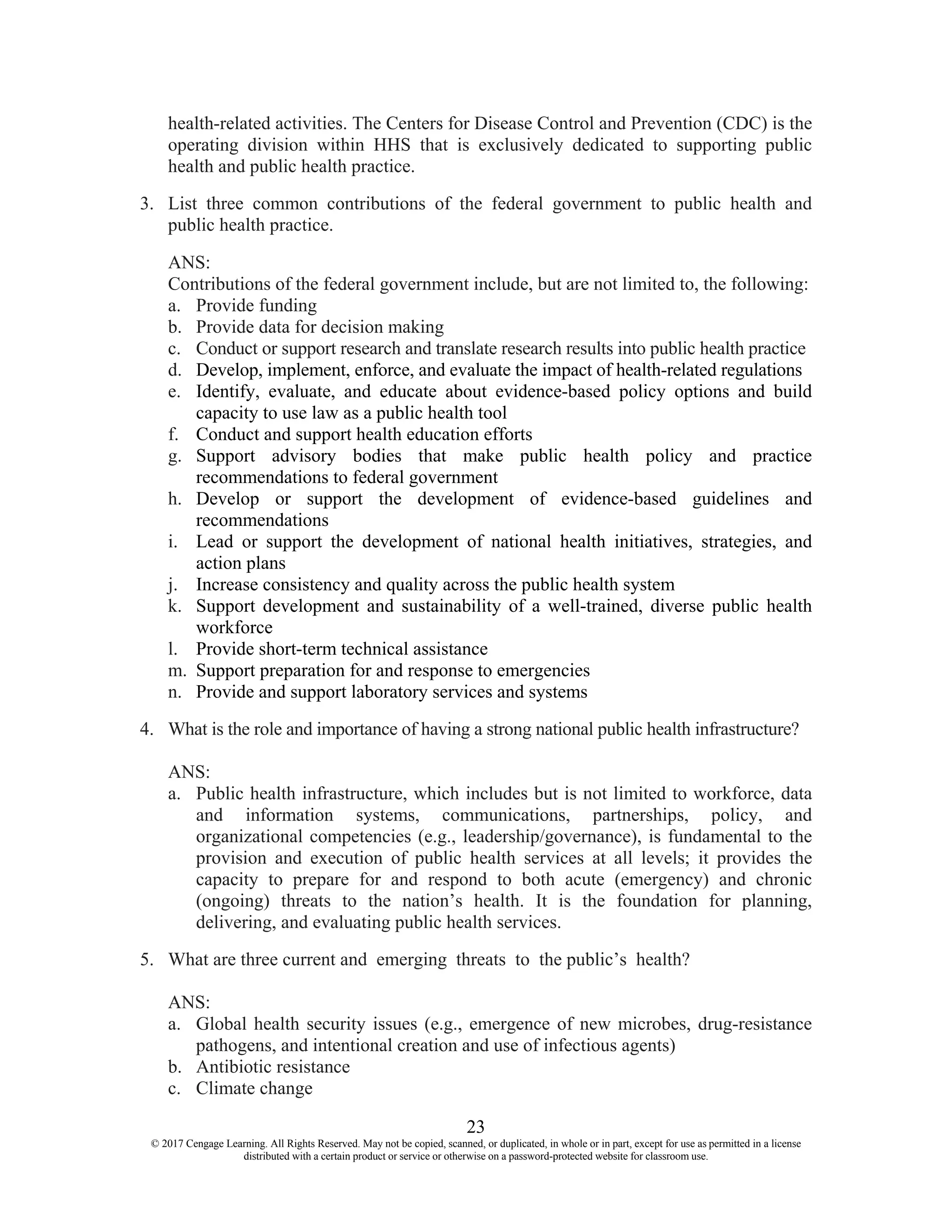
role of the federal government: The activities or responsibilities of the agencies and
organizations within the federal government.
Surgeon General: The operational head of the U.S. Public Health Service
Commissioned Corps, often referred to as “The Nation's Doctor,” and considered the
leading governmental public health spokesperson.
INSTRUCTOR TIPS/OPTIONAL ACTIVITIES
1. Have students explore the Department of Health and Human Services (DHHS)
website at http://www.hhs.gov/about/index.html. Have students choose an agency of
HHS, and explore what the agency does, when it was created, and who is in charge.
Are there any areas of agencies that the student thinks may be missing? Could certain
agencies be combined?
2. Have students break up into groups and research a health-related policy area. Find out
which political action committees and lobbyists are supporting the health policy and
which are against the area. Has any legislation been proposed into Congress regarding
this health area?
3. Have students explore the Centers for Disease Control and Prevention (CDC) website
http://www.cdc.gov/ and the current health issues being addressed by the agency.
Have the class break up into four (or more) groups, and have each group select a
public health problem that involves CDC action or interest. Groups should discuss
and provide a brief verbal or written report on CDC current actions and/or proposed
solutions to the problem.
SUGGESTED ANSWERS TO CHAPTER REVIEW QUESTIONS
1. What are the general roles and responsibilities of federal public health?
ANS:
a. Ensure all levels of government have the capabilities to provide essential public
health services.
b. Act when health threats may span more than one state, a region, or the entire nation.
c. Act where the solutions may be beyond the jurisdiction of individual states.
d. Act to assist the states when they lack the expertise or resources to effectively
respond in a public health emergency (e.g., disaster, bioterrorism, emerging
disease).
e. Facilitate the formulation of public health goals (in collaboration with state and
local governments and other relevant stakeholders.
2. What branch of government is responsible for day-to-day enforcement and administration
of federal laws? What department within that branch contains the majority of federal
health-related activities? What operating division within that department is exclusively
dedicated to supporting public health and public health practice?
ANS:
The Executive Branch of government is responsible for day-to-day enforcement and
administration of federal laws. The Department of Health and Human Services (HHS)
is the department within the Executive Branch that contains the majority of federal
23
© 2017 Cengage Learning. All Rights Reserved. May not be copied, scanned, or duplicated, in whole or in part, except for use as permitted in a license
distributed with a certain product or service or otherwise on a password-protected website for classroom use.
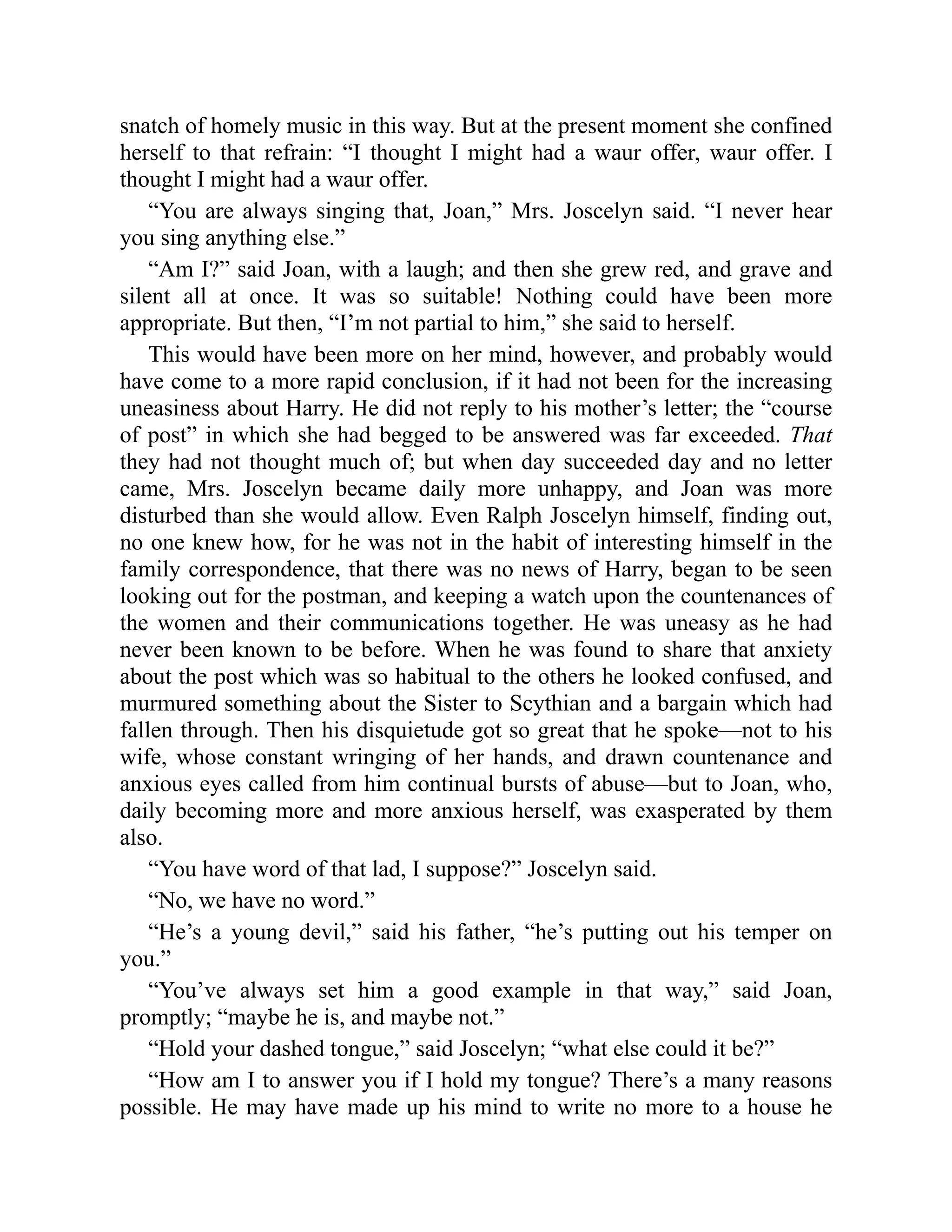
health-related activities. The Centers for Disease Control and Prevention (CDC) is the
operating division within HHS that is exclusively dedicated to supporting public
health and public health practice.
3. List three common contributions of the federal government to public health and
public health practice.
ANS:
Contributions of the federal government include, but are not limited to, the following:
a. Provide funding
b. Provide data for decision making
c. Conduct or support research and translate research results into public health practice
d. Develop, implement, enforce, and evaluate the impact of health-related regulations
e. Identify, evaluate, and educate about evidence-based policy options and build
capacity to use law as a public health tool
f. Conduct and support health education efforts
g. Support advisory bodies that make public health policy and practice
recommendations to federal government
h. Develop or support the development of evidence-based guidelines and
recommendations
i. Lead or support the development of national health initiatives, strategies, and
action plans
j. Increase consistency and quality across the public health system
k. Support development and sustainability of a well-trained, diverse public health
workforce
l. Provide short-term technical assistance
m. Support preparation for and response to emergencies
n. Provide and support laboratory services and systems
4. What is the role and importance of having a strong national public health infrastructure?
ANS:
a. Public health infrastructure, which includes but is not limited to workforce, data
and information systems, communications, partnerships, policy, and
organizational competencies (e.g., leadership/governance), is fundamental to the
provision and execution of public health services at all levels; it provides the
capacity to prepare for and respond to both acute (emergency) and chronic
(ongoing) threats to the nation’s health. It is the foundation for planning,
delivering, and evaluating public health services.
5. What are three current and emerging threats to the public’s health?
ANS:
a. Global health security issues (e.g., emergence of new microbes, drug-resistance
pathogens, and intentional creation and use of infectious agents)
b. Antibiotic resistance
c. Climate change
Random documents with unrelated
content Scribd suggests to you:
snatch of homely music in this way. But at the present moment she confined
herself to that refrain: “I thought I might had a waur offer, waur offer. I
thought I might had a waur offer.
“You are always singing that, Joan,” Mrs. Joscelyn said. “I never hear
you sing anything else.”
“Am I?” said Joan, with a laugh; and then she grew red, and grave and
silent all at once. It was so suitable! Nothing could have been more
appropriate. But then, “I’m not partial to him,” she said to herself.
This would have been more on her mind, however, and probably would
have come to a more rapid conclusion, if it had not been for the increasing
uneasiness about Harry. He did not reply to his mother’s letter; the “course
of post” in which she had begged to be answered was far exceeded. That
they had not thought much of; but when day succeeded day and no letter
came, Mrs. Joscelyn became daily more unhappy, and Joan was more
disturbed than she would allow. Even Ralph Joscelyn himself, finding out,
no one knew how, for he was not in the habit of interesting himself in the
family correspondence, that there was no news of Harry, began to be seen
looking out for the postman, and keeping a watch upon the countenances of
the women and their communications together. He was uneasy as he had
never been known to be before. When he was found to share that anxiety
about the post which was so habitual to the others he looked confused, and
murmured something about the Sister to Scythian and a bargain which had
fallen through. Then his disquietude got so great that he spoke—not to his
wife, whose constant wringing of her hands, and drawn countenance and
anxious eyes called from him continual bursts of abuse—but to Joan, who,
daily becoming more and more anxious herself, was exasperated by them
also.
“You have word of that lad, I suppose?” Joscelyn said.
“No, we have no word.”
“He’s a young devil,” said his father, “he’s putting out his temper on
you.”
“You’ve always set him a good example in that way,” said Joan,
promptly; “maybe he is, and maybe not.”
“Hold your dashed tongue,” said Joscelyn; “what else could it be?”
“How am I to answer you if I hold my tongue? There’s a many reasons
possible. He may have made up his mind to write no more to a house he
was turned out of.”
“Stuff and nonsense! he was coming in at a disgraceful hour, and the
door was locked, at a time when every honest door is locked.”
“I’m glad you can ease your conscience in that way,” said Joan; “it was
at no disgraceful hour; all the boys have been out later, you’ve been out
later, many’s the time, yourself. He may have made up his mind as I say,”
she added, distinctly, “to disown the house as his home, at which I for one
would not wonder: or he may,” and here her voice faltered, “he may—and
that’s what I fear—have gone off as lads do——”
“Rubbish! blanked nonsense!” cried the father, but his ruddy
countenance paled a little. “What do you mean by going off as lads do?”
“I cannot tell you,” said Joan, with sober disdain, “if you don’t know.”
“It’s just a dashed story you’ve got up,” her father said.
“It’s no story at all, for I hope it isn’t so, and I don’t know what it is—
but to my mind that’s the most like. I wouldn’t put it into mother’s head for
all the world, poor dear!”
“Dash you!” cried Joscelyn, “you are finely taken up with your mother. I
never saw the like before; you have been easy enough about your mother
and all her whining and complaining. What makes you set up this dashed
nonsense, enough to make a man sick, now?”
“I never minded before,” said Joan, “maybe more shame to me. I’m very
anxious about Harry myself, and that makes me understand the trouble
mother’s in, poor dear!”
“Dash you and her too! It’s all the blanked nonsense he’s got from her,
the young idiot!”
“That’s true: he has a deal of mother in him, poor lad!” Joan said, drying
her eyes.
Joscelyn lifted his hand, and clenched his fist as if he would have given
her a blow.
“You’re all a set of —— ——s!” he cried, launching furiously forth into
the kind of eloquence which was habitual to him; but furious as he was, and
brutal, there was a keen arrow of pain in his heart too; he was angry with
himself. He could have beaten himself with that big fist. What a fool he had
been to expose himself, to put it in the power of any lad to expose him!
There was nothing he could not have done to himself in the rage of self-
reproach and shame which had come upon him. It was a little for Harry—he
was not unnatural, and he had a feeling for his offspring—but it was much
more that he had laid himself open to the remarks of the county, and every
friend and every enemy who might like to gossip about him and say the
worst that there was to say.
Perhaps there was a little satisfaction in Joan’s bosom at the sight of the
disturbance in her father’s. He deserved to be disturbed. She was glad that
he should suffer, that he should get in some degree the recompense of his
ill-doings. But this was only a transitory diversion to the painful strain of
her thoughts. The waiting was hard to bear. How their hearts beat when they
saw the postman approaching along the dusty road, and there was a terrible
moment of doubt as to whether or not he would turn up the path to the
White House! And when he came there was a still hotter excitement as
Joan, with fingers which never had trembled before, turned over the letters.
She could not trust herself to speak, but only shook her head, looking at her
mother at the window. How many days? It seemed to have been going on
for years, not days, this intolerable suspense, which, though it was
unbearable, had to be borne. Only about a fortnight had elapsed, however,
when there came a packet with the Liverpool postmark. It was a large one,
and seemed to contain so much that for the first moment Joan scarcely
noticed that the address was not written in her brother’s hand. She took it
into the parlour, her heart beating loudly, and broke open the envelope,
while her mother, trembling, hurried to her side full of eager joy. There
tumbled out upon the table, however, four or five closed letters, all
addressed to Harry—and nothing more. Then it was that Joan turned the
envelope and looked at what was written upon it: and only then discovered
that the packet was addressed to Harry, and bore the stamp of his office.
Mrs. Joscelyn’s letter was among the other contents. Harry had never
received it. The two looked at each other blankly, turning over the letters
which had fallen on the table with trembling hands. It was like touching
something dead.
“What does it mean? Oh Joan, what is the meaning of it?” Mrs. Joscelyn
said.
Joan turned them all over again, aghast, almost stupid in her dismay. “It
means he has never got your letter, mother; then how could he answer it,
poor lad?” she said, with a keen impulse of angry despair.
This seemed reasonable enough in the first stupefaction; but afterwards
the mother gave a lamentable cry. “Why did he not get it?—why did he not
get my letter, Joan?”
“He has not been there, mother.” Joan spoke in a low tone of terror, as if
she were afraid to trust the air with that too evident conclusion—for where,
if he were not there, could Harry be? Then she examined the outside
envelope over again with anxious futility, as if that could give her any
information. Written inside the flap was the request, “Please acknowledge
receipt.” The envelope bore the office stamp. All was done in the most
business-like way. She had seen Harry’s letters come to him in exactly the
same envelope when he was at home for one of his holidays. The inference
that he was still at home, that all was peaceful and well, and his letters
forwarded to him in the usual course, overpowered Joan, calm as she was.
A few great tears, looking like large raindrops as they pelted down upon the
letters, fell from her eyes in spite of herself. “There never was such a fool as
I am,” she cried with a hysterical laugh, “I’m worse than mother or
anybody. What’s so wonderful about it? He’s gone to London or
somewhere, having still his time to himself—why should he have gone
back to the office and spoiled his holiday. That would just have been—
preposterous.” This big word gave her a certain relief. It seemed to take
some of the weight off her heart as she brought it out. “Preposterous,” she
repeated, looking almost angrily at her mother. “You might see that, without
asking me.”
Mrs. Joscelyn gazed at her, half carried away by this outburst of what
looked like argument; but then she sank into a chair and wrung her hands,
and began to weep. “Oh Joan, where is he, where is he, if he is not there?
What has happened to my boy?”
That was a terrible day to everybody concerned. Joscelyn himself came
in under pretence of wanting something, and seeing the letters lying on the
table stooped to look at them with a face which grew very dark in spite of
himself. He looked at the women, one seated crying in her chair, the other
standing stupefied, staring about her, not knowing what she did.
“Has he come back?” he said, the words escaping him in spite of
himself.
And these two who had been under his rule so long, the timid, feeble
wife, the sober-minded daughter, rose, as it were, and flung themselves
upon him. They who had been so voiceless hitherto, fell upon him like a
hail-storm, taking him by surprise, beating him down with a sudden storm
of wrath and reproach. His wife, who had never ventured to say her soul
was her own; who had lain still, weeping and terrified, allowing him to be
the master on that night when all the harm had been done; and Joan, who
had borne his fury so often with stolid composure, making no reply. All the
pent up grievances of years he heard of now, with an astonishment, to hear
their opinion of him, which was equal to his stupefaction at their rebellion.
Even the harshest domestic tyrant finds it difficult to face the fact that he is
a terror to his surroundings, still more that they see through his external
bigness, and know him to be at bottom a coward and a bully. Joscelyn was
absolutely cowed by this revelation. He tried a few volleys of oaths, like
those which usually forced them into silence; but without effect. He raised
his voice and thundered; but they did not care. It was Mrs. Joscelyn who led
this attack.
“Come back?” she cried; “he will never come back—how dare you stand
there and look at his letters that are like his graveclothes, and ask ‘Has he
come back?’ You that have driven him from his home—that have turned his
sweetness into bitterness; that have driven my boy from me, and broken my
heart. Oh, you may shake your fist at me! What do I care? what do you
suppose I care? Do you think I mind if you killed me? You have done far
worse; you have driven away my boy, and in all the world I do not know
where he is. Oh man, get out of my sight. I cannot endure the sight of you. I
cannot endure the sight of you!” she cried.
And Joscelyn stood aghast. He was pale at first, then a purple flood of
rage came over him. “You dashed old witch—you miserable blanked old cat
—you —— —— ——” He caught his breath in his consternation and fury.
He did not know what to say.
“Oh, what do I care for your swearing,” she cried, with an almost
majestic wave of her thin white hand. “Go away, for God’s sake, go away—
what are your oaths and your bad words to me? I’m used to them now.
Many a time I have been terrified by them; but you can’t frighten me now.
What do they mean?—nothing! I am used to them; you might as well save
yourself the trouble. I am not afraid of anything you can do. You’ve done
your worst, Ralph Joscelyn; you have driven away my boy, my boy. Oh
Joan, where is my boy?” the poor woman cried, turning from her husband
with another indignant wave of her hand, to her daughter, with whom she
never had been linked in such tender and close union before.
“By ——!” cried Joscelyn, “I’ll teach you, madam, to defy me. Your
boy, as you call him, had better never show his face again here. Your boy! if
you come to that, what have you got to do with one of them? They’re my
children, and you’re my wife, and it’s me you’ve got to look to and take
your orders from, you dashed old wild-cat, you blanked old ——!”
“Oh, hold your tongue, father!” Joan cried, turning her head in angry
impatience. “Mother’s quite right, we’re used to all that.”
What could a man so assailed do? He could not get over his
astonishment. He remained finally master of the field, in so far that they left
him there volleying forth those thunders which they disdained, and saw to
be nothing but words. Joscelyn recognized with the strangest humiliation
that they were but words, when his women, his slaves, first ventured to let
him know that they saw through him, and found them all to be froth and
emptiness. If somebody had discovered Jove’s thunderbolts to be but
fireworks, the Father of the Gods must have fallen to the ground like an
exhausted rocket. Joscelyn felt something like this. He came down whirling
from his imaginary eminence, down into an abyss of emptiness and
darkness, and struck blankly against a real something which resisted him,
which he could move no longer. He was not without feeling, and he became
suddenly dumb as they closed the door, leaving him a much discomfited
hero in possession of the field. Rebellion in his house, his slaves
emancipated, the boy lost, and the whole story likely to be published over
the length and breadth of the county, and himself exposed to every petty
gossip and critical assembly in it. This was a terrible downfall for such a
man to bear.
That day messengers were sent off to Tom and Will, who came, in haste,
thinking it was a funeral to which they were summoned, to hear all the tale,
and to give their solemn verdict against their father. They were not afraid of
him now; they could swear themselves almost as fiercely as he could, and
he did not overawe them as he used to do.
“The governor oughtn’t to have done it,” Will said to Tom.
“He ought to have had more consideration,” Tom replied. “It doesn’t do
to treat young fellows so; I wouldn’t have put up with it myself, and no
more will Harry.”
“If we’ve seen the last of him,” said the other, “we know where to lay
the fault.”
There could not have been a more complete family unanimity on this
point at least.
B
CHAPTER XV.
NO NEWS.
UT neither Will nor Tom had any suggestion to make, or knew what to
do in such an emergency. They thought it might be well to write to the
office and ask what was known of him, or to his Liverpool lodgings;
and for themselves, they were anxious to get back to their own homes, their
wives, and their work. Even before the afternoon was out they had so far
exhausted the subject of Harry that they were not unwilling to join their
father in an examination of the Sister to Scythian, and “pass their opinion”
on her, and the high hopes Joscelyn entertained of her. Joan looked on at
this change of sentiment and subject with a half understanding and half
bewilderment. In other family troubles before this she too had been glad to
escape from the monotony of a painful subject with a half scorn and whole
impatience of her mother’s persistence in it, exactly like the sentiment her
brothers showed now. Only this time her own heart was profoundly
engaged; she felt like her mother, and along with her comprehension of the
feeling of “the boys,” had a perfectly new and bitter sense of their
heartlessness, their stupid indifference, their desire to escape from this one
thing which was more important than anything else in earth or heaven.
What was the Sister to Scythian in comparison with Harry? And they had
all allowed that Harry’s disappearance was a serious matter: they had not
deceived themselves, or made it out to be some “nonsense of mother’s.”
This time they had been obliged to confess there was grave cause for
anxiety; and then they had gone to the stables with the father whom they
had been unanimous in blaming, and had given all their minds to the points
of the horse. Joan had never been given to investigating the feebleness of
human character. She would scarcely have understood the words had they
been suggested to her, or, at least, would have treated them as too high-
flown for ordinary meaning; but for once in a way the wonder was brought
home to her, and she saw and understood it. “The boys” were sorry about
their brother, sorry that such a thing should have occurred; annoyed that
their domestic affairs should thus be thrown open to the public, and more or
less sympathetic with their mother, though not quite sure that it did not
serve her right for making a favourite of her youngest son; but when they
had expressed these feelings, what more were they to say? They could not
go on talking about it for ever; they could not bring Harry back if they
talked till doomsday; and besides, when once their opinion was expressed
and their regrets said, Harry was not a subject of very great importance to
them—whereas the Sister to Scythian might advance the interests of the
family and make the Joscelyn stable celebrated. And Joan understood it all,
she knew it by herself: yet was angry with a harsh and disappointed pain
which all her reason could not subdue. Mrs. Joscelyn in the parlour,
absorbed in that one passion of anxiety, did not even appreciate this failure
of the interest of the others in what was so great a matter to herself so much
as her daughter did.
“What do the boys say? What do they think we should do?” she asked
Joan a hundred times. “What shall we do? Oh! Joan, what do they think we
should do?”
“They are not thinking anything about it, mother,” Joan said. “They are
off to the stables, looking at that beast. They are more taken up with her
than with Harry. An ill-conditioned brute! I wish, for my part, she was at the
bottom of the sea; but set a horse before the men, and they think of nothing
else—if all the brothers in the world were perishing before their eyes.”
“Miss Joan,” said a voice behind her, “I am astonished to hear you say
that; you whom I have always taken to be such an excellent judge of a horse
yourself.”
The two women turned upon the new-comer with mingled feelings, half
angry that he had intruded upon them, half excited by a sudden wild hope
that a stranger might have some new light to throw upon a subject which
they had exhausted, for they could not hide their trouble from him. Mrs.
Joscelyn could not speak without an overflow of tears, and even Joan’s eyes
were red, and there was that look of irritation and vexation and impatience
in her face which comes so naturally to a capable person suddenly set down
before a painful difficulty which she can see no way in her experience of
coping with. Selby looked at her with anxious eyes. Was she angry with
him? but, if so, there was a sudden gleam of expectation in her face too,
suddenly looking up at him, as if she had said within herself, “If help is
possible it is here—” which gave him courage; and he hastened to explain
with that look and tone of sympathy in which strangers so often excel those
who ought to be the natural consolers.
“I see I have come in at a wrong time,” he said. “I knocked, but I
suppose you did not hear. I ought to go away, but I want to stay: for you are
in trouble, and if I could be of any use to you——”
“Mr. Selby is—a true well-wisher,” said Joan, looking with almost
timidity at her mother. She was not given to blushing, but she blushed now
all over her face and her throat, and made such an appeal with her eyes as
those eyes had never made before. “It will be best to tell him,” she said:
“he, maybe, could think of something; and what is the use of trying to hide
it? it will soon be all over the country-side.”
“Indeed I am a well-wisher,” he cried; “if I can do anything, I will do it
with all my heart. If it’s about your brother Harry, I’ve heard something—”
and he looked from Joan to Mrs. Joscelyn with eyes so full of sympathy that
they felt the look as a sick man feels a cool hand laid upon his hot forehead.
They told him their story with anxious questions as to what he had
heard. He had heard, of course, a great deal more than there was to hear,
that Harry had come to blows with his father, that there had been a struggle
and a fight, and that the young man had been kicked out of the house. Some
added that he lay on the Fells all night, so much injured was he; and there
were whispers of vice on Harry’s part as the cause of such a violent
proceeding, which Selby was too wise to betray to the poor women. When
they had told him all they knew, he sprang up to his feet and looked at his
watch with an air of readiness and capability which at once gave them hope.
“It is quite clear what must be done,” he said; “you must send somebody
to Liverpool at once, this very night. It’s too late for the mid-day train, but
the night one will do.”
“Send somebody to Liverpool!” Joan’s countenance flushed again while
her mother’s grew pale.
“Oh!” cried Mrs. Joscelyn, “but who can we get to go?” while Joan, who
had never been beyond Carlisle in her life, stood up unconsciously with
such a gasp as catches the breath after a sudden plunge into the sea. She
knew nothing about the world, and she belonged to a generation which
believed that a woman could do nothing out of her own home; but a rush of
blood came to her face, and of tremendous energy to her heart. In the
suggestion there seemed so much hope, although almost as much fear.
“Who will you get to go? Me if you like,” said Selby, with the
benevolent glow of a man who feels himself a sort of good angel to women
in trouble. “I have nothing very particular to do, and I have a pass on the
railway, and I’m used to travelling. I will go to-night, and come back to-
morrow night. You will hear sooner that way than any other way, and it is
far easier to make inquiries personally than by letter—and far more
satisfactory.”
The colour left Joan’s cheek; there was a little falling back of relief, yet
half disappointment, from the sudden alarmed temerity of impulse that had
come upon her. She looked at him with, in the midst of her trouble, a faint
—the very faintest—touch of a smile at one corner of her mouth. “Aha, my
lad! I know what that is for!” Joan said to herself, swift as lightning; but
even the interested motive thus revealed was not displeasing to her, and the
whole suggestion went through her mind like an arrow on the wind,
showing only for a second against the dark atmosphere of anxiety within.
“Oh, Mr. Selby, how could I ask you to do that for me? How could I ever
repay you for such kindness?” Mrs. Joscelyn cried, wringing her tremulous
hands. There was no complication of ideas in her mind. She was bewildered
by the suggestion, by the offer, by this unexampled effort of friendship. No
one had ever offered her such a service before. To imagine that it was for
the love of Joan that it was offered to her did not enter her mind. She knew
no motive possible, and it filled her with astonishment—astonishment
almost too great for hope. A journey was a thing which, in her experience,
was only undertaken after great preparations and much thought. To go to-
day and return to-morrow was a proceeding unknown to her. And then why
should he, a stranger, not belonging to her, undertake such a journey for
her? and how could she repay him? She had not even money to pay his
expenses if she could have offered payment, and how was she to make it up
to him? In this strait she turned her eyes anxiously upon Joan, who was
standing by, silenced by an agitation such as had never been seen in her
before.
“It is far, far too much trouble,” Joan faltered. “If I could go myself
——”
“You!” cried the mother, upon whom the weakness of her sex and its
incapacity had always been strongly impressed. “Oh, what could you do,
Joan? what can a woman do? They will not even let a woman into these
offices—or so I’ve heard. Oh no, no, not you—and it’s far too much, far too
much, as you say, to ask—”
“You are not asking,” said Selby, beaming. “It is I who am offering to do
it. I should like to do it; it would give me pleasure. You need not fear I will
say anything to hurt his feelings. I will act as if he were a young brother of
my own. As for the travelling it is nothing, and it will cost me even next to
nothing, for I have my pass, being engaged on the railway. Not that I make
much of that—for if it cost me ever so much I should be all the more glad to
do it, Mrs. Joscelyn. To ease your mind I would do anything,” he said, and
this time he glanced at Joan with a corner of his eye; but with meaning
enough to make it very distinct to her prepared intelligence. And at the
corner of Joan’s mouth, that infinitesimal curve, became for a second
almost a dimple. How could she help seeing through him?—but she was not
displeased.
“And if I find any difficulty in tracing him,” said Selby, a little carried
away by his enthusiasm, “I will engage a detective—”
But at this Mrs. Joscelyn threw up her hands with a sudden paleness, and
almost fainted; while Joan looked at him with a sternness that made the
heart of her suitor tremble, as it had done for a moment when he heard her
scolding Bess in the dairy.
“Do you think my brother is a lad that should have the police set after
him?” she said.
“It is not the police,” said Selby mildly; but they were ignorant of all
modern habits in this way, and the suggestion was so great an offence to
them, that it nearly took away all their gratitude and hope in the proposal he
had made. He was prudent enough to say no more about it; but took Harry’s
address at his lodgings and at his office, making careful note of everything
in a way that went to Mrs. Joscelyn’s heart. Her courage rose as she saw
him make these notes. They looked like something doing, an effort which
must come to some result. To-morrow early this good friend would be on
the spot; would see with his eyes and hear with his ears everything that
could be heard or seen; and she could not doubt that he would bring light
out of the darkness. Her tears dried as she looked at him; the feeble
wringing of her hands was stayed—they clasped each other instead with a
tremulous patience and almost steadiness. Never before had there been a
reasonable being like this, kind and sympathetic and understanding, to stand
by her in any of her troubles; it seemed an almost miraculous goodness to
the heart-broken woman. And Harry must hear reason at the hands of such a
man. If he did so much for her, surely he would do more for Harry. She was
comforted beyond measure by the very sight of him as he stood and took
down the address. And that he should be willing to do so much for her,
seemed miraculous to her. She could not think of any other reason for his
kindness.
As for Joan, she was consoled too, partly by gratitude like her mother’s,
but partly also by her insight into Selby’s real motive, which her mother did
not guess. Her brow and her eyes were very grave and heavy still with
anxiety; but the dimple remained at the corner of her mouth. She saw
through him very well; he was not generous or disinterested, as her mother
thought. She knew his motive. And Joan was not sure yet that it would do
him any good notwithstanding her gratitude. She was by no means free
from a little sidelong sense of that knavery which is common enough in
such matters. She meant to accept, as far as this went, his self-devotion, but
she was not sure that the hopes he was building upon it might not be
fallacious hopes, and secretly entertained in her inmost heart a half-
determination to cheat him yet, and prove him wrong in his reliance upon
the services he was going to render her. But mingled as this process of
thought was, it was on the whole exhilarating. Her heart rose a little. She
thought more of herself as she caught a glimpse of herself in Philip Selby’s
eyes, and as her self-esteem received a sensible stimulus, her hopes
increased with it. The more we think of ourselves the more sure we are that
good and not evil will happen to us. There is nothing more terrible in
misfortune than the depression and sense of demerit which it brings with it.
Joan thought better of herself through the spectacles which Selby provided,
and she could not help feeling an incipient certainty, not altogether new to
her, that with a person possessing such qualities as hers all must go well.
Fortified by these hopes, the mother and daughter saw Tom and Will
depart with equanimity.
“Well, mother,” Will said, as he shook her by the hand (North-country
people are not given to demonstrations of affection), “I hope you’ll soon
have word of that boy. You needn’t fret: we’ve been in a good many
scrapes, but we’ve always got safe out of them.”
Will was the best fellow of the two. Tom took it altogether more easily.
“Yes, yes, you’ll hear,” he said; “I’m not the least afraid. Harry’s like the
ill-penny that always turns up. There’s nothing that I can see to fret about.”
Joan nodded to them when they got on their horses with a friendly
satisfaction to be quit of them. She had no ideal to be offended in her
brothers. Mrs. Joscelyn, when her momentary buoyancy of new hope was
over, felt bitterly to the depths of her foolish heart that her sons were of a
very common, selfish grain, such as some years ago it would have broken
her heart to think of. She had been drilled into it, and had yielded to
necessity; but still when something made her observation clearer she
remembered and felt the downfall. The slow coming down of heart and
hope by which a woman arrives at the fact that her child is not ideal, nor
even excellent, nor superior in any way to the coarsest common pâte of
man, is very gradual. Perhaps the greater number do not reach it at all, but
are content to deceive themselves and think all their offspring right and
perfect. But Mrs. Joscelyn was not of this kind. She could not get over her
sons’ indifference. “Another man going out to bring me news—taking all
that trouble—a stranger that is nothing to us—and my own boys, my own
boys caring nothing.” Over this again the poor soul, faithful in all the
devices of self-torment, shed a few bitter tears.
“Now, mother, you are beginning to fuss again,” said Joan, in a vexed
tone. “Dear, dear, haven’t we trouble enough?” Even she who shared the
real family grief so warmly thought this one of “mother’s fusses,” and was
impatient at her folly. “As if everybody didn’t know that Will and Tom were
just——Will and Tom,” Joan said to herself. That they had turned out to be
so instead of being heroes, did not strike her as a subject of complaint.
Mr. Selby was gone three days. The mission he had undertaken soon
showed itself to be more difficult than he thought. Harry had gone away
without leaving a trace behind him. He had appeared at the office for an
hour or two quite unexpectedly before his leave had expired, and paid a few
small debts, and taken away some small articles which were in his desk,
disappearing again without a word as to his destination. At his lodgings
Harry had not been seen at all. His portmanteau was there, forlorn in the
dusky lobby of the lodging-house, and the unfortunate hamper, out of which
odours not altogether delightful were proceeding, and which the mistress of
the house implored Mr. Selby to take away with him. He did not know what
to do: finally, but with great secrecy, that his principals might not be
offended, he put a detective on Harry’s track, such as it was. But there
seemed no track, not so much as a circle in the water or a footprint upon the
soil, to show where he had gone. Selby had gone to Liverpool with great
confidence in himself; pleased, for he had a good heart, to please and
console these two women; but also pleased, for his own part, to show at
once how kind and how clever he was. He had not a doubt that he would
succeed and go back triumphant, and prove himself so superior to all the
clowns about, that Joan could have no further hesitation; and it was in this
confidence, being so sure that the work he had taken up would be
prosperous, that he had set out upon his mission. But when he returned his
mind was very different; he was greatly depressed, not only with the sense
that what he had to tell was unsatisfactory, but that his own prestige would
be seriously impaired. He had left home with the conviction that he would
find everything out and set everything right; that neither would adverse fate
be able to baffle him in the wisdom of his investigations, nor Harry be able
to resist his brotherly-fatherly representations. And when Philip Selby
found nothing but a blank void, in which there was nobody to persuade and
remonstrate with, he felt himself tumble down from the vantage ground
which he had thought so certain. How was he to go back and say he had
failed? His detectives had indeed done their best to buoy him up with hope;
but he was obliged to come back with no news, presenting a very blank
countenance to the anxious looks of the mother and sister. The first sight of
him sent their hearts down, down to the very depths.
“He is not there, Mrs. Joscelyn; but I hope soon to hear news of him,” he
said deprecating, as if it had been his fault—which was not the satisfactory
position he had hoped to hold in coming back.
And then the fact had to be faced in all its simplicity. Harry had
disappeared. The firm could throw no light on the question. They did not
know where he had gone, nor why he had gone. He had gone honourably,
that was all, had got payment of the salary which was due to him, and had
settled various little debts which he was owing. Nobody knew anything of
larger liabilities, if he had them. He was gone absolutely, without leaving a
trace behind. His employers were surprised by the inquiries, not giving
much importance as yet to the fact that he had exceeded his time of leave;
but they could give no information, and satisfy no anxiety. He was gone,
that was all about it. The whole tale was written in Selby’s face to the two
anxious women who had awaited him with so much hope.
A
CHAPTER XVI.
WHAT CAN’T BE CURED MUST BE ENDURED.
LL great evils are more intolerable, more terrible, before than after they
come. It seems to us in advance as if the mind could never accustom
itself to such a change, or life close over the wound. And yet, when but
a very short time has elapsed, we find that obedient Nature has accepted
and acknowledged the inevitable fact, and that use and wont, so rent
asunder by the change, have begun to throw new fibres of their cobweb
tissue over the chasm. There was a moment when poor Mrs. Joscelyn
thought that she could not bear this rending asunder. She turned her face to
the wall and closed her eyes, and declared that she could not endure the
light. She lay thus for weeks, but not in any stupor; on the contrary, with
every sense alert, and all standing sentinel, hearing Harry’s step in every
sound outside, and divining him in every whisper of the wind. She had no
objection to the detective now, but was kept alive from morning to morning
by the news which Selby brought her, scraps of news entirely delusive, but
which kept a fire of agitation and expectation alive in her heart. Selby spent
a great deal of money upon the detective with little use, an expense which
neither Joan nor her mother divined or thought of. To them he had said at
first that he had left a “friend” on the spot to pursue the inquiry, and they
had not doubted his statement. But by-and-by there came a time when the
expenditure seemed to him no longer necessary. He was not rich, although
he was sufficiently well-off, and it was doing no good, neither in respect to
Harry nor to Joan, who was short and sharp with him in her angry grief, and
seemed almost to blame him for the catastrophe altogether; and, indeed,
Joan was unreasonably sharp. She could not help asking within herself what
was the good of a man if he could not do as much as this? She felt sure that
if she had gone herself she must have discovered something; and she began
to get sick of the sight of Selby coming up to the White House morning
after morning with his no news. It provoked her entirely without reason; his
long face provoked her. If he would but stay away and hold his tongue
when he could do no good! She was all the more unjust to him, perhaps,
that she had secretly built upon his success almost as much as he himself
had done, and had felt that it would justify anything that might follow out of
gratitude for such a service. But the service had not been accomplished,
though it had cost more trouble and expenditure of one sort and another
than if it had been successfully done, and not only was Joan very miserable
about her brother, but she was thrown out altogether in respect to the suitor,
who had, she grudgingly allowed to herself, established a certain claim
upon her by his efforts, even though he had not been successful. She was
very difficult to get on with, all the household acknowledged, at this period.
A lover might well have been alarmed had he heard her voice lifted high in
the dairy, and in the house, setting everything in order. Woe to the maid who
neglected her work in these days, or the man either. Joan came upon them
like a thunderstorm; there were times when Selby, stalking up to the house
with his bulletin, heard her and trembled. If this was how she was going to
be, would it not be wiser in a lover to give up such a dangerous pursuit? But
though it gave him a cold shiver he persevered, and took her sharpness
gently, and bore with her unreason, having a soul above his judgment.
There were times when this little conflict going on within him, and the trial
of his faithful purpose over all doubts, was visible in his countenance,
betraying Joan to a momentary amusement in the midst of her irritation and
trouble; and she would be still sharper to him afterwards—then break into a
short laugh within herself. It was her only diversion in her trouble to see
how Selby got frightened and swerved, and then took heart again.
“I’m enough to give any decent man a fright,” Joan said to herself, with
her half laugh; and it was true that she led the household, as all the maids
said, “a terrible life.”
But Mrs. Joscelyn lay with her face to the wall, and moaned by times:
but generally listened, listened, night and day, her whole being concentrated
into her ears. She got a kind of monomania on the subject. He seemed to her
to be always coming home, on the road, drawing nearer and nearer. Joan,
dozing in a chair by her bedside, when she was at her worst, she would
wake up suddenly and implore to go down to the door and look out.
“Somebody went by and stopped, I am sure he stopped—and looked to
see if there was any one up. Run down, run down, and open to him, Joan!”
Joan did it a dozen times at least, and standing at the open door in the
middle of the night, looking over the black invisible country, or into the
pale moonlight which revealed it in a vague whiteness, would shed a few
tears, and feel the night wind go chill to her heart before she shut and
locked again the door that had been once closed upon her brother.
“Oh, there’s a deal of mother in him, the Lord have a care of him!” Joan
would say: and going back again, add: “There was no one, I knew very well
there was no one; I went to humour you. Now just you humour me and go
to sleep, go to sleep, poor dear!” and she would smooth the pillow and the
bed very softly for all her scolding.
It was a dreadful day, the day on which the portmanteau came back, and
the hamper, which smelt so badly, and which was now a half rotten mass,
not fit even for the pigs. To see them coming in the cart from the station
was like a funeral; the very horse went slowly, though he was wont to break
into a clumsy canter as soon as he came within sight of his stable. Even the
dumb beast felt it, old Simon said; and the man got the things out very
quietly, and carried them up to Harry’s room with solemnity, as they might
have carried his coffin. Joan unpacked all his clothes again as she had
folded them, with her tears falling like rain. She put them back in his
drawers with many a dismal thought. Would he ever come back to find
them all there waiting for him? or was it over for ever, and would Harry
never enter the house again? The arrival of these relics increased Mrs.
Joscelyn’s sufferings so much that the doctor had to be sent for, who made
but one prescription, succinct, in one word: “Liddy:” for he knew the family
well, and all its members. Joan clasped her hands together as the thought
struck her. “And me never to have thought of that! It shows the head I must
have,” she said.
And this was how it came about that suddenly, without anyone knowing
of it, one afternoon when Joan had been absent for an hour or two, there
arose a sudden commotion in the house, a clanging of doors, a sound of
voices, a rush up the stairs of something that was between the flight of a
bird and the blowing of a brisk wind and the patter of airy steps—a
movement, and a sentiment of fresh life, and arrival, and new hope. It was
not a noise, the creature was too light, too melodious for that: her step
scarcely touched the stair, the door which she pushed open did not bang as
when other hands touched it, but flew round upon its hinges as airy as
herself; and when she flung herself upon the bed with a soft cry of
“Mother!” the whole place seemed full of her, brightening and growing
warm with pleasure. Mrs. Joscelyn turned round with an answering cry, and
took happiness into her feeble arms with a shock of sudden consolation that
sent the blood into motion again in her veins. She was not happy herself,
poor soul! but happiness stood by her bed, and clasped her neck, and
breathed into her its soft natural sweetness.
“Oh, my Liddy, my Liddy!” the poor woman said.
Liddy was all in a commotion of gladness to get back; to stop her lessons
in mid-career of the “half;” to be of such importance that she was sent for to
help and cure her mother. Harry’s loss was a very secondary matter to the
girl, who had not seen very much of Harry, nor had ever been used to look
upon him as a necessary part of home; but she listened to all the story,
which her mother found a great relief in telling her from beginning to end,
with a childish pleasure in the tale as well as sympathy with the teller.
“Oh, but he’ll come back,” Liddy said, with a happy confidence, which
made far more impression on her mother than all that had been said by
people who knew a great deal better than Liddy.
“Do you think so, my darling?” she asked with piteous eyes—as if the
child could tell. Joan looking on, and much advantaged herself by the little
stir of mind which her resolution to send for Liddy, and the prompt carrying
out of the same, had roused within her, could not but laugh once more that
sharp laugh of mingled amusement and wonder, to see how efficacious her
remedy was.
“Mother’s very queer when all’s done,” she said to herself. She had done
everything for everybody throughout all this troubled moment; but Liddy,
who could do nothing save kiss Mrs. Joscelyn’s white face and warm her
chilly hands, and promise with confident ignorance, “Oh, but he’ll come
back,” was of far greater account than she. But it was a great relief to her
mind all the same. And by and by this great event which had disturbed even
the rude soul of Ralph Joscelyn, and filled him with shame and angry
confusion, began to be a thing they were all used to, and which had entered
into the fabric of their lives.
END OF THE FIRST VOLUME.
London: Printed by A. Schulze, 13, Poland Street.
*** END OF THE PROJECT GUTENBERG EBOOK HARRY JOSCELYN;
VOL. 1 OF 3 ***
Updated editions will replace the previous one—the old editions will
be renamed.
Creating the works from print editions not protected by U.S.
copyright law means that no one owns a United States copyright in
these works, so the Foundation (and you!) can copy and distribute it
in the United States without permission and without paying
copyright royalties. Special rules, set forth in the General Terms of
Use part of this license, apply to copying and distributing Project
Gutenberg™ electronic works to protect the PROJECT GUTENBERG™
concept and trademark. Project Gutenberg is a registered trademark,
and may not be used if you charge for an eBook, except by following
the terms of the trademark license, including paying royalties for use
of the Project Gutenberg trademark. If you do not charge anything
for copies of this eBook, complying with the trademark license is
very easy. You may use this eBook for nearly any purpose such as
creation of derivative works, reports, performances and research.
Project Gutenberg eBooks may be modified and printed and given
away—you may do practically ANYTHING in the United States with
eBooks not protected by U.S. copyright law. Redistribution is subject
to the trademark license, especially commercial redistribution.
START: FULL LICENSE
THE FULL PROJECT GUTENBERG LICENSE
PLEASE READ THIS BEFORE YOU DISTRIBUTE OR USE THIS WORK
To protect the Project Gutenberg™ mission of promoting the free
distribution of electronic works, by using or distributing this work (or
any other work associated in any way with the phrase “Project
Gutenberg”), you agree to comply with all the terms of the Full
Project Gutenberg™ License available with this file or online at
www.gutenberg.org/license.
Section 1. General Terms of Use and
Redistributing Project Gutenberg™
electronic works
1.A. By reading or using any part of this Project Gutenberg™
electronic work, you indicate that you have read, understand, agree
to and accept all the terms of this license and intellectual property
(trademark/copyright) agreement. If you do not agree to abide by all
the terms of this agreement, you must cease using and return or
destroy all copies of Project Gutenberg™ electronic works in your
possession. If you paid a fee for obtaining a copy of or access to a
Project Gutenberg™ electronic work and you do not agree to be
bound by the terms of this agreement, you may obtain a refund
from the person or entity to whom you paid the fee as set forth in
paragraph 1.E.8.
1.B. “Project Gutenberg” is a registered trademark. It may only be
used on or associated in any way with an electronic work by people
who agree to be bound by the terms of this agreement. There are a
few things that you can do with most Project Gutenberg™ electronic
works even without complying with the full terms of this agreement.
See paragraph 1.C below. There are a lot of things you can do with
Project Gutenberg™ electronic works if you follow the terms of this
agreement and help preserve free future access to Project
Gutenberg™ electronic works. See paragraph 1.E below.
1.C. The Project Gutenberg Literary Archive Foundation (“the
Foundation” or PGLAF), owns a compilation copyright in the
collection of Project Gutenberg™ electronic works. Nearly all the
individual works in the collection are in the public domain in the
United States. If an individual work is unprotected by copyright law
in the United States and you are located in the United States, we do
not claim a right to prevent you from copying, distributing,
performing, displaying or creating derivative works based on the
work as long as all references to Project Gutenberg are removed. Of
course, we hope that you will support the Project Gutenberg™
mission of promoting free access to electronic works by freely
sharing Project Gutenberg™ works in compliance with the terms of
this agreement for keeping the Project Gutenberg™ name associated
with the work. You can easily comply with the terms of this
agreement by keeping this work in the same format with its attached
full Project Gutenberg™ License when you share it without charge
with others.
1.D. The copyright laws of the place where you are located also
govern what you can do with this work. Copyright laws in most
countries are in a constant state of change. If you are outside the
United States, check the laws of your country in addition to the
terms of this agreement before downloading, copying, displaying,
performing, distributing or creating derivative works based on this
work or any other Project Gutenberg™ work. The Foundation makes
no representations concerning the copyright status of any work in
any country other than the United States.
1.E. Unless you have removed all references to Project Gutenberg:
1.E.1. The following sentence, with active links to, or other
immediate access to, the full Project Gutenberg™ License must
appear prominently whenever any copy of a Project Gutenberg™
work (any work on which the phrase “Project Gutenberg” appears,
or with which the phrase “Project Gutenberg” is associated) is
accessed, displayed, performed, viewed, copied or distributed:
This eBook is for the use of anyone anywhere in the United
States and most other parts of the world at no cost and with
almost no restrictions whatsoever. You may copy it, give it away
or re-use it under the terms of the Project Gutenberg License
included with this eBook or online at www.gutenberg.org. If you
are not located in the United States, you will have to check the
laws of the country where you are located before using this
eBook.
1.E.2. If an individual Project Gutenberg™ electronic work is derived
from texts not protected by U.S. copyright law (does not contain a
notice indicating that it is posted with permission of the copyright
holder), the work can be copied and distributed to anyone in the
United States without paying any fees or charges. If you are
redistributing or providing access to a work with the phrase “Project
Gutenberg” associated with or appearing on the work, you must
comply either with the requirements of paragraphs 1.E.1 through
1.E.7 or obtain permission for the use of the work and the Project
Gutenberg™ trademark as set forth in paragraphs 1.E.8 or 1.E.9.
1.E.3. If an individual Project Gutenberg™ electronic work is posted
with the permission of the copyright holder, your use and distribution
must comply with both paragraphs 1.E.1 through 1.E.7 and any
additional terms imposed by the copyright holder. Additional terms
will be linked to the Project Gutenberg™ License for all works posted
with the permission of the copyright holder found at the beginning
of this work.
1.E.4. Do not unlink or detach or remove the full Project
Gutenberg™ License terms from this work, or any files containing a
part of this work or any other work associated with Project
Gutenberg™.
1.E.5. Do not copy, display, perform, distribute or redistribute this
electronic work, or any part of this electronic work, without
prominently displaying the sentence set forth in paragraph 1.E.1
with active links or immediate access to the full terms of the Project
Gutenberg™ License.
1.E.6. You may convert to and distribute this work in any binary,
compressed, marked up, nonproprietary or proprietary form,
including any word processing or hypertext form. However, if you
provide access to or distribute copies of a Project Gutenberg™ work
in a format other than “Plain Vanilla ASCII” or other format used in
the official version posted on the official Project Gutenberg™ website
(www.gutenberg.org), you must, at no additional cost, fee or
expense to the user, provide a copy, a means of exporting a copy, or
a means of obtaining a copy upon request, of the work in its original
“Plain Vanilla ASCII” or other form. Any alternate format must
include the full Project Gutenberg™ License as specified in
paragraph 1.E.1.
1.E.7. Do not charge a fee for access to, viewing, displaying,
performing, copying or distributing any Project Gutenberg™ works
unless you comply with paragraph 1.E.8 or 1.E.9.
1.E.8. You may charge a reasonable fee for copies of or providing
access to or distributing Project Gutenberg™ electronic works
provided that:
• You pay a royalty fee of 20% of the gross profits you derive
from the use of Project Gutenberg™ works calculated using the
method you already use to calculate your applicable taxes. The
fee is owed to the owner of the Project Gutenberg™ trademark,
but he has agreed to donate royalties under this paragraph to
the Project Gutenberg Literary Archive Foundation. Royalty
payments must be paid within 60 days following each date on
which you prepare (or are legally required to prepare) your
periodic tax returns. Royalty payments should be clearly marked
as such and sent to the Project Gutenberg Literary Archive
Foundation at the address specified in Section 4, “Information
about donations to the Project Gutenberg Literary Archive
Foundation.”
• You provide a full refund of any money paid by a user who
notifies you in writing (or by e-mail) within 30 days of receipt
that s/he does not agree to the terms of the full Project
Gutenberg™ License. You must require such a user to return or
destroy all copies of the works possessed in a physical medium
and discontinue all use of and all access to other copies of
Project Gutenberg™ works.
• You provide, in accordance with paragraph 1.F.3, a full refund of
any money paid for a work or a replacement copy, if a defect in
the electronic work is discovered and reported to you within 90
days of receipt of the work.
• You comply with all other terms of this agreement for free
distribution of Project Gutenberg™ works.
1.E.9. If you wish to charge a fee or distribute a Project Gutenberg™
electronic work or group of works on different terms than are set
forth in this agreement, you must obtain permission in writing from
the Project Gutenberg Literary Archive Foundation, the manager of
the Project Gutenberg™ trademark. Contact the Foundation as set
forth in Section 3 below.
1.F.
1.F.1. Project Gutenberg volunteers and employees expend
considerable effort to identify, do copyright research on, transcribe
and proofread works not protected by U.S. copyright law in creating
the Project Gutenberg™ collection. Despite these efforts, Project
Gutenberg™ electronic works, and the medium on which they may
be stored, may contain “Defects,” such as, but not limited to,
incomplete, inaccurate or corrupt data, transcription errors, a
copyright or other intellectual property infringement, a defective or
damaged disk or other medium, a computer virus, or computer
codes that damage or cannot be read by your equipment.
1.F.2. LIMITED WARRANTY, DISCLAIMER OF DAMAGES - Except for
the “Right of Replacement or Refund” described in paragraph 1.F.3,
the Project Gutenberg Literary Archive Foundation, the owner of the
Project Gutenberg™ trademark, and any other party distributing a
Project Gutenberg™ electronic work under this agreement, disclaim
all liability to you for damages, costs and expenses, including legal
fees. YOU AGREE THAT YOU HAVE NO REMEDIES FOR
NEGLIGENCE, STRICT LIABILITY, BREACH OF WARRANTY OR
BREACH OF CONTRACT EXCEPT THOSE PROVIDED IN PARAGRAPH
1.F.3. YOU AGREE THAT THE FOUNDATION, THE TRADEMARK
OWNER, AND ANY DISTRIBUTOR UNDER THIS AGREEMENT WILL
NOT BE LIABLE TO YOU FOR ACTUAL, DIRECT, INDIRECT,
CONSEQUENTIAL, PUNITIVE OR INCIDENTAL DAMAGES EVEN IF
YOU GIVE NOTICE OF THE POSSIBILITY OF SUCH DAMAGE.
1.F.3. LIMITED RIGHT OF REPLACEMENT OR REFUND - If you
discover a defect in this electronic work within 90 days of receiving
it, you can receive a refund of the money (if any) you paid for it by
sending a written explanation to the person you received the work
from. If you received the work on a physical medium, you must
return the medium with your written explanation. The person or
entity that provided you with the defective work may elect to provide
a replacement copy in lieu of a refund. If you received the work
electronically, the person or entity providing it to you may choose to
give you a second opportunity to receive the work electronically in
lieu of a refund. If the second copy is also defective, you may
demand a refund in writing without further opportunities to fix the
problem.
1.F.4. Except for the limited right of replacement or refund set forth
in paragraph 1.F.3, this work is provided to you ‘AS-IS’, WITH NO
OTHER WARRANTIES OF ANY KIND, EXPRESS OR IMPLIED,
Welcome to our website – the perfect destination for book lovers and
knowledge seekers. We believe that every book holds a new world,
offering opportunities for learning, discovery, and personal growth.
That’s why we are dedicated to bringing you a diverse collection of
books, ranging from classic literature and specialized publications to
self-development guides and children's books.
More than just a book-buying platform, we strive to be a bridge
connecting you with timeless cultural and intellectual values. With an
elegant, user-friendly interface and a smart search system, you can
quickly find the books that best suit your interests. Additionally,
our special promotions and home delivery services help you save time
and fully enjoy the joy of reading.
Join us on a journey of knowledge exploration, passion nurturing, and
personal growth every day!
testbankfan.com

Scutchfield and Kecks Principles of Public Health Practice 4th Edition Erwin Solutions Manual

  • 1.
    Scutchfield and KecksPrinciples of Public Health Practice 4th Edition Erwin Solutions Manual download https://testbankfan.com/product/scutchfield-and-kecks-principles- of-public-health-practice-4th-edition-erwin-solutions-manual/ Find test banks or solution manuals at testbankfan.com today!

  • 2.
    We have selectedsome products that you may be interested in Click the link to download now or visit testbankfan.com for more options!. Scutchfield and Kecks Principles of Public Health Practice 4th Edition Erwin Test Bank https://testbankfan.com/product/scutchfield-and-kecks-principles-of- public-health-practice-4th-edition-erwin-test-bank/ Community Public Health Nursing Practice Health for families and Populations 5th Edition Maurer Test Bank https://testbankfan.com/product/community-public-health-nursing- practice-health-for-families-and-populations-5th-edition-maurer-test- bank/ Practice of Public Relations 13th Edition Seitel Solutions Manual https://testbankfan.com/product/practice-of-public-relations-13th- edition-seitel-solutions-manual/ Algebra and Trigonometry 10th Edition Sullivan Test Bank https://testbankfan.com/product/algebra-and-trigonometry-10th-edition- sullivan-test-bank/
  • 3.
    Implementing Organizational Change3rd Edition Spector Test Bank https://testbankfan.com/product/implementing-organizational- change-3rd-edition-spector-test-bank/ Precalculus 6th Edition Blitzer Test Bank https://testbankfan.com/product/precalculus-6th-edition-blitzer-test- bank/ Entrepreneurial Small Business 5th Edition Katz Solutions Manual https://testbankfan.com/product/entrepreneurial-small-business-5th- edition-katz-solutions-manual/ Personal Finance An Integrated Planning Approach 8th Edition Frasca Test Bank https://testbankfan.com/product/personal-finance-an-integrated- planning-approach-8th-edition-frasca-test-bank/ Society Ethics and Technology 5th Edition Winston Test Bank https://testbankfan.com/product/society-ethics-and-technology-5th- edition-winston-test-bank/
  • 4.
    Philosophical Foundations ofEducation 9th Edition Ozmon Test Bank https://testbankfan.com/product/philosophical-foundations-of- education-9th-edition-ozmon-test-bank/
  • 5.
    21 © 2017 CengageLearning. All Rights Reserved. May not be copied, scanned, or duplicated, in whole or in part, except for use as permitted in a license distributed with a certain product or service or otherwise on a password-protected website for classroom use. 7 The Federal Contribution to Public Health Georgia A. Moore, MS • Craig W. Thomas, PhD • Judith A. Monroe, MD LEARNING OBJECTIVES Upon completion of this chapter, the reader will be able to: 1. Describe the various components of the federal government as they relate to public health. 2. Analyze the authorities, roles, and responsibilities of federal agencies in public health. 3. Examine examples of federal influence on and contributions to the public health system. 4. Assess emerging trends and possible future directions for public health from a federal perspective. KEY TERMS federal regulation: A rule or order issued by a federal executive-branch department or administrative agency, generally under authority granted by statute, which enforces or amplifies laws enacted by the legislature and has the force of law. health system transformation: Fundamental changes to the inputs and processes of multiple levels of health and health care, for the purpose of producing improvements in outcomes. National Center for Health Statistics (NCHS): NCHS is the primary federal government agency responsible for collecting, analyzing, and distributing data on health and health care. NCHS provides free downloadable public-use data files to researchers, teachers, students, and others through its Public-Use Data Files and Documentation site. NCHS also houses the Health Indicators Warehouse (HIW), which serves as a federal data hub for the U.S. Department of Health and Human Services' health data initiative. public health infrastructure: Includes but is not limited to workforce, data and information systems, communications, partnerships, policy, and organizational competencies (e.g., leadership/governance). This is fundamental to the provision and execution of public health services at all levels; it provides the capacity to prepare for and respond to both acute (emergency) and chronic (ongoing) threats to the nation’s health.
  • 6.
    22 © 2017 CengageLearning. All Rights Reserved. May not be copied, scanned, or duplicated, in whole or in part, except for use as permitted in a license distributed with a certain product or service or otherwise on a password-protected website for classroom use. role of the federal government: The activities or responsibilities of the agencies and organizations within the federal government. Surgeon General: The operational head of the U.S. Public Health Service Commissioned Corps, often referred to as “The Nation's Doctor,” and considered the leading governmental public health spokesperson. INSTRUCTOR TIPS/OPTIONAL ACTIVITIES 1. Have students explore the Department of Health and Human Services (DHHS) website at http://www.hhs.gov/about/index.html. Have students choose an agency of HHS, and explore what the agency does, when it was created, and who is in charge. Are there any areas of agencies that the student thinks may be missing? Could certain agencies be combined? 2. Have students break up into groups and research a health-related policy area. Find out which political action committees and lobbyists are supporting the health policy and which are against the area. Has any legislation been proposed into Congress regarding this health area? 3. Have students explore the Centers for Disease Control and Prevention (CDC) website http://www.cdc.gov/ and the current health issues being addressed by the agency. Have the class break up into four (or more) groups, and have each group select a public health problem that involves CDC action or interest. Groups should discuss and provide a brief verbal or written report on CDC current actions and/or proposed solutions to the problem. SUGGESTED ANSWERS TO CHAPTER REVIEW QUESTIONS 1. What are the general roles and responsibilities of federal public health? ANS: a. Ensure all levels of government have the capabilities to provide essential public health services. b. Act when health threats may span more than one state, a region, or the entire nation. c. Act where the solutions may be beyond the jurisdiction of individual states. d. Act to assist the states when they lack the expertise or resources to effectively respond in a public health emergency (e.g., disaster, bioterrorism, emerging disease). e. Facilitate the formulation of public health goals (in collaboration with state and local governments and other relevant stakeholders. 2. What branch of government is responsible for day-to-day enforcement and administration of federal laws? What department within that branch contains the majority of federal health-related activities? What operating division within that department is exclusively dedicated to supporting public health and public health practice? ANS: The Executive Branch of government is responsible for day-to-day enforcement and administration of federal laws. The Department of Health and Human Services (HHS) is the department within the Executive Branch that contains the majority of federal
  • 7.
    23 © 2017 CengageLearning. All Rights Reserved. May not be copied, scanned, or duplicated, in whole or in part, except for use as permitted in a license distributed with a certain product or service or otherwise on a password-protected website for classroom use. health-related activities. The Centers for Disease Control and Prevention (CDC) is the operating division within HHS that is exclusively dedicated to supporting public health and public health practice. 3. List three common contributions of the federal government to public health and public health practice. ANS: Contributions of the federal government include, but are not limited to, the following: a. Provide funding b. Provide data for decision making c. Conduct or support research and translate research results into public health practice d. Develop, implement, enforce, and evaluate the impact of health-related regulations e. Identify, evaluate, and educate about evidence-based policy options and build capacity to use law as a public health tool f. Conduct and support health education efforts g. Support advisory bodies that make public health policy and practice recommendations to federal government h. Develop or support the development of evidence-based guidelines and recommendations i. Lead or support the development of national health initiatives, strategies, and action plans j. Increase consistency and quality across the public health system k. Support development and sustainability of a well-trained, diverse public health workforce l. Provide short-term technical assistance m. Support preparation for and response to emergencies n. Provide and support laboratory services and systems 4. What is the role and importance of having a strong national public health infrastructure? ANS: a. Public health infrastructure, which includes but is not limited to workforce, data and information systems, communications, partnerships, policy, and organizational competencies (e.g., leadership/governance), is fundamental to the provision and execution of public health services at all levels; it provides the capacity to prepare for and respond to both acute (emergency) and chronic (ongoing) threats to the nation’s health. It is the foundation for planning, delivering, and evaluating public health services. 5. What are three current and emerging threats to the public’s health? ANS: a. Global health security issues (e.g., emergence of new microbes, drug-resistance pathogens, and intentional creation and use of infectious agents) b. Antibiotic resistance c. Climate change
  • 8.
    Random documents withunrelated content Scribd suggests to you:
  • 9.
    snatch of homelymusic in this way. But at the present moment she confined herself to that refrain: “I thought I might had a waur offer, waur offer. I thought I might had a waur offer. “You are always singing that, Joan,” Mrs. Joscelyn said. “I never hear you sing anything else.” “Am I?” said Joan, with a laugh; and then she grew red, and grave and silent all at once. It was so suitable! Nothing could have been more appropriate. But then, “I’m not partial to him,” she said to herself. This would have been more on her mind, however, and probably would have come to a more rapid conclusion, if it had not been for the increasing uneasiness about Harry. He did not reply to his mother’s letter; the “course of post” in which she had begged to be answered was far exceeded. That they had not thought much of; but when day succeeded day and no letter came, Mrs. Joscelyn became daily more unhappy, and Joan was more disturbed than she would allow. Even Ralph Joscelyn himself, finding out, no one knew how, for he was not in the habit of interesting himself in the family correspondence, that there was no news of Harry, began to be seen looking out for the postman, and keeping a watch upon the countenances of the women and their communications together. He was uneasy as he had never been known to be before. When he was found to share that anxiety about the post which was so habitual to the others he looked confused, and murmured something about the Sister to Scythian and a bargain which had fallen through. Then his disquietude got so great that he spoke—not to his wife, whose constant wringing of her hands, and drawn countenance and anxious eyes called from him continual bursts of abuse—but to Joan, who, daily becoming more and more anxious herself, was exasperated by them also. “You have word of that lad, I suppose?” Joscelyn said. “No, we have no word.” “He’s a young devil,” said his father, “he’s putting out his temper on you.” “You’ve always set him a good example in that way,” said Joan, promptly; “maybe he is, and maybe not.” “Hold your dashed tongue,” said Joscelyn; “what else could it be?” “How am I to answer you if I hold my tongue? There’s a many reasons possible. He may have made up his mind to write no more to a house he

  • 10.
    was turned outof.” “Stuff and nonsense! he was coming in at a disgraceful hour, and the door was locked, at a time when every honest door is locked.” “I’m glad you can ease your conscience in that way,” said Joan; “it was at no disgraceful hour; all the boys have been out later, you’ve been out later, many’s the time, yourself. He may have made up his mind as I say,” she added, distinctly, “to disown the house as his home, at which I for one would not wonder: or he may,” and here her voice faltered, “he may—and that’s what I fear—have gone off as lads do——” “Rubbish! blanked nonsense!” cried the father, but his ruddy countenance paled a little. “What do you mean by going off as lads do?” “I cannot tell you,” said Joan, with sober disdain, “if you don’t know.” “It’s just a dashed story you’ve got up,” her father said. “It’s no story at all, for I hope it isn’t so, and I don’t know what it is— but to my mind that’s the most like. I wouldn’t put it into mother’s head for all the world, poor dear!” “Dash you!” cried Joscelyn, “you are finely taken up with your mother. I never saw the like before; you have been easy enough about your mother and all her whining and complaining. What makes you set up this dashed nonsense, enough to make a man sick, now?” “I never minded before,” said Joan, “maybe more shame to me. I’m very anxious about Harry myself, and that makes me understand the trouble mother’s in, poor dear!” “Dash you and her too! It’s all the blanked nonsense he’s got from her, the young idiot!” “That’s true: he has a deal of mother in him, poor lad!” Joan said, drying her eyes. Joscelyn lifted his hand, and clenched his fist as if he would have given her a blow. “You’re all a set of —— ——s!” he cried, launching furiously forth into the kind of eloquence which was habitual to him; but furious as he was, and brutal, there was a keen arrow of pain in his heart too; he was angry with himself. He could have beaten himself with that big fist. What a fool he had been to expose himself, to put it in the power of any lad to expose him! There was nothing he could not have done to himself in the rage of self-
  • 11.
    reproach and shamewhich had come upon him. It was a little for Harry—he was not unnatural, and he had a feeling for his offspring—but it was much more that he had laid himself open to the remarks of the county, and every friend and every enemy who might like to gossip about him and say the worst that there was to say. Perhaps there was a little satisfaction in Joan’s bosom at the sight of the disturbance in her father’s. He deserved to be disturbed. She was glad that he should suffer, that he should get in some degree the recompense of his ill-doings. But this was only a transitory diversion to the painful strain of her thoughts. The waiting was hard to bear. How their hearts beat when they saw the postman approaching along the dusty road, and there was a terrible moment of doubt as to whether or not he would turn up the path to the White House! And when he came there was a still hotter excitement as Joan, with fingers which never had trembled before, turned over the letters. She could not trust herself to speak, but only shook her head, looking at her mother at the window. How many days? It seemed to have been going on for years, not days, this intolerable suspense, which, though it was unbearable, had to be borne. Only about a fortnight had elapsed, however, when there came a packet with the Liverpool postmark. It was a large one, and seemed to contain so much that for the first moment Joan scarcely noticed that the address was not written in her brother’s hand. She took it into the parlour, her heart beating loudly, and broke open the envelope, while her mother, trembling, hurried to her side full of eager joy. There tumbled out upon the table, however, four or five closed letters, all addressed to Harry—and nothing more. Then it was that Joan turned the envelope and looked at what was written upon it: and only then discovered that the packet was addressed to Harry, and bore the stamp of his office. Mrs. Joscelyn’s letter was among the other contents. Harry had never received it. The two looked at each other blankly, turning over the letters which had fallen on the table with trembling hands. It was like touching something dead. “What does it mean? Oh Joan, what is the meaning of it?” Mrs. Joscelyn said. Joan turned them all over again, aghast, almost stupid in her dismay. “It means he has never got your letter, mother; then how could he answer it, poor lad?” she said, with a keen impulse of angry despair.
  • 12.
    This seemed reasonableenough in the first stupefaction; but afterwards the mother gave a lamentable cry. “Why did he not get it?—why did he not get my letter, Joan?” “He has not been there, mother.” Joan spoke in a low tone of terror, as if she were afraid to trust the air with that too evident conclusion—for where, if he were not there, could Harry be? Then she examined the outside envelope over again with anxious futility, as if that could give her any information. Written inside the flap was the request, “Please acknowledge receipt.” The envelope bore the office stamp. All was done in the most business-like way. She had seen Harry’s letters come to him in exactly the same envelope when he was at home for one of his holidays. The inference that he was still at home, that all was peaceful and well, and his letters forwarded to him in the usual course, overpowered Joan, calm as she was. A few great tears, looking like large raindrops as they pelted down upon the letters, fell from her eyes in spite of herself. “There never was such a fool as I am,” she cried with a hysterical laugh, “I’m worse than mother or anybody. What’s so wonderful about it? He’s gone to London or somewhere, having still his time to himself—why should he have gone back to the office and spoiled his holiday. That would just have been— preposterous.” This big word gave her a certain relief. It seemed to take some of the weight off her heart as she brought it out. “Preposterous,” she repeated, looking almost angrily at her mother. “You might see that, without asking me.” Mrs. Joscelyn gazed at her, half carried away by this outburst of what looked like argument; but then she sank into a chair and wrung her hands, and began to weep. “Oh Joan, where is he, where is he, if he is not there? What has happened to my boy?” That was a terrible day to everybody concerned. Joscelyn himself came in under pretence of wanting something, and seeing the letters lying on the table stooped to look at them with a face which grew very dark in spite of himself. He looked at the women, one seated crying in her chair, the other standing stupefied, staring about her, not knowing what she did. “Has he come back?” he said, the words escaping him in spite of himself. And these two who had been under his rule so long, the timid, feeble wife, the sober-minded daughter, rose, as it were, and flung themselves
  • 13.
    upon him. Theywho had been so voiceless hitherto, fell upon him like a hail-storm, taking him by surprise, beating him down with a sudden storm of wrath and reproach. His wife, who had never ventured to say her soul was her own; who had lain still, weeping and terrified, allowing him to be the master on that night when all the harm had been done; and Joan, who had borne his fury so often with stolid composure, making no reply. All the pent up grievances of years he heard of now, with an astonishment, to hear their opinion of him, which was equal to his stupefaction at their rebellion. Even the harshest domestic tyrant finds it difficult to face the fact that he is a terror to his surroundings, still more that they see through his external bigness, and know him to be at bottom a coward and a bully. Joscelyn was absolutely cowed by this revelation. He tried a few volleys of oaths, like those which usually forced them into silence; but without effect. He raised his voice and thundered; but they did not care. It was Mrs. Joscelyn who led this attack. “Come back?” she cried; “he will never come back—how dare you stand there and look at his letters that are like his graveclothes, and ask ‘Has he come back?’ You that have driven him from his home—that have turned his sweetness into bitterness; that have driven my boy from me, and broken my heart. Oh, you may shake your fist at me! What do I care? what do you suppose I care? Do you think I mind if you killed me? You have done far worse; you have driven away my boy, and in all the world I do not know where he is. Oh man, get out of my sight. I cannot endure the sight of you. I cannot endure the sight of you!” she cried. And Joscelyn stood aghast. He was pale at first, then a purple flood of rage came over him. “You dashed old witch—you miserable blanked old cat —you —— —— ——” He caught his breath in his consternation and fury. He did not know what to say. “Oh, what do I care for your swearing,” she cried, with an almost majestic wave of her thin white hand. “Go away, for God’s sake, go away— what are your oaths and your bad words to me? I’m used to them now. Many a time I have been terrified by them; but you can’t frighten me now. What do they mean?—nothing! I am used to them; you might as well save yourself the trouble. I am not afraid of anything you can do. You’ve done your worst, Ralph Joscelyn; you have driven away my boy, my boy. Oh Joan, where is my boy?” the poor woman cried, turning from her husband
  • 14.
    with another indignantwave of her hand, to her daughter, with whom she never had been linked in such tender and close union before. “By ——!” cried Joscelyn, “I’ll teach you, madam, to defy me. Your boy, as you call him, had better never show his face again here. Your boy! if you come to that, what have you got to do with one of them? They’re my children, and you’re my wife, and it’s me you’ve got to look to and take your orders from, you dashed old wild-cat, you blanked old ——!” “Oh, hold your tongue, father!” Joan cried, turning her head in angry impatience. “Mother’s quite right, we’re used to all that.” What could a man so assailed do? He could not get over his astonishment. He remained finally master of the field, in so far that they left him there volleying forth those thunders which they disdained, and saw to be nothing but words. Joscelyn recognized with the strangest humiliation that they were but words, when his women, his slaves, first ventured to let him know that they saw through him, and found them all to be froth and emptiness. If somebody had discovered Jove’s thunderbolts to be but fireworks, the Father of the Gods must have fallen to the ground like an exhausted rocket. Joscelyn felt something like this. He came down whirling from his imaginary eminence, down into an abyss of emptiness and darkness, and struck blankly against a real something which resisted him, which he could move no longer. He was not without feeling, and he became suddenly dumb as they closed the door, leaving him a much discomfited hero in possession of the field. Rebellion in his house, his slaves emancipated, the boy lost, and the whole story likely to be published over the length and breadth of the county, and himself exposed to every petty gossip and critical assembly in it. This was a terrible downfall for such a man to bear. That day messengers were sent off to Tom and Will, who came, in haste, thinking it was a funeral to which they were summoned, to hear all the tale, and to give their solemn verdict against their father. They were not afraid of him now; they could swear themselves almost as fiercely as he could, and he did not overawe them as he used to do. “The governor oughtn’t to have done it,” Will said to Tom. “He ought to have had more consideration,” Tom replied. “It doesn’t do to treat young fellows so; I wouldn’t have put up with it myself, and no more will Harry.”
  • 15.
    “If we’ve seenthe last of him,” said the other, “we know where to lay the fault.” There could not have been a more complete family unanimity on this point at least.
  • 16.
    B CHAPTER XV. NO NEWS. UTneither Will nor Tom had any suggestion to make, or knew what to do in such an emergency. They thought it might be well to write to the office and ask what was known of him, or to his Liverpool lodgings; and for themselves, they were anxious to get back to their own homes, their wives, and their work. Even before the afternoon was out they had so far exhausted the subject of Harry that they were not unwilling to join their father in an examination of the Sister to Scythian, and “pass their opinion” on her, and the high hopes Joscelyn entertained of her. Joan looked on at this change of sentiment and subject with a half understanding and half bewilderment. In other family troubles before this she too had been glad to escape from the monotony of a painful subject with a half scorn and whole impatience of her mother’s persistence in it, exactly like the sentiment her brothers showed now. Only this time her own heart was profoundly engaged; she felt like her mother, and along with her comprehension of the feeling of “the boys,” had a perfectly new and bitter sense of their heartlessness, their stupid indifference, their desire to escape from this one thing which was more important than anything else in earth or heaven. What was the Sister to Scythian in comparison with Harry? And they had all allowed that Harry’s disappearance was a serious matter: they had not deceived themselves, or made it out to be some “nonsense of mother’s.” This time they had been obliged to confess there was grave cause for anxiety; and then they had gone to the stables with the father whom they had been unanimous in blaming, and had given all their minds to the points of the horse. Joan had never been given to investigating the feebleness of human character. She would scarcely have understood the words had they been suggested to her, or, at least, would have treated them as too high- flown for ordinary meaning; but for once in a way the wonder was brought home to her, and she saw and understood it. “The boys” were sorry about their brother, sorry that such a thing should have occurred; annoyed that their domestic affairs should thus be thrown open to the public, and more or
  • 17.
    less sympathetic withtheir mother, though not quite sure that it did not serve her right for making a favourite of her youngest son; but when they had expressed these feelings, what more were they to say? They could not go on talking about it for ever; they could not bring Harry back if they talked till doomsday; and besides, when once their opinion was expressed and their regrets said, Harry was not a subject of very great importance to them—whereas the Sister to Scythian might advance the interests of the family and make the Joscelyn stable celebrated. And Joan understood it all, she knew it by herself: yet was angry with a harsh and disappointed pain which all her reason could not subdue. Mrs. Joscelyn in the parlour, absorbed in that one passion of anxiety, did not even appreciate this failure of the interest of the others in what was so great a matter to herself so much as her daughter did. “What do the boys say? What do they think we should do?” she asked Joan a hundred times. “What shall we do? Oh! Joan, what do they think we should do?” “They are not thinking anything about it, mother,” Joan said. “They are off to the stables, looking at that beast. They are more taken up with her than with Harry. An ill-conditioned brute! I wish, for my part, she was at the bottom of the sea; but set a horse before the men, and they think of nothing else—if all the brothers in the world were perishing before their eyes.” “Miss Joan,” said a voice behind her, “I am astonished to hear you say that; you whom I have always taken to be such an excellent judge of a horse yourself.” The two women turned upon the new-comer with mingled feelings, half angry that he had intruded upon them, half excited by a sudden wild hope that a stranger might have some new light to throw upon a subject which they had exhausted, for they could not hide their trouble from him. Mrs. Joscelyn could not speak without an overflow of tears, and even Joan’s eyes were red, and there was that look of irritation and vexation and impatience in her face which comes so naturally to a capable person suddenly set down before a painful difficulty which she can see no way in her experience of coping with. Selby looked at her with anxious eyes. Was she angry with him? but, if so, there was a sudden gleam of expectation in her face too, suddenly looking up at him, as if she had said within herself, “If help is possible it is here—” which gave him courage; and he hastened to explain
  • 18.
    with that lookand tone of sympathy in which strangers so often excel those who ought to be the natural consolers. “I see I have come in at a wrong time,” he said. “I knocked, but I suppose you did not hear. I ought to go away, but I want to stay: for you are in trouble, and if I could be of any use to you——” “Mr. Selby is—a true well-wisher,” said Joan, looking with almost timidity at her mother. She was not given to blushing, but she blushed now all over her face and her throat, and made such an appeal with her eyes as those eyes had never made before. “It will be best to tell him,” she said: “he, maybe, could think of something; and what is the use of trying to hide it? it will soon be all over the country-side.” “Indeed I am a well-wisher,” he cried; “if I can do anything, I will do it with all my heart. If it’s about your brother Harry, I’ve heard something—” and he looked from Joan to Mrs. Joscelyn with eyes so full of sympathy that they felt the look as a sick man feels a cool hand laid upon his hot forehead. They told him their story with anxious questions as to what he had heard. He had heard, of course, a great deal more than there was to hear, that Harry had come to blows with his father, that there had been a struggle and a fight, and that the young man had been kicked out of the house. Some added that he lay on the Fells all night, so much injured was he; and there were whispers of vice on Harry’s part as the cause of such a violent proceeding, which Selby was too wise to betray to the poor women. When they had told him all they knew, he sprang up to his feet and looked at his watch with an air of readiness and capability which at once gave them hope. “It is quite clear what must be done,” he said; “you must send somebody to Liverpool at once, this very night. It’s too late for the mid-day train, but the night one will do.” “Send somebody to Liverpool!” Joan’s countenance flushed again while her mother’s grew pale. “Oh!” cried Mrs. Joscelyn, “but who can we get to go?” while Joan, who had never been beyond Carlisle in her life, stood up unconsciously with such a gasp as catches the breath after a sudden plunge into the sea. She knew nothing about the world, and she belonged to a generation which believed that a woman could do nothing out of her own home; but a rush of blood came to her face, and of tremendous energy to her heart. In the suggestion there seemed so much hope, although almost as much fear.
  • 19.
    “Who will youget to go? Me if you like,” said Selby, with the benevolent glow of a man who feels himself a sort of good angel to women in trouble. “I have nothing very particular to do, and I have a pass on the railway, and I’m used to travelling. I will go to-night, and come back to- morrow night. You will hear sooner that way than any other way, and it is far easier to make inquiries personally than by letter—and far more satisfactory.” The colour left Joan’s cheek; there was a little falling back of relief, yet half disappointment, from the sudden alarmed temerity of impulse that had come upon her. She looked at him with, in the midst of her trouble, a faint —the very faintest—touch of a smile at one corner of her mouth. “Aha, my lad! I know what that is for!” Joan said to herself, swift as lightning; but even the interested motive thus revealed was not displeasing to her, and the whole suggestion went through her mind like an arrow on the wind, showing only for a second against the dark atmosphere of anxiety within. “Oh, Mr. Selby, how could I ask you to do that for me? How could I ever repay you for such kindness?” Mrs. Joscelyn cried, wringing her tremulous hands. There was no complication of ideas in her mind. She was bewildered by the suggestion, by the offer, by this unexampled effort of friendship. No one had ever offered her such a service before. To imagine that it was for the love of Joan that it was offered to her did not enter her mind. She knew no motive possible, and it filled her with astonishment—astonishment almost too great for hope. A journey was a thing which, in her experience, was only undertaken after great preparations and much thought. To go to- day and return to-morrow was a proceeding unknown to her. And then why should he, a stranger, not belonging to her, undertake such a journey for her? and how could she repay him? She had not even money to pay his expenses if she could have offered payment, and how was she to make it up to him? In this strait she turned her eyes anxiously upon Joan, who was standing by, silenced by an agitation such as had never been seen in her before. “It is far, far too much trouble,” Joan faltered. “If I could go myself ——” “You!” cried the mother, upon whom the weakness of her sex and its incapacity had always been strongly impressed. “Oh, what could you do, Joan? what can a woman do? They will not even let a woman into these
  • 20.
    offices—or so I’veheard. Oh no, no, not you—and it’s far too much, far too much, as you say, to ask—” “You are not asking,” said Selby, beaming. “It is I who am offering to do it. I should like to do it; it would give me pleasure. You need not fear I will say anything to hurt his feelings. I will act as if he were a young brother of my own. As for the travelling it is nothing, and it will cost me even next to nothing, for I have my pass, being engaged on the railway. Not that I make much of that—for if it cost me ever so much I should be all the more glad to do it, Mrs. Joscelyn. To ease your mind I would do anything,” he said, and this time he glanced at Joan with a corner of his eye; but with meaning enough to make it very distinct to her prepared intelligence. And at the corner of Joan’s mouth, that infinitesimal curve, became for a second almost a dimple. How could she help seeing through him?—but she was not displeased. “And if I find any difficulty in tracing him,” said Selby, a little carried away by his enthusiasm, “I will engage a detective—” But at this Mrs. Joscelyn threw up her hands with a sudden paleness, and almost fainted; while Joan looked at him with a sternness that made the heart of her suitor tremble, as it had done for a moment when he heard her scolding Bess in the dairy. “Do you think my brother is a lad that should have the police set after him?” she said. “It is not the police,” said Selby mildly; but they were ignorant of all modern habits in this way, and the suggestion was so great an offence to them, that it nearly took away all their gratitude and hope in the proposal he had made. He was prudent enough to say no more about it; but took Harry’s address at his lodgings and at his office, making careful note of everything in a way that went to Mrs. Joscelyn’s heart. Her courage rose as she saw him make these notes. They looked like something doing, an effort which must come to some result. To-morrow early this good friend would be on the spot; would see with his eyes and hear with his ears everything that could be heard or seen; and she could not doubt that he would bring light out of the darkness. Her tears dried as she looked at him; the feeble wringing of her hands was stayed—they clasped each other instead with a tremulous patience and almost steadiness. Never before had there been a reasonable being like this, kind and sympathetic and understanding, to stand
  • 21.
    by her inany of her troubles; it seemed an almost miraculous goodness to the heart-broken woman. And Harry must hear reason at the hands of such a man. If he did so much for her, surely he would do more for Harry. She was comforted beyond measure by the very sight of him as he stood and took down the address. And that he should be willing to do so much for her, seemed miraculous to her. She could not think of any other reason for his kindness. As for Joan, she was consoled too, partly by gratitude like her mother’s, but partly also by her insight into Selby’s real motive, which her mother did not guess. Her brow and her eyes were very grave and heavy still with anxiety; but the dimple remained at the corner of her mouth. She saw through him very well; he was not generous or disinterested, as her mother thought. She knew his motive. And Joan was not sure yet that it would do him any good notwithstanding her gratitude. She was by no means free from a little sidelong sense of that knavery which is common enough in such matters. She meant to accept, as far as this went, his self-devotion, but she was not sure that the hopes he was building upon it might not be fallacious hopes, and secretly entertained in her inmost heart a half- determination to cheat him yet, and prove him wrong in his reliance upon the services he was going to render her. But mingled as this process of thought was, it was on the whole exhilarating. Her heart rose a little. She thought more of herself as she caught a glimpse of herself in Philip Selby’s eyes, and as her self-esteem received a sensible stimulus, her hopes increased with it. The more we think of ourselves the more sure we are that good and not evil will happen to us. There is nothing more terrible in misfortune than the depression and sense of demerit which it brings with it. Joan thought better of herself through the spectacles which Selby provided, and she could not help feeling an incipient certainty, not altogether new to her, that with a person possessing such qualities as hers all must go well. Fortified by these hopes, the mother and daughter saw Tom and Will depart with equanimity. “Well, mother,” Will said, as he shook her by the hand (North-country people are not given to demonstrations of affection), “I hope you’ll soon have word of that boy. You needn’t fret: we’ve been in a good many scrapes, but we’ve always got safe out of them.” Will was the best fellow of the two. Tom took it altogether more easily.
  • 22.
    “Yes, yes, you’llhear,” he said; “I’m not the least afraid. Harry’s like the ill-penny that always turns up. There’s nothing that I can see to fret about.” Joan nodded to them when they got on their horses with a friendly satisfaction to be quit of them. She had no ideal to be offended in her brothers. Mrs. Joscelyn, when her momentary buoyancy of new hope was over, felt bitterly to the depths of her foolish heart that her sons were of a very common, selfish grain, such as some years ago it would have broken her heart to think of. She had been drilled into it, and had yielded to necessity; but still when something made her observation clearer she remembered and felt the downfall. The slow coming down of heart and hope by which a woman arrives at the fact that her child is not ideal, nor even excellent, nor superior in any way to the coarsest common pâte of man, is very gradual. Perhaps the greater number do not reach it at all, but are content to deceive themselves and think all their offspring right and perfect. But Mrs. Joscelyn was not of this kind. She could not get over her sons’ indifference. “Another man going out to bring me news—taking all that trouble—a stranger that is nothing to us—and my own boys, my own boys caring nothing.” Over this again the poor soul, faithful in all the devices of self-torment, shed a few bitter tears. “Now, mother, you are beginning to fuss again,” said Joan, in a vexed tone. “Dear, dear, haven’t we trouble enough?” Even she who shared the real family grief so warmly thought this one of “mother’s fusses,” and was impatient at her folly. “As if everybody didn’t know that Will and Tom were just——Will and Tom,” Joan said to herself. That they had turned out to be so instead of being heroes, did not strike her as a subject of complaint. Mr. Selby was gone three days. The mission he had undertaken soon showed itself to be more difficult than he thought. Harry had gone away without leaving a trace behind him. He had appeared at the office for an hour or two quite unexpectedly before his leave had expired, and paid a few small debts, and taken away some small articles which were in his desk, disappearing again without a word as to his destination. At his lodgings Harry had not been seen at all. His portmanteau was there, forlorn in the dusky lobby of the lodging-house, and the unfortunate hamper, out of which odours not altogether delightful were proceeding, and which the mistress of the house implored Mr. Selby to take away with him. He did not know what to do: finally, but with great secrecy, that his principals might not be offended, he put a detective on Harry’s track, such as it was. But there
  • 23.
    seemed no track,not so much as a circle in the water or a footprint upon the soil, to show where he had gone. Selby had gone to Liverpool with great confidence in himself; pleased, for he had a good heart, to please and console these two women; but also pleased, for his own part, to show at once how kind and how clever he was. He had not a doubt that he would succeed and go back triumphant, and prove himself so superior to all the clowns about, that Joan could have no further hesitation; and it was in this confidence, being so sure that the work he had taken up would be prosperous, that he had set out upon his mission. But when he returned his mind was very different; he was greatly depressed, not only with the sense that what he had to tell was unsatisfactory, but that his own prestige would be seriously impaired. He had left home with the conviction that he would find everything out and set everything right; that neither would adverse fate be able to baffle him in the wisdom of his investigations, nor Harry be able to resist his brotherly-fatherly representations. And when Philip Selby found nothing but a blank void, in which there was nobody to persuade and remonstrate with, he felt himself tumble down from the vantage ground which he had thought so certain. How was he to go back and say he had failed? His detectives had indeed done their best to buoy him up with hope; but he was obliged to come back with no news, presenting a very blank countenance to the anxious looks of the mother and sister. The first sight of him sent their hearts down, down to the very depths. “He is not there, Mrs. Joscelyn; but I hope soon to hear news of him,” he said deprecating, as if it had been his fault—which was not the satisfactory position he had hoped to hold in coming back. And then the fact had to be faced in all its simplicity. Harry had disappeared. The firm could throw no light on the question. They did not know where he had gone, nor why he had gone. He had gone honourably, that was all, had got payment of the salary which was due to him, and had settled various little debts which he was owing. Nobody knew anything of larger liabilities, if he had them. He was gone absolutely, without leaving a trace behind. His employers were surprised by the inquiries, not giving much importance as yet to the fact that he had exceeded his time of leave; but they could give no information, and satisfy no anxiety. He was gone, that was all about it. The whole tale was written in Selby’s face to the two anxious women who had awaited him with so much hope.
  • 24.
    A CHAPTER XVI. WHAT CAN’TBE CURED MUST BE ENDURED. LL great evils are more intolerable, more terrible, before than after they come. It seems to us in advance as if the mind could never accustom itself to such a change, or life close over the wound. And yet, when but a very short time has elapsed, we find that obedient Nature has accepted and acknowledged the inevitable fact, and that use and wont, so rent asunder by the change, have begun to throw new fibres of their cobweb tissue over the chasm. There was a moment when poor Mrs. Joscelyn thought that she could not bear this rending asunder. She turned her face to the wall and closed her eyes, and declared that she could not endure the light. She lay thus for weeks, but not in any stupor; on the contrary, with every sense alert, and all standing sentinel, hearing Harry’s step in every sound outside, and divining him in every whisper of the wind. She had no objection to the detective now, but was kept alive from morning to morning by the news which Selby brought her, scraps of news entirely delusive, but which kept a fire of agitation and expectation alive in her heart. Selby spent a great deal of money upon the detective with little use, an expense which neither Joan nor her mother divined or thought of. To them he had said at first that he had left a “friend” on the spot to pursue the inquiry, and they had not doubted his statement. But by-and-by there came a time when the expenditure seemed to him no longer necessary. He was not rich, although he was sufficiently well-off, and it was doing no good, neither in respect to Harry nor to Joan, who was short and sharp with him in her angry grief, and seemed almost to blame him for the catastrophe altogether; and, indeed, Joan was unreasonably sharp. She could not help asking within herself what was the good of a man if he could not do as much as this? She felt sure that if she had gone herself she must have discovered something; and she began to get sick of the sight of Selby coming up to the White House morning after morning with his no news. It provoked her entirely without reason; his long face provoked her. If he would but stay away and hold his tongue when he could do no good! She was all the more unjust to him, perhaps,
  • 25.
    that she hadsecretly built upon his success almost as much as he himself had done, and had felt that it would justify anything that might follow out of gratitude for such a service. But the service had not been accomplished, though it had cost more trouble and expenditure of one sort and another than if it had been successfully done, and not only was Joan very miserable about her brother, but she was thrown out altogether in respect to the suitor, who had, she grudgingly allowed to herself, established a certain claim upon her by his efforts, even though he had not been successful. She was very difficult to get on with, all the household acknowledged, at this period. A lover might well have been alarmed had he heard her voice lifted high in the dairy, and in the house, setting everything in order. Woe to the maid who neglected her work in these days, or the man either. Joan came upon them like a thunderstorm; there were times when Selby, stalking up to the house with his bulletin, heard her and trembled. If this was how she was going to be, would it not be wiser in a lover to give up such a dangerous pursuit? But though it gave him a cold shiver he persevered, and took her sharpness gently, and bore with her unreason, having a soul above his judgment. There were times when this little conflict going on within him, and the trial of his faithful purpose over all doubts, was visible in his countenance, betraying Joan to a momentary amusement in the midst of her irritation and trouble; and she would be still sharper to him afterwards—then break into a short laugh within herself. It was her only diversion in her trouble to see how Selby got frightened and swerved, and then took heart again. “I’m enough to give any decent man a fright,” Joan said to herself, with her half laugh; and it was true that she led the household, as all the maids said, “a terrible life.” But Mrs. Joscelyn lay with her face to the wall, and moaned by times: but generally listened, listened, night and day, her whole being concentrated into her ears. She got a kind of monomania on the subject. He seemed to her to be always coming home, on the road, drawing nearer and nearer. Joan, dozing in a chair by her bedside, when she was at her worst, she would wake up suddenly and implore to go down to the door and look out. “Somebody went by and stopped, I am sure he stopped—and looked to see if there was any one up. Run down, run down, and open to him, Joan!” Joan did it a dozen times at least, and standing at the open door in the middle of the night, looking over the black invisible country, or into the
  • 26.
    pale moonlight whichrevealed it in a vague whiteness, would shed a few tears, and feel the night wind go chill to her heart before she shut and locked again the door that had been once closed upon her brother. “Oh, there’s a deal of mother in him, the Lord have a care of him!” Joan would say: and going back again, add: “There was no one, I knew very well there was no one; I went to humour you. Now just you humour me and go to sleep, go to sleep, poor dear!” and she would smooth the pillow and the bed very softly for all her scolding. It was a dreadful day, the day on which the portmanteau came back, and the hamper, which smelt so badly, and which was now a half rotten mass, not fit even for the pigs. To see them coming in the cart from the station was like a funeral; the very horse went slowly, though he was wont to break into a clumsy canter as soon as he came within sight of his stable. Even the dumb beast felt it, old Simon said; and the man got the things out very quietly, and carried them up to Harry’s room with solemnity, as they might have carried his coffin. Joan unpacked all his clothes again as she had folded them, with her tears falling like rain. She put them back in his drawers with many a dismal thought. Would he ever come back to find them all there waiting for him? or was it over for ever, and would Harry never enter the house again? The arrival of these relics increased Mrs. Joscelyn’s sufferings so much that the doctor had to be sent for, who made but one prescription, succinct, in one word: “Liddy:” for he knew the family well, and all its members. Joan clasped her hands together as the thought struck her. “And me never to have thought of that! It shows the head I must have,” she said. And this was how it came about that suddenly, without anyone knowing of it, one afternoon when Joan had been absent for an hour or two, there arose a sudden commotion in the house, a clanging of doors, a sound of voices, a rush up the stairs of something that was between the flight of a bird and the blowing of a brisk wind and the patter of airy steps—a movement, and a sentiment of fresh life, and arrival, and new hope. It was not a noise, the creature was too light, too melodious for that: her step scarcely touched the stair, the door which she pushed open did not bang as when other hands touched it, but flew round upon its hinges as airy as herself; and when she flung herself upon the bed with a soft cry of “Mother!” the whole place seemed full of her, brightening and growing warm with pleasure. Mrs. Joscelyn turned round with an answering cry, and
  • 27.
    took happiness intoher feeble arms with a shock of sudden consolation that sent the blood into motion again in her veins. She was not happy herself, poor soul! but happiness stood by her bed, and clasped her neck, and breathed into her its soft natural sweetness. “Oh, my Liddy, my Liddy!” the poor woman said. Liddy was all in a commotion of gladness to get back; to stop her lessons in mid-career of the “half;” to be of such importance that she was sent for to help and cure her mother. Harry’s loss was a very secondary matter to the girl, who had not seen very much of Harry, nor had ever been used to look upon him as a necessary part of home; but she listened to all the story, which her mother found a great relief in telling her from beginning to end, with a childish pleasure in the tale as well as sympathy with the teller. “Oh, but he’ll come back,” Liddy said, with a happy confidence, which made far more impression on her mother than all that had been said by people who knew a great deal better than Liddy. “Do you think so, my darling?” she asked with piteous eyes—as if the child could tell. Joan looking on, and much advantaged herself by the little stir of mind which her resolution to send for Liddy, and the prompt carrying out of the same, had roused within her, could not but laugh once more that sharp laugh of mingled amusement and wonder, to see how efficacious her remedy was. “Mother’s very queer when all’s done,” she said to herself. She had done everything for everybody throughout all this troubled moment; but Liddy, who could do nothing save kiss Mrs. Joscelyn’s white face and warm her chilly hands, and promise with confident ignorance, “Oh, but he’ll come back,” was of far greater account than she. But it was a great relief to her mind all the same. And by and by this great event which had disturbed even the rude soul of Ralph Joscelyn, and filled him with shame and angry confusion, began to be a thing they were all used to, and which had entered into the fabric of their lives. END OF THE FIRST VOLUME. London: Printed by A. Schulze, 13, Poland Street.
  • 28.
    *** END OFTHE PROJECT GUTENBERG EBOOK HARRY JOSCELYN; VOL. 1 OF 3 *** Updated editions will replace the previous one—the old editions will be renamed. Creating the works from print editions not protected by U.S. copyright law means that no one owns a United States copyright in these works, so the Foundation (and you!) can copy and distribute it in the United States without permission and without paying copyright royalties. Special rules, set forth in the General Terms of Use part of this license, apply to copying and distributing Project Gutenberg™ electronic works to protect the PROJECT GUTENBERG™ concept and trademark. Project Gutenberg is a registered trademark, and may not be used if you charge for an eBook, except by following the terms of the trademark license, including paying royalties for use of the Project Gutenberg trademark. If you do not charge anything for copies of this eBook, complying with the trademark license is very easy. You may use this eBook for nearly any purpose such as creation of derivative works, reports, performances and research. Project Gutenberg eBooks may be modified and printed and given away—you may do practically ANYTHING in the United States with eBooks not protected by U.S. copyright law. Redistribution is subject to the trademark license, especially commercial redistribution. START: FULL LICENSE
  • 29.
    THE FULL PROJECTGUTENBERG LICENSE
  • 30.
    PLEASE READ THISBEFORE YOU DISTRIBUTE OR USE THIS WORK To protect the Project Gutenberg™ mission of promoting the free distribution of electronic works, by using or distributing this work (or any other work associated in any way with the phrase “Project Gutenberg”), you agree to comply with all the terms of the Full Project Gutenberg™ License available with this file or online at www.gutenberg.org/license. Section 1. General Terms of Use and Redistributing Project Gutenberg™ electronic works 1.A. By reading or using any part of this Project Gutenberg™ electronic work, you indicate that you have read, understand, agree to and accept all the terms of this license and intellectual property (trademark/copyright) agreement. If you do not agree to abide by all the terms of this agreement, you must cease using and return or destroy all copies of Project Gutenberg™ electronic works in your possession. If you paid a fee for obtaining a copy of or access to a Project Gutenberg™ electronic work and you do not agree to be bound by the terms of this agreement, you may obtain a refund from the person or entity to whom you paid the fee as set forth in paragraph 1.E.8. 1.B. “Project Gutenberg” is a registered trademark. It may only be used on or associated in any way with an electronic work by people who agree to be bound by the terms of this agreement. There are a few things that you can do with most Project Gutenberg™ electronic works even without complying with the full terms of this agreement. See paragraph 1.C below. There are a lot of things you can do with Project Gutenberg™ electronic works if you follow the terms of this agreement and help preserve free future access to Project Gutenberg™ electronic works. See paragraph 1.E below.
  • 31.
    1.C. The ProjectGutenberg Literary Archive Foundation (“the Foundation” or PGLAF), owns a compilation copyright in the collection of Project Gutenberg™ electronic works. Nearly all the individual works in the collection are in the public domain in the United States. If an individual work is unprotected by copyright law in the United States and you are located in the United States, we do not claim a right to prevent you from copying, distributing, performing, displaying or creating derivative works based on the work as long as all references to Project Gutenberg are removed. Of course, we hope that you will support the Project Gutenberg™ mission of promoting free access to electronic works by freely sharing Project Gutenberg™ works in compliance with the terms of this agreement for keeping the Project Gutenberg™ name associated with the work. You can easily comply with the terms of this agreement by keeping this work in the same format with its attached full Project Gutenberg™ License when you share it without charge with others. 1.D. The copyright laws of the place where you are located also govern what you can do with this work. Copyright laws in most countries are in a constant state of change. If you are outside the United States, check the laws of your country in addition to the terms of this agreement before downloading, copying, displaying, performing, distributing or creating derivative works based on this work or any other Project Gutenberg™ work. The Foundation makes no representations concerning the copyright status of any work in any country other than the United States. 1.E. Unless you have removed all references to Project Gutenberg: 1.E.1. The following sentence, with active links to, or other immediate access to, the full Project Gutenberg™ License must appear prominently whenever any copy of a Project Gutenberg™ work (any work on which the phrase “Project Gutenberg” appears, or with which the phrase “Project Gutenberg” is associated) is accessed, displayed, performed, viewed, copied or distributed:
  • 32.
    This eBook isfor the use of anyone anywhere in the United States and most other parts of the world at no cost and with almost no restrictions whatsoever. You may copy it, give it away or re-use it under the terms of the Project Gutenberg License included with this eBook or online at www.gutenberg.org. If you are not located in the United States, you will have to check the laws of the country where you are located before using this eBook. 1.E.2. If an individual Project Gutenberg™ electronic work is derived from texts not protected by U.S. copyright law (does not contain a notice indicating that it is posted with permission of the copyright holder), the work can be copied and distributed to anyone in the United States without paying any fees or charges. If you are redistributing or providing access to a work with the phrase “Project Gutenberg” associated with or appearing on the work, you must comply either with the requirements of paragraphs 1.E.1 through 1.E.7 or obtain permission for the use of the work and the Project Gutenberg™ trademark as set forth in paragraphs 1.E.8 or 1.E.9. 1.E.3. If an individual Project Gutenberg™ electronic work is posted with the permission of the copyright holder, your use and distribution must comply with both paragraphs 1.E.1 through 1.E.7 and any additional terms imposed by the copyright holder. Additional terms will be linked to the Project Gutenberg™ License for all works posted with the permission of the copyright holder found at the beginning of this work. 1.E.4. Do not unlink or detach or remove the full Project Gutenberg™ License terms from this work, or any files containing a part of this work or any other work associated with Project Gutenberg™. 1.E.5. Do not copy, display, perform, distribute or redistribute this electronic work, or any part of this electronic work, without prominently displaying the sentence set forth in paragraph 1.E.1
  • 33.
    with active linksor immediate access to the full terms of the Project Gutenberg™ License. 1.E.6. You may convert to and distribute this work in any binary, compressed, marked up, nonproprietary or proprietary form, including any word processing or hypertext form. However, if you provide access to or distribute copies of a Project Gutenberg™ work in a format other than “Plain Vanilla ASCII” or other format used in the official version posted on the official Project Gutenberg™ website (www.gutenberg.org), you must, at no additional cost, fee or expense to the user, provide a copy, a means of exporting a copy, or a means of obtaining a copy upon request, of the work in its original “Plain Vanilla ASCII” or other form. Any alternate format must include the full Project Gutenberg™ License as specified in paragraph 1.E.1. 1.E.7. Do not charge a fee for access to, viewing, displaying, performing, copying or distributing any Project Gutenberg™ works unless you comply with paragraph 1.E.8 or 1.E.9. 1.E.8. You may charge a reasonable fee for copies of or providing access to or distributing Project Gutenberg™ electronic works provided that: • You pay a royalty fee of 20% of the gross profits you derive from the use of Project Gutenberg™ works calculated using the method you already use to calculate your applicable taxes. The fee is owed to the owner of the Project Gutenberg™ trademark, but he has agreed to donate royalties under this paragraph to the Project Gutenberg Literary Archive Foundation. Royalty payments must be paid within 60 days following each date on which you prepare (or are legally required to prepare) your periodic tax returns. Royalty payments should be clearly marked as such and sent to the Project Gutenberg Literary Archive Foundation at the address specified in Section 4, “Information
  • 34.
    about donations tothe Project Gutenberg Literary Archive Foundation.” • You provide a full refund of any money paid by a user who notifies you in writing (or by e-mail) within 30 days of receipt that s/he does not agree to the terms of the full Project Gutenberg™ License. You must require such a user to return or destroy all copies of the works possessed in a physical medium and discontinue all use of and all access to other copies of Project Gutenberg™ works. • You provide, in accordance with paragraph 1.F.3, a full refund of any money paid for a work or a replacement copy, if a defect in the electronic work is discovered and reported to you within 90 days of receipt of the work. • You comply with all other terms of this agreement for free distribution of Project Gutenberg™ works. 1.E.9. If you wish to charge a fee or distribute a Project Gutenberg™ electronic work or group of works on different terms than are set forth in this agreement, you must obtain permission in writing from the Project Gutenberg Literary Archive Foundation, the manager of the Project Gutenberg™ trademark. Contact the Foundation as set forth in Section 3 below. 1.F. 1.F.1. Project Gutenberg volunteers and employees expend considerable effort to identify, do copyright research on, transcribe and proofread works not protected by U.S. copyright law in creating the Project Gutenberg™ collection. Despite these efforts, Project Gutenberg™ electronic works, and the medium on which they may be stored, may contain “Defects,” such as, but not limited to, incomplete, inaccurate or corrupt data, transcription errors, a copyright or other intellectual property infringement, a defective or
  • 35.
    damaged disk orother medium, a computer virus, or computer codes that damage or cannot be read by your equipment. 1.F.2. LIMITED WARRANTY, DISCLAIMER OF DAMAGES - Except for the “Right of Replacement or Refund” described in paragraph 1.F.3, the Project Gutenberg Literary Archive Foundation, the owner of the Project Gutenberg™ trademark, and any other party distributing a Project Gutenberg™ electronic work under this agreement, disclaim all liability to you for damages, costs and expenses, including legal fees. YOU AGREE THAT YOU HAVE NO REMEDIES FOR NEGLIGENCE, STRICT LIABILITY, BREACH OF WARRANTY OR BREACH OF CONTRACT EXCEPT THOSE PROVIDED IN PARAGRAPH 1.F.3. YOU AGREE THAT THE FOUNDATION, THE TRADEMARK OWNER, AND ANY DISTRIBUTOR UNDER THIS AGREEMENT WILL NOT BE LIABLE TO YOU FOR ACTUAL, DIRECT, INDIRECT, CONSEQUENTIAL, PUNITIVE OR INCIDENTAL DAMAGES EVEN IF YOU GIVE NOTICE OF THE POSSIBILITY OF SUCH DAMAGE. 1.F.3. LIMITED RIGHT OF REPLACEMENT OR REFUND - If you discover a defect in this electronic work within 90 days of receiving it, you can receive a refund of the money (if any) you paid for it by sending a written explanation to the person you received the work from. If you received the work on a physical medium, you must return the medium with your written explanation. The person or entity that provided you with the defective work may elect to provide a replacement copy in lieu of a refund. If you received the work electronically, the person or entity providing it to you may choose to give you a second opportunity to receive the work electronically in lieu of a refund. If the second copy is also defective, you may demand a refund in writing without further opportunities to fix the problem. 1.F.4. Except for the limited right of replacement or refund set forth in paragraph 1.F.3, this work is provided to you ‘AS-IS’, WITH NO OTHER WARRANTIES OF ANY KIND, EXPRESS OR IMPLIED,
  • 36.
    Welcome to ourwebsite – the perfect destination for book lovers and knowledge seekers. We believe that every book holds a new world, offering opportunities for learning, discovery, and personal growth. That’s why we are dedicated to bringing you a diverse collection of books, ranging from classic literature and specialized publications to self-development guides and children's books. More than just a book-buying platform, we strive to be a bridge connecting you with timeless cultural and intellectual values. With an elegant, user-friendly interface and a smart search system, you can quickly find the books that best suit your interests. Additionally, our special promotions and home delivery services help you save time and fully enjoy the joy of reading. Join us on a journey of knowledge exploration, passion nurturing, and personal growth every day! testbankfan.com