Scutchfield and Kecks Principles of Public
Health Practice 4th Edition Erwin Solutions
Manual download

https://testbankdeal.com/product/scutchfield-and-kecks-
principles-of-public-health-practice-4th-edition-erwin-solutions-
manual/
Visit testbankdeal.com today to download the complete set of
test bank or solution manual
Here are some recommended products for you. Click the link to
download, or explore more at testbankdeal.com
Scutchfield and Kecks Principles of Public Health Practice
4th Edition Erwin Test Bank
https://testbankdeal.com/product/scutchfield-and-kecks-principles-of-
public-health-practice-4th-edition-erwin-test-bank/
Community Public Health Nursing Practice Health for
families and Populations 5th Edition Maurer Test Bank
https://testbankdeal.com/product/community-public-health-nursing-
practice-health-for-families-and-populations-5th-edition-maurer-test-
bank/
Practice of Public Relations 13th Edition Seitel Solutions
Manual
https://testbankdeal.com/product/practice-of-public-relations-13th-
edition-seitel-solutions-manual/
Facilities Planning 4th Edition Tompkins Solutions Manual
https://testbankdeal.com/product/facilities-planning-4th-edition-
tompkins-solutions-manual/
Financial Accounting A Critical Approach Canadian 4th
Edition Friedlan Test Bank
https://testbankdeal.com/product/financial-accounting-a-critical-
approach-canadian-4th-edition-friedlan-test-bank/
Intermediate Accounting Canadian Canadian 6th Edition
Beechy Solutions Manual
https://testbankdeal.com/product/intermediate-accounting-canadian-
canadian-6th-edition-beechy-solutions-manual/
Invitation to Health Building Your Future Brief Edition
8th Edition Dianne Hales Test Bank
https://testbankdeal.com/product/invitation-to-health-building-your-
future-brief-edition-8th-edition-dianne-hales-test-bank/
Structural Analysis 3rd Edition Kassimali Solutions Manual
https://testbankdeal.com/product/structural-analysis-3rd-edition-
kassimali-solutions-manual/
Physics Laboratory Manual 4th Edition David Loyd Solutions
Manual
https://testbankdeal.com/product/physics-laboratory-manual-4th-
edition-david-loyd-solutions-manual/
Essentials of MIS 13th Edition laudon Test Bank
https://testbankdeal.com/product/essentials-of-mis-13th-edition-
laudon-test-bank/
21
© 2017 Cengage Learning. All Rights Reserved. May not be copied, scanned, or duplicated, in whole or in part, except for use as permitted in a license
distributed with a certain product or service or otherwise on a password-protected website for classroom use.
7
The Federal Contribution to
Public Health
Georgia A. Moore, MS • Craig W. Thomas, PhD • Judith A. Monroe, MD
LEARNING OBJECTIVES
Upon completion of this chapter, the reader will be able to:
1. Describe the various components of the federal government as they relate to public
health.
2. Analyze the authorities, roles, and responsibilities of federal agencies in public health.
3. Examine examples of federal influence on and contributions to the public health system.
4. Assess emerging trends and possible future directions for public health from a federal
perspective.
KEY TERMS
federal regulation: A rule or order issued by a federal executive-branch department or
administrative agency, generally under authority granted by statute, which enforces or
amplifies laws enacted by the legislature and has the force of law.
health system transformation: Fundamental changes to the inputs and processes of multiple
levels of health and health care, for the purpose of producing improvements in outcomes.
National Center for Health Statistics (NCHS): NCHS is the primary federal
government agency responsible for collecting, analyzing, and distributing data on health
and health care. NCHS provides free downloadable public-use data files to researchers,
teachers, students, and others through its Public-Use Data Files and Documentation site.
NCHS also houses the Health Indicators Warehouse (HIW), which serves as a federal
data hub for the U.S. Department of Health and Human Services' health data initiative.
public health infrastructure: Includes but is not limited to workforce, data and
information systems, communications, partnerships, policy, and organizational
competencies (e.g., leadership/governance). This is fundamental to the provision and
execution of public health services at all levels; it provides the capacity to prepare for and
respond to both acute (emergency) and chronic (ongoing) threats to the nation’s health.
22
© 2017 Cengage Learning. All Rights Reserved. May not be copied, scanned, or duplicated, in whole or in part, except for use as permitted in a license
distributed with a certain product or service or otherwise on a password-protected website for classroom use.
role of the federal government: The activities or responsibilities of the agencies and
organizations within the federal government.
Surgeon General: The operational head of the U.S. Public Health Service
Commissioned Corps, often referred to as “The Nation's Doctor,” and considered the
leading governmental public health spokesperson.
INSTRUCTOR TIPS/OPTIONAL ACTIVITIES
1. Have students explore the Department of Health and Human Services (DHHS)
website at http://www.hhs.gov/about/index.html. Have students choose an agency of
HHS, and explore what the agency does, when it was created, and who is in charge.
Are there any areas of agencies that the student thinks may be missing? Could certain
agencies be combined?
2. Have students break up into groups and research a health-related policy area. Find out
which political action committees and lobbyists are supporting the health policy and
which are against the area. Has any legislation been proposed into Congress regarding
this health area?
3. Have students explore the Centers for Disease Control and Prevention (CDC) website
http://www.cdc.gov/ and the current health issues being addressed by the agency.
Have the class break up into four (or more) groups, and have each group select a
public health problem that involves CDC action or interest. Groups should discuss
and provide a brief verbal or written report on CDC current actions and/or proposed
solutions to the problem.
SUGGESTED ANSWERS TO CHAPTER REVIEW QUESTIONS
1. What are the general roles and responsibilities of federal public health?
ANS:
a. Ensure all levels of government have the capabilities to provide essential public
health services.
b. Act when health threats may span more than one state, a region, or the entire nation.
c. Act where the solutions may be beyond the jurisdiction of individual states.
d. Act to assist the states when they lack the expertise or resources to effectively
respond in a public health emergency (e.g., disaster, bioterrorism, emerging
disease).
e. Facilitate the formulation of public health goals (in collaboration with state and
local governments and other relevant stakeholders.
2. What branch of government is responsible for day-to-day enforcement and administration
of federal laws? What department within that branch contains the majority of federal
health-related activities? What operating division within that department is exclusively
dedicated to supporting public health and public health practice?
ANS:
The Executive Branch of government is responsible for day-to-day enforcement and
administration of federal laws. The Department of Health and Human Services (HHS)
is the department within the Executive Branch that contains the majority of federal
23
© 2017 Cengage Learning. All Rights Reserved. May not be copied, scanned, or duplicated, in whole or in part, except for use as permitted in a license
distributed with a certain product or service or otherwise on a password-protected website for classroom use.
health-related activities. The Centers for Disease Control and Prevention (CDC) is the
operating division within HHS that is exclusively dedicated to supporting public
health and public health practice.
3. List three common contributions of the federal government to public health and
public health practice.
ANS:
Contributions of the federal government include, but are not limited to, the following:
a. Provide funding
b. Provide data for decision making
c. Conduct or support research and translate research results into public health practice
d. Develop, implement, enforce, and evaluate the impact of health-related regulations
e. Identify, evaluate, and educate about evidence-based policy options and build
capacity to use law as a public health tool
f. Conduct and support health education efforts
g. Support advisory bodies that make public health policy and practice
recommendations to federal government
h. Develop or support the development of evidence-based guidelines and
recommendations
i. Lead or support the development of national health initiatives, strategies, and
action plans
j. Increase consistency and quality across the public health system
k. Support development and sustainability of a well-trained, diverse public health
workforce
l. Provide short-term technical assistance
m. Support preparation for and response to emergencies
n. Provide and support laboratory services and systems
4. What is the role and importance of having a strong national public health infrastructure?
ANS:
a. Public health infrastructure, which includes but is not limited to workforce, data
and information systems, communications, partnerships, policy, and
organizational competencies (e.g., leadership/governance), is fundamental to the
provision and execution of public health services at all levels; it provides the
capacity to prepare for and respond to both acute (emergency) and chronic
(ongoing) threats to the nation’s health. It is the foundation for planning,
delivering, and evaluating public health services.
5. What are three current and emerging threats to the public’s health?
ANS:
a. Global health security issues (e.g., emergence of new microbes, drug-resistance
pathogens, and intentional creation and use of infectious agents)
b. Antibiotic resistance
c. Climate change
Discovering Diverse Content Through
Random Scribd Documents
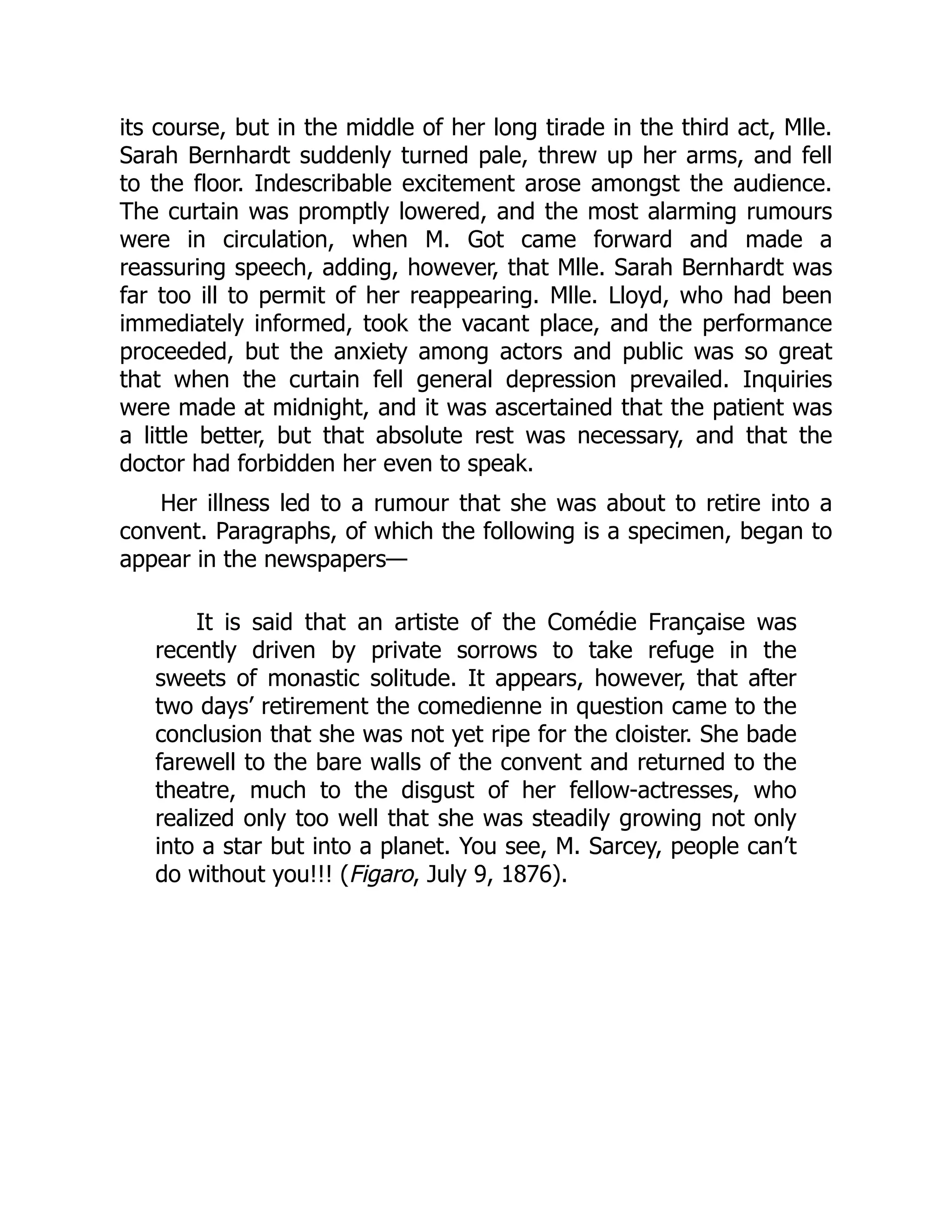
Mme. Sarah Bernhardt in her coffin.
Sarah Bernhardt was now a full-blown Parisian celebrity, and her
fame was destined to go on increasing. Curiosity began to be felt
concerning even the most insignificant details of her daily life. This
public curiosity stimulated her, as an independent and original
person, to brave the gossip of the city and its bourgeois hypocrisy.
All sorts of more or less true tales of her eccentricities were told
about this time. She was constantly haunted by ideas of death, her
frail organization being, no doubt, still incomplete. From time to time
she fainted on the stage, and her unruly imagination promptly led
her to expect the most direful consequences, but her extraordinary
elasticity of temperament soon supplied her with renewed strength
and vitality, and the complete prostration of to-day was always
followed on the morrow by the most sanguine anticipations. One day
she caused herself to be measured for a coffin, and had it brought
to her house. This coffin, which she courageously keeps at the foot
of the bed, is made of pear-wood. The only ornament consists of the
artiste’s initials S. B., with the motto Quand-même! The inside is
lined with white satin, and is provided with a mattress, bolster, and
cushions—a bed fit for the most charming of coquettes. But for the
spectacle of the lid, always ready to be screwed down, any one
would readily lie on this pleasant, perfumed couch. Unfortunately,
the lid is a stern reality. There is something else to note. Inspired by
a strange but poetical fancy, Mme. Sarah Bernhardt has lined the
bottom of the coffin with her most cherished souvenirs. Love-letters
and faded bouquets are there, huddled together pell-mell, awaiting
her coming—waiting to remind her, in the silence of the tomb, of the
sad or happy hours in which she knew them.
The première of L’Etrangère (May 25, 1876) was exclusively a
personal success for her. The newspapers spoke severely of M.
Dumas’ work—
If Mlle. Sarah Bernhardt, said M. Sarcey, had not thrown
the glamour of her gestures and diction over the silly
sentimentality of Mrs. Clarkson, the public would have burst
out laughing. The piece is simply bad melodrama of the
Ambigu type.
Her health was still far from robust, and during a performance of
L’Etrangère (May 25, 1876) a painful incident occurred. Before the
curtain rose M. Got had asked the indulgence of the public for Mlle.
Sarah Bernhardt, who was indisposed. The request was far from
unnecessary, for as soon as the young artiste appeared on the stage
it was evident that she was in great pain. The performance followed
its course, but in the middle of her long tirade in the third act, Mlle.
Sarah Bernhardt suddenly turned pale, threw up her arms, and fell
to the floor. Indescribable excitement arose amongst the audience.
The curtain was promptly lowered, and the most alarming rumours
were in circulation, when M. Got came forward and made a
reassuring speech, adding, however, that Mlle. Sarah Bernhardt was
far too ill to permit of her reappearing. Mlle. Lloyd, who had been
immediately informed, took the vacant place, and the performance
proceeded, but the anxiety among actors and public was so great
that when the curtain fell general depression prevailed. Inquiries
were made at midnight, and it was ascertained that the patient was
a little better, but that absolute rest was necessary, and that the
doctor had forbidden her even to speak.
Her illness led to a rumour that she was about to retire into a
convent. Paragraphs, of which the following is a specimen, began to
appear in the newspapers—
It is said that an artiste of the Comédie Française was
recently driven by private sorrows to take refuge in the
sweets of monastic solitude. It appears, however, that after
two days’ retirement the comedienne in question came to the
conclusion that she was not yet ripe for the cloister. She bade
farewell to the bare walls of the convent and returned to the
theatre, much to the disgust of her fellow-actresses, who
realized only too well that she was steadily growing not only
into a star but into a planet. You see, M. Sarcey, people can’t
do without you!!! (Figaro, July 9, 1876).
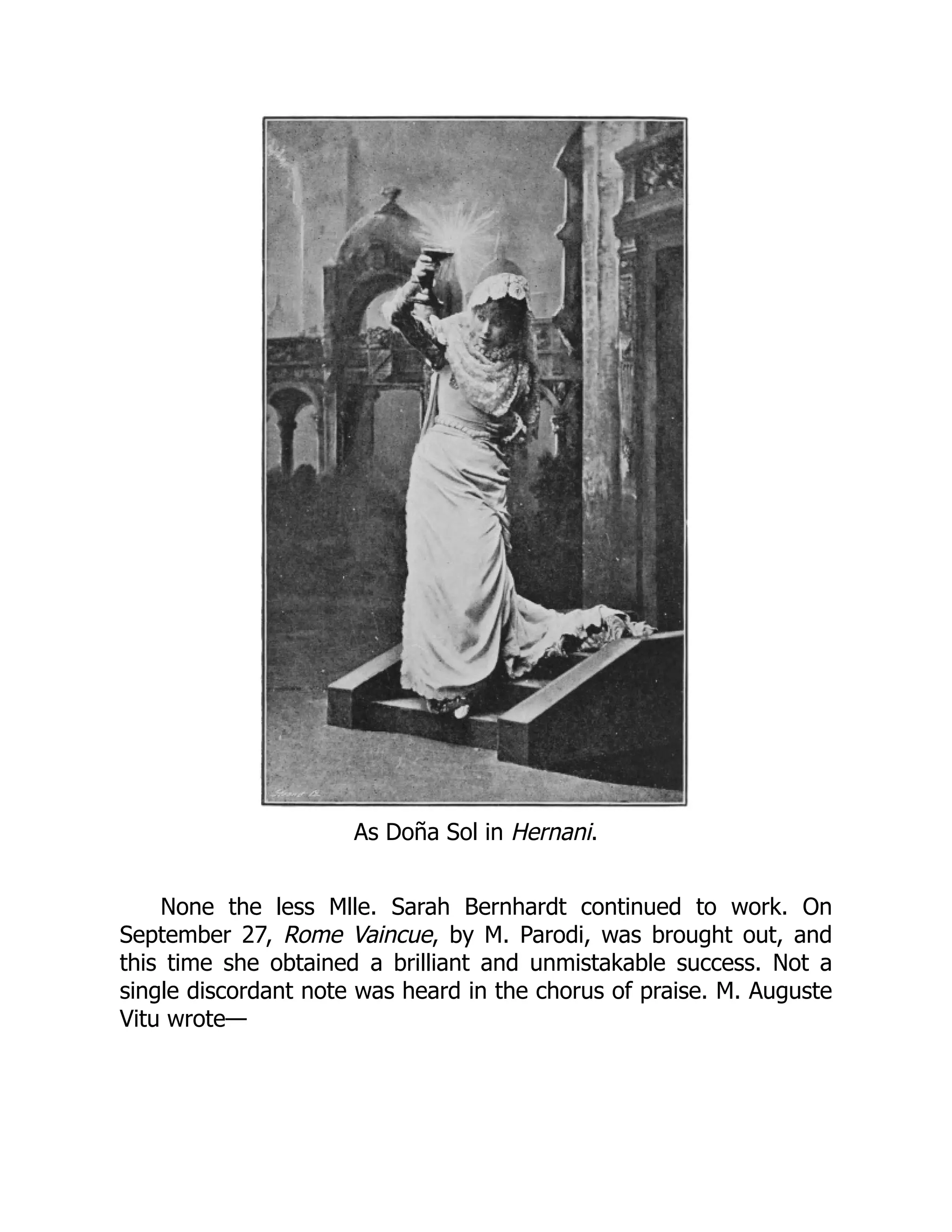
As Doña Sol in Hernani.
None the less Mlle. Sarah Bernhardt continued to work. On
September 27, Rome Vaincue, by M. Parodi, was brought out, and
this time she obtained a brilliant and unmistakable success. Not a
single discordant note was heard in the chorus of praise. M. Auguste
Vitu wrote—
Draped like an antique statue, her head crowned with
long white curls under her matron’s veil, Mlle. Sarah
Bernhardt made Posthumia one of her finest creations. No
other living actress could have rendered this character with so
much nobility, grandeur, and true feeling. The genuine tears
shed by her audience must have shown her how deeply she
had touched their hearts and minds.
M. Sarcey was quite poetical—
When Parodi came to chat with me about the rehearsals
then going on, he said—“I never imagined how much there
was in the part until I heard Mlle. Sarah Bernhardt play it. She
puts into it all the life it has. I cannot recognize my own
verses when they fall from her lips.” I have indeed rarely seen
anything so perfectly fine, especially as regards the last act.
She was no longer a comedienne, but human nature itself,
interpreted by a marvellous intelligence, a soul full of fire, and
the most harmonious and melodious voice that ever delighted
human ears. She acts with her whole heart and soul. She is a
marvellous, incomparable artiste, one of the élite, or, in a
word, a genius.
She appeared in Hernani on November 21, 1877, with
considerable success. She was now unmistakably the spoilt child of
the public. She had vanquished almost all her adversaries, and
practically every theatre-goer was an admirer of her talent. She
realized this and profited by it. Nevertheless she had her moments
of humility and self-effacement. She wrote as follows to her manager
on New Year’s Day, 1878—
My dear Monsieur Perrin, I have begun the year badly. I
caught cold this morning when coming back from the
cemetery, and I am far from well. I should have liked to tell
you this evening of all the grateful affection I feel for you. If
you could only understand how entirely I am yours! But all
that is difficult for me to express. I owe everything to you.
The good points I have, you brought out. I tried to become a
little somebody, and you determined that it should be so.
Blessings on that determination of yours, and my loving
greetings to you! My illness depresses me, and I have little
hope of completing the year just begun. Monsieur Perrin, I
love you very much.
Sarah Bernhardt.
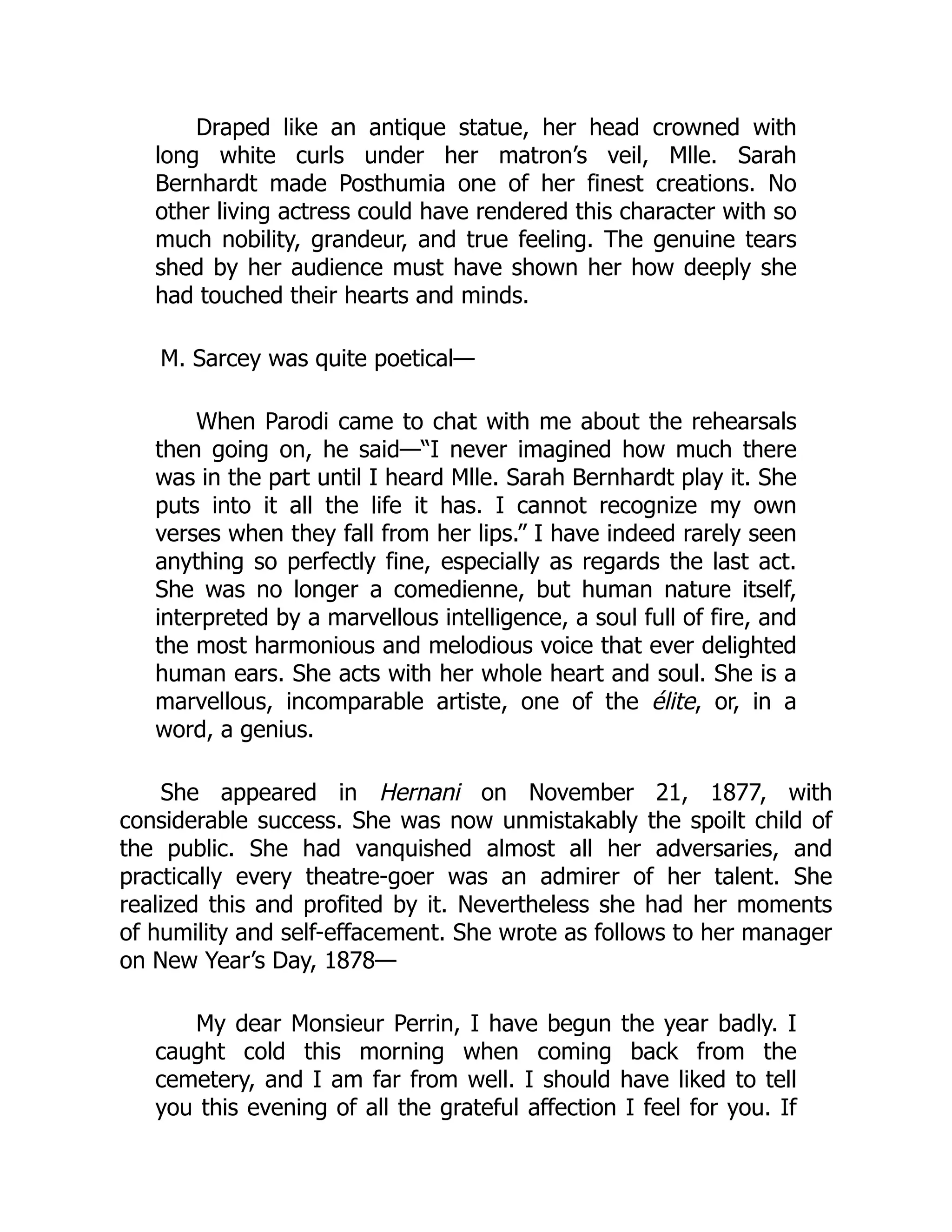
As Doña Sol in Hernani.
Her celebrity was unmistakably shown by the wild stories which
began to be told about her. She was said to have thrown a live kitten
on to a fire; to have poisoned with her own fair hands two monkeys
which had ceased to please her; to have cut off a dog’s head with a
view to solving the question whether life continues after
decapitation; the skeleton in her bedroom was all that remained of
one of her victims, etc. As a matter of fact, she was then keeping
two Russian greyhounds, a poodle, a bulldog, a terrier, a leveret, a
parrot, three cats, and several birds. Afterwards she kept lions!
Could a woman who was so fond of animals torture them as she was
said to have done?
At Bressant’s benefit performance, February 27, 1878, she
played two acts from Jean Aicard’s Othello with M. Mounet-Sully,
who failed completely. M. Sarcey says—
As for Mlle. Sarah Bernhardt, she simply rescued the
piece. Her attitude in the death-agony, her head and arms
hanging over the side of the bed, was so fine, graceful, and
tragic, that enthusiastic applause came from every part of the
house.
M. Auguste Vitu summed up his opinion as follows—
Mlle. Sarah Bernhardt was very fine as Desdemona. It is
one of her best creations. I say nothing of M. Mounet-Sully,
whose efforts were not a success.
On April 2 she appeared for the first time as Alcmène in
Amphitryon. No notice was taken of this in the newspapers. She
again played in Zaïre (May 30), and Le Sphinx (October 28), with
continued success. In the meantime she made several ascents in
Giffard’s captive balloon at the Exhibition, to the great scandal of the
Boulevards. An article published by Albert Millaud in the Figaro gives
a very good idea of the spirit of gossip then prevailing. Sarah
Bernhardt replied to his article in the following letter—
Your kind references to the artiste induce me to write in
defence of the woman. Those who persist in dinning me into
the ears of the public are clever enemies of mine. It is
excessively annoying not to be able to do anything without
being accused of eccentricity. I love balloon ascents, but now
I dare not indulge in them. I have never skinned dogs or
burnt cats alive. My hair is not dyed, and my face has a
sufficiently corpse-like pallor to absolve me from the suspicion
of painting. I am told that my thinness is eccentric, but what
am I to do? I should much prefer to be one of those happy
people who are neither too fat nor too thin. My illnesses are
said to attract too much attention, but they come without
warning and strike me down wherever I may happen to be,
and if people are there, so much the worse. I am reproached
with trying to do everything: acting, sculpture, and painting;
but these things amuse me, and bring me money to spend as
best pleases me. Such are my crimes. You have taken my
part, perhaps without intending to do so, but none the less I
thank you heartily. As you applauded the artiste, I did not like
to think that the woman might seem so unpleasant a
contrast; and then it is such a pleasure to complain! Thanks
for your kindness, Monsieur Millaud.
Sarah Bernhardt.
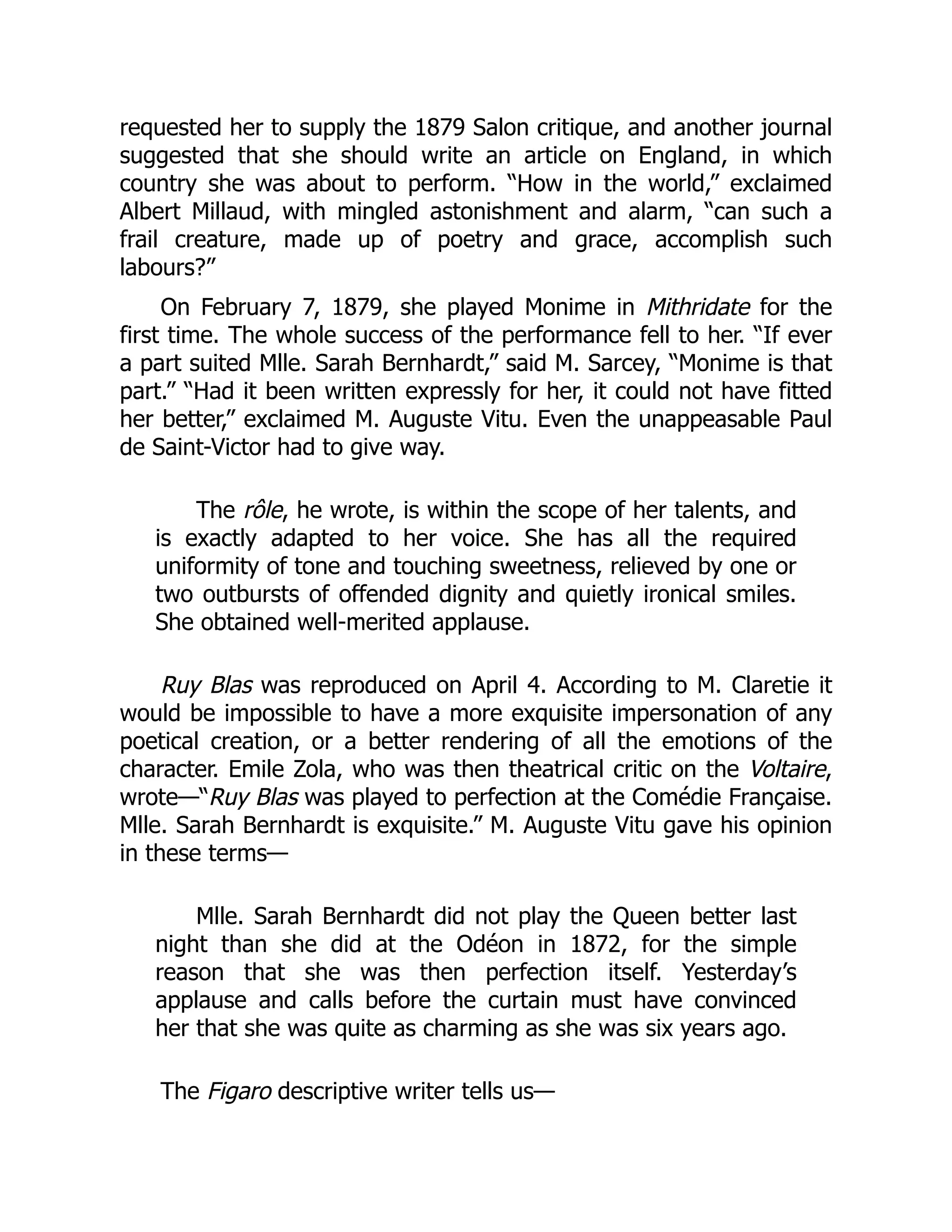
Mme. Sarah Bernhardt in her travelling costume.
Some little time afterwards she published an account of her
ballooning experiences in an amusing little book entitled, In the
Clouds; Impressions of a Chair, with some very pretty illustrations by
Clairin. The simple and unstudied gaiety of this book brought it into
great favour. Of course she was accused of another attempt to
advertise herself, and her literary efforts were riddled with epigrams,
but she was beginning to be accustomed to this kind of thing.
Several newspapers asked her to write for them. The Globe
requested her to supply the 1879 Salon critique, and another journal
suggested that she should write an article on England, in which
country she was about to perform. “How in the world,” exclaimed
Albert Millaud, with mingled astonishment and alarm, “can such a
frail creature, made up of poetry and grace, accomplish such
labours?”
On February 7, 1879, she played Monime in Mithridate for the
first time. The whole success of the performance fell to her. “If ever
a part suited Mlle. Sarah Bernhardt,” said M. Sarcey, “Monime is that
part.” “Had it been written expressly for her, it could not have fitted
her better,” exclaimed M. Auguste Vitu. Even the unappeasable Paul
de Saint-Victor had to give way.
The rôle, he wrote, is within the scope of her talents, and
is exactly adapted to her voice. She has all the required
uniformity of tone and touching sweetness, relieved by one or
two outbursts of offended dignity and quietly ironical smiles.
She obtained well-merited applause.
Ruy Blas was reproduced on April 4. According to M. Claretie it
would be impossible to have a more exquisite impersonation of any
poetical creation, or a better rendering of all the emotions of the
character. Emile Zola, who was then theatrical critic on the Voltaire,
wrote—“Ruy Blas was played to perfection at the Comédie Française.
Mlle. Sarah Bernhardt is exquisite.” M. Auguste Vitu gave his opinion
in these terms—
Mlle. Sarah Bernhardt did not play the Queen better last
night than she did at the Odéon in 1872, for the simple
reason that she was then perfection itself. Yesterday’s
applause and calls before the curtain must have convinced
her that she was quite as charming as she was six years ago.
The Figaro descriptive writer tells us—
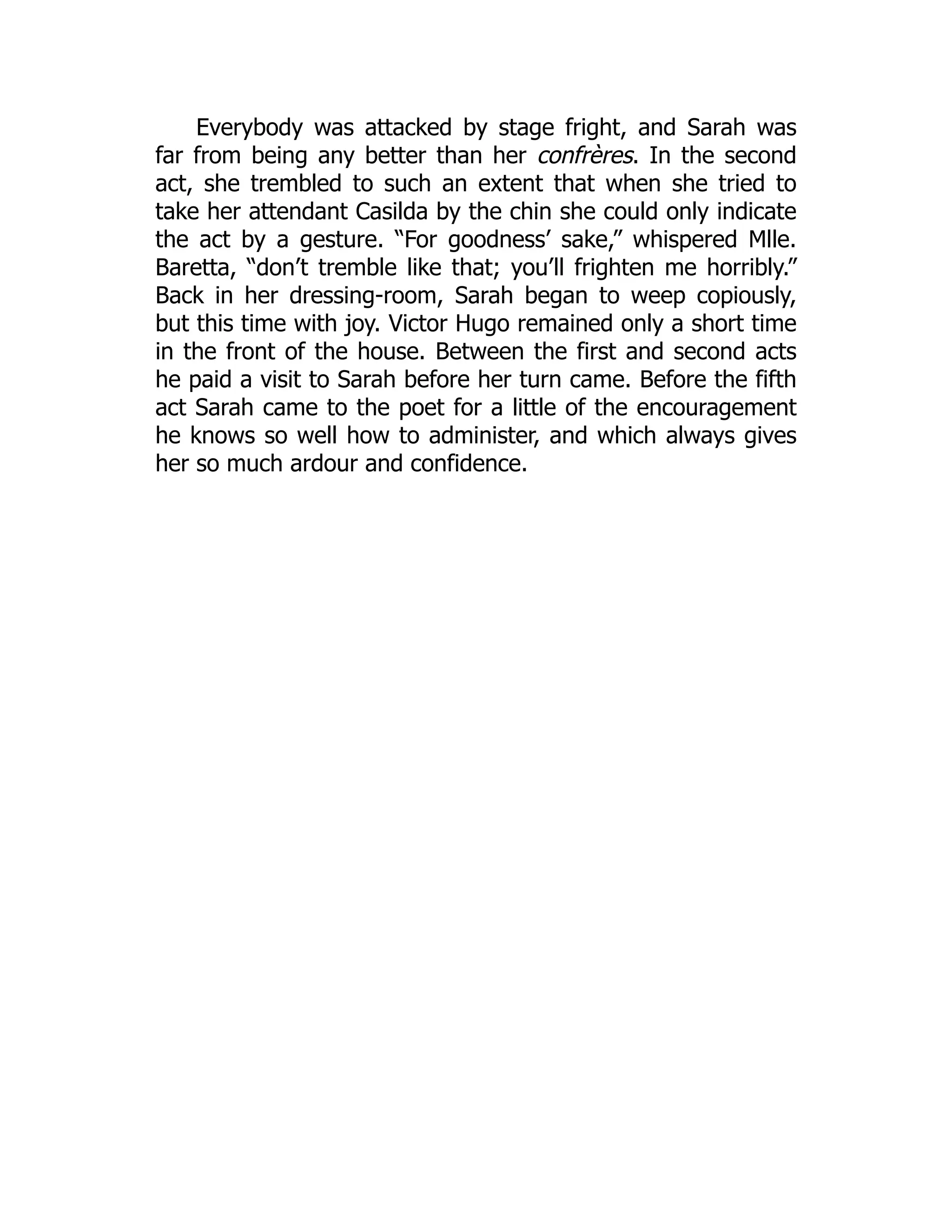
Everybody was attacked by stage fright, and Sarah was
far from being any better than her confrères. In the second
act, she trembled to such an extent that when she tried to
take her attendant Casilda by the chin she could only indicate
the act by a gesture. “For goodness’ sake,” whispered Mlle.
Baretta, “don’t tremble like that; you’ll frighten me horribly.”
Back in her dressing-room, Sarah began to weep copiously,
but this time with joy. Victor Hugo remained only a short time
in the front of the house. Between the first and second acts
he paid a visit to Sarah before her turn came. Before the fifth
act Sarah came to the poet for a little of the encouragement
he knows so well how to administer, and which always gives
her so much ardour and confidence.
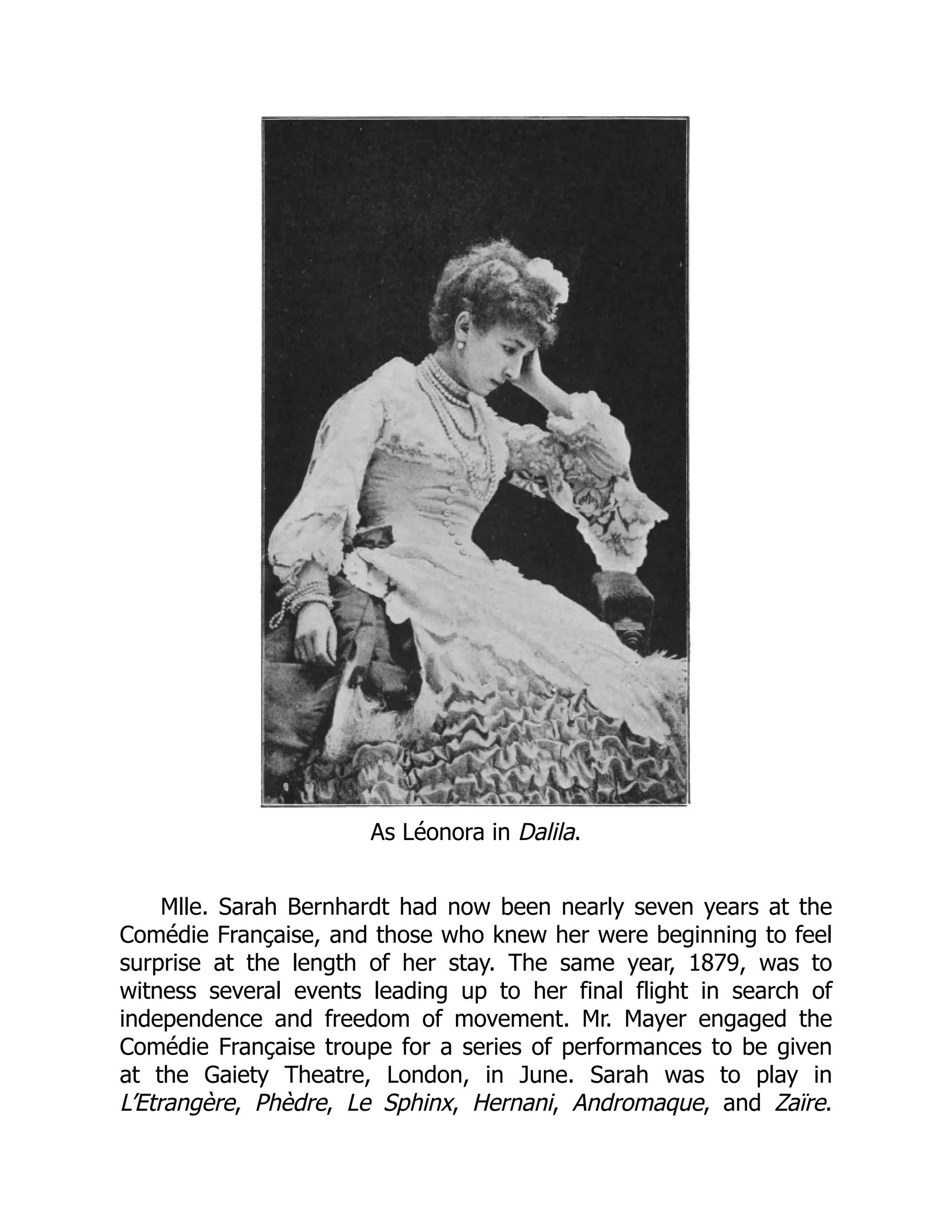
As Léonora in Dalila.
Mlle. Sarah Bernhardt had now been nearly seven years at the
Comédie Française, and those who knew her were beginning to feel
surprise at the length of her stay. The same year, 1879, was to
witness several events leading up to her final flight in search of
independence and freedom of movement. Mr. Mayer engaged the
Comédie Française troupe for a series of performances to be given
at the Gaiety Theatre, London, in June. Sarah was to play in
L’Etrangère, Phèdre, Le Sphinx, Hernani, Andromaque, and Zaïre.
The company left for London on June 1. Next day Phèdre was
played, and L’Etrangère on the 3rd. Sarah was somewhat coldly
received at first, but British iciness soon melted beneath the
tragedienne’s fire. On the 9th, M. Sarcey felt justified in writing
—“The English can adore two idols at the same time, and they are
now devoted to Mlle. Sarah Bernhardt.”
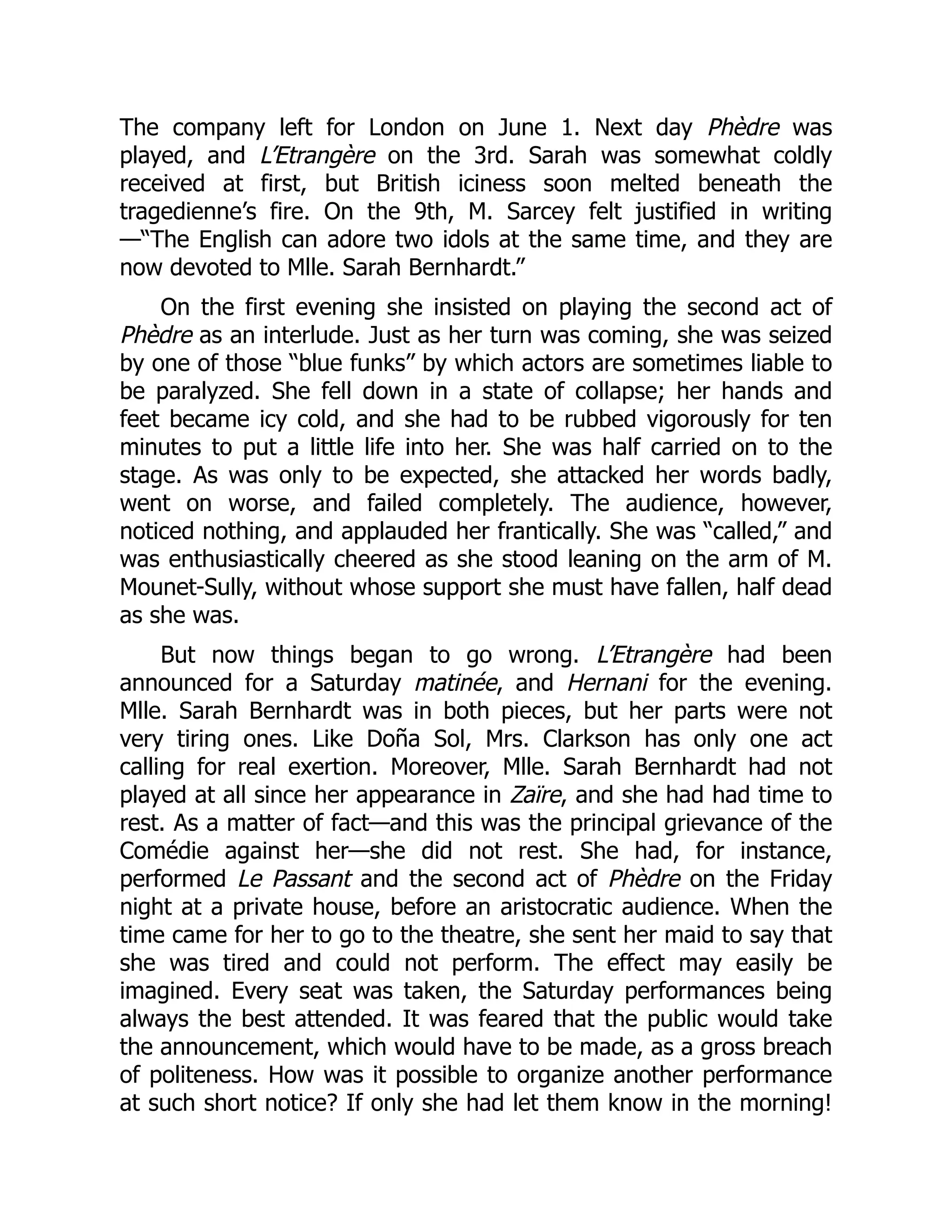
On the first evening she insisted on playing the second act of
Phèdre as an interlude. Just as her turn was coming, she was seized
by one of those “blue funks” by which actors are sometimes liable to
be paralyzed. She fell down in a state of collapse; her hands and
feet became icy cold, and she had to be rubbed vigorously for ten
minutes to put a little life into her. She was half carried on to the
stage. As was only to be expected, she attacked her words badly,
went on worse, and failed completely. The audience, however,
noticed nothing, and applauded her frantically. She was “called,” and
was enthusiastically cheered as she stood leaning on the arm of M.
Mounet-Sully, without whose support she must have fallen, half dead
as she was.
But now things began to go wrong. L’Etrangère had been
announced for a Saturday matinée, and Hernani for the evening.
Mlle. Sarah Bernhardt was in both pieces, but her parts were not
very tiring ones. Like Doña Sol, Mrs. Clarkson has only one act
calling for real exertion. Moreover, Mlle. Sarah Bernhardt had not
played at all since her appearance in Zaïre, and she had had time to
rest. As a matter of fact—and this was the principal grievance of the
Comédie against her—she did not rest. She had, for instance,
performed Le Passant and the second act of Phèdre on the Friday
night at a private house, before an aristocratic audience. When the
time came for her to go to the theatre, she sent her maid to say that
she was tired and could not perform. The effect may easily be
imagined. Every seat was taken, the Saturday performances being
always the best attended. It was feared that the public would take
the announcement, which would have to be made, as a gross breach
of politeness. How was it possible to organize another performance
at such short notice? If only she had let them know in the morning!
There was, however, no escape. Coquelin, whose turn it was to
make the announcements for the week, went before the curtain. In
a few well-chosen words he explained what had occurred, asked the
audience to excuse the Comédie Française, and wound up by
announcing that there would be no performance. A great commotion
followed, and several hisses were heard—a very rare occurrence in a
good English theatre. Chance brought an addition to the strength of
the company in the shape of an actor who happened to call at the
theatre for his letters. Some one pointed out that it would now be
possible to play Tartuffe, and Coquelin was called upon to make
another proclamation. But Coquelin was too disconcerted to do
anything of the kind. “I should be a perfect weathercock,” he
exclaimed. “I really can’t go on and say the exact opposite of what I
said five minutes before. Let Got go!” Got was the doyen and sage
of the company, the last resource in desperate emergencies. He
went forward and delivered a little speech to the effect that Tartuffe
would be performed for those who liked to remain, and that their
money would be returned. As for those who desired to see
L’Etrangère, their tickets would be available for a special matinée,
which would be given on the Wednesday following.
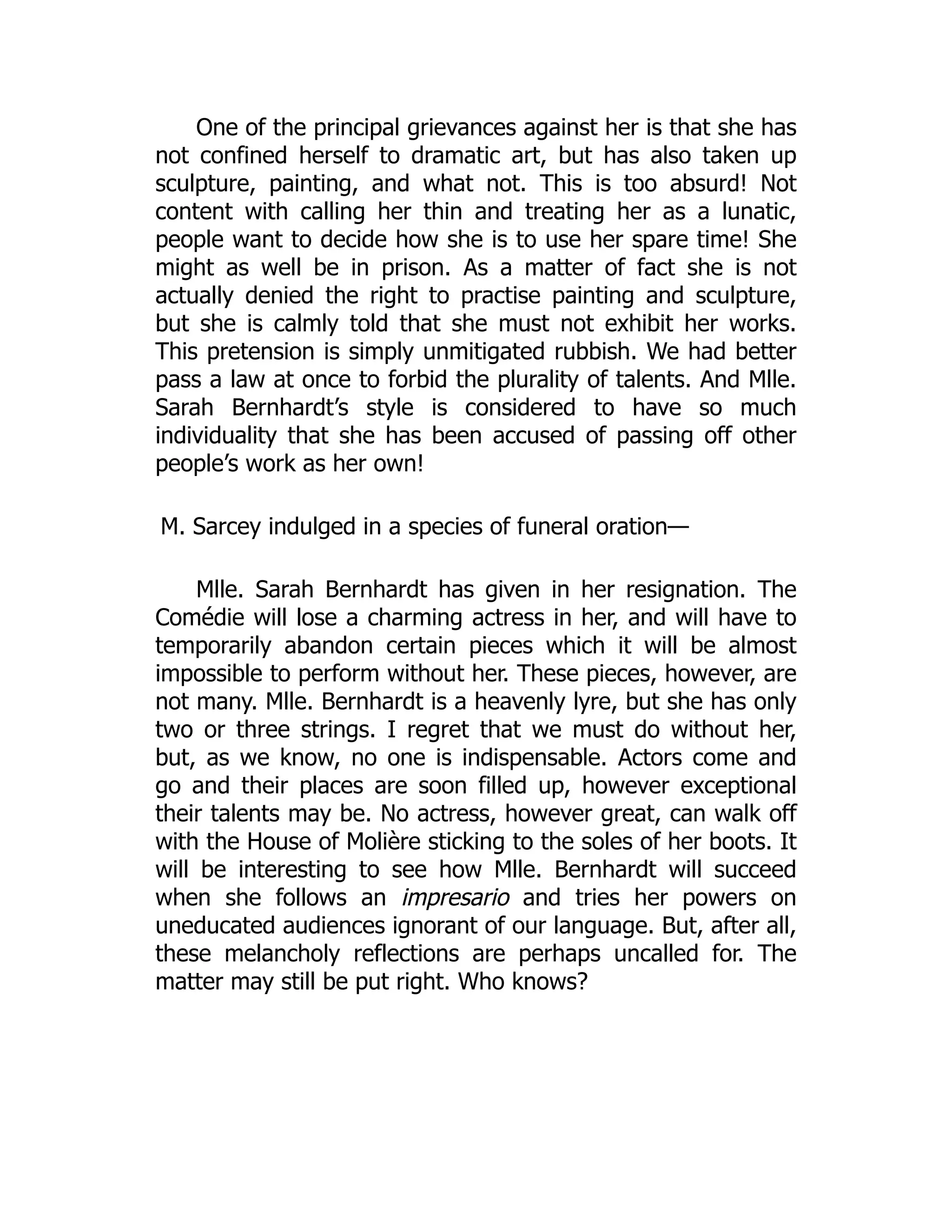
Mme. Sarah Bernhardt in 1877.
Here was a pretty kettle of fish! M. Sarcey, who had, as usual,
accompanied the Comédie Française troupe, observed—
Another affair of this kind would be more than enough to
make the Comédie Française unpopular in England. Those
persons who, through caprice or a desire to show off, or, to
put it differently, through a mistaken estimate of their own
physical powers, place their confrères in such difficulties, are
greatly to blame, and they may be sure that a day will come
when they will have to atone for such conduct. Spoilt children
are amusing until some friend of the family wants to know at
what time they are put to bed.
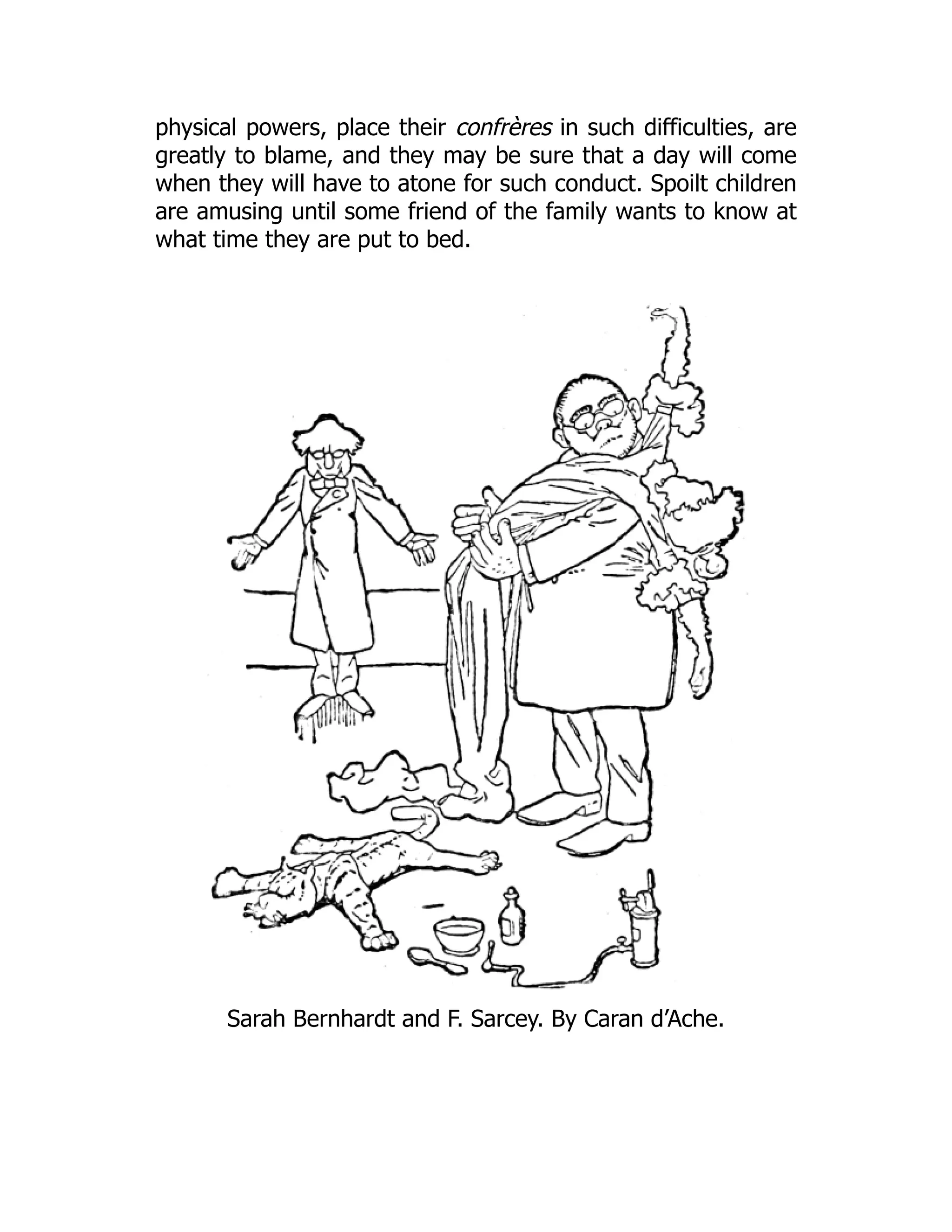
Sarah Bernhardt and F. Sarcey. By Caran d’Ache.
The whole of the French Press rose in wrath. M. Albert Wolff, in
the Figaro, was particularly aggressive. He raked up all the old
grievances against the actress, and accused her of having gone
about in male attire, and having organized an exhibition of her
sculpture and paintings in London. Sarah sent him the following
reply by telegraph—
London, June 28.
Monsieur Albert Wolff, Figaro Office.
Do you really believe these insane stories, Monsieur
Wolff? Who could have given you such information? In spite
of all the infamous slanders that must have been poured into
your ear, I still think you a friend with a little kindness for me.
I give you my word of honour that I have never worn man’s
clothes here in London; I did not even bring my suit with me.
I absolutely deny the story. I went once, and only once, to
the little exhibition I organized, and that was the day on
which admission was by invitation only. Consequently it is
false to say that a single shilling was paid on purpose for any
one to see me. It is true that I give private performances, but
you are aware that I am one of the worst paid sociétaires of
the Comédie Française, and I am entitled to make up the
difference. That I am exhibiting sixteen pictures and eight
pieces of sculpture is perfectly true, but as I brought them
here to sell them I must let them be seen. With regard to the
respect due to the House of Molière, my dear M. Wolff, I
maintain that I uphold it better than anybody, because I am
incapable of inventing such slanders on one of its standard-
bearers. If the silly stories told about me have wearied the
Parisians and decided them, as you lead me to fear, to give
me a bad reception, I will not expose any one to the
possibility of having to commit an act of cowardice, and I will
hand in my resignation. If the London public is incensed
against me by the rumours in circulation, and has decided to
change its kindness into hostility, I hope the Comédie will
allow me to leave England at once, so that the company may
not experience the pain of seeing one of their number hooted
and hissed. I send you this letter by telegraph—a piece of
extravagance justified by the importance I attach to public
opinion. I beg you, my dear Monsieur Wolff, to accord my
letter at least as much consideration as you have given to the
calumnies circulated by my enemies.
With a friendly hand-shake, I am, etc.,
Sarah Bernhardt.
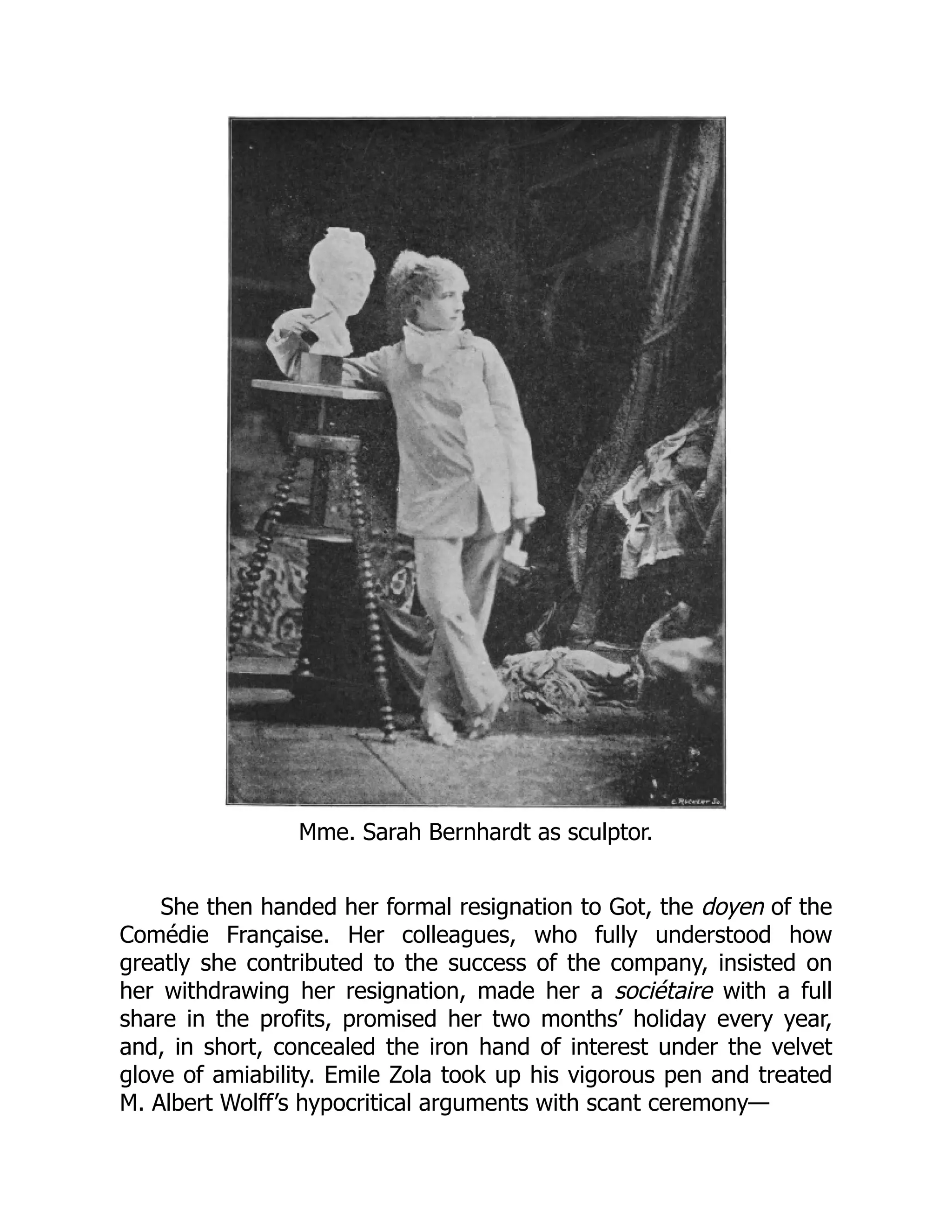
Mme. Sarah Bernhardt as sculptor.
She then handed her formal resignation to Got, the doyen of the
Comédie Française. Her colleagues, who fully understood how
greatly she contributed to the success of the company, insisted on
her withdrawing her resignation, made her a sociétaire with a full
share in the profits, promised her two months’ holiday every year,
and, in short, concealed the iron hand of interest under the velvet
glove of amiability. Emile Zola took up his vigorous pen and treated
M. Albert Wolff’s hypocritical arguments with scant ceremony—
One of the principal grievances against her is that she has
not confined herself to dramatic art, but has also taken up
sculpture, painting, and what not. This is too absurd! Not
content with calling her thin and treating her as a lunatic,
people want to decide how she is to use her spare time! She
might as well be in prison. As a matter of fact she is not
actually denied the right to practise painting and sculpture,
but she is calmly told that she must not exhibit her works.
This pretension is simply unmitigated rubbish. We had better
pass a law at once to forbid the plurality of talents. And Mlle.
Sarah Bernhardt’s style is considered to have so much
individuality that she has been accused of passing off other
people’s work as her own!
M. Sarcey indulged in a species of funeral oration—
Mlle. Sarah Bernhardt has given in her resignation. The
Comédie will lose a charming actress in her, and will have to
temporarily abandon certain pieces which it will be almost
impossible to perform without her. These pieces, however, are
not many. Mlle. Bernhardt is a heavenly lyre, but she has only
two or three strings. I regret that we must do without her,
but, as we know, no one is indispensable. Actors come and
go and their places are soon filled up, however exceptional
their talents may be. No actress, however great, can walk off
with the House of Molière sticking to the soles of her boots. It
will be interesting to see how Mlle. Bernhardt will succeed
when she follows an impresario and tries her powers on
uneducated audiences ignorant of our language. But, after all,
these melancholy reflections are perhaps uncalled for. The
matter may still be put right. Who knows?
Welcome to our website – the perfect destination for book lovers and
knowledge seekers. We believe that every book holds a new world,
offering opportunities for learning, discovery, and personal growth.
That’s why we are dedicated to bringing you a diverse collection of
books, ranging from classic literature and specialized publications to
self-development guides and children's books.
More than just a book-buying platform, we strive to be a bridge
connecting you with timeless cultural and intellectual values. With an
elegant, user-friendly interface and a smart search system, you can
quickly find the books that best suit your interests. Additionally,
our special promotions and home delivery services help you save time
and fully enjoy the joy of reading.
Join us on a journey of knowledge exploration, passion nurturing, and
personal growth every day!
testbankdeal.com

Scutchfield and Kecks Principles of Public Health Practice 4th Edition Erwin Solutions Manual

  • 1.
    Scutchfield and KecksPrinciples of Public Health Practice 4th Edition Erwin Solutions Manual download https://testbankdeal.com/product/scutchfield-and-kecks- principles-of-public-health-practice-4th-edition-erwin-solutions- manual/ Visit testbankdeal.com today to download the complete set of test bank or solution manual

  • 2.
    Here are somerecommended products for you. Click the link to download, or explore more at testbankdeal.com Scutchfield and Kecks Principles of Public Health Practice 4th Edition Erwin Test Bank https://testbankdeal.com/product/scutchfield-and-kecks-principles-of- public-health-practice-4th-edition-erwin-test-bank/ Community Public Health Nursing Practice Health for families and Populations 5th Edition Maurer Test Bank https://testbankdeal.com/product/community-public-health-nursing- practice-health-for-families-and-populations-5th-edition-maurer-test- bank/ Practice of Public Relations 13th Edition Seitel Solutions Manual https://testbankdeal.com/product/practice-of-public-relations-13th- edition-seitel-solutions-manual/ Facilities Planning 4th Edition Tompkins Solutions Manual https://testbankdeal.com/product/facilities-planning-4th-edition- tompkins-solutions-manual/
  • 3.
    Financial Accounting ACritical Approach Canadian 4th Edition Friedlan Test Bank https://testbankdeal.com/product/financial-accounting-a-critical- approach-canadian-4th-edition-friedlan-test-bank/ Intermediate Accounting Canadian Canadian 6th Edition Beechy Solutions Manual https://testbankdeal.com/product/intermediate-accounting-canadian- canadian-6th-edition-beechy-solutions-manual/ Invitation to Health Building Your Future Brief Edition 8th Edition Dianne Hales Test Bank https://testbankdeal.com/product/invitation-to-health-building-your- future-brief-edition-8th-edition-dianne-hales-test-bank/ Structural Analysis 3rd Edition Kassimali Solutions Manual https://testbankdeal.com/product/structural-analysis-3rd-edition- kassimali-solutions-manual/ Physics Laboratory Manual 4th Edition David Loyd Solutions Manual https://testbankdeal.com/product/physics-laboratory-manual-4th- edition-david-loyd-solutions-manual/
  • 4.
    Essentials of MIS13th Edition laudon Test Bank https://testbankdeal.com/product/essentials-of-mis-13th-edition- laudon-test-bank/
  • 5.
    21 © 2017 CengageLearning. All Rights Reserved. May not be copied, scanned, or duplicated, in whole or in part, except for use as permitted in a license distributed with a certain product or service or otherwise on a password-protected website for classroom use. 7 The Federal Contribution to Public Health Georgia A. Moore, MS • Craig W. Thomas, PhD • Judith A. Monroe, MD LEARNING OBJECTIVES Upon completion of this chapter, the reader will be able to: 1. Describe the various components of the federal government as they relate to public health. 2. Analyze the authorities, roles, and responsibilities of federal agencies in public health. 3. Examine examples of federal influence on and contributions to the public health system. 4. Assess emerging trends and possible future directions for public health from a federal perspective. KEY TERMS federal regulation: A rule or order issued by a federal executive-branch department or administrative agency, generally under authority granted by statute, which enforces or amplifies laws enacted by the legislature and has the force of law. health system transformation: Fundamental changes to the inputs and processes of multiple levels of health and health care, for the purpose of producing improvements in outcomes. National Center for Health Statistics (NCHS): NCHS is the primary federal government agency responsible for collecting, analyzing, and distributing data on health and health care. NCHS provides free downloadable public-use data files to researchers, teachers, students, and others through its Public-Use Data Files and Documentation site. NCHS also houses the Health Indicators Warehouse (HIW), which serves as a federal data hub for the U.S. Department of Health and Human Services' health data initiative. public health infrastructure: Includes but is not limited to workforce, data and information systems, communications, partnerships, policy, and organizational competencies (e.g., leadership/governance). This is fundamental to the provision and execution of public health services at all levels; it provides the capacity to prepare for and respond to both acute (emergency) and chronic (ongoing) threats to the nation’s health.
  • 6.
    22 © 2017 CengageLearning. All Rights Reserved. May not be copied, scanned, or duplicated, in whole or in part, except for use as permitted in a license distributed with a certain product or service or otherwise on a password-protected website for classroom use. role of the federal government: The activities or responsibilities of the agencies and organizations within the federal government. Surgeon General: The operational head of the U.S. Public Health Service Commissioned Corps, often referred to as “The Nation's Doctor,” and considered the leading governmental public health spokesperson. INSTRUCTOR TIPS/OPTIONAL ACTIVITIES 1. Have students explore the Department of Health and Human Services (DHHS) website at http://www.hhs.gov/about/index.html. Have students choose an agency of HHS, and explore what the agency does, when it was created, and who is in charge. Are there any areas of agencies that the student thinks may be missing? Could certain agencies be combined? 2. Have students break up into groups and research a health-related policy area. Find out which political action committees and lobbyists are supporting the health policy and which are against the area. Has any legislation been proposed into Congress regarding this health area? 3. Have students explore the Centers for Disease Control and Prevention (CDC) website http://www.cdc.gov/ and the current health issues being addressed by the agency. Have the class break up into four (or more) groups, and have each group select a public health problem that involves CDC action or interest. Groups should discuss and provide a brief verbal or written report on CDC current actions and/or proposed solutions to the problem. SUGGESTED ANSWERS TO CHAPTER REVIEW QUESTIONS 1. What are the general roles and responsibilities of federal public health? ANS: a. Ensure all levels of government have the capabilities to provide essential public health services. b. Act when health threats may span more than one state, a region, or the entire nation. c. Act where the solutions may be beyond the jurisdiction of individual states. d. Act to assist the states when they lack the expertise or resources to effectively respond in a public health emergency (e.g., disaster, bioterrorism, emerging disease). e. Facilitate the formulation of public health goals (in collaboration with state and local governments and other relevant stakeholders. 2. What branch of government is responsible for day-to-day enforcement and administration of federal laws? What department within that branch contains the majority of federal health-related activities? What operating division within that department is exclusively dedicated to supporting public health and public health practice? ANS: The Executive Branch of government is responsible for day-to-day enforcement and administration of federal laws. The Department of Health and Human Services (HHS) is the department within the Executive Branch that contains the majority of federal
  • 7.
    23 © 2017 CengageLearning. All Rights Reserved. May not be copied, scanned, or duplicated, in whole or in part, except for use as permitted in a license distributed with a certain product or service or otherwise on a password-protected website for classroom use. health-related activities. The Centers for Disease Control and Prevention (CDC) is the operating division within HHS that is exclusively dedicated to supporting public health and public health practice. 3. List three common contributions of the federal government to public health and public health practice. ANS: Contributions of the federal government include, but are not limited to, the following: a. Provide funding b. Provide data for decision making c. Conduct or support research and translate research results into public health practice d. Develop, implement, enforce, and evaluate the impact of health-related regulations e. Identify, evaluate, and educate about evidence-based policy options and build capacity to use law as a public health tool f. Conduct and support health education efforts g. Support advisory bodies that make public health policy and practice recommendations to federal government h. Develop or support the development of evidence-based guidelines and recommendations i. Lead or support the development of national health initiatives, strategies, and action plans j. Increase consistency and quality across the public health system k. Support development and sustainability of a well-trained, diverse public health workforce l. Provide short-term technical assistance m. Support preparation for and response to emergencies n. Provide and support laboratory services and systems 4. What is the role and importance of having a strong national public health infrastructure? ANS: a. Public health infrastructure, which includes but is not limited to workforce, data and information systems, communications, partnerships, policy, and organizational competencies (e.g., leadership/governance), is fundamental to the provision and execution of public health services at all levels; it provides the capacity to prepare for and respond to both acute (emergency) and chronic (ongoing) threats to the nation’s health. It is the foundation for planning, delivering, and evaluating public health services. 5. What are three current and emerging threats to the public’s health? ANS: a. Global health security issues (e.g., emergence of new microbes, drug-resistance pathogens, and intentional creation and use of infectious agents) b. Antibiotic resistance c. Climate change
  • 8.
    Discovering Diverse ContentThrough Random Scribd Documents
  • 9.
    Mme. Sarah Bernhardtin her coffin. Sarah Bernhardt was now a full-blown Parisian celebrity, and her fame was destined to go on increasing. Curiosity began to be felt concerning even the most insignificant details of her daily life. This public curiosity stimulated her, as an independent and original person, to brave the gossip of the city and its bourgeois hypocrisy. All sorts of more or less true tales of her eccentricities were told about this time. She was constantly haunted by ideas of death, her frail organization being, no doubt, still incomplete. From time to time
  • 10.
    she fainted onthe stage, and her unruly imagination promptly led her to expect the most direful consequences, but her extraordinary elasticity of temperament soon supplied her with renewed strength and vitality, and the complete prostration of to-day was always followed on the morrow by the most sanguine anticipations. One day she caused herself to be measured for a coffin, and had it brought to her house. This coffin, which she courageously keeps at the foot of the bed, is made of pear-wood. The only ornament consists of the artiste’s initials S. B., with the motto Quand-même! The inside is lined with white satin, and is provided with a mattress, bolster, and cushions—a bed fit for the most charming of coquettes. But for the spectacle of the lid, always ready to be screwed down, any one would readily lie on this pleasant, perfumed couch. Unfortunately, the lid is a stern reality. There is something else to note. Inspired by a strange but poetical fancy, Mme. Sarah Bernhardt has lined the bottom of the coffin with her most cherished souvenirs. Love-letters and faded bouquets are there, huddled together pell-mell, awaiting her coming—waiting to remind her, in the silence of the tomb, of the sad or happy hours in which she knew them. The première of L’Etrangère (May 25, 1876) was exclusively a personal success for her. The newspapers spoke severely of M. Dumas’ work— If Mlle. Sarah Bernhardt, said M. Sarcey, had not thrown the glamour of her gestures and diction over the silly sentimentality of Mrs. Clarkson, the public would have burst out laughing. The piece is simply bad melodrama of the Ambigu type. Her health was still far from robust, and during a performance of L’Etrangère (May 25, 1876) a painful incident occurred. Before the curtain rose M. Got had asked the indulgence of the public for Mlle. Sarah Bernhardt, who was indisposed. The request was far from unnecessary, for as soon as the young artiste appeared on the stage it was evident that she was in great pain. The performance followed
  • 11.
    its course, butin the middle of her long tirade in the third act, Mlle. Sarah Bernhardt suddenly turned pale, threw up her arms, and fell to the floor. Indescribable excitement arose amongst the audience. The curtain was promptly lowered, and the most alarming rumours were in circulation, when M. Got came forward and made a reassuring speech, adding, however, that Mlle. Sarah Bernhardt was far too ill to permit of her reappearing. Mlle. Lloyd, who had been immediately informed, took the vacant place, and the performance proceeded, but the anxiety among actors and public was so great that when the curtain fell general depression prevailed. Inquiries were made at midnight, and it was ascertained that the patient was a little better, but that absolute rest was necessary, and that the doctor had forbidden her even to speak. Her illness led to a rumour that she was about to retire into a convent. Paragraphs, of which the following is a specimen, began to appear in the newspapers— It is said that an artiste of the Comédie Française was recently driven by private sorrows to take refuge in the sweets of monastic solitude. It appears, however, that after two days’ retirement the comedienne in question came to the conclusion that she was not yet ripe for the cloister. She bade farewell to the bare walls of the convent and returned to the theatre, much to the disgust of her fellow-actresses, who realized only too well that she was steadily growing not only into a star but into a planet. You see, M. Sarcey, people can’t do without you!!! (Figaro, July 9, 1876).
  • 12.
    As Doña Solin Hernani. None the less Mlle. Sarah Bernhardt continued to work. On September 27, Rome Vaincue, by M. Parodi, was brought out, and this time she obtained a brilliant and unmistakable success. Not a single discordant note was heard in the chorus of praise. M. Auguste Vitu wrote—
  • 13.
    Draped like anantique statue, her head crowned with long white curls under her matron’s veil, Mlle. Sarah Bernhardt made Posthumia one of her finest creations. No other living actress could have rendered this character with so much nobility, grandeur, and true feeling. The genuine tears shed by her audience must have shown her how deeply she had touched their hearts and minds. M. Sarcey was quite poetical— When Parodi came to chat with me about the rehearsals then going on, he said—“I never imagined how much there was in the part until I heard Mlle. Sarah Bernhardt play it. She puts into it all the life it has. I cannot recognize my own verses when they fall from her lips.” I have indeed rarely seen anything so perfectly fine, especially as regards the last act. She was no longer a comedienne, but human nature itself, interpreted by a marvellous intelligence, a soul full of fire, and the most harmonious and melodious voice that ever delighted human ears. She acts with her whole heart and soul. She is a marvellous, incomparable artiste, one of the élite, or, in a word, a genius. She appeared in Hernani on November 21, 1877, with considerable success. She was now unmistakably the spoilt child of the public. She had vanquished almost all her adversaries, and practically every theatre-goer was an admirer of her talent. She realized this and profited by it. Nevertheless she had her moments of humility and self-effacement. She wrote as follows to her manager on New Year’s Day, 1878— My dear Monsieur Perrin, I have begun the year badly. I caught cold this morning when coming back from the cemetery, and I am far from well. I should have liked to tell you this evening of all the grateful affection I feel for you. If
  • 14.
    you could onlyunderstand how entirely I am yours! But all that is difficult for me to express. I owe everything to you. The good points I have, you brought out. I tried to become a little somebody, and you determined that it should be so. Blessings on that determination of yours, and my loving greetings to you! My illness depresses me, and I have little hope of completing the year just begun. Monsieur Perrin, I love you very much. Sarah Bernhardt.
  • 15.
    As Doña Solin Hernani. Her celebrity was unmistakably shown by the wild stories which began to be told about her. She was said to have thrown a live kitten on to a fire; to have poisoned with her own fair hands two monkeys which had ceased to please her; to have cut off a dog’s head with a view to solving the question whether life continues after decapitation; the skeleton in her bedroom was all that remained of one of her victims, etc. As a matter of fact, she was then keeping two Russian greyhounds, a poodle, a bulldog, a terrier, a leveret, a
  • 16.
    parrot, three cats,and several birds. Afterwards she kept lions! Could a woman who was so fond of animals torture them as she was said to have done? At Bressant’s benefit performance, February 27, 1878, she played two acts from Jean Aicard’s Othello with M. Mounet-Sully, who failed completely. M. Sarcey says— As for Mlle. Sarah Bernhardt, she simply rescued the piece. Her attitude in the death-agony, her head and arms hanging over the side of the bed, was so fine, graceful, and tragic, that enthusiastic applause came from every part of the house. M. Auguste Vitu summed up his opinion as follows— Mlle. Sarah Bernhardt was very fine as Desdemona. It is one of her best creations. I say nothing of M. Mounet-Sully, whose efforts were not a success. On April 2 she appeared for the first time as Alcmène in Amphitryon. No notice was taken of this in the newspapers. She again played in Zaïre (May 30), and Le Sphinx (October 28), with continued success. In the meantime she made several ascents in Giffard’s captive balloon at the Exhibition, to the great scandal of the Boulevards. An article published by Albert Millaud in the Figaro gives a very good idea of the spirit of gossip then prevailing. Sarah Bernhardt replied to his article in the following letter— Your kind references to the artiste induce me to write in defence of the woman. Those who persist in dinning me into the ears of the public are clever enemies of mine. It is excessively annoying not to be able to do anything without being accused of eccentricity. I love balloon ascents, but now I dare not indulge in them. I have never skinned dogs or
  • 17.
    burnt cats alive.My hair is not dyed, and my face has a sufficiently corpse-like pallor to absolve me from the suspicion of painting. I am told that my thinness is eccentric, but what am I to do? I should much prefer to be one of those happy people who are neither too fat nor too thin. My illnesses are said to attract too much attention, but they come without warning and strike me down wherever I may happen to be, and if people are there, so much the worse. I am reproached with trying to do everything: acting, sculpture, and painting; but these things amuse me, and bring me money to spend as best pleases me. Such are my crimes. You have taken my part, perhaps without intending to do so, but none the less I thank you heartily. As you applauded the artiste, I did not like to think that the woman might seem so unpleasant a contrast; and then it is such a pleasure to complain! Thanks for your kindness, Monsieur Millaud. Sarah Bernhardt.
  • 18.
    Mme. Sarah Bernhardtin her travelling costume. Some little time afterwards she published an account of her ballooning experiences in an amusing little book entitled, In the Clouds; Impressions of a Chair, with some very pretty illustrations by Clairin. The simple and unstudied gaiety of this book brought it into great favour. Of course she was accused of another attempt to advertise herself, and her literary efforts were riddled with epigrams, but she was beginning to be accustomed to this kind of thing. Several newspapers asked her to write for them. The Globe
  • 19.
    requested her tosupply the 1879 Salon critique, and another journal suggested that she should write an article on England, in which country she was about to perform. “How in the world,” exclaimed Albert Millaud, with mingled astonishment and alarm, “can such a frail creature, made up of poetry and grace, accomplish such labours?” On February 7, 1879, she played Monime in Mithridate for the first time. The whole success of the performance fell to her. “If ever a part suited Mlle. Sarah Bernhardt,” said M. Sarcey, “Monime is that part.” “Had it been written expressly for her, it could not have fitted her better,” exclaimed M. Auguste Vitu. Even the unappeasable Paul de Saint-Victor had to give way. The rôle, he wrote, is within the scope of her talents, and is exactly adapted to her voice. She has all the required uniformity of tone and touching sweetness, relieved by one or two outbursts of offended dignity and quietly ironical smiles. She obtained well-merited applause. Ruy Blas was reproduced on April 4. According to M. Claretie it would be impossible to have a more exquisite impersonation of any poetical creation, or a better rendering of all the emotions of the character. Emile Zola, who was then theatrical critic on the Voltaire, wrote—“Ruy Blas was played to perfection at the Comédie Française. Mlle. Sarah Bernhardt is exquisite.” M. Auguste Vitu gave his opinion in these terms— Mlle. Sarah Bernhardt did not play the Queen better last night than she did at the Odéon in 1872, for the simple reason that she was then perfection itself. Yesterday’s applause and calls before the curtain must have convinced her that she was quite as charming as she was six years ago. The Figaro descriptive writer tells us—
  • 20.
    Everybody was attackedby stage fright, and Sarah was far from being any better than her confrères. In the second act, she trembled to such an extent that when she tried to take her attendant Casilda by the chin she could only indicate the act by a gesture. “For goodness’ sake,” whispered Mlle. Baretta, “don’t tremble like that; you’ll frighten me horribly.” Back in her dressing-room, Sarah began to weep copiously, but this time with joy. Victor Hugo remained only a short time in the front of the house. Between the first and second acts he paid a visit to Sarah before her turn came. Before the fifth act Sarah came to the poet for a little of the encouragement he knows so well how to administer, and which always gives her so much ardour and confidence.
  • 21.
    As Léonora inDalila. Mlle. Sarah Bernhardt had now been nearly seven years at the Comédie Française, and those who knew her were beginning to feel surprise at the length of her stay. The same year, 1879, was to witness several events leading up to her final flight in search of independence and freedom of movement. Mr. Mayer engaged the Comédie Française troupe for a series of performances to be given at the Gaiety Theatre, London, in June. Sarah was to play in L’Etrangère, Phèdre, Le Sphinx, Hernani, Andromaque, and Zaïre.
  • 22.
    The company leftfor London on June 1. Next day Phèdre was played, and L’Etrangère on the 3rd. Sarah was somewhat coldly received at first, but British iciness soon melted beneath the tragedienne’s fire. On the 9th, M. Sarcey felt justified in writing —“The English can adore two idols at the same time, and they are now devoted to Mlle. Sarah Bernhardt.” On the first evening she insisted on playing the second act of Phèdre as an interlude. Just as her turn was coming, she was seized by one of those “blue funks” by which actors are sometimes liable to be paralyzed. She fell down in a state of collapse; her hands and feet became icy cold, and she had to be rubbed vigorously for ten minutes to put a little life into her. She was half carried on to the stage. As was only to be expected, she attacked her words badly, went on worse, and failed completely. The audience, however, noticed nothing, and applauded her frantically. She was “called,” and was enthusiastically cheered as she stood leaning on the arm of M. Mounet-Sully, without whose support she must have fallen, half dead as she was. But now things began to go wrong. L’Etrangère had been announced for a Saturday matinée, and Hernani for the evening. Mlle. Sarah Bernhardt was in both pieces, but her parts were not very tiring ones. Like Doña Sol, Mrs. Clarkson has only one act calling for real exertion. Moreover, Mlle. Sarah Bernhardt had not played at all since her appearance in Zaïre, and she had had time to rest. As a matter of fact—and this was the principal grievance of the Comédie against her—she did not rest. She had, for instance, performed Le Passant and the second act of Phèdre on the Friday night at a private house, before an aristocratic audience. When the time came for her to go to the theatre, she sent her maid to say that she was tired and could not perform. The effect may easily be imagined. Every seat was taken, the Saturday performances being always the best attended. It was feared that the public would take the announcement, which would have to be made, as a gross breach of politeness. How was it possible to organize another performance at such short notice? If only she had let them know in the morning!
  • 23.
    There was, however,no escape. Coquelin, whose turn it was to make the announcements for the week, went before the curtain. In a few well-chosen words he explained what had occurred, asked the audience to excuse the Comédie Française, and wound up by announcing that there would be no performance. A great commotion followed, and several hisses were heard—a very rare occurrence in a good English theatre. Chance brought an addition to the strength of the company in the shape of an actor who happened to call at the theatre for his letters. Some one pointed out that it would now be possible to play Tartuffe, and Coquelin was called upon to make another proclamation. But Coquelin was too disconcerted to do anything of the kind. “I should be a perfect weathercock,” he exclaimed. “I really can’t go on and say the exact opposite of what I said five minutes before. Let Got go!” Got was the doyen and sage of the company, the last resource in desperate emergencies. He went forward and delivered a little speech to the effect that Tartuffe would be performed for those who liked to remain, and that their money would be returned. As for those who desired to see L’Etrangère, their tickets would be available for a special matinée, which would be given on the Wednesday following.
  • 24.
    Mme. Sarah Bernhardtin 1877. Here was a pretty kettle of fish! M. Sarcey, who had, as usual, accompanied the Comédie Française troupe, observed— Another affair of this kind would be more than enough to make the Comédie Française unpopular in England. Those persons who, through caprice or a desire to show off, or, to put it differently, through a mistaken estimate of their own
  • 25.
    physical powers, placetheir confrères in such difficulties, are greatly to blame, and they may be sure that a day will come when they will have to atone for such conduct. Spoilt children are amusing until some friend of the family wants to know at what time they are put to bed. Sarah Bernhardt and F. Sarcey. By Caran d’Ache.
  • 26.
    The whole ofthe French Press rose in wrath. M. Albert Wolff, in the Figaro, was particularly aggressive. He raked up all the old grievances against the actress, and accused her of having gone about in male attire, and having organized an exhibition of her sculpture and paintings in London. Sarah sent him the following reply by telegraph— London, June 28. Monsieur Albert Wolff, Figaro Office. Do you really believe these insane stories, Monsieur Wolff? Who could have given you such information? In spite of all the infamous slanders that must have been poured into your ear, I still think you a friend with a little kindness for me. I give you my word of honour that I have never worn man’s clothes here in London; I did not even bring my suit with me. I absolutely deny the story. I went once, and only once, to the little exhibition I organized, and that was the day on which admission was by invitation only. Consequently it is false to say that a single shilling was paid on purpose for any one to see me. It is true that I give private performances, but you are aware that I am one of the worst paid sociétaires of the Comédie Française, and I am entitled to make up the difference. That I am exhibiting sixteen pictures and eight pieces of sculpture is perfectly true, but as I brought them here to sell them I must let them be seen. With regard to the respect due to the House of Molière, my dear M. Wolff, I maintain that I uphold it better than anybody, because I am incapable of inventing such slanders on one of its standard- bearers. If the silly stories told about me have wearied the Parisians and decided them, as you lead me to fear, to give me a bad reception, I will not expose any one to the possibility of having to commit an act of cowardice, and I will hand in my resignation. If the London public is incensed against me by the rumours in circulation, and has decided to
  • 27.
    change its kindnessinto hostility, I hope the Comédie will allow me to leave England at once, so that the company may not experience the pain of seeing one of their number hooted and hissed. I send you this letter by telegraph—a piece of extravagance justified by the importance I attach to public opinion. I beg you, my dear Monsieur Wolff, to accord my letter at least as much consideration as you have given to the calumnies circulated by my enemies. With a friendly hand-shake, I am, etc., Sarah Bernhardt.
  • 28.
    Mme. Sarah Bernhardtas sculptor. She then handed her formal resignation to Got, the doyen of the Comédie Française. Her colleagues, who fully understood how greatly she contributed to the success of the company, insisted on her withdrawing her resignation, made her a sociétaire with a full share in the profits, promised her two months’ holiday every year, and, in short, concealed the iron hand of interest under the velvet glove of amiability. Emile Zola took up his vigorous pen and treated M. Albert Wolff’s hypocritical arguments with scant ceremony—
  • 29.
    One of theprincipal grievances against her is that she has not confined herself to dramatic art, but has also taken up sculpture, painting, and what not. This is too absurd! Not content with calling her thin and treating her as a lunatic, people want to decide how she is to use her spare time! She might as well be in prison. As a matter of fact she is not actually denied the right to practise painting and sculpture, but she is calmly told that she must not exhibit her works. This pretension is simply unmitigated rubbish. We had better pass a law at once to forbid the plurality of talents. And Mlle. Sarah Bernhardt’s style is considered to have so much individuality that she has been accused of passing off other people’s work as her own! M. Sarcey indulged in a species of funeral oration— Mlle. Sarah Bernhardt has given in her resignation. The Comédie will lose a charming actress in her, and will have to temporarily abandon certain pieces which it will be almost impossible to perform without her. These pieces, however, are not many. Mlle. Bernhardt is a heavenly lyre, but she has only two or three strings. I regret that we must do without her, but, as we know, no one is indispensable. Actors come and go and their places are soon filled up, however exceptional their talents may be. No actress, however great, can walk off with the House of Molière sticking to the soles of her boots. It will be interesting to see how Mlle. Bernhardt will succeed when she follows an impresario and tries her powers on uneducated audiences ignorant of our language. But, after all, these melancholy reflections are perhaps uncalled for. The matter may still be put right. Who knows?
  • 30.
    Welcome to ourwebsite – the perfect destination for book lovers and knowledge seekers. We believe that every book holds a new world, offering opportunities for learning, discovery, and personal growth. That’s why we are dedicated to bringing you a diverse collection of books, ranging from classic literature and specialized publications to self-development guides and children's books. More than just a book-buying platform, we strive to be a bridge connecting you with timeless cultural and intellectual values. With an elegant, user-friendly interface and a smart search system, you can quickly find the books that best suit your interests. Additionally, our special promotions and home delivery services help you save time and fully enjoy the joy of reading. Join us on a journey of knowledge exploration, passion nurturing, and personal growth every day! testbankdeal.com