Hartnell College
Salinas, California
Collaboration is the
Key to a Successful
Technology Program
Technology Climate
Pre-1995 Status
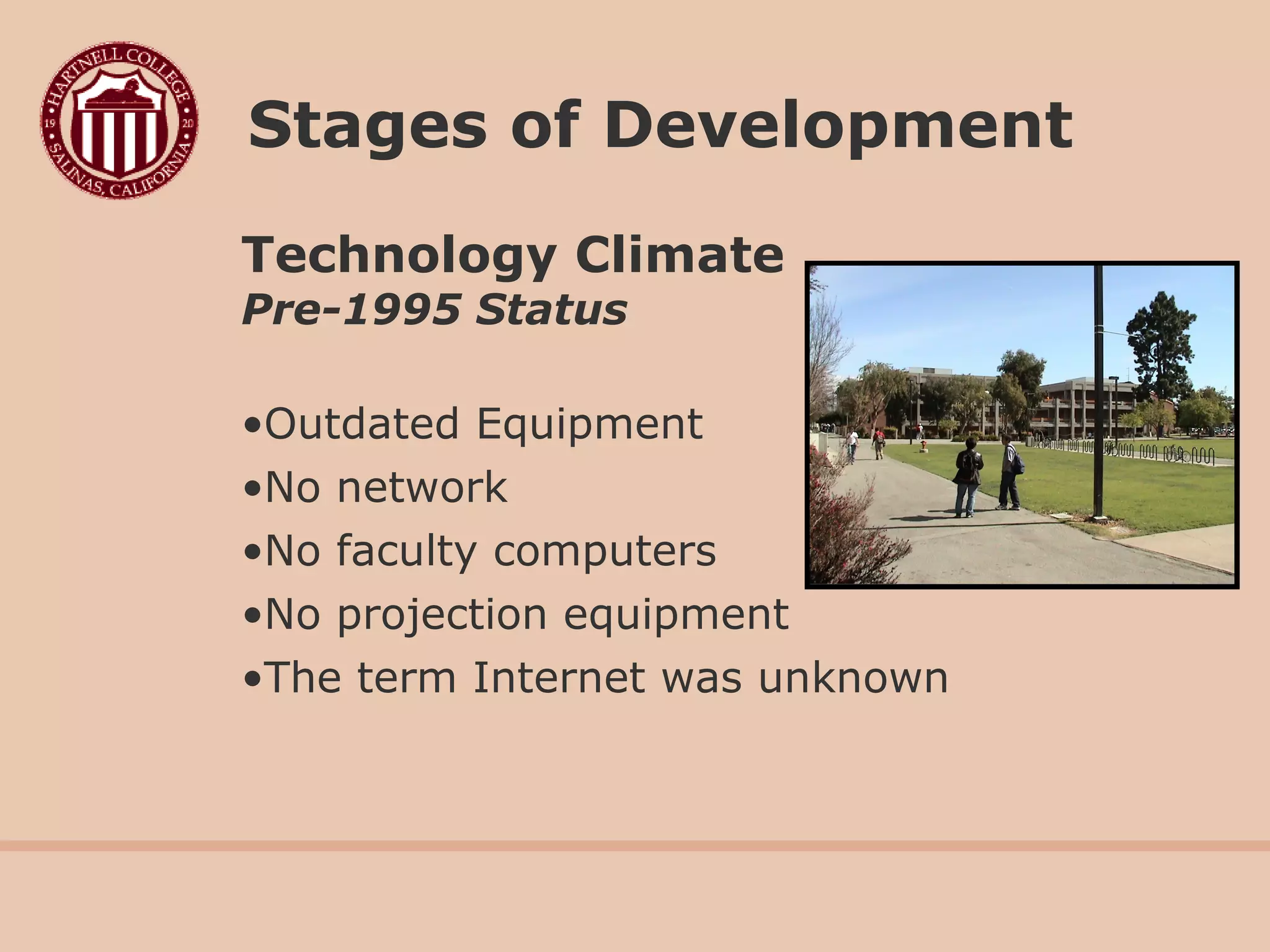
•Outdated Equipment
•No network
•No faculty computers
•No projection equipment
•The term Internet was unknown
Stages of Development
External Assessment
•Students demand new technologies
•Employers demand new skills in
workforce
•Administration required to understand
the need for better data management
•Faculty recognize need for technology
integration and support
•Increasing competition
Stages of Development
Problem Identification
Needs assessment results
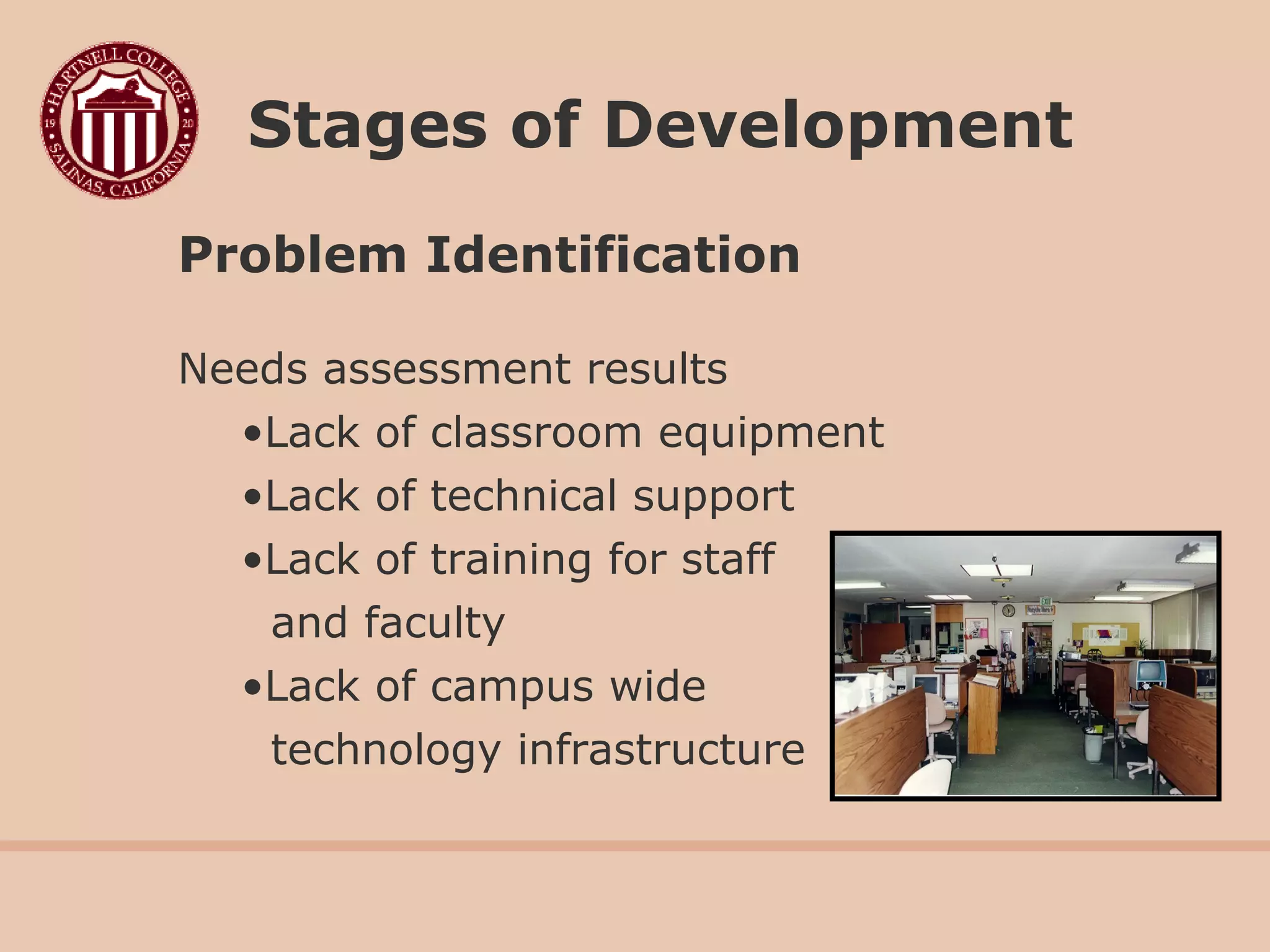
•Lack of classroom equipment
•Lack of technical support
•Lack of training for staff
and faculty
•Lack of campus wide
technology infrastructure
Stages of Development
Hartnell’s Vision
The board developed a vision statement. The following
are excerpts from the statement Hartnell College shall:
• seek and dedicate resources to be a
technologically advanced institution
• anticipate and respond to change
• be a valuable resource and facilitator of change
for it’s communities
• excel in the recruitment, retention, and
placements of students
Stages of Development
Four Stages
New Venture, Expansion, Professionalism
and Maturity
Each stage contains 3 categories
• Organizational support conditions
 Leadership, Funding, Infrastructure
• Instructional technology utilization
 Participants, Uses, Assessment
• Professional development activities
 Focus, Delivery, Format
Stages of Development
Organizational Support Conditions
1995-97
Funding
•Title III
•Technology Training Infrastructure
Program
•More information about TTIP
Leadership
•Board support
•Superintendent support
New Venture
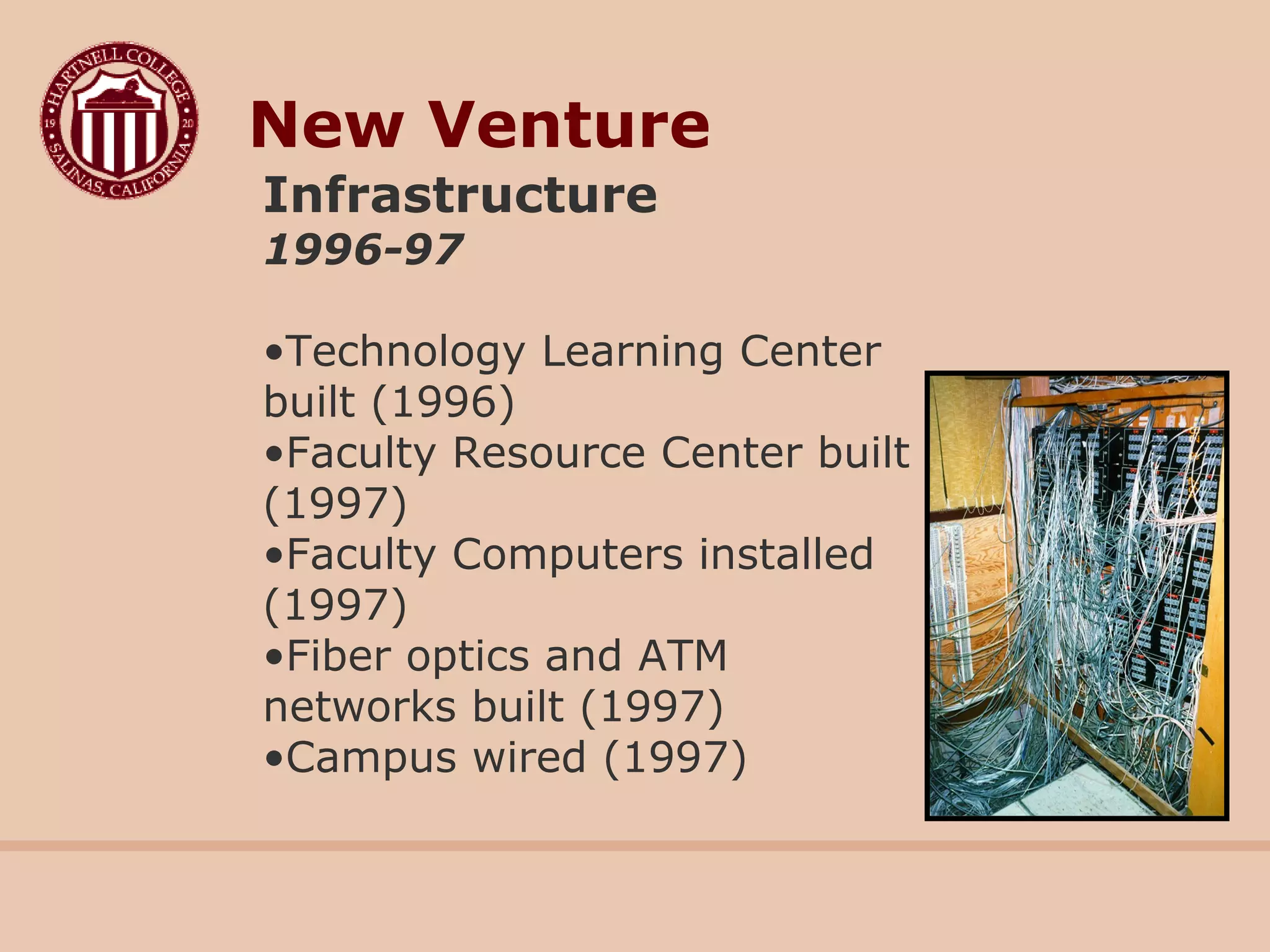
Infrastructure
1996-97
•Technology Learning Center
built (1996)
•Faculty Resource Center built
(1997)
•Faculty Computers installed
(1997)
•Fiber optics and ATM
networks built (1997)
•Campus wired (1997)
New Venture
New Venture
Technology Utilization
Challenges
•Resistance to change
•New technology not understood or used
•Common vision not shared by faculty, staff
and administration
•Slow integration into classroom
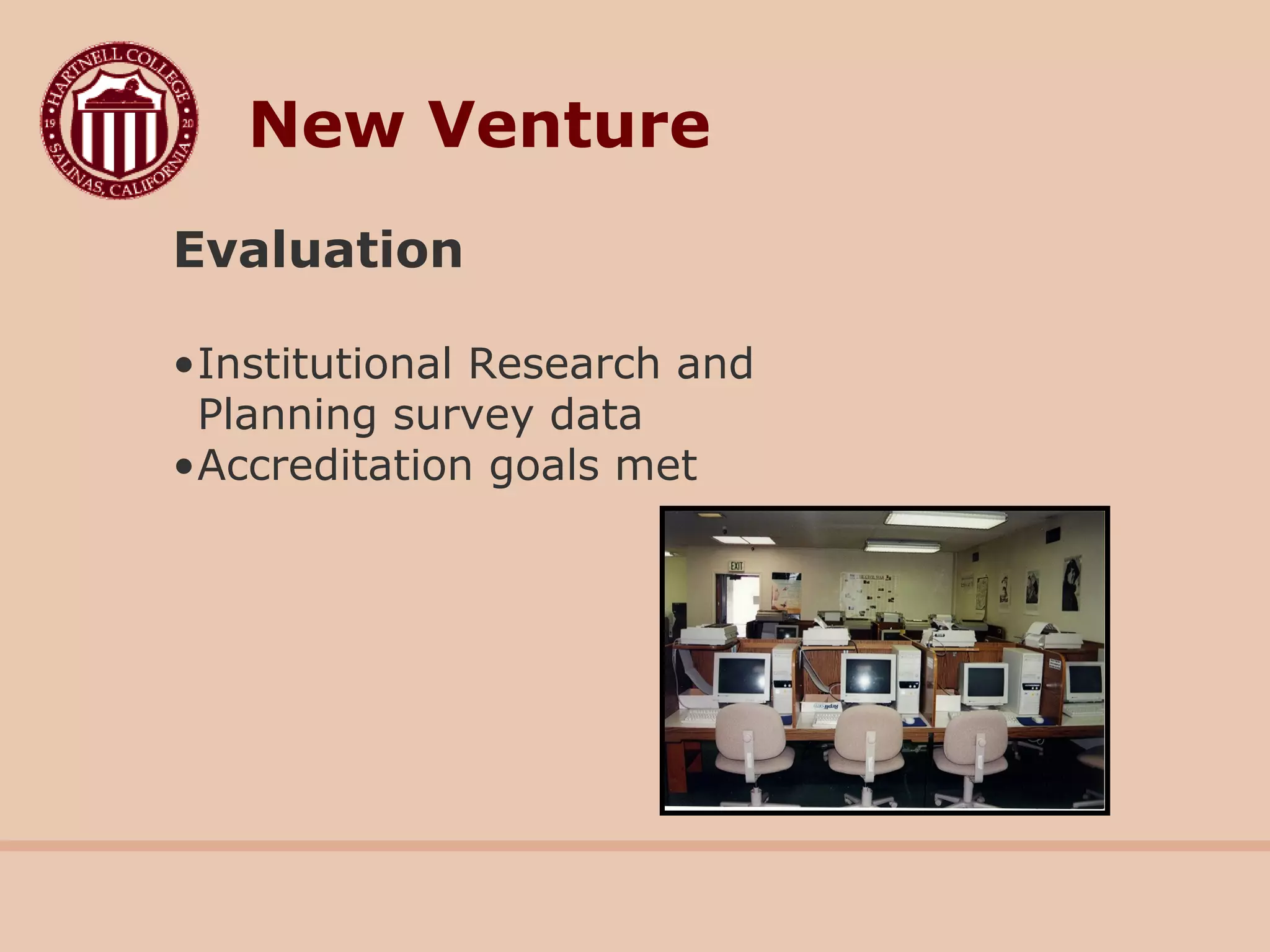
Evaluation
•Institutional Research and
Planning survey data
•Accreditation goals met
New Venture
Organizational Support Conditions
•Funding
• Trustees Innovation Grants Obtained
• Faculty technology pioneers supported
•Leadership support is growing
•Infrastructure
• Desktop computers deployed campus wide
• All classrooms wired
• Smart classrooms were built
Expansion
Technology Utilization
Faculty Resource Center
•Institutional Technologist hired
•Offers staff development training
•Support of faculty resource center
•Supports special projects
Expansion
Instructional
Technology
The Center Supports
•Technology Learning Center (TLC)
•Computer equipment
•Video conferencing technologies
•Faculty Resource Center (FRC)
•Test and provide support for new
technologies
•Integrate new technologies on campus
•Support existing equipment
Expansion
Professional Development Activities
•Sign-in sheet to track department and
technology usage
•Surveys given at trainings
•Goals set for accreditation purposes
•Survey given by Institutional Research and
Planning
Expansion
Organizational Support Conditions
•Technology plan evolution
• New hardware/software standards
•Multiple grant applications
• New Title V technology grant success
•Faculty and staff buy-in
• Conference attendance and presentations
•Increased network support staff
Professionalism
Challenges
Technology Utilization
•Video Conferencing
•Smart Classrooms
•Online Course Delivery
•Collaboration
•WAN
•Other colleges
Professionalism
Challenges
Instructional Technology
Hired new instructional technologist:
Implements and assists with ADA
compliance with technologies
Supports current instructional
technologists duties
Coordinates distance education program
Professionalism
Professional Development
Activities
Expansion
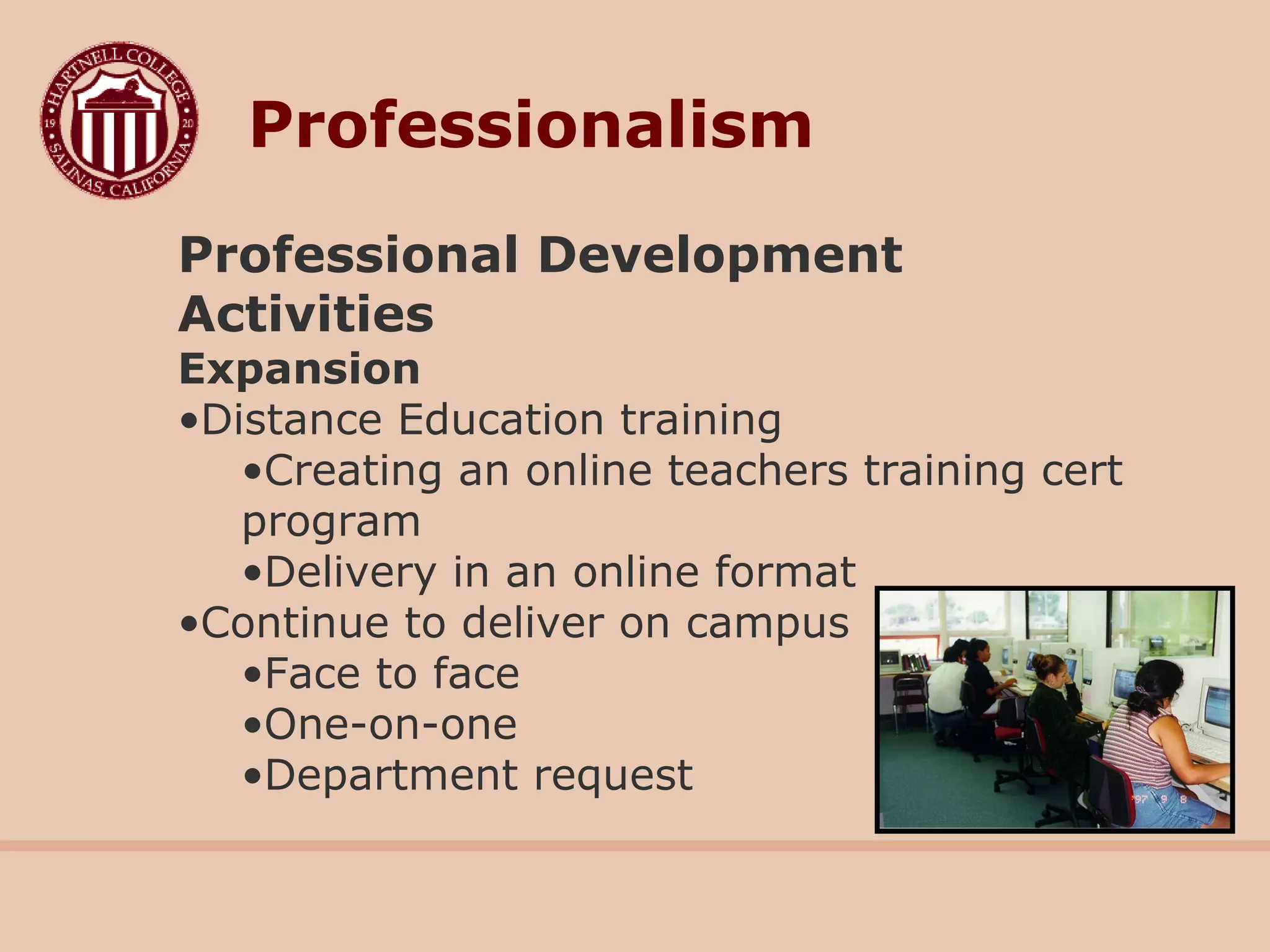
•Distance Education training
•Creating an online teachers training cert
program
•Delivery in an online format
•Continue to deliver on campus
•Face to face
•One-on-one
•Department request
Professionalism
Organizational Support Conditions
Sustainability
•Management Reorganization
•Institutional budget support
•Keeping campus technology current
•Shared governance
Maturity
Technology Utilization
Sustainability
•Control – good and bad
•Communication issues
•Institution budget support
•Continued institutional
support
Maturity
Professional Development
Activities
Web Delivered student services
Institution/state supported technology
funding
Developed and sustainable distance
education program
Future
Hartnell College
Salinas, California
Thank you
for coming!

SCUP

Editor's Notes

  • #3 Dr. Valeau 8088, 8084 PC and Mac SEs No perceived need for a campus network President thought the computer was unnecessary asked during web demonstration to Hawaii who was paying telephone charge Last TV bought was 10 years old
  • #4 Dr. Valeau Students knowledge outpacing technologies taught and available on campus Administration understands the need for better management information, data integration and processes control Faculty voice need for classroom change and support
  • #5 Dr. Valeau
  • #6 Dr. Valeau
  • #7 Dr. Valeau The stages represent the different stages that fostering a technology program may go through. Within each stage there are different items to look at evaluate and work with. We have borrowed the model designed by the @One Project, Integrating Instructional Technology in the California Community Colleges, November 2002 report. This report and model can be found at http://www.cccco.edu/divisions/tris/telecom.htm under research and reports. Organizational Support Conditions: Leadership, Funding, Infrastructure Instructional Technology Utilization: Participants, Uses, Assessment Professional Development Activities: Focus, Delivery, Format
  • #8 Leadership: A few key players were gathering support by leaders, necessity of technology still not proven. Funding: Title III and TTIP Infrastructure: See next slide
  • #9 Technology Learning Center built (1996) Fiber optics and ATM networks started building in 1996, finished ‘97 What are Net Days (1997)
  • #10 Challenges with uses and participants Participants: Slow to have many participants, few tech savvy instructors Uses: Word processing, spreadsheets, some internet research (teacher) Assessment: None Professional Development Activities Focus, Delivery, and format: Training delivered through staff development, may or may not have any technology training included. Reliant on outside training sources and regional workshops.
  • #11 Professional Development Activities- The need for the faculty resource center and support personnel for technology training is established. Trainings will provide the opportunity to evaluate, assess, train, and integrate technology on campus. The faculty resource center will bring technology and teachers together, facilitating communication between technical process and learning with technology integration into the campus.
  • #12 Funding Instructional Tech hired with Title V funds, FRC expansion used grant funding Leadership: More buy-in. Technology appreciated and used, Resource center invaluable to the integration and continued faculty/staff support and use. Infrastructure – Deployment of computers into all departments, full time faculty offices
  • #13 Technology Utilization Staff development consists of technology training, workshops and seminars for the teachers/staff that are now using technology ina ll aspects of their jobs Equipment in instructional technologist supported areas include video conference technologies, scanning, particular software support such as Photoshop that is not deployed campus wide and many new technologies that the FRC is just testing. Special projects include video editing, distance ed administration, and administrator presentations/projects
  • #14 Existing technologies would include: scanners, digital photography, color printing, video editing equipment, four pc’s, four macs, zip drives, New technologies might include: CD burning, DVD burning plasma screen
  • #15 Focus: More teachers/staff discovering and using the FRC/TLC. As they come in surveys are being taken about areas of training they would like, technologies they would like to use. Distance education comes to Hartnell. CVC offers hosting of course management software. Encouraging teachers to develop and teach online courses. Training for developing online courses and for using the software Blackboard is popular. Training is delivered on campus, face to face.
  • #16 Funding: New joint title V grant, allows for further technology development at a time when funding is scarce. Allows for technologies to be upgraded and new technologies to be purchased. As well as continued support of the FRC/TLC and video conferencing technologies. The newly formed TMPT creates a technology plan that sets standards and gives area of responsibility to particular departments and personnel. Leadership: There is a great deal more support from administration, staff, and faculty as more discover the FRC and have better technology integrated into their areas. Infrastructure All full time faculty have desktops, networked laser printers are deployed across campus. Computers now have CD burning capabilities. Support is critical but available on campus.
  • #17 Participants: Staff and faculty are utilizing technology for a variety of reasons. Very few staff/faculty are not using technology in some way shape or form. Uses: Video conferencing is being utilized from Administration to faculty for conferences and classes. Collaboration is occuring with a variety of technologies supported on campus. Assessment:
  • #18 Describe the grant in which the new IT was funded
  • #19 Describe briefly the HOTT Academy Goal ( one sentence statement) Delivery method