SCULPTURE
BIL. NAMA NO. ID
1. KHAIRUNNISA BINTI ISHAK BDG13-07-001
2. MASAYU SHAREENA BINTI SONGIP BDG13-07-003
3. KHUZAIMAH BINTI KHOLID BDG13-07-005
4. KAMAL ANUAR BIN RAMLI BGD13-07-048
5. MUHAMAD ABDUL RAUF BIN
KHAIRULANUAR
BDG13-07-031
6. MUHAMMAD FADHLAN BIN SUHAIMI BDG13-07-029
LANDSCAPE
ARCHITECTURE
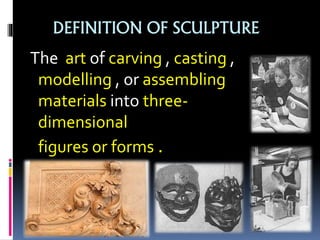
DEFINITION OF SCULPTURE
The art of carving , casting ,
modelling , or assembling
materials into three-
dimensional
figures or forms .
TYPES OF SCULPTURE
 1 . RELIEF SCULPTURE
 Figures which are attached to flat background.
 Bas or low relief
 High relief
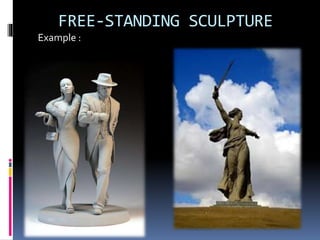
2 . FREE-STANDING SCULPTURE
 Figure that can be seen all side of it (3D)
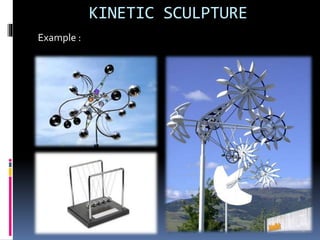
3 . KINETIC SCULTURE
 Sculpture that move.
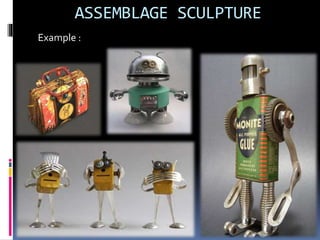
4 . ASSEMBLAGE SCULPTURE
 Sculpture pieced together from found and scavenged
item that no relationship to one another.
RELIEF SCULPTURE
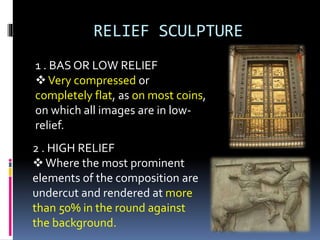
1 . BAS OR LOW RELIEF
Very compressed or
completely flat, as on most coins,
on which all images are in low-
relief.
2 . HIGH RELIEF
Where the most prominent
elements of the composition are
undercut and rendered at more
than 50% in the round against
the background.
FREE-STANDING SCULPTURE
Example :
KINETIC SCULPTURE
Example :
ASSEMBLAGE SCULPTURE
Example :
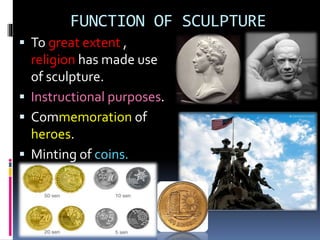
FUNCTION OF SCULPTURE
 To great extent ,
religion has made use
of sculpture.
 Instructional purposes.
 Commemoration of
heroes.
 Minting of coins.
TYPES OF MATERIALS
 STONE
 BRONZE
 WOOD
 IVORY (animal tooth or tusk)
 TERRA COTTA ( clay or glazed ceramic)
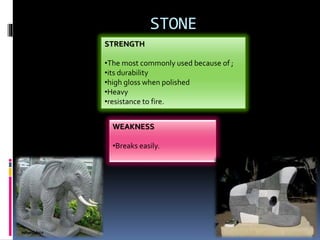
STONE
STRENGTH
•The most commonly used because of ;
•its durability
•high gloss when polished
•Heavy
•resistance to fire.
WEAKNESS
•Breaks easily.
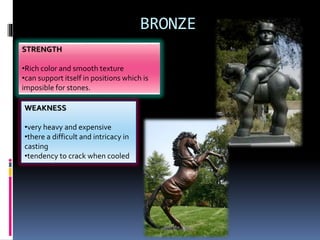
BRONZE
STRENGTH
•Rich color and smooth texture
•can support itself in positions which is
imposible for stones.
WEAKNESS
•very heavy and expensive
•there a difficult and intricacy in
casting
•tendency to crack when cooled
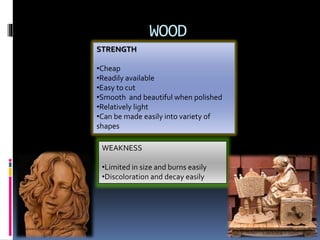
WOOD
STRENGTH
•Cheap
•Readily available
•Easy to cut
•Smooth and beautiful when polished
•Relatively light
•Can be made easily into variety of
shapes
WEAKNESS
•Limited in size and burns easily
•Discoloration and decay easily
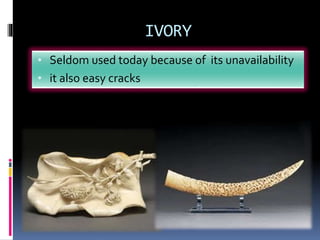
IVORY
• Seldom used today because of its unavailability
• it also easy cracks
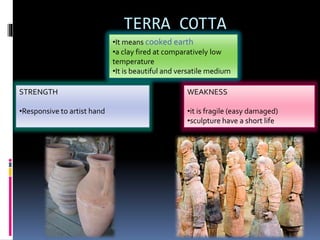
TERRA COTTA
•It means cooked earth
•a clay fired at comparatively low
temperature
•It is beautiful and versatile medium
STRENGTH
•Responsive to artist hand
WEAKNESS
•it is fragile (easy damaged)
•sculpture have a short life
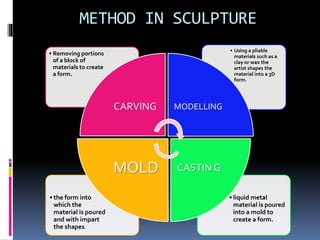
METHOD IN SCULPTURE
• liquid metal
material is poured
into a mold to
create a form.
• the form into
which the
material is poured
and with impart
the shapes.
• Using a pliable
materials such as a
clay or wax the
artist shapes the
material into a 3D
form.
• Removing portions
of a block of
materials to create
a form.
CARVING MODELLING
CASTIN GMOLD
Sculpture GROUP KARL .. DAB 2B JAN-JUN 2014

Sculpture GROUP KARL .. DAB 2B JAN-JUN 2014

  • 1.
    SCULPTURE BIL. NAMA NO.ID 1. KHAIRUNNISA BINTI ISHAK BDG13-07-001 2. MASAYU SHAREENA BINTI SONGIP BDG13-07-003 3. KHUZAIMAH BINTI KHOLID BDG13-07-005 4. KAMAL ANUAR BIN RAMLI BGD13-07-048 5. MUHAMAD ABDUL RAUF BIN KHAIRULANUAR BDG13-07-031 6. MUHAMMAD FADHLAN BIN SUHAIMI BDG13-07-029 LANDSCAPE ARCHITECTURE
  • 2.
    DEFINITION OF SCULPTURE Theart of carving , casting , modelling , or assembling materials into three- dimensional figures or forms .
  • 3.
    TYPES OF SCULPTURE 1 . RELIEF SCULPTURE  Figures which are attached to flat background.  Bas or low relief  High relief 2 . FREE-STANDING SCULPTURE  Figure that can be seen all side of it (3D) 3 . KINETIC SCULTURE  Sculpture that move. 4 . ASSEMBLAGE SCULPTURE  Sculpture pieced together from found and scavenged item that no relationship to one another.
  • 4.
    RELIEF SCULPTURE 1 .BAS OR LOW RELIEF Very compressed or completely flat, as on most coins, on which all images are in low- relief. 2 . HIGH RELIEF Where the most prominent elements of the composition are undercut and rendered at more than 50% in the round against the background.
  • 5.
  • 6.
  • 7.
  • 8.
    FUNCTION OF SCULPTURE To great extent , religion has made use of sculpture.  Instructional purposes.  Commemoration of heroes.  Minting of coins.
  • 9.
    TYPES OF MATERIALS STONE  BRONZE  WOOD  IVORY (animal tooth or tusk)  TERRA COTTA ( clay or glazed ceramic)
  • 10.
    STONE STRENGTH •The most commonlyused because of ; •its durability •high gloss when polished •Heavy •resistance to fire. WEAKNESS •Breaks easily.
  • 11.
    BRONZE STRENGTH •Rich color andsmooth texture •can support itself in positions which is imposible for stones. WEAKNESS •very heavy and expensive •there a difficult and intricacy in casting •tendency to crack when cooled
  • 12.
    WOOD STRENGTH •Cheap •Readily available •Easy tocut •Smooth and beautiful when polished •Relatively light •Can be made easily into variety of shapes WEAKNESS •Limited in size and burns easily •Discoloration and decay easily
  • 13.
    IVORY • Seldom usedtoday because of its unavailability • it also easy cracks
  • 14.
    TERRA COTTA •It meanscooked earth •a clay fired at comparatively low temperature •It is beautiful and versatile medium STRENGTH •Responsive to artist hand WEAKNESS •it is fragile (easy damaged) •sculpture have a short life
  • 15.
    METHOD IN SCULPTURE •liquid metal material is poured into a mold to create a form. • the form into which the material is poured and with impart the shapes. • Using a pliable materials such as a clay or wax the artist shapes the material into a 3D form. • Removing portions of a block of materials to create a form. CARVING MODELLING CASTIN GMOLD