Under the guidance of
Madeeha Fathima
GROUP MEMBERS
1.PREETAM -2AB21EC014
2.YASEEN -2AB21EC010
3.ROHIT PATGAR -2AB21EC015
4.SUHAIB -2AB21EC021
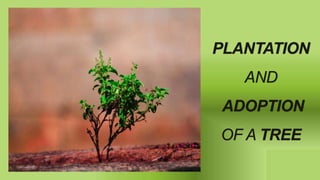
PLANTATION
AND
ADOPTION
OF A TREE
INDEX
Introduction
Benefits
Side Effects
Conclusion
INTRODUCTION
Tree plantation is a biological practice where large number of trees
and plants are planted in a given area.
Adaptations make it easier for plants to survive in their specific
habitat, and reproduce, passing those traits on to their offspring.
Compost can be prepared within pot or mud pit.Organic waste of
kitchen,garden or crop fields is collected and placed in the sun for 8-
12 days.
TULSI PLANT
• holy basil, (Ocimum tenuiflorum), also called tulsi or tulasi, flowering
plant of the mint family (Lamiaceae) grown for its aromatic leaves. Holy
basil is native to the Indian subcontinent and grows throughout
Southeast Asia.
• The plant has green leaves and it can grow up to 60 cm tall. tulsi
required well-drained soil,plenty of sunlight and moderate watering.
BENEFITS
1.Natural Immunity Booster.
2.Lower Blood Glucose.
3. Reduces Cold, Cough & Other Respiratory Disorders.
4. Reduces Stress & Blood Pressure.
5. Good for Heart Health.
6.Oral and Dental Health.
7.Lower Blood Glucose.
SIDE EFFECTS
• Nausea.
• Diarrhea.
• It may ​not suitable for pregnant women.
• It may cause damage to the liver.
CONCLUSION
• Among all plants, the Tulsi plant is one of the most beneficial in your
garden. It looks beautiful, spreads a lovely aroma, absorbs toxins to
purify the air and has medicinal and Vastu benefit.
• Plant as many trees as possible this will reduce pollution and Global
warming so you should plant tree.The ecological system of our planet is
a shared responsibility of all the citizens.
HERITAGE WALK
AND
CRAFTS CORNER
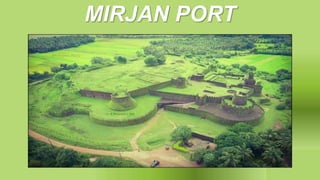
MIRJAN PORT
INTRODUCTION
The Mirjan fort stands on the banks of the Aganashini River near the
Mirjan village. A series of laterite steps lead up to the double-walled
stone fort.The fort is spread across 10 acres. It has four main entrances
with a number of canals and secret passageways along with
interconnected wells and a circular moat.The fort is renowned for its high
ceilings, bastions and watchtowers that offer a bird’s eye view of the
surrounding area.
HISTORY OF MIRJAN
PORT
• According to story, the fort was built by Queen Chennabhairadevi sometime in
the late 1500s to early 1600s. Queen Chennabhairadevi was also known as
the pepper queen.She lived in the fort for many years until the Talikota war
after which she moved to an island in the Sharavathi river. Yet another story
talks of the fort being built by a Bijapur noble named Sherif-ul Mulk to protect
the Kumta town.
• In the 17th century, the fort was captured by Keladi queen Chennamma. In
1757, it was seized by the Marathas and a few laters, by the British empire. At
the time, it was a minor port used to export spices like pepper, wild nutmeg,
cassia, and saltpetre.
CONCLUSION
• Heritage is legacy from the past, what we live with today, and what we
pass on to future generations. Our cultural and natural heritage are
both irreplaceable sources of life and inspiration. Cultural heritage is
reference point to the past. It helps us to understand history and the
ancestry that binds us together, at the same time, being an integral part
of our present, and of our future. Heritage walk can be an innovative
approach towards the preservation of cultural heritage of the Srinagar
city. Heritage walk helps to make people aware about the importance of
preserving the rich heritage and culture, promote culture and heritage
at national as well as at international levels, plays significant role in
sustaining local communities, and eventually paves way for
entrepreneurial opportunities for the locals.
WATER CONSERVATION
INTRODUCTION
• Water conservation refers to reducing the usage of water and recycling
of waste water for different purposes like domestic usage, industries,
agriculture etc. This presentation highlights about the purpose, scope
and methods of water conservation practices. We need water for many
things including cleaning, cooking, using the washroom, and more.
Moreover, we need clean water to lead a healthy life.We can take many
steps to conserve water on a national level as well as an individual
level.
IMPORTANCE OF WATER
CONSERVATION
• A human being cannot survive without water, even forjust a few days.
• Water is vital for all living beings to maintain life on earth.
• Water helps humans to stay hydrated and help fight diseases.
• Water is used in industries like mining, steel, electricity, food, etc., in
large quantities.
• Saving water protects our natural eco system for future generation.
Methods of Water Conservation
1. Protection of Water from Pollution.
2. Redistribution of Water.
3. Rational Use of Groundwater.
4. Increasing Forest Cover.
5. Change in Crop Pattern.
6. Conserving Water in Industries.
7. Use rainwater effectively.
CONCLUSION
• We should understand the importance of water conservation from the
fact that now only 3% of water is left on earth.And if we continue to
waste it in this way, all the sources of water can be exhausted in
future.Therefore, we need to be aware of and seriously try to conserve
water while fulfilling their moral responsibility.
ORGANIC FARMING
AND
WASTE
MANAGEMENT
ORGANIC FARMING
Organic farming can be defined as an agricultural process that uses
biological fertilisers and pest control acquired from animal or plant waste.
Organic farming was actually initiated as an answer to the environmental
sufferings caused by the use of chemical pesticides and synthetic
fertilisers. In other words, organic farming is a new system of farming or
agriculture that repairs, maintains, and improves the ecological balance.
BENEFITS OF ORGANIC
FARMING
• Environment-friendly.
• Healthy and tasty food.
• It improves soil health and reduce soil erosion.
• Inexpensive process.
• It uses organic inputs.
• Generates income through exports.
• Organic farming is more labour intensive. Hence, it generates more
employment.
LIMITATION OF ORGANIC FARMING
• Less output.
• The lack of awareness.
• Organic products generally demand a higher price due to a higher
demand.
• Organic products have a shorter shelf life due to the absence of
artificial preservatives
WASTE MANAGEMENT
• Waste management or waste disposal includes the processes and
actions required to manage waste from its inception to its final
disposal.
• This includes the collection, transport, treatment and disposal of waste,
together with monitoring and regulation of the waste management
process .
• Waste can be solid, liquid, or gases and each type has different
methods of disposal and management.
• Waste management deals with all types of waste, including
industrial, household, municipal, organic, biomedical, radioactive waste,
In some cases, waste can pose a threat to human health.
BENEFITS OF WASTE
DISPOSAL
• Keeps the Environment Clean.
• Reduces pollution and Ecological Contamination
• Money generation – companies may buy recyclable materials due to
their value. Additionally, the waste management industry creates
employment opportunities.
CONCLUSION
• Organic agricultural practices are a promising method that will hopefully
be expanded in the near future. In our environmentally conscious world,
people need to be more informed about how their food is produced and
what effects that is having on the earth and our futures.
• The behaviour of generating garbage is too dangerous not only for
today's generation, but also for future generations. It is critical to educate
people and encourage them to practise Recycle, Reuse, and Reduce
instead of producing waste. Waste disposal should be a priority for
municipalities and governments.
FOOD WALK
INTRODUCTION
A Food Tour, also known as Culinary Tour, is a guided tour designed to
introduce you to the history and traditions of a people through their food
culture.A Food and Drink Tour includes food and beverage tastings
related to a theme. It can be about the local culture or a specific region of
the city.During a food walk, you usually go out with a group of people, led
by a local expert who is a food lover too. You walk down a locality and try
to get under its skin through its food. The talk focused on how food
walks can help drive culinary tourism in India.
BENEFITS
• Opportunities to try unique and authentic dishes
• Immersion into local or street food culture
• History and Traditions Behind the Food We Eat
• Supporting local economies by patronizing small businesses and food
market
CONCLUSION
Food walk is a series where we explore different types of food and
cuisines from various regions around the world. Food is the need of
every living organism. Therefore, we mustn’t waste Food
THANK YOU…

SCR.pptx

  • 1.
    Under the guidanceof Madeeha Fathima
  • 2.
    GROUP MEMBERS 1.PREETAM -2AB21EC014 2.YASEEN-2AB21EC010 3.ROHIT PATGAR -2AB21EC015 4.SUHAIB -2AB21EC021
  • 3.
  • 4.
  • 5.
    INTRODUCTION Tree plantation isa biological practice where large number of trees and plants are planted in a given area. Adaptations make it easier for plants to survive in their specific habitat, and reproduce, passing those traits on to their offspring. Compost can be prepared within pot or mud pit.Organic waste of kitchen,garden or crop fields is collected and placed in the sun for 8- 12 days.
  • 6.
    TULSI PLANT • holybasil, (Ocimum tenuiflorum), also called tulsi or tulasi, flowering plant of the mint family (Lamiaceae) grown for its aromatic leaves. Holy basil is native to the Indian subcontinent and grows throughout Southeast Asia. • The plant has green leaves and it can grow up to 60 cm tall. tulsi required well-drained soil,plenty of sunlight and moderate watering.
  • 7.
    BENEFITS 1.Natural Immunity Booster. 2.LowerBlood Glucose. 3. Reduces Cold, Cough & Other Respiratory Disorders. 4. Reduces Stress & Blood Pressure. 5. Good for Heart Health. 6.Oral and Dental Health. 7.Lower Blood Glucose.
  • 8.
    SIDE EFFECTS • Nausea. •Diarrhea. • It may ​not suitable for pregnant women. • It may cause damage to the liver.
  • 9.
    CONCLUSION • Among allplants, the Tulsi plant is one of the most beneficial in your garden. It looks beautiful, spreads a lovely aroma, absorbs toxins to purify the air and has medicinal and Vastu benefit. • Plant as many trees as possible this will reduce pollution and Global warming so you should plant tree.The ecological system of our planet is a shared responsibility of all the citizens.
  • 10.
  • 11.
  • 12.
    INTRODUCTION The Mirjan fortstands on the banks of the Aganashini River near the Mirjan village. A series of laterite steps lead up to the double-walled stone fort.The fort is spread across 10 acres. It has four main entrances with a number of canals and secret passageways along with interconnected wells and a circular moat.The fort is renowned for its high ceilings, bastions and watchtowers that offer a bird’s eye view of the surrounding area.
  • 13.
    HISTORY OF MIRJAN PORT •According to story, the fort was built by Queen Chennabhairadevi sometime in the late 1500s to early 1600s. Queen Chennabhairadevi was also known as the pepper queen.She lived in the fort for many years until the Talikota war after which she moved to an island in the Sharavathi river. Yet another story talks of the fort being built by a Bijapur noble named Sherif-ul Mulk to protect the Kumta town. • In the 17th century, the fort was captured by Keladi queen Chennamma. In 1757, it was seized by the Marathas and a few laters, by the British empire. At the time, it was a minor port used to export spices like pepper, wild nutmeg, cassia, and saltpetre.
  • 14.
    CONCLUSION • Heritage islegacy from the past, what we live with today, and what we pass on to future generations. Our cultural and natural heritage are both irreplaceable sources of life and inspiration. Cultural heritage is reference point to the past. It helps us to understand history and the ancestry that binds us together, at the same time, being an integral part of our present, and of our future. Heritage walk can be an innovative approach towards the preservation of cultural heritage of the Srinagar city. Heritage walk helps to make people aware about the importance of preserving the rich heritage and culture, promote culture and heritage at national as well as at international levels, plays significant role in sustaining local communities, and eventually paves way for entrepreneurial opportunities for the locals.
  • 15.
  • 16.
    INTRODUCTION • Water conservationrefers to reducing the usage of water and recycling of waste water for different purposes like domestic usage, industries, agriculture etc. This presentation highlights about the purpose, scope and methods of water conservation practices. We need water for many things including cleaning, cooking, using the washroom, and more. Moreover, we need clean water to lead a healthy life.We can take many steps to conserve water on a national level as well as an individual level.
  • 17.
    IMPORTANCE OF WATER CONSERVATION •A human being cannot survive without water, even forjust a few days. • Water is vital for all living beings to maintain life on earth. • Water helps humans to stay hydrated and help fight diseases. • Water is used in industries like mining, steel, electricity, food, etc., in large quantities. • Saving water protects our natural eco system for future generation.
  • 18.
    Methods of WaterConservation 1. Protection of Water from Pollution. 2. Redistribution of Water. 3. Rational Use of Groundwater. 4. Increasing Forest Cover. 5. Change in Crop Pattern. 6. Conserving Water in Industries. 7. Use rainwater effectively.
  • 19.
    CONCLUSION • We shouldunderstand the importance of water conservation from the fact that now only 3% of water is left on earth.And if we continue to waste it in this way, all the sources of water can be exhausted in future.Therefore, we need to be aware of and seriously try to conserve water while fulfilling their moral responsibility.
  • 20.
  • 21.
    ORGANIC FARMING Organic farmingcan be defined as an agricultural process that uses biological fertilisers and pest control acquired from animal or plant waste. Organic farming was actually initiated as an answer to the environmental sufferings caused by the use of chemical pesticides and synthetic fertilisers. In other words, organic farming is a new system of farming or agriculture that repairs, maintains, and improves the ecological balance.
  • 22.
    BENEFITS OF ORGANIC FARMING •Environment-friendly. • Healthy and tasty food. • It improves soil health and reduce soil erosion. • Inexpensive process. • It uses organic inputs. • Generates income through exports. • Organic farming is more labour intensive. Hence, it generates more employment.
  • 23.
    LIMITATION OF ORGANICFARMING • Less output. • The lack of awareness. • Organic products generally demand a higher price due to a higher demand. • Organic products have a shorter shelf life due to the absence of artificial preservatives
  • 24.
    WASTE MANAGEMENT • Wastemanagement or waste disposal includes the processes and actions required to manage waste from its inception to its final disposal. • This includes the collection, transport, treatment and disposal of waste, together with monitoring and regulation of the waste management process . • Waste can be solid, liquid, or gases and each type has different methods of disposal and management. • Waste management deals with all types of waste, including industrial, household, municipal, organic, biomedical, radioactive waste, In some cases, waste can pose a threat to human health.
  • 25.
    BENEFITS OF WASTE DISPOSAL •Keeps the Environment Clean. • Reduces pollution and Ecological Contamination • Money generation – companies may buy recyclable materials due to their value. Additionally, the waste management industry creates employment opportunities.
  • 26.
    CONCLUSION • Organic agriculturalpractices are a promising method that will hopefully be expanded in the near future. In our environmentally conscious world, people need to be more informed about how their food is produced and what effects that is having on the earth and our futures. • The behaviour of generating garbage is too dangerous not only for today's generation, but also for future generations. It is critical to educate people and encourage them to practise Recycle, Reuse, and Reduce instead of producing waste. Waste disposal should be a priority for municipalities and governments.
  • 27.
  • 28.
    INTRODUCTION A Food Tour,also known as Culinary Tour, is a guided tour designed to introduce you to the history and traditions of a people through their food culture.A Food and Drink Tour includes food and beverage tastings related to a theme. It can be about the local culture or a specific region of the city.During a food walk, you usually go out with a group of people, led by a local expert who is a food lover too. You walk down a locality and try to get under its skin through its food. The talk focused on how food walks can help drive culinary tourism in India.
  • 29.
    BENEFITS • Opportunities totry unique and authentic dishes • Immersion into local or street food culture • History and Traditions Behind the Food We Eat • Supporting local economies by patronizing small businesses and food market
  • 30.
    CONCLUSION Food walk isa series where we explore different types of food and cuisines from various regions around the world. Food is the need of every living organism. Therefore, we mustn’t waste Food
  • 31.