SOCIAL CONNECTIVITY AND
RESPONSIBILITIES...
BY:
T Pushpa Navya
1DT21CS173
Heritage site
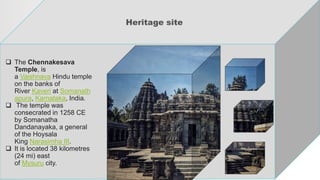
 The Chennakesava
Temple, is
a Vaishnava Hindu temple
on the banks of
River Kaveri at Somanath
apura, Karnataka, India.
 The temple was
consecrated in 1258 CE
by Somanatha
Dandanayaka, a general
of the Hoysala
King Narasimha III.
 It is located 38 kilometres
(24 mi) east
of Mysuru city.
History
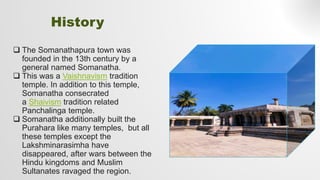
 The Somanathapura town was
founded in the 13th century by a
general named Somanatha.
 This was a Vaishnavism tradition
temple. In addition to this temple,
Somanatha consecrated
a Shaivism tradition related
Panchalinga temple.
 Somanatha additionally built the
Purahara like many temples, but all
these temples except the
Lakshminarasimha have
disappeared, after wars between the
Hindu kingdoms and Muslim
Sultanates ravaged the region.
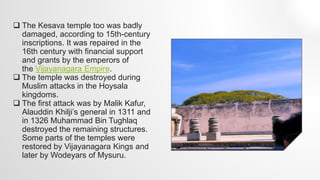
 The Kesava temple too was badly
damaged, according to 15th-century
inscriptions. It was repaired in the
16th century with financial support
and grants by the emperors of
the Vijayanagara Empire.
 The temple was destroyed during
Muslim attacks in the Hoysala
kingdoms.
 The first attack was by Malik Kafur,
Alauddin Khilji’s general in 1311 and
in 1326 Muhammad Bin Tughlaq
destroyed the remaining structures.
Some parts of the temples were
restored by Vijayanagara Kings and
later by Wodeyars of Mysuru.
Architecture
 The northern and southern row of small
shrines inside the pillared courtyard
corridor consists of eighteen single shrine
and one linked-double shrine each.
 The linked-double shrine is at the
northwestern and southwestern corners of
the courtyard.
 In total, the Kesava temple consists of 58
small 1x1 small shrines, 4 small 2x1
linked-double shrines, 2 near entrance,
and the main central temple.
 The 64 corridor shrines once
featured Vedic and Puranic deities and
rooms for pilgrims
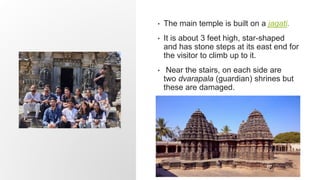
• The main temple is built on a jagati.
• It is about 3 feet high, star-shaped
and has stone steps at its east end for
the visitor to climb up to it.
• Near the stairs, on each side are
two dvarapala (guardian) shrines but
these are damaged.
Restaurant Selection: Begin by choosing
a diverse selection of restaurants,
including varying cuisines and price
ranges. You can also select restaurants
based on location, popularity or
reputation, and availability of tables.
Take detailed notes during your visits to
each restaurant, paying attention to
factors such as the quality of the food, the
service, the atmosphere, and the
cleanliness of the restaurant.
 We asked customers about their
satisfaction with the food,
service, and atmosphere, as well as
any areas for improvement.
 We enquired staff about their
knowledge of the menu, customer
service experience, and the
restaurant's management.
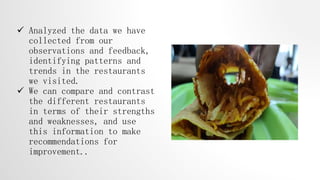
 Analyzed the data we have
collected from our
observations and feedback,
identifying patterns and
trends in the restaurants
we visited.
 We can compare and contrast
the different restaurants
in terms of their strengths
and weaknesses, and use
this information to make
recommendations for
improvement..
 Based on our analysis, provide
recommendations for each
restaurant on how they can
improve their overall customer
experience.
 This could include suggestions
for menu changes, improvements
in customer service, or changes
to the restaurant's ambiance.
Conclusion:
Conclusion of our report with a
summary of our findings and
recommendations. This could include
an overall assessment of the food
walk.
Water conservation refers to
the practice of using water
efficiently in order to reduce
waste and conserve this
precious resource. This is
particularly important in areas
with water scarcity or where
water resources are limited.
WATER
CONSERVATION
 Fixing leaks.
 Installing water-efficient fixtures
 Using water wisely outdoors
 Reusing water
 Educating others
 Bengaluru, is a city in southern India
that has been facing significant water
scarcity in recent years.
 The Bangalore Water Supply and
Sewerage Board (BWSSB) has mandated
that all new constructions in the
city must have rainwater harvesting
systems installed.
 BWSSB also implemented water
metering for all connections in the
city.
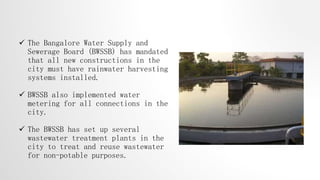
 The BWSSB has set up several
wastewater treatment plants in the
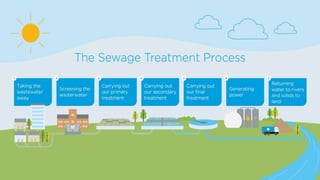
city to treat and reuse wastewater
for non-potable purposes.
there are several areas in Bangalore that have been identified as
water-stressed or water-scarce.
1.Whitefield: facing severe water scarcity due to rapid
urbanization and groundwater depletion.
2.Sarjapur Road: facing water scarcity due to a lack of proper
water infrastructure.
3.Koramangala: facing water scarcity due to high demand and
insufficient water supply.
4.Electronic City: facing water scarcity due to a lack of proper
water infrastructure and high demand.
 Waste management is a crucial aspect of
environmental sustainability. It is the process
of collecting, transporting, processing, and
disposing of waste materials effectively
 Waste management refers to the activities and
actions required to manage waste from its
inception to its final disposal
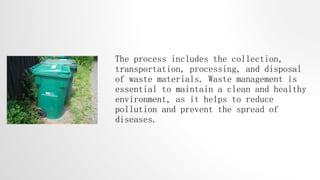
The process includes the collection,
transportation, processing, and disposal
of waste materials. Waste management is
essential to maintain a clean and healthy
environment, as it helps to reduce
pollution and prevent the spread of
diseases.
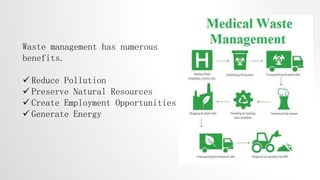
Waste management has numerous
benefits.
 Reduce Pollution
 Preserve Natural Resources
 Create Employment Opportunities
 Generate Energy
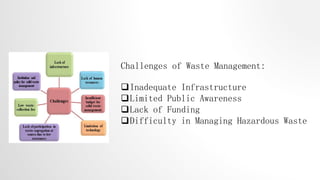
Challenges of Waste Management:
Inadequate Infrastructure
Limited Public Awareness
Lack of Funding
Difficulty in Managing Hazardous Waste
Solutions to Waste Management:
1.Improving Infrastructure
2.Educating the Public
3.Encouraging Recycling
4.Implementing Hazardous Waste Management
Conclusion:
Waste management is a critical aspect of environmental
sustainability. Proper waste management helps to reduce pollution,
conserve natural resources, and generate energy. However, waste
management is not without its challenges, including inadequate
infrastructure, limited public awareness, lack of funding, and
difficulty in managing hazardous waste.
 Plantation and adoption of a
tree refers to the process of
planting a tree and taking
responsibility for its growth
and care.
 This can be done for a variety
of reasons, such as
environmental conservation,
beautification, or personal
enjoyment. Here is some
information on plantation and
adoption of a tree.
choose the right tree species for the location
and purpose. Factors to consider include
climate, soil type, available space, and
desired benefits, such as shade or fruit
production.
Once the tree species has been chosen, the
next step is to plant the tree. The planting
process typically involves digging a hole,
placing the tree in the hole, and backfilling
with soil. It is important to follow proper
planting techniques to ensure the tree has a
healthy start, such as planting at the right
depth and spacing, and watering thoroughly.
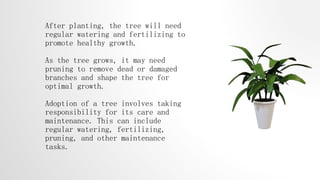
After planting, the tree will need
regular watering and fertilizing to
promote healthy growth.
As the tree grows, it may need
pruning to remove dead or damaged
branches and shape the tree for
optimal growth.
Adoption of a tree involves taking
responsibility for its care and
maintenance. This can include
regular watering, fertilizing,
pruning, and other maintenance
tasks.
 Adopting a tree can be a rewarding
experience, as it allows individuals to
contribute to environmental conservation
and beautification efforts.
 plantation and adoption of a tree is an
important process for promoting
environmental sustainability and personal
enjoyment.
1.Carbon sequestration: Trees are known to absorb carbon dioxide from the atmosphere and store it in
their biomass. This process helps to reduce greenhouse gas emissions and mitigate climate change.
2.Biodiversity conservation: Trees provide habitats for various species of birds, insects, and other
wildlife, which are essential for maintaining a healthy and diverse ecosystem.
3.Soil conservation: Trees help to prevent soil erosion by stabilizing the soil with their roots, and they
also improve soil fertility by adding nutrients to the soil through their fallen leaves.
4.Air purification: Trees absorb pollutants from the air and produce oxygen, which improves air quality
and helps to reduce the negative impacts of air pollution on human health.
Benifits of planting trees
Social connectivity and responsibilities.pptx

Social connectivity and responsibilities.pptx

  • 1.
  • 2.
    Heritage site  TheChennakesava Temple, is a Vaishnava Hindu temple on the banks of River Kaveri at Somanath apura, Karnataka, India.  The temple was consecrated in 1258 CE by Somanatha Dandanayaka, a general of the Hoysala King Narasimha III.  It is located 38 kilometres (24 mi) east of Mysuru city.
  • 3.
    History  The Somanathapuratown was founded in the 13th century by a general named Somanatha.  This was a Vaishnavism tradition temple. In addition to this temple, Somanatha consecrated a Shaivism tradition related Panchalinga temple.  Somanatha additionally built the Purahara like many temples, but all these temples except the Lakshminarasimha have disappeared, after wars between the Hindu kingdoms and Muslim Sultanates ravaged the region.
  • 4.
     The Kesavatemple too was badly damaged, according to 15th-century inscriptions. It was repaired in the 16th century with financial support and grants by the emperors of the Vijayanagara Empire.  The temple was destroyed during Muslim attacks in the Hoysala kingdoms.  The first attack was by Malik Kafur, Alauddin Khilji’s general in 1311 and in 1326 Muhammad Bin Tughlaq destroyed the remaining structures. Some parts of the temples were restored by Vijayanagara Kings and later by Wodeyars of Mysuru.
  • 5.
    Architecture  The northernand southern row of small shrines inside the pillared courtyard corridor consists of eighteen single shrine and one linked-double shrine each.  The linked-double shrine is at the northwestern and southwestern corners of the courtyard.  In total, the Kesava temple consists of 58 small 1x1 small shrines, 4 small 2x1 linked-double shrines, 2 near entrance, and the main central temple.  The 64 corridor shrines once featured Vedic and Puranic deities and rooms for pilgrims
  • 6.
    • The maintemple is built on a jagati. • It is about 3 feet high, star-shaped and has stone steps at its east end for the visitor to climb up to it. • Near the stairs, on each side are two dvarapala (guardian) shrines but these are damaged.
  • 7.
    Restaurant Selection: Beginby choosing a diverse selection of restaurants, including varying cuisines and price ranges. You can also select restaurants based on location, popularity or reputation, and availability of tables. Take detailed notes during your visits to each restaurant, paying attention to factors such as the quality of the food, the service, the atmosphere, and the cleanliness of the restaurant.
  • 8.
     We askedcustomers about their satisfaction with the food, service, and atmosphere, as well as any areas for improvement.  We enquired staff about their knowledge of the menu, customer service experience, and the restaurant's management.
  • 9.
     Analyzed thedata we have collected from our observations and feedback, identifying patterns and trends in the restaurants we visited.  We can compare and contrast the different restaurants in terms of their strengths and weaknesses, and use this information to make recommendations for improvement..
  • 10.
     Based onour analysis, provide recommendations for each restaurant on how they can improve their overall customer experience.  This could include suggestions for menu changes, improvements in customer service, or changes to the restaurant's ambiance.
  • 11.
    Conclusion: Conclusion of ourreport with a summary of our findings and recommendations. This could include an overall assessment of the food walk.
  • 12.
    Water conservation refersto the practice of using water efficiently in order to reduce waste and conserve this precious resource. This is particularly important in areas with water scarcity or where water resources are limited. WATER CONSERVATION
  • 13.
     Fixing leaks. Installing water-efficient fixtures  Using water wisely outdoors  Reusing water  Educating others  Bengaluru, is a city in southern India that has been facing significant water scarcity in recent years.
  • 14.
     The BangaloreWater Supply and Sewerage Board (BWSSB) has mandated that all new constructions in the city must have rainwater harvesting systems installed.  BWSSB also implemented water metering for all connections in the city.  The BWSSB has set up several wastewater treatment plants in the city to treat and reuse wastewater for non-potable purposes.
  • 15.
    there are severalareas in Bangalore that have been identified as water-stressed or water-scarce. 1.Whitefield: facing severe water scarcity due to rapid urbanization and groundwater depletion. 2.Sarjapur Road: facing water scarcity due to a lack of proper water infrastructure. 3.Koramangala: facing water scarcity due to high demand and insufficient water supply. 4.Electronic City: facing water scarcity due to a lack of proper water infrastructure and high demand.
  • 17.
     Waste managementis a crucial aspect of environmental sustainability. It is the process of collecting, transporting, processing, and disposing of waste materials effectively  Waste management refers to the activities and actions required to manage waste from its inception to its final disposal
  • 18.
    The process includesthe collection, transportation, processing, and disposal of waste materials. Waste management is essential to maintain a clean and healthy environment, as it helps to reduce pollution and prevent the spread of diseases.
  • 19.
    Waste management hasnumerous benefits.  Reduce Pollution  Preserve Natural Resources  Create Employment Opportunities  Generate Energy
  • 20.
    Challenges of WasteManagement: Inadequate Infrastructure Limited Public Awareness Lack of Funding Difficulty in Managing Hazardous Waste
  • 21.
    Solutions to WasteManagement: 1.Improving Infrastructure 2.Educating the Public 3.Encouraging Recycling 4.Implementing Hazardous Waste Management Conclusion: Waste management is a critical aspect of environmental sustainability. Proper waste management helps to reduce pollution, conserve natural resources, and generate energy. However, waste management is not without its challenges, including inadequate infrastructure, limited public awareness, lack of funding, and difficulty in managing hazardous waste.
  • 22.
     Plantation andadoption of a tree refers to the process of planting a tree and taking responsibility for its growth and care.  This can be done for a variety of reasons, such as environmental conservation, beautification, or personal enjoyment. Here is some information on plantation and adoption of a tree.
  • 23.
    choose the righttree species for the location and purpose. Factors to consider include climate, soil type, available space, and desired benefits, such as shade or fruit production. Once the tree species has been chosen, the next step is to plant the tree. The planting process typically involves digging a hole, placing the tree in the hole, and backfilling with soil. It is important to follow proper planting techniques to ensure the tree has a healthy start, such as planting at the right depth and spacing, and watering thoroughly.
  • 24.
    After planting, thetree will need regular watering and fertilizing to promote healthy growth. As the tree grows, it may need pruning to remove dead or damaged branches and shape the tree for optimal growth. Adoption of a tree involves taking responsibility for its care and maintenance. This can include regular watering, fertilizing, pruning, and other maintenance tasks.
  • 25.
     Adopting atree can be a rewarding experience, as it allows individuals to contribute to environmental conservation and beautification efforts.  plantation and adoption of a tree is an important process for promoting environmental sustainability and personal enjoyment.
  • 26.
    1.Carbon sequestration: Treesare known to absorb carbon dioxide from the atmosphere and store it in their biomass. This process helps to reduce greenhouse gas emissions and mitigate climate change. 2.Biodiversity conservation: Trees provide habitats for various species of birds, insects, and other wildlife, which are essential for maintaining a healthy and diverse ecosystem. 3.Soil conservation: Trees help to prevent soil erosion by stabilizing the soil with their roots, and they also improve soil fertility by adding nutrients to the soil through their fallen leaves. 4.Air purification: Trees absorb pollutants from the air and produce oxygen, which improves air quality and helps to reduce the negative impacts of air pollution on human health. Benifits of planting trees