GUESS THE
PICTURE
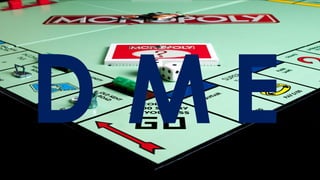
GUESS THE PICTURE SO YOU CAN
JUMBLE THE GIVEN LETTERS TO
UNLOCK THE HIDDEN WORD.
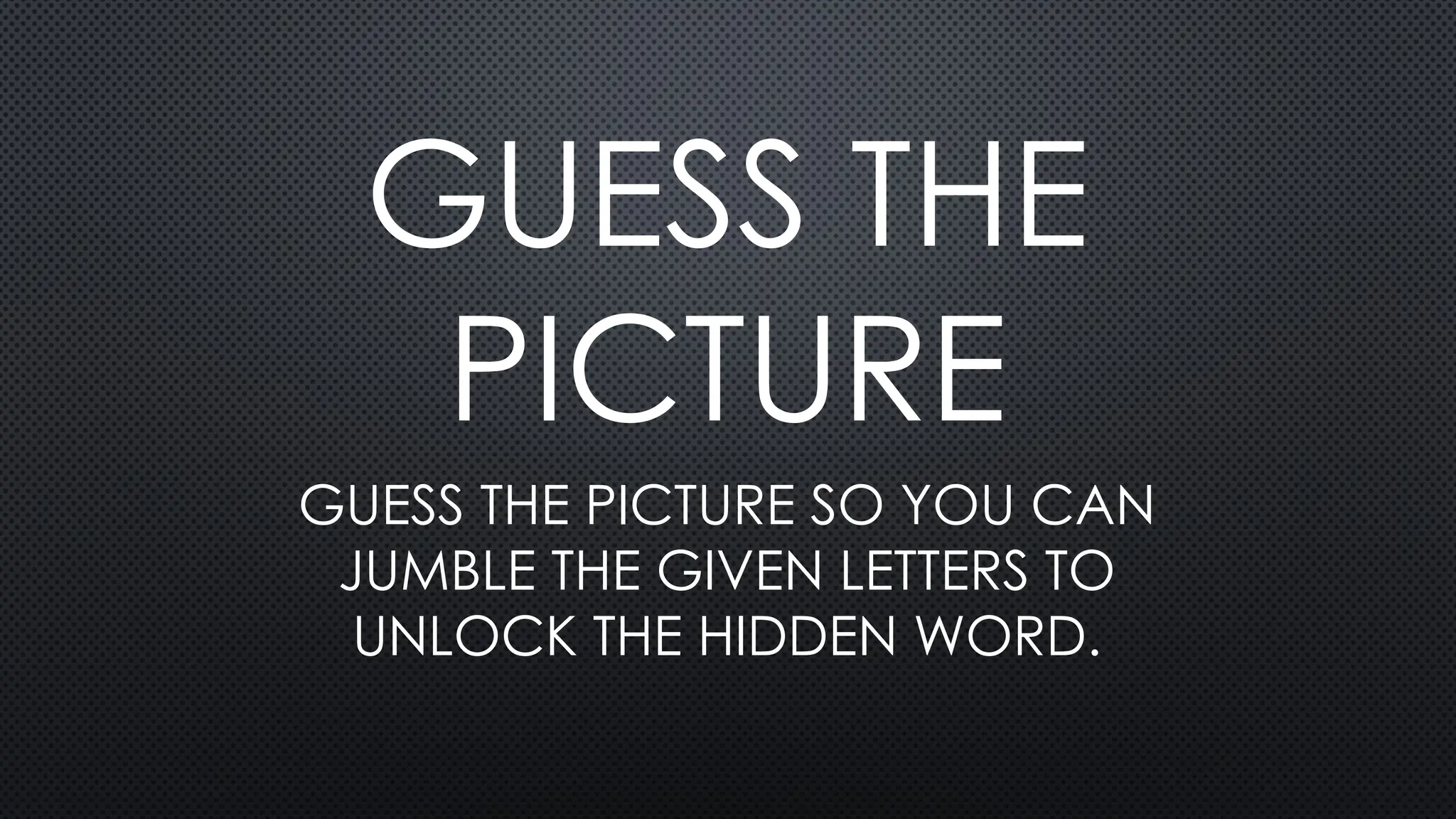
B A G
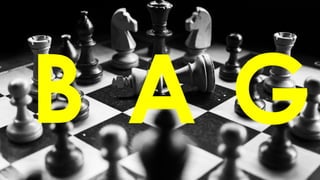
O A R
D M E
LESSON OBJECTIVES:
1. DISCUSS THE NATURE/BACKGROUND OF THE GAME SCRABBLE
2. EXPLAIN THE HEALTH AND FITNESS BENEFITS DERIVE FROM
PLAYING
SCRABBLE
3. PRACTICE PROPER AND ACCEPTABLE BEHAVIOR WHEN
PARTICIPATING IN
INDOOR RECREATIONAL ACTIVITIES
4. EXECUTE BASIC SKILLS AND TACTICS IN INDOOR
RECREATIONAL ACTIVITIES
5. INTERPRET RULES AND REGULATIONS OF THE GAME SCRABBLE
6. APPLY KNOWLEDGE OF RULES AND REGULATIONS IN SCRABBLE
SCRABBLE
WHAT IS SCRABBLE?
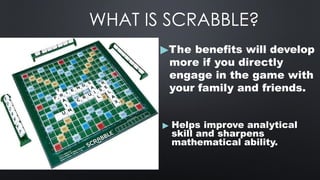
▶ An international popular word
game where a word power,
strategy and luck are equally
important.
▶ A word game in which two or
four players score points by
placing tiles on to a game
board which is divided into a
15 x 15 grid of squares.
▶ Recognize as an excellent
means for increasing
vocabulary and word power.
WHAT IS SCRABBLE?
▶The benefits will develop
more if you directly
engage in the game with
your family and friends.
▶ Helps improve analytical
skill and sharpens
mathematical ability.
HISTORY OF SCRABBLE
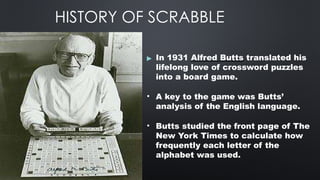
▶ In 1931 Alfred Butts translated his
lifelong love of crossword puzzles
into a board game.
• A key to the game was Butts’
analysis of the English language.
• Butts studied the front page of The
New York Times to calculate how
frequently each letter of the
alphabet was used.
HISTORY OF SCRABBLE
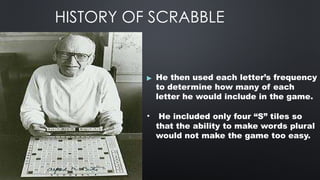
▶ He then used each letter’s frequency
to determine how many of each
letter he would include in the game.
• He included only four “S” tiles so
that the ability to make words plural
would not make the game too easy.
HISTORY OF SCRABBLE
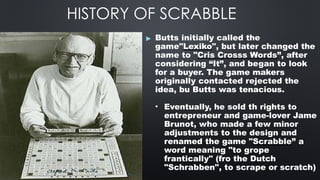
▶ Butts initially called the
game"Lexiko", but later changed the
name to "Cris Crosss Words”, after
considering “It”, and began to look
for a buyer. The game makers
originally contacted rejected the
idea, bu Butts was tenacious.
• Eventually, he sold th rights to
entrepreneur and game-lover Jame
Brunot, who made a few minor
adjustments to the design and
renamed the game "Scrabble” a
word meaning "to grope
frantically" (fro the Dutch
"Schrabben", to scrape or scratch)
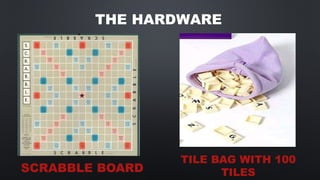
THE HARDWARE
SCRABBLE BOARD
TILE BAG WITH 100
TILES
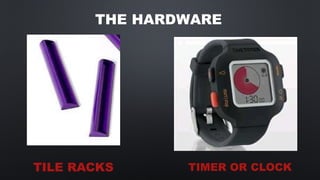
THE HARDWARE
TILE RACKS TIMER OR CLOCK
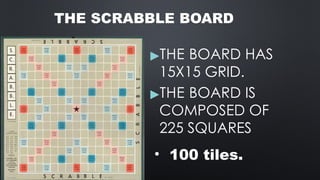
THE SCRABBLE BOARD
▶THE BOARD HAS
15X15 GRID.
▶THE BOARD IS
COMPOSED OF
225 SQUARES
• 100 tiles.
EVALUATION
A.IDENTIFY THE CORRECT ANSWER.
_____________1. A word game in which two or four players score
points by placing tiles on to a game board which
is divided into a 15 x 15 grid of squares.
_____________2. How many maximum members can play the
scrabble
_____________3. How many blank tiles are included in the game?
_____________4. The Scrabble board has grid.
_____________5. The Scrabble board is composed____of squares
and 100 tiles.
SCRABBLE
WHAT ARE THE
MATERIALS YOU
NEED IN PLAYING
SCRABBLE?
THE SCRABBLE BOARD
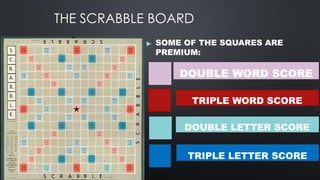
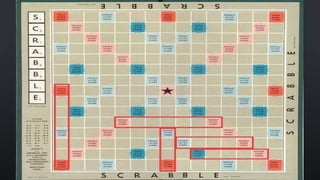
▶ SOME OF THE SQUARES ARE
PREMIUM:
DOUBLE WORD SCORE
TRIPLE WORD SCORE
DOUBLE LETTER SCORE
TRIPLE LETTER SCORE
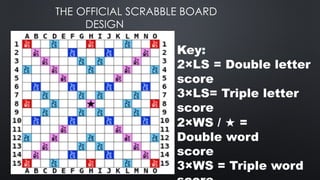
THE OFFICIAL SCRABBLE BOARD
DESIGN
Key:
2×LS = Double letter
score
3×LS= Triple letter
score
2×WS / ★ =
Double word
score
3×WS = Triple word
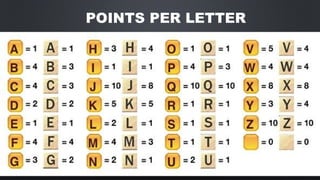
POINTS PER LETTER
BEFORE THE GAME
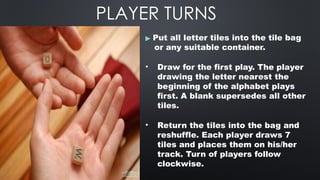
PLAYER TURNS
▶ Put all letter tiles into the tile bag
or any suitable container.
• Draw for the first play. The player
drawing the letter nearest the
beginning of the alphabet plays
first. A blank supersedes all other
tiles.
• Return the tiles into the bag and
reshuffle. Each player draws 7
tiles and places them on his/her
track. Turn of players follow
clockwise.
WORD JUDGE
▶ TO DECIDE WORD
CHALLENGES, A WORD
JUDGE IS ELECTED BY THE
PLAYERS WHO MAY BE ONE
OF THEM.
HE OR SHE MAY ALSO ACT AS
THE SCOREKEEPER WHO KEEPS
A TALLY OF EACH PLAYER’S
SCORE, ENTERING IT AFTER
DICTIONARY
• Before the game
begins, the players
must first agree on
the dictionary to be
used in settling
challenges on what
words to allow or not
to allow.
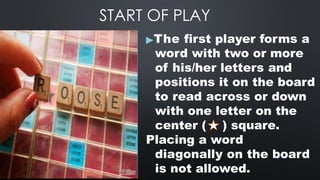
START OF PLAY
▶The first player forms a
word with two or more
of his/her letters and
positions it on the board
to read across or down
with one letter on the
center ( ) square.
Placing a word
diagonally on the board
is not allowed.
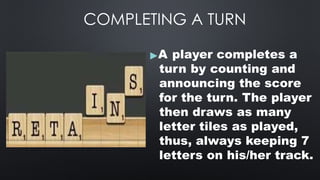
COMPLETING A TURN
▶A player completes a
turn by counting and
announcing the score
for the turn. The player
then draws as many
letter tiles as played,
thus, always keeping 7
letters on his/her track.
PLAYING THE GAME
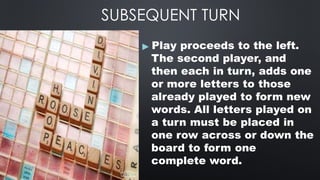
SUBSEQUENT TURN
▶ Play proceeds to the left.
The second player, and
then each in turn, adds one
or more letters to those
already played to form new
words. All letters played on
a turn must be placed in
one row across or down the
board to form one
complete word.
FORMING NEW WORDS
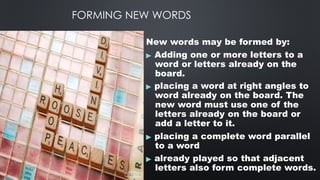
New words may be formed by:
▶ Adding one or more letters to a
word or letters already on the
board.
▶ placing a word at right angles to
word already on the board. The
new word must use one of the
letters already on the board or
add a letter to it.
▶ placing a complete word parallel
to a word
▶ already played so that adjacent
letters also form complete words.
BLANK TILES
▶The two blank tiles may
be used as any letters.
When playing a blank, the
player must state which
letter it represents. It
remains that latter for
the rest of the game.
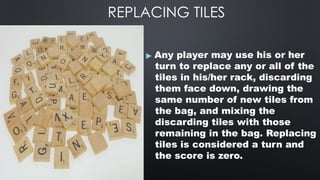
REPLACING TILES
▶ Any player may use his or her
turn to replace any or all of the
tiles in his/her rack, discarding
them face down, drawing the
same number of new tiles from
the bag, and mixing the
discarding tiles with those
remaining in the bag. Replacing
tiles is considered a turn and
the score is zero.
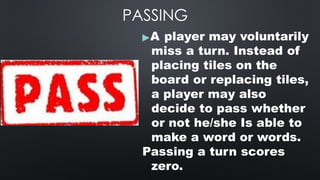
PASSING
▶A player may voluntarily
miss a turn. Instead of
placing tiles on the
board or replacing tiles,
a player may also
decide to pass whether
or not he/she Is able to
make a word or words.
Passing a turn scores
zero.
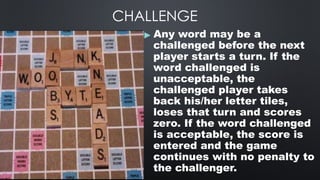
CHALLENGE
▶ Any word may be a
challenged before the next
player starts a turn. If the
word challenged is
unacceptable, the
challenged player takes
back his/her letter tiles,
loses that turn and scores
zero. If the word challenged
is acceptable, the score is
entered and the game
continues with no penalty to
the challenger.
SCORING THE GAME
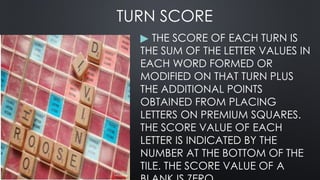
TURN SCORE
▶ THE SCORE OF EACH TURN IS
THE SUM OF THE LETTER VALUES IN
EACH WORD FORMED OR
MODIFIED ON THAT TURN PLUS
THE ADDITIONAL POINTS
OBTAINED FROM PLACING
LETTERS ON PREMIUM SQUARES.
THE SCORE VALUE OF EACH
LETTER IS INDICATED BY THE
NUMBER AT THE BOTTOM OF THE
TILE. THE SCORE VALUE OF A
PREMIUM LETTER SQUARES
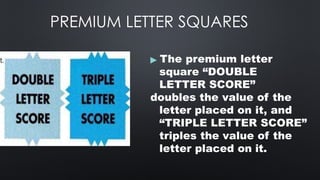
▶ The premium letter
square “DOUBLE
LETTER SCORE”
doubles the value of the
letter placed on it, and
“TRIPLE LETTER SCORE”
triples the value of the
letter placed on it.
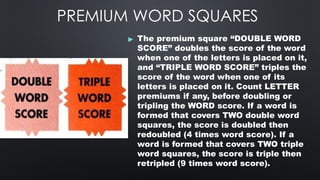
PREMIUM WORD SQUARES
▶ The premium square “DOUBLE WORD
SCORE” doubles the score of the word
when one of the letters is placed on it,
and “TRIPLE WORD SCORE” triples the
score of the word when one of its
letters is placed on it. Count LETTER
premiums if any, before doubling or
tripling the WORD score. If a word is
formed that covers TWO double word
squares, the score is doubled then
redoubled (4 times word score). If a
word is formed that covers TWO triple
word squares, the score is triple then
retripled (9 times word score).
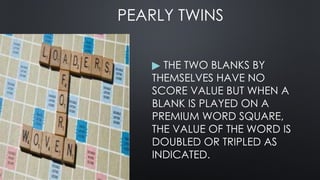
PEARLY TWINS
▶ THE TWO BLANKS BY
THEMSELVES HAVE NO
SCORE VALUE BUT WHEN A
BLANK IS PLAYED ON A
PREMIUM WORD SQUARE,
THE VALUE OF THE WORD IS
DOUBLED OR TRIPLED AS
INDICATED.
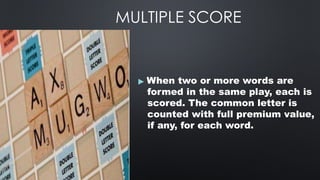
MULTIPLE SCORE
▶ When two or more words are
formed in the same play, each is
scored. The common letter is
counted with full premium value,
if any, for each word.
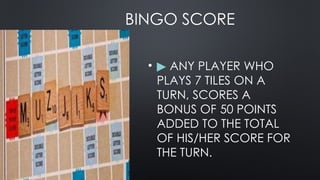
BINGO SCORE
• ▶ ANY PLAYER WHO
PLAYS 7 TILES ON A
TURN, SCORES A
BONUS OF 50 POINTS
ADDED TO THE TOTAL
OF HIS/HER SCORE FOR
THE TURN.
ENDING GAME
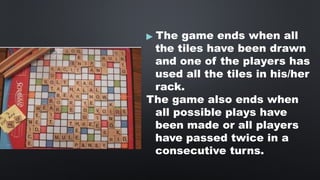
▶ The game ends when all
the tiles have been drawn
and one of the players has
used all the tiles in his/her
rack.
The game also ends when
all possible plays have
been made or all players
have passed twice in a
consecutive turns.
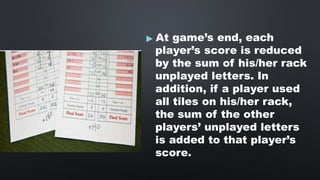
▶ At game’s end, each
player’s score is reduced
by the sum of his/her rack
unplayed letters. In
addition, if a player used
all tiles on his/her rack,
the sum of the other
players’ unplayed letters
is added to that player’s
score.
▶The player with the
highest final score WINS
the game. Players who
tie for the highest final
score shall equally be
considered as winners
(DRAW).
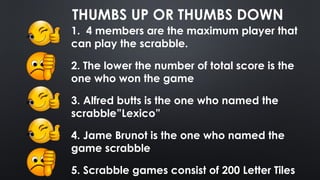
THUMBS UP OR THUMBS DOWN
1. 4 members are the maximum player that
can play the scrabble.
2. The lower the number of total score is the
one who won the game
3. Alfred butts is the one who named the
scrabble”Lexico”
4. Jame Brunot is the one who named the
game scrabble
5. Scrabble games consist of 200 Letter Tiles
EVALUATION
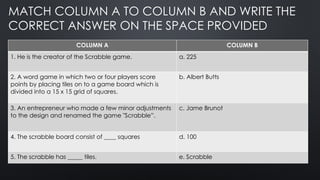
MATCH COLUMN A TO COLUMN B AND WRITE THE
CORRECT ANSWER ON THE SPACE PROVIDED
COLUMN A COLUMN B
1. He is the creator of the Scrabble game. a. 225
2. A word game in which two or four players score
points by placing tiles on to a game board which is
divided into a 15 x 15 grid of squares.
b. Albert Butts
3. An entrepreneur who made a few minor adjustments
to the design and renamed the game "Scrabble”.
c. Jame Brunot
4. The scrabble board consist of ____ squares d. 100
5. The scrabble has _____ tiles. e. Scrabble
THANK YOU!

scrabble LESSON FO MAPEH 8 LEARNERS MELCS BASE

  • 1.
    GUESS THE PICTURE GUESS THEPICTURE SO YOU CAN JUMBLE THE GIVEN LETTERS TO UNLOCK THE HIDDEN WORD.
  • 2.
  • 3.
  • 4.
  • 5.
    LESSON OBJECTIVES: 1. DISCUSSTHE NATURE/BACKGROUND OF THE GAME SCRABBLE 2. EXPLAIN THE HEALTH AND FITNESS BENEFITS DERIVE FROM PLAYING SCRABBLE 3. PRACTICE PROPER AND ACCEPTABLE BEHAVIOR WHEN PARTICIPATING IN INDOOR RECREATIONAL ACTIVITIES 4. EXECUTE BASIC SKILLS AND TACTICS IN INDOOR RECREATIONAL ACTIVITIES 5. INTERPRET RULES AND REGULATIONS OF THE GAME SCRABBLE 6. APPLY KNOWLEDGE OF RULES AND REGULATIONS IN SCRABBLE
  • 6.
  • 7.
    WHAT IS SCRABBLE? ▶An international popular word game where a word power, strategy and luck are equally important. ▶ A word game in which two or four players score points by placing tiles on to a game board which is divided into a 15 x 15 grid of squares. ▶ Recognize as an excellent means for increasing vocabulary and word power.
  • 8.
    WHAT IS SCRABBLE? ▶Thebenefits will develop more if you directly engage in the game with your family and friends. ▶ Helps improve analytical skill and sharpens mathematical ability.
  • 9.
    HISTORY OF SCRABBLE ▶In 1931 Alfred Butts translated his lifelong love of crossword puzzles into a board game. • A key to the game was Butts’ analysis of the English language. • Butts studied the front page of The New York Times to calculate how frequently each letter of the alphabet was used.
  • 10.
    HISTORY OF SCRABBLE ▶He then used each letter’s frequency to determine how many of each letter he would include in the game. • He included only four “S” tiles so that the ability to make words plural would not make the game too easy.
  • 11.
    HISTORY OF SCRABBLE ▶Butts initially called the game"Lexiko", but later changed the name to "Cris Crosss Words”, after considering “It”, and began to look for a buyer. The game makers originally contacted rejected the idea, bu Butts was tenacious. • Eventually, he sold th rights to entrepreneur and game-lover Jame Brunot, who made a few minor adjustments to the design and renamed the game "Scrabble” a word meaning "to grope frantically" (fro the Dutch "Schrabben", to scrape or scratch)
  • 12.
  • 13.
  • 14.
    THE SCRABBLE BOARD ▶THEBOARD HAS 15X15 GRID. ▶THE BOARD IS COMPOSED OF 225 SQUARES • 100 tiles.
  • 16.
  • 17.
    A.IDENTIFY THE CORRECTANSWER. _____________1. A word game in which two or four players score points by placing tiles on to a game board which is divided into a 15 x 15 grid of squares. _____________2. How many maximum members can play the scrabble _____________3. How many blank tiles are included in the game? _____________4. The Scrabble board has grid. _____________5. The Scrabble board is composed____of squares and 100 tiles.
  • 18.
  • 19.
    WHAT ARE THE MATERIALSYOU NEED IN PLAYING SCRABBLE?
  • 21.
    THE SCRABBLE BOARD ▶SOME OF THE SQUARES ARE PREMIUM: DOUBLE WORD SCORE TRIPLE WORD SCORE DOUBLE LETTER SCORE TRIPLE LETTER SCORE
  • 22.
    THE OFFICIAL SCRABBLEBOARD DESIGN Key: 2×LS = Double letter score 3×LS= Triple letter score 2×WS / ★ = Double word score 3×WS = Triple word
  • 23.
  • 24.
  • 25.
    PLAYER TURNS ▶ Putall letter tiles into the tile bag or any suitable container. • Draw for the first play. The player drawing the letter nearest the beginning of the alphabet plays first. A blank supersedes all other tiles. • Return the tiles into the bag and reshuffle. Each player draws 7 tiles and places them on his/her track. Turn of players follow clockwise.
  • 26.
    WORD JUDGE ▶ TODECIDE WORD CHALLENGES, A WORD JUDGE IS ELECTED BY THE PLAYERS WHO MAY BE ONE OF THEM. HE OR SHE MAY ALSO ACT AS THE SCOREKEEPER WHO KEEPS A TALLY OF EACH PLAYER’S SCORE, ENTERING IT AFTER
  • 27.
    DICTIONARY • Before thegame begins, the players must first agree on the dictionary to be used in settling challenges on what words to allow or not to allow.
  • 28.
    START OF PLAY ▶Thefirst player forms a word with two or more of his/her letters and positions it on the board to read across or down with one letter on the center ( ) square. Placing a word diagonally on the board is not allowed.
  • 29.
    COMPLETING A TURN ▶Aplayer completes a turn by counting and announcing the score for the turn. The player then draws as many letter tiles as played, thus, always keeping 7 letters on his/her track.
  • 30.
  • 31.
    SUBSEQUENT TURN ▶ Playproceeds to the left. The second player, and then each in turn, adds one or more letters to those already played to form new words. All letters played on a turn must be placed in one row across or down the board to form one complete word.
  • 32.
    FORMING NEW WORDS Newwords may be formed by: ▶ Adding one or more letters to a word or letters already on the board. ▶ placing a word at right angles to word already on the board. The new word must use one of the letters already on the board or add a letter to it. ▶ placing a complete word parallel to a word ▶ already played so that adjacent letters also form complete words.
  • 33.
    BLANK TILES ▶The twoblank tiles may be used as any letters. When playing a blank, the player must state which letter it represents. It remains that latter for the rest of the game.
  • 34.
    REPLACING TILES ▶ Anyplayer may use his or her turn to replace any or all of the tiles in his/her rack, discarding them face down, drawing the same number of new tiles from the bag, and mixing the discarding tiles with those remaining in the bag. Replacing tiles is considered a turn and the score is zero.
  • 35.
    PASSING ▶A player mayvoluntarily miss a turn. Instead of placing tiles on the board or replacing tiles, a player may also decide to pass whether or not he/she Is able to make a word or words. Passing a turn scores zero.
  • 36.
    CHALLENGE ▶ Any wordmay be a challenged before the next player starts a turn. If the word challenged is unacceptable, the challenged player takes back his/her letter tiles, loses that turn and scores zero. If the word challenged is acceptable, the score is entered and the game continues with no penalty to the challenger.
  • 37.
  • 38.
    TURN SCORE ▶ THESCORE OF EACH TURN IS THE SUM OF THE LETTER VALUES IN EACH WORD FORMED OR MODIFIED ON THAT TURN PLUS THE ADDITIONAL POINTS OBTAINED FROM PLACING LETTERS ON PREMIUM SQUARES. THE SCORE VALUE OF EACH LETTER IS INDICATED BY THE NUMBER AT THE BOTTOM OF THE TILE. THE SCORE VALUE OF A
  • 39.
    PREMIUM LETTER SQUARES ▶The premium letter square “DOUBLE LETTER SCORE” doubles the value of the letter placed on it, and “TRIPLE LETTER SCORE” triples the value of the letter placed on it.
  • 40.
    PREMIUM WORD SQUARES ▶The premium square “DOUBLE WORD SCORE” doubles the score of the word when one of the letters is placed on it, and “TRIPLE WORD SCORE” triples the score of the word when one of its letters is placed on it. Count LETTER premiums if any, before doubling or tripling the WORD score. If a word is formed that covers TWO double word squares, the score is doubled then redoubled (4 times word score). If a word is formed that covers TWO triple word squares, the score is triple then retripled (9 times word score).
  • 42.
    PEARLY TWINS ▶ THETWO BLANKS BY THEMSELVES HAVE NO SCORE VALUE BUT WHEN A BLANK IS PLAYED ON A PREMIUM WORD SQUARE, THE VALUE OF THE WORD IS DOUBLED OR TRIPLED AS INDICATED.
  • 43.
    MULTIPLE SCORE ▶ Whentwo or more words are formed in the same play, each is scored. The common letter is counted with full premium value, if any, for each word.
  • 44.
    BINGO SCORE • ▶ANY PLAYER WHO PLAYS 7 TILES ON A TURN, SCORES A BONUS OF 50 POINTS ADDED TO THE TOTAL OF HIS/HER SCORE FOR THE TURN.
  • 45.
  • 46.
    ▶ The gameends when all the tiles have been drawn and one of the players has used all the tiles in his/her rack. The game also ends when all possible plays have been made or all players have passed twice in a consecutive turns.
  • 47.
    ▶ At game’send, each player’s score is reduced by the sum of his/her rack unplayed letters. In addition, if a player used all tiles on his/her rack, the sum of the other players’ unplayed letters is added to that player’s score.
  • 48.
    ▶The player withthe highest final score WINS the game. Players who tie for the highest final score shall equally be considered as winners (DRAW).
  • 50.
    THUMBS UP ORTHUMBS DOWN 1. 4 members are the maximum player that can play the scrabble. 2. The lower the number of total score is the one who won the game 3. Alfred butts is the one who named the scrabble”Lexico” 4. Jame Brunot is the one who named the game scrabble 5. Scrabble games consist of 200 Letter Tiles
  • 51.
  • 52.
    MATCH COLUMN ATO COLUMN B AND WRITE THE CORRECT ANSWER ON THE SPACE PROVIDED COLUMN A COLUMN B 1. He is the creator of the Scrabble game. a. 225 2. A word game in which two or four players score points by placing tiles on to a game board which is divided into a 15 x 15 grid of squares. b. Albert Butts 3. An entrepreneur who made a few minor adjustments to the design and renamed the game "Scrabble”. c. Jame Brunot 4. The scrabble board consist of ____ squares d. 100 5. The scrabble has _____ tiles. e. Scrabble
  • 53.

Editor's Notes

  • #17 IF THE TIME PERMITS ALLOW THE STUDENTS TO PLAY
  • #18 Day 2