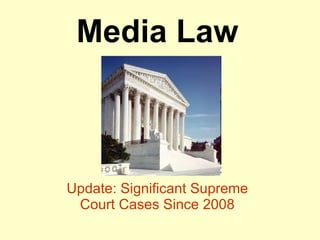
Media Law Update: Significant Supreme Court Cases Since 2008
Introduction Our textbook was published in 2008. Since then, there have been some new developments in media law. This mixed media slideshow will cover some of the most significant and interesting Supreme Court decisions during the past three years.
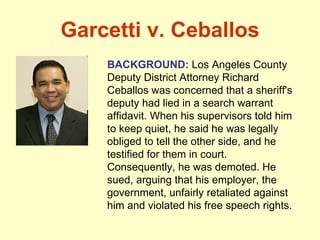
Garcetti v. Ceballos BACKGROUND:  Los Angeles County Deputy District Attorney Richard Ceballos was concerned that a sheriff's deputy had lied in a search warrant affidavit. When his supervisors told him to keep quiet, he said he was legally obliged to tell the other side, and he testified for them in court.  Consequently, he was demoted. He sued, arguing that his employer, the government, unfairly retaliated against him and violated his free speech rights.
Legal Issue The Supreme Court examined whether a public employee's purely job-related speech, expressed strictly pursuant to the duties of employment, be protected by the First Amendment simply because it touched on a matter of public concern, or must the speech also be engaged in "as a citizen?"
Outcome In a 5-to-4 decision authored by Justice Anthony Kennedy, the Supreme Court held that speech by a public official is only protected if it is engaged in as a private citizen, not if it is expressed as part of the official's public duties. Ceballos's employers were justified in taking action against him based on his testimony and cooperation with the defense, therefore, because it happened as part of his official duties. "The fact that his duties sometimes required him to speak or write," Justice Kennedy wrote, "does not mean his supervisors were prohibited from evaluating his performance."
What does this mean? Basically, the Supreme Court said the nation's 21 million public employees do not have the protection of the First Amendment when they raise concerns about wrongdoing as part of their job duties. Critics, including civil libertarians and attorneys for whistle-blowers, said the impact of the ruling could be sweeping, silencing conscientious public employees and endangering public health and safety.
Federal Election Commission v. Wisconsin Right to Life  &  McCain, et al. v. Wisconsin Right to Life (consolidated)
Background Wisconsin Right to Life, a nonprofit political advocacy group, ran advertisements encouraging viewers to contact two U.S. Senators and tell them to oppose filibusters of judicial nominees. WRTL intended to keep running the ads through the 2004 election, but the Bipartisan Campaign Reform Act of 2002 prohibits corporate funds from being used for certain political advertisements in the 60-day period prior to an election. WRTL sued the Federal Election Commission, claiming that the BCRA was unconstitutional as applied to the advertisements.
FYI Just a couple years prior to this case, the Supreme Court had upheld the constitutionality of the entire BRCA, when it was challenged. So, who do you think won this case?
Outcome Surprise! By a 5-4 vote the Court ruled that BCRA's limitations on political advertising were unconstitutional as they applied to issue ads like WRTL's. The Court developed a new test to determine whether ads are genuine issue ads or express political advocacy. If it’s the former type of ad, it’s OK to run it during through election.  The following video briefly explains the decision in plain English…
More recently: Citizens United v.  Federal Election Commission In 2010, the Supreme Court completely reversed course on the BRCA, declaring it unconstitutional. By a 5-4 vote, the Court ruled that the government may not ban political spending by corporations in candidate elections. Dissenting justices (and President Obama) warned that allowing corporate money to flood the political marketplace would corrupt democracy.
Tenn. Secondary School Athletic Assoc. v. Brentwood Academy BACKGROUND:  Interesting case for sports fans... Brentwood Academy, a private school, was a voluntary member of the Tennessee Secondary School Athletic Association. After Brentwood's football coach violated the association’s recruiting rules by contacting some prospective players at other schools, the association imposed various penalties on Brentwood. Brentwood sued the association, claiming that its First Amendment and Due Process rights were being violated.
The Supreme Court had ruled previously in a 2001 case that because the TSSAA was composed primarily of public schools, it was a state actor subject to the limitations of the Constitution. Accordingly, the District Court faulted the TSSAA for violations of Brentwood's constitutional rights and threw out the TSSAA's penalties. Case History
On appeal, the TSSAA argued that it had not exercised the "police power" of the State, but merely enforced a voluntary contractual agreement with Brentwood. The U.S. Court of Appeals for the Sixth circuit rejected this argument, characterizing the TSSAA's actions as those of a "government regulator." The Sixth Circuit held that the state interest in regulating athletic competition was not substantial enough to counter-balance Brentwood's First Amendment rights, and it affirmed the lower court's ruling for Brentwood.
Outcome In a unanimous opinion written by Justice John Paul Stevens, the Court ruled that "[t]he anti-recruiting rule strikes nowhere near the heart of the First Amendment." Brentwood's speech rights do not extend to potentially coercive one-on-one communications between a coach and potential students, especially after the school voluntarily agreed to the anti-recruiting rule. Also, Justice Thomas recommended that the Court revisit and overrule its previous holding that TSSAA is a state actor.
Sidenote Notice how the Supreme Court sort-of reverses course both on this case and the campaign finance case, even though both issues had previously come up recently. It happens. Some of the justices on the Court changed since the initial rulings. That’s why the President’s decision on whom to appoint to a Supreme Court vacancy is so critical. When you have these 5-4 votes, changing just one justice can affect the outcome.
Davenport v. Washington Education Association BACKGROUND:  In some states, public sector labor unions are allowed to collect fees from non-union members. The Supreme Court has ruled that unions may use these fees for political purposes, but only if the non-union member does not object. Washington state also has a "paycheck protection" law, which requires unions to obtain specific permission from non-members before using their fees for political activity. Davenport, a non-union teacher, sued the Washington Education Association teacher's union for violating the law.
Case History WEA appealed to the Washington Court of Appeals, arguing that Washington's requirement that unions get prior permission was an unconstitutional burden on the unions' First Amendment right to associate for political purposes. Davenport countered that his own First Amendment rights were being violated when his fees went to political causes he did not agree with. The state Court of Appeals ruled in favor of WEA. On appeal, the Washington Supreme Court affirmed, ruling that the burden must lie on the nonmember to assert his rights and object to the political fees.
Legal Issue The Supreme Court examined whether a state law requiring labor unions to obtain permission from non-union members before using the non-members' fees for political purposes violate unions' First Amendment rights?
Outcome No. In a unanimous opinion written by Justice Scalia, the Court overturned the Washington state courts, ruling that the First Amendment allows a state to require public-sector unions collecting "agency-shop" fees from non-union employees to obtain permission from the employees before using the money for political purposes.
Morse v. Frederick One of the more colorful Supreme Court cases in recent history. That’s why it’s best to watch the following video clip below for background info…
Case History Remember:  Tinker v. Des Moines Independent Community School District , which extended First Amendment protection to student speech except where the speech would cause a disturbance. Because the student in this case was punished for his message rather than for any disturbance, the Ninth Circuit Court ruled, the punishment was unconstitutional.
Outcome The Supreme Court reversed the Ninth Circuit by a 5-4 vote, ruling that school officials can prohibit students from displaying messages that promote illegal drug use. Chief Justice John Roberts's majority opinion held that although students do have some right to political speech even while in school, this right does not extend to pro-drug messages that may undermine the school's important mission to discourage drug use. The majority held that Frederick's message, though "cryptic," was reasonably interpreted as promoting marijuana use - equivalent to "[Take] bong hits" or "bong hits [are a good thing]." In ruling for Morse, the Court affirmed that the speech rights of public school students are not as extensive as those adults normally enjoy, and that the highly protective standard set by  Tinker  would not always be applied.
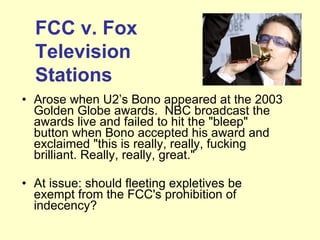
Arose when U2’s Bono appeared at the 2003 Golden Globe awards.  NBC broadcast the awards live and failed to hit the "bleep" button when Bono accepted his award and exclaimed "this is really, really, fucking brilliant. Really, really, great."   At issue: should fleeting expletives be exempt from the FCC's prohibition of indecency?  FCC v. Fox Television Stations
Consider some examples…
Thought that was amusing? Here’s another example…
Outcome By a 5-4 vote, the Supreme Court ruled that the FCC could fine stations for fleeting expletives. So, even if an athlete drops the “F-bomb” during an interview, the station can be fined. Does this seem fair? Consider that stations have the technology to delay live broadcasts by a few seconds to ensure they can bleep out curse words. On the other hand, sometimes curses slip through the censors.
U.S. v. Stevens In April 2010, the Supreme Court was forced to choose between protecting the First Amendment and preventing cruelty to animals. Congress passed a law a decade ago to halt the practice of selling videos that depicted tiny animals being crushed to death. It had been rarely used, however, and came under challenge when prosecutors used it against the dog-fighting industry.
Background For more info on the case, watch the following news report…
Outcome In a 8-1 ruling, the Supreme Court overturned the conviction of a Virginia man who sold dog-fighting videos. Chief Justice John G. Roberts Jr., speaking for the court, said the First Amendment does not allow the government to criminalize whole categories of speech and expression that are deemed undesirable. Roberts also said the law was too broad and could allow prosecutions for selling photos of out-of-season hunting, for example.
Snyder v. Phelps Background :  Westboro Baptist Church, which is known for its extreme stance against homosexuality, regularly began picketing funerals for U.S. soldiers killed in war. Church members believed the soldiers died because God was punishing the U.S. for its deteriorating morality standards. And the controversial funeral pickets helped bring media attention for their cause.
The family of one deceased soldier filed a lawsuit against the church, claiming defamation, invasion of privacy and the intentional infliction of emotional distress for displaying signs that said, "Thank God for dead soldiers" and "Fag troops" at Snyder's funeral. The case eventually made it’s way to the U.S. Supreme Court.  For more info, watch the following video….
Outcome In one of its most controversial decisions in recent years, the Supreme Court ruled in favor of the church. The Court held that the First Amendment shields those who stage a protest at the funeral of a military service member from liability. Only Justice Samuel Alito disagreed with the ruling, arguing: "Our profound national commitment to free and open debate is not a license for the vicious verbal assault that occurred in this case."
The  End.

SCOTUS / Media Law Update: 2008-2011

  • 1.
    Media Law Update:Significant Supreme Court Cases Since 2008
  • 2.
    Introduction Our textbookwas published in 2008. Since then, there have been some new developments in media law. This mixed media slideshow will cover some of the most significant and interesting Supreme Court decisions during the past three years.
  • 3.
    Garcetti v. CeballosBACKGROUND: Los Angeles County Deputy District Attorney Richard Ceballos was concerned that a sheriff's deputy had lied in a search warrant affidavit. When his supervisors told him to keep quiet, he said he was legally obliged to tell the other side, and he testified for them in court. Consequently, he was demoted. He sued, arguing that his employer, the government, unfairly retaliated against him and violated his free speech rights.
  • 4.
    Legal Issue TheSupreme Court examined whether a public employee's purely job-related speech, expressed strictly pursuant to the duties of employment, be protected by the First Amendment simply because it touched on a matter of public concern, or must the speech also be engaged in "as a citizen?"
  • 5.
    Outcome In a5-to-4 decision authored by Justice Anthony Kennedy, the Supreme Court held that speech by a public official is only protected if it is engaged in as a private citizen, not if it is expressed as part of the official's public duties. Ceballos's employers were justified in taking action against him based on his testimony and cooperation with the defense, therefore, because it happened as part of his official duties. "The fact that his duties sometimes required him to speak or write," Justice Kennedy wrote, "does not mean his supervisors were prohibited from evaluating his performance."
  • 6.
    What does thismean? Basically, the Supreme Court said the nation's 21 million public employees do not have the protection of the First Amendment when they raise concerns about wrongdoing as part of their job duties. Critics, including civil libertarians and attorneys for whistle-blowers, said the impact of the ruling could be sweeping, silencing conscientious public employees and endangering public health and safety.
  • 7.
    Federal Election Commissionv. Wisconsin Right to Life & McCain, et al. v. Wisconsin Right to Life (consolidated)
  • 8.
    Background Wisconsin Rightto Life, a nonprofit political advocacy group, ran advertisements encouraging viewers to contact two U.S. Senators and tell them to oppose filibusters of judicial nominees. WRTL intended to keep running the ads through the 2004 election, but the Bipartisan Campaign Reform Act of 2002 prohibits corporate funds from being used for certain political advertisements in the 60-day period prior to an election. WRTL sued the Federal Election Commission, claiming that the BCRA was unconstitutional as applied to the advertisements.
  • 9.
    FYI Just acouple years prior to this case, the Supreme Court had upheld the constitutionality of the entire BRCA, when it was challenged. So, who do you think won this case?
  • 10.
    Outcome Surprise! Bya 5-4 vote the Court ruled that BCRA's limitations on political advertising were unconstitutional as they applied to issue ads like WRTL's. The Court developed a new test to determine whether ads are genuine issue ads or express political advocacy. If it’s the former type of ad, it’s OK to run it during through election. The following video briefly explains the decision in plain English…
  • 11.
    More recently: CitizensUnited v. Federal Election Commission In 2010, the Supreme Court completely reversed course on the BRCA, declaring it unconstitutional. By a 5-4 vote, the Court ruled that the government may not ban political spending by corporations in candidate elections. Dissenting justices (and President Obama) warned that allowing corporate money to flood the political marketplace would corrupt democracy.
  • 12.
    Tenn. Secondary SchoolAthletic Assoc. v. Brentwood Academy BACKGROUND: Interesting case for sports fans... Brentwood Academy, a private school, was a voluntary member of the Tennessee Secondary School Athletic Association. After Brentwood's football coach violated the association’s recruiting rules by contacting some prospective players at other schools, the association imposed various penalties on Brentwood. Brentwood sued the association, claiming that its First Amendment and Due Process rights were being violated.
  • 13.
    The Supreme Courthad ruled previously in a 2001 case that because the TSSAA was composed primarily of public schools, it was a state actor subject to the limitations of the Constitution. Accordingly, the District Court faulted the TSSAA for violations of Brentwood's constitutional rights and threw out the TSSAA's penalties. Case History
  • 14.
    On appeal, theTSSAA argued that it had not exercised the "police power" of the State, but merely enforced a voluntary contractual agreement with Brentwood. The U.S. Court of Appeals for the Sixth circuit rejected this argument, characterizing the TSSAA's actions as those of a "government regulator." The Sixth Circuit held that the state interest in regulating athletic competition was not substantial enough to counter-balance Brentwood's First Amendment rights, and it affirmed the lower court's ruling for Brentwood.
  • 15.
    Outcome In aunanimous opinion written by Justice John Paul Stevens, the Court ruled that "[t]he anti-recruiting rule strikes nowhere near the heart of the First Amendment." Brentwood's speech rights do not extend to potentially coercive one-on-one communications between a coach and potential students, especially after the school voluntarily agreed to the anti-recruiting rule. Also, Justice Thomas recommended that the Court revisit and overrule its previous holding that TSSAA is a state actor.
  • 16.
    Sidenote Notice howthe Supreme Court sort-of reverses course both on this case and the campaign finance case, even though both issues had previously come up recently. It happens. Some of the justices on the Court changed since the initial rulings. That’s why the President’s decision on whom to appoint to a Supreme Court vacancy is so critical. When you have these 5-4 votes, changing just one justice can affect the outcome.
  • 17.
    Davenport v. WashingtonEducation Association BACKGROUND: In some states, public sector labor unions are allowed to collect fees from non-union members. The Supreme Court has ruled that unions may use these fees for political purposes, but only if the non-union member does not object. Washington state also has a "paycheck protection" law, which requires unions to obtain specific permission from non-members before using their fees for political activity. Davenport, a non-union teacher, sued the Washington Education Association teacher's union for violating the law.
  • 18.
    Case History WEAappealed to the Washington Court of Appeals, arguing that Washington's requirement that unions get prior permission was an unconstitutional burden on the unions' First Amendment right to associate for political purposes. Davenport countered that his own First Amendment rights were being violated when his fees went to political causes he did not agree with. The state Court of Appeals ruled in favor of WEA. On appeal, the Washington Supreme Court affirmed, ruling that the burden must lie on the nonmember to assert his rights and object to the political fees.
  • 19.
    Legal Issue TheSupreme Court examined whether a state law requiring labor unions to obtain permission from non-union members before using the non-members' fees for political purposes violate unions' First Amendment rights?
  • 20.
    Outcome No. Ina unanimous opinion written by Justice Scalia, the Court overturned the Washington state courts, ruling that the First Amendment allows a state to require public-sector unions collecting "agency-shop" fees from non-union employees to obtain permission from the employees before using the money for political purposes.
  • 21.
    Morse v. FrederickOne of the more colorful Supreme Court cases in recent history. That’s why it’s best to watch the following video clip below for background info…
  • 22.
    Case History Remember: Tinker v. Des Moines Independent Community School District , which extended First Amendment protection to student speech except where the speech would cause a disturbance. Because the student in this case was punished for his message rather than for any disturbance, the Ninth Circuit Court ruled, the punishment was unconstitutional.
  • 23.
    Outcome The SupremeCourt reversed the Ninth Circuit by a 5-4 vote, ruling that school officials can prohibit students from displaying messages that promote illegal drug use. Chief Justice John Roberts's majority opinion held that although students do have some right to political speech even while in school, this right does not extend to pro-drug messages that may undermine the school's important mission to discourage drug use. The majority held that Frederick's message, though "cryptic," was reasonably interpreted as promoting marijuana use - equivalent to "[Take] bong hits" or "bong hits [are a good thing]." In ruling for Morse, the Court affirmed that the speech rights of public school students are not as extensive as those adults normally enjoy, and that the highly protective standard set by Tinker would not always be applied.
  • 24.
    Arose when U2’sBono appeared at the 2003 Golden Globe awards.  NBC broadcast the awards live and failed to hit the "bleep" button when Bono accepted his award and exclaimed "this is really, really, fucking brilliant. Really, really, great."  At issue: should fleeting expletives be exempt from the FCC's prohibition of indecency?  FCC v. Fox Television Stations
  • 25.
  • 26.
    Thought that wasamusing? Here’s another example…
  • 27.
    Outcome By a5-4 vote, the Supreme Court ruled that the FCC could fine stations for fleeting expletives. So, even if an athlete drops the “F-bomb” during an interview, the station can be fined. Does this seem fair? Consider that stations have the technology to delay live broadcasts by a few seconds to ensure they can bleep out curse words. On the other hand, sometimes curses slip through the censors.
  • 28.
    U.S. v. StevensIn April 2010, the Supreme Court was forced to choose between protecting the First Amendment and preventing cruelty to animals. Congress passed a law a decade ago to halt the practice of selling videos that depicted tiny animals being crushed to death. It had been rarely used, however, and came under challenge when prosecutors used it against the dog-fighting industry.
  • 29.
    Background For moreinfo on the case, watch the following news report…
  • 30.
    Outcome In a8-1 ruling, the Supreme Court overturned the conviction of a Virginia man who sold dog-fighting videos. Chief Justice John G. Roberts Jr., speaking for the court, said the First Amendment does not allow the government to criminalize whole categories of speech and expression that are deemed undesirable. Roberts also said the law was too broad and could allow prosecutions for selling photos of out-of-season hunting, for example.
  • 31.
    Snyder v. PhelpsBackground : Westboro Baptist Church, which is known for its extreme stance against homosexuality, regularly began picketing funerals for U.S. soldiers killed in war. Church members believed the soldiers died because God was punishing the U.S. for its deteriorating morality standards. And the controversial funeral pickets helped bring media attention for their cause.
  • 32.
    The family ofone deceased soldier filed a lawsuit against the church, claiming defamation, invasion of privacy and the intentional infliction of emotional distress for displaying signs that said, "Thank God for dead soldiers" and "Fag troops" at Snyder's funeral. The case eventually made it’s way to the U.S. Supreme Court. For more info, watch the following video….
  • 33.
    Outcome In oneof its most controversial decisions in recent years, the Supreme Court ruled in favor of the church. The Court held that the First Amendment shields those who stage a protest at the funeral of a military service member from liability. Only Justice Samuel Alito disagreed with the ruling, arguing: "Our profound national commitment to free and open debate is not a license for the vicious verbal assault that occurred in this case."
  • 34.