Scottsboro Trial and  To Kill a Mockingbird
Similarities with  T o Kill a Mockingbird Tom Robinson's trial bears striking parallels to the "Scottsboro Trial," one of the most famous-or infamous-court cases in American history.  Both the fictional and the historical cases take place in the 1930s, a time of turmoil and change in America, and both occur in Alabama.  In both, too, the defendants were African-American men, the accusers white women.  In both instances the charge was rape.  In addition, other substantial similarities between the fictional and historical trials become apparent.
The Scottsboro Boys March 25, 1931 Depression Vagabonds—riding trains looking for work A black man and a white man start a fist fight over a simple misunderstanding Black group forces the whites off the train
Whites thrown off train report assault to authorities Train stopped—9 black men arrested and thrown in the Scottsboro County Jail Two mill workers from Huntsville—Victoria Price and Ruby Bates—accused the boys of rape Near lynching—National Guard called in to protect the suspects
Town forms its own opinion:  GUILTY! Defense Team—No Dream Team (One attorney was an UNPAID, unprepared drunk who could hardly walk straight in the courtroom.  The other was in his seventies and had not tried a case in decades  (rumors of senility or Alzheimer's) No cross-examinations or closing arguments Verdict:  GUILTY GUILTY GUILTY
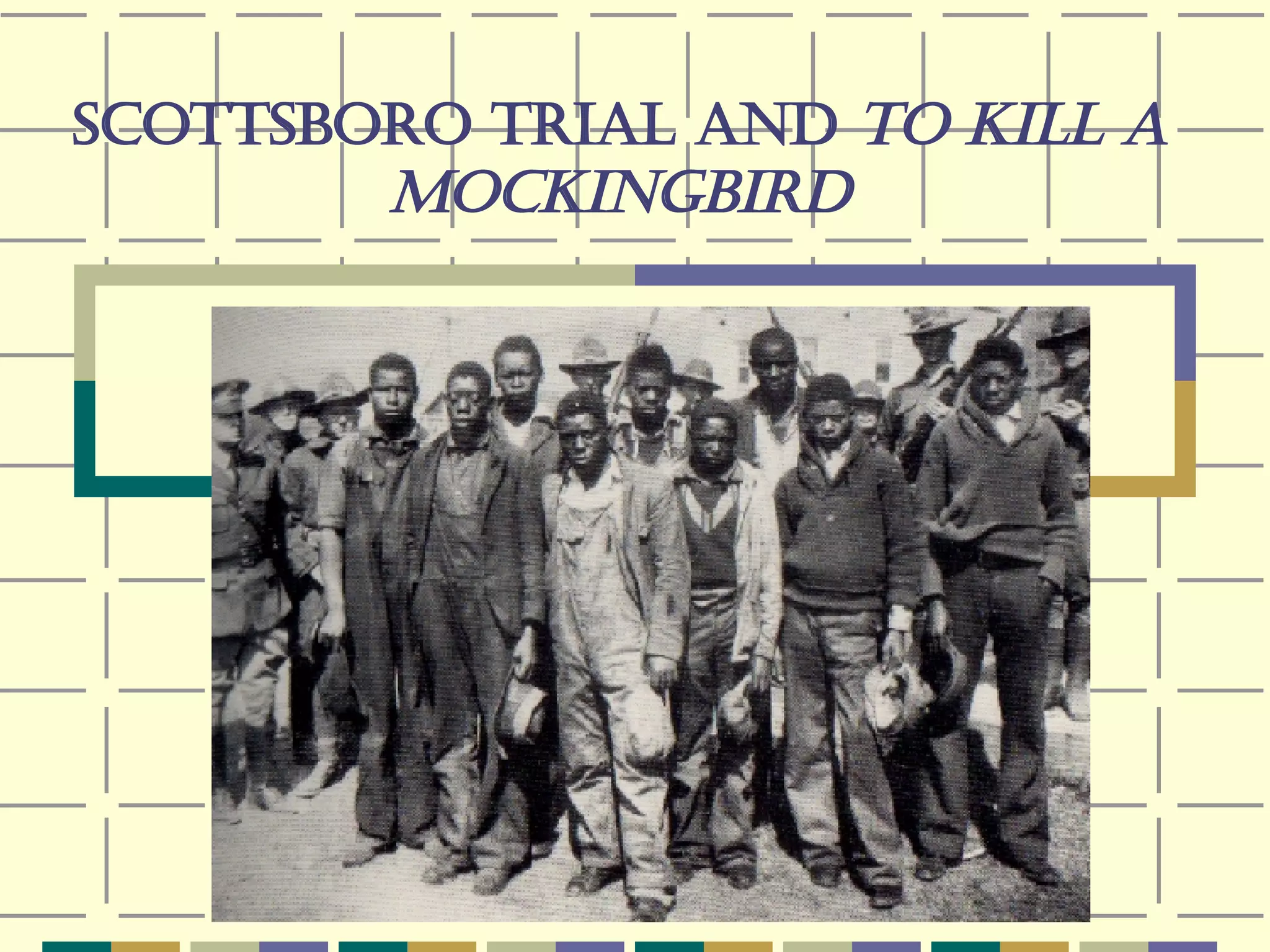
The Scottsboro Boys Trial March 25, 1931:  freight train stopped in a tiny northern Alabama town and 9 African American male passengers were arrested. Two white women, one underage, accused the men of raping them on the train.  The first man was tried and found guilty within a month; he was sentenced to death.
A series of well-publicized trials followed…they were centered on the older woman’s testimony.  She was a known prostitute who seemingly was attempting to avoid getting in trouble for taking a minor across state lines for prostitution (under the Mann Act).
Historical Context Social and economic climate of the 1930s:  Great Depression, millions of people had lost their jobs, their homes, their businesses, or their land, and everything that made up their way of life. In every American city of any size, long "bread lines" of the unemployed formed to receive basic foodstuffs for themselves and their families, their only means of subsistence.
Historical Context Continued The economic collapse of the 1930s resulted in ferocious rivalry for the very few jobs that became available. Consequently, the ill will between black and white people (which had existed ever since the Civil War) intensified, as each group competed with the other for the few available jobs. One result was that incidents of lynchings--primarily of African-Americans--continued. Here, lynching should be defined as the murder of a person by a group of people who set themselves up as judge, jury, and executioner outside the legal system.
Major Figures: Defendants Charley Weems, Clarence Norris, Haywood Patterson, Andy Wright,Willie Roberson, Eugene Williams, Ozie Powell, Olen Montgomery,and Roy Wright.  Chief Defense Attorney:Samuel Leibowitz
Accusers Victoria Price and Ruby Bates
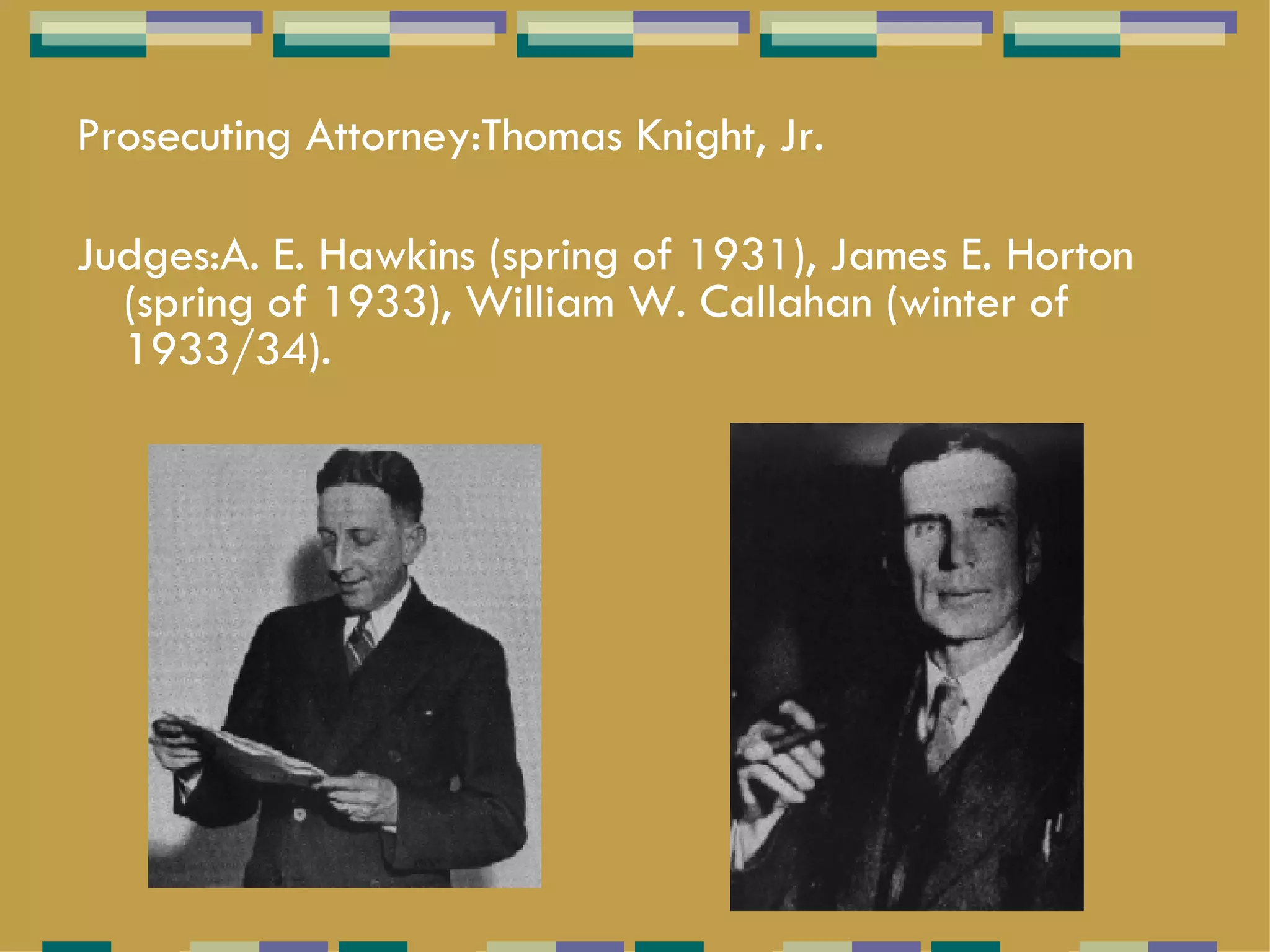
Prosecuting Attorney:Thomas Knight, Jr.   Judges:A. E. Hawkins (spring of 1931), James E. Horton (spring of 1933), William W. Callahan (winter of 1933/34).
Chief Witnesses other than the accusers and defendants: Jack Tiller, friend of Price and Bates; Lester Carter, friend of Price and Bates; Dr. R. R. Bridges, examining physician.
Chronology March 25, 1931 Arrest of nine Scottsboro "boys.“ April 6-9, 1931 First trials in Scottsboro, Alabama. Appeals begin and continue for a year and a half. November 7, 1932 United States Supreme Court orders new trials.  March 27, 1933 Second trials begin. April 9, 1933 Patterson found guilty and sentenced to death in June. June 22, 1933 Judge Horton overturns guilty verdict. Nov./Dec.1933 Clarence Norris is tried, found guilty, and sentenced to death. Appeals continue for two years while he remains on death row. April 1, 1935 U.S. Supreme Court reverses the convictions of Patterson and Norris. May 1, 1935 Another round of trials begins and Patterson is given a 75-year sentence. July 26, 1937 Charges against four men are dropped. 1940s All but one escape or are paroled. June 9, 1950 The last Scottsboro defendant is released from prison. October 25, 1976 Clarence Norris is pardoned.
Parallels Between the Scottsboro and Tom Robinson Trials   The Scottsboro Trials Took place in the 1930s  Took place in northern Alabama  Began with a charge of rape made by white women against African American men  The poor white status of the accusers was a critical issue.  A central figure was a heroic judge, a member of the Alabama Bar who overturned a guilty jury verdict against African American men.  This judge went against public sentiment in trying to protect the rights of the African American defendants.  The first juries failed to include any African Americans, a situation which caused the U.S. Supreme Court to overturn the guilty verdict.  The jury ignored evidence, for example, that the women suffered no injuries.  Attitudes about Southern women and poor whites complicated the trial.
Tom Robinson's Trial Occurs in the 1930s  Takes place in southern Alabama  Begins with a charge of rape made by a white woman against an African American man  The poor white status of Mayella is a critical issue.  A central figure is Atticus, lawyer, legislator and member of the Alabama Bar, who defends an African American man.   Atticus arouses anger in the community in trying to defend Tom Robinson.   The verdict is rendered by a jury of poor white residents of Old Sarum.     The jury ignores evidence, for example, that Tom has a useless left arm.   Attitudes about Southern women and poor whites complicate the trial of Tom Robinson.
The Author and the Book Harper Lee's Childhood Grew up in 1930s - rural southern Alabama town  Father - Amasa Lee - attorney who served in state legislature in Alabama   Older brother and young neighbor (Truman Capote) are playmates  Harper Lee - an avid reader   Six years old when Scottsboro trials were meticulously covered in state and local newspapers  Scout Finch's Childhood Grew up in 1930s - rural southern Alabama town  Father - Atticus Finch - attorney who served in state legislature in Alabama  Older brother and young neighbor (Dill) are playmates  Scout reads before she enters school; reads  Mobile Register  newspaper in first grade  Six years old when the trial of Tom Robinson takes place

Scottsboro And Mockingbird

  • 1.
    Scottsboro Trial and To Kill a Mockingbird
  • 2.
    Similarities with T o Kill a Mockingbird Tom Robinson's trial bears striking parallels to the "Scottsboro Trial," one of the most famous-or infamous-court cases in American history. Both the fictional and the historical cases take place in the 1930s, a time of turmoil and change in America, and both occur in Alabama. In both, too, the defendants were African-American men, the accusers white women. In both instances the charge was rape. In addition, other substantial similarities between the fictional and historical trials become apparent.
  • 3.
    The Scottsboro BoysMarch 25, 1931 Depression Vagabonds—riding trains looking for work A black man and a white man start a fist fight over a simple misunderstanding Black group forces the whites off the train
  • 4.
    Whites thrown offtrain report assault to authorities Train stopped—9 black men arrested and thrown in the Scottsboro County Jail Two mill workers from Huntsville—Victoria Price and Ruby Bates—accused the boys of rape Near lynching—National Guard called in to protect the suspects
  • 5.
    Town forms itsown opinion: GUILTY! Defense Team—No Dream Team (One attorney was an UNPAID, unprepared drunk who could hardly walk straight in the courtroom. The other was in his seventies and had not tried a case in decades (rumors of senility or Alzheimer's) No cross-examinations or closing arguments Verdict: GUILTY GUILTY GUILTY
  • 6.
    The Scottsboro BoysTrial March 25, 1931: freight train stopped in a tiny northern Alabama town and 9 African American male passengers were arrested. Two white women, one underage, accused the men of raping them on the train. The first man was tried and found guilty within a month; he was sentenced to death.
  • 7.
    A series ofwell-publicized trials followed…they were centered on the older woman’s testimony. She was a known prostitute who seemingly was attempting to avoid getting in trouble for taking a minor across state lines for prostitution (under the Mann Act).
  • 8.
    Historical Context Socialand economic climate of the 1930s: Great Depression, millions of people had lost their jobs, their homes, their businesses, or their land, and everything that made up their way of life. In every American city of any size, long "bread lines" of the unemployed formed to receive basic foodstuffs for themselves and their families, their only means of subsistence.
  • 9.
    Historical Context ContinuedThe economic collapse of the 1930s resulted in ferocious rivalry for the very few jobs that became available. Consequently, the ill will between black and white people (which had existed ever since the Civil War) intensified, as each group competed with the other for the few available jobs. One result was that incidents of lynchings--primarily of African-Americans--continued. Here, lynching should be defined as the murder of a person by a group of people who set themselves up as judge, jury, and executioner outside the legal system.
  • 10.
    Major Figures: DefendantsCharley Weems, Clarence Norris, Haywood Patterson, Andy Wright,Willie Roberson, Eugene Williams, Ozie Powell, Olen Montgomery,and Roy Wright. Chief Defense Attorney:Samuel Leibowitz
  • 11.
  • 12.
    Prosecuting Attorney:Thomas Knight,Jr. Judges:A. E. Hawkins (spring of 1931), James E. Horton (spring of 1933), William W. Callahan (winter of 1933/34).
  • 13.
    Chief Witnesses otherthan the accusers and defendants: Jack Tiller, friend of Price and Bates; Lester Carter, friend of Price and Bates; Dr. R. R. Bridges, examining physician.
  • 14.
    Chronology March 25,1931 Arrest of nine Scottsboro "boys.“ April 6-9, 1931 First trials in Scottsboro, Alabama. Appeals begin and continue for a year and a half. November 7, 1932 United States Supreme Court orders new trials. March 27, 1933 Second trials begin. April 9, 1933 Patterson found guilty and sentenced to death in June. June 22, 1933 Judge Horton overturns guilty verdict. Nov./Dec.1933 Clarence Norris is tried, found guilty, and sentenced to death. Appeals continue for two years while he remains on death row. April 1, 1935 U.S. Supreme Court reverses the convictions of Patterson and Norris. May 1, 1935 Another round of trials begins and Patterson is given a 75-year sentence. July 26, 1937 Charges against four men are dropped. 1940s All but one escape or are paroled. June 9, 1950 The last Scottsboro defendant is released from prison. October 25, 1976 Clarence Norris is pardoned.
  • 15.
    Parallels Between theScottsboro and Tom Robinson Trials The Scottsboro Trials Took place in the 1930s Took place in northern Alabama Began with a charge of rape made by white women against African American men The poor white status of the accusers was a critical issue. A central figure was a heroic judge, a member of the Alabama Bar who overturned a guilty jury verdict against African American men. This judge went against public sentiment in trying to protect the rights of the African American defendants. The first juries failed to include any African Americans, a situation which caused the U.S. Supreme Court to overturn the guilty verdict. The jury ignored evidence, for example, that the women suffered no injuries. Attitudes about Southern women and poor whites complicated the trial.
  • 16.
    Tom Robinson's TrialOccurs in the 1930s Takes place in southern Alabama Begins with a charge of rape made by a white woman against an African American man The poor white status of Mayella is a critical issue. A central figure is Atticus, lawyer, legislator and member of the Alabama Bar, who defends an African American man.   Atticus arouses anger in the community in trying to defend Tom Robinson.   The verdict is rendered by a jury of poor white residents of Old Sarum.     The jury ignores evidence, for example, that Tom has a useless left arm.   Attitudes about Southern women and poor whites complicate the trial of Tom Robinson.
  • 17.
    The Author andthe Book Harper Lee's Childhood Grew up in 1930s - rural southern Alabama town Father - Amasa Lee - attorney who served in state legislature in Alabama   Older brother and young neighbor (Truman Capote) are playmates Harper Lee - an avid reader   Six years old when Scottsboro trials were meticulously covered in state and local newspapers Scout Finch's Childhood Grew up in 1930s - rural southern Alabama town Father - Atticus Finch - attorney who served in state legislature in Alabama Older brother and young neighbor (Dill) are playmates Scout reads before she enters school; reads Mobile Register newspaper in first grade Six years old when the trial of Tom Robinson takes place