SCoRE: A learner-friendly
corpus and software
Michael H. Brown
Kanda Institute of Foreign Languages
brown-ma@kifl.ac.jp
Outline
1. Key terms and background
2. SCoRE tools
3. How my students and I used SCoRE
4. How my students felt about SCoRE
5. Points for consideration
Corpora and Data-driven Learning
Corpus: A searchable database of systematically collected
language data (i.e. texts).
Data-driven Learning (DDL): Learners accessing and
exploiting the data found in corpora for learning purposes.
Guided Induction
1. Illustrations: looking at data
2. Interaction: discussing observations
3. Intervention: providing guides or hints
4. Induction: making/describing one’s own ‘rule’
(Flowerdew, 2009)
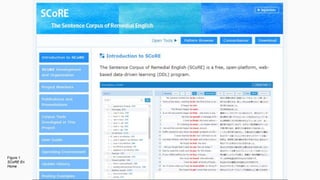
SCoRE
● SCoRE is the Sentence
Corpus of Remedial English.
● It is a collection of over
10,000 English sentences
featuring selected grammar
patterns.
● The English sentences are
paired with 10,000
Japanese sentences.
● It is primarily for Japanese
learners of English.
(Chujo et al., 2015)
Figure 1
SCoRE En
Home
Figure 2 SCoRE En Pattern Browser
Figure 3 SCoRE En Concordancer
Figure 4
SCoRE Ja
Home
Figure 5 SCoRE Ja Pattern Browser
Figure 6 SCoRE Ja Concordancer
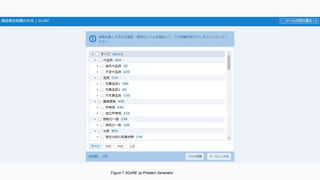
Figure 7 SCoRE Ja Problem Generator
Figure 8 SCoRE Ja Problems
Using SCoRE
- In an earlier study, SCoRE was used to teach grammar patterns from a
coursebook (Brown, 2017).
- The coursebook lent itself to a PPP approach to grammar instruction.
- SCoRE-assisted guided induction activities were used in place of the
coursebook for several explicit grammar patterns.
- Students generally found the software easy to use, and many believed
that this approach helped them more than the PPP approach.
Using SCoRE, cont.
- The present study involved using SCoRE as a supplementary resource
for addressing a) grammatical constructions that students were having
trouble grasping and b) common and reoccurring errors.
- The instructional approach was again Guided Induction.
- At the end of the term, students completed a survey on their feelings
and reactions to using SCoRE and Guided Induction.
Guided Induction Example
- The use of “almost people”, as in, “I think almost people like sports” is a
common, reoccurring error.
- Students looked up almost using the SCoRE concordance tool.
- They filled in a worksheet that was designed to guide them in noticing
particular features of how almost is used.
- The guidance given was intended to help students themselves inductively
reason that almost everyone is the phrasing they probably want to use.
Survey (n=74)
Completely
disagree
Mostly
disagree
Disagree a
little
Agree a little Mostly agree Completely
agree
SCoRE was
easy to use
2 3 3 33 22 11
I know how to
use the
concordancer
well
1 4 1 19 48 1
I know how to
use the
P.B.well
2 6 4 33 25 4
Survey (n=74)
Completely
disagree
Mostly
disagree
Disagree a
little
Agree a little Mostly agree Completely
agree
The SCoRE
worksheets were
helpful
0 3 6 7 52 6
The SCoRE
worksheets were
clear
2 6 6 26 30 4
The SCoRE
worksheets were
challenging
0 1 9 13 46 5
Survey (n=74)
Completely
disagree
Mostly
disagree
Disagree a
little
Agree a little Mostly
agree
Completely
agree
The SCoRE activities
improved my
grammar
understanding
0 2 7 7 52 6
I prefer the bilingual
version of SCoRE
0 0 14 39 14 7
I would like it if
SCoRE were used in
other classes
0 3 16 37 26 2
Points for considerations
- SCoRE is simple to use.
- Students’ perceptions are that it is helpful.
- In my perception, familiarity with SCoRE and the Guided Induction activities was
important. That is, students seemed to like them more as they became more
familiar with them.
HOWEVER
- There was no instrument for clearly disentangling perceptions of SCoRE itself
from the approach (Guided Induction).
- In discussions, students mentioned software issues with the Problem
Generator (e.g. misaligned sentence pairs), as well as frustration that there is
References
Brown, M.H. (2017). “Using the Sentence Corpus of Remedial English to Introduce Data-Driven Learning
Tasks”, Kanda Academic Review, 1(1), 1-4.
Chujo, K., Oghigian, K. and Akasegawa, S. (2015). “A corpus and grammatical browsing system for
remedial EFL learners,” In A. Leńko-Szymańska and A. Boulton (eds.), Multiple Affordances of Language
Corpora for Data-driven Learning. Amsterdam: John Benjamins. 109-128.
Flowerdew, L. (2009). “Applying corpus linguistics to pedagogy: A critical evaluation”.
International Journal of Corpus Linguistics, 14(3), 393-417.
---------------------------------------------------------------------------------------------------------------------------------------------
The Sentence Corpus of Remedial English can be found at:
www.score-corpus.org (Japanese)
www.score-corpus.org/en (English)
These slides will be made available via my Twitter @Za_Maikeru
And via my corpus linguistics blog: https://corpling4efl.wordpress.com
Thank you for listening.

SCoRE: A learner-friendly corpus and software

  • 1.
    SCoRE: A learner-friendly corpusand software Michael H. Brown Kanda Institute of Foreign Languages brown-ma@kifl.ac.jp
  • 2.
    Outline 1. Key termsand background 2. SCoRE tools 3. How my students and I used SCoRE 4. How my students felt about SCoRE 5. Points for consideration
  • 3.
    Corpora and Data-drivenLearning Corpus: A searchable database of systematically collected language data (i.e. texts). Data-driven Learning (DDL): Learners accessing and exploiting the data found in corpora for learning purposes.
  • 4.
    Guided Induction 1. Illustrations:looking at data 2. Interaction: discussing observations 3. Intervention: providing guides or hints 4. Induction: making/describing one’s own ‘rule’ (Flowerdew, 2009)
  • 5.
    SCoRE ● SCoRE isthe Sentence Corpus of Remedial English. ● It is a collection of over 10,000 English sentences featuring selected grammar patterns. ● The English sentences are paired with 10,000 Japanese sentences. ● It is primarily for Japanese learners of English. (Chujo et al., 2015)
  • 6.
  • 7.
    Figure 2 SCoREEn Pattern Browser
  • 8.
    Figure 3 SCoREEn Concordancer
  • 9.
  • 10.
    Figure 5 SCoREJa Pattern Browser
  • 11.
    Figure 6 SCoREJa Concordancer
  • 12.
    Figure 7 SCoREJa Problem Generator
  • 13.
    Figure 8 SCoREJa Problems
  • 14.
    Using SCoRE - Inan earlier study, SCoRE was used to teach grammar patterns from a coursebook (Brown, 2017). - The coursebook lent itself to a PPP approach to grammar instruction. - SCoRE-assisted guided induction activities were used in place of the coursebook for several explicit grammar patterns. - Students generally found the software easy to use, and many believed that this approach helped them more than the PPP approach.
  • 15.
    Using SCoRE, cont. -The present study involved using SCoRE as a supplementary resource for addressing a) grammatical constructions that students were having trouble grasping and b) common and reoccurring errors. - The instructional approach was again Guided Induction. - At the end of the term, students completed a survey on their feelings and reactions to using SCoRE and Guided Induction.
  • 16.
    Guided Induction Example -The use of “almost people”, as in, “I think almost people like sports” is a common, reoccurring error. - Students looked up almost using the SCoRE concordance tool. - They filled in a worksheet that was designed to guide them in noticing particular features of how almost is used. - The guidance given was intended to help students themselves inductively reason that almost everyone is the phrasing they probably want to use.
  • 17.
    Survey (n=74) Completely disagree Mostly disagree Disagree a little Agreea little Mostly agree Completely agree SCoRE was easy to use 2 3 3 33 22 11 I know how to use the concordancer well 1 4 1 19 48 1 I know how to use the P.B.well 2 6 4 33 25 4
  • 18.
    Survey (n=74) Completely disagree Mostly disagree Disagree a little Agreea little Mostly agree Completely agree The SCoRE worksheets were helpful 0 3 6 7 52 6 The SCoRE worksheets were clear 2 6 6 26 30 4 The SCoRE worksheets were challenging 0 1 9 13 46 5
  • 19.
    Survey (n=74) Completely disagree Mostly disagree Disagree a little Agreea little Mostly agree Completely agree The SCoRE activities improved my grammar understanding 0 2 7 7 52 6 I prefer the bilingual version of SCoRE 0 0 14 39 14 7 I would like it if SCoRE were used in other classes 0 3 16 37 26 2
  • 20.
    Points for considerations -SCoRE is simple to use. - Students’ perceptions are that it is helpful. - In my perception, familiarity with SCoRE and the Guided Induction activities was important. That is, students seemed to like them more as they became more familiar with them. HOWEVER - There was no instrument for clearly disentangling perceptions of SCoRE itself from the approach (Guided Induction). - In discussions, students mentioned software issues with the Problem Generator (e.g. misaligned sentence pairs), as well as frustration that there is
  • 21.
    References Brown, M.H. (2017).“Using the Sentence Corpus of Remedial English to Introduce Data-Driven Learning Tasks”, Kanda Academic Review, 1(1), 1-4. Chujo, K., Oghigian, K. and Akasegawa, S. (2015). “A corpus and grammatical browsing system for remedial EFL learners,” In A. Leńko-Szymańska and A. Boulton (eds.), Multiple Affordances of Language Corpora for Data-driven Learning. Amsterdam: John Benjamins. 109-128. Flowerdew, L. (2009). “Applying corpus linguistics to pedagogy: A critical evaluation”. International Journal of Corpus Linguistics, 14(3), 393-417. --------------------------------------------------------------------------------------------------------------------------------------------- The Sentence Corpus of Remedial English can be found at: www.score-corpus.org (Japanese) www.score-corpus.org/en (English) These slides will be made available via my Twitter @Za_Maikeru And via my corpus linguistics blog: https://corpling4efl.wordpress.com Thank you for listening.