Scopus Title
selection criteria
Ramin Sadeghi, MD
Nuclear Medicine Research
Center, Mashhad University of
Medical Sciences
SCOPUS Database
 Being indexed in Scopus is a major
attainment for journals worldwide and
achieving this success brings with it not only a
measure of satisfaction but also assurance of
the quality of your journal to other members of
the scientific community.
What journals are eligible for
Scopus review?
 Minimum Criteria:
 The Journal should consist of peer-reviewed content
 The Journal should be published on a regular basis (have an
ISSN number that has been registered with the International
ISSN Centre)
 Content should be relevant and readable for an international
audience (at minimum have references in Roman script and
English language abstracts and article titles)
 The Journal should have a publication ethics and publication
malpractice statement
 Additionally, it is general policy that a journal needs to
have a publication history of at least two years before it
can be reviewed for Scopus coverage.
What is a peer reviewed article in a
peer-reviewed journal?
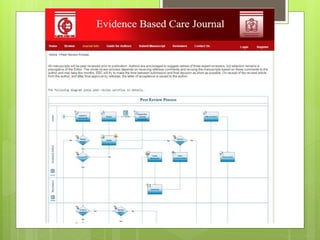
 The author of the article must submit it to the journal editor who forwards
the article to experts in the field, after it has been processed through the
relevant journal submission system. Because the reviewers specialize in
the same scholarly area as the author, they are considered the author’s
peers (hence “peer-review”).
 These impartial reviewers are charged with carefully evaluating the quality
of the submitted manuscript, often using their own evaluation criteria to
assist the review process.
 The peer reviewers check a number of issues in the manuscript including
assessing the validity of the research methodology and procedures. They
would also be vigilant for any unethical practice in the research or
plagiarism.
 If appropriate, they may recommend revisions and re-submission of an
article. In other cases they may recommend rejection for various reasons.
The editor of a journal is reliant on its reviewers to offer guidance on
whether to accept or reject an article.
Why does the abstract of an article
have to be published in English?
 The main language of the international scientific
community – and therefore also for Scopus users – is
considered to be English.
 Therefore, all content of the records that are available
in Scopus (title, abstract, keywords) need to be in
English. Also indexing, profiling and processing of
content in Scopus are based on the English language.
 Please note that the full-text of titles covered in Scopus
can be in any language as long as the title, abstracts
and keywords are in English. Currently journals that
have full-text content in 40 different languages are
covered in Scopus.
What is a Publication Ethics and
Publication Malpractice Statement?
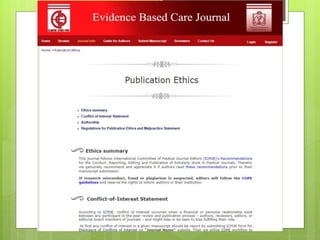
 The Publication Ethics and Publication Malpractice
Statement is a statement which makes it clear that the
Publisher adheres to a recognized Code of Conduct
and ethical practice in relation to its own work and that
of its journals.
 This statement should include content based on the
principles of an organization such as COPE, such as
equality for all articles/authors by the Editor and
Editorial team and journal reviewers; confidentiality;
publication fraud; originality and plagiarism as well as
notification of what action it would take if this is
suspected; authorship rules and disclosures and
conflict of interests.
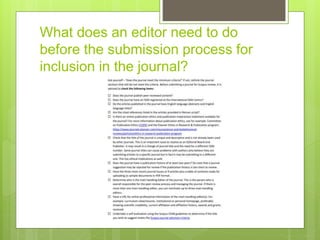
What does an editor need to do
before the submission process for
inclusion in the journal?
Following submission to Scopus, how
long will it take before getting a
response?
 Depending on the number of suggestions
received and the available information about
the suggested title, it will take 6-12 months
before the review process is completed.
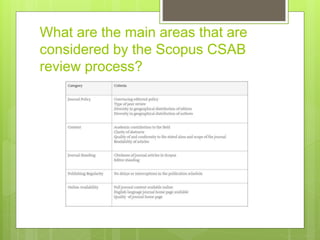
What are the main areas that are
considered by the Scopus CSAB
review process?
Journal Policy
 Convincing editorial concept/policy
 Type of peer-review
 Diversity geographic distribution of editors
 Diversity geographic distribution of authors
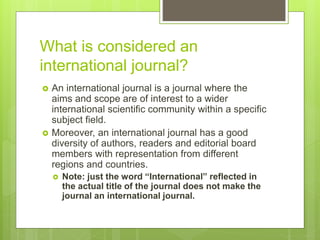
What is considered an
international journal?
 An international journal is a journal where the
aims and scope are of interest to a wider
international scientific community within a specific
subject field.
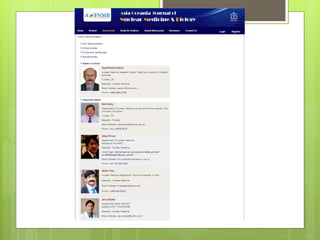
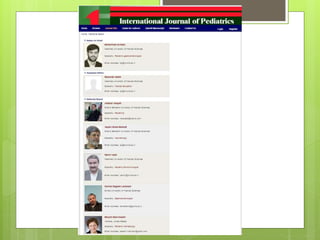
 Moreover, an international journal has a good
diversity of authors, readers and editorial board
members with representation from different
regions and countries.
 Note: just the word “International” reflected in
the actual title of the journal does not make the
journal an international journal.
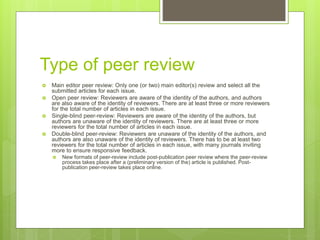
Type of peer review
 Main editor peer review: Only one (or two) main editor(s) review and select all the
submitted articles for each issue.
 Open peer review: Reviewers are aware of the identity of the authors, and authors
are also aware of the identity of reviewers. There are at least three or more reviewers
for the total number of articles in each issue.
 Single-blind peer-review: Reviewers are aware of the identity of the authors, but
authors are unaware of the identity of reviewers. There are at least three or more
reviewers for the total number of articles in each issue.
 Double-blind peer-review: Reviewers are unaware of the identity of the authors, and
authors are also unaware of the identity of reviewers. There has to be at least two
reviewers for the total number of articles in each issue, with many journals inviting
more to ensure responsive feedback.
 New formats of peer-review include post-publication peer review where the peer-review
process takes place after a (preliminary version of the) article is published. Post-
publication peer-review takes place online.
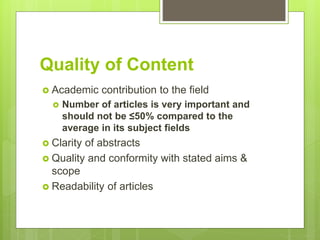
Quality of Content
 Academic contribution to the field
 Number of articles is very important and
should not be ≤50% compared to the
average in its subject fields
 Clarity of abstracts
 Quality and conformity with stated aims &
scope
 Readability of articles
Journal Standing
 Citedness of journal articles in Scopus
 Editor standing
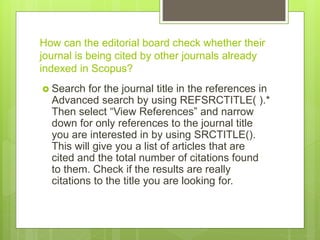
How can the editorial board check whether their
journal is being cited by other journals already
indexed in Scopus?
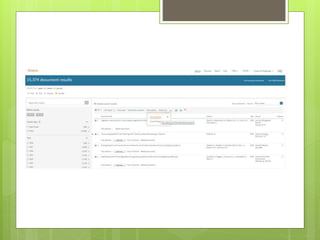
 Search for the journal title in the references in
Advanced search by using REFSRCTITLE( ).*
Then select “View References” and narrow
down for only references to the journal title
you are interested in by using SRCTITLE().
This will give you a list of articles that are
cited and the total number of citations found
to them. Check if the results are really
citations to the title you are looking for.
Editor standing
 Have a URL for online professional
information of the main handling editor(s). For
example, curriculum vitae/resume,
institutional or personal homepage, preferably
showing scientific credibility, current affiliation
and affiliation history, awards and grants
received.
Who should be nominated as the main
handling editor of the journal?
 The main handling Editor(s) should not just be in
name only (that is not contributing to the journal
editor role) nor should they be an ad hoc Editorial
Board member; instead they need to involved with
the journal and its management.
 It is highly recommended that the main handling
editor (or Editor in Chief in some journals) take an
active interest in wanting to raise the overall
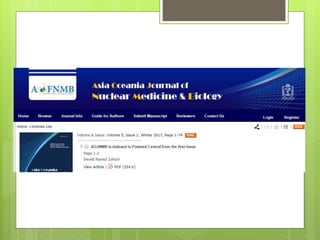
quality of the journal. Their involvement is often
seen in their Editorials in some of the journal
issues.
Regularity
 No delay in publication schedule
Online Availability
 Content available online
 English-language journal home page
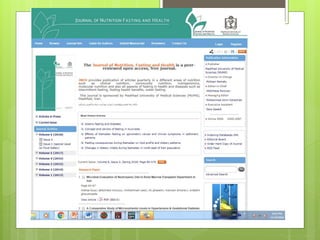
 Quality of home page
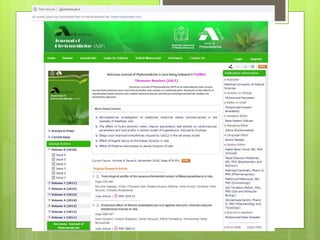
How important is the website
information to the submission process?
 If the reviewer is unable to find the information in
relation to all aspects of the review process on the
journal website, then it will be very difficult to
assess the quality of the journal for inclusion in
Scopus. It is also important that the website and
the journal be clearly visible and separated from
other marketing or promotion material of the
publisher. For example a university published
journal being placed in the middle of the main
University web-site rather than a dedicated journal
home page.
What should the website
information include?
 • Information about the Editor / Editor in Chief and the structure and
names of the Editorial Boards and/or International Advisory Board
members.
 Author guidelines explaining the manuscript submission process and
criteria.
 Information on how the peer-review process is organized.
 Publishing ethics guidelines. The publishing ethics guidelines should
make it clear what action the Editor or Editorial Board will take if any
malpractice is suspected.
 (if relevant) Clear information about criteria and costs of Open Access
options.
 Information about how potential readers can get access to the full-text
articles published in the journal.
 Information about the role and organization of the publisher of the journal.
How important is it to keep the
website updated?
 If a journal can be seen to have a reducing
number of articles over time, or major time gaps
between one issue and the other then this raises
questions of whether that journal is receiving
enough articles (copy flow) to sustain itself .
 One of the most important issues is to ensure that
all links on the website are working and also that
any links created function appropriately and have
the most up to date information.
What should a Publisher do if the journal
information is part of a University department or a
Society?
 It is recommended that whenever possible
that a journal publication has its own website
or home page if it is published on behalf of a
Society or Institute. This to ensure that the
information and content can be readily seen
and considered as a distinct publication in its
own right by potential authors, readers and
the reviewers of the Scopus CSAB.
Examples
 The production standards are high, but the journal is only
producing around 30 articles per annum, including a significant
proportion of case reports.
This journal will most probably secure accession to SCOPUS in
due course, but there is much that the editors could do to
strengthen the title in strategic terms.
The title itself would benefit from being more specific and
regional, for example "The Iranian Journal of..."
The fact that it is a single institutional journal may in fact
constrain its appeal to a wider potential authorship. Greater
independence from the University may allow it to grow as a
successful national and regional journal in its field, and attract a
wider range of papers.
 …………is published in English by the Mashhad University of Medical Sciences. The
production standards are high, but the contents are not "medical" in the strict sense
that almost all of the articles refer to experimentation on cell lines, mice and rats.
If the journal title were "The Iranian Journal of experimental plant biology" or
similar, then this work might be credible and the journal would probably justify
accession to SCOPUS.
However, the content is not persuasive of a medical journal, as there are very few
credible and rigorous clinical studies, and no evidence of the large
scale, independent and longitudinal clinical trials which are necessary to establish the
therapeutic utility of the agents under study.
I this refer the editors back to the 2014 review comments. This journal is impressive
on presentational grounds, but it remains suspect on medical and quality grounds, in
that accession of the Journal to SCOPUS at this point would imbue the journal and
its purpose with a spurious credibility which the journal content does not presently
justify".
 “-----is published in Iran by the Mashhad University of Medical Sciences. It
is one of a very large number of relatively low volume institutional journals
from Iranian Universities, in a sector which is ripe for consolidation and
greater collaboration.
The choice of title is curious, as this is primarily "The Iranian Journal of
Medical Toxcicology", the term "Asia-Pacific" usually being used by
journals originating in RimPac countries.
The journal is publishing around 35 articles per annum of variable but
generally weak quality.
The web page should make clear:
- The publication Ethics Policy of the Journal
- Its strategy for long term archiving of content
- All publication charges which it raises in respect of the open access
model.
 ----------- Journal is one of a number of health journals from
Mashhad University of Medical Sciences in Iran.
It is only publishing around 26 articles per annum and citation
activity is minimal. The content is of local interest but not of
sufficient quality or originality to be internationally of significant
ineterst.
The title is nondescript and would be better geographically
defined as "The Iranian Journal of ..." or similar.
The Editorial Board is disproportionately large to the number of
articles published.
 -----------is published by "the Asia Oceania Federation of Nuclear Medicine & Biology"
in Mashhad, Iran. The journal would appear to be one of a large portfolio of medical
journals from The University of Mashhad.
As yet, it is only publishing around 20 articles per annum, with some citation
activity. The editorial board is very large relative to this activity, and more use could
be made of members of the board to expand the content.
This journal should be suitable for accession to SCOPUS in due course, and there
should be considerable regional interest in the content. The Editors should develop
a strategic plan to expand the quality and quanity of coverage.
The editors and publishers might wish to explore a co-hosting or partnership
arrangement with one of the major international academic publishers to secure the
professional, presentational and distribution skills and infrastructure of such
organisations.
In any case, the web site should make clear the funding model and the long term
archiving arranegements for journal content. If there are any publication charges,
these should also be made clear".
 Despite the implicit international aspirations of its geographically non-
specific title, the editorial board and authorship is almost entirely
Iranian or Iranian diaspora. The journal would almost certainly be
strengthened rather than weakened by a stronger regional identity and
title, for example as "The Iranian Journal of..."
Alternatively, there needs to be an aggressive policy of international
diversification of an active and effective editorial board, and
internationalisation of the authorship and content.
The journal is currently attracting only around 30 articles per annum, of
variable quality. There is an overreliance on extensive statistical analysis
of data which in places is obscuring rather than illuminating the underlying
observations, insights and discussion of some very complex social issues
for a very practical target audience.
 --------is one of a number of health subject journals from
Mashhad University of Medical Sciences. It has been approved
by Department of Culture and Islamic Guidance No. 91/10251
date 2012 and is regulated by the Medical Journal Commission
of the Iranian Ministry of Health and Medical Education as a
scientific –research journal.
This is presently a parochial institutional journal which is only
publishing around 20 per articles per annum of primarily local
interest, and attracting very little citation activity. There is a
large Iranian editorial board with strong local representation,
relative to the number of articles published.
On the positive side, co-publication in English will progressively
bring the content to a wider audience.
 “--------) is one of a large number of specialist journals published in Iran by Mashhad
University. Publication standards are high, and it is publishing around 30 articles
per annum with limited citation activity.
As such, it is one of a very large number of mono-institutional university health
journals worldwide, which all suffer from the similar constraint of a narrow
authorship, readership and editorial base, and which struggle to secure
sufficient quality and specialisation of content to become competitive with
their national, regional and international competitors.
The title is very similar to a number of other journals in the field, with potential for
market confusion, and it would benefit from greater geographic specificity, eg "The
Iranian Journal of ... " or "The Mashhad University Journal of ..."
This journal clearly serves a local purpose, and it shows considerable potential, but it
would benefit from a clear strategy to increase the quality & quantity of content,
perhaps through national and/or regional partnerships with similar journals".

Scopus title selection criteria

  • 1.
    Scopus Title selection criteria RaminSadeghi, MD Nuclear Medicine Research Center, Mashhad University of Medical Sciences
  • 2.
    SCOPUS Database  Beingindexed in Scopus is a major attainment for journals worldwide and achieving this success brings with it not only a measure of satisfaction but also assurance of the quality of your journal to other members of the scientific community.
  • 3.
    What journals areeligible for Scopus review?  Minimum Criteria:  The Journal should consist of peer-reviewed content  The Journal should be published on a regular basis (have an ISSN number that has been registered with the International ISSN Centre)  Content should be relevant and readable for an international audience (at minimum have references in Roman script and English language abstracts and article titles)  The Journal should have a publication ethics and publication malpractice statement  Additionally, it is general policy that a journal needs to have a publication history of at least two years before it can be reviewed for Scopus coverage.
  • 4.
    What is apeer reviewed article in a peer-reviewed journal?  The author of the article must submit it to the journal editor who forwards the article to experts in the field, after it has been processed through the relevant journal submission system. Because the reviewers specialize in the same scholarly area as the author, they are considered the author’s peers (hence “peer-review”).  These impartial reviewers are charged with carefully evaluating the quality of the submitted manuscript, often using their own evaluation criteria to assist the review process.  The peer reviewers check a number of issues in the manuscript including assessing the validity of the research methodology and procedures. They would also be vigilant for any unethical practice in the research or plagiarism.  If appropriate, they may recommend revisions and re-submission of an article. In other cases they may recommend rejection for various reasons. The editor of a journal is reliant on its reviewers to offer guidance on whether to accept or reject an article.
  • 6.
    Why does theabstract of an article have to be published in English?  The main language of the international scientific community – and therefore also for Scopus users – is considered to be English.  Therefore, all content of the records that are available in Scopus (title, abstract, keywords) need to be in English. Also indexing, profiling and processing of content in Scopus are based on the English language.  Please note that the full-text of titles covered in Scopus can be in any language as long as the title, abstracts and keywords are in English. Currently journals that have full-text content in 40 different languages are covered in Scopus.
  • 7.
    What is aPublication Ethics and Publication Malpractice Statement?  The Publication Ethics and Publication Malpractice Statement is a statement which makes it clear that the Publisher adheres to a recognized Code of Conduct and ethical practice in relation to its own work and that of its journals.  This statement should include content based on the principles of an organization such as COPE, such as equality for all articles/authors by the Editor and Editorial team and journal reviewers; confidentiality; publication fraud; originality and plagiarism as well as notification of what action it would take if this is suspected; authorship rules and disclosures and conflict of interests.
  • 9.
    What does aneditor need to do before the submission process for inclusion in the journal?
  • 10.
    Following submission toScopus, how long will it take before getting a response?  Depending on the number of suggestions received and the available information about the suggested title, it will take 6-12 months before the review process is completed.
  • 11.
    What are themain areas that are considered by the Scopus CSAB review process?
  • 12.
    Journal Policy  Convincingeditorial concept/policy  Type of peer-review  Diversity geographic distribution of editors  Diversity geographic distribution of authors
  • 13.
    What is consideredan international journal?  An international journal is a journal where the aims and scope are of interest to a wider international scientific community within a specific subject field.  Moreover, an international journal has a good diversity of authors, readers and editorial board members with representation from different regions and countries.  Note: just the word “International” reflected in the actual title of the journal does not make the journal an international journal.
  • 16.
    Type of peerreview  Main editor peer review: Only one (or two) main editor(s) review and select all the submitted articles for each issue.  Open peer review: Reviewers are aware of the identity of the authors, and authors are also aware of the identity of reviewers. There are at least three or more reviewers for the total number of articles in each issue.  Single-blind peer-review: Reviewers are aware of the identity of the authors, but authors are unaware of the identity of reviewers. There are at least three or more reviewers for the total number of articles in each issue.  Double-blind peer-review: Reviewers are unaware of the identity of the authors, and authors are also unaware of the identity of reviewers. There has to be at least two reviewers for the total number of articles in each issue, with many journals inviting more to ensure responsive feedback.  New formats of peer-review include post-publication peer review where the peer-review process takes place after a (preliminary version of the) article is published. Post- publication peer-review takes place online.
  • 17.
    Quality of Content Academic contribution to the field  Number of articles is very important and should not be ≤50% compared to the average in its subject fields  Clarity of abstracts  Quality and conformity with stated aims & scope  Readability of articles
  • 18.
    Journal Standing  Citednessof journal articles in Scopus  Editor standing
  • 19.
    How can theeditorial board check whether their journal is being cited by other journals already indexed in Scopus?  Search for the journal title in the references in Advanced search by using REFSRCTITLE( ).* Then select “View References” and narrow down for only references to the journal title you are interested in by using SRCTITLE(). This will give you a list of articles that are cited and the total number of citations found to them. Check if the results are really citations to the title you are looking for.
  • 21.
    Editor standing  Havea URL for online professional information of the main handling editor(s). For example, curriculum vitae/resume, institutional or personal homepage, preferably showing scientific credibility, current affiliation and affiliation history, awards and grants received.
  • 22.
    Who should benominated as the main handling editor of the journal?  The main handling Editor(s) should not just be in name only (that is not contributing to the journal editor role) nor should they be an ad hoc Editorial Board member; instead they need to involved with the journal and its management.  It is highly recommended that the main handling editor (or Editor in Chief in some journals) take an active interest in wanting to raise the overall quality of the journal. Their involvement is often seen in their Editorials in some of the journal issues.
  • 24.
    Regularity  No delayin publication schedule
  • 26.
    Online Availability  Contentavailable online  English-language journal home page  Quality of home page
  • 27.
    How important isthe website information to the submission process?  If the reviewer is unable to find the information in relation to all aspects of the review process on the journal website, then it will be very difficult to assess the quality of the journal for inclusion in Scopus. It is also important that the website and the journal be clearly visible and separated from other marketing or promotion material of the publisher. For example a university published journal being placed in the middle of the main University web-site rather than a dedicated journal home page.
  • 28.
    What should thewebsite information include?  • Information about the Editor / Editor in Chief and the structure and names of the Editorial Boards and/or International Advisory Board members.  Author guidelines explaining the manuscript submission process and criteria.  Information on how the peer-review process is organized.  Publishing ethics guidelines. The publishing ethics guidelines should make it clear what action the Editor or Editorial Board will take if any malpractice is suspected.  (if relevant) Clear information about criteria and costs of Open Access options.  Information about how potential readers can get access to the full-text articles published in the journal.  Information about the role and organization of the publisher of the journal.
  • 29.
    How important isit to keep the website updated?  If a journal can be seen to have a reducing number of articles over time, or major time gaps between one issue and the other then this raises questions of whether that journal is receiving enough articles (copy flow) to sustain itself .  One of the most important issues is to ensure that all links on the website are working and also that any links created function appropriately and have the most up to date information.
  • 30.
    What should aPublisher do if the journal information is part of a University department or a Society?  It is recommended that whenever possible that a journal publication has its own website or home page if it is published on behalf of a Society or Institute. This to ensure that the information and content can be readily seen and considered as a distinct publication in its own right by potential authors, readers and the reviewers of the Scopus CSAB.
  • 32.
  • 33.
     The productionstandards are high, but the journal is only producing around 30 articles per annum, including a significant proportion of case reports. This journal will most probably secure accession to SCOPUS in due course, but there is much that the editors could do to strengthen the title in strategic terms. The title itself would benefit from being more specific and regional, for example "The Iranian Journal of..." The fact that it is a single institutional journal may in fact constrain its appeal to a wider potential authorship. Greater independence from the University may allow it to grow as a successful national and regional journal in its field, and attract a wider range of papers.
  • 34.
     …………is publishedin English by the Mashhad University of Medical Sciences. The production standards are high, but the contents are not "medical" in the strict sense that almost all of the articles refer to experimentation on cell lines, mice and rats. If the journal title were "The Iranian Journal of experimental plant biology" or similar, then this work might be credible and the journal would probably justify accession to SCOPUS. However, the content is not persuasive of a medical journal, as there are very few credible and rigorous clinical studies, and no evidence of the large scale, independent and longitudinal clinical trials which are necessary to establish the therapeutic utility of the agents under study. I this refer the editors back to the 2014 review comments. This journal is impressive on presentational grounds, but it remains suspect on medical and quality grounds, in that accession of the Journal to SCOPUS at this point would imbue the journal and its purpose with a spurious credibility which the journal content does not presently justify".
  • 35.
     “-----is publishedin Iran by the Mashhad University of Medical Sciences. It is one of a very large number of relatively low volume institutional journals from Iranian Universities, in a sector which is ripe for consolidation and greater collaboration. The choice of title is curious, as this is primarily "The Iranian Journal of Medical Toxcicology", the term "Asia-Pacific" usually being used by journals originating in RimPac countries. The journal is publishing around 35 articles per annum of variable but generally weak quality. The web page should make clear: - The publication Ethics Policy of the Journal - Its strategy for long term archiving of content - All publication charges which it raises in respect of the open access model.
  • 36.
     ----------- Journalis one of a number of health journals from Mashhad University of Medical Sciences in Iran. It is only publishing around 26 articles per annum and citation activity is minimal. The content is of local interest but not of sufficient quality or originality to be internationally of significant ineterst. The title is nondescript and would be better geographically defined as "The Iranian Journal of ..." or similar. The Editorial Board is disproportionately large to the number of articles published.
  • 37.
     -----------is publishedby "the Asia Oceania Federation of Nuclear Medicine & Biology" in Mashhad, Iran. The journal would appear to be one of a large portfolio of medical journals from The University of Mashhad. As yet, it is only publishing around 20 articles per annum, with some citation activity. The editorial board is very large relative to this activity, and more use could be made of members of the board to expand the content. This journal should be suitable for accession to SCOPUS in due course, and there should be considerable regional interest in the content. The Editors should develop a strategic plan to expand the quality and quanity of coverage. The editors and publishers might wish to explore a co-hosting or partnership arrangement with one of the major international academic publishers to secure the professional, presentational and distribution skills and infrastructure of such organisations. In any case, the web site should make clear the funding model and the long term archiving arranegements for journal content. If there are any publication charges, these should also be made clear".
  • 38.
     Despite theimplicit international aspirations of its geographically non- specific title, the editorial board and authorship is almost entirely Iranian or Iranian diaspora. The journal would almost certainly be strengthened rather than weakened by a stronger regional identity and title, for example as "The Iranian Journal of..." Alternatively, there needs to be an aggressive policy of international diversification of an active and effective editorial board, and internationalisation of the authorship and content. The journal is currently attracting only around 30 articles per annum, of variable quality. There is an overreliance on extensive statistical analysis of data which in places is obscuring rather than illuminating the underlying observations, insights and discussion of some very complex social issues for a very practical target audience.
  • 39.
     --------is oneof a number of health subject journals from Mashhad University of Medical Sciences. It has been approved by Department of Culture and Islamic Guidance No. 91/10251 date 2012 and is regulated by the Medical Journal Commission of the Iranian Ministry of Health and Medical Education as a scientific –research journal. This is presently a parochial institutional journal which is only publishing around 20 per articles per annum of primarily local interest, and attracting very little citation activity. There is a large Iranian editorial board with strong local representation, relative to the number of articles published. On the positive side, co-publication in English will progressively bring the content to a wider audience.
  • 40.
     “--------) isone of a large number of specialist journals published in Iran by Mashhad University. Publication standards are high, and it is publishing around 30 articles per annum with limited citation activity. As such, it is one of a very large number of mono-institutional university health journals worldwide, which all suffer from the similar constraint of a narrow authorship, readership and editorial base, and which struggle to secure sufficient quality and specialisation of content to become competitive with their national, regional and international competitors. The title is very similar to a number of other journals in the field, with potential for market confusion, and it would benefit from greater geographic specificity, eg "The Iranian Journal of ... " or "The Mashhad University Journal of ..." This journal clearly serves a local purpose, and it shows considerable potential, but it would benefit from a clear strategy to increase the quality & quantity of content, perhaps through national and/or regional partnerships with similar journals".