Collaborative


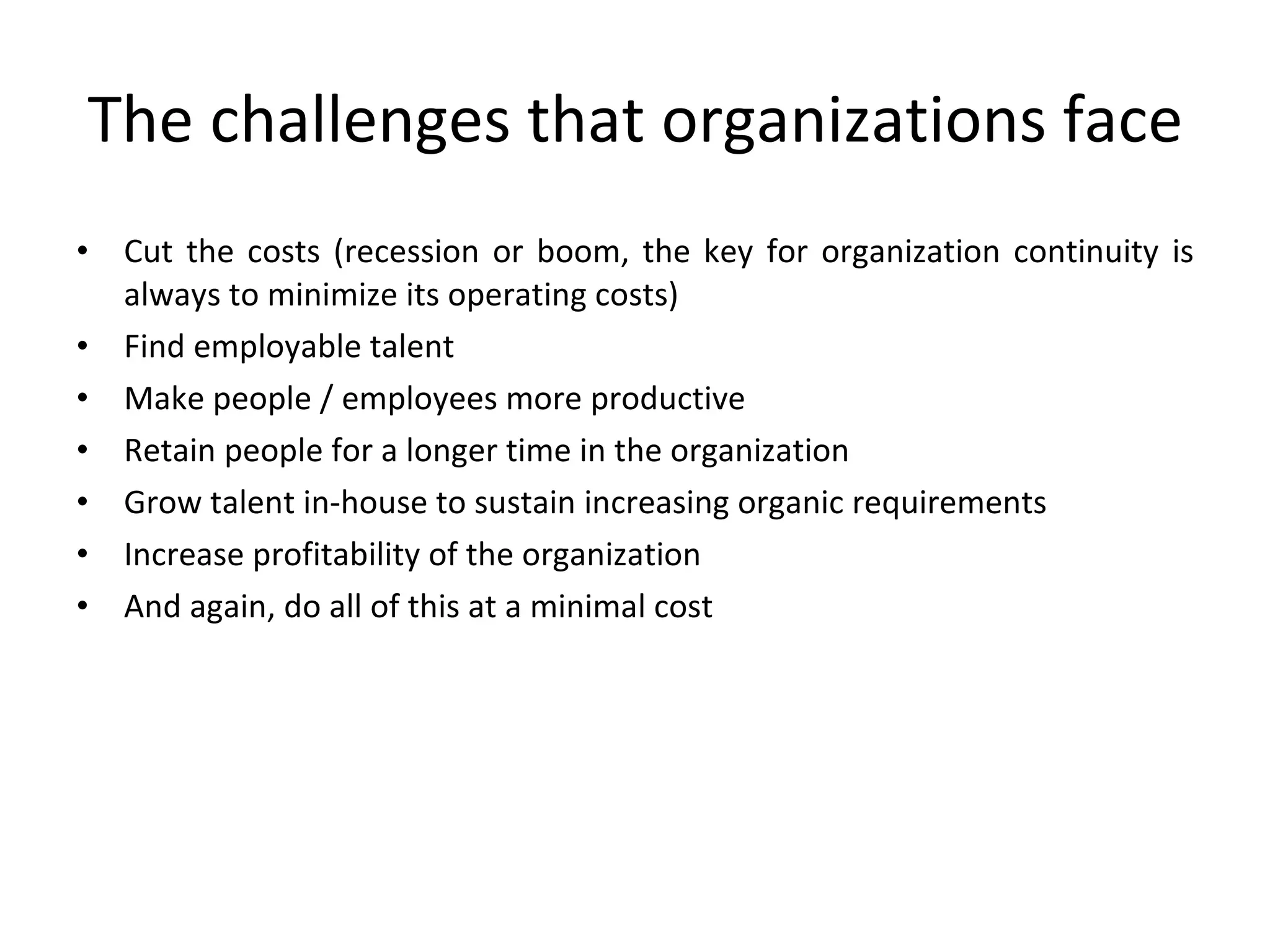
The challenges that organizations face Cut the costs (recession or boom, the key for organization continuity is always to minimize its operating costs) Find employable talent Make people / employees more productive Retain people for a longer time in the organization Grow talent in-house to sustain increasing organic requirements Increase profitability of the organization And again, do all of this at a minimal cost
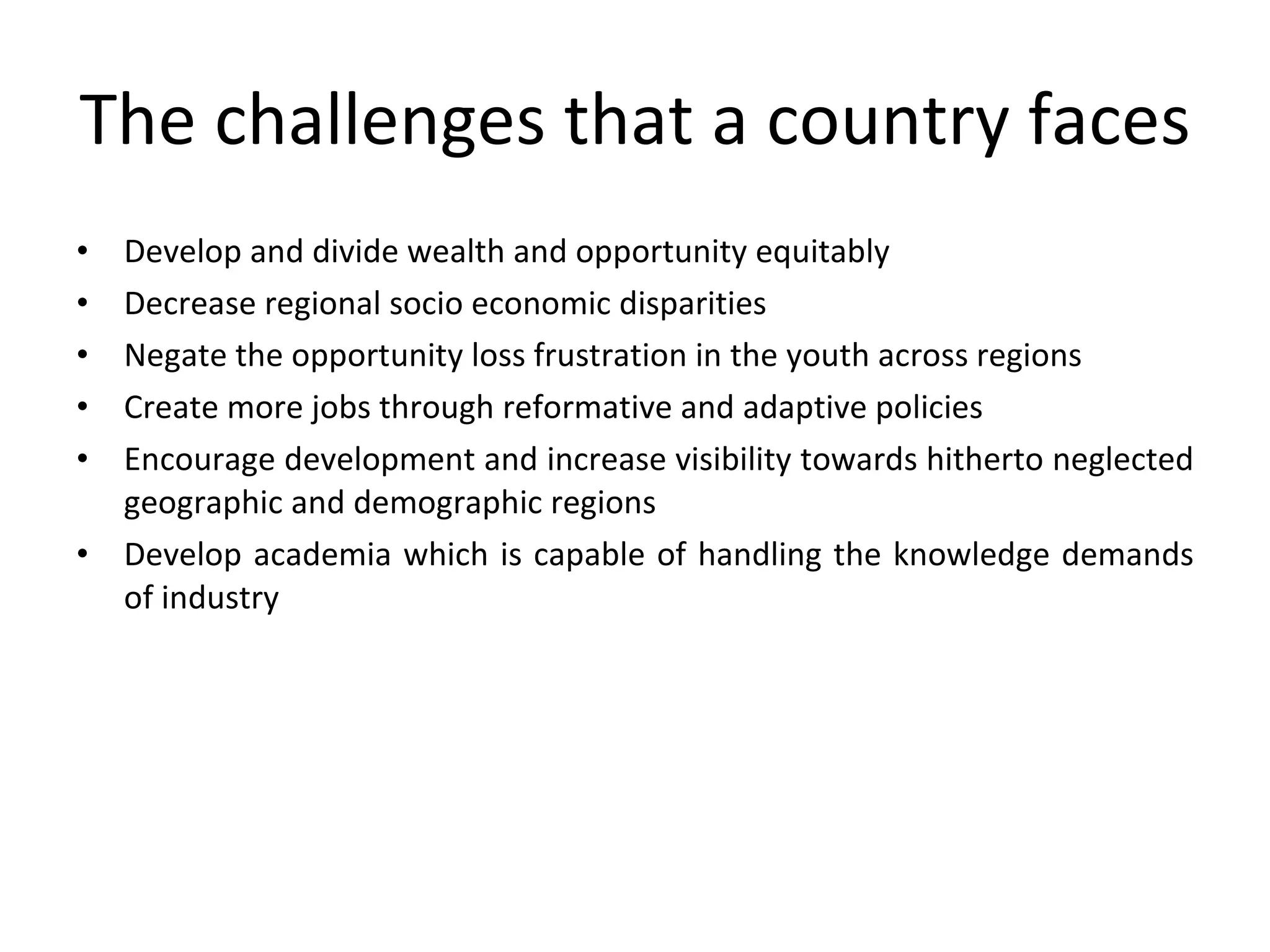
The challenges that a country faces Develop and divide wealth and opportunity equitably Decrease regional socio economic disparities Negate the opportunity loss frustration in the youth across regions Create more jobs through reformative and adaptive policies Encourage development and increase visibility towards hitherto neglected geographic and demographic regions Develop academia which is capable of handling the knowledge demands of industry
Challenges have remained the same… irrespective of an economic boom or a recession
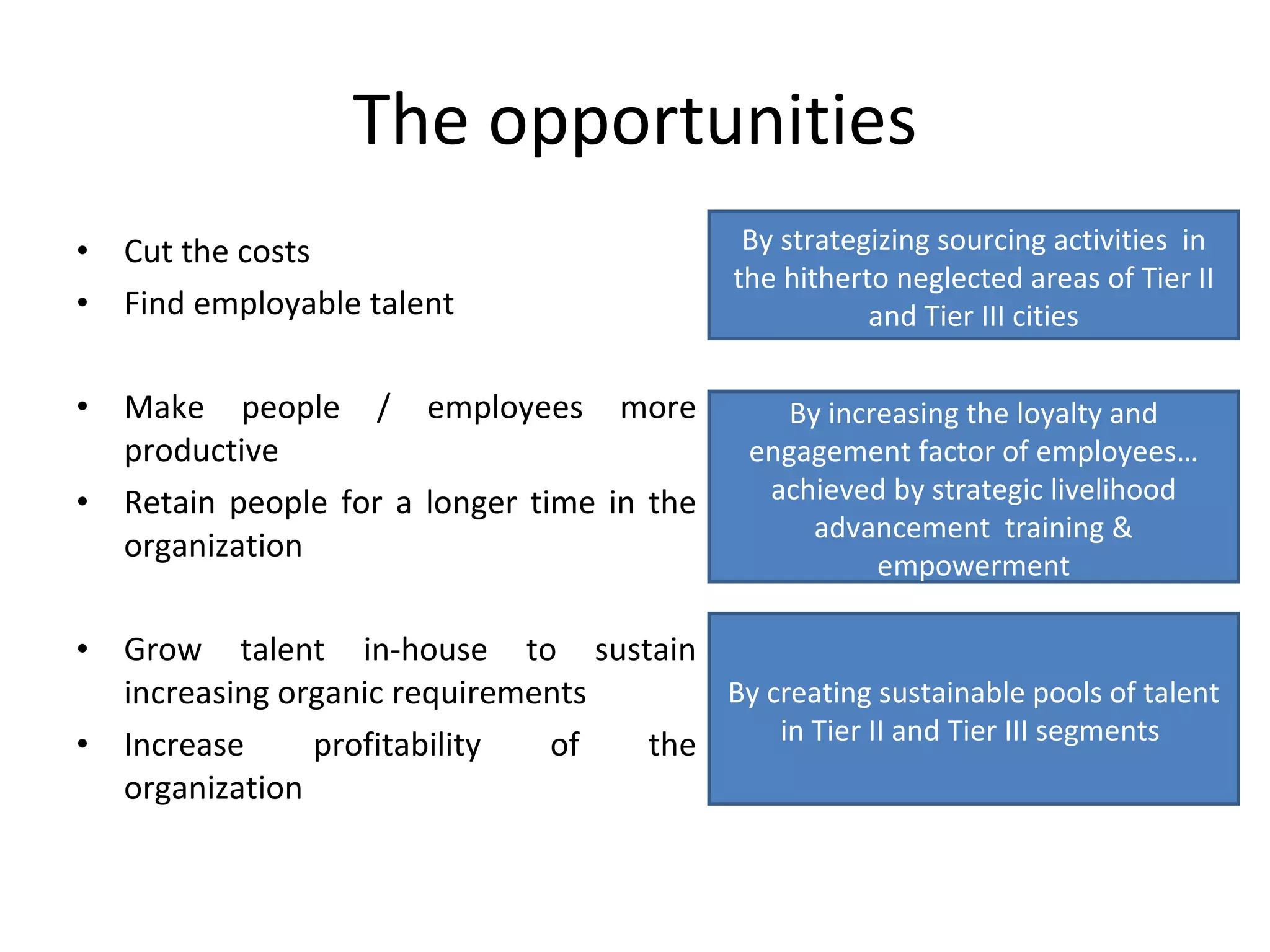
The opportunities Cut the costs  Find employable talent Make people / employees more productive Retain people for a longer time in the organization Grow talent in-house to sustain increasing organic requirements Increase profitability of the organization By strategizing sourcing activities  in the hitherto neglected areas of Tier II and Tier III cities By increasing the loyalty and engagement factor of employees…achieved by strategic livelihood advancement  training & empowerment By creating sustainable pools of talent in Tier II and Tier III segments
 
One common thread we have found is that while the students display open ended knowledge, they are clueless when it comes to applying the knowledge even in trivial practical situations.
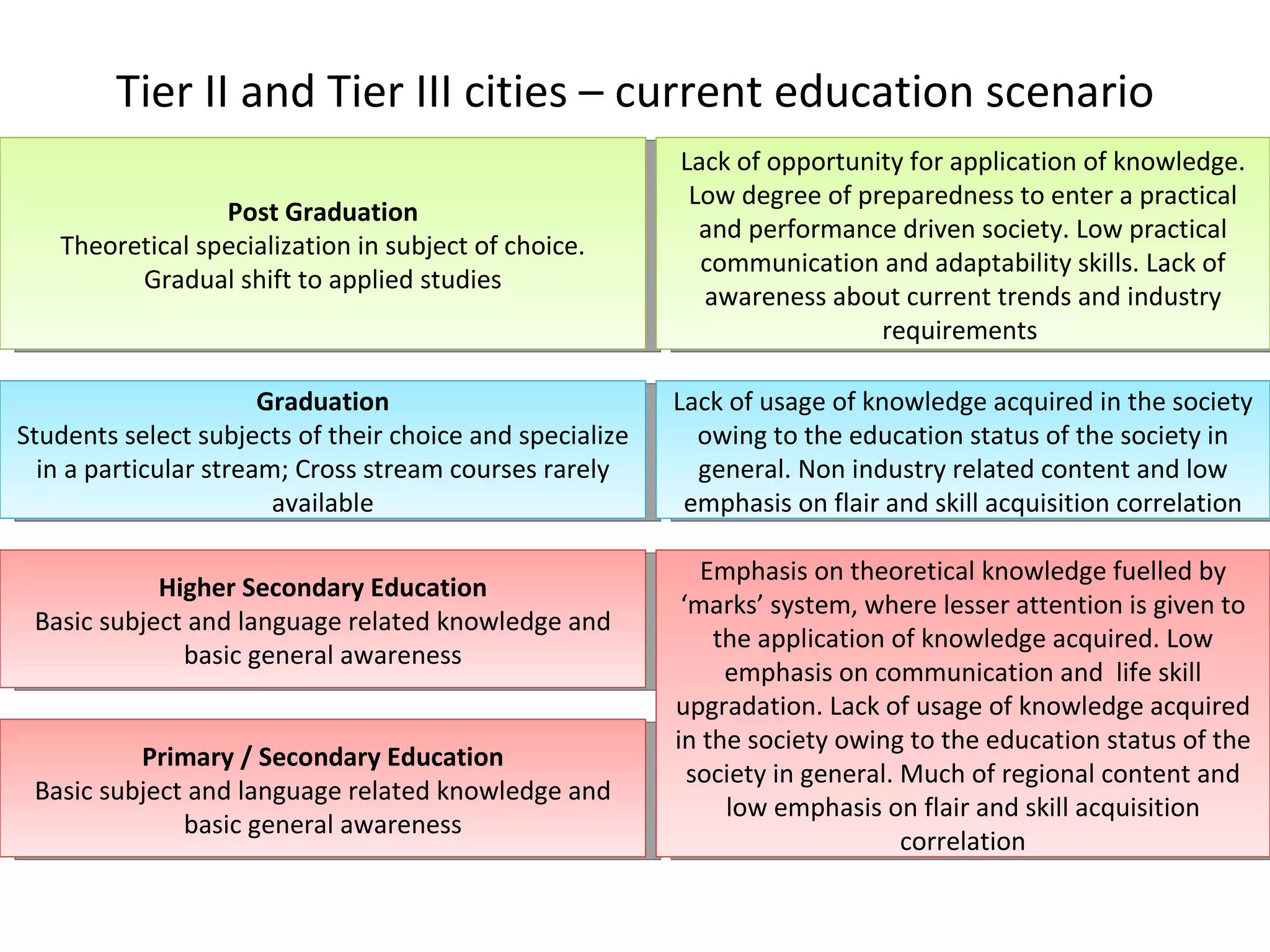
Tier II and Tier III cities – current education scenario Primary / Secondary Education Basic subject and language related knowledge and basic general awareness Higher Secondary Education Basic subject and language related knowledge and basic general awareness Graduation Students select subjects of their choice and specialize in a particular stream; Cross stream courses rarely available Post Graduation Theoretical specialization in subject of choice. Gradual shift to applied studies Emphasis on theoretical knowledge fuelled by ‘marks’ system, where lesser attention is given to the application of knowledge acquired. Low emphasis on communication and  life skill upgradation. Lack of usage of knowledge acquired in the society owing to the education status of the society in general. Much of regional content and low emphasis on flair and skill acquisition correlation Lack of usage of knowledge acquired in the society owing to the education status of the society in general. Non industry related content and low emphasis on flair and skill acquisition correlation Lack of opportunity for application of knowledge. Low degree of preparedness to enter a practical and performance driven society. Low practical communication and adaptability skills. Lack of awareness about current trends and industry requirements
The key issue The key issue still remains the same. Job readiness of the graduates who are fresh out of college.  No doubt, they have been imparted with basic knowledge, but the industry expectations from them are different. This is further compounded by the lack of attention given to Tier II and Tier III cities with respect to additional certification programmers which are readily available in Tier I cities.  Lower per capita income on Tier II and III cities adds to the issue of applicability of existing but expensive certification courses.
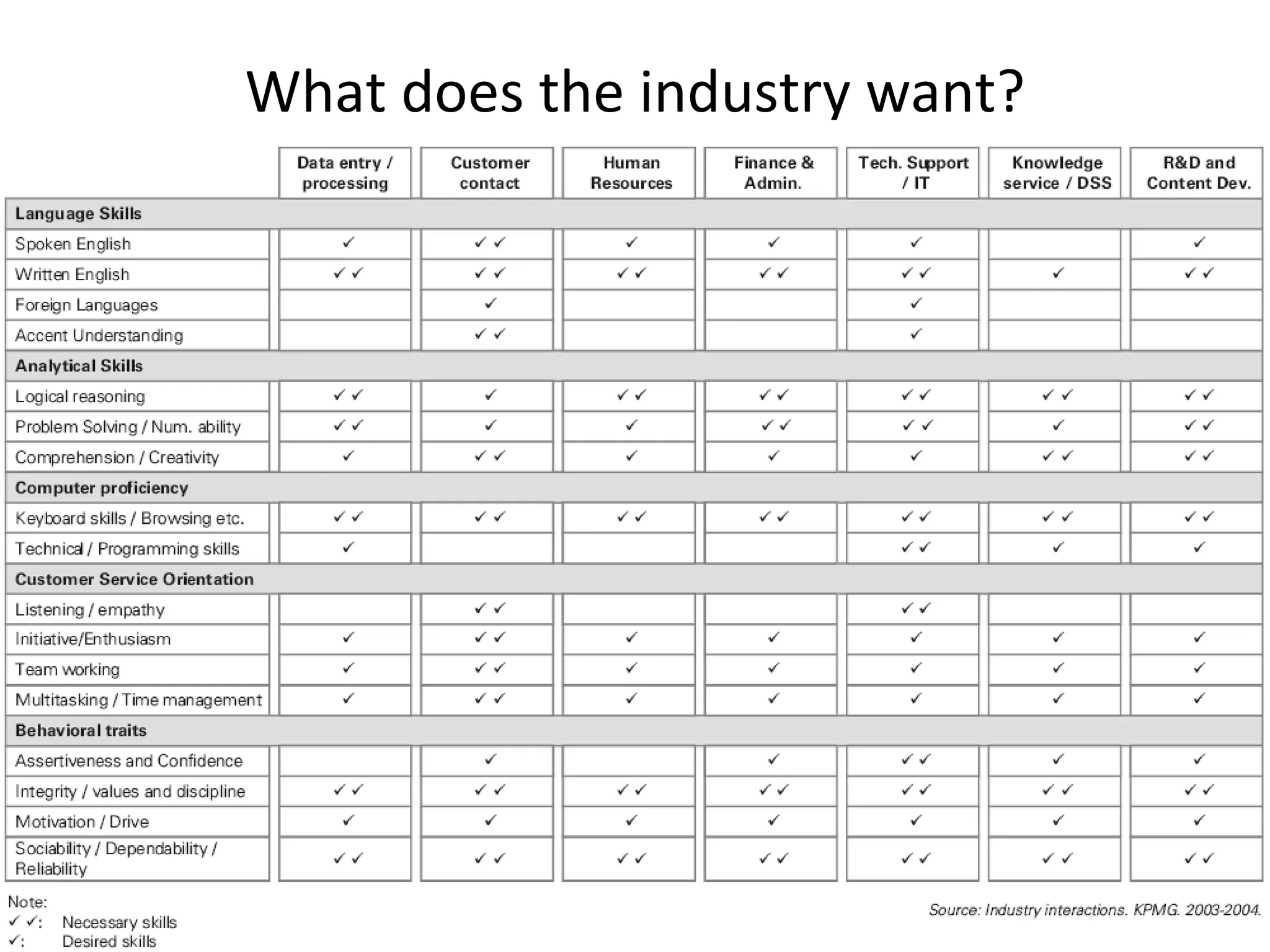
What does the industry want?
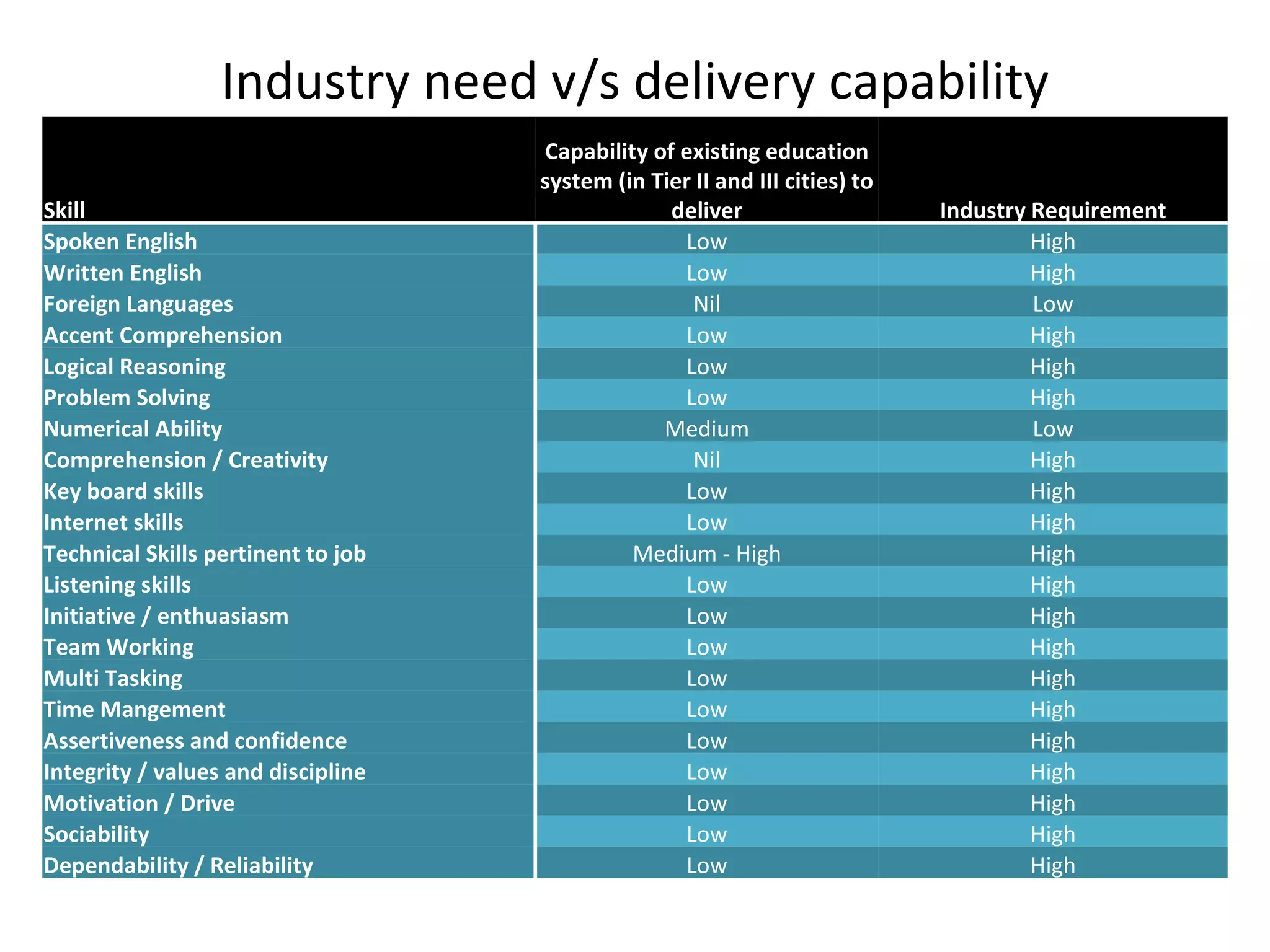
Industry need v/s delivery capability Skill Capability of existing education system (in Tier II and III cities) to deliver Industry Requirement Spoken English Low High Written English Low High Foreign Languages Nil Low Accent Comprehension Low High Logical Reasoning Low High Problem Solving Low High Numerical Ability Medium Low Comprehension / Creativity Nil High Key board skills Low High Internet skills Low High Technical Skills pertinent to job Medium - High High Listening skills Low High Initiative / enthuasiasm Low High Team Working Low High Multi Tasking Low High Time Mangement Low High Assertiveness and confidence Low High Integrity / values and discipline Low High Motivation / Drive Low High Sociability Low High Dependability / Reliability Low High
c
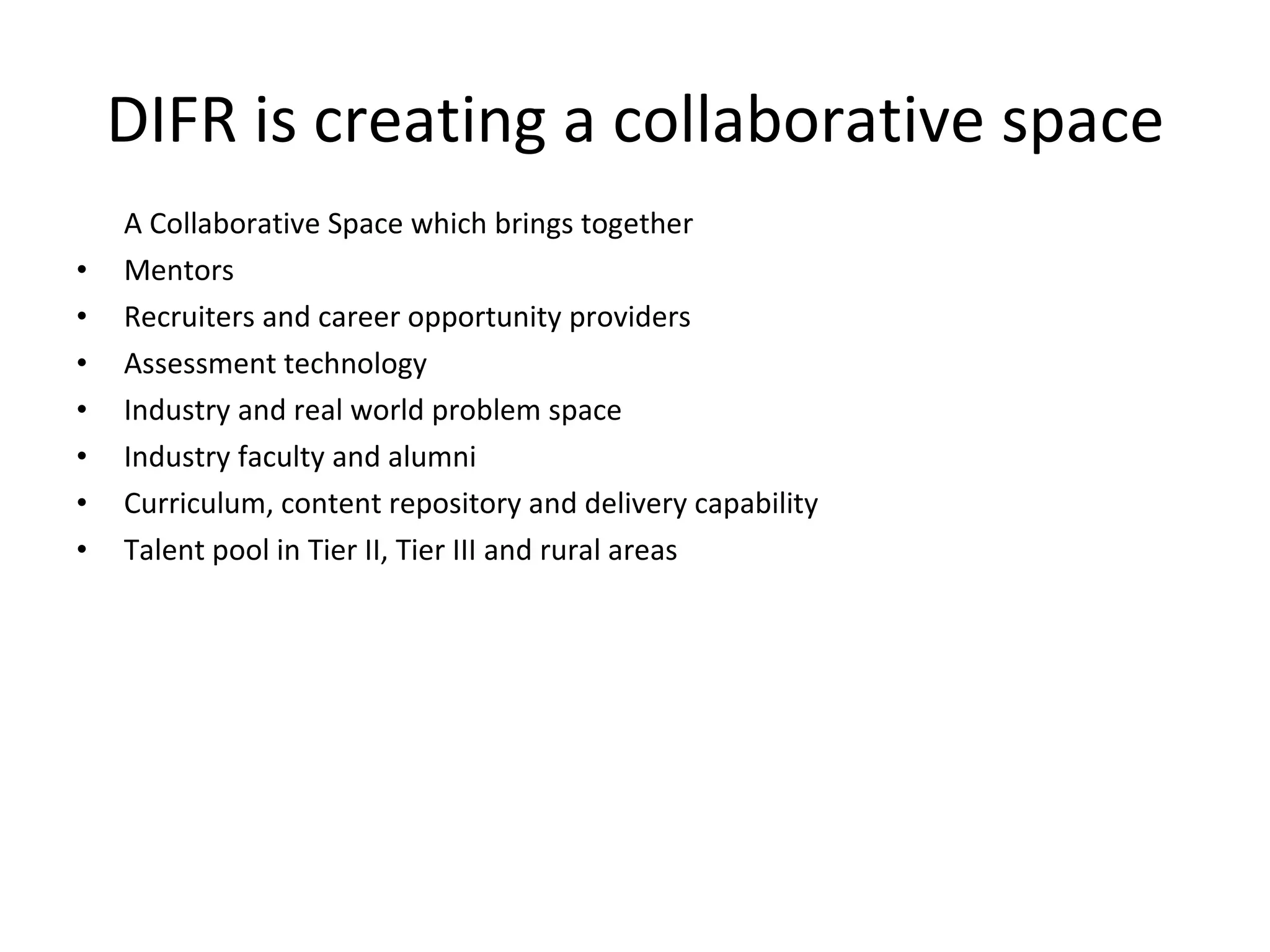
DIFR is creating a collaborative space A Collaborative Space which brings together Mentors Recruiters and career opportunity providers Assessment technology Industry and real world problem space Industry faculty and alumni  Curriculum, content repository and delivery capability Talent pool in Tier II, Tier III and rural areas
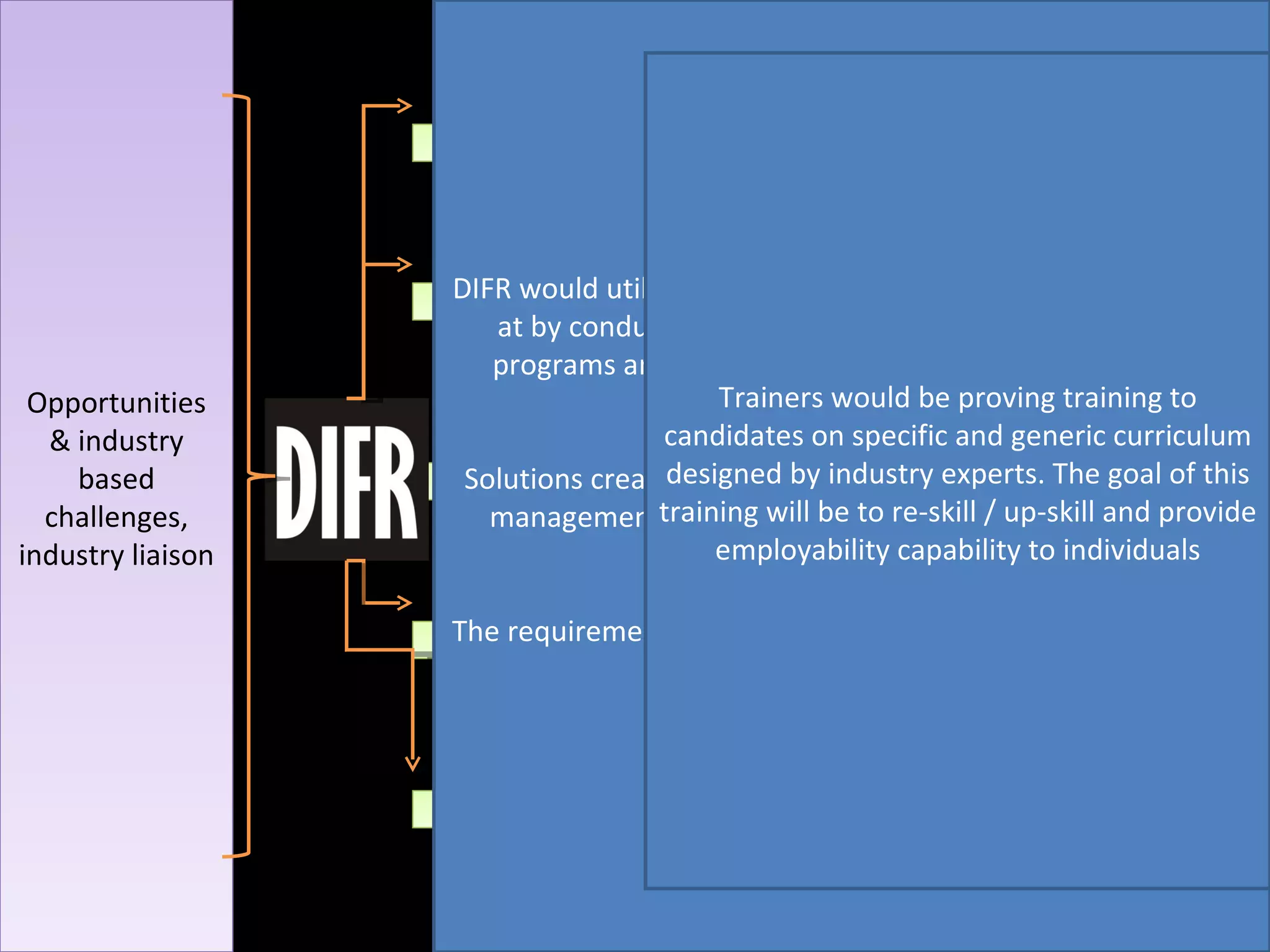
Opportunities & industry based challenges, industry liaison Recruitment partners Assessment partner Mentors Industry faculty & industry Relevant training Employable talent pool DIFR would utilize its understanding of industry base – arrived at by conducting workshops, seminars, communication programs and surveys to customize talent management solutions for organizations. Solutions created will be covering the entire gamut of talent management cycle starting from manpower planning till retentrition. The requirements would be then fed to collaborative partners for action. Role of recruiters is to identify trainable and suitable talent pool, solicit their participation in the program of DIFR for the purposes of livelihood advancement Recruiters will also be building a database of  candidates,  administering assessments  and referring them to mentors for re-skilling  & up skilling Assessment partner would be developing specific assessments based on generic requirements and specific requirements Mentors, as the name indicates, will be dealing with guiding the candidates referred by the recruitment partners, assessing them on potential capabilities (with the assistance of assessment results derived from the assessment partner), nominating for possible positions and related training Industry faculty and industry association of DIFR would assist DIFR in creating sector, industry and company specific training curriculum and guidance plan.  They would also act as absorbers, absorbing candidates generated by recruitment partners and mentors Trainers would be proving training to candidates on specific and generic curriculum designed by industry experts. The goal of this training will be to re-skill / up-skill and provide employability capability to individuals
Interested?
Contact us at 206 / 207, Paradigm B, Mindspace, Malad Link Road, Malad (West), Mumbai 400064 Maharashtra India   Ph: +91 22 6704 0280 / 81 / 82 Fax: +91 22 2844 9875 Mob: +91 97110 06289   Mail:  [email_address] Web:  www.difr.in

DIFR Collaborative V1.0

  • 1.
  • 2.
  • 3.
  • 4.
  • 5.
  • 6.
    The challenges thatorganizations face Cut the costs (recession or boom, the key for organization continuity is always to minimize its operating costs) Find employable talent Make people / employees more productive Retain people for a longer time in the organization Grow talent in-house to sustain increasing organic requirements Increase profitability of the organization And again, do all of this at a minimal cost
  • 7.
    The challenges thata country faces Develop and divide wealth and opportunity equitably Decrease regional socio economic disparities Negate the opportunity loss frustration in the youth across regions Create more jobs through reformative and adaptive policies Encourage development and increase visibility towards hitherto neglected geographic and demographic regions Develop academia which is capable of handling the knowledge demands of industry
  • 8.
    Challenges have remainedthe same… irrespective of an economic boom or a recession
  • 9.
    The opportunities Cutthe costs Find employable talent Make people / employees more productive Retain people for a longer time in the organization Grow talent in-house to sustain increasing organic requirements Increase profitability of the organization By strategizing sourcing activities in the hitherto neglected areas of Tier II and Tier III cities By increasing the loyalty and engagement factor of employees…achieved by strategic livelihood advancement training & empowerment By creating sustainable pools of talent in Tier II and Tier III segments
  • 10.
  • 11.
    One common threadwe have found is that while the students display open ended knowledge, they are clueless when it comes to applying the knowledge even in trivial practical situations.
  • 12.
    Tier II andTier III cities – current education scenario Primary / Secondary Education Basic subject and language related knowledge and basic general awareness Higher Secondary Education Basic subject and language related knowledge and basic general awareness Graduation Students select subjects of their choice and specialize in a particular stream; Cross stream courses rarely available Post Graduation Theoretical specialization in subject of choice. Gradual shift to applied studies Emphasis on theoretical knowledge fuelled by ‘marks’ system, where lesser attention is given to the application of knowledge acquired. Low emphasis on communication and life skill upgradation. Lack of usage of knowledge acquired in the society owing to the education status of the society in general. Much of regional content and low emphasis on flair and skill acquisition correlation Lack of usage of knowledge acquired in the society owing to the education status of the society in general. Non industry related content and low emphasis on flair and skill acquisition correlation Lack of opportunity for application of knowledge. Low degree of preparedness to enter a practical and performance driven society. Low practical communication and adaptability skills. Lack of awareness about current trends and industry requirements
  • 13.
    The key issueThe key issue still remains the same. Job readiness of the graduates who are fresh out of college. No doubt, they have been imparted with basic knowledge, but the industry expectations from them are different. This is further compounded by the lack of attention given to Tier II and Tier III cities with respect to additional certification programmers which are readily available in Tier I cities. Lower per capita income on Tier II and III cities adds to the issue of applicability of existing but expensive certification courses.
  • 14.
    What does theindustry want?
  • 15.
    Industry need v/sdelivery capability Skill Capability of existing education system (in Tier II and III cities) to deliver Industry Requirement Spoken English Low High Written English Low High Foreign Languages Nil Low Accent Comprehension Low High Logical Reasoning Low High Problem Solving Low High Numerical Ability Medium Low Comprehension / Creativity Nil High Key board skills Low High Internet skills Low High Technical Skills pertinent to job Medium - High High Listening skills Low High Initiative / enthuasiasm Low High Team Working Low High Multi Tasking Low High Time Mangement Low High Assertiveness and confidence Low High Integrity / values and discipline Low High Motivation / Drive Low High Sociability Low High Dependability / Reliability Low High
  • 16.
  • 17.
    DIFR is creatinga collaborative space A Collaborative Space which brings together Mentors Recruiters and career opportunity providers Assessment technology Industry and real world problem space Industry faculty and alumni Curriculum, content repository and delivery capability Talent pool in Tier II, Tier III and rural areas
  • 18.
    Opportunities & industrybased challenges, industry liaison Recruitment partners Assessment partner Mentors Industry faculty & industry Relevant training Employable talent pool DIFR would utilize its understanding of industry base – arrived at by conducting workshops, seminars, communication programs and surveys to customize talent management solutions for organizations. Solutions created will be covering the entire gamut of talent management cycle starting from manpower planning till retentrition. The requirements would be then fed to collaborative partners for action. Role of recruiters is to identify trainable and suitable talent pool, solicit their participation in the program of DIFR for the purposes of livelihood advancement Recruiters will also be building a database of candidates, administering assessments and referring them to mentors for re-skilling & up skilling Assessment partner would be developing specific assessments based on generic requirements and specific requirements Mentors, as the name indicates, will be dealing with guiding the candidates referred by the recruitment partners, assessing them on potential capabilities (with the assistance of assessment results derived from the assessment partner), nominating for possible positions and related training Industry faculty and industry association of DIFR would assist DIFR in creating sector, industry and company specific training curriculum and guidance plan. They would also act as absorbers, absorbing candidates generated by recruitment partners and mentors Trainers would be proving training to candidates on specific and generic curriculum designed by industry experts. The goal of this training will be to re-skill / up-skill and provide employability capability to individuals
  • 19.
  • 20.
    Contact us at206 / 207, Paradigm B, Mindspace, Malad Link Road, Malad (West), Mumbai 400064 Maharashtra India   Ph: +91 22 6704 0280 / 81 / 82 Fax: +91 22 2844 9875 Mob: +91 97110 06289   Mail:  [email_address] Web:  www.difr.in