Created by: Raj Takhar, PhD Researcher
First Published: October 2016
© 2016 Sukhraj Takhar All Rights Reserved
Topic Areas
1. Implement a Material Declaration System.
2. The ABC of Material Declarations.
3. Declarable Substance List Size to Data Flows.
4. Performing A Material Declaration Pilot.
5. Typical Material Declaration Response Times
© 2016 Sukhraj Takhar All Rights Reserved
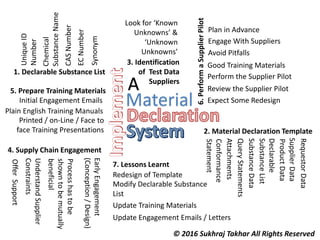
A
Material
© 2016 Sukhraj Takhar All Rights Reserved
6.PerformaSupplierPilot
Plan in Advance
Engage With Suppliers
Avoid Pitfalls
Good Training Materials
Perform the Supplier Pilot
Redesign of Template
Review the Supplier Pilot
2. Material Declaration Template
SupplierData
RequestorData
ProductData
Declarable
SubstanceList
SubstanceData
QueryStatements
Attachments
Conformance
Statement
1. Declarable Substance List
UniqueID
Number
CASNumber
ECNumber
Chemical
SubstanceName
Synonym
Look for ‘Known
Unknowns’ &
‘Unknown
Unknowns’
3. Identification
of Test Data
Suppliers
Update Training Materials
4. Supply Chain Engagement
EarlyEngagement
(Conception/Design)
Processhastobe
showntobemutually
beneficial
UnderstandSupplier
Constraints
OfferSupport
7. Lessons Learnt
Initial Engagement Emails
5. Prepare Training Materials
Plain English Training Manuals
Printed / on-Line / Face to
face Training Presentations
Modify Declarable Substance
List
Expect Some Redesign
Update Engagement Emails / Letters
The ABC of Material Declarations
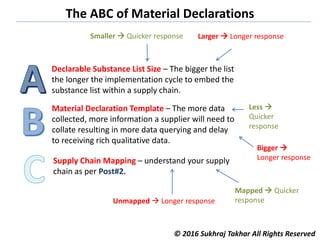
Declarable Substance List Size – The bigger the list
the longer the implementation cycle to embed the
substance list within a supply chain.
Material Declaration Template – The more data
collected, more information a supplier will need to
collate resulting in more data querying and delay
to receiving rich qualitative data.
Supply Chain Mapping – understand your supply
chain as per Post#2.
Smaller  Quicker response Larger  Longer response
Less 
Quicker
response
Bigger 
Longer response
Unmapped  Longer response
Mapped  Quicker
response
© 2016 Sukhraj Takhar All Rights Reserved
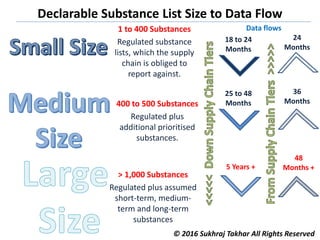
Declarable Substance List Size to Data Flow
1 to 400 Substances
Regulated substance
lists, which the supply
chain is obliged to
report against.
© 2016 Sukhraj Takhar All Rights Reserved
18 to 24
Months
> 1,000 Substances
Regulated plus assumed
short-term, medium-
term and long-term
substances
400 to 500 Substances
Regulated plus
additional prioritised
substances.
24
Months
Data flows
25 to 48
Months
36
Months
5 Years +
48
Months +
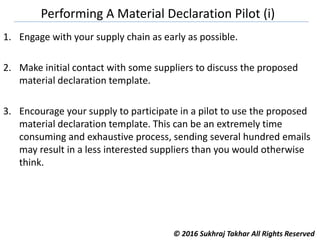
Performing A Material Declaration Pilot (i)
1. Engage with your supply chain as early as possible.
2. Make initial contact with some suppliers to discuss the proposed
material declaration template.
3. Encourage your supply to participate in a pilot to use the proposed
material declaration template. This can be an extremely time
consuming and exhaustive process, sending several hundred emails
may result in a less interested suppliers than you would otherwise
think.
© 2016 Sukhraj Takhar All Rights Reserved
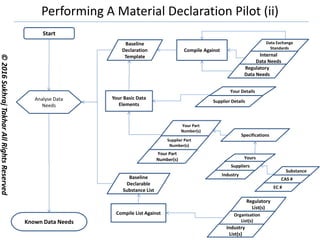
Performing A Material Declaration Pilot (ii)
Start
Analyse Data
Needs
Baseline
Declaration
Template
Baseline
Declarable
Substance List
Compile List Against
Regulatory
List(s)
Organisation
List(s)
Industry
List(s)
Compile Against
Data Exchange
Standards
Internal
Data Needs
Regulatory
Data Needs
Your Basic Data
Elements
Your Details
Supplier Details
Your Part
Number(s)
Supplier Part
Number(s)
Your Part
Number(s)
Specifications
Yours
Suppliers
Industry
Substance
CAS #
EC #
Known Data Needs
©2016SukhrajTakharAllRightsReserved
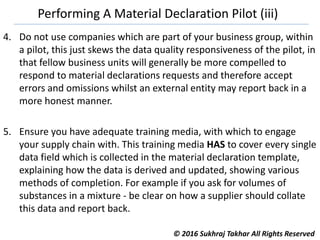
Performing A Material Declaration Pilot (iii)
4. Do not use companies which are part of your business group, within
a pilot, this just skews the data quality responsiveness of the pilot, in
that fellow business units will generally be more compelled to
respond to material declarations requests and therefore accept
errors and omissions whilst an external entity may report back in a
more honest manner.
5. Ensure you have adequate training media, with which to engage
your supply chain with. This training media HAS to cover every single
data field which is collected in the material declaration template,
explaining how the data is derived and updated, showing various
methods of completion. For example if you ask for volumes of
substances in a mixture - be clear on how a supplier should collate
this data and report back.
© 2016 Sukhraj Takhar All Rights Reserved
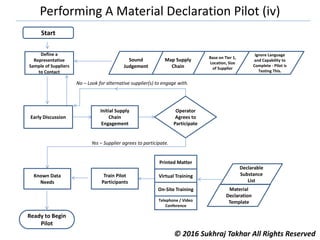
Performing A Material Declaration Pilot (iv)
Start
Ready to Begin
Pilot
Known Data
Needs
Initial Supply
Chain
Engagement
Early Discussion
Operator
Agrees to
Participate
No – Look for alternative supplier(s) to engage with.
Define a
Representative
Sample of Suppliers
to Contact
Map Supply
Chain
Sound
Judgement
Base on Tier 1,
Location, Size
of Supplier
Ignore Language
and Capability to
Complete - Pilot is
Testing This.
Yes – Supplier agrees to participate.
Train Pilot
Participants
Declarable
Substance
List
Material
Declaration
Template
Printed Matter
Virtual Training
On-Site Training
Telephone / Video
Conference
© 2016 Sukhraj Takhar All Rights Reserved
Performing A Material Declaration Pilot (v)
6. With an agreed set of suppliers, perform an initial training activity
either as a face to face event or via online web conferencing /
training media.
7. Allow suppliers a fair period of time from receipt of the material
declaration template to update and respond to it, as part of the pilot
activities. The MINIMUM period has to be 2-3 months to complete
and feedback data.
8. Create a survey monkey type questionnaire to get feedback from
suppliers.
© 2016 Sukhraj Takhar All Rights Reserved
Performing A Material Declaration Pilot (vi)
Start
Supplier
Declaration Data
Transmitted
Assume Operator
Awaiting on Their
Supply Chain
Information Flowing
Back
Provide Guidance
and Ensure Training
Matter Is Updated
No
Begin Pilot
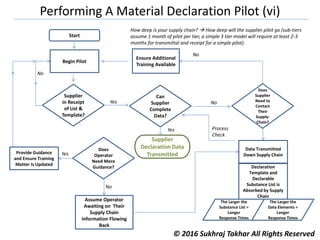
How deep is your supply chain?  How deep will the supplier pilot go (sub-tiers
assume 1 month of pilot per tier, a simple 3 tier model will require at least 2-3
months for transmittal and receipt for a simple pilot).
Ensure Additional
Training Available
The Larger the
Substance List =
Longer
Response Times
Supplier
in Receipt
of List &
Template?
Can
Supplier
Complete
Data?
Does
Supplier
Need to
Contact
Their
Supply-
Chain?
Yes
No
Yes
No
Yes
Data Transmitted
Down Supply Chain
No
Declaration
Template and
Declarable
Substance List is
Absorbed by Supply
Chain
The Larger the
Data Elements =
Longer
Response Times
Does
Operator
Need More
Guidance?
Process
Check
© 2016 Sukhraj Takhar All Rights Reserved
Performing A Material Declaration Pilot (vii)
6. When reviewing the results of a pilot be sure to collate and record:
 How many potential suppliers were contacted by participants in a pilot?
 How were the supplier contacted?
 How many suppliers were approached and how many agreed to respond initially?
 How diverse were the suppliers who agreed to participate - by this I mean where they all tier 1
type suppliers or several tiers down within your respective supply chain
 How many suppliers agreed but did not send any completed materials declaration templates?
7. Of the received material declaration templates, how many were
received completed and received incomplete material declaration.
8. Record the response rate in terms of data that was completed
material declaration templates (correctly completed) as opposed the
number of suppliers originally approached.
9. This data should be presented back in the analysis documentation to
show just how well the material declaration template was received
by a supply chain.
© 2016 Sukhraj Takhar All Rights Reserved
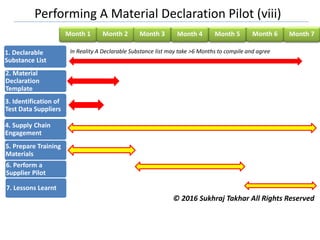
Performing A Material Declaration Pilot (viii)
© 2016 Sukhraj Takhar All Rights Reserved
Month 1
1. Declarable
Substance List
2. Material
Declaration
Template
Month 2 Month 3 Month 4 Month 5 Month 6
3. Identification of
Test Data Suppliers
In Reality A Declarable Substance list may take >6 Months to compile and agree
4. Supply Chain
Engagement
5. Prepare Training
Materials
6. Perform a
Supplier Pilot
7. Lessons Learnt
Month 7
Typical Material Declaration Response Rates (i)
Response rates can be defined as the number of completed
material declaration templates you receive back from your
supply chain, measured against the total number of
material declaration templates submitted throughout your
supply chain.
If your material declaration template is too complex and
time consuming to complete, then it will take a while for the
data to flow back to you.
© 2016 Sukhraj Takhar All Rights Reserved
Typical Material Declaration Response Rates (ii)
A realistic working assumption would be to expect for an
initial material declaration template a response rate of less
than 20% for an initial pilot.
This means in reality you will receive 20 completed
responses back from a supply for every 100 material
declaration templates which are distributed to you supply
chain.
If your material declaration template is overly complicated,
with a more complex declarable substance list, then this
figure will be greatly reduced
© 2016 Sukhraj Takhar All Rights Reserved

Implementing A Material Declaration System

  • 1.
    Created by: RajTakhar, PhD Researcher First Published: October 2016 © 2016 Sukhraj Takhar All Rights Reserved
  • 2.
    Topic Areas 1. Implementa Material Declaration System. 2. The ABC of Material Declarations. 3. Declarable Substance List Size to Data Flows. 4. Performing A Material Declaration Pilot. 5. Typical Material Declaration Response Times © 2016 Sukhraj Takhar All Rights Reserved
  • 3.
    A Material © 2016 SukhrajTakhar All Rights Reserved 6.PerformaSupplierPilot Plan in Advance Engage With Suppliers Avoid Pitfalls Good Training Materials Perform the Supplier Pilot Redesign of Template Review the Supplier Pilot 2. Material Declaration Template SupplierData RequestorData ProductData Declarable SubstanceList SubstanceData QueryStatements Attachments Conformance Statement 1. Declarable Substance List UniqueID Number CASNumber ECNumber Chemical SubstanceName Synonym Look for ‘Known Unknowns’ & ‘Unknown Unknowns’ 3. Identification of Test Data Suppliers Update Training Materials 4. Supply Chain Engagement EarlyEngagement (Conception/Design) Processhastobe showntobemutually beneficial UnderstandSupplier Constraints OfferSupport 7. Lessons Learnt Initial Engagement Emails 5. Prepare Training Materials Plain English Training Manuals Printed / on-Line / Face to face Training Presentations Modify Declarable Substance List Expect Some Redesign Update Engagement Emails / Letters
  • 4.
    The ABC ofMaterial Declarations Declarable Substance List Size – The bigger the list the longer the implementation cycle to embed the substance list within a supply chain. Material Declaration Template – The more data collected, more information a supplier will need to collate resulting in more data querying and delay to receiving rich qualitative data. Supply Chain Mapping – understand your supply chain as per Post#2. Smaller  Quicker response Larger  Longer response Less  Quicker response Bigger  Longer response Unmapped  Longer response Mapped  Quicker response © 2016 Sukhraj Takhar All Rights Reserved
  • 5.
    Declarable Substance ListSize to Data Flow 1 to 400 Substances Regulated substance lists, which the supply chain is obliged to report against. © 2016 Sukhraj Takhar All Rights Reserved 18 to 24 Months > 1,000 Substances Regulated plus assumed short-term, medium- term and long-term substances 400 to 500 Substances Regulated plus additional prioritised substances. 24 Months Data flows 25 to 48 Months 36 Months 5 Years + 48 Months +
  • 6.
    Performing A MaterialDeclaration Pilot (i) 1. Engage with your supply chain as early as possible. 2. Make initial contact with some suppliers to discuss the proposed material declaration template. 3. Encourage your supply to participate in a pilot to use the proposed material declaration template. This can be an extremely time consuming and exhaustive process, sending several hundred emails may result in a less interested suppliers than you would otherwise think. © 2016 Sukhraj Takhar All Rights Reserved
  • 7.
    Performing A MaterialDeclaration Pilot (ii) Start Analyse Data Needs Baseline Declaration Template Baseline Declarable Substance List Compile List Against Regulatory List(s) Organisation List(s) Industry List(s) Compile Against Data Exchange Standards Internal Data Needs Regulatory Data Needs Your Basic Data Elements Your Details Supplier Details Your Part Number(s) Supplier Part Number(s) Your Part Number(s) Specifications Yours Suppliers Industry Substance CAS # EC # Known Data Needs ©2016SukhrajTakharAllRightsReserved
  • 8.
    Performing A MaterialDeclaration Pilot (iii) 4. Do not use companies which are part of your business group, within a pilot, this just skews the data quality responsiveness of the pilot, in that fellow business units will generally be more compelled to respond to material declarations requests and therefore accept errors and omissions whilst an external entity may report back in a more honest manner. 5. Ensure you have adequate training media, with which to engage your supply chain with. This training media HAS to cover every single data field which is collected in the material declaration template, explaining how the data is derived and updated, showing various methods of completion. For example if you ask for volumes of substances in a mixture - be clear on how a supplier should collate this data and report back. © 2016 Sukhraj Takhar All Rights Reserved
  • 9.
    Performing A MaterialDeclaration Pilot (iv) Start Ready to Begin Pilot Known Data Needs Initial Supply Chain Engagement Early Discussion Operator Agrees to Participate No – Look for alternative supplier(s) to engage with. Define a Representative Sample of Suppliers to Contact Map Supply Chain Sound Judgement Base on Tier 1, Location, Size of Supplier Ignore Language and Capability to Complete - Pilot is Testing This. Yes – Supplier agrees to participate. Train Pilot Participants Declarable Substance List Material Declaration Template Printed Matter Virtual Training On-Site Training Telephone / Video Conference © 2016 Sukhraj Takhar All Rights Reserved
  • 10.
    Performing A MaterialDeclaration Pilot (v) 6. With an agreed set of suppliers, perform an initial training activity either as a face to face event or via online web conferencing / training media. 7. Allow suppliers a fair period of time from receipt of the material declaration template to update and respond to it, as part of the pilot activities. The MINIMUM period has to be 2-3 months to complete and feedback data. 8. Create a survey monkey type questionnaire to get feedback from suppliers. © 2016 Sukhraj Takhar All Rights Reserved
  • 11.
    Performing A MaterialDeclaration Pilot (vi) Start Supplier Declaration Data Transmitted Assume Operator Awaiting on Their Supply Chain Information Flowing Back Provide Guidance and Ensure Training Matter Is Updated No Begin Pilot How deep is your supply chain?  How deep will the supplier pilot go (sub-tiers assume 1 month of pilot per tier, a simple 3 tier model will require at least 2-3 months for transmittal and receipt for a simple pilot). Ensure Additional Training Available The Larger the Substance List = Longer Response Times Supplier in Receipt of List & Template? Can Supplier Complete Data? Does Supplier Need to Contact Their Supply- Chain? Yes No Yes No Yes Data Transmitted Down Supply Chain No Declaration Template and Declarable Substance List is Absorbed by Supply Chain The Larger the Data Elements = Longer Response Times Does Operator Need More Guidance? Process Check © 2016 Sukhraj Takhar All Rights Reserved
  • 12.
    Performing A MaterialDeclaration Pilot (vii) 6. When reviewing the results of a pilot be sure to collate and record:  How many potential suppliers were contacted by participants in a pilot?  How were the supplier contacted?  How many suppliers were approached and how many agreed to respond initially?  How diverse were the suppliers who agreed to participate - by this I mean where they all tier 1 type suppliers or several tiers down within your respective supply chain  How many suppliers agreed but did not send any completed materials declaration templates? 7. Of the received material declaration templates, how many were received completed and received incomplete material declaration. 8. Record the response rate in terms of data that was completed material declaration templates (correctly completed) as opposed the number of suppliers originally approached. 9. This data should be presented back in the analysis documentation to show just how well the material declaration template was received by a supply chain. © 2016 Sukhraj Takhar All Rights Reserved
  • 13.
    Performing A MaterialDeclaration Pilot (viii) © 2016 Sukhraj Takhar All Rights Reserved Month 1 1. Declarable Substance List 2. Material Declaration Template Month 2 Month 3 Month 4 Month 5 Month 6 3. Identification of Test Data Suppliers In Reality A Declarable Substance list may take >6 Months to compile and agree 4. Supply Chain Engagement 5. Prepare Training Materials 6. Perform a Supplier Pilot 7. Lessons Learnt Month 7
  • 14.
    Typical Material DeclarationResponse Rates (i) Response rates can be defined as the number of completed material declaration templates you receive back from your supply chain, measured against the total number of material declaration templates submitted throughout your supply chain. If your material declaration template is too complex and time consuming to complete, then it will take a while for the data to flow back to you. © 2016 Sukhraj Takhar All Rights Reserved
  • 15.
    Typical Material DeclarationResponse Rates (ii) A realistic working assumption would be to expect for an initial material declaration template a response rate of less than 20% for an initial pilot. This means in reality you will receive 20 completed responses back from a supply for every 100 material declaration templates which are distributed to you supply chain. If your material declaration template is overly complicated, with a more complex declarable substance list, then this figure will be greatly reduced © 2016 Sukhraj Takhar All Rights Reserved