Disclosure in practice
Audit by AIB of the national implementation of disclosure
Liesbeth Switten, AIB
Meeting AIB-Disclosure Competent Bodies, Copenhagen, 21 May 2019
AIB copyright © 2018. We reserve the rights in this document and in the information contained therein.
Reproduction, use or disclosure to third parties without express authority is strictly forbidden.
The AIB is a non-profit-making international association.
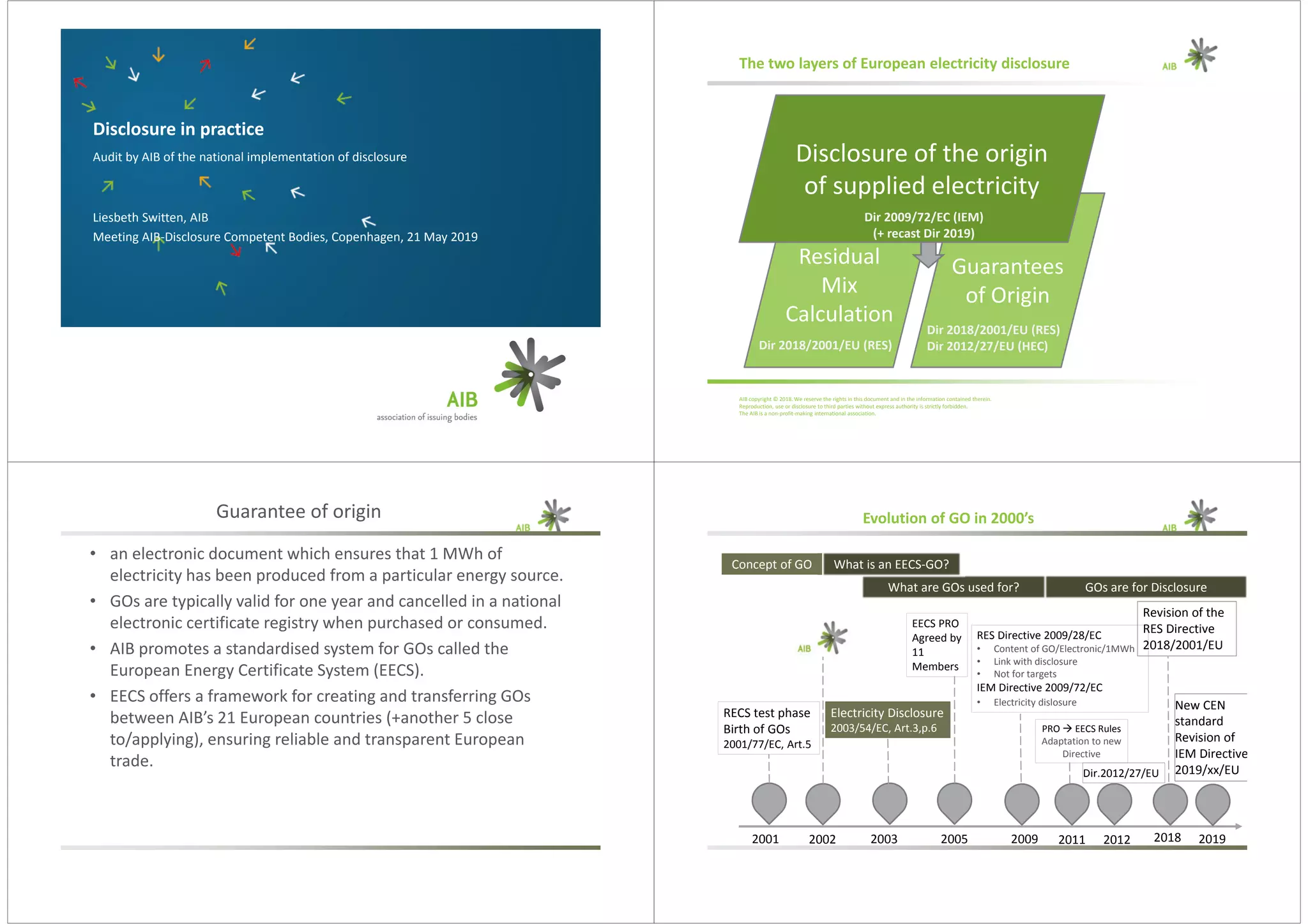
The two layers of European electricity disclosure
Residual
Mix
Calculation
Guarantees
of Origin
Dir 2018/2001/EU (RES)
Dir 2012/27/EU (HEC)
Disclosure of the origin
of supplied electricity
Dir 2009/72/EC (IEM)
(+ recast Dir 2019)
Dir 2018/2001/EU (RES)
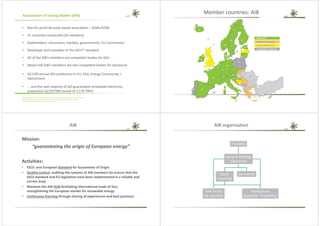
Guarantee of origin
• an electronic document which ensures that 1 MWh of
electricity has been produced from a particular energy source.
• GOs are typically valid for one year and cancelled in a national
electronic certificate registry when purchased or consumed.
• AIB promotes a standardised system for GOs called the
European Energy Certificate System (EECS).
• EECS offers a framework for creating and transferring GOs
between AIB’s 21 European countries (+another 5 close
to/applying), ensuring reliable and transparent European
trade.
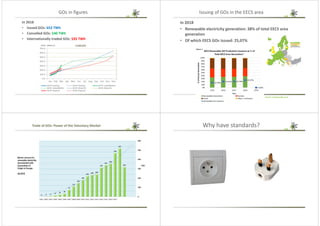
Electricity Disclosure
2003/54/EC, Art.3,p.6
Evolution of GO in 2000’s
RECS test phase
Birth of GOs
2001/77/EC, Art.5
EECS PRO
Agreed by
11
Members
RES Directive 2009/28/EC
• Content of GO/Electronic/1MWh
• Link with disclosure
• Not for targets
IEM Directive 2009/72/EC
• Electricity dislosure
2001 20032002 2005
Concept of GO
What are GOs used for? GOs are for Disclosure
PRO EECS Rules
Adaptation to new
Directive
2009 2011
Revision of the
RES Directive
2018/2001/EU
What is an EECS-GO?
20182012
Dir.2012/27/EU
2019
New CEN
standard
Revision of
IEM Directive
2019/xx/EU
AIB copyright © 2018. We reserve the rights in this document and in the information contained therein.
Reproduction, use or disclosure to third parties without express authority is strictly forbidden.
The AIB is a non-profit-making international association.
Association of Issuing Bodies (AIB)
• Not-for-profit Brussels-based association – AISBL/IVZW
• 21 countries connected (24 members)
• Stakeholders: consumers, markets, governments, EU Commission
• Developer and custodian of the EECS™ standard
• All of the AIB’s members are competent bodies for GOs
• About half AIB’s members are also competent bodies for disclosure
• 50.53% annual RES production in EU, EEA, Energy Community +
Switzerland
• ... and the vast majority of GO-guaranteed renewable electricity
production (0,595TWh issued of 1,176 TWh)
Member countries: AIB
POUK
ME
RS
AIB
Mission:
“guaranteeing the origin of European energy”
Activities:
• EECS: one European Standard for Guarantees of Origin
• Quality control: auditing the systems of AIB members (to ensure that the
EECS standard and EU legislation have been implemented in a reliable and
correct way)
• Maintain the AIB HUB facilitating international trade of Gos,
strengthening the European market for renewable energy
• Continuous learning through sharing of experiences and best practices
AIB organisation
Task Forces
(as required)
Workgroups
(quarterly monthly)
General Meeting
(Quarterly)
Board
(monthly)
Secretariat
President
GOs in figures
In 2018
• Issued GOs: 652 TWh
• Cancelled GOs: 540 TWh
• Internationally traded GOs: 535 TWh
Issuing of GOs in the EECS area
In 2018
• Renewable electricity generation: 38% of total EECS area
generation
• Of which EECS GOs issued: 25,07%
Source: energyorigins.net
Trade of GOs: Power of the Voluntary Market Why have standards?
Why isn’t the law enough?
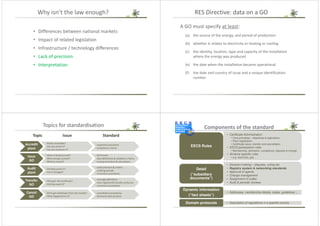
• Differences between national markets
• Impact of related legislation
• Infrastructure / technology differences
• Lack of precision
• Interpretation
A GO must specify at least:
(a) the source of the energy, and period of production
(b) whether it relates to electricity or heating or cooling
(c) the identity, location, type and capacity of the installation
where the energy was produced
(e) the date when the installation became operational
(f) the date and country of issue and a unique identification
number
RES Directive: data on a GO
Topics for standardisation
Accredit
plant
- Really renewable?
- Can you prove it?
- Can you measure it?
- inspection procedure
- acceptance criteria
Issue
GO
- What is being burned?
- What energy content?
- What to record?
- GO format
- data definitions & validation criteria
- issuing procedure & calculations
Audit
plant
- Did they prove it?
- Has it changed?
- audit practices & criteria
- auditing periods
- correction procedures
Transfer
GO
- Who got the certificate?
- Did they want it?
- message definitions
- inter-registry GO transfer protocols
- correction procedures
Cancel
GO
- Did it get withdrawn from the market?
- What happened to it?
- cancellation procedures
- disclosure best practice
Topic Issue Standard
Components of the standard
• Certificate Administration
• Core principles – objectives & aspirations
• Plant registration
• Certificate issue, transfer and cancellation
• EECS participation rules
• Membership, admission, compliance, disputes & change
• Scheme specific rules
• e.g. electricity, gas ...
EECS Rules
• Decision-making – disputes, voting etc
• Registry system & networking standards
• Approval of agents
• Change management
• Assignment of codes
• Audit & periodic reviews
Detail
(“subsidiary
documents”)
• Addresses, membership details, codes, guidelines ...
Dynamic information
(“fact sheets”)
• Description of regulations in a specific countryDomain protocols
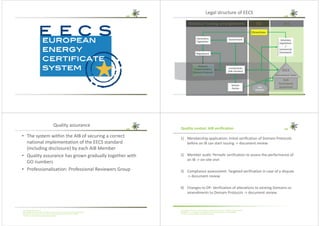
Directives
EU
Legal structure of EECS
EECS
International Rules
AIB
Voluntary
regulations
/
commercial
framework
National
implementation
(Domain Protocol)
National Trading arrangements
Secondary
legislation
Market
Parties
Government
Regulations
Issuing Body
(AIB member)
HUB
Participants
AgreementCEN
EN16325
Title | 26 May 2019 | Slide: 19
AIB copyright © 2017. We reserve the rights in this document and in the information contained therein.
Reproduction, use or disclosure to third parties without express authority is strictly forbidden.
The AIB is a non-profit-making international association.
Quality assurance
• The system within the AIB of securing a correct
national implementation of the EECS standard
(including disclosure) by each AIB Member
• Quality assurance has grown gradually together with
GO numbers
• Professionalisation: Professional Reviewers Group
AIB copyright © 2018. We reserve the rights in this document and in the information contained therein.
Reproduction, use or disclosure to third parties without express authority is strictly forbidden.
The AIB is a non-profit-making international association.
Quality control: AIB verification
1) Membership application: Initial verification of Domain Protocols
before an IB can start issuing -> document review
2) Member audit: Periodic verification to assess the performance of
an IB -> on-site visit
3) Compliance assessment: Targeted verification in case of a dispute
-> document review
4) Changes to DP: Verification of alterations to existing Domains or
amendments to Domain Protocols -> document review
AIB copyright © 2018. We reserve the rights in this document and in the information contained therein.
Reproduction, use or disclosure to third parties without express authority is strictly forbidden.
The AIB is a non-profit-making international association.
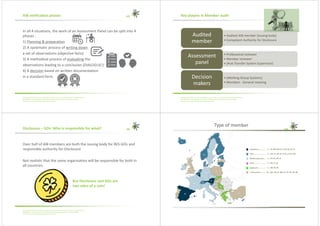
AIB verification phases
In all 4 situations, the work of an Assessment Panel can be split into 4
phases :
1) Planning & preparation
2) A systematic process of writing down
a set of observations (objective facts)
3) A methodical process of evaluating the
observations leading to a conclusion (DIALOGUE!)
4) A decision based on written documentation
in a standard form.
AIB copyright © 2018. We reserve the rights in this document and in the information contained therein.
Reproduction, use or disclosure to third parties without express authority is strictly forbidden.
The AIB is a non-profit-making international association.
Key players in Member audit
• Audited AIB member (issuing body)
• Competent Authority for Disclosure
Audited
member
• Professional reviewer
• Member reviewer
• (Hub Transfer System Supervisor)
Assessment
panel
• (Working Group Systems)
• Members - General meeting
Decision
makers
AIB copyright © 2018. We reserve the rights in this document and in the information contained therein.
Reproduction, use or disclosure to third parties without express authority is strictly forbidden.
The AIB is a non-profit-making international association.
Disclosure – GOs: Who is responsible for what?
Over half of AIB members are both the issuing body for RES-GOs and
responsible authority for Disclosure
Not realistic that the same organisation will be responsible for both in
all countries
But Disclosure and GOs are
two sides of a coin!
Type of member
Regulators ………….. 8 …AT, BE (Fed, B, F, W), ES, LU, SI
TSOs ……………………. 9 …CH, CY, DK, EE, FI, IS, LT, NL, NO
Market operators … 4 …CZ, FR, HR, IE
Other ………………….. 3 ...DE, IT, SE
Applicants …………… 2 …GR, RS, SK
In discussion ………. 10 …BA, HU, LV, ME, PL, PT, TK, UK, XK
Title | 26 May 2019 | Slide: 25
AIB copyright © 2017. We reserve the rights in this document and in the information contained therein.
Reproduction, use or disclosure to third parties without express authority is strictly forbidden.
The AIB is a non-profit-making international association.
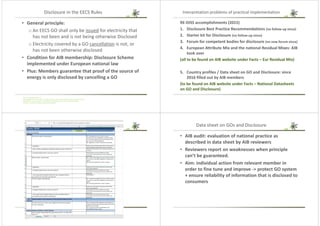
Disclosure in the EECS Rules
• General principle:
o An EECS GO shall only be issued for electricity that
has not been and is not being otherwise Disclosed
o Electricity covered by a GO cancellation is not, or
has not been otherwise disclosed
• Condition for AIB membership: Disclosure Scheme
implemented under European national law
• Plus: Members guarantee that proof of the source of
energy is only disclosed by cancelling a GO
Interpretation problems of practical implementation
RE-DISS accomplishments (2015)
1. Disclosure Best Practice Recommendations (no follow-up since)
2. Starter kit for Disclosure (no follow-up since)
3. Forum for competent bodies for disclosure (no new forum since)
4. European Attribute Mix and the national Residual Mixes: AIB
took over
(all to be found on AIB website under Facts – Eur Residual Mix)
5. Country profiles / Data sheet on GO and Disclosure: since
2016 filled out by AIB members
(to be found on AIB website under Facts – National Datasheets
on GO and Disclosure)
Data sheet on GOs and Disclosure
• AIB audit: evaluation of national practice as
described in data sheet by AIB reviewers
• Reviewers report on weaknesses when principle
can’t be guaranteed.
• Aim: individual action from relevant member in
order to fine tune and improve -> protect GO system
+ ensure reliability of information that is disclosed to
consumers
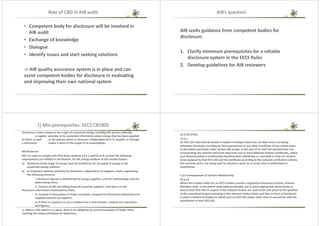
Role of CBD in AIB audit
• Competent body for disclosure will be involved in
AIB audit
• Exchange of knowledge
• Dialogue
• Identify issues and start seeking solutions
-> AIB quality assurance system is in place and can
assist competent bodies for disclosure in evaluating
and improving their own national system
AIB’s question
AIB seeks guidance from competent bodies for
disclosure:
1. Clarify minimum prerequisites for a reliable
disclosure system in the EECS Rules
2. Develop guidelines for AIB reviewers
1) Min.prerequisites: EECS CR1805
Disclosure a claim related to the origin of consumed energy, including the process whereby
a supplier provides to its customers information about energy that has been supplied
to them, as well as the process where a consumer independent from its supplier or through
a third party makes a claim on the origin of its consumption;
N9 Disclosure
N9.1 In order to comply with EECS Rules sections C3.3.1 and E3.3.14, at least the following
requirements are fulfilled in the Domain, for the energy medium of the related Output:
a) Disclosure of the origin of energy must be mandatory for all supply of energy in the
concerned energy medium;
b) A competent national authority for Disclosure, independent of suppliers, exists, supervising
the following elements:
i. Disclosure figures as determined by energy suppliers, and the methodology used for
determining them;
ii. Content of bills and billing material issued by suppliers, with focus on the
Disclosure information mentioned on them;
iii. Amount of Guarantees of Origin cancelled, compared to Disclosure statements and
supplied volumes by suppliers;
iv. If there is a practice to use a residual mix in that Domain, residual mix calculation
and figures;
c) Where a GO system is in place, there is an obligation to cancel Guarantees of Origin when
claiming the related attributes for Disclosure.
C3.3 EECS GOs
C3.3.1
An EECS GO shall only be Issued in respect of Output which has not been and is not being
otherwise Disclosed, including by the IssuanceIssue of any other Certificate of any variety (save
to the extent permitted under Section C8) except, in the case of an EECS GO derived from and
incorporating the relevant electronic data from one or more National Scheme Certificates, where
such National Scheme Certificate(s) has/have been withdrawn or cancelled in order for it/them
to be replaced by that EECS GO and the Certificate according to the national certification scheme
has not been and is not being used for disclosure prior to or at the time of withdrawal or
cancellation.
E.3.3 Consequences of Scheme Membership
E3.3.14
Where the Product Rules for an EECS Product contain a Legislative Disclosure Scheme, Scheme
Members shall, to the extent reasonably practicable, put in place appropriate mechanisms to
ensure that EECS GOs in respect of the relevant Output are used as the sole proof of the qualities
of the associated Output according to the relevant Product Rules and that no form of Disclosure
is used in relation to Output to which such an EECS GO relates other than in connection with the
cancellation of that EECS GO.
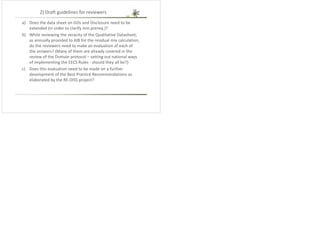
2) Draft guidelines for reviewers
a) Does the data sheet on GOs and Disclosure need to be
extended (in order to clarify min.prereq.)?
b) While reviewing the veracity of the Qualitative Datasheet,
as annually provided to AIB for the residual mix calculation,
do the reviewers need to make an evaluation of each of
the answers? (Many of them are already covered in the
review of the Domain protocol – setting out national ways
of implementing the EECS Rules - should they all be?)
c) Does this evaluation need to be made on a further
development of the Best Practice Recommendations as
elaborated by the RE-DISS project?

AIB 2019 - disclosure workshop - Liesbeth Switten

  • 1.
    Disclosure in practice Auditby AIB of the national implementation of disclosure Liesbeth Switten, AIB Meeting AIB-Disclosure Competent Bodies, Copenhagen, 21 May 2019 AIB copyright © 2018. We reserve the rights in this document and in the information contained therein. Reproduction, use or disclosure to third parties without express authority is strictly forbidden. The AIB is a non-profit-making international association. The two layers of European electricity disclosure Residual Mix Calculation Guarantees of Origin Dir 2018/2001/EU (RES) Dir 2012/27/EU (HEC) Disclosure of the origin of supplied electricity Dir 2009/72/EC (IEM) (+ recast Dir 2019) Dir 2018/2001/EU (RES) Guarantee of origin • an electronic document which ensures that 1 MWh of electricity has been produced from a particular energy source. • GOs are typically valid for one year and cancelled in a national electronic certificate registry when purchased or consumed. • AIB promotes a standardised system for GOs called the European Energy Certificate System (EECS). • EECS offers a framework for creating and transferring GOs between AIB’s 21 European countries (+another 5 close to/applying), ensuring reliable and transparent European trade. Electricity Disclosure 2003/54/EC, Art.3,p.6 Evolution of GO in 2000’s RECS test phase Birth of GOs 2001/77/EC, Art.5 EECS PRO Agreed by 11 Members RES Directive 2009/28/EC • Content of GO/Electronic/1MWh • Link with disclosure • Not for targets IEM Directive 2009/72/EC • Electricity dislosure 2001 20032002 2005 Concept of GO What are GOs used for? GOs are for Disclosure PRO EECS Rules Adaptation to new Directive 2009 2011 Revision of the RES Directive 2018/2001/EU What is an EECS-GO? 20182012 Dir.2012/27/EU 2019 New CEN standard Revision of IEM Directive 2019/xx/EU
  • 2.
    AIB copyright ©2018. We reserve the rights in this document and in the information contained therein. Reproduction, use or disclosure to third parties without express authority is strictly forbidden. The AIB is a non-profit-making international association. Association of Issuing Bodies (AIB) • Not-for-profit Brussels-based association – AISBL/IVZW • 21 countries connected (24 members) • Stakeholders: consumers, markets, governments, EU Commission • Developer and custodian of the EECS™ standard • All of the AIB’s members are competent bodies for GOs • About half AIB’s members are also competent bodies for disclosure • 50.53% annual RES production in EU, EEA, Energy Community + Switzerland • ... and the vast majority of GO-guaranteed renewable electricity production (0,595TWh issued of 1,176 TWh) Member countries: AIB POUK ME RS AIB Mission: “guaranteeing the origin of European energy” Activities: • EECS: one European Standard for Guarantees of Origin • Quality control: auditing the systems of AIB members (to ensure that the EECS standard and EU legislation have been implemented in a reliable and correct way) • Maintain the AIB HUB facilitating international trade of Gos, strengthening the European market for renewable energy • Continuous learning through sharing of experiences and best practices AIB organisation Task Forces (as required) Workgroups (quarterly monthly) General Meeting (Quarterly) Board (monthly) Secretariat President
  • 3.
    GOs in figures In2018 • Issued GOs: 652 TWh • Cancelled GOs: 540 TWh • Internationally traded GOs: 535 TWh Issuing of GOs in the EECS area In 2018 • Renewable electricity generation: 38% of total EECS area generation • Of which EECS GOs issued: 25,07% Source: energyorigins.net Trade of GOs: Power of the Voluntary Market Why have standards?
  • 4.
    Why isn’t thelaw enough? • Differences between national markets • Impact of related legislation • Infrastructure / technology differences • Lack of precision • Interpretation A GO must specify at least: (a) the source of the energy, and period of production (b) whether it relates to electricity or heating or cooling (c) the identity, location, type and capacity of the installation where the energy was produced (e) the date when the installation became operational (f) the date and country of issue and a unique identification number RES Directive: data on a GO Topics for standardisation Accredit plant - Really renewable? - Can you prove it? - Can you measure it? - inspection procedure - acceptance criteria Issue GO - What is being burned? - What energy content? - What to record? - GO format - data definitions & validation criteria - issuing procedure & calculations Audit plant - Did they prove it? - Has it changed? - audit practices & criteria - auditing periods - correction procedures Transfer GO - Who got the certificate? - Did they want it? - message definitions - inter-registry GO transfer protocols - correction procedures Cancel GO - Did it get withdrawn from the market? - What happened to it? - cancellation procedures - disclosure best practice Topic Issue Standard Components of the standard • Certificate Administration • Core principles – objectives & aspirations • Plant registration • Certificate issue, transfer and cancellation • EECS participation rules • Membership, admission, compliance, disputes & change • Scheme specific rules • e.g. electricity, gas ... EECS Rules • Decision-making – disputes, voting etc • Registry system & networking standards • Approval of agents • Change management • Assignment of codes • Audit & periodic reviews Detail (“subsidiary documents”) • Addresses, membership details, codes, guidelines ... Dynamic information (“fact sheets”) • Description of regulations in a specific countryDomain protocols
  • 5.
    Directives EU Legal structure ofEECS EECS International Rules AIB Voluntary regulations / commercial framework National implementation (Domain Protocol) National Trading arrangements Secondary legislation Market Parties Government Regulations Issuing Body (AIB member) HUB Participants AgreementCEN EN16325 Title | 26 May 2019 | Slide: 19 AIB copyright © 2017. We reserve the rights in this document and in the information contained therein. Reproduction, use or disclosure to third parties without express authority is strictly forbidden. The AIB is a non-profit-making international association. Quality assurance • The system within the AIB of securing a correct national implementation of the EECS standard (including disclosure) by each AIB Member • Quality assurance has grown gradually together with GO numbers • Professionalisation: Professional Reviewers Group AIB copyright © 2018. We reserve the rights in this document and in the information contained therein. Reproduction, use or disclosure to third parties without express authority is strictly forbidden. The AIB is a non-profit-making international association. Quality control: AIB verification 1) Membership application: Initial verification of Domain Protocols before an IB can start issuing -> document review 2) Member audit: Periodic verification to assess the performance of an IB -> on-site visit 3) Compliance assessment: Targeted verification in case of a dispute -> document review 4) Changes to DP: Verification of alterations to existing Domains or amendments to Domain Protocols -> document review
  • 6.
    AIB copyright ©2018. We reserve the rights in this document and in the information contained therein. Reproduction, use or disclosure to third parties without express authority is strictly forbidden. The AIB is a non-profit-making international association. AIB verification phases In all 4 situations, the work of an Assessment Panel can be split into 4 phases : 1) Planning & preparation 2) A systematic process of writing down a set of observations (objective facts) 3) A methodical process of evaluating the observations leading to a conclusion (DIALOGUE!) 4) A decision based on written documentation in a standard form. AIB copyright © 2018. We reserve the rights in this document and in the information contained therein. Reproduction, use or disclosure to third parties without express authority is strictly forbidden. The AIB is a non-profit-making international association. Key players in Member audit • Audited AIB member (issuing body) • Competent Authority for Disclosure Audited member • Professional reviewer • Member reviewer • (Hub Transfer System Supervisor) Assessment panel • (Working Group Systems) • Members - General meeting Decision makers AIB copyright © 2018. We reserve the rights in this document and in the information contained therein. Reproduction, use or disclosure to third parties without express authority is strictly forbidden. The AIB is a non-profit-making international association. Disclosure – GOs: Who is responsible for what? Over half of AIB members are both the issuing body for RES-GOs and responsible authority for Disclosure Not realistic that the same organisation will be responsible for both in all countries But Disclosure and GOs are two sides of a coin! Type of member Regulators ………….. 8 …AT, BE (Fed, B, F, W), ES, LU, SI TSOs ……………………. 9 …CH, CY, DK, EE, FI, IS, LT, NL, NO Market operators … 4 …CZ, FR, HR, IE Other ………………….. 3 ...DE, IT, SE Applicants …………… 2 …GR, RS, SK In discussion ………. 10 …BA, HU, LV, ME, PL, PT, TK, UK, XK
  • 7.
    Title | 26May 2019 | Slide: 25 AIB copyright © 2017. We reserve the rights in this document and in the information contained therein. Reproduction, use or disclosure to third parties without express authority is strictly forbidden. The AIB is a non-profit-making international association. Disclosure in the EECS Rules • General principle: o An EECS GO shall only be issued for electricity that has not been and is not being otherwise Disclosed o Electricity covered by a GO cancellation is not, or has not been otherwise disclosed • Condition for AIB membership: Disclosure Scheme implemented under European national law • Plus: Members guarantee that proof of the source of energy is only disclosed by cancelling a GO Interpretation problems of practical implementation RE-DISS accomplishments (2015) 1. Disclosure Best Practice Recommendations (no follow-up since) 2. Starter kit for Disclosure (no follow-up since) 3. Forum for competent bodies for disclosure (no new forum since) 4. European Attribute Mix and the national Residual Mixes: AIB took over (all to be found on AIB website under Facts – Eur Residual Mix) 5. Country profiles / Data sheet on GO and Disclosure: since 2016 filled out by AIB members (to be found on AIB website under Facts – National Datasheets on GO and Disclosure) Data sheet on GOs and Disclosure • AIB audit: evaluation of national practice as described in data sheet by AIB reviewers • Reviewers report on weaknesses when principle can’t be guaranteed. • Aim: individual action from relevant member in order to fine tune and improve -> protect GO system + ensure reliability of information that is disclosed to consumers
  • 8.
    Role of CBDin AIB audit • Competent body for disclosure will be involved in AIB audit • Exchange of knowledge • Dialogue • Identify issues and start seeking solutions -> AIB quality assurance system is in place and can assist competent bodies for disclosure in evaluating and improving their own national system AIB’s question AIB seeks guidance from competent bodies for disclosure: 1. Clarify minimum prerequisites for a reliable disclosure system in the EECS Rules 2. Develop guidelines for AIB reviewers 1) Min.prerequisites: EECS CR1805 Disclosure a claim related to the origin of consumed energy, including the process whereby a supplier provides to its customers information about energy that has been supplied to them, as well as the process where a consumer independent from its supplier or through a third party makes a claim on the origin of its consumption; N9 Disclosure N9.1 In order to comply with EECS Rules sections C3.3.1 and E3.3.14, at least the following requirements are fulfilled in the Domain, for the energy medium of the related Output: a) Disclosure of the origin of energy must be mandatory for all supply of energy in the concerned energy medium; b) A competent national authority for Disclosure, independent of suppliers, exists, supervising the following elements: i. Disclosure figures as determined by energy suppliers, and the methodology used for determining them; ii. Content of bills and billing material issued by suppliers, with focus on the Disclosure information mentioned on them; iii. Amount of Guarantees of Origin cancelled, compared to Disclosure statements and supplied volumes by suppliers; iv. If there is a practice to use a residual mix in that Domain, residual mix calculation and figures; c) Where a GO system is in place, there is an obligation to cancel Guarantees of Origin when claiming the related attributes for Disclosure. C3.3 EECS GOs C3.3.1 An EECS GO shall only be Issued in respect of Output which has not been and is not being otherwise Disclosed, including by the IssuanceIssue of any other Certificate of any variety (save to the extent permitted under Section C8) except, in the case of an EECS GO derived from and incorporating the relevant electronic data from one or more National Scheme Certificates, where such National Scheme Certificate(s) has/have been withdrawn or cancelled in order for it/them to be replaced by that EECS GO and the Certificate according to the national certification scheme has not been and is not being used for disclosure prior to or at the time of withdrawal or cancellation. E.3.3 Consequences of Scheme Membership E3.3.14 Where the Product Rules for an EECS Product contain a Legislative Disclosure Scheme, Scheme Members shall, to the extent reasonably practicable, put in place appropriate mechanisms to ensure that EECS GOs in respect of the relevant Output are used as the sole proof of the qualities of the associated Output according to the relevant Product Rules and that no form of Disclosure is used in relation to Output to which such an EECS GO relates other than in connection with the cancellation of that EECS GO.
  • 9.
    2) Draft guidelinesfor reviewers a) Does the data sheet on GOs and Disclosure need to be extended (in order to clarify min.prereq.)? b) While reviewing the veracity of the Qualitative Datasheet, as annually provided to AIB for the residual mix calculation, do the reviewers need to make an evaluation of each of the answers? (Many of them are already covered in the review of the Domain protocol – setting out national ways of implementing the EECS Rules - should they all be?) c) Does this evaluation need to be made on a further development of the Best Practice Recommendations as elaborated by the RE-DISS project?