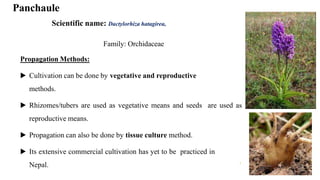
Scientific name: Dactylorhiza hatagirea,
1
Family: Orchidaceae
Propagation Methods:
▶ Cultivation can be done by vegetative and reproductive
methods.
▶ Rhizomes/tubers are used as vegetative means and seeds are used as
reproductive means.
▶ Propagation can also be done by tissue culture method.
▶ Its extensive commercial cultivation has yet to be practiced in
Nepal.
Panchaule
Propagation by seed
2
▶ Seed is collected during Oct-Nov.
▶ Seeds are sown in nursery beds duringApril-May.
▶ About one kg seed is needed to cultivate one ha field.
▶ Seeds have very low germination capacity.
▶ Seedlings from nursery can be transplanted in the field in June- July.
Vegetative propagation
▶ Usage of rhizome for large scale cultivation is best suited.
▶ Rhizomes/tubers are used for vegetative propagation.
▶ For vegetative propagation sprouted cuttings are soaked in water for one night and implanted
in nursery bed inApril-May.
▶ About 90% rhizomes germinate or sprout within one week.
Panchaule
Cultivation method
3
▶ Seedlings of height 15 cm in bed should be transplanted to the cultivation
plot during rainy season, June-July.
▶ Spacing of 30 cm for each seedling and 60 cm for each row.
▶ Gentle slopes, open moist areas and humus soil of the subalpine and alpine zones are suitable and
cultivation for better growth.
▶ Cultivation land is prepared with the treatment of compost manure 15-20 tonnes/ha.
▶ Weeding is necessary in every 2 months.
▶ Irrigation and hoeing is also preferred.
▶ An average of 300 kg rhizomes can be harvested from 1 ha cultivation.
▶ Rhizome collection can be done in Oct-Nov from 4-5 years old mother plant.
Panchaule
Scientific name : Neopicrorhiza scrophulariiflora
Family: Scrophulariaceae
Propagation Method
▶ Natural regeneration takes place by rhizomes and seeds.
▶ During winter the above ground part dries and gets buried under snow. In the
beginning of summer the plant starts growing from dormant underground rhizomes.
▶ Rhizome cultivation is faster than seed cultivation.
▶ Trial commercial cultivation has started in Himalayan districts.
Propagation by seed
▶ Mature seeds from 2-3 years mother plant is collected during October
and stored in dry place.
▶ The seeds are sown in the nursery during March-April.
▶ For better germination seeds are soaked in water for 24 hours.
4
Kutki
▶ Seeds are mixed with sand at the ratio of 1:5, about one kg seed is required for one
ha kutki cultivation.
5
▶ Seeds are sown at a spacing of 10 cm each in a row. Can also be sown directly in
poly bags.
▶ Germination takes place in 15-30 days. Germination percentage is about 60.
Vegetative propagation :
▶ Rhizomes with 3-4 cm in length from 2-3 years mature plant are
appropriate for cultivation.
▶ Rhizomes are implanted in nursery in November-December keeping distance 30x30 cm
for individuals and 60x60 cm for rows.
▶ It is said that production from rhizome cultivation has better quality.
Kutki

Scientific name.pptx

  • 1.
    Scientific name: Dactylorhizahatagirea, 1 Family: Orchidaceae Propagation Methods: ▶ Cultivation can be done by vegetative and reproductive methods. ▶ Rhizomes/tubers are used as vegetative means and seeds are used as reproductive means. ▶ Propagation can also be done by tissue culture method. ▶ Its extensive commercial cultivation has yet to be practiced in Nepal. Panchaule
  • 2.
    Propagation by seed 2 ▶Seed is collected during Oct-Nov. ▶ Seeds are sown in nursery beds duringApril-May. ▶ About one kg seed is needed to cultivate one ha field. ▶ Seeds have very low germination capacity. ▶ Seedlings from nursery can be transplanted in the field in June- July. Vegetative propagation ▶ Usage of rhizome for large scale cultivation is best suited. ▶ Rhizomes/tubers are used for vegetative propagation. ▶ For vegetative propagation sprouted cuttings are soaked in water for one night and implanted in nursery bed inApril-May. ▶ About 90% rhizomes germinate or sprout within one week. Panchaule
  • 3.
    Cultivation method 3 ▶ Seedlingsof height 15 cm in bed should be transplanted to the cultivation plot during rainy season, June-July. ▶ Spacing of 30 cm for each seedling and 60 cm for each row. ▶ Gentle slopes, open moist areas and humus soil of the subalpine and alpine zones are suitable and cultivation for better growth. ▶ Cultivation land is prepared with the treatment of compost manure 15-20 tonnes/ha. ▶ Weeding is necessary in every 2 months. ▶ Irrigation and hoeing is also preferred. ▶ An average of 300 kg rhizomes can be harvested from 1 ha cultivation. ▶ Rhizome collection can be done in Oct-Nov from 4-5 years old mother plant. Panchaule
  • 4.
    Scientific name :Neopicrorhiza scrophulariiflora Family: Scrophulariaceae Propagation Method ▶ Natural regeneration takes place by rhizomes and seeds. ▶ During winter the above ground part dries and gets buried under snow. In the beginning of summer the plant starts growing from dormant underground rhizomes. ▶ Rhizome cultivation is faster than seed cultivation. ▶ Trial commercial cultivation has started in Himalayan districts. Propagation by seed ▶ Mature seeds from 2-3 years mother plant is collected during October and stored in dry place. ▶ The seeds are sown in the nursery during March-April. ▶ For better germination seeds are soaked in water for 24 hours. 4 Kutki
  • 5.
    ▶ Seeds aremixed with sand at the ratio of 1:5, about one kg seed is required for one ha kutki cultivation. 5 ▶ Seeds are sown at a spacing of 10 cm each in a row. Can also be sown directly in poly bags. ▶ Germination takes place in 15-30 days. Germination percentage is about 60. Vegetative propagation : ▶ Rhizomes with 3-4 cm in length from 2-3 years mature plant are appropriate for cultivation. ▶ Rhizomes are implanted in nursery in November-December keeping distance 30x30 cm for individuals and 60x60 cm for rows. ▶ It is said that production from rhizome cultivation has better quality. Kutki