Quarter 3 - Module
3
Have you seen an artwork on a stained glass? Stained glasses are seen in
churches, art museums, and even in some houses. The design on stained
glasses are
achieved through the use of glasses with various colors and hues. The light
that
partially gets through stained glasses highlights the different colors and
hues,
making them a sight to behold.
While light partially gets through a stained glass, some materials like a
wooden
door, do not allow light to pass through them. There are also materials like
the clear
glass windows, that let light shine through them.
DISCOV
ER
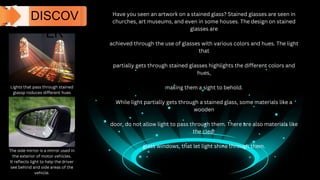
Lights that pass through stained
glassp roduces different hues
The side mirror is a mirror used in
the exterior of motor vehicles.
It reflects light to help the driver
see behind and side areas of the
vehicle.
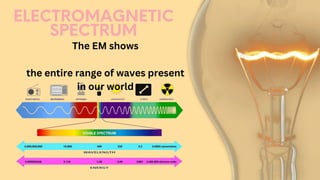
The light that is visible to the human eye is
called visible light or simply light.
The visible light is only part of the
electromagnetic spectrum. (EM).
The EM shows
the entire range of waves present
in our world
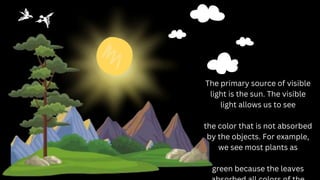
The primary source of visible
light is the sun. The visible
light allows us to see
the color that is not absorbed
by the objects. For example,
we see most plants as
green because the leaves
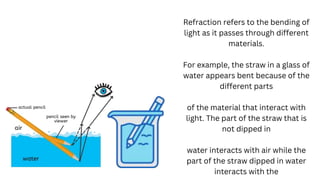
Refraction refers to the bending of
light as it passes through different
materials.
For example, the straw in a glass of
water appears bent because of the
different parts
of the material that interact with
light. The part of the straw that is
not dipped in
water interacts with air while the
part of the straw dipped in water
interacts with the
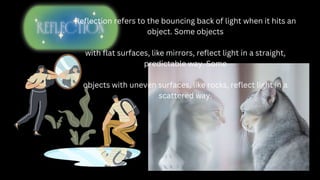
Reflection refers to the bouncing back of light when it hits an
object. Some objects
with flat surfaces, like mirrors, reflect light in a straight,
predictable way. Some
objects with uneven surfaces, like rocks, reflect light in a
scattered way.
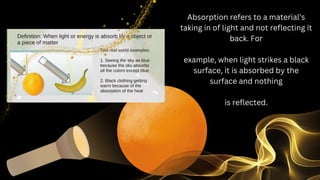
Absorption refers to a material’s
taking in of light and not reflecting it
back. For
example, when light strikes a black
surface, it is absorbed by the
surface and nothing
is reflected.
Transmission refers to the passing of light through some materials. For example,
when light passes through a glass window, it is transmitted to the other side,
allowing
the light to pass through the window.
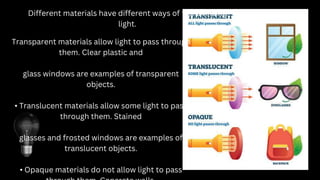
Different materials have different ways of transmitting
light.
Transparent materials allow light to pass through
them. Clear plastic and
glass windows are examples of transparent
objects.
• Translucent materials allow some light to pass
through them. Stained
glasses and frosted windows are examples of
translucent objects.
• Opaque materials do not allow light to pass
Explore
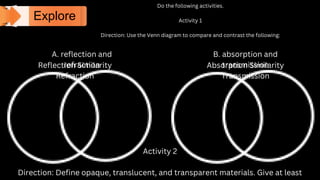
Do the following activities.
Activity 1
Direction: Use the Venn diagram to compare and contrast the following:
A. reflection and
refraction
B. absorption and
transmission
Reflection Similarity
Refraction
Absorption Similarity
Transmission
Activity 2
Direction: Define opaque, translucent, and transparent materials. Give at least
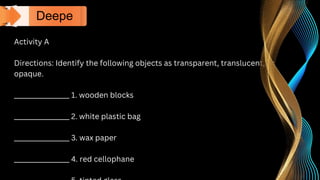
Activity A
Directions: Identify the following objects as transparent, translucent, or
opaque.
_________________ 1. wooden blocks
_________________ 2. white plastic bag
_________________ 3. wax paper
_________________ 4. red cellophane
Deepe
n
Deepe
n
Activity B
Direction: List down objects found in your school or at home that are opaque,
translucent and transparent.
Directions: Match column A (definition) with column B (concept). Write the letter of
the correct answer in your notebook.
Column A Column B
______ 1. Primary source of light A. absorption
______ 2. The taking in of light and not reflecting B. transmission
it back by some materials
______ 3. The scientific study of light and how it C. opaque
interacts with different objects
______ 4. The bending of light as it passes through D. optics
a different material
______ 5. Objects that do not allow light to pass E. reflection
Deepe
n

Science.pptx

  • 1.
    Quarter 3 -Module 3
  • 2.
    Have you seenan artwork on a stained glass? Stained glasses are seen in churches, art museums, and even in some houses. The design on stained glasses are achieved through the use of glasses with various colors and hues. The light that partially gets through stained glasses highlights the different colors and hues, making them a sight to behold. While light partially gets through a stained glass, some materials like a wooden door, do not allow light to pass through them. There are also materials like the clear glass windows, that let light shine through them. DISCOV ER Lights that pass through stained glassp roduces different hues The side mirror is a mirror used in the exterior of motor vehicles. It reflects light to help the driver see behind and side areas of the vehicle.
  • 3.
    The light thatis visible to the human eye is called visible light or simply light. The visible light is only part of the electromagnetic spectrum. (EM).
  • 4.
    The EM shows theentire range of waves present in our world
  • 5.
    The primary sourceof visible light is the sun. The visible light allows us to see the color that is not absorbed by the objects. For example, we see most plants as green because the leaves
  • 6.
    Refraction refers tothe bending of light as it passes through different materials. For example, the straw in a glass of water appears bent because of the different parts of the material that interact with light. The part of the straw that is not dipped in water interacts with air while the part of the straw dipped in water interacts with the
  • 7.
    Reflection refers tothe bouncing back of light when it hits an object. Some objects with flat surfaces, like mirrors, reflect light in a straight, predictable way. Some objects with uneven surfaces, like rocks, reflect light in a scattered way.
  • 8.
    Absorption refers toa material’s taking in of light and not reflecting it back. For example, when light strikes a black surface, it is absorbed by the surface and nothing is reflected.
  • 9.
    Transmission refers tothe passing of light through some materials. For example, when light passes through a glass window, it is transmitted to the other side, allowing the light to pass through the window.
  • 10.
    Different materials havedifferent ways of transmitting light. Transparent materials allow light to pass through them. Clear plastic and glass windows are examples of transparent objects. • Translucent materials allow some light to pass through them. Stained glasses and frosted windows are examples of translucent objects. • Opaque materials do not allow light to pass
  • 11.
    Explore Do the followingactivities. Activity 1 Direction: Use the Venn diagram to compare and contrast the following: A. reflection and refraction B. absorption and transmission Reflection Similarity Refraction Absorption Similarity Transmission Activity 2 Direction: Define opaque, translucent, and transparent materials. Give at least
  • 12.
    Activity A Directions: Identifythe following objects as transparent, translucent, or opaque. _________________ 1. wooden blocks _________________ 2. white plastic bag _________________ 3. wax paper _________________ 4. red cellophane Deepe n
  • 13.
    Deepe n Activity B Direction: Listdown objects found in your school or at home that are opaque, translucent and transparent.
  • 14.
    Directions: Match columnA (definition) with column B (concept). Write the letter of the correct answer in your notebook. Column A Column B ______ 1. Primary source of light A. absorption ______ 2. The taking in of light and not reflecting B. transmission it back by some materials ______ 3. The scientific study of light and how it C. opaque interacts with different objects ______ 4. The bending of light as it passes through D. optics a different material ______ 5. Objects that do not allow light to pass E. reflection Deepe n