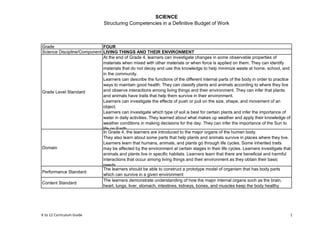
Grade
Science Discipline/Component
Grade Level Standard
Domain
Performance Standard
Content Standard
In Grade 4, the learners are introduced to the major organs of the human body.
They also learn about some parts that help plants and animals survive in places where they live.
Learners learn that humans, animals, and plants go through life cycles. Some inherited traits
may be affected by the environment at certain stages in their life cycles. Learners investigate that
animals and plants live in specific habitats. Learners learn that there are beneficial and harmful
interactions that occur among living things and their environment as they obtain their basic
needs.
The learners should be able to construct a prototype model of organism that has body parts
which can survive in a given environment
The learners demonstrate understanding of how the major internal organs such as the brain,
heart, lungs, liver, stomach, intestines, kidneys, bones, and muscles keep the body healthy
SCIENCE
Structuring Competencies in a Definitive Budget of Work
FOUR
LIVING THINGS AND THEIR ENVIRONMENT
At the end of Grade 4, learners can investigate changes in some observable properties of
materials when mixed with other materials or when force is applied on them. They can identify
materials that do not decay and use this knowledge to help minimize waste at home, school, and
in the community.
Learners can describe the functions of the different internal parts of the body in order to practice
ways to maintain good health. They can classify plants and animals according to where they live
and observe interactions among living things and their environment. They can infer that plants
and animals have traits that help them survive in their environment.
Learners can investigate the effects of push or pull on the size, shape, and movement of an
object.
Learners can investigate which type of soil is best for certain plants and infer the importance of
water in daily activities. They learned about what makes up weather and apply their knowledge of
weather conditions in making decisions for the day. They can infer the importance of the Sun to
life on Earth.
K to 12 Curriculum Guide 1
SCIENCE
Structuring Competencies in a Definitive Budget of Work
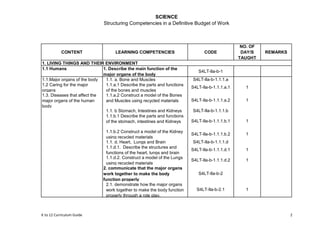
CONTENT LEARNING COMPETENCIES CODE
NO. OF
DAY/S
TAUGHT
REMARKS
1.1 Humans 1. Describe the main function of the
major organs of the body
S4LT-IIa-b-1
1.1.Major organs of the body 1.1. a. Bone and Muscles S4LT-IIa-b-1.1.1.a
1.2 Caring for the major
organs
1.1.a.1 Describe the parts and functions
of the bones and muscles
S4LT-IIa-b-1.1.1.a.1 1
1.3. Diseases that affect the
major organs of the human
body
1.1.a.2 Construct a model of the Bones
and Muscles using recycled materials S4LT-IIa-b-1.1.1.a.2 1
1.1. b Stomach, Intestines and Kidneys S4LT-IIa-b-1.1.1.b
1.1.b.1 Describe the parts and functions
of the stomach, intestines and Kidneys S4LT-IIa-b-1.1.1.b.1 1
1.1.b.2 Construct a model of the Kidney
using recycled materials
S4LT-IIa-b-1.1.1.b.2 1
1.1. d. Heart, Lungs and Brain S4LT-IIa-b-1.1.1.d
1.1.d.1. Describe the structures and
functions of the heart, lungs and brain
S4LT-IIa-b-1.1.1.d.1 1
1.1.d.2. Construct a model of the Lungs
using recycled materials
S4LT-IIa-b-1.1.1.d.2 1
2. communicate that the major organs
work together to make the body
function properly
S4LT-IIa-b-2
2.1. demonstrate how the major organs
work together to make the body function
properly through a role play.
S4LT-IIa-b-2.1 1
1. LIVING THINGS AND THEIR ENVIRONMENT
K to 12 Curriculum Guide 2
SCIENCE
Structuring Competencies in a Definitive Budget of Work
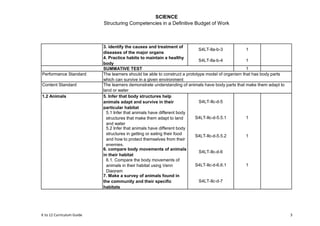
3. identify the causes and treatment of
diseases of the major organs
S4LT-IIa-b-3 1
4. Practice habits to maintain a healthy
body
S4LT-IIa-b-4 1
SUMMATIVE TEST 1
Performance Standard
Content Standard
1.2 Animals 5. Infer that body structures help
animals adapt and survive in their
particular habitat
S4LT-IIc-d-5
5.1 Infer that animals have different body
structures that make them adapt to land
and water
S4LT-IIc-d-5.5.1 1
5.2 Infer that animals have different body
structures in getting or eating their food
and how to protect themselves from their
enemies.
S4LT-IIc-d-5.5.2 1
6. compare body movements of animals
in their habitat
S4LT-IIc-d-6
6.1. Compare the body movements of
animals in their habitat using Venn
Diagram
S4LT-IIc-d-6.6.1 1
7. Make a survey of animals found in
the community and their specific
habitats
S4LT-IIc-d-7
The learners should be able to construct a prototype model of organism that has body parts
which can survive in a given environment
The learners demonstrate understanding of animals have body parts that make them adapt to
land or water
K to 12 Curriculum Guide 3
SCIENCE
Structuring Competencies in a Definitive Budget of Work
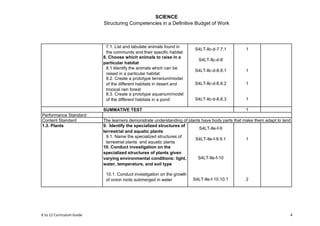
7.1. List and tabulate animals found in
the community and their specific habitat
S4LT-IIc-d-7.7.1 1
8. Choose which animals to raise in a
particular habitat
S4LT-IIc-d-8
8.1 Identify the animals which can be
raised in a particular habitat
S4LT-IIc-d-8.8.1 1
8.2. Create a prototype terrarium/model
of the different habitats in desert and
tropical rain forest
S4LT-IIc-d-8.8.2 1
8.3. Create a prototype aquarium/model
of the different habitats in a pond S4LT-IIc-d-8.8.3 1
SUMMATIVE TEST 1
Performance Standard
Content Standard
1.3. Plants 9. Identify the specialized structures of
terrestrial and aquatic plants
S4LT-IIe-f-9
9.1. Name the specialized structures of
terrestrial plants and aquatic plants
S4LT-IIe-f-9.9.1 1
10. Conduct investigation on the
specialized structures of plants given
varying environmental conditions: light,
water, temperature, and soil type
S4LT-IIe-f-10
10.1. Conduct investigation on the growth
of onion roots submerged in water S4LT-IIe-f-10.10.1 2
The learners demonstrate understanding of plants have body parts that make them adapt to land
K to 12 Curriculum Guide 4
SCIENCE
Structuring Competencies in a Definitive Budget of Work
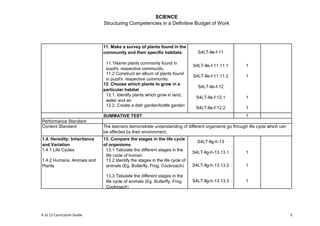
11. Make a survey of plants found in the
community and their specific habitats S4LT-IIe-f-11
11.1Name plants commonly found in
pupil's respective community.
S4LT-IIe-f-11.11.1 1
11.2 Construct an album of plants found
in pupil's respective community.
S4LT-IIe-f-11.11.2 1
12. Choose which plants to grow in a
particular habitat
S4LT-IIe-f-12
12.1. Identify plants which grow in land,
water and air
S4LT-IIe-f-12.1 1
12.2. Create a dish garden/bottle garden
S4LT-IIe-f-12.2 1
SUMMATIVE TEST 1
Performance Standard
Content Standard
1.4. Heredity: Inheritance
and Variation
13. Compare the stages in the life cycle
of organisms
S4LT-IIg-h-13
1.4.1 Life Cycles 13.1 Tabulate the different stages in the
life cycle of human
S4LT-IIg-h-13.13.1 1
1.4.2 Humans, Animals and
Plants
13.2 Identify the stages in the life cycle of
animals (Eg. Butterfly, Frog, Cockroach) S4LT-IIg-h-13.13.2 1
13.3 Tabulate the different stages in the
life cycle of animals (Eg. Butterfly, Frog,
Cockroach)
S4LT-IIg-h-13.13.3 1
The learners demonstrate understanding of different organisms go through life cycle which can
be affected by their environment.
K to 12 Curriculum Guide 5
SCIENCE
Structuring Competencies in a Definitive Budget of Work
13.4 Tabulate the different stages in the
life cycle of Plants (Eg. Seed
germination)
S4LT-IIg-h-13.13.4 1
13.5 Compare the different stages in the
life cycle of humans, animals and plants
in a tabular form.
S4LT-IIg-h-13.13.5 1
14. Describe the effect of the
environment on the life cycle of
organisms
S4LT-IIg-h-14
14.1. Describe the effects of different
environmental conditions in the life cycle
of organisms (Eg. Flood, Drought,
Environmental Calamities, Ultraviolet
rays)
S4LT-IIg-h-14.14.1 1
14.2. Create a 3-Dimensional Model of
the life cycle of a frog and a cockroach
S4LT-IIg-h-14.14.2 1
SUMMATIVE TEST 1
Performance Standard
Content Standard
1.5. Ecosystem 15. describe some types of beneficial
interactions among living things
S4LT-IIi-j-15
1.5.1 Beneficial and Harmful
interactions
15.1 Describe the beneficial effects of
interactions among livings things in their
environment (Mutualism, Commensalism)
S4LT-IIi-j-15.15.1 1
The learners demonstrate understanding of beneficial and harmful interactions occur among
living things and their environment as they obtain basic needs.
K to 12 Curriculum Guide 6
SCIENCE
Structuring Competencies in a Definitive Budget of Work
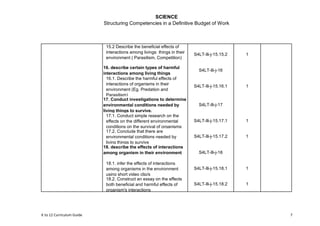
15.2 Describe the beneficial effects of
interactions among livings things in their
environment ( Parasitism, Competition)
S4LT-IIi-j-15.15.2 1
16. describe certain types of harmful
interactions among living things
S4LT-IIi-j-16
16.1. Describe the harmful effects of
interactions of organisms in their
environment (Eg. Predation and
Parasitism)
S4LT-IIi-j-15.16.1 1
17. Conduct investigations to determine
environmental conditions needed by
living things to survive.
S4LT-IIi-j-17
17.1. Conduct simple research on the
effects on the different environmental
conditions on the survival of organisms
S4LT-IIi-j-15.17.1 1
17.2. Conclude that there are
environmental conditions needed by
living things to survive
S4LT-IIi-j-15.17.2 1
18. describe the effects of interactions
among organism in their environment S4LT-IIi-j-18
18.1. infer the effects of interactions
among organisms in the environment
using short video clip/s
S4LT-IIi-j-15.18.1 1
18.2. Construct an essay on the effects
both beneficial and harmful effects of
organism's interactions
S4LT-IIi-j-15.18.2 1
K to 12 Curriculum Guide 7
SCIENCE
Structuring Competencies in a Definitive Budget of Work
18.3. Draw/illustrate the effects both
beneficial and harmful of organism's
interactions in their environment
S4LT-IIi-j-15.18.3 1
SUMMATIVE TEST 1
43
2
45
PERIODICAL TEST
OVERALL TOTAL NUMBER OF DAYS
TOTAL NUMBER OF DAYS
K to 12 Curriculum Guide 8

Science_4_Q2_LAMP_V3.pdf

  • 1.
    Grade Science Discipline/Component Grade LevelStandard Domain Performance Standard Content Standard In Grade 4, the learners are introduced to the major organs of the human body. They also learn about some parts that help plants and animals survive in places where they live. Learners learn that humans, animals, and plants go through life cycles. Some inherited traits may be affected by the environment at certain stages in their life cycles. Learners investigate that animals and plants live in specific habitats. Learners learn that there are beneficial and harmful interactions that occur among living things and their environment as they obtain their basic needs. The learners should be able to construct a prototype model of organism that has body parts which can survive in a given environment The learners demonstrate understanding of how the major internal organs such as the brain, heart, lungs, liver, stomach, intestines, kidneys, bones, and muscles keep the body healthy SCIENCE Structuring Competencies in a Definitive Budget of Work FOUR LIVING THINGS AND THEIR ENVIRONMENT At the end of Grade 4, learners can investigate changes in some observable properties of materials when mixed with other materials or when force is applied on them. They can identify materials that do not decay and use this knowledge to help minimize waste at home, school, and in the community. Learners can describe the functions of the different internal parts of the body in order to practice ways to maintain good health. They can classify plants and animals according to where they live and observe interactions among living things and their environment. They can infer that plants and animals have traits that help them survive in their environment. Learners can investigate the effects of push or pull on the size, shape, and movement of an object. Learners can investigate which type of soil is best for certain plants and infer the importance of water in daily activities. They learned about what makes up weather and apply their knowledge of weather conditions in making decisions for the day. They can infer the importance of the Sun to life on Earth. K to 12 Curriculum Guide 1
  • 2.
    SCIENCE Structuring Competencies ina Definitive Budget of Work CONTENT LEARNING COMPETENCIES CODE NO. OF DAY/S TAUGHT REMARKS 1.1 Humans 1. Describe the main function of the major organs of the body S4LT-IIa-b-1 1.1.Major organs of the body 1.1. a. Bone and Muscles S4LT-IIa-b-1.1.1.a 1.2 Caring for the major organs 1.1.a.1 Describe the parts and functions of the bones and muscles S4LT-IIa-b-1.1.1.a.1 1 1.3. Diseases that affect the major organs of the human body 1.1.a.2 Construct a model of the Bones and Muscles using recycled materials S4LT-IIa-b-1.1.1.a.2 1 1.1. b Stomach, Intestines and Kidneys S4LT-IIa-b-1.1.1.b 1.1.b.1 Describe the parts and functions of the stomach, intestines and Kidneys S4LT-IIa-b-1.1.1.b.1 1 1.1.b.2 Construct a model of the Kidney using recycled materials S4LT-IIa-b-1.1.1.b.2 1 1.1. d. Heart, Lungs and Brain S4LT-IIa-b-1.1.1.d 1.1.d.1. Describe the structures and functions of the heart, lungs and brain S4LT-IIa-b-1.1.1.d.1 1 1.1.d.2. Construct a model of the Lungs using recycled materials S4LT-IIa-b-1.1.1.d.2 1 2. communicate that the major organs work together to make the body function properly S4LT-IIa-b-2 2.1. demonstrate how the major organs work together to make the body function properly through a role play. S4LT-IIa-b-2.1 1 1. LIVING THINGS AND THEIR ENVIRONMENT K to 12 Curriculum Guide 2
  • 3.
    SCIENCE Structuring Competencies ina Definitive Budget of Work 3. identify the causes and treatment of diseases of the major organs S4LT-IIa-b-3 1 4. Practice habits to maintain a healthy body S4LT-IIa-b-4 1 SUMMATIVE TEST 1 Performance Standard Content Standard 1.2 Animals 5. Infer that body structures help animals adapt and survive in their particular habitat S4LT-IIc-d-5 5.1 Infer that animals have different body structures that make them adapt to land and water S4LT-IIc-d-5.5.1 1 5.2 Infer that animals have different body structures in getting or eating their food and how to protect themselves from their enemies. S4LT-IIc-d-5.5.2 1 6. compare body movements of animals in their habitat S4LT-IIc-d-6 6.1. Compare the body movements of animals in their habitat using Venn Diagram S4LT-IIc-d-6.6.1 1 7. Make a survey of animals found in the community and their specific habitats S4LT-IIc-d-7 The learners should be able to construct a prototype model of organism that has body parts which can survive in a given environment The learners demonstrate understanding of animals have body parts that make them adapt to land or water K to 12 Curriculum Guide 3
  • 4.
    SCIENCE Structuring Competencies ina Definitive Budget of Work 7.1. List and tabulate animals found in the community and their specific habitat S4LT-IIc-d-7.7.1 1 8. Choose which animals to raise in a particular habitat S4LT-IIc-d-8 8.1 Identify the animals which can be raised in a particular habitat S4LT-IIc-d-8.8.1 1 8.2. Create a prototype terrarium/model of the different habitats in desert and tropical rain forest S4LT-IIc-d-8.8.2 1 8.3. Create a prototype aquarium/model of the different habitats in a pond S4LT-IIc-d-8.8.3 1 SUMMATIVE TEST 1 Performance Standard Content Standard 1.3. Plants 9. Identify the specialized structures of terrestrial and aquatic plants S4LT-IIe-f-9 9.1. Name the specialized structures of terrestrial plants and aquatic plants S4LT-IIe-f-9.9.1 1 10. Conduct investigation on the specialized structures of plants given varying environmental conditions: light, water, temperature, and soil type S4LT-IIe-f-10 10.1. Conduct investigation on the growth of onion roots submerged in water S4LT-IIe-f-10.10.1 2 The learners demonstrate understanding of plants have body parts that make them adapt to land K to 12 Curriculum Guide 4
  • 5.
    SCIENCE Structuring Competencies ina Definitive Budget of Work 11. Make a survey of plants found in the community and their specific habitats S4LT-IIe-f-11 11.1Name plants commonly found in pupil's respective community. S4LT-IIe-f-11.11.1 1 11.2 Construct an album of plants found in pupil's respective community. S4LT-IIe-f-11.11.2 1 12. Choose which plants to grow in a particular habitat S4LT-IIe-f-12 12.1. Identify plants which grow in land, water and air S4LT-IIe-f-12.1 1 12.2. Create a dish garden/bottle garden S4LT-IIe-f-12.2 1 SUMMATIVE TEST 1 Performance Standard Content Standard 1.4. Heredity: Inheritance and Variation 13. Compare the stages in the life cycle of organisms S4LT-IIg-h-13 1.4.1 Life Cycles 13.1 Tabulate the different stages in the life cycle of human S4LT-IIg-h-13.13.1 1 1.4.2 Humans, Animals and Plants 13.2 Identify the stages in the life cycle of animals (Eg. Butterfly, Frog, Cockroach) S4LT-IIg-h-13.13.2 1 13.3 Tabulate the different stages in the life cycle of animals (Eg. Butterfly, Frog, Cockroach) S4LT-IIg-h-13.13.3 1 The learners demonstrate understanding of different organisms go through life cycle which can be affected by their environment. K to 12 Curriculum Guide 5
  • 6.
    SCIENCE Structuring Competencies ina Definitive Budget of Work 13.4 Tabulate the different stages in the life cycle of Plants (Eg. Seed germination) S4LT-IIg-h-13.13.4 1 13.5 Compare the different stages in the life cycle of humans, animals and plants in a tabular form. S4LT-IIg-h-13.13.5 1 14. Describe the effect of the environment on the life cycle of organisms S4LT-IIg-h-14 14.1. Describe the effects of different environmental conditions in the life cycle of organisms (Eg. Flood, Drought, Environmental Calamities, Ultraviolet rays) S4LT-IIg-h-14.14.1 1 14.2. Create a 3-Dimensional Model of the life cycle of a frog and a cockroach S4LT-IIg-h-14.14.2 1 SUMMATIVE TEST 1 Performance Standard Content Standard 1.5. Ecosystem 15. describe some types of beneficial interactions among living things S4LT-IIi-j-15 1.5.1 Beneficial and Harmful interactions 15.1 Describe the beneficial effects of interactions among livings things in their environment (Mutualism, Commensalism) S4LT-IIi-j-15.15.1 1 The learners demonstrate understanding of beneficial and harmful interactions occur among living things and their environment as they obtain basic needs. K to 12 Curriculum Guide 6
  • 7.
    SCIENCE Structuring Competencies ina Definitive Budget of Work 15.2 Describe the beneficial effects of interactions among livings things in their environment ( Parasitism, Competition) S4LT-IIi-j-15.15.2 1 16. describe certain types of harmful interactions among living things S4LT-IIi-j-16 16.1. Describe the harmful effects of interactions of organisms in their environment (Eg. Predation and Parasitism) S4LT-IIi-j-15.16.1 1 17. Conduct investigations to determine environmental conditions needed by living things to survive. S4LT-IIi-j-17 17.1. Conduct simple research on the effects on the different environmental conditions on the survival of organisms S4LT-IIi-j-15.17.1 1 17.2. Conclude that there are environmental conditions needed by living things to survive S4LT-IIi-j-15.17.2 1 18. describe the effects of interactions among organism in their environment S4LT-IIi-j-18 18.1. infer the effects of interactions among organisms in the environment using short video clip/s S4LT-IIi-j-15.18.1 1 18.2. Construct an essay on the effects both beneficial and harmful effects of organism's interactions S4LT-IIi-j-15.18.2 1 K to 12 Curriculum Guide 7
  • 8.
    SCIENCE Structuring Competencies ina Definitive Budget of Work 18.3. Draw/illustrate the effects both beneficial and harmful of organism's interactions in their environment S4LT-IIi-j-15.18.3 1 SUMMATIVE TEST 1 43 2 45 PERIODICAL TEST OVERALL TOTAL NUMBER OF DAYS TOTAL NUMBER OF DAYS K to 12 Curriculum Guide 8